
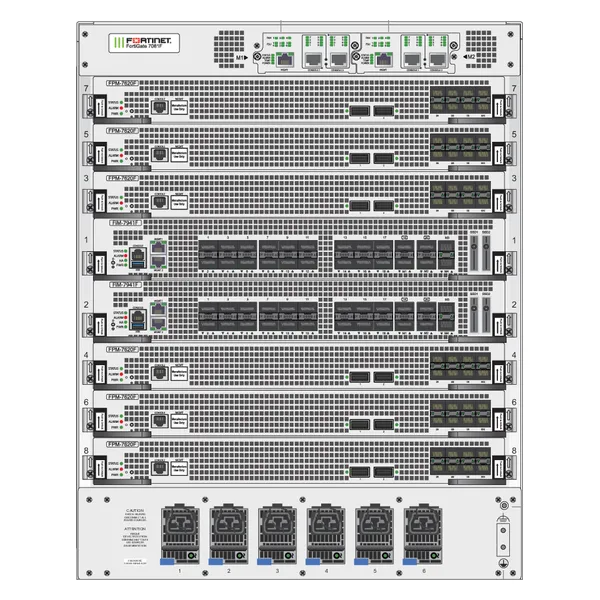
FortiGate 7081F Tanzania
FortiGate 7081F is a high-end modular next-generation firewall for organizations that need to secure very large data-center, enterprise and service-provider traffic flows without treating security as an afterthought. Fortinet positions the 7000F Series for large enterprises and service providers protecting data centers and hybrid IT. For the FG-7081F, Fortinet publishes 405 Gbps IPS, 330 Gbps NGFW and 312 Gbps threat-protection performance, while its product introduction describes up to 1.2 Tbps firewall throughput. The chassis supports high-capacity interfaces including 400GE and is built around Fortinet purpose-designed security processors. For Tanzanian buyers, the practical decision is not simply whether the appliance is fast; it is whether the selected chassis, processor modules, interface modules, subscriptions, redundancy model and surrounding switching architecture match the actual workload.
Published Fortinet performance for the FG-7081F platform.
Designed for security inspection at demanding enterprise and data-center scale.
A useful sizing reference when evaluating enabled security services.
High-speed interface options support modern core and data-center designs.
What the FortiGate 7081F is designed to solve
At this performance class, firewall selection is usually driven by aggregation, east-west and north-south traffic, internet edge security, data-center segmentation, high-volume VPN, hybrid-cloud connectivity, service-provider requirements or consolidation of multiple security functions. The 7081F is not a branch firewall scaled upward; it is a chassis platform intended for environments where throughput, session scale, high-speed interfaces, resilience and operational consistency matter together. FortiOS provides the common networking and security operating environment, while FortiGuard security services can add threat intelligence and inspection capabilities according to the subscriptions selected.
The modular design matters because large environments change. Interface density, traffic patterns and capacity can evolve as new server clusters, cloud interconnects, internet circuits, campuses or customer services are added. Fortinet describes the 7081F as an eight-slot chassis capable of housing up to six Fortinet Processor Modules. Buyers should therefore define the complete bill of materials rather than request only a chassis name. The quotation discussion should identify processor modules, interface modules, transceivers, power requirements, support, subscriptions and high-availability requirements.
Verified FortiGate 7081F technical highlights
| Area | Published information | Procurement relevance |
|---|---|---|
| IPS | 405 Gbps | Useful when intrusion-prevention inspection is a major workload. |
| NGFW | 330 Gbps | Relevant to application-aware security sizing. |
| Threat protection | 312 Gbps | Important for realistic security-service capacity planning. |
| Firewall throughput | Up to 1.2 Tbps | Shows raw forwarding scale; do not substitute it for inspected-throughput sizing. |
| Interfaces | 25GE/10GE/GE, 100GE/40GE and 400GE families listed by Fortinet | Match interface modules and optics to the surrounding switching fabric. |
Deployment and integration planning
A successful 7081F deployment begins with traffic engineering. Document current and forecast internet bandwidth, data-center uplinks, inter-zone traffic, encrypted traffic, VPN demand, public services, routing protocols, virtual domains if required, segmentation boundaries and high-availability objectives. Security throughput should be assessed with the inspection features that will actually be enabled. Raw firewall throughput can be useful for one part of the design, but it does not represent every security workload.
The surrounding network must also be designed for the firewall’s scale. Core switches, aggregation switches, optics, fiber, rack space, power feeds and cooling can become constraints if they are not considered in the same project. For related infrastructure planning, review FourTeck Tanzania’s firewall and network-security solution overview, technology shop and product catalogue, IT integration services, Tanzania project enquiry page, FourTeck Tanzania company overview, and the site’s networking, server, structured-cabling and wireless solution coverage available from the main solutions page. These related areas matter because a data-center firewall depends on the network, rack, power and operational environment around it.
FortiGate 7081F licensing and subscription planning
The hardware platform and security subscriptions should be planned as one procurement decision. FortiGuard services provide security intelligence and inspection functions, but the exact bundle and term should be selected against the organization’s security policy and operational requirements. Buyers should ask which services are included in a proposed bundle, the subscription duration, support entitlement, renewal date, management requirements and whether additional Fortinet products are part of the architecture. Avoid comparing two quotations only by chassis price if their subscriptions, modules, support terms or optics differ.
For large environments, operational tooling also matters. Centralized policy management, logging, analytics and Security Fabric integration may affect the final architecture. Confirm the management and logging design before purchase, especially when multiple FortiGate systems, virtual domains, branch sites or security teams are involved. A procurement document should distinguish mandatory day-one components from optional expansion items so budget holders can see what is required for production and what can be phased later.
FortiGate 7081F Tanzania
Organizations evaluating FortiGate 7081F in Tanzania are typically dealing with a security requirement where ordinary branch-firewall sizing is no longer enough. A large data center, financial environment, telecom or service-provider core, government platform, cloud hosting environment, university network, national enterprise or multi-site organization can generate traffic patterns that demand high-speed interfaces and sustained inspection capacity. The starting point should be a traffic and security profile: internet capacity, private WAN traffic, east-west data-center flows, VPN demand, published applications, expected concurrent sessions and the security services that will be enabled.
Tanzania deployments also benefit from treating power, cooling, rack layout and connectivity as part of the firewall project. A chassis of this class belongs in properly engineered infrastructure with redundant power planning, suitable environmental control and organized high-speed fiber connectivity. If the organization is upgrading from smaller appliances, the migration plan should map existing interfaces, VLANs, routes, NAT policies, VPNs, objects and security rules. The project should also identify obsolete rules rather than blindly reproducing years of configuration history.
Procurement teams should request a complete bill of materials. The phrase “FortiGate 7081F price Tanzania” is useful as an initial search, but a meaningful quotation needs more detail: chassis variant, processor modules, interface modules, optics, support and FortiGuard subscription term, high-availability quantity, management/logging requirements and any professional services. FourTeck’s Tanzania contact page specifically encourages firewall buyers to provide internet speed, VPN use, branch connectivity, remote users and expected security services. That information makes model and configuration discussions more precise.
For organizations operating beyond Tanzania, a standardized Fortinet architecture can also simplify policy and operational practices across countries. FourTeck maintains regional resources including FourTeck Kenya, FourTeck Uganda, Fortinet UAE solutions, FourTeck Ghana and FourTeck Nigeria. These regional links are useful for organizations coordinating infrastructure across multiple operating markets.
FortiGate 7081F Dar es Salaam
Dar es Salaam organizations considering the FortiGate 7081F may include enterprises with major headquarters, data centers, financial platforms, telecom infrastructure, logistics operations, hosting environments and other high-throughput networks. The city’s concentration of business connectivity makes the edge architecture especially important: multiple internet circuits, carrier handoffs, cloud connections, partner links and remote branches can converge on the same security boundary. The 7081F should therefore be sized from aggregate inspected traffic and resilience objectives rather than from a single ISP circuit.
A useful design exercise is to map traffic into zones. Internet ingress and egress, public application zones, internal server segments, management networks, backup traffic, partner networks and user access may have different inspection and policy requirements. Where encrypted traffic is inspected, capacity planning should account for the actual security profile. High-speed 100GE or 400GE connectivity can remove interface bottlenecks in appropriate architectures, but the switch fabric and optics must be compatible with the chosen Fortinet interface modules.
High availability deserves equal attention. A large firewall can still represent a critical dependency if power, links or configuration are not redundant. Procurement planning should determine whether two chassis are required, how upstream and downstream links will be distributed, what failure behavior is expected and how maintenance will be performed. Change control, configuration backup and logging should be defined before production cutover. For a migration, document current NAT, routing, VPN, security policies and application dependencies, then test the new environment with an agreed rollback path.
When requesting a Dar es Salaam quotation, provide rack and power details as well as network requirements. FourTeck Tanzania’s verified contact page lists Dar es Salaam among its contact locations and asks buyers to describe product, quantity, site type, existing equipment, users, desired outcome and timeline. For a 7081F project, add interface speeds, expected traffic growth, subscription requirements and whether centralized Fortinet management or logging is already deployed.
FortiGate 7081F Mwanza
A FortiGate 7081F requirement in Mwanza is likely to arise when an organization is consolidating significant regional traffic, operating a substantial private data center, serving many branches or building a high-capacity security gateway. The first question should be architectural fit. If the actual requirement is a smaller campus or branch edge, another FortiGate model may be more appropriate; if Mwanza is a major aggregation point with large bandwidth growth, dense server infrastructure or service-provider functions, the 7081F’s modular high-end design becomes more relevant.
Regional connectivity planning should consider the difference between current bandwidth and future core capacity. A firewall platform is often retained longer than individual access circuits. If uplinks are expected to grow, interface and processor-module choices should preserve a sensible expansion path. At the same time, over-sizing without a workload case adds cost and operational complexity. Build a three-to-five-year traffic model covering peak throughput, encrypted sessions, VPN, internal segmentation and expected security services, then compare those needs with published Fortinet performance.
Operational resilience is particularly important for infrastructure that supports multiple sites. The security gateway should not become difficult to maintain because all policies are undocumented or because changes depend on one administrator. Use clear naming, role-based administration, configuration backups, centralized logs and formal policy review. When branches connect by IPsec or SD-WAN, document tunnel ownership, routing, failover and application priorities. If the firewall protects server workloads, coordinate maintenance windows with the application and virtualization teams.
A Mwanza procurement request should therefore contain more than “FortiGate 7081F supplier Tanzania.” Include the network diagram, expected interfaces, high-availability plan, service subscriptions, management and logging platform, desired support term, transceiver requirements and target implementation window. This gives the supplier enough information to prepare a comparable bill of materials and reduces the risk of discovering missing modules or licenses during deployment.
FortiGate 7081F Arusha
For Arusha, the FortiGate 7081F is relevant to organizations whose security perimeter or data-center workload genuinely requires high-end chassis performance. Large institutions, regional enterprise hubs, hosting environments and networks consolidating many sites may need this class of platform. Before selecting it, distinguish between user internet traffic and data-center traffic. A campus with thousands of users can have different session and inspection patterns from a server environment carrying large east-west flows or high-volume public services.
Security policy design should be completed alongside sizing. Define which zones require intrusion prevention, application control, malware inspection, web controls or other FortiGuard capabilities. Identify encrypted traffic and certificate requirements. Determine whether segmentation will be implemented physically, through VLANs, virtual domains or a combination. This policy map makes it easier to estimate which traffic paths consume security-processing resources and which interfaces need the highest capacity.
Arusha buyers should also consider the physical environment. Chassis firewalls require appropriate rack space, power, cooling and cable management. Redundant power feeds and UPS design should be coordinated with the data-center facilities plan. Fiber patching should be labeled and documented, and spare optics or critical components can be considered according to the organization’s risk tolerance and support model. These details are easy to overlook when attention is focused only on headline throughput.
FourTeck Tanzania’s contact page lists Arusha among its contact locations and recommends that firewall enquiries include user/device context, internet speed, VPN requirements, branch connectivity and expected services. For a 7081F, expand that brief with current firewall model, peak traffic graphs, projected growth, data-center switching speeds, routing protocols, HA requirements and Fortinet management products already in use. A structured request allows the technical discussion to focus on fit and migration rather than simply confirming that the model exists.
FortiGate 7081F Dodoma
In Dodoma, a FortiGate 7081F project may support a large institutional, government, enterprise or shared-services environment where network availability and security inspection are critical. The procurement process should begin by defining service impact. Which applications become unavailable if the firewall is offline? Which networks require isolation? Which external services must remain reachable? How much maintenance downtime is acceptable? These answers drive high availability, redundant links, change procedures and support requirements.
The 7081F’s performance makes it suitable for demanding environments, but performance alone does not create a resilient design. Upstream routers, core switches, DNS, identity, authentication, management and logging systems can all be dependencies. Review the entire service path and remove single points of failure where the business requirement justifies it. For high availability, confirm interface mapping and switching behavior during failover. For routing, document convergence expectations and ensure that adjacent network devices are configured consistently.
Security governance is another procurement consideration. Large firewalls often accumulate thousands of objects and rules over time. Establish policy ownership, naming conventions, expiry dates for temporary access and regular rule review from the beginning. Centralized logging can support troubleshooting, audit and incident response. FortiGuard services should be selected against required controls and budget, with renewal responsibility clearly assigned so security subscriptions do not become an unexpected lifecycle issue.
The verified FourTeck Tanzania contact page identifies Dodoma as one of its listed contact locations. A strong quotation request should specify whether the 7081F is for a new data center, replacement, capacity upgrade or consolidation project. Include current throughput, internet/WAN links, interfaces, VPNs, zones, expected subscriptions, HA design, desired support duration and deployment schedule. If configuration migration is required, note the current platform and approximate policy complexity so implementation effort can be discussed separately from hardware supply.
FortiGate 7081F UAE
UAE buyers evaluating the FortiGate 7081F often operate dense data-center, cloud, financial, carrier, hospitality-group, government or multi-site enterprise networks. The model’s high-speed interface options and modular processing architecture suit environments where the security layer must keep pace with large switching fabrics. Procurement should still be workload-led. Record traffic by security zone, peak and average utilization, application mix, encryption, VPN and expected growth before choosing modules.
The UAE is also a common coordination point for organizations with branches across the Middle East and Africa. A Fortinet design can be standardized around common policy, management and logging principles while using different FortiGate sizes at each site. The 7081F can occupy the high-capacity data-center or hub role while smaller platforms serve branches. Standardization should focus on repeatable architecture, not forcing identical hardware everywhere.
When comparing quotations, check the exact chassis variant, processor and interface modules, optics, FortiGuard services, support term and professional services. A lower headline number can represent a materially different configuration. For specialist regional context, FourTeck’s Fortinet UAE resource can support broader Fortinet enquiries, while FourTeck UAE covers wider infrastructure requirements.
Deployment planning should include rack elevation, dual power, cooling, structured fiber paths, switch compatibility and maintenance access. Define the cutover method, validation tests and rollback criteria. If the firewall is replacing an existing platform, use the migration as an opportunity to clean obsolete policies and confirm application ownership. A well-planned high-end firewall project is an architecture and operations exercise, not merely a hardware installation.
FortiGate 7081F Uganda
Organizations searching for FortiGate 7081F Uganda should first determine whether the platform will secure a central data center, national network hub, service-provider edge or large enterprise aggregation point. This distinction changes the traffic model. A public-facing data center may prioritize server sessions and DDoS-aware architecture, while an enterprise hub may combine user internet, SaaS, branch VPN and private application traffic. Build the sizing model from the actual mix.
Fortinet’s published 312 Gbps threat protection, 330 Gbps NGFW and 405 Gbps IPS figures show the performance class of the 7081F, but buyers should evaluate their intended FortiOS and FortiGuard configuration rather than assuming every workload behaves identically. Include encrypted traffic, routing, NAT, VPN, segmentation and logging in the design review. The surrounding switching fabric should be able to deliver the expected traffic without creating bottlenecks before or after the firewall.
For organizations with sites in both Tanzania and Uganda, consistent templates can simplify support. Common object naming, VPN standards, VLAN conventions, administrator roles, logging destinations and backup procedures make cross-border operations easier. Hardware size can vary by site. FourTeck’s Uganda technology site provides a regional point of reference for broader IT and security requirements.
A procurement package should list the required FortiGuard subscription, support term, HA quantity, modules and optics. Ask for line-item clarity so future renewals and expansion are easier to manage. If professional services are needed, separate design, migration, installation, testing and documentation tasks. This helps stakeholders understand what is hardware, what is recurring subscription and what is implementation effort.
FortiGate 7081F Kampala
Kampala enterprises and service providers considering the FortiGate 7081F may need a security platform for a major data center or connectivity hub. High-capacity internet and private links can make interface planning as important as firewall throughput. Identify carrier handoffs, core-switch ports, transceiver types, link aggregation and redundancy before finalizing the interface-module configuration. A mismatch at this stage can delay deployment even when the chassis itself is available.
Security inspection requirements should be documented per traffic path. Not every network segment necessarily needs the same profile, but exceptions should be based on policy and risk rather than performance shortcuts. Define which traffic receives IPS, application controls and other threat protection. For TLS inspection, plan certificate deployment and application exceptions carefully. The goal is predictable security behavior that can be operated by the team after handover.
A Kampala implementation may also serve branch connectivity. If IPsec VPN or SD-WAN is part of the design, document the number of sites, bandwidth per tunnel, routing behavior, failover and application priorities. For multi-country environments, coordinate addressing and routing to avoid overlapping networks. Central logging and monitoring can provide a common operational view, while role-based administration can separate responsibilities across teams.
Before asking for a price, prepare a bill-of-materials brief covering chassis, processor capacity, interfaces, optics, HA, FortiGuard services, support, management/logging and migration. This creates a procurement comparison based on equivalent scope. FourTeck Uganda and FourTeck Tanzania can also be referenced when a regional project spans both markets, helping the buyer frame the firewall within a wider network and infrastructure requirement.
FortiGate 7081F Arua
Arua buyers searching for the FortiGate 7081F should validate scale carefully. This is a high-end data-center platform, so the strongest business case is a regional hub, shared infrastructure platform, service-provider environment or large organization aggregating substantial traffic. If the requirement is a conventional office edge, the FortiGate portfolio includes smaller models that may fit better. Correct sizing protects both budget and operational simplicity.
Where the 7081F is justified, connectivity resilience may be a major driver. Multiple WAN or backbone paths can be designed so the security layer does not depend on a single carrier or switch. The failover design should be tested, not merely documented. Confirm routing convergence, session behavior, monitoring and escalation procedures. If remote sites depend on the hub, define what services continue during a partial failure and what backup path is available.
Infrastructure readiness is also important. A modular chassis needs suitable rack, power and cooling conditions, along with organized fiber connectivity. Remote or regionally distributed operations benefit from clear labeling and documentation because troubleshooting may involve multiple teams. Keep an accurate rack elevation, interface map, IP plan, routing diagram, policy ownership record and backup procedure. These operational assets are part of a dependable deployment.
For procurement, avoid requesting an unspecified “7081F full set.” Define the exact security and connectivity requirement, then obtain a line-item proposal. Include subscription duration, support, modules, optics and implementation expectations. If future capacity is uncertain, ask which expansion choices can be deferred and which must be included at initial installation. That approach supports a phased investment without creating avoidable redesign later.
FortiGate 7081F Mbarara
For Mbarara, FortiGate 7081F procurement should be tied to a clear high-capacity use case. A large private data center, regional aggregation hub, service-provider network or organization centralizing many branch connections may justify the platform. Begin with measurable requirements: peak inspected traffic, projected growth, concurrent sessions, new connections, VPN throughput, interface speeds and the number of security zones. This prevents model selection from being based only on brand familiarity.
If the firewall will protect critical applications, application owners should participate in migration planning. Identify inbound and outbound dependencies, NAT, DNS, certificates, authentication and partner access. Test policies in stages where possible. For high availability, agree how failover will be validated and how upgrades will be performed. A technically redundant pair still needs an operational procedure that the support team understands.
The 7081F’s modularity can support growth, but procurement should document what is installed on day one. Processor and interface modules, optics, power and subscriptions need to be visible in the bill of materials. Support and FortiGuard terms should have clear start and renewal dates. Centralized logging capacity should be sized for the expected event volume and retention policy rather than added after the firewall goes live.
For a multi-site Ugandan organization, use the project to establish repeatable standards for branch VPNs, addressing, security objects, administrator roles and documentation. This makes future site additions easier. A high-end firewall delivers its greatest value when it becomes part of a well-managed security architecture, not when it operates as an isolated appliance with undocumented policies.
FortiGate 7081F Gulu
Gulu organizations evaluating FortiGate 7081F should assess whether the site is expected to function as a core regional security point. High-end chassis platforms are most useful where large volumes of traffic, demanding security inspection, many connections or high-speed backbone interfaces converge. If growth plans include new data-center services, cloud connectivity or additional branches, those future flows should be included in sizing rather than considered only after purchase.
A good design separates performance requirements from policy requirements. Performance describes how much traffic and how many sessions the system must handle. Policy defines what the system must inspect, allow, block, log and segment. Both are necessary. Build a matrix of source zones, destination zones, applications, security profiles and expected bandwidth. This provides a practical foundation for configuration and later rule review.
Physical and network dependencies should be documented before delivery. Confirm rack units, power feeds, cooling, switch ports, fiber type, optics and cable paths. For HA, reserve interfaces and switching capacity for both systems. For management, define out-of-band access where appropriate and protect administrative interfaces. Establish configuration backup and emergency-access procedures so recovery does not depend on one person’s knowledge.
When obtaining a Gulu quotation, ask suppliers to identify all hardware and recurring elements separately. FortiGuard services, support and management products can materially affect lifecycle cost. Clarify whether implementation, migration and documentation are included. A detailed scope gives finance teams a more accurate total-cost picture and gives technical teams a clearer basis for acceptance testing.
FortiGate 7081F Kenya
Kenyan organizations looking at FortiGate 7081F may be securing high-capacity data centers, financial platforms, cloud and hosting services, carrier environments or large enterprise cores. At this scale, architecture teams should model traffic between internet, WAN, cloud and internal data-center zones. The firewall may sit at one boundary or perform multiple segmentation roles, and that placement changes both throughput and interface requirements.
Fortinet’s high-speed interface support can align with modern data-center fabrics, but buyers should verify the exact interface module and transceiver combination required for their switches. Link speed alone is not enough: redundancy, port density, breakout requirements, routing and maintenance paths all affect the design. The HA architecture should avoid hidden dependencies on a single upstream switch or power source.
For companies operating in Kenya and Tanzania, policy consistency can simplify cross-border IT operations. Use shared standards for VPNs, objects, logging, administrator roles and change control while adapting hardware size to each site. FourTeck’s Kenya technology site provides regional context for broader networking and security projects, while the Tanzania site can support requirements centered on Tanzanian infrastructure.
A Kenya 7081F quotation should specify chassis configuration, HA quantity, security subscriptions, support term, modules, optics and professional services. If replacing an existing firewall, include the current policy count, VPNs, routes and major integrations. Plan acceptance tests for throughput, failover, application access, VPN, logging and management. Clear acceptance criteria make the transition from procurement to production much easier to govern.
FortiGate 7081F Kuwait
Kuwait deployments of the FortiGate 7081F can suit large enterprise, government, energy, finance, hosting and service-provider environments where security inspection must operate at very high throughput. Buyers should translate the business requirement into technical inputs before requesting equipment: current and planned bandwidth, data-center switching speeds, application zones, encrypted traffic, remote connectivity and availability targets.
Environmental and facilities planning deserves attention for a chassis platform. Confirm rack placement, redundant power feeds, UPS/generator strategy, cooling and maintenance access. High-speed fiber paths should be planned and labeled before cutover. Where the firewall is part of a new data-center build, coordinate its interfaces with the core and border architecture early rather than treating security as a final appliance inserted after the network is complete.
FortiGuard and support choices should be documented in procurement schedules. Compare proposals using the same term and service bundle. If centralized Fortinet management, logging or analytics are required, include them in the architecture and budget from the beginning. Lifecycle planning should identify subscription renewal ownership and expected hardware expansion so the system remains supported after the initial project closes.
For regional FourTeck coverage, FourTeck Kuwait can provide a local-market reference point, while Tanzania-focused requirements can be coordinated through FourTeck Tanzania. Organizations operating in both regions may benefit from shared firewall standards and documentation even where the actual appliance sizes differ.
FortiGate 7081F Ghana
Ghanaian enterprises and service providers considering FortiGate 7081F should determine the role it will play in the security architecture. A central internet edge, data-center segmentation firewall, hosting gateway or multi-site hub can each create different throughput, session and interface demands. Use traffic measurements where available rather than relying only on user counts, because server and service-provider environments can carry enormous traffic with comparatively few human users.
The security design should identify which FortiGuard services will be enabled and where encrypted traffic will be inspected. Consider logging volume and retention at the same time. High-throughput inspection can produce significant security telemetry, and the operations team needs a practical way to search, retain and respond to it. Administrator roles and change approval should also be defined before the platform accumulates complex policy.
If the 7081F is part of a resilient pair, test real failure scenarios: interface loss, upstream path loss, device failover and maintenance. Ensure that routing and switching behavior is understood by both network and security teams. The objective is predictable service restoration, not simply having two boxes in a rack. Documentation should include interface maps, HA state, routing neighbors, critical policies and escalation contacts.
For broader infrastructure coordination, FourTeck Ghana provides a regional technology reference. A complete quotation request should identify modules, optics, subscriptions, support, HA and implementation separately. This makes proposals easier to compare and prevents recurring security services from being hidden inside an ambiguous appliance price.
FortiGate 7081F Nigeria
Nigeria’s large enterprise, financial, telecom, cloud and service-provider environments can generate the kind of scale for which the FortiGate 7081F is designed. Where multiple high-bandwidth circuits and dense data-center networks converge, firewall interfaces, session scale and inspection throughput all become important. Capacity planning should account for growth, because a security platform at the core is more disruptive to replace than a branch appliance.
Architecture teams should distinguish north-south traffic from east-west segmentation. If the same chassis is expected to handle both, model the combined flows and security profiles. High-speed interfaces can support modern fabrics, but the exact topology should avoid unnecessary traffic hairpinning. Routing design, virtual domains, policy segmentation and HA should be reviewed as a single system rather than as independent features.
Operational processes are especially important in complex environments. Use structured object names, policy comments, ownership, ticket references and periodic review. Centralize logs and monitor resource utilization so capacity trends are visible before they become incidents. Establish a firmware lifecycle and maintenance process. When subscriptions renew, verify that the services still match the organization’s security controls instead of renewing a bundle automatically without review.
FourTeck’s Nigeria technology site provides regional context for IT infrastructure enquiries. For a 7081F request, prepare a detailed scope covering chassis, modules, optics, FortiGuard, support, management, logging, migration and testing. This enables technical and commercial teams to compare equivalent proposals and understand total lifecycle commitments.
FortiGate 7081F Seychelles
Seychelles organizations considering the FortiGate 7081F are likely to have a specialized high-capacity requirement such as a major data center, telecom environment, shared-services hub or enterprise network aggregating substantial traffic. Because island environments can place additional importance on resilient connectivity and planned maintenance, the security architecture should consider carrier diversity, spare strategy, remote administration and clear escalation procedures.
The 7081F should be selected only after comparing the actual workload with the wider FortiGate portfolio. If high-end capacity is justified, define interfaces and modules around the switching and carrier architecture. If the requirement is smaller, selecting a more appropriately sized model can reduce cost and complexity while still delivering FortiOS and FortiGuard capabilities. Model fit is more important than choosing the largest available appliance.
For a critical Seychelles deployment, document the complete recovery approach. High availability, redundant power and links are valuable, but operational readiness includes backups, configuration archives, tested administrator access and maintenance procedures. If support requires remote collaboration, accurate diagrams and logs become even more important. Plan firmware updates and subscription renewals well before deadlines so changes can be scheduled around business operations.
A quotation should state the chassis variant, modules, optics, subscriptions, support term, HA quantity and any implementation services. Include expected delivery destination and project schedule without assuming stock or lead time; these should be confirmed at quotation stage. For organizations connected to East African operations, align naming, VPN and policy standards with Tanzania, Kenya or Uganda sites where practical, creating a security environment that can be supported consistently across the region.
Related Tanzania infrastructure for a 7081F project
A high-end firewall normally sits inside a wider infrastructure stack. FourTeck Tanzania’s main site describes firewall/VPN security, network switching, servers and storage, structured cabling and fiber, Wi-Fi, and integrated IT support. The Tanzania solutions overview is useful for understanding these dependencies; the Tanzania shop provides product navigation; the services page is relevant to integration and lifecycle work; the about page provides company context; and the contact page provides the verified enquiry path. Within the solutions overview, buyers can also navigate directly to firewall security, network switching, servers/storage, structured cabling/UPS, Wi-Fi and integrated IT support sections. These relationships matter because interface capacity, fiber, switching, power and operational support can determine whether the firewall performs as designed.
FortiGate 7081F quotation checklist
Provide current and projected throughput, internet/WAN circuits, switch port speeds, interface count, optics and expected growth.
List required IPS, application control, threat protection, encrypted inspection and other FortiGuard requirements.
State HA requirements, redundant links, power design, maintenance expectations and acceptable downtime.
Include management, logging, administrator roles, backup, support term, migration and documentation requirements.
FortiGate 7081F FAQs
What is the FortiGate 7081F?
It is a high-end modular Fortinet FortiGate 7000F Series next-generation firewall designed for large enterprise, service-provider and data-center security environments.
What threat-protection performance does Fortinet publish for the 7081F?
Fortinet publishes 312 Gbps threat protection for the FG-7081F, alongside 330 Gbps NGFW and 405 Gbps IPS figures in the 7000F Series data sheet.
Does the FortiGate 7081F support 400GE?
Fortinet lists 400GE QSFP-DD among the interface families for the FG-7081F platform. The exact interface module and optic requirements should be confirmed for the proposed configuration.
How should I request FortiGate 7081F pricing in Tanzania?
Request a complete bill of materials rather than only a chassis price. Include modules, optics, HA quantity, FortiGuard services, support term, management/logging and implementation requirements.
Is the 7081F suitable for a normal branch office?
It is positioned as a high-end data-center platform. A branch should be sized against its real throughput, users, VPN and security-service needs; a smaller FortiGate may be more appropriate when high-end chassis capacity is unnecessary.
Decision recap
Choose the FortiGate 7081F when the requirement genuinely calls for high-end modular firewall capacity, very high inspected throughput, high-speed interfaces and data-center-class scalability. Validate the decision with traffic measurements, security profiles, HA objectives and interface requirements. Then build a complete bill of materials covering the chassis, processing and interface modules, optics, FortiGuard subscriptions, support, management/logging and deployment services. This approach makes the technical design easier to defend and commercial proposals easier to compare.
Consult FourTeck Tanzania about FortiGate 7081F
For a useful pre-sales discussion, share the intended deployment role, current firewall, peak traffic, internet and WAN links, interface speeds, VPN requirements, security services, high-availability plan, existing Fortinet management tools and target project schedule. FourTeck can use that information to discuss product fit, configuration scope and quotation requirements without assuming stock, price or delivery timing before these are confirmed.


Reviews
There are no reviews yet.