
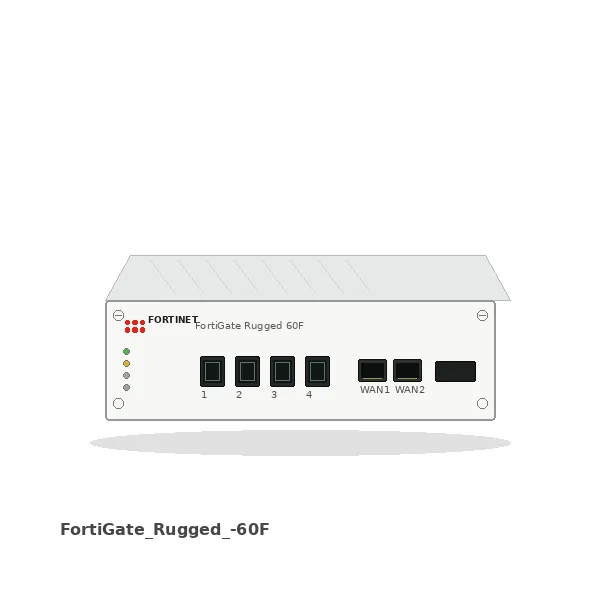
FortiGate Rugged 60F (FGR-60F) Tanzania
FortiGate Rugged 60F (FGR-60F) brings Fortinet next-generation firewall and secure networking capabilities into industrial and operational technology environments. It is intended for deployments where a conventional office firewall may not be the right physical fit, including manufacturing facilities, utility infrastructure, remote technical sites, transportation systems and other distributed environments. FourTeck Tanzania can help organizations evaluate the appliance against interface, throughput, VPN, segmentation, SD-WAN and security-service requirements before procurement.
What is the FortiGate Rugged 60F?
The FGR-60F is part of Fortinet’s FortiGate Rugged firewall family for industrial and OT security. Fortinet lists the model with a FortiSoC4 processor and FortiOS, bringing security and networking functions together on a rugged platform. The published interface set includes four Gigabit Ethernet RJ45 interfaces, a bypass pair using PORT4 and WAN1, two Gigabit RJ45/SFP shared-media pairs, a DB9 serial interface, USB and an RJ45 console port. The base FGR-60F does not include the integrated 3G/4G modem found in the separate FGR-60F-3G4G variant, so buyers should distinguish the exact model during quotation.
Fortinet publishes firewall throughput of 6/6/5.95 Gbps for 1518/512/64-byte UDP packets, 950 Mbps IPS throughput, 550 Mbps NGFW throughput and 500 Mbps threat-protection throughput under the vendor’s stated test conditions. These are laboratory performance figures rather than a promise of application throughput in every production network. Real results depend on enabled inspection, traffic profile, policy design, VPN use, logging, security subscriptions and surrounding infrastructure.
Key FGR-60F capabilities for industrial networks
Rugged deployment focus
Designed for industrial and OT settings where network security equipment may need to be deployed closer to machines, control systems, substations or remote infrastructure rather than only in climate-controlled offices.
Secure networking
FortiOS combines firewalling with routing, VPN, segmentation and SD-WAN functions, allowing security policy and connectivity decisions to be coordinated on one platform.
Industrial connectivity
RJ45, shared RJ45/SFP media options and a DB9 serial interface provide useful connectivity choices when integrating modern IP networks with industrial environments.
Verified technical specifications
| Processor | FortiSoC4 |
| GE RJ45 interfaces | 4 |
| Bypass GE RJ45 pair | PORT4 and WAN1 |
| GE RJ45/SFP shared-media pairs | 2 |
| Serial interface | 1 × DB9 |
| Firewall throughput | 6/6/5.95 Gbps (1518/512/64-byte UDP) |
| IPS throughput | 950 Mbps |
| NGFW throughput | 550 Mbps |
| Threat protection | 500 Mbps |
| Concurrent TCP sessions | 600,000 |
| New TCP sessions/second | 19,000 |
| IPsec VPN throughput | 3.5 Gbps (512-byte packets, vendor test conditions) |
| Form factor | Desktop / DIN-rail / wall mount |
Industrial and OT deployment planning
A rugged firewall purchase should begin with the network architecture rather than a model number alone. Document the upstream links, VLANs, routing domains, industrial cells or zones, remote-access requirements, site-to-site tunnels, management path, logging destination and security inspection that will be enabled. For operational technology networks, it is particularly important to understand which devices need to communicate, which protocols are business-critical and where segmentation boundaries can be introduced without disrupting production.
The FGR-60F can be considered where a compact rugged appliance must enforce policy between industrial network segments or connect a remote site securely to a central network. The bypass-capable port pair may also matter in designs where continuity considerations are important. Procurement teams should validate the complete bill of materials, power arrangement, transceivers where fiber is required, mounting method, subscriptions and management requirements before ordering.

FortiGate Rugged 60F Tanzania
Organizations evaluating FortiGate Rugged 60F in Tanzania commonly need to secure networks that extend beyond ordinary office floors. Industrial facilities, energy and utility environments, logistics operations, remote technical compounds, mining-related infrastructure, manufacturing plants and distributed sites can all create a requirement for stronger separation between operational assets and enterprise IT. The FGR-60F is relevant when the firewall itself must fit an industrial deployment model while still providing FortiOS security and networking capabilities. A Tanzania procurement exercise should therefore consider both cybersecurity policy and the physical environment in which the appliance will operate.
Before requesting a quotation, buyers should document expected internet or private-WAN bandwidth, the number of routed and switched segments, VPN requirements, inspection services, fiber or copper connectivity, serial integration needs and the desired mounting method. The published 500 Mbps threat-protection figure is useful for initial sizing, but production sizing should allow for traffic growth, encrypted traffic, logging and the exact security features that will be enabled. Where industrial systems are sensitive to latency or downtime, implementation planning should include maintenance windows, rollback procedures and staged policy enforcement rather than treating the firewall as a simple drop-in replacement.
Tanzania projects may also need to connect a rugged edge location to a head office, data center or cloud environment. In such cases, IPsec VPN, routing and SD-WAN capabilities can be evaluated together with segmentation policy. Buyers can review the broader FourTeck Tanzania technology portfolio for complementary networking and security requirements, while regional Fortinet resources at FourTeck Fortinet solutions can help frame related platform considerations. A useful quotation request should identify the exact FGR-60F model, required security subscriptions, intended deployment environment and any accessories needed so that commercial discussions start from a technically coherent requirement.
FortiGate Rugged 60F Dar es Salaam
For Dar es Salaam organizations, the FGR-60F can fit projects that combine enterprise connectivity with industrial or infrastructure-facing networks. Port operations, logistics, manufacturing, utilities, building systems, technical facilities and distributed commercial operations can create network boundaries where ordinary office security assumptions are insufficient. A rugged firewall can be positioned at a site edge or between network zones to apply controlled connectivity, inspect permitted traffic and establish secure tunnels to central resources.
Planning should start with a current network diagram. Identify internet circuits, private links, VLANs, industrial subnets, management networks and any systems that cannot tolerate unplanned interruption. If fiber handoff is required, the shared RJ45/SFP media options may be relevant, but optics and compatibility should be validated as part of the bill of materials. The serial interface may also be useful in particular industrial integration scenarios, although its actual use should be confirmed against the connected equipment and operational design.
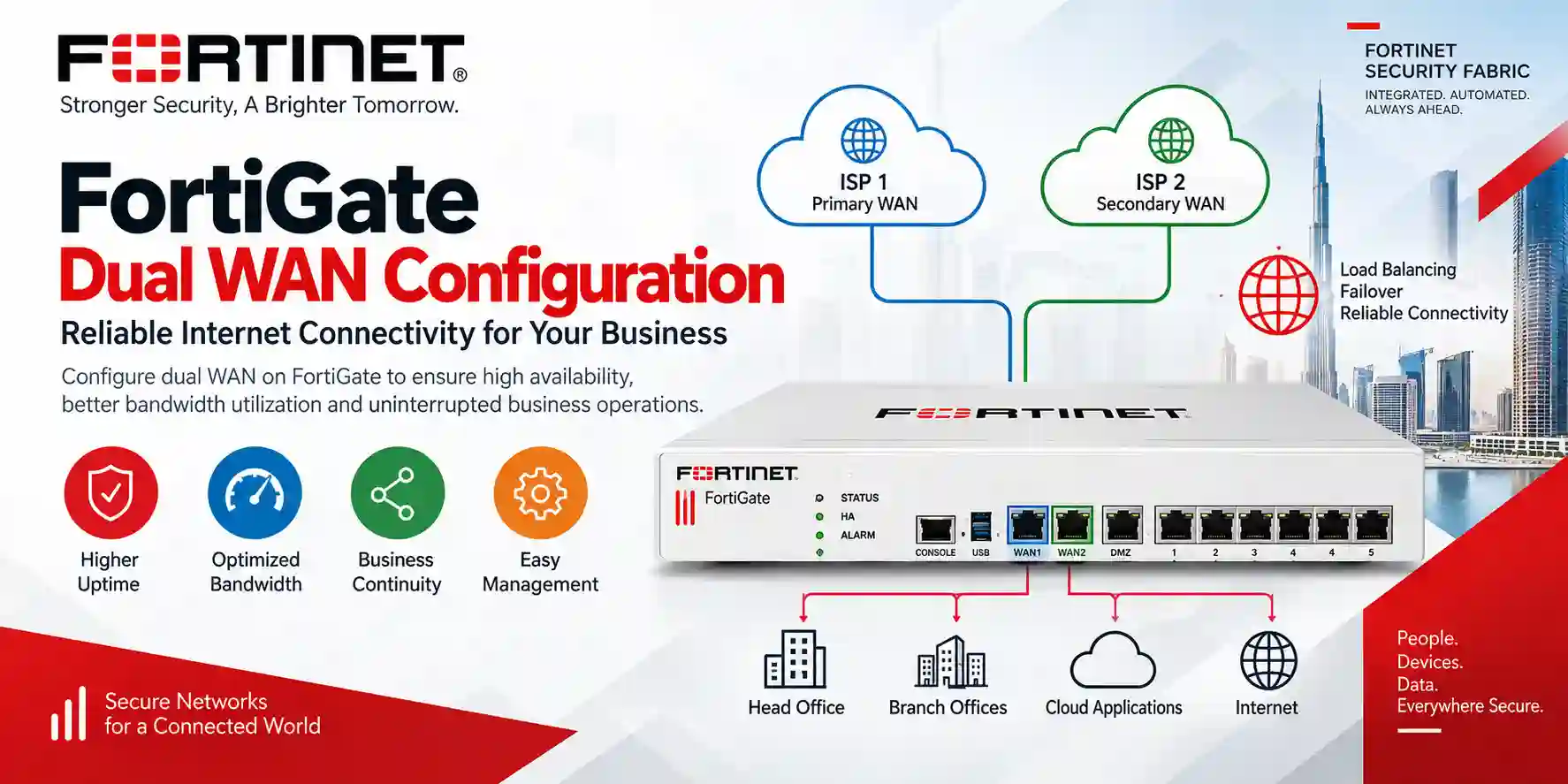
A Dar es Salaam quotation should not be based only on headline firewall throughput. Security inspection, VPN traffic, session load and future expansion affect practical sizing. Organizations should decide whether they need only the appliance or a bundle that includes appropriate FortiGuard services and support. For environments with multiple internet links, review the broader guidance represented by FourTeck’s FortiGate dual-WAN deployment visual as a planning reference, while treating the final configuration as site-specific. A documented scope makes it easier to align procurement, network engineering and operational teams before installation.
FortiGate Rugged 60F Mwanza
In Mwanza, organizations considering the FortiGate Rugged 60F may be supporting remote facilities, industrial operations, processing environments, logistics sites or infrastructure where secure communications must continue across geographically distributed locations. The central question is whether the network needs an industrially oriented firewall at the edge and whether the FGR-60F capacity and interface mix match the actual traffic and topology.
For a branch or operational site, administrators can use IPsec VPN to connect permitted networks back to central systems, while firewall policy can restrict communication between user, server, management and operational segments. Segmentation is most effective when based on documented application flows rather than broad allow rules. Teams should inventory controllers, monitoring platforms, engineering workstations, cameras, sensors, servers and remote-management systems, then decide which flows are required. This approach helps reduce unnecessary connectivity while preserving business operations.
Mwanza buyers should include environmental and installation details in the procurement request. Specify where the unit will be mounted, the available power arrangement, copper or fiber uplinks, expected WAN speeds and whether centralized logging or management is planned. If the site depends on more than one carrier or WAN path, SD-WAN design can be evaluated alongside security policy. The appliance supports substantial session capacity, but sizing should still reflect real inspection requirements. For regional procurement coordination beyond Tanzania, FourTeck Africa provides a broader regional technology context without implying local stock or guaranteed service availability at a particular site.
FortiGate Rugged 60F Arusha
Arusha deployments may combine offices, hospitality or institutional facilities with remote infrastructure, utility systems, surveillance networks and technical operations. Where those networks require controlled separation and secure connectivity, the FGR-60F can be assessed as a rugged FortiGate edge platform. The correct design depends on the number of security zones, bandwidth, inspection profile and operational dependencies rather than city location alone.
A practical design exercise should classify assets by function and trust. Corporate users, guest access, management systems, servers, cameras and operational devices should not automatically share unrestricted paths. Firewall policy can enforce explicit communication between zones, while VPNs can protect traffic between locations. For administrators supporting remote sites, centralized visibility and logging are important because troubleshooting physical access can be more difficult than in a conventional office. Security-service selection should therefore be considered together with monitoring and operational support processes.
When requesting an Arusha quotation, include the FGR-60F model name exactly, required term for subscriptions or support, anticipated WAN capacity, interface needs and any mounting or transceiver requirements. If cellular connectivity is mandatory, note that the base FGR-60F and the separate FGR-60F-3G4G are distinct models; procurement should not assume the base unit contains the cellular modem. This distinction is especially important for remote-site designs where backup connectivity is part of the architecture.
FortiGate Rugged 60F Dodoma
Dodoma organizations can evaluate the FortiGate Rugged 60F for infrastructure and operational environments that require a compact rugged security gateway. Government-related facilities, utilities, institutions, distributed technical sites and private-sector operations may all need secure links between remote locations and central systems. The FGR-60F combines routing, firewall, VPN and advanced inspection functions through FortiOS, allowing a project team to design connectivity and security policy together.
Procurement should be tied to a clear security architecture. Identify which networks are trusted, semi-trusted or operationally sensitive; determine where traffic inspection is required; and estimate peak throughput with the planned security services enabled. Fortinet’s performance figures provide a baseline for comparison, but real traffic patterns can differ significantly. Organizations should also decide how configuration backups, firmware lifecycle, logging, administrator access and incident response will be managed after deployment.
For sites connecting to headquarters or a central data center, the published IPsec capability makes the FGR-60F relevant for secure site-to-site connectivity, subject to complete design validation. Administrators should avoid exposing management interfaces unnecessarily and should use controlled administrative access. A quotation request that includes topology, expected traffic, required subscriptions and implementation objectives enables a more meaningful product discussion than asking for hardware price alone.
FortiGate Rugged 60F UAE
UAE projects involving industrial facilities, utilities, transportation, energy, manufacturing or remote infrastructure can evaluate the FGR-60F where ruggedized firewall deployment and FortiOS capabilities are required together. The appliance can sit at an industrial edge, enforce segmentation between zones, provide secure WAN connectivity and apply threat inspection according to licensed services and policy design.
The procurement process should distinguish the base FGR-60F from cellular variants and newer Rugged models. Buyers should compare required throughput, physical interfaces, environmental constraints and lifecycle requirements rather than assuming every Rugged model is interchangeable. The two shared RJ45/SFP media pairs can support flexible media planning, while the DB9 serial interface may be relevant for certain industrial environments. Any transceiver, mounting and power requirements should be confirmed in the final bill of materials.
For UAE-focused Fortinet project context, organizations can consult FourTeck Fortinet UAE resources and FourTeck UAE. These links can support broader solution exploration, while the exact commercial availability, service scope and delivery terms for an FGR-60F requirement should be confirmed in a quotation rather than assumed from web content.
FortiGate Rugged 60F Uganda
Uganda organizations with distributed infrastructure, industrial sites, utilities, manufacturing, logistics or remote operational networks can consider the FGR-60F when they need FortiGate security functions in a rugged platform. A typical requirement may involve securing a remote location, segmenting operational devices from enterprise users and creating encrypted connectivity back to a main site.
The design should account for available WAN connectivity and how the site behaves during an upstream outage. If two links are available, SD-WAN policy can be evaluated for path selection and resilience, but failover behavior should be tested against the applications that matter to the business. VPN, DNS, authentication and cloud-dependent services can behave differently during link transitions, so implementation teams should validate the complete service path rather than only checking that an interface changes state.
Uganda buyers should document the number of protected networks, expected throughput, security inspection, VPN peers and management requirements. For complementary regional resources, visit FourTeck Uganda. Commercial details such as stock, delivery and local implementation coverage should be confirmed for the specific project and date.
FortiGate Rugged 60F Kampala
Kampala-based teams may use the FGR-60F in projects that connect an administrative or head-office environment with industrial, utility or remote operational locations. The rugged model is particularly relevant at the operational edge, where security policy must be enforced close to industrial assets while maintaining encrypted connectivity to central services.
A sound deployment separates user access, management traffic and operational communications according to business need. Administrators should map required protocols and destinations, build policies around those flows and log important security events. Where remote administrators need access, the organization should define an approved remote-access method rather than exposing device management directly to untrusted networks. Firmware and subscription planning should also be part of the operating model.
When comparing quotations in Kampala, verify the exact appliance model, support and security-service terms, power and mounting requirements and any SFP optics. Do not treat the FGR-60F and FGR-60F-3G4G as the same SKU. The latter adds cellular functionality; the base model does not. Clear model identification helps prevent a procurement mismatch.
FortiGate Rugged 60F Arua
For Arua and other remote-site environments, secure connectivity and manageable operations can be as important as raw firewall speed. An FGR-60F deployment can be designed to protect a local network, establish encrypted tunnels and enforce segmentation while administrators manage policy centrally or through established operational procedures.
Remote sites should be designed for troubleshooting. Label interfaces, document addressing, keep approved configuration backups and define how administrators will reach the appliance if a primary WAN path fails. If cellular backup is required, procurement must specify a model and external connectivity solution that actually supports that requirement; the standard FGR-60F should not be assumed to include integrated 3G/4G.
Arua procurement requests should include bandwidth, tunnel count, security features, interface media, mounting conditions and expected growth. This gives technical teams enough context to judge whether the FGR-60F is appropriately sized and whether accessories or an alternative Rugged model should be evaluated.
FortiGate Rugged 60F Mbarara
Mbarara organizations evaluating industrial cybersecurity can consider the FGR-60F for network boundaries where operational assets need controlled access to enterprise or external services. The goal should be to reduce unnecessary trust between network zones while preserving the communications required for production, monitoring and administration.
Start by identifying assets and traffic flows. Controllers, monitoring systems, engineering stations, cameras, sensors and business applications may each require different access. Firewall policies can then be built around explicit requirements. Where a central SOC or IT team monitors multiple sites, logging and consistent configuration standards can improve visibility and simplify incident investigation.
For quotation planning, include whether the project requires FortiGuard security services, VPN, SD-WAN, centralized management, fiber connectivity or serial integration. Vendor throughput numbers should be interpreted under their stated test conditions and matched to the enabled feature set. Capacity headroom is sensible where traffic growth is expected.
FortiGate Rugged 60F Gulu
Gulu projects may involve remote facilities and infrastructure where dependable secure connectivity is required between a local operational network and central applications. The FGR-60F can provide firewall enforcement and encrypted site connectivity in a rugged form factor, but successful deployment depends on accurate network discovery and disciplined policy design.
Teams should document critical applications, acceptable downtime and the dependencies that cross the firewall. Industrial environments can contain legacy devices or protocols that behave differently from ordinary enterprise applications. Changes should therefore be staged and validated, with rollback procedures available. Security controls are most useful when they improve risk posture without unexpectedly interrupting essential operations.
A Gulu quotation should specify the exact model, desired subscription term, connectivity and mounting requirements. If resilience is a priority, describe primary and secondary WAN options and any requirements for power redundancy elsewhere in the site design. This allows the proposed firewall to be evaluated as one component of a complete resilient architecture.
FortiGate Rugged 60F Kenya
Kenya industrial and infrastructure projects can assess the FortiGate Rugged 60F for secure segmentation, site-to-site VPN and protected edge connectivity. Manufacturing, utilities, transport, energy, logistics and remote technical facilities may need security enforcement closer to operational systems than a conventional corporate perimeter can provide.
Sizing should consider inspected traffic rather than internet circuit speed alone. East-west flows between zones, VPN traffic and security-service use can all affect load. The FGR-60F’s published IPS, NGFW and threat-protection figures offer useful reference points, while final sizing should include expected growth and the actual feature profile. Network teams should also determine whether shared copper/fiber interfaces match uplink requirements and whether serial connectivity has a defined role.
For Kenya-related solution exploration, FourTeck Kenya provides regional context. Availability, pricing, implementation scope and support terms should be confirmed for the exact project rather than inferred from a general product page.
FortiGate Rugged 60F Kuwait
Kuwait organizations operating industrial, energy, utility, logistics or remote infrastructure can evaluate the FGR-60F where a rugged firewall is needed at a network edge or segmentation boundary. FortiOS allows firewall, routing, VPN and SD-WAN policy to be considered together, which can simplify architecture when one platform is expected to secure and connect a remote site.
Environmental suitability is only one part of the decision. Buyers should also validate security throughput, port media, VPN scale, subscriptions, management architecture and lifecycle planning. Where operational technology is involved, change control and application-flow discovery should precede restrictive policy deployment. A firewall can only enforce the rules it is given; accurate asset and communication inventories are essential.
A Kuwait quotation request should identify the exact FGR-60F model and avoid assuming cellular capability in the base unit. Include subscription term, optics, mounting and project requirements so that the bill of materials can be reviewed coherently. Regional procurement information can be explored through the wider FourTeck network where applicable.
FortiGate Rugged 60F Ghana
Ghana deployments in industrial, utility, energy, logistics and distributed infrastructure environments may benefit from evaluating a rugged firewall where security policy must extend to remote or operational sites. The FGR-60F provides a compact FortiGate platform with copper, shared copper/fiber and serial connectivity options that can suit varied network-edge designs.
Project teams should establish segmentation goals before configuring policies. If operational systems need access to central servers, DNS, NTP, update repositories or monitoring platforms, those dependencies should be documented. Site-to-site IPsec can protect communications between locations, while security inspection can be applied according to risk and performance requirements. Logging should support troubleshooting and incident response.
For procurement, specify expected bandwidth, inspected traffic, tunnel requirements, mounting and media type. If the project needs cellular backup, make that explicit so the correct variant or complementary connectivity solution is evaluated. Commercial terms and availability should always be confirmed in a current quotation.
FortiGate Rugged 60F Nigeria
Nigeria’s diverse industrial and infrastructure environments can create demand for secure networking at sites that are geographically dispersed or operationally distinct from headquarters. The FGR-60F can be evaluated for industrial segmentation, secure WAN connectivity and protected access to central applications where a rugged FortiGate form factor is appropriate.
Resilience planning should consider more than the firewall. WAN diversity, power design, upstream equipment, DNS, authentication and remote-management paths can all affect service continuity. If dual WAN is used, SD-WAN policies should reflect application priorities and be tested under realistic failure conditions. Security policies should be staged carefully where legacy operational systems are involved.
Procurement teams should request the exact model and subscription bundle, identify interface and optic requirements, and provide a high-level topology. That information supports a better sizing discussion and reduces the risk of purchasing a device that lacks a required connectivity option. Broader regional technology context is available through FourTeck’s Africa-focused resources.
FortiGate Rugged 60F Seychelles
Seychelles organizations with distributed facilities, utilities, hospitality infrastructure, transportation systems or remote technical sites can assess the FGR-60F where a rugged security gateway is needed. Secure site-to-site connectivity can be particularly important when systems are spread across locations and central IT teams need consistent policy enforcement.
A design should identify which services must remain reachable, what traffic crosses the security boundary and how the site will be managed remotely. VPN and firewall policy should be aligned with application requirements, while logs and configuration backups support ongoing operations. If connectivity options are constrained, WAN failover and out-of-band access should be considered as part of the overall architecture rather than assumed to be inherent in the firewall.
For a quotation, specify the FGR-60F model, subscription term, expected throughput, port media, mounting needs and whether centralized management is required. Buyers should validate current product lifecycle and software compatibility for their planned deployment at the time of purchase.
Licensing, subscriptions and lifecycle planning
The hardware appliance and security-service subscriptions are separate planning considerations. Organizations should identify which FortiGuard services are required, the desired term and the support level appropriate to their operations. Renewal planning matters because an industrial firewall can remain physically installed for years while threat intelligence, software maintenance and support entitlements change over time.
Before purchase, confirm the supported FortiOS release path for the exact FGR-60F and verify compatibility with any centralized management or analytics platforms in the environment. Fortinet documentation currently lists FGR-60F among supported Rugged models in multiple FortiOS branches, but software planning should be based on the release selected for the project and current vendor guidance at implementation time.
Buying and sizing checklist
Network scope
List WAN links, VLANs, routed networks, operational zones, remote sites and required VPN peers.
Security profile
Identify IPS, application control, web filtering, malware protection and other services that may be enabled.
Physical deployment
Confirm mounting, power, copper/fiber media, optics, cabling and environmental requirements.
Operations
Define logging, backups, administrator access, firmware maintenance, monitoring and incident-response ownership.
Related FourTeck security resources
Explore FourTeck Tanzania for the Tanzania technology portfolio, Fortinet-focused FourTeck resources for broader Fortinet solution context, FourTeck Africa for regional technology requirements, FourTeck Uganda for Uganda-related projects and FourTeck Kenya for Kenya-related requirements. These links are provided for solution exploration; project-specific stock, delivery, authorization and service scope should be confirmed directly.
FortiGate Rugged 60F FAQs
Is FGR-60F the same as FG-60F?
No. FGR-60F is a FortiGate Rugged model intended for industrial and OT-oriented deployments. It should not be confused with the standard FortiGate 60F appliance.
Does the FGR-60F include 4G?
The base FGR-60F does not include the integrated cellular modem. Fortinet lists a separate FGR-60F-3G4G variant with 3G/4G LTE and GPS.
What is the published threat-protection throughput?
Fortinet publishes 500 Mbps threat-protection throughput for the FGR-60F under its stated test methodology. Actual deployment performance depends on configuration and traffic.
Can it be DIN-rail mounted?
Fortinet lists desktop, DIN-rail and wall-mount form factors for the FGR-60F. Confirm required mounting components in the final bill of materials.
Can the FGR-60F support site-to-site VPN?
Yes. Fortinet publishes IPsec VPN performance and tunnel capacity for the platform. The final VPN architecture should be sized and configured for the project’s peers, encryption settings and traffic profile.
Quotation checklist for FortiGate Rugged 60F
For a useful quotation, provide the exact model name FGR-60F, quantity, required FortiGuard or support term, WAN bandwidth, expected inspected traffic, number of sites and VPNs, copper or fiber requirements, mounting preference, centralized management requirements and any target deployment date. If cellular connectivity is required, state this explicitly so the correct model or supporting solution can be considered.
Decision recap
Choose the FortiGate Rugged 60F when the requirement is specifically for a rugged FortiGate platform and its verified interface and performance profile matches the industrial network design. Do not select it solely because the name resembles the standard FG-60F. Confirm the environmental requirement, security throughput, WAN design, fiber or copper interfaces, VPN needs, subscriptions, management approach and lifecycle plan before purchase.
Plan your FGR-60F deployment with FourTeck Tanzania
Share your network topology, site type, bandwidth, security requirements and preferred subscription term. FourTeck can use those details to discuss product fit and prepare a project-specific quotation without assuming stock, delivery dates or service coverage that has not been confirmed.


Reviews
There are no reviews yet.