
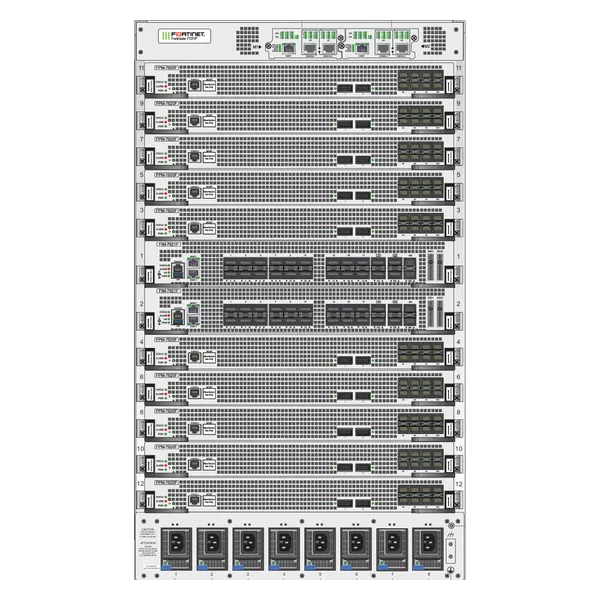
Fortinet FortiGate 7121F Tanzania
FortiGate 7121F is Fortinet’s modular high-end data-center firewall platform for organizations that need extremely high inspection capacity, resilient chassis architecture and room to scale security processing. For Tanzanian enterprises evaluating core data-center protection, high-volume north-south traffic inspection, internal segmentation, encrypted traffic visibility, multi-site VPN concentration or service-provider security, the 7121F belongs in a very different class from compact branch appliances. Fortinet specifies the model at up to 675 Gbps IPS, 550 Gbps NGFW and 520 Gbps threat-protection throughput, with a modular 16U chassis designed around redundant management, interface and processor modules.
FortiGate 7121F Overview and Verified Architecture
The FortiGate 7121F is a 16U, 19-inch rackmount, 12-slot chassis. Fortinet documents a 1 Tbps fabric backplane and 50 Gbps base backplane. Two redundant System Management Modules supervise chassis power and cooling and provide management access. Interface modules occupy slots 1 and 2, while as many as ten FortiGate Processor Modules can occupy slots 3 through 12. This architecture matters for procurement because a 7121F project is not simply a firewall appliance purchase: the final design depends on module population, required interfaces, power architecture, redundancy targets, optics, cabling, FortiOS design and security-service subscriptions.
Published Fortinet IPS performance for the FG-7121F.
Published NGFW throughput for enterprise inspection workloads.
Published threat-protection throughput for the platform.
Generation matters. Fortinet documents first- and second-generation 7121F hardware. Generation 1 uses eight 2000W AC or DC power supplies, while Generation 2 uses eight 2500W AC or DC supplies and supports additional power redundancy flexibility. Procurement teams should therefore request an exact bill of materials rather than relying only on the family name.
Where FortiGate 7121F Fits
The 7121F is best evaluated for environments where firewall performance, encrypted traffic inspection, session scale, resilient modularity and expansion capacity are strategic requirements. Typical evaluation scenarios include large data centers, telecom and service-provider networks, major financial or government infrastructure, large campus cores, cloud interconnection points and enterprise environments consolidating multiple security functions. It can form part of a Fortinet Security Fabric design alongside centralized management, analytics, switching, wireless, endpoint and other Fortinet technologies. Buyers should size the solution against real traffic profiles rather than headline bandwidth alone: application mix, SSL inspection, IPS policies, VPN encryption, logging, redundancy, east-west segmentation and projected growth all affect the final architecture.
Technical and Procurement Planning
A FortiGate 7121F quotation should identify the chassis generation, interface modules, processor modules, AC or DC power requirements, transceivers, rack requirements, FortiCare term, FortiGuard service bundle and any centralized management or logging components. Fortinet lists a fully assembled chassis weight of approximately 203.1 kg and maximum power consumption of 9754W, so rack loading, power feeds, cooling and physical access must be checked before installation. The platform supports hot-swappable power supplies and modular components, but redundancy must be engineered deliberately around the customer’s availability objectives.
For broader Fortinet portfolio context, buyers can review Fourteck Fortinet UAE for enterprise firewall and licensing topics, Fortinet Kenya solutions for East African project context, Fourteck Uganda FortiGate coverage for regional procurement, Fourteck UAE for wider IT infrastructure requirements, and Fourteck Africa for cross-border technology projects. These resources help procurement teams coordinate projects that extend beyond a single Tanzanian site.
Fortinet FortiGate 7121F Tanzania
Organizations searching for FortiGate 7121F Tanzania are usually planning security at data-center or very large enterprise scale. The first question should not be whether the appliance has enough raw firewall throughput; it should be what traffic must be inspected, where trust boundaries sit, how many links and security zones are required, and what availability model the business expects. A Tanzanian bank, carrier, public institution, cloud operator or large diversified enterprise may have very different requirements even when peak bandwidth is similar. A useful design workshop therefore maps internet edges, private WAN links, cloud connectivity, partner networks, remote access, server segments and disaster-recovery paths before selecting modules and subscriptions. Power and cooling deserve early attention because this is a 16U chassis platform rather than a conventional 1U appliance. Facilities teams should validate rack capacity, redundant electrical feeds and heat handling while network teams confirm optics and interface speeds. Security teams should separately define IPS, application control, malware inspection, encrypted-traffic policy, segmentation and logging requirements. Procurement should request the exact generation and module configuration, FortiCare term and FortiGuard package in the quotation. This prevents an apparently simple FG-7121F request from becoming an incomplete bill of materials. For deployments connecting Dar es Salaam data centers with other Tanzanian regions, the design should also consider carrier diversity, WAN routing and failover behavior. Fourteck can use these inputs to structure a quotation and solution discussion without assuming that one configuration suits every enterprise.
Fortinet FortiGate 7121F Dar es Salaam
FortiGate 7121F Dar es Salaam enquiries commonly align with large headquarters, data centers, telecom environments, financial infrastructure and organizations aggregating substantial national or international traffic. In these environments the firewall may sit between internet transit, private WAN services, cloud connectivity, server networks and high-value application zones. The 7121F’s modular chassis can be evaluated where a fixed appliance would constrain interface density or long-term processing expansion. Before procurement, document the current and projected bandwidth of every major path, but also capture the percentage of encrypted traffic, expected concurrent sessions, new-session rates, VPN demand and security profiles. Those factors determine practical sizing more accurately than ISP bandwidth alone. Dar es Salaam deployments should include a facilities review because the chassis occupies 16 rack units and has significant power and cooling requirements. The rack plan should include service clearance, cable management, transceiver selection and redundant power design. Network architects should decide whether the 7121F will operate as an internet edge, data-center segmentation firewall, VPN concentrator, inter-zone control point or a combination of roles. Where business continuity is critical, high availability should be designed together with upstream and downstream routing so that firewall resilience is not undermined by a single switch, carrier or power path. Logging and management capacity should also be considered from the beginning. A quote request should therefore include site topology, required ports, expected traffic, desired security services, HA requirements and subscription term. This gives the commercial team enough information to distinguish chassis, modules, optics, licenses and associated Fortinet management components instead of returning an ambiguous hardware-only price.
Fortinet FortiGate 7121F Mwanza
A FortiGate 7121F Mwanza project is likely to be justified by a large regional operation, major industrial environment, service-provider node or enterprise architecture that concentrates traffic from many sites rather than a normal office perimeter. The design process should begin by identifying why traffic is being aggregated in Mwanza: regional branches, production facilities, logistics operations, customer services, private data-center workloads or connectivity back to a national core. If the platform will protect both north-south internet traffic and east-west server traffic, separate security zones and policy objectives should be documented so inspection capacity is allocated realistically. Link diversity is another important consideration. Multiple carriers or paths can improve resilience, but routing, SD-WAN or dynamic failover behavior must be designed alongside the firewall rather than treated as an afterthought. For encrypted site-to-site connectivity, capture tunnel counts, encryption requirements and expected throughput between Mwanza, Dar es Salaam and other locations. Physical deployment planning is equally important: the 7121F is a large chassis with substantial power draw and heat output, so rack, electrical and cooling readiness should be verified before shipping or installation scheduling. Procurement teams should request an exact hardware generation and module population, because Fortinet documents generation-specific power-supply differences. They should also define FortiCare and FortiGuard terms, support expectations, optics and spare strategy. This creates a defensible bill of materials for finance and technical review. Fourteck can use these details to discuss the platform as part of a broader security architecture rather than treating it as a commodity firewall, helping Mwanza organizations align capacity, resiliency and subscription choices with the real network design.
Fortinet FortiGate 7121F Arusha
FortiGate 7121F Arusha buyers should evaluate the model when the site acts as a major enterprise hub, regional data center, large hosting environment or aggregation point for substantial application and WAN traffic. The 7121F is far beyond the requirements of an ordinary branch office, so a sound business case should identify the workloads that demand a modular chassis and very high security throughput. An Arusha organization connecting hospitality groups, institutions, industrial operations or distributed branches may need segmentation between user, server, guest, operational and partner networks. The firewall architecture should translate those trust boundaries into interfaces, virtual domains where appropriate, policies and inspection profiles. Teams should also establish how much TLS-encrypted traffic will be inspected, because encrypted application visibility can be a major sizing consideration. If remote sites depend on the Arusha hub, VPN and WAN failure scenarios should be modeled so a firewall maintenance event or carrier outage does not interrupt critical operations. Facilities planning is essential: verify rack dimensions and loading, redundant power availability, cooling capacity and safe handling for the large chassis. The final quotation should identify the selected interface and processor modules, transceivers, cables, FortiCare support, FortiGuard security services and any FortiManager or FortiAnalyzer requirements. Buyers comparing the 7121F with smaller FortiGate platforms should focus on required inspection performance, session scale, modular expansion and resiliency rather than model prestige. A smaller platform can be more appropriate when requirements are modest. Fourteck can review topology, bandwidth, security policies, expansion horizon and procurement constraints to help structure a technically relevant Arusha quotation and avoid oversizing or an incomplete chassis configuration.
Fortinet FortiGate 7121F Dodoma
FortiGate 7121F Dodoma evaluations can arise where government, institutional or large enterprise networks require high-capacity security at a core data center or centralized network boundary. Such projects typically involve more than internet firewalling. They may include segmentation between departments, data-center zones, partner networks, cloud services, remote offices and administrative systems. A requirements document should therefore list each security zone, expected traffic path, interface type, routing relationship and inspection policy. For critical public or enterprise services, availability objectives should be translated into redundant firewall, switching, power and carrier designs rather than relying on a single resilient component. The 7121F’s modular construction supports substantial scale, but the chassis also introduces facilities requirements that must be considered early. Validate rack space, floor and rack loading, AC or DC power architecture, cooling and maintenance access. Fortinet documents different power-supply capabilities between hardware generations, making the exact generation an important procurement line item. Security subscriptions should also be explicit. Teams need to decide which FortiGuard services are required, the FortiCare support term, logging retention objectives and whether centralized FortiManager or FortiAnalyzer infrastructure is part of the project. For tender or formal procurement, request the complete bill of materials rather than a single chassis price so competing offers can be compared on the same scope. Include optics, modules, support, subscriptions and implementation assumptions. Fourteck can work from those technical inputs to prepare a Dodoma-focused commercial discussion, while the customer’s network and security stakeholders retain clear visibility into why each component is required and how the platform fits the wider architecture.
Fortinet FortiGate 7121F UAE
FortiGate 7121F UAE projects are most relevant to hyperscale data centers, large enterprises, service providers, government environments and organizations requiring very high security inspection capacity. The UAE’s dense mix of data centers, cloud interconnections, international connectivity and multi-site enterprises can create designs where firewall capacity must accommodate large encrypted flows and rapid growth. The 7121F should be assessed against the exact role it will perform: internet edge, data-center perimeter, internal segmentation, VPN aggregation, cloud interconnect security or consolidated multi-tenant services. Each role changes the required interfaces, processor population and policy mix. For organizations operating between UAE and African markets, architecture teams should also model latency, WAN paths, regional failover and centralized versus distributed inspection. A UAE bill of materials should specify chassis generation, FIM and FPM modules, optics, AC or DC power design, FortiCare, FortiGuard subscriptions and centralized management or analytics. Because the chassis is 16U and power-intensive, data-center rack and power reservations should be confirmed before purchase. Buyers can use the Fourteck Fortinet UAE resource linked above to explore regional Fortinet procurement and licensing context. Price comparisons should be made on equivalent configurations: a chassis with minimal modules cannot be compared fairly with a fully populated, subscription-inclusive design. Organizations should also plan migration from the current firewall, including routing, NAT, security policies, VPNs, certificates, logging and change windows. This turns the acquisition into a controlled infrastructure project rather than a hardware swap and provides a clearer basis for commercial evaluation.
Fortinet FortiGate 7121F Uganda
FortiGate 7121F Uganda demand is expected to center on large-scale environments such as telecom networks, major financial platforms, national institutions, service providers and data centers rather than ordinary branch sites. A Ugandan organization considering this chassis should first establish the aggregation role of the firewall and whether the requirement is driven by internet capacity, internal segmentation, VPN concentration, encrypted traffic inspection or future growth. Where traffic from Kampala and regional locations converges on a central facility, network diagrams should quantify both present loads and expansion assumptions. High availability should be designed across the full path, including upstream carriers, core switching and power. The 7121F offers modular expansion, but that flexibility means procurement must identify interface modules, processor modules and optics precisely. Power and cooling are significant planning items for the 16U chassis, and facilities teams should confirm rack readiness before shipment. FortiCare and FortiGuard terms should be chosen according to the organization’s support and security-service requirements rather than left as generic placeholders. For regulated or audit-sensitive environments, logging architecture and retention should be discussed at the same time as firewall sizing. If Uganda sites connect to Tanzania, Kenya or UAE infrastructure, include inter-country VPN and routing requirements in the design so the central firewall is sized for encrypted traffic as well as internet inspection. Fourteck’s Uganda and regional resources can support procurement conversations, but customers should request a complete solution scope showing hardware, subscriptions, optics, implementation assumptions and support. That approach makes technical and financial comparison more meaningful and reduces the risk of discovering missing components after purchase approval.
Fortinet FortiGate 7121F Kampala
FortiGate 7121F Kampala is a relevant search for organizations building or upgrading a major data-center security layer in Uganda’s primary commercial and technology hub. A Kampala deployment could consolidate security for headquarters, branches, cloud connections, partner networks and internet services, but consolidation should be supported by careful segmentation so one policy domain does not become unnecessarily complex. Architects should inventory high-value applications, external services, user populations and inter-site links, then classify traffic according to trust level and inspection requirements. The resulting matrix informs interface count, routing, virtual domains, security profiles and logging. If the firewall will terminate large numbers of IPsec tunnels or inspect substantial TLS traffic, those workloads must be included in sizing. The physical chassis also requires serious data-center preparation: 16U of rack space, suitable power feeds, cooling and cable management should be reserved. Redundant design should include more than firewall components; switches, carrier handoffs and management access need equivalent attention. During procurement, insist on exact model generation and module quantities and identify whether transceivers are included. Subscription duration can materially change the commercial package, so FortiCare and FortiGuard terms should be stated clearly. Migration planning should cover existing firewall objects, policies, NAT, routing, VPNs and certificates and include rollback procedures. A staged deployment can reduce risk for critical Kampala services. Fourteck can structure a quotation around these inputs and coordinate the Fortinet product discussion, while customer teams can use the documented design assumptions to verify that the selected configuration supports both current traffic and realistic expansion.
Fortinet FortiGate 7121F Arua
FortiGate 7121F Arua is a specialized requirement because the platform is designed for very large-scale security rather than conventional regional offices. The model becomes relevant if Arua hosts a substantial service-provider node, data center, cross-border connectivity hub or enterprise aggregation facility handling traffic for many downstream sites. In such a case, planning should start with traffic engineering: identify inbound and outbound links, private network connections, expected peak utilization, encrypted flows, session behavior and security policies. If the site supports cross-border or remote operations, network teams should define failover paths and determine whether security inspection remains centralized in Arua or distributed across smaller FortiGate appliances. This can prevent unnecessary backhaul and clarify the role of the 7121F. The chassis’s modular architecture allows processing and interface capacity to be designed around the project, but it also requires a precise bill of materials. Facilities readiness is especially important for a large 16U system: confirm rack availability, redundant power, cooling, grounding, cable management and physical handling arrangements. Procurement should specify FortiCare support, FortiGuard subscriptions, optics and any centralized logging or management systems. A project team should also plan remote administration and out-of-band access so operators can manage the chassis during WAN incidents. When comparing quotations, check that vendors are proposing equivalent generations and module populations. Fourteck can use the Arua project’s topology and performance requirements to develop a commercial scope rather than assuming a standard configuration, which is particularly important for a chassis whose final capability depends on its installed modules and surrounding network design.
Fortinet FortiGate 7121F Mbarara
A FortiGate 7121F Mbarara deployment should be tied to a high-capacity regional core, data-center or service-provider use case. For most individual offices, smaller FortiGate models will be more appropriate, so the first sizing exercise should establish whether Mbarara is aggregating enough users, sites, services or network traffic to justify a chassis platform. If it is, map every major traffic domain: internet, MPLS or private WAN, cloud, partner connections, server networks, management networks and remote-access services. Security teams can then define which flows require IPS, application control, malware prevention, SSL inspection or strict segmentation. This avoids applying maximum inspection indiscriminately and provides a realistic capacity model. Organizations should also evaluate future growth, especially where additional branches or digital services may be centralized in Mbarara. The 7121F’s modular design can support expansion, but module selection and power planning need to anticipate that roadmap. Physical deployment must account for 16U rack space, substantial chassis weight, power feeds and heat output. For business continuity, define HA behavior, routing convergence and maintenance procedures before implementation. Procurement documentation should include the chassis generation, FIM and FPM quantities, optics, FortiCare, FortiGuard bundle, management and analytics requirements and any professional-service scope. This level of detail helps finance compare like-for-like offers and gives engineers a clear deployment baseline. Fourteck can review those requirements for a Mbarara quotation and discuss related regional Fortinet options when a distributed design using smaller firewalls at remote sites and a 7121F at the core provides a better architecture.
Fortinet FortiGate 7121F Gulu
FortiGate 7121F Gulu enquiries should be approached as data-center and network-core projects. The chassis is intended for extremely demanding security workloads, so organizations should document the business services that require this scale. A service provider may need large session capacity and high-speed interfaces; a large enterprise may prioritize encrypted application inspection and segmentation; an institutional network may require resilient control between multiple security zones. Those scenarios can lead to different module and policy designs even when they use the same 7121F chassis. If Gulu operates as a regional hub, architects should model traffic from connected branches and consider whether internet breakout is centralized or local. VPN throughput, tunnel design and carrier redundancy should be captured alongside normal firewall traffic. The implementation plan should also cover logging, monitoring and administrative access because operational visibility is critical on a high-capacity platform. Facilities teams need to reserve adequate rack space, power and cooling and verify how the chassis will be physically installed and maintained. The procurement team should not accept an unspecified “FortiGate 7121F” line item; it should ask for exact chassis generation, installed interface and processor modules, transceivers, FortiCare support and FortiGuard subscription term. If high availability is required, the duplicated infrastructure and surrounding switching must be reflected in the budget. Fourteck can use these details to prepare a Gulu-focused scope and help compare centralized versus distributed Fortinet designs. The result should be a platform selected for measurable traffic and resilience requirements, not simply because it is the largest available firewall.
Fortinet FortiGate 7121F Kenya
FortiGate 7121F Kenya projects can fit large data centers, carriers, financial institutions, cloud and hosting providers and enterprises with high-volume regional connectivity. Nairobi and other major business centers may aggregate traffic from many Kenyan and East African sites, making inspection performance and modular expansion important. The 7121F should be sized from traffic flows and security controls: internet edge capacity, private WAN, cloud interconnects, VPN encryption, SSL inspection, IPS, segmentation and expected growth. Where the Kenyan facility also supports Tanzania or Uganda operations, architects should model cross-border links and decide which security functions are centralized. A modular chassis can simplify consolidation, but it can also create a critical concentration point, so HA, routing diversity, power and upstream switching should be designed as a system. The physical 16U footprint and power requirements mean data-center facilities approval should precede procurement. Commercial teams should request an exact chassis and module configuration, optics and subscription package. Fortinet’s documented hardware generations have different PSU capabilities, so generation must be explicit. Migration from an existing firewall should be treated as a controlled project with policy cleanup, routing validation, VPN migration, testing and rollback. Fourteck’s Kenya Fortinet resource can provide regional context for procurement and related Fortinet products. For organizations tendering the solution, require every bidder to price the same module counts, FortiCare duration and FortiGuard services so offers are comparable. A well-defined Kenya 7121F project should therefore connect business availability requirements to a measurable architecture and a complete bill of materials rather than focusing only on headline throughput.
Fortinet FortiGate 7121F Kuwait
FortiGate 7121F Kuwait is relevant to high-capacity enterprise, government, service-provider and data-center environments that require modular firewall scale and strong security inspection. Before selecting the platform, identify whether the primary requirement is internet-edge protection, internal data-center segmentation, VPN aggregation, cloud connectivity or multi-tenant security. Each use case places different demands on interfaces and processing. Kuwait organizations with multiple facilities should document WAN topology, primary and backup carriers and the traffic expected to traverse the central firewall. Encrypted application inspection should be considered explicitly because modern enterprise traffic is predominantly encrypted and policy choices can materially affect design. The 7121F’s modular chassis supports substantial expansion, but the customer must choose the correct FIM and FPM population, optics and power arrangement. Data-center facilities should validate the 16U footprint, rack loading, power feeds and cooling. High availability requires duplicated planning across firewall, switching and connectivity layers. Procurement teams should ask for a complete configuration showing hardware generation, modules, FortiCare support, FortiGuard services, management and logging. Subscription length and service bundle should be identical when comparing vendor quotes. If the firewall replaces an existing platform, migration should include object and policy review rather than blindly transferring legacy rules. This is an opportunity to simplify security zones, remove obsolete policies and document routing and NAT behavior. Fourteck’s regional network can support cross-market procurement discussions for customers whose Kuwait infrastructure connects to UAE or African operations. The strongest commercial request will include topology, traffic, port speeds, redundancy and security-service expectations, allowing the quote to reflect a real architecture.
Fortinet FortiGate 7121F Ghana
FortiGate 7121F Ghana requirements are likely to originate from major enterprises, telecom operators, data centers, financial institutions and organizations consolidating security for large numbers of users or services. A Ghana deployment should begin with a capacity and risk assessment. Network teams need to identify peak and average traffic, link speeds, session characteristics, encrypted traffic, VPN requirements and projected growth. Security teams should map trust zones and determine where IPS, application control, web security, malware inspection and SSL inspection are required. This combination produces a more accurate sizing model than a simple bandwidth number. If Accra or another facility serves as a regional hub, consider whether traffic from remote branches should be backhauled to the 7121F or inspected locally using smaller FortiGate platforms. The answer depends on WAN economics, latency, policy consistency and operational design. For the central chassis, facilities planning must include 16U rack space, suitable electrical capacity, cooling and safe installation. Hardware generation and module population should be specified in the quotation, together with transceivers and redundancy assumptions. FortiCare and FortiGuard subscriptions should be aligned to the organization’s operational and security objectives, while centralized management and logging should be included where required. A migration plan should define testing, change windows and rollback. Procurement teams can then compare proposals on equivalent technical scope. Fourteck can discuss the Ghana requirement as part of a regional Fortinet architecture and prepare a quotation based on actual interface, capacity, subscription and support needs instead of offering an undefined chassis-only price.
Fortinet FortiGate 7121F Nigeria
FortiGate 7121F Nigeria is positioned for very large network-security environments, including carriers, major financial institutions, cloud and hosting providers, government infrastructure and large enterprises. Nigeria’s scale can produce data-center designs with substantial internet, branch, mobile, cloud and partner traffic, so security capacity must be modeled carefully. The 7121F can be considered where modular interfaces and processing are needed to avoid frequent platform replacement as traffic grows. Architects should inventory all high-speed links and classify traffic by required security controls. A workload dominated by encrypted application inspection can have different sizing needs from a network primarily performing basic stateful firewalling. VPN concentration, internal segmentation and multi-tenant policies should be included as separate design dimensions. High availability should cover not only a second firewall chassis but also redundant switching, routing, power and carrier connectivity. Because the platform occupies 16U and can consume significant power, facilities engineering should validate rack and cooling readiness before procurement. The bill of materials must state chassis generation, FIM and FPM modules, optics, FortiCare, FortiGuard services and management or analytics components. For multi-site Nigerian organizations, decide whether smaller FortiGates will secure branches while the 7121F protects the central data center; this often creates clearer fault domains than sending every function through one device. Migration should include policy rationalization, routing tests and staged cutover. Fourteck can structure a Nigeria quotation around these details and coordinate regional requirements where the same organization operates in Ghana, Kenya, Tanzania, Uganda or UAE.
Fortinet FortiGate 7121F Seychelles
FortiGate 7121F Seychelles is a highly specialized fit because the chassis targets very large security workloads. It may be considered for a major telecom, hosting, government or consolidated data-center environment where many services and connections are protected at a central point. For most individual enterprises in Seychelles, a smaller FortiGate model may be more economical and operationally appropriate, so sizing should be evidence-driven. If the 7121F is justified, document international connectivity, local data-center links, cloud paths, VPN traffic and internal segmentation. Island connectivity considerations make resilience planning particularly important: carrier diversity, failover routing and the placement of critical services should be designed together with firewall high availability. The modular chassis can provide substantial processing and interface scale, but exact modules and optics must match the selected network design. Facilities teams should validate the 16U rack footprint, weight, power and cooling requirements and ensure maintenance access. Procurement should identify chassis generation, power type, FIM and FPM quantities, transceivers, FortiCare and FortiGuard terms. Where centralized logging is required, estimate event volume and retention so analytics infrastructure is sized appropriately. A migration from an existing firewall should include configuration review, policy cleanup, VPN transition, routing validation and a rollback plan. Fourteck can use the Seychelles organization’s traffic and connectivity details to compare a 7121F core design with alternatives and prepare a complete commercial scope. This prevents oversizing while ensuring that genuine high-capacity requirements are not constrained by an appliance selected only on purchase price.
Compatibility, Licensing and Operations
FortiGate 7121F runs FortiOS and can participate in the broader Fortinet Security Fabric. Security-service selection should be based on required controls and subscription terms. FortiCare covers support-related needs, while FortiGuard service bundles can add threat intelligence and security functions. Exact entitlements can change by bundle and term, so quotations should state the service names and durations rather than relying on shorthand. For centralized estates, FortiManager and FortiAnalyzer may be considered for policy administration, logging and analysis. Compatibility with optics, neighboring switches, routing protocols and existing monitoring should be validated during design.
FortiGate 7121F Quotation Checklist
✓ Interface speeds and quantities
✓ Encrypted traffic and SSL inspection scope
✓ VPN tunnels and remote-access demand
✓ AC/DC power and redundancy
✓ Rack and cooling readiness
✓ Required transceivers and cabling
✓ FortiGuard service bundle
✓ Management and logging platform
✓ HA, migration and implementation scope
Frequently Asked Questions
What is the FortiGate 7121F designed for?
Fortinet positions the 7121F in its high-end data-center firewall category. It is suited to large enterprise and service-provider environments requiring very high inspection performance, modular expansion and resilient chassis architecture.
What are the published FortiGate 7121F security performance figures?
Fortinet’s current 7000F Series data sheet lists 675 Gbps IPS throughput, 550 Gbps NGFW throughput and 520 Gbps threat-protection throughput for the FG-7121F. Real deployments should be sized against enabled features and traffic profiles.
How large is the FortiGate 7121F?
Fortinet documents a 16U, 19-inch rackmount chassis. A fully assembled chassis is listed at about 203.1 kg, so rack loading, handling, power and cooling must be planned.
Are there different FortiGate 7121F hardware generations?
Yes. Fortinet documents Generation 1 and Generation 2. Both support the same software features, while Generation 2 uses higher-capacity 2500W power supplies and has power-system improvements.
What information is needed for a FortiGate 7121F Tanzania quote?
Provide required interface speeds, traffic and inspection targets, HA design, preferred power architecture, module needs, FortiCare term, FortiGuard services, optics and management/logging requirements. A network diagram is especially useful for this chassis class.
Decision Recap
Choose the FortiGate 7121F for a verified high-scale requirement, not simply for maximum specifications. Its value is the combination of modular chassis architecture, very high Fortinet-published security throughput, redundant management and expansion potential. The correct purchase is a complete engineered configuration covering modules, power, optics, subscriptions, management, facilities and migration. Share your topology and performance targets with Fourteck to build the quotation around the actual environment.




Reviews
There are no reviews yet.