
FortiRecorder F and G Series
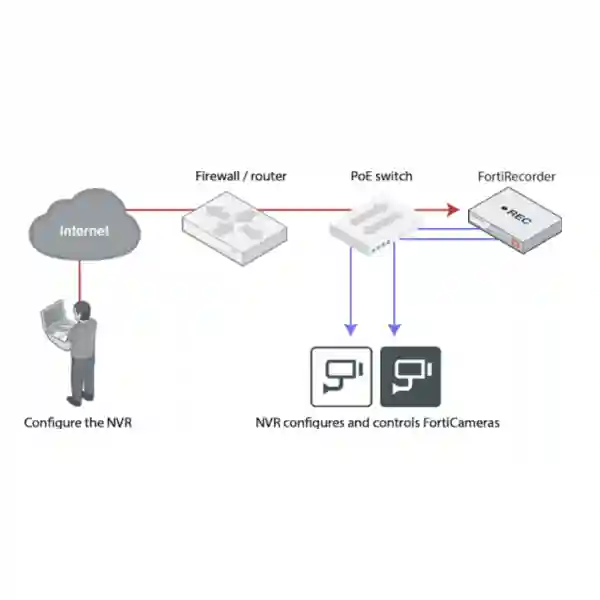
FortiRecorder F and G Series network video recorders provide centralized management for configuring cameras, recording video feeds, viewing live video and reviewing stored footage. Fortinet’s current hardware portfolio identifies FortiRecorder 400F and FortiRecorder 100G, alongside FortiRecorder VM. For Tanzanian organizations planning IP surveillance, the important buying decision is not simply recorder capacity: camera count, bitrate, retention period, recording schedule, storage architecture, user concurrency, network uplinks and future expansion all influence the correct design.
FortiRecorder 400F and 100G at a glance
Fortinet positions FortiRecorder as a network video recorder and video management platform for physical-security deployments. The FortiRecorder 400F supports up to 64 cameras and ships with one 4 TB drive, with the platform supporting up to four 8 TB drives. The FortiRecorder 100G supports up to 16 cameras and includes 2 TB storage. The 400F provides three Gigabit Ethernet RJ45 interfaces and supports RAID 0, 1, 5 and 10; the 100G provides four Gigabit Ethernet RJ45 interfaces. These values are model-specific and should not be treated as interchangeable across the family.
| Model | Camera capacity | Storage | Interfaces | Best-fit planning context |
|---|---|---|---|---|
| FortiRecorder 100G | Up to 16 cameras | 1 × 2 TB | 4 × GE RJ45 | Compact sites and smaller camera estates |
| FortiRecorder 400F | Up to 64 cameras | 1 × 4 TB supplied; up to 4 × 8 TB | 3 × GE RJ45 | Larger on-premises recording requirements |
Recording flexibility
FortiRecorder supports scheduled, manual, motion-triggered and continuous recording approaches. Recording policy should be designed around security objectives and retention rather than assuming every camera needs the same schedule.
Central video operations
Operators can use FortiRecorder for camera configuration, live viewing, playback and video export. FortiCentral can provide on-site video management across connected FortiRecorder and FortiCamera devices.
Integration planning
FortiRecorder supports network integration functions including RADIUS, LDAP, SNMP and remote data storage. It can also connect with access-control systems so video and door events can be correlated where the deployment supports that workflow.
How to size a FortiRecorder deployment
Camera quantity is only the first sizing input. Fortinet’s guidance highlights the number of streams from each camera, recording schedule, resolution, frame rate, bitrate mode, image quality, storage settings and simultaneous playback demand. Retention depends on available storage and the aggregate video bandwidth generated by the cameras. A quotation therefore becomes more useful when the buyer supplies the expected camera count, camera resolutions, preferred frame rates, whether recording is continuous or motion-based, target retention in days, number of monitoring users and any NAS or remote-storage requirement.
The recorder should also be considered as part of the network. IP cameras generate sustained traffic, so access switching, PoE budget, VLAN design, uplink capacity and the route between cameras and recorder matter. A recorder installed in a well-designed rack can still deliver a poor user experience if video streams cross congested links. For multi-building or multi-floor environments, identify where cameras terminate, where recording occurs and how operators access live and historical video. This is especially important when high-resolution cameras, multiple simultaneous streams or remote monitoring are required.
Buyer note: F Series and G Series terminology
For current purchasing, verify the exact model rather than relying on the generation letter alone. Fortinet currently lists FortiRecorder 400F and FortiRecorder 100G as the hardware recorders, with FortiRecorder VM as the virtual option. Older FortiRecorder models appear in legacy documentation, but a new procurement request should identify the required current model, camera capacity, storage and support terms explicitly.
FortiRecorder F and G Series Tanzania
Organizations evaluating FortiRecorder F and G Series in Tanzania should begin with the surveillance outcome rather than the recorder model. A retail location may prioritize entrance coverage, transaction areas and efficient incident review, while a warehouse may require longer retention, loading-bay visibility and a larger number of outdoor cameras. Offices, schools, healthcare facilities, hospitality properties and industrial sites each create different combinations of camera count, resolution, lighting, user access and retention. FortiRecorder can centralize camera configuration and video recording, but the design still needs a clear coverage plan and a network that can carry camera traffic reliably.
For a smaller Tanzanian site with no more than 16 cameras, FortiRecorder 100G may be a model to evaluate, subject to bandwidth and retention calculations. A site requiring more camera channels can consider FortiRecorder 400F, which supports up to 64 cameras and offers expandable local storage. Larger or virtualized environments can evaluate FortiRecorder VM. The camera ceiling alone does not determine suitability: recording quality, simultaneous playback, motion percentage, storage target and future expansion must be reviewed before selecting hardware.
A Tanzania quotation request should therefore include camera quantity, model or resolution where known, target recording days, whether recording is continuous or event-driven, existing PoE switching, rack and UPS availability, operator locations and remote-viewing expectations. For projects that combine surveillance with network security, review FourTeck Tanzania’s integrated IT and security solutions. The site explains how cameras, PoE switching, storage, firewalls and power should be planned together. Procurement teams can also use the Tanzania contact page to submit model, quantity and project details for a quotation.
FortiRecorder F and G Series Dar es Salaam
Dar es Salaam deployments often involve busy commercial sites where surveillance must support day-to-day operations as well as incident investigation. Offices, retail environments, warehouses, logistics facilities, hospitality properties and multi-tenant buildings can generate very different recording loads. Start by mapping entrances, exits, cash-handling areas, reception points, parking, loading areas and restricted rooms. This determines camera purpose before recorder capacity is calculated. Identification views usually need different camera placement and image quality from broad situational monitoring.
For FortiRecorder 100G, the published capacity is up to 16 cameras with 2 TB local storage. FortiRecorder 400F supports up to 64 cameras and provides a storage path from its supplied 4 TB drive to a maximum configuration of four 8 TB drives. In a Dar es Salaam project, retention should be calculated from actual stream settings instead of assuming that a given disk size always produces a fixed number of recording days. Frame rate, resolution, bitrate and motion activity can materially change consumption.
Network readiness is equally important. Camera VLANs, PoE budgets, uplinks and UPS-backed switching should be reviewed before installation. Where operators need remote access, the design should avoid casually exposing management services to the public internet. Strong authentication, controlled roles and secure network access are preferable. When requesting a quotation, include the site type, camera count, target retention, existing network hardware, rack space and any access-control integration requirement. This helps distinguish a simple recorder purchase from a complete surveillance architecture and reduces the risk of missing storage, switching or support components.
FortiRecorder F and G Series Mwanza
A FortiRecorder project in Mwanza can serve offices, retail premises, education sites, warehouses, hospitality facilities and operational locations that need centralized IP video recording. The first design question is how footage will be used. Security teams that routinely review incidents need fast, predictable playback and clear camera naming. Sites that primarily need evidential retention may place greater emphasis on storage duration. Operations teams may also value live viewing and event correlation. These requirements influence recorder, storage and network choices.
FortiRecorder 100G is positioned for up to 16 cameras, while FortiRecorder 400F scales to up to 64. Buyers should leave sensible headroom when future cameras are likely, rather than designing to an exact channel ceiling on day one. Storage planning should include resolution, frame rate, codec settings, recording schedule and expected motion. If remote storage is part of the architecture, network and NAS performance also need consideration. Fortinet’s sizing guidance notes that real-world performance depends on multiple factors, so published laboratory figures should not be treated as guaranteed site limits.
For Mwanza procurement, prepare a simple camera schedule showing location, purpose, resolution, recording mode and retention. Add details of switches, uplinks, UPS protection and monitoring workstations. This creates a better bill of materials and makes it easier to identify whether the 100G, 400F or a virtual deployment is appropriate. The same exercise also highlights cabling, PoE or storage gaps before equipment is ordered, helping the recorder become part of a maintainable surveillance system rather than an isolated appliance.
FortiRecorder F and G Series Arusha
Arusha organizations considering FortiRecorder may have surveillance requirements across hospitality, offices, education, tourism-related facilities, retail and mixed indoor-outdoor environments. These sites can place different demands on recording. Outdoor perimeter cameras may generate different motion patterns from indoor corridor cameras; reception and entrance cameras may need stronger identification detail; public areas may require careful retention and access policies. Recorder sizing should reflect those differences rather than using one generic profile for every channel.
FortiRecorder provides centralized camera configuration, live viewing, recording and playback. The 100G supports up to 16 cameras and the 400F up to 64. FortiRecorder 400F also supports RAID options and expandable internal storage, which can be relevant when local resilience and longer retention are priorities. RAID selection does not replace backup or archiving policy, and storage protection should be aligned with the importance of recorded evidence.
For an Arusha project, document whether operators monitor video continuously or only investigate events, how many users need concurrent access, whether remote branches are involved and how long recordings should remain available. Check rack environment, cooling, stable power and UPS capacity. Camera networks should be segmented appropriately and uplinks sized for aggregate video traffic. If access control is also being deployed, FortiRecorder can be considered in workflows that correlate door events with video. A detailed quotation request should include these integration points so licenses, cameras, recorder capacity, storage and network components can be assessed together.
FortiRecorder F and G Series Dodoma
FortiRecorder F and G Series procurement in Dodoma should focus on a clear, auditable surveillance requirement. Administrative offices, institutions, campuses, commercial facilities and branch locations may need video for security, safety and operational review. A useful design starts with camera objectives and retention policy. For each camera, define what must be visible, the approximate resolution, whether recording is continuous or event-driven and how many days of footage should remain available.
Those inputs make the distinction between FortiRecorder 100G and 400F easier to evaluate. The 100G supports up to 16 cameras with 2 TB local storage; the 400F supports up to 64 cameras and can expand beyond its supplied 4 TB disk. A system with only a modest number of cameras can still require significant storage if high bitrates and long retention are selected, while motion-based recording may reduce consumption in suitable environments. Actual sizing should therefore use the intended stream profiles.
Dodoma buyers should also consider operational continuity. The recorder, PoE switches and critical network links can be connected to appropriately sized UPS infrastructure, while rack ventilation and cable organization improve maintainability. User permissions should distinguish administrators from monitoring operators, and remote access should be designed securely. For formal procurement, request the exact recorder model, FortiCare support term, required hard drives or licenses, compatible cameras and any installation services as separate line items. This makes technical and commercial comparison clearer and helps avoid ambiguity about what the quotation includes.
FortiRecorder F and G Series UAE
For UAE organizations coordinating FortiRecorder with Tanzania or other regional sites, standardization can simplify surveillance operations. A common naming convention, recording policy, camera profile strategy and support process helps IT and security teams manage multiple locations without relearning each deployment. The hardware choice can still vary by site: a compact branch may fit within the 16-camera capacity of FortiRecorder 100G, while a larger site may need FortiRecorder 400F or a virtual architecture.
The design should account for storage and bandwidth at each location rather than centralizing assumptions. Continuous high-resolution recording can create substantial local storage demand, while remote live viewing can consume WAN capacity. Where video is accessed between countries or branches, security policy and network design should be reviewed carefully. Users should receive only the access they need, and remote management should be protected through appropriate network controls.
FourTeck’s UAE technology site can support broader regional technology discussions, while Fortinet UAE resources are relevant for organizations standardizing Fortinet security infrastructure. When comparing procurement across markets, use exact Fortinet part numbers and support terms rather than model names alone. This reduces errors when recorders, FortiCare, storage accessories or licenses are sourced for different sites and makes cross-border project documentation easier to maintain.
FortiRecorder F and G Series Uganda
Uganda deployments can benefit from the same disciplined sizing process: count cameras, define recording profiles, calculate retention and verify the network path. FortiRecorder 100G and 400F address different camera scales, but neither should be selected solely by the headline channel number. A project with fewer cameras can have demanding storage needs, while a larger estate with event-based recording may have a different profile. Monitoring concurrency and remote viewing also affect the user experience.
Organizations with branches in both Uganda and Tanzania can standardize camera naming, VLANs, user roles and documentation. This makes it easier to support incidents across sites and to plan expansion. FortiRecorder’s centralized camera configuration and playback functions are useful when operational procedures are consistent. Where access control is deployed, event correlation can be considered as part of the physical-security workflow rather than maintaining completely separate systems.
For regional procurement, the FourTeck Uganda site provides a relevant country touchpoint. A quotation should specify recorder model, camera count, retention objective, storage configuration, FortiCare requirement and any third-party camera licensing needs. If the project is an expansion of an existing installation, include the current FortiRecorder software version and camera models so compatibility can be checked before new hardware or licenses are committed.
FortiRecorder F and G Series Kampala
Kampala businesses planning IP surveillance frequently need a practical balance between camera coverage, recording retention and network cost. A recorder should be selected after the camera plan is known. A 16-camera design may align with FortiRecorder 100G, while larger sites can evaluate FortiRecorder 400F up to its published 64-camera capacity. Expansion headroom is useful where additional entrances, parking areas or new floors may later require coverage.
Storage is often the variable that changes most during design. Increasing resolution, frame rate or retention can increase capacity requirements even when camera quantity stays unchanged. Motion-based schedules may be suitable for some areas, while critical zones may justify continuous recording. Define these policies by camera group and test whether the resulting storage target fits the selected recorder or needs remote storage.
Network design should keep surveillance traffic predictable. Managed PoE switches, VLAN separation, adequate uplinks and UPS protection are practical foundations. Remote monitoring should be secured, with controlled accounts and role-based access. When requesting pricing in Kampala, include camera models if already chosen, expected recording settings, target retention, number of monitoring users and any integration with access control. These details allow a supplier to quote a complete system rather than a recorder that may later need unplanned storage or network upgrades.
FortiRecorder F and G Series Arua
Arua sites considering FortiRecorder should give particular attention to maintainability and infrastructure readiness. Surveillance reliability depends on the complete chain from camera and cabling to PoE switch, uplink, recorder, storage and power. Before choosing between FortiRecorder 100G and 400F, document how many cameras are required today, likely expansion, recording quality and retention. This creates a defensible basis for model selection.
For locations where technical visits may require planning, clear documentation is valuable. Camera names should correspond to physical locations, switch ports should be labelled and recorder settings should be backed up according to operational policy. UPS capacity and environmental conditions around the recorder should be reviewed. A small amount of preparation can make remote troubleshooting substantially easier when a camera or network link fails.
FortiRecorder supports live and recorded viewing, event monitoring and centralized configuration, but users still need appropriate roles and procedures. Decide who can export footage, who can change camera settings and how long recordings should be retained. If remote viewing is required, include the site’s internet characteristics in the design. A procurement request for Arua should list the recorder, storage, cameras, support and installation scope separately, making it easier to confirm compatibility and understand the total surveillance solution.
FortiRecorder F and G Series Mbarara
Mbarara organizations can approach FortiRecorder selection by separating three questions: how many cameras must be recorded, how much video must be retained and how operators will use the footage. FortiRecorder 100G addresses deployments up to 16 cameras; FortiRecorder 400F supports up to 64. The correct model depends on more than count because storage consumption and playback load vary with stream settings and user behavior.
A site that records continuously at higher quality may need more storage than one using motion-triggered recording, even with the same number of cameras. The security objective should determine which policy is appropriate. Retention should be set according to organizational and applicable legal requirements rather than an arbitrary default. If footage is operationally important, consider how it will be exported, archived and protected.
For deployment, verify PoE capacity, cable quality, uplink bandwidth, rack conditions and UPS support. Camera traffic can be isolated through managed network design, and remote access should use controlled security measures. Where the organization already operates Fortinet infrastructure, the surveillance project can be reviewed in the wider context of network segmentation and security management. Providing a camera schedule and site network summary with a quotation request helps suppliers validate the bill of materials and reduces the likelihood of incompatible or undersized components.
FortiRecorder F and G Series Gulu
For Gulu surveillance projects, FortiRecorder can provide a centralized platform for camera configuration, recording, live monitoring and playback. The design should be grounded in site risks and operational workflows. Entrance identification, perimeter awareness, stock areas and general office monitoring each call for different camera positioning and recording priorities. A recorder specification should follow that coverage plan.
FortiRecorder 100G provides up to 16 camera channels with 2 TB storage, while FortiRecorder 400F scales to 64 cameras and offers expandable local disk capacity. If the project is likely to grow, allow channel and storage headroom. Fortinet also offers FortiRecorder VM for virtualized deployments, which can be relevant to organizations with suitable server infrastructure and larger camera estates.
Gulu buyers should include support and lifecycle planning in the purchase. Confirm the desired FortiCare term, software compatibility and any external-camera licenses before ordering. For existing systems, record current firmware and camera models. For new sites, plan IP addressing, VLANs, PoE, uplinks, user roles and secure remote access before commissioning. A structured handover should include camera names, credentials management, network diagrams and recording policies so the system can be maintained without relying on undocumented installer knowledge.
FortiRecorder F and G Series Kenya
Kenya-based organizations with Tanzanian operations may use FortiRecorder as part of a common regional surveillance standard. Standardization can cover recorder families, camera profiles, naming conventions, user roles and documentation while still allowing each site to use the model that fits its scale. FortiRecorder 100G supports up to 16 cameras; FortiRecorder 400F supports up to 64; FortiRecorder VM extends the architecture into virtualized environments.
Cross-site consistency is especially useful for IT teams that review video or support infrastructure across borders. The recording policy should nevertheless reflect each site’s risk and bandwidth. A warehouse may need longer retention and more outdoor coverage than a small office. Remote viewing between sites should be planned with WAN capacity and security in mind rather than assuming all video can be streamed continuously without impact.
The FourTeck Kenya site is a relevant regional resource for organizations coordinating technology procurement in Kenya. When preparing a multi-country bill of materials, specify exact Fortinet SKUs, storage accessories, camera licenses and support durations. This prevents a family-level description such as “FortiRecorder G Series” from obscuring the actual appliance required at each location. It also makes future renewals and replacements easier because the asset register contains precise model and support information.
FortiRecorder F and G Series Kuwait
Kuwait organizations evaluating FortiRecorder for regional standardization can apply the same model-specific approach used for Tanzania. FortiRecorder 100G is the compact current appliance supporting up to 16 cameras, while FortiRecorder 400F supports up to 64 and offers greater local storage expansion. Virtual deployments can evaluate FortiRecorder VM where server resources, licensing and architecture support that approach.
For multi-country security teams, operational consistency can matter as much as hardware. Use standardized camera names, recording profiles, retention categories and operator roles. Document firmware versions and support contracts. If video is reviewed remotely, account for WAN bandwidth and ensure access follows security policy. A recorder should not be treated as a generic storage box; it is part of the physical-security and network environment.
For procurement, confirm exact part numbers and support terms in the quotation. Disk requirements, FortiCare and third-party camera licensing can change the complete order. Where a Kuwait project is connected to broader FourTeck regional work, use FourTeck Kuwait for the relevant market context. A clear specification shared across procurement and technical teams helps avoid ordering a recorder that meets camera count but misses retention, storage or compatibility requirements.
FortiRecorder F and G Series Ghana
Ghana deployments can use FortiRecorder for centralized network video recording across business environments that require reliable review of live and stored footage. Begin with a camera and retention matrix. FortiRecorder 100G may fit sites up to 16 cameras, while FortiRecorder 400F supports up to 64. For larger virtualized requirements, FortiRecorder VM can be evaluated. Capacity figures are a starting point, not a substitute for bandwidth and storage calculations.
Storage consumption is influenced by resolution, frame rate, bitrate, recording schedule and scene activity. Monitoring load also depends on how many users simultaneously view live or recorded streams. When these variables are documented before purchase, the system can be sized with useful headroom. Network design should also account for camera VLANs, PoE power, uplinks, recorder connectivity and secure remote access.
Regional organizations can consult FourTeck Ghana when coordinating technology requirements in that market. For a FortiRecorder quotation, provide exact camera quantities, desired retention, current or proposed camera models, support term and installation scope. If the project uses third-party cameras, confirm current compatibility and licensing before ordering. This prevents assumptions based on ONVIF or generic IP-camera support from becoming procurement errors.
FortiRecorder F and G Series Nigeria
Nigeria organizations planning FortiRecorder should treat the recorder, storage and network as one system. FortiRecorder 100G supports up to 16 cameras, while FortiRecorder 400F supports up to 64. The 400F can expand local storage beyond its supplied disk, which may be relevant for sites with longer retention or higher recording rates. FortiRecorder VM is available for virtual environments and larger scale.
The recording policy should match the security use case. Continuous recording can be appropriate for critical areas, while motion or scheduled recording can be useful elsewhere. Storage calculations should use actual intended profiles. Network uplinks must carry aggregate video traffic without causing congestion for other business services, and PoE switches should have sufficient power budget for connected cameras. UPS protection and rack cooling also contribute to system reliability.
When buying for Nigeria and Tanzania under one corporate standard, keep model and support records precise. Country procurement teams should know whether they are ordering FRC-100G, FRC-400F, storage accessories, VM licenses or FortiCare. The regional FourTeck network can support coordinated discussions, but every quotation should still be validated for the specific site. This is particularly important when existing cameras, NAS storage or access-control systems must be integrated rather than replaced.
FortiRecorder F and G Series Seychelles
Seychelles surveillance projects can involve hospitality, offices, retail, facilities and distributed properties where camera recording must remain manageable even when sites are geographically separated. FortiRecorder provides centralized camera configuration, recording, live viewing and playback. The 100G supports up to 16 cameras and the 400F up to 64, with FortiRecorder VM available for virtual deployments.
For island or multi-property environments, bandwidth planning deserves particular attention. Recording locally can reduce dependence on WAN links for continuous camera streams, while remote operators can access footage as required. The exact architecture depends on connectivity, retention and operational needs. If multiple sites are monitored centrally, define which users need live access, how frequently footage is exported and what happens if a WAN link is unavailable.
Procurement should include recorder capacity, storage, support and compatible cameras as a coordinated bill of materials. Environmental conditions, rack ventilation, power protection and cabling should be reviewed at each site. Where an organization operates properties in several countries, standardized documentation can simplify support even when the hardware scale differs. Exact Fortinet model numbers and software versions should be recorded so future compatibility checks, support cases and upgrades can be handled accurately.
Compatibility, third-party cameras and integration
FortiRecorder supports FortiCamera deployments and current documentation also provides for third-party camera support and licensing. Compatibility must be checked against the FortiRecorder software release and the camera model before purchase. Do not assume that every ONVIF-capable camera exposes every function through the recorder. Existing projects should provide camera manufacturer, exact model and firmware details so the intended recording, motion, analytics and control functions can be validated.
FortiRecorder can also connect to access-control systems to correlate events such as door openings. This can make incident review more useful by linking a physical access event with relevant video. Integration should be scoped carefully: identify the access-control platform, required event workflow and operator responsibilities. Network segmentation and permissions remain important because video and access-control systems both handle sensitive security information.
Related infrastructure for FortiRecorder
A dependable recorder needs a dependable network. FourTeck Tanzania’s main site covers IP cameras, NVR and video management, network switches and LAN infrastructure, firewall and VPN solutions, servers and storage, access control, and structured cabling, racks and UPS. These dependencies matter because camera traffic, PoE, retention, remote access and power continuity all affect recorder performance. The current Tanzania site exposes these solution areas within its integrated technology page rather than as seven distinct verified URLs, so links are intentionally not fabricated.
Quotation checklist
FortiRecorder FAQs
Which current FortiRecorder hardware models are available?
Fortinet currently lists FortiRecorder 400F and FortiRecorder 100G as hardware NVR models, alongside FortiRecorder VM as the virtual option.
How many cameras does FortiRecorder 100G support?
Fortinet publishes support for up to 16 cameras on FortiRecorder 100G. Actual deployment planning should still consider bandwidth, storage and monitoring load.
How many cameras does FortiRecorder 400F support?
FortiRecorder 400F is listed for up to 64 cameras. It ships with one 4 TB drive and supports up to four 8 TB drives.
What affects FortiRecorder storage retention?
Retention depends on available storage and total camera video bandwidth. Resolution, frame rate, bitrate, recording schedule, motion activity and storage settings all influence consumption.
Can FortiRecorder work with third-party cameras?
FortiRecorder documentation includes third-party camera support and external-camera licensing. Compatibility should be checked for the exact FortiRecorder release and camera model before procurement.
Can FortiRecorder integrate with access control?
Fortinet documents connectivity with access-control systems for correlating events such as door openings with video. Integration scope depends on the systems and workflow involved.
Decision recap
Choose FortiRecorder by matching the recorder to the complete surveillance workload. FortiRecorder 100G is the current compact hardware option for up to 16 cameras; FortiRecorder 400F supports up to 64 cameras and greater local storage expansion; FortiRecorder VM addresses virtualized scaling. Confirm camera compatibility, retention, recording profiles, network bandwidth, user concurrency, support and future growth before ordering.
Consultation panel
For a useful quotation, send FourTeck Tanzania the site location, camera quantity, camera models if known, target retention, recording schedule, existing network and storage details, and the exact FortiRecorder model you are considering. If you are replacing an existing recorder, include its model and software version. This allows the discussion to focus on compatibility and sizing instead of a generic price request.




Reviews
There are no reviews yet.