
FORTINET SECURE ACCESS SWITCHING • TANZANIA
FortiSwitch FS-148F Tanzania
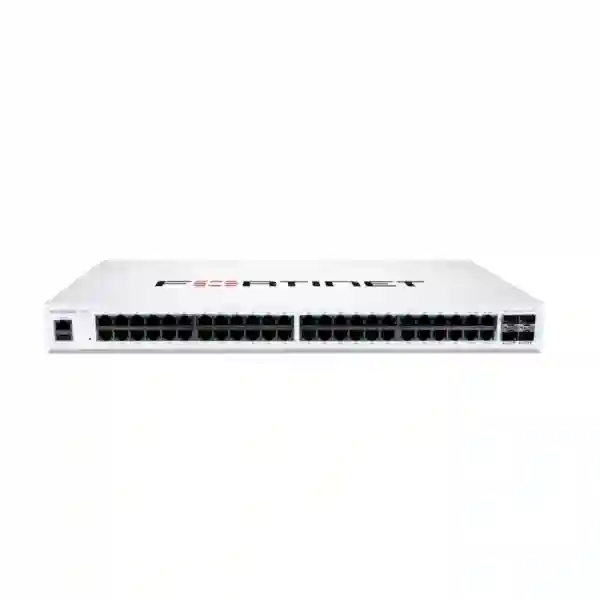
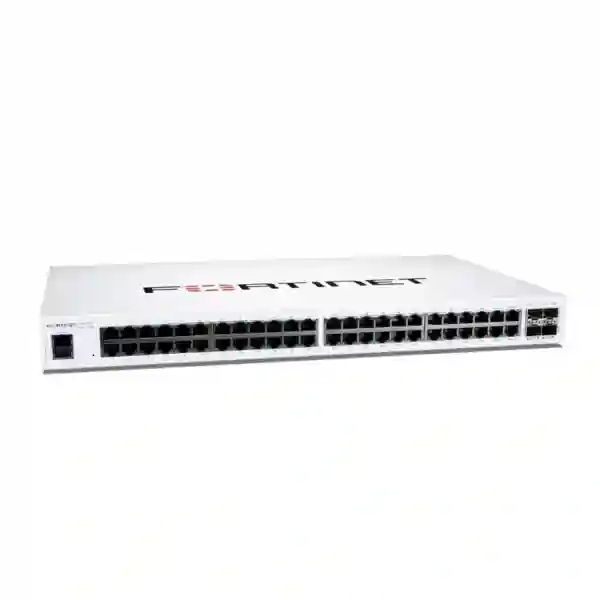
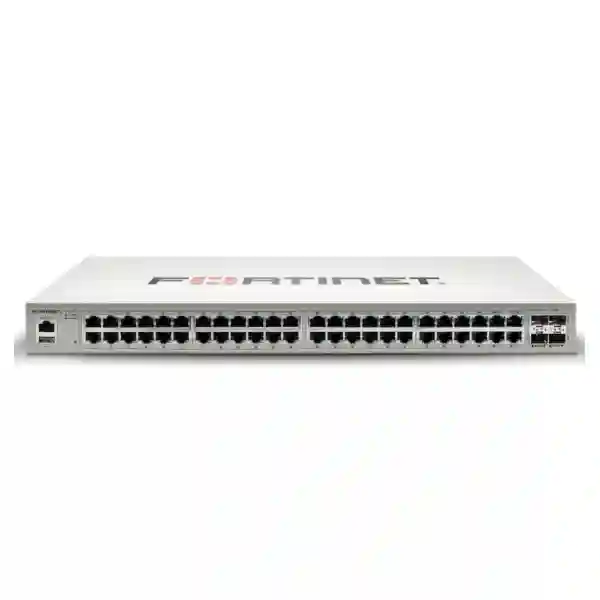
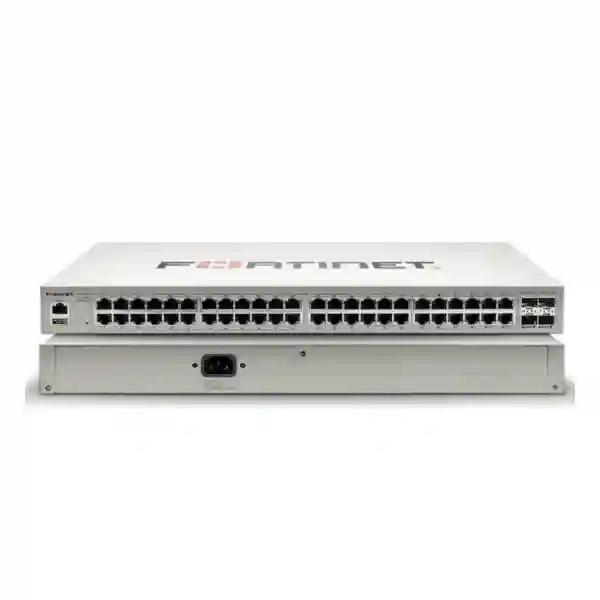
FortiSwitch FS-148F is a high-density 1RU access switch for organizations that need 48 Gigabit Ethernet copper connections, four 10GE SFP+ uplinks and centralized Fortinet network control. Fortinet specifies 176 Gbps switching capacity, 260 Mpps forwarding, a 32K MAC address table, support for up to 4K VLANs and FortiLink integration with FortiGate. The base FS-148F is the non-PoE model; buyers who need switch-powered phones, cameras or access points should evaluate the separate FS-148F-POE or FS-148F-FPOE variants rather than assuming PoE is included.
RJ45 access ports for wired business endpoints.
SFP+ uplinks for aggregation, servers or backbone connectivity.
Official duplex switching capacity for the FS-148F.
Official duplex packet forwarding specification.
FortiSwitch FS-148F Overview
The FS-148F addresses a common enterprise and branch requirement: providing many wired access ports without limiting the network to 1 Gigabit uplinks. Forty-eight copper ports can serve desktops, printers, servers, controllers and other Ethernet devices, while four 10 Gigabit SFP+ interfaces provide faster paths toward aggregation switches, firewalls, servers or fiber backbones. This combination makes the switch relevant for dense office floors, schools, clinics, hotels, warehouses, professional-service firms and multi-department business sites where port count and uplink capacity both matter.
Fortinet positions FortiSwitch as secure access infrastructure that can integrate with FortiGate through FortiLink. In an appropriate Fortinet architecture, network and security teams can coordinate access-layer management with the firewall instead of treating the switch as an unrelated device. The FS-148F can also operate in non-FortiLink deployments through its supported management methods. Procurement teams should therefore evaluate both the hardware requirement and the intended management architecture before ordering.
Verified FS-148F Technical Highlights
| Network interfaces | 48 × GE RJ45 + 4 × 10GE SFP+ |
| Console | 1 × RJ45 serial console |
| Form factor | 1RU rack mount |
| PoE on base FS-148F | No |
| Switching capacity | 176 Gbps |
| Packets per second | 260 Mpps |
| MAC addresses | 32K |
| VLANs | 4K |
| Memory / flash | 512 MB DDR3 / 64 MB |
| Dimensions | 44 × 260 × 440 mm |
| Weight | 3.46 kg |
| Operating range | 0°C to 45°C; 10%–90% non-condensing humidity |
Planning the FS-148F in a Business Network
A 48-port switch should be selected from a port and topology plan rather than simply from the current device count. Reserve capacity for growth, patch-panel changes, additional users and infrastructure endpoints. Decide whether the four 10GE SFP+ ports will be used for redundant uplinks, separate server links, switch aggregation or a combination. Confirm transceiver and fiber requirements for every optical connection. Where multiple VLANs are required, document user, voice, wireless, camera, server, guest and management networks before deployment so policies remain understandable.
Because the base FS-148F does not provide PoE, it is particularly suitable where connected endpoints have independent power or where PoE is supplied by other access switches or injectors. If the project includes many IP phones, wireless access points or cameras, compare the PoE variants before purchase. Selecting the wrong variant can create unnecessary external power requirements. FourTeck Tanzania can help buyers review port count, PoE demand, uplink speed, rack space, cabling and FortiGate integration before preparing a quotation.
FortiSwitch FS-148F Tanzania
For Tanzania organizations, the FS-148F is relevant when a site needs a dense managed access layer with enough ports for a full office floor, department, lab, classroom block, server-room edge or branch consolidation point. The procurement discussion should begin with an inventory of connected devices and the network services they use. Forty-eight Gigabit ports provide substantial endpoint density, but the design still needs to account for spare capacity, uplink utilization and whether endpoints require PoE. The base FS-148F has no PoE, so a Tanzania buyer planning IP phones, cameras or access points should quantify those powered devices before deciding between the base model and the separate PoE variants.
The four 10GE SFP+ interfaces are important for sites that do not want a 1 Gigabit uplink to become the bottleneck for dozens of access ports. A business can plan fiber or compatible high-speed links toward aggregation, a FortiGate environment, servers or another switching layer. VLAN planning can separate departments, guests, infrastructure and management traffic, while FortiLink can simplify operations when the switch is deployed with a compatible FortiGate. For standalone requirements, teams can still plan conventional switch management and network controls.
Tanzania deployments should also review rack depth, airflow, UPS capacity, patching, labeling and environmental conditions. Fortinet specifies operation from 0°C to 45°C, so equipment rooms need appropriate ventilation and temperature control. Before requesting a quote, provide the quantity of FS-148F units, current firewall or core switch, desired uplink media, VLAN count, rack arrangement and growth expectations. See FourTeck Tanzania’s integrated IT and networking solutions for related infrastructure planning.
FortiSwitch FS-148F Dar es Salaam
Dar es Salaam businesses often need access switching for headquarters, commercial offices, hospitality properties, warehouses, professional services and multi-floor workplaces. In these environments, the FS-148F can act as a 48-port managed access switch where endpoints are powered separately and where high-speed uplinks are needed toward the rest of the network. A practical design starts by mapping desks, printers, servers, controllers and other wired devices to patch-panel ports. Leave room for expansion rather than consuming all 48 ports on day one, especially in offices where teams, meeting rooms or security systems may grow.
For a building with several floors or wiring closets, the four 10GE SFP+ interfaces can support higher-capacity inter-switch or aggregation paths, subject to the chosen topology and compatible optics. Network teams should document VLAN IDs, trunk links, spanning-tree design and any link aggregation before installation. Where FortiGate is already the security gateway, FortiLink can make the FortiSwitch part of a more unified Fortinet management model. This is useful when administrators want access policy and network operations to be coordinated rather than split across unrelated interfaces.
The purchasing checklist for Dar es Salaam should include switch quantity, rack space, patch panels, fiber type, SFP+ modules, UPS runtime, firewall compatibility and whether any endpoint needs PoE. The base FS-148F should not be ordered for a powered-edge requirement without a separate power plan. For project discussions, use the verified FourTeck Tanzania contact page and include existing equipment and expected device count so the quotation can reflect the complete switching requirement.
FortiSwitch FS-148F Mwanza
Mwanza organizations evaluating the FS-148F may be replacing unmanaged switches, consolidating several smaller access switches or building a new structured LAN. The advantage of starting with a managed 48-port platform is not merely the port count; it is the ability to plan the access layer around segmentation, uplink capacity and operational visibility. The FS-148F provides 48 Gigabit copper interfaces and four 10GE SFP+ ports, allowing the local access layer to connect many wired endpoints while preserving faster paths to upstream infrastructure.
A good Mwanza deployment should distinguish endpoint demand from backbone demand. User desktops may require only Gigabit access, while traffic from many users converging on file servers, internet gateways or shared applications can justify 10 Gigabit uplinks. If the building has separate communications rooms, fiber uplinks may also help with distance and electrical isolation. Confirm fiber type, connector format and compatible transceivers before procurement rather than treating optics as an afterthought. The switch is rack-mounted, so cabinet dimensions, airflow, patching and power protection should be part of the bill of materials.
Where a FortiGate is present, FortiLink integration can reduce management fragmentation and help align the wired access network with Fortinet security architecture. If no FortiGate is planned, the switch can still serve a conventional managed LAN role. Buyers should also remember that FS-148F is non-PoE. Schools, clinics, hotels and offices with many powered endpoints should calculate PoE needs separately and compare the FS-148F-POE or FPOE variants where appropriate. FourTeck can help turn the site inventory into a clearer quotation and deployment scope.
FortiSwitch FS-148F Arusha
Arusha buyers may consider the FS-148F for business offices, tourism and hospitality operations, education environments, NGOs, professional organizations and distributed branch networks. In each case, the correct decision depends on how many wired endpoints must be connected and how traffic moves beyond the access switch. Forty-eight Gigabit ports can reduce the need to scatter multiple small switches around a site, while four 10GE SFP+ interfaces provide flexibility for backbone and aggregation connections.
For hospitality or campus-style networks, segmentation deserves attention before equipment arrives. Staff systems, guest services, operational devices and management traffic may need different VLANs and access policies. The FS-148F supports large VLAN scale, but a clean design should use only the segments the business can document and operate. If the site already uses FortiGate, FortiLink can provide centralized control of compatible FortiSwitch infrastructure and can simplify the relationship between security policy and the wired network. That integration should be planned with firmware compatibility, topology and administrative responsibilities in mind.
Power requirements are another selection checkpoint. The standard FS-148F does not deliver PoE to access ports. A project involving IP phones, wireless APs or IP cameras should not assume those devices can be powered directly from this model. Buyers should identify every PoE endpoint and its power requirement, then compare the dedicated PoE variants if needed. Rack ventilation is also important because Fortinet specifies a 0°C to 45°C operating range. For broader infrastructure work, FourTeck Tanzania can coordinate switching with cabling, firewall, Wi-Fi, rack and UPS planning rather than treating the switch as an isolated purchase.
FortiSwitch FS-148F Dodoma
Dodoma organizations planning office expansions, institutional networks, administrative sites or new buildings can use the FS-148F as a dense managed access switch where 48 copper ports are appropriate. New projects benefit from designing the logical and physical network together. The patch-panel layout should correspond to room and outlet labeling, VLANs should correspond to business functions, and uplinks should be selected for expected aggregate traffic rather than only present-day utilization. The four 10GE SFP+ interfaces give the FS-148F room for higher-speed connectivity to an aggregation layer or key infrastructure.
A procurement specification should state whether the switch will be managed through FortiGate/FortiLink or as a standalone managed device, because that affects the deployment workflow and operational ownership. It should also identify any redundancy requirements, link aggregation, fiber distances, SFP+ optics, rack dimensions and UPS expectations. The FS-148F supports 32K MAC addresses and up to 4K VLANs according to Fortinet, but practical designs should remain as simple as the business requirement permits. Complexity without documentation can make troubleshooting harder.
The base model’s lack of PoE is especially important during tender or quotation preparation. If the project scope includes IP telephony, Wi-Fi or surveillance, determine whether those systems use separate PoE switches, local power adapters or a FortiSwitch PoE variant. That single distinction can change the bill of materials significantly. FourTeck Tanzania’s networking approach also considers structured cabling, racks and power protection, helping Dodoma buyers prepare a complete requirement rather than discovering missing accessories during installation.
FortiSwitch FS-148F UAE
UAE organizations evaluating the FS-148F often have established rack, structured-cabling and firewall environments, making compatibility and lifecycle planning central to procurement. The switch offers 48 Gigabit RJ45 ports and four 10GE SFP+ uplinks in 1RU, which can fit branch offices, corporate floors and access closets that need high port density without PoE. The four high-speed interfaces allow architects to avoid forcing all access traffic through a single Gigabit uplink, although the final topology should be based on application flows, redundancy and upstream equipment.
In Fortinet-centered networks, FortiLink provides a path to manage FortiSwitch through compatible FortiGate infrastructure. That can be useful for organizations standardizing branch configurations or seeking closer coordination between access networking and security policy. Buyers should still verify the intended FortiOS/FortiSwitch compatibility and deployment design as part of implementation. For standalone environments, the switch supports conventional management methods and can be integrated into a broader multi-vendor LAN.
The procurement team should specify whether optical uplinks require multimode or single-mode fiber, the transceiver reach, rack airflow, power source and support term. If phones, cameras or APs require switch power, compare the separate PoE variants because the base FS-148F provides no PoE. UAE buyers can also review FourTeck UAE IT and networking solutions when the switching requirement is part of a wider firewall, Wi-Fi, cabling or infrastructure project.
FortiSwitch FS-148F Uganda
Uganda businesses can use the FS-148F where a branch, campus, office or operations site requires a substantial number of wired ports and a managed network foundation. The model’s 48 Gigabit copper interfaces are suited to endpoint access, while four 10GE SFP+ ports can be allocated to upstream switches, fiber backbone connections or other high-capacity links. Before purchase, the organization should create a port schedule that identifies active endpoints, spare ports and any equipment that may be added during the expected service life.
FortiLink is particularly relevant when a compatible FortiGate already protects the site. Integrating switching and firewall management can reduce the number of independent systems administrators must maintain and can help extend policy visibility into the access network. This should not replace good network documentation: VLANs, trunks, IP plans, port descriptions, fiber paths and administrator roles should still be recorded. For sites with several branches, consistent naming and templates can make support easier.
Uganda procurement teams should explicitly distinguish FS-148F from FS-148F-POE and FS-148F-FPOE. The standard model does not power Ethernet endpoints. If cameras, access points and phones form a large share of the port count, calculate their PoE demand before selecting hardware. Also include compatible SFP+ modules, rack accessories, UPS protection and patching in the quotation request. For regional assistance, FourTeck Uganda provides related Fortinet and business networking context.
FortiSwitch FS-148F Kampala
Kampala offices, hotels, schools, clinics, financial services and commercial facilities may need a switch that can concentrate many wired endpoints in one rack while maintaining faster uplinks to the network core. The FS-148F fits that access-layer pattern with 48 Gigabit RJ45 ports and four 10GE SFP+ interfaces. It is best evaluated as part of a topology: identify which devices remain on copper access, where traffic is aggregated, whether servers are local, and how internet and inter-VLAN traffic reaches the firewall.
A busy Kampala office can have cloud applications, file transfers, voice, Wi-Fi and security systems sharing the same physical infrastructure. VLAN separation and suitable uplink capacity help prevent the LAN from becoming an unmanaged flat network. FortiLink can make the FS-148F a logical extension of a compatible FortiGate, giving Fortinet-focused teams a more unified operational model. Organizations that do not use FortiGate can still deploy the switch in a standard managed-switch role.
For quotation accuracy, provide the expected number of connected endpoints, existing FortiGate or core-switch model, desired uplink speed, fiber distance, rack location and support requirements. Confirm power strategy for endpoints because the FS-148F itself is non-PoE. If the network includes many phones, cameras or APs, a PoE variant may reduce separate power infrastructure. Planning these details before procurement avoids a common problem: buying enough data ports but not enough endpoint power or backbone capacity.
FortiSwitch FS-148F Arua
Arua sites considering the FS-148F may value consolidation and manageability, particularly when replacing a collection of small unmanaged switches. A single 48-port managed platform can make port assignments, VLANs and uplinks easier to document, provided the physical cabling is organized. The FS-148F’s four 10GE SFP+ ports are useful when the access switch needs a higher-capacity connection to another rack, a server environment or an upstream aggregation layer. Fiber can also be appropriate where distance or building layout makes copper uplinks unsuitable.
Reliability planning should include more than the switch specification. Rack ventilation, clean power, UPS runtime, cable labeling and spare transceivers can all affect operational continuity. Fortinet specifies the base model for 0°C to 45°C operation and 10% to 90% non-condensing humidity. Equipment rooms should therefore be assessed for heat and airflow rather than assuming any enclosed cabinet is acceptable. The side-to-back airflow path should not be obstructed.
If the Arua deployment is part of a Fortinet security architecture, FortiLink can connect access switching management with a compatible FortiGate. If not, standalone management remains possible. The most important procurement distinction is that FS-148F is not a PoE switch. Identify powered devices before ordering and choose the appropriate variant or separate PoE infrastructure. A complete request should include switch count, optics, fiber, rack accessories, patching and configuration scope so the solution arrives ready for a coherent deployment.
FortiSwitch FS-148F Mbarara
Mbarara businesses planning a structured LAN can evaluate the FS-148F for medium-density and high-density access requirements where 48 Gigabit connections are useful. A switch of this size is often deployed in a communications rack serving a floor, building zone or branch office. Rather than connecting endpoints randomly, administrators should map ports to patch-panel outlets, apply descriptive port names and document VLAN membership. This makes moves, additions and troubleshooting much faster over the life of the network.
The FS-148F’s four 10GE SFP+ interfaces can be used strategically for backbone connectivity. For example, a site may allocate links to aggregation and server infrastructure or use link aggregation where supported by the overall design. The exact arrangement depends on redundancy goals and traffic patterns. Fortinet reports 176 Gbps switching capacity and 260 Mpps forwarding, providing a useful hardware foundation, but real-world performance also depends on topology, configuration and connected systems.
Where a FortiGate is already installed, FortiLink integration can centralize FortiSwitch control and align network access with the broader Fortinet Security Fabric approach. Mbarara buyers should also confirm whether endpoint power is required. The standard FS-148F offers zero PoE ports, so a network dominated by IP phones, cameras or wireless APs may be better served by the appropriate PoE variant. Include UPS, rack, patching, optics and configuration needs in the request for quotation to avoid incomplete procurement.
FortiSwitch FS-148F Gulu
Gulu organizations can consider the FS-148F when they need a centrally managed wired access layer with room for many users or devices. The 48 Gigabit ports provide a practical density for offices, education, healthcare, hospitality and institutional sites, while the four 10GE SFP+ interfaces allow faster upstream connectivity. When the site has multiple network cabinets, planners should decide whether the FS-148F is an access switch in each closet or whether a different aggregation architecture is more appropriate.
The network should be designed around business services. User traffic, administration, guest access, servers and infrastructure can be separated logically with VLANs, with routing and security policies applied at the appropriate layer. If a compatible FortiGate is used, FortiLink can simplify centralized management of the switch. This is particularly helpful when administrators want a consistent interface across security and access networking, though careful documentation and change control remain essential.
For Gulu procurement, verify the physical environment as carefully as the logical design. The switch is 1RU and 440 mm wide, with a depth of 260 mm, so rack compatibility is straightforward in many standard cabinets but should still be confirmed. Provide clean protected power and maintain suitable cooling. Because the base model does not support PoE, powered endpoints need another solution. Compare PoE variants before ordering if phones, cameras or access points will occupy many ports. A detailed bill of materials should also include optics, fiber patch cords and any required rack or cable-management components.
FortiSwitch FS-148F Kenya
Kenya buyers searching for a 48-port Fortinet switch often need a balance between endpoint density, faster uplinks and integration with existing FortiGate security. The FS-148F provides 48 Gigabit RJ45 ports and four 10GE SFP+ interfaces in a compact 1RU chassis. It is suitable where connected devices do not require switch-delivered PoE, or where PoE is handled elsewhere. Businesses with large IP-phone, Wi-Fi or camera deployments should compare the dedicated PoE variants before finalizing a purchase.
For Nairobi, Mombasa and other business locations, topology planning should consider whether the switch connects directly to a firewall, an aggregation layer or another access switch. Four 10GE uplinks provide flexibility, but the correct optics and fiber type must match distance and upstream interfaces. Administrators should also decide how VLANs, spanning tree, link aggregation and management access will be standardized. When a compatible FortiGate is present, FortiLink can bring FortiSwitch into centralized Fortinet management.
Procurement should cover more than the chassis. Ask for compatible transceivers, patch leads, rack accessories, support, UPS capacity and configuration scope where required. Fortinet lists 176 Gbps switching capacity, 260 Mpps forwarding, 32K MAC entries and 4K VLAN support for the model. Buyers can review FourTeck Kenya for regional Fortinet and networking guidance, especially when the switch is being purchased alongside FortiGate, Wi-Fi or structured LAN infrastructure.
FortiSwitch FS-148F Kuwait
Kuwait organizations deploying the FS-148F can use it as a high-density access switch for office, branch and institutional networks that need 48 Gigabit copper ports without PoE. The four 10GE SFP+ uplinks are useful for connecting the access layer to aggregation, server or backbone infrastructure at higher speed. In a new installation, planners should map every copper port to a business function and reserve capacity for future additions rather than designing to exactly 48 current devices.
Equipment-room conditions are especially important in warm climates. Fortinet specifies an operating temperature of 0°C to 45°C and side-to-back airflow for the FS-148F. Rack ventilation, cooling and unobstructed airflow should therefore be part of the installation plan. Power should be protected appropriately, and the switch’s built-in AC supply should be considered in the UPS load calculation along with firewall, routers, servers and other rack equipment.
If the network uses FortiGate, FortiLink can centralize FortiSwitch management and help coordinate access networking with security policy. If the environment is multi-vendor, the FS-148F can still be planned as a managed switch using its supported standalone methods. The base model has no PoE, so projects with phones, cameras and access points should calculate power needs before procurement. Include optics, fiber, patching and support requirements in the quotation to ensure the purchased system matches the deployment rather than only the switch model.
FortiSwitch FS-148F Ghana
Ghana businesses evaluating Fortinet switching may choose the FS-148F when they need a 48-port access layer and want the option of integrating switch management with a compatible FortiGate. The model supplies 48 Gigabit RJ45 interfaces and four 10GE SFP+ ports, giving administrators a clear separation between endpoint access and higher-speed upstream connectivity. It is a non-PoE model, making it most suitable when connected devices have independent power or when powered endpoints are served by separate PoE infrastructure.
For office and campus networks, the buying process should include a traffic and topology review. Identify server locations, internet gateway paths, inter-building links and the number of VLANs required. The four SFP+ ports can support fiber uplinks, but transceiver selection must match fiber type and distance. If redundancy is required, decide how links will be distributed and whether link aggregation is part of the design. Fortinet’s 176 Gbps switching and 260 Mpps forwarding specifications describe the platform capability, while the network architecture determines how effectively that capacity is used.
Ghana procurement teams should also include rack, UPS, cooling, patch panels and labeling in project planning. FortiLink can reduce operational fragmentation in Fortinet-centered networks, while standalone management supports other designs. For broader regional requirements, FourTeck Ghana provides related IT infrastructure context. When requesting a quote, specify switch quantity, optics, support term, FortiGate model if applicable and any configuration or installation assistance required.
FortiSwitch FS-148F Nigeria
Nigeria organizations with dense office, branch, education, healthcare, hospitality or commercial networks can evaluate the FS-148F for managed Gigabit access. Forty-eight RJ45 ports can serve a substantial endpoint population from one rack unit, while four 10GE SFP+ ports provide higher-speed paths to the rest of the infrastructure. The design should avoid treating all ports as equivalent: user access, servers, trunks and management links should be assigned intentionally and documented.
For multi-floor or multi-building environments, fiber uplinks may be appropriate between communications rooms. Confirm the required reach, fiber standard and compatible SFP+ transceivers before ordering. VLANs can separate business functions and reduce the risks of a flat network, while FortiLink can centralize switch control when the FS-148F is paired with a compatible FortiGate. Organizations operating several sites can benefit from repeatable configuration standards, naming conventions and documentation so branch networks are easier to support.
The standard FS-148F is not a PoE switch. This matters for Nigerian projects involving CCTV, wireless access points or IP telephony because those devices frequently expect power from the access layer. Compare FS-148F-POE and FS-148F-FPOE if PoE is required, and size the power budget against actual endpoint demand. The project bill should also account for UPS, cooling, rack space and cabling. FourTeck Nigeria can provide regional context for integrated networking and security requirements.
FortiSwitch FS-148F Seychelles
Seychelles organizations in hospitality, professional services, education, government-related operations and distributed businesses may need a compact but high-density access switch for offices, back-of-house systems and communications rooms. The FS-148F offers 48 Gigabit Ethernet access ports in 1RU and four 10GE SFP+ interfaces for faster uplinks. For properties with separate buildings or distant network rooms, fiber uplinks can be especially useful, provided the optics and cabling are selected for the actual distance and environment.
Network planning should consider service separation. Guest systems, staff devices, operational platforms, management interfaces and server resources may require different VLANs and security policies. A compatible FortiGate can manage FortiSwitch through FortiLink, creating a more unified Fortinet architecture. Where the switch is used independently, administrators should still apply disciplined access control, management security, backups and configuration documentation. High port density is most valuable when the network remains understandable after future changes.
For procurement, verify rack dimensions, ventilation, UPS protection, fiber accessories and endpoint power. The FS-148F base model does not provide PoE, so a hospitality or surveillance-heavy site with many APs, phones or cameras should assess the PoE variants. Fortinet specifies operation up to 45°C, making equipment-room cooling and airflow important. A quotation request should include the site count, switch quantity, desired uplink architecture, current firewall, optical distances and support expectations so the hardware selection reflects the complete project.
FS-148F vs PoE Variants
The FS-148F, FS-148F-POE and FS-148F-FPOE share the same 48 Gigabit access-port count, four 10GE SFP+ uplinks, 176 Gbps switching capacity and 260 Mpps forwarding specification, but their power-delivery capabilities differ. The FS-148F has no PoE. The FS-148F-POE provides PoE on 24 ports with a 370 W PoE budget, while the FS-148F-FPOE provides PoE on all 48 ports with a 740 W budget. Choose the base model when endpoint power is not required; choose a PoE variant only after calculating the number and power class of phones, cameras, APs or other powered devices.
Related FourTeck Network Resources
A switch normally sits inside a larger architecture. FourTeck Tanzania covers managed switching, firewall, Wi-Fi, structured cabling, racks and integrated IT infrastructure from its Tanzania technology solutions. Regional organizations can also review FourTeck Kenya networking and Fortinet solutions, FourTeck Uganda business networking, FourTeck Ghana IT infrastructure, and FourTeck Nigeria IT services. These regional resources are useful when a project spans more than one country or when switching is being coordinated with FortiGate and other infrastructure.
FortiSwitch FS-148F FAQ
How many ports does the FS-148F have?
It has 48 Gigabit Ethernet RJ45 access ports plus four 10GE SFP+ interfaces and one RJ45 serial console port.
Does FortiSwitch FS-148F support PoE?
No. The base FS-148F has no PoE ports. Fortinet offers separate FS-148F-POE and FS-148F-FPOE variants for powered endpoint requirements.
What is the switching capacity?
Fortinet specifies 176 Gbps duplex switching capacity and 260 Mpps duplex packet forwarding for the FS-148F.
Can FS-148F be managed through FortiGate?
Yes. FortiLink integration allows compatible FortiSwitch devices to be managed as part of a FortiGate-centered architecture. Compatibility and topology should be checked for the intended FortiOS and FortiSwitch deployment.
What should I include in a quotation request?
Provide switch quantity, site, existing firewall or core switch, number of connected devices, PoE requirements, desired uplink speed, fiber distances, VLAN needs, rack and UPS requirements, support term and whether configuration or installation assistance is required.
Quotation Checklist
Confirm exact model and quantity; count current and future access ports; identify every PoE endpoint; document current FortiGate or upstream switch; define SFP+ uplink speed and fiber distance; specify VLANs; confirm rack space, cooling and UPS; select support requirements; and state whether deployment, configuration or migration assistance is needed.
Decision Recap
Choose FS-148F when you need 48 non-PoE Gigabit access ports, four 10GE SFP+ uplinks and Fortinet-compatible managed switching in 1RU. If endpoints require switch power, evaluate the PoE variants. If the site has fewer ports, different uplink requirements or specialized redundancy needs, compare other FortiSwitch models before ordering.
Consult FourTeck Tanzania
A useful FS-148F discussion should cover the whole access layer rather than only the chassis. Share the device count, existing FortiGate or firewall, uplink topology, PoE requirement, fiber distances, rack environment and expansion plan. FourTeck can then help clarify whether FS-148F is the correct variant and what optics, cabling, power protection and configuration work should be included. Request a current quotation and availability confirmation before procurement.




Reviews
There are no reviews yet.