
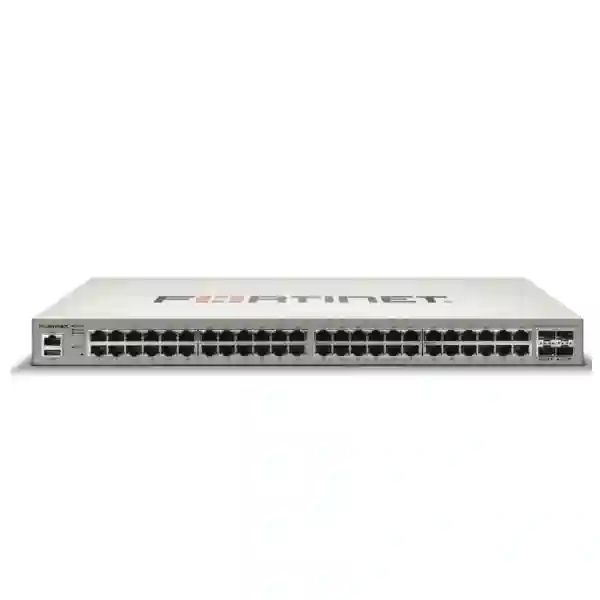
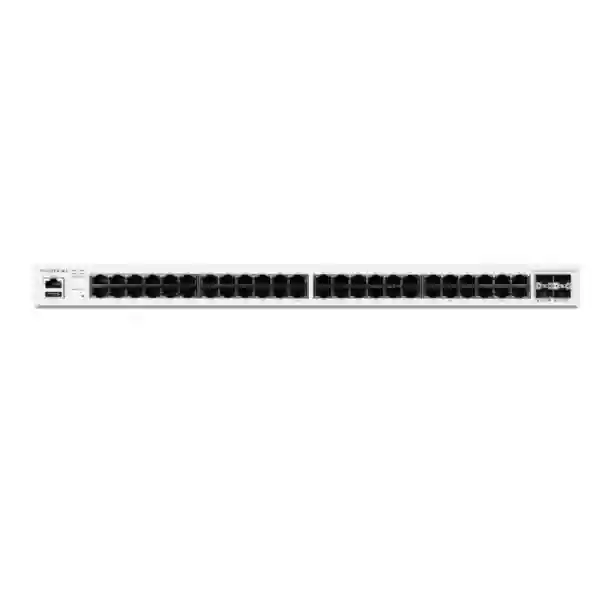
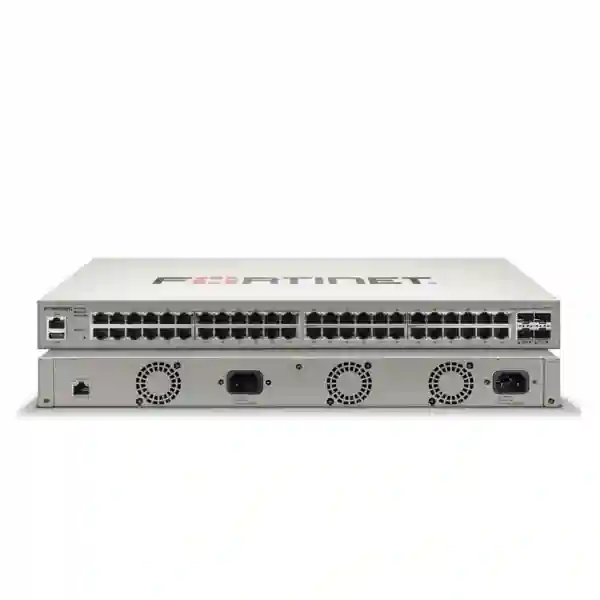
FortiSwitch FS-448E-POE Tanzania
The FortiSwitch FS-448E-POE is a secure campus access switch for organizations that need a large number of Gigabit Ethernet connections, Power over Ethernet for selected endpoints, resilient uplink options and close integration with the Fortinet ecosystem. For Tanzanian enterprises, schools, healthcare organizations, hospitality environments, public-sector networks and multi-site businesses, the model provides a practical platform for consolidating user, voice, wireless and surveillance connectivity on a managed switching layer. Buyers evaluating the FS-448E-POE should plan not only for port count, but also for PoE demand, uplink capacity, VLAN design, redundancy, rack power, transceivers, software compatibility and the management architecture that will be used across the wider network.
Verified Product Positioning
Fortinet places the FS-448E family in its secure campus switching portfolio. The FS-448E-POE is identified in Fortinet ordering information as a 48-port model with PoE available on 24 ports. That makes it particularly relevant where a network needs many wired access connections but only part of the endpoint population requires power from the switch.
PoE Planning
Power over Ethernet can simplify installation for devices such as wireless access points, IP cameras and VoIP phones because power and data can share the Ethernet connection. Actual project design should still calculate device power requirements, port allocation, switch power budget, UPS capacity and growth headroom before procurement.
FortiSwitch FS-448E-POE Overview
The FS-448E-POE is designed for access-layer and campus deployments where network administrators need a manageable combination of port density, PoE capability and Fortinet integration. Its 48 Gigabit Ethernet access ports support dense user and device connectivity, while the model’s PoE capability is available on 24 ports according to Fortinet’s ordering guide. The platform also belongs to a product family that supports Layer 2 and Layer 3 switching functions and can participate in Fortinet-managed network architectures.
A sensible deployment begins with endpoint classification. Desktops, printers and many fixed appliances may need data only, while access points, IP phones and cameras often need PoE. Mapping those requirements to the 24 PoE-capable ports helps determine whether FS-448E-POE is the right fit or whether a full-PoE alternative is more appropriate. Network designers should also account for uplink design, fiber type, switch stacking or aggregation strategy where applicable, and the FortiSwitchOS version required for planned features.
Fortinet documentation for current supported software trains includes FS-448E-POE among supported 4xxE models. Fortinet also documents model-specific capabilities such as configurable PoE priority and Precision Time Protocol support in supported releases. These features can matter in environments where powered endpoints need controlled prioritization or where accurate network timing is important. Software release notes and the current FortiSwitch feature matrix should always be checked during implementation because available behavior can vary by software version.
Key Business Benefits
Dense Access Connectivity
Forty-eight Gigabit access ports make the switch suitable for floors, departments and equipment rooms with a substantial concentration of Ethernet-connected devices.
Selective PoE
Twenty-four PoE-capable ports can support projects where only part of the access layer needs switch-supplied power, helping teams align switch selection with the actual endpoint mix.
Fortinet Integration
Organizations already using FortiGate and other Fortinet technologies can evaluate FortiSwitch as part of a more integrated operational and security architecture.
Technical and Deployment Guidance
For a production design, start with a port schedule rather than simply counting users. Record every desktop, phone, access point, camera, printer, server-management interface, building-control endpoint and spare connection. Mark which endpoints require PoE and their expected power class. This creates a more reliable basis for choosing between the FS-448E-POE and another FortiSwitch variant. It also prevents the common problem of having enough physical ports but insufficient powered ports in the areas that need them.
VLAN planning should separate traffic according to business and security requirements. Typical projects may isolate corporate users, voice, guest wireless, cameras, building systems and management traffic. The exact segmentation policy should be determined by the organization’s security architecture. When FortiSwitch is deployed with FortiGate management, teams can evaluate FortiLink-based operation and the relevant FortiOS/FortiSwitchOS compatibility guidance before upgrades or rollout.
PoE configuration can include priority settings so more important powered endpoints receive preference when power availability is constrained. Fortinet documentation identifies critical, high, medium and low priority behavior for managed switches and specifically includes FS-448E-POE among models supporting medium priority in documented software versions. Administrators should validate the exact software release and feature matrix used in their environment before relying on a specific setting.
Compatibility, Integration and Management
The value of a campus switch is strongly influenced by how it will be managed. FortiSwitch can be used in Fortinet-centric architectures, and Fortinet documentation provides separate guidance for FortiGate-managed switching, standalone FortiSwitchOS operation and other supported management approaches. The correct choice depends on network size, security design, operational model and existing Fortinet investment.
Before ordering optics or cabling, confirm the required uplink interfaces, transceiver specifications and fiber plant. Do not assume that an existing optic is compatible simply because its connector fits. Check the current Fortinet compatibility documentation and project-specific distance, fiber type and speed requirements. The same discipline applies to software: confirm the supported FortiOS and FortiSwitchOS combination before integrating a new switch into an existing managed fabric.
For broader security architecture planning, visit FourTeck Tanzania for related infrastructure solutions, FourTeck Fortinet solutions for Fortinet-focused information, FourTeck Uganda for regional procurement context, and FourTeck Kenya for East African infrastructure enquiries. These resources can help procurement teams coordinate related switching, firewall and network requirements across multiple markets.
FortiSwitch FS-448E-POE Tanzania
Organizations sourcing the FortiSwitch FS-448E-POE in Tanzania should begin by defining the network role the switch will perform. A headquarters floor may prioritize dense user access, IP telephony and wireless access points, while a hotel may combine staff devices, guest wireless infrastructure, cameras and operational systems. A school or university may need segmented academic, administration, laboratory and wireless networks. The same switch can serve different roles, but the port, PoE and uplink plan should be designed around the actual environment rather than a generic bill of materials.
For Tanzanian procurement, a quotation request is more useful when it includes the number of switches, intended FortiGate integration, expected powered endpoints, required uplink speeds, fiber distances, rack requirements, redundancy expectations and support term. This allows the supplier to distinguish between the base switch requirement and accessories such as transceivers, patching, rack power protection and licensing or support services where applicable. Buyers should also state whether the deployment is a new network or an expansion of an existing Fortinet environment.
Power quality and backup design deserve attention. A PoE access switch can become a power dependency for many edge devices, so UPS sizing should consider both switch consumption and the connected PoE load rather than only the chassis. In sites where wireless, voice or surveillance availability is important, the electrical design should align with the desired service continuity. Environmental conditions, rack ventilation and cable management should also be reviewed during implementation.
For Tanzania-wide deployments, standardizing VLAN templates, port naming, firmware policy and documentation can simplify support across branches. Teams should record serial numbers, software versions, uplink mappings, PoE allocations and device locations. This operational discipline is often as important as the hardware choice itself because it reduces troubleshooting time and makes future expansion more predictable.
FortiSwitch FS-448E-POE Dar es Salaam
Dar es Salaam businesses evaluating FS-448E-POE commonly need switching for offices, hospitality properties, education facilities, warehouses and multi-floor commercial environments. The 48-port access density can suit communications rooms where many endpoints converge, while the 24 PoE-capable ports can be allocated to devices such as wireless access points, IP phones and selected cameras. The first design question should be whether half-PoE port coverage matches the endpoint mix; projects with a much higher proportion of powered devices may need a different PoE strategy.
In a multi-floor building, planners should identify the copper horizontal cabling limits and use suitable fiber uplinks between telecommunications rooms where needed. Uplink redundancy, aggregation and core connectivity should be designed before switch quantities are finalized. Where FortiGate is already present, the organization can assess FortiLink management and consistent segmentation policies across the access layer.
Procurement teams in Dar es Salaam should request a complete equipment schedule rather than only a switch price. Useful details include compatible optics, rack accessories, patching requirements, UPS capacity, support coverage and implementation scope. This helps separate mandatory components from optional enhancements and makes quotations easier to compare on a like-for-like basis.
For growing organizations, spare-port planning matters. Filling all 48 ports on day one leaves little room for new staff, additional access points or new security devices. A practical design keeps sensible capacity for change and documents which ports are reserved for future PoE endpoints. This approach can reduce disruptive recabling and emergency purchases later.
FortiSwitch FS-448E-POE Mwanza
For Mwanza organizations, the FS-448E-POE can be evaluated as an access switch for business campuses, healthcare facilities, educational networks, hotels and distributed commercial operations. A 48-port switch can consolidate many local endpoints into one managed access layer, but design quality depends on understanding what those endpoints are and how much PoE they require. Wireless access points and cameras can consume a meaningful portion of the available PoE capacity, so device-by-device planning is preferable to rough estimates.
Branch and campus deployments should also consider resilience. If one switch supports a large number of phones, access points or cameras, its power and uplink paths become operationally important. UPS design, redundant upstream connectivity where required and clear spare-equipment procedures can reduce the impact of failures. Network teams should document uplink topology and avoid creating accidental single points of failure without understanding the business consequence.
Where the switch is integrated into a Fortinet environment, version compatibility should be reviewed before installation. Firmware should be selected according to supported release guidance rather than upgraded ad hoc. Change windows, configuration backups and rollback planning are especially useful for networks serving critical business operations.
A Mwanza quotation can be made more accurate by providing endpoint counts, required PoE ports, fiber distances, existing firewall model, desired VLANs and expected growth. If the project includes wireless or surveillance, include those device models or at least their power requirements. That information helps determine whether the FS-448E-POE is correctly sized for the planned edge environment.
FortiSwitch FS-448E-POE Arusha
Arusha buyers may consider FS-448E-POE for hotels, tour and travel operations, schools, offices, healthcare sites and other environments where wired access, wireless infrastructure and IP devices share a common campus network. The model’s mix of 48 Gigabit access ports and 24 PoE-capable ports is useful when powered endpoints represent a significant but not universal portion of the device estate.
Hospitality and guest-facing environments should pay particular attention to wireless access-point density and PoE requirements. The switch count should be derived from a wireless design and cabling plan, not simply the number of rooms. Staff networks, guest services, voice and security systems may also require separate VLANs and access policies. When cameras are included, video traffic and recorder connectivity should be considered in uplink sizing.
For sites with remote support requirements, consistent configuration standards can make troubleshooting easier. Port descriptions, VLAN assignments, PoE priorities and uplink labels should be documented. Administrators can use appropriate Fortinet management options to align switching with the broader network architecture, subject to supported software and licensing choices.
Arusha procurement teams should ask for a solution-level quotation that clearly identifies the switch, support term, optics, installation materials and any professional services. They should also distinguish between required and optional items. This prevents a low initial hardware price from obscuring missing components that are necessary to complete the deployment.
FortiSwitch FS-448E-POE Dodoma
In Dodoma, the FS-448E-POE can support structured access networks for government-related environments, enterprises, education, healthcare and expanding office campuses. Buyers should focus on architecture and lifecycle planning: how many endpoints connect today, how many will require PoE, what segmentation is needed, and how the switch will connect to the distribution or core layer.
Networks carrying business systems and voice should be designed with traffic separation and service priorities appropriate to the organization. PoE priority can be useful where some powered devices are more operationally important than others, but the preferred design is to size power capacity with suitable headroom. Fortinet documentation should be checked for the exact supported behavior of the software release chosen for deployment.
For public and institutional procurement, documentation can be as important as the device. A bill of materials should identify model numbers, optics, support requirements and installation scope clearly. Acceptance criteria can include port testing, VLAN verification, uplink checks, PoE endpoint validation, configuration backup and handover documentation. These steps help ensure that procurement results in an operational network rather than simply delivered hardware.
Dodoma projects that will expand to multiple buildings or branches should establish repeatable templates. Standard naming, VLAN conventions, firmware baselines and monitoring practices make future additions easier. The FS-448E-POE can then be evaluated not as an isolated switch but as part of a controlled access-layer design.
FortiSwitch FS-448E-POE UAE
UAE organizations sourcing FS-448E-POE may be building dense office, hospitality, retail, education or mixed-use networks where centralized security and access switching are important. The model can be considered when 48 Gigabit ports are required and approximately half of the access connections need PoE. A detailed endpoint schedule remains essential because a deployment dominated by powered wireless and camera devices may call for a full-PoE alternative or additional switches.
Large commercial environments often require fiber uplinks between floors or buildings. Designers should confirm optic type, speed, fiber medium and distance against current Fortinet compatibility information. Where redundant uplinks or aggregation are required, the topology should be designed alongside the upstream FortiGate, distribution or core platform.
Operational teams should also plan software lifecycle management. A standardized FortiSwitchOS version, tested compatibility with FortiOS where FortiGate management is used, maintenance windows and configuration backups reduce deployment risk. Features such as PTP support can be relevant in specialized timing-sensitive environments, but should be validated against the exact software release and design requirements.
For UAE procurement and related Fortinet enquiries, the FourTeck UAE technology site and Fortinet-focused FourTeck resources can provide regional context. A useful RFQ should include switch quantities, powered endpoint counts, uplink requirements, optics, support term and whether configuration or installation assistance is needed.
FortiSwitch FS-448E-POE Uganda
Ugandan organizations evaluating the FS-448E-POE can use the same structured approach: map endpoints, identify PoE devices, size uplinks and confirm management architecture before purchasing. The switch’s 48 Gigabit access ports can serve a substantial device population, while its 24 PoE-capable ports can power a selected set of phones, access points or cameras.
For multi-branch organizations, standardization can reduce operational complexity. Using consistent VLAN IDs, port descriptions, firmware baselines and configuration templates makes it easier for a central IT team to support remote sites. Where FortiGate is part of the architecture, FortiSwitch integration can be evaluated as part of the wider security and management design rather than treating switching as a separate operational silo.
Power continuity should be planned carefully because a PoE switch may supply several business-critical edge devices. UPS calculations should include both chassis and powered-device demand, with reasonable headroom. Sites should also consider rack cooling, grounding and cable management to protect reliability over the equipment lifecycle.
Uganda procurement teams can consult FourTeck Uganda for related regional technology requirements. Include the existing firewall environment, required support term and project timeline in the RFQ so the solution can be scoped beyond the base switch.
FortiSwitch FS-448E-POE Kampala
Kampala enterprises, schools, hotels, clinics and commercial campuses may use FS-448E-POE at the access layer where many wired endpoints share a communications room. The model is particularly relevant when the network has a mixed population of powered and non-powered devices. Twenty-four PoE-capable ports can be reserved for access points, phones and cameras, while the remaining access ports serve endpoints that have their own power.
In buildings with multiple wiring closets, designers should avoid assuming every closet has the same requirements. One floor may have many wireless access points and phones, while another may mostly serve desktops. A per-closet port and PoE schedule can reveal whether FS-448E-POE fits each location or whether a mixture of switch models is more efficient.
Network segmentation should reflect business risk. Guest access, staff devices, cameras, voice and management interfaces may require distinct VLANs and security policies. Fortinet integration can help organizations build a coordinated architecture, but configuration should follow the organization’s approved security design and supported product documentation.
For procurement, specify optics and fiber requirements early. Missing transceivers are a common reason a switch cannot be commissioned immediately after delivery. A complete Kampala project schedule should also include patch leads, rack space, UPS capacity, labeling and configuration handover.
FortiSwitch FS-448E-POE Arua
Arua deployments may involve branch offices, institutions, hospitality properties, healthcare environments and organizations that need a manageable access network with room for growth. FS-448E-POE offers 48 Gigabit access connections, allowing one switch to consolidate a substantial number of endpoints, while 24 PoE-capable ports can support selected powered devices.
Remote-site reliability often depends on simple, well-documented designs. IT teams should label uplinks, record VLANs, reserve spare ports and keep configuration backups. If the site is managed centrally, remote monitoring and standardized software policies can reduce the need for reactive troubleshooting. The switch should be deployed with a supported software release aligned with the rest of the Fortinet environment.
Electrical planning is especially important where power quality or continuity is a concern. Because PoE devices depend on the switch for power, the UPS must be sized for the expected load. Critical endpoints can also be identified in the port plan so their power and connectivity requirements are understood during maintenance or fault conditions.
An Arua RFQ should include the number of users, phones, access points and cameras, along with fiber distances and upstream equipment. This information makes it easier to confirm whether the 24 powered ports are sufficient and whether additional switches, optics or support services are required.
FortiSwitch FS-448E-POE Mbarara
Mbarara organizations can evaluate FS-448E-POE for office, education, healthcare, hospitality and commercial networks requiring a dense Gigabit access layer. The model is most suitable when its combination of 48 data ports and 24 PoE-capable ports matches the real endpoint mix. Buyers should therefore count powered devices separately from total Ethernet devices.
Wireless projects should use the access-point design to drive switch planning. The number and placement of access points determine both port and PoE demand. Camera systems can add another significant powered-device population, while IP phones may further increase the requirement. A single combined schedule prevents different project teams from unintentionally competing for the same PoE ports.
For business continuity, identify which endpoints must remain operational during short power events and size backup power accordingly. Network teams can also define PoE priorities where supported and appropriate. However, adequate power capacity is preferable to depending on priority behavior as a normal operating condition.
Mbarara procurement should include support and lifecycle considerations. Confirm the desired support term, software policy and responsibility for installation, configuration and handover. This makes total project cost clearer and helps the organization plan ongoing operations after the switch is installed.
FortiSwitch FS-448E-POE Gulu
Gulu businesses and institutions looking for Fortinet switching can consider FS-448E-POE when a site needs many Gigabit access connections plus PoE for a defined subset of endpoints. The switch can form part of a structured access layer supporting staff devices, wireless, voice and surveillance traffic, subject to correct segmentation and capacity planning.
A good design starts with physical infrastructure. Check rack space, patch-panel layout, copper cabling quality, fiber uplinks, ventilation and UPS capacity. These factors can determine deployment success even when the switch itself is correctly selected. Where new cabling is required, test and document links before commissioning network services.
For organizations with limited onsite IT resources, standardized configurations and clear handover documents can simplify support. Port maps, IP addressing, VLAN assignments, administrator access procedures and backup locations should be recorded securely. Central management options can then be evaluated according to the wider Fortinet architecture.
When requesting a Gulu quotation, provide the expected endpoint list and whether the switch will join an existing FortiGate-managed network. Include any requirement for optics, installation and support. This reduces ambiguity and helps avoid incomplete bills of materials.
FortiSwitch FS-448E-POE Kenya
Kenyan enterprises can evaluate FS-448E-POE for branch, campus and commercial access networks where Fortinet integration and mixed PoE requirements are priorities. The 48-port density can support busy wiring closets, while 24 PoE-capable ports serve selected wireless, voice and surveillance endpoints. The model should be compared against full-PoE alternatives when most connected devices require power.
Multi-site Kenyan organizations can benefit from consistent network standards. Defining repeatable VLANs, management conventions, firmware baselines and monitoring practices helps central teams manage branches with less variation. Where FortiGate devices are deployed, the switching design can be coordinated with firewall policy and network segmentation.
High-density offices should also consider uplink utilization. Forty-eight access ports can aggregate substantial traffic, especially where users access cloud applications, local servers or high-throughput wireless networks. The upstream design should be sized according to expected traffic rather than merely matching the minimum connectivity needed to bring the switch online.
For Kenya-related procurement, visit FourTeck Kenya. A complete RFQ should identify switch quantity, powered endpoints, optics, support period, installation scope and existing Fortinet equipment so the solution can be assessed as a whole.
FortiSwitch FS-448E-POE Kuwait
Kuwait organizations considering FS-448E-POE may be planning office, education, hospitality, healthcare or commercial networks with dense Ethernet requirements. The switch provides a useful balance where many endpoints need Gigabit connectivity but only 24 of the 48 access connections need PoE. Endpoint classification is therefore central to model selection.
In high-availability environments, planners should examine upstream redundancy, power protection and maintenance procedures. A switch serving phones, access points and cameras can affect several services simultaneously if it loses power. UPS sizing and network topology should reflect the operational importance of those services.
Environmental and rack planning should not be overlooked. Ensure suitable ventilation, organized patching and service access around the switch. Fiber optics and transceivers should be selected according to Fortinet compatibility guidance and the actual cabling plant. Software compatibility should also be verified before integrating with an existing FortiGate-managed environment.
Kuwait procurement teams should request itemized quotations that distinguish hardware, support, optics and services. This makes competing proposals easier to evaluate and prevents essential accessories from being hidden outside the base switch price.
FortiSwitch FS-448E-POE Ghana
Ghanaian businesses and institutions can consider FS-448E-POE when they need a high-density access switch with Fortinet ecosystem integration and PoE on a defined subset of ports. It can support office users, access points, phones, cameras and other Ethernet devices, provided the 24-port PoE allocation is sufficient for the planned deployment.
For campus projects, planners should divide requirements by wiring closet. Total building endpoint count alone can hide local capacity issues. Each closet should have its own data-port count, PoE count, uplink plan and spare-capacity target. This approach also helps determine whether every location needs the same switch model.
Where business operations depend on powered endpoints, backup power should be sized carefully. The connected PoE load can materially increase the power requirement compared with an unpowered access switch. Organizations should include this load in UPS and electrical planning and maintain enough capacity for reasonable future growth.
Ghana procurement teams can use regional FourTeck resources when coordinating wider network requirements. The RFQ should state whether FortiGate integration is planned, which optics are needed, and whether configuration or installation assistance is part of the project.
FortiSwitch FS-448E-POE Nigeria
Nigerian enterprises with large offices, campuses, hotels, schools or distributed facilities can evaluate FS-448E-POE as part of a secure access architecture. The switch’s dense 48-port access layer can consolidate many wired devices, while 24 PoE-capable ports can be dedicated to powered endpoints. The ratio is particularly suitable where desktops and other self-powered devices remain a large part of the network.
Large sites should pay attention to traffic concentration. A 48-port switch can collect substantial user and wireless traffic, so uplink design should consider application patterns, server access, internet usage and inter-VLAN traffic. Redundancy requirements should be based on business impact and the capabilities of the upstream architecture.
For multi-branch deployments, a standard build document can define firmware, management addresses, VLANs, port profiles, naming conventions and monitoring. This reduces configuration drift and supports more predictable troubleshooting. Fortinet software compatibility should be checked whenever new switches are added to an established environment.
Nigeria procurement should include a complete bill of materials and support requirements. Buyers should avoid comparing quotations that include different optics, service terms or accessories as though they were equivalent. Clear scope improves both technical fit and commercial comparison.
FortiSwitch FS-448E-POE Seychelles
Seychelles organizations in hospitality, professional services, education and other sectors may evaluate FS-448E-POE for sites where wired access, wireless infrastructure, voice and cameras share a managed campus network. The 48-port platform can reduce the number of access switches required in a wiring room, while 24 PoE-capable ports can support selected powered endpoints.
Hospitality environments should coordinate switching with the wireless design. Access-point placement, guest capacity, back-office systems and surveillance can all influence port and PoE demand. If the powered-device count approaches or exceeds 24 in a closet, the design should be reconsidered before purchase rather than relying on later workarounds.
Remote-island logistics make accurate bills of materials especially valuable. Confirm optics, patching, rack accessories and support requirements before shipment. Spare-capacity planning can also reduce the need for urgent expansion purchases. Where uptime is important, consider the appropriate backup power and redundancy design for the site.
A Seychelles quotation request should include network diagrams or at least endpoint and uplink counts. If FortiGate management is planned, provide the firewall model and software environment so compatibility can be reviewed as part of the implementation scope.
Buying and Sizing Checklist
Before ordering FS-448E-POE, confirm the total number of Ethernet endpoints, the number requiring PoE, expected per-device power demand, required spare capacity, uplink speed and redundancy, fiber type and distance, transceiver requirements, rack space, UPS capacity, management method, FortiGate integration, software compatibility, support term and installation scope. If the switch will support voice, wireless or surveillance, include those teams in the design review so their endpoint counts are not missed.
For quotations, provide quantities and site locations, but avoid assuming that every location needs identical hardware. A branch with ten powered devices has different needs from a floor with forty access points and phones. Correct sizing can reduce both under-provisioning and unnecessary cost.
Frequently Asked Questions
How many PoE ports does the FS-448E-POE provide?
Fortinet’s ordering guide identifies the FS-448E-POE as providing PoE on 24 of its 48 access ports. Buyers with more than 24 powered endpoints in one switch location should evaluate their design and consider a different PoE model or additional switching capacity.
Can it power wireless access points and IP phones?
PoE is commonly used for wireless access points, IP phones and cameras. Confirm each endpoint’s standards and power requirements against the switch capabilities and available power budget before deployment.
Can FS-448E-POE be managed with FortiGate?
FortiSwitch platforms support FortiGate-managed architectures through Fortinet’s documented management framework. Check the current FortiOS and FortiSwitchOS compatibility and feature documentation for the exact environment before deployment.
Does the model support PoE priority?
Fortinet documentation lists FS-448E-POE among models supporting configurable PoE priority behavior in documented software releases. Validate the feature matrix for the software version you intend to run.
What information should I provide for a quotation?
Provide switch quantity, site, endpoint count, number and type of PoE devices, uplink requirements, fiber distances, optics, existing FortiGate environment, desired support term and whether installation or configuration assistance is required.
Decision Recap
FS-448E-POE is a strong candidate when a project needs 48 Gigabit access ports, PoE on 24 ports and Fortinet-oriented campus management. The most important sizing question is whether 24 powered ports match the endpoint plan. The most important implementation questions concern uplinks, optics, VLANs, power backup, software compatibility and management architecture.
For a procurement-ready design, prepare an endpoint and PoE schedule before requesting pricing. That single step improves model selection, accessory planning and quotation accuracy across Tanzania and regional deployments.
Consultation and Quotation Preparation
FourTeck can use your project requirements to structure a quotation around the FS-448E-POE and related network components. Share the number of sites, expected user and device counts, PoE endpoints, existing Fortinet products, uplink requirements and support expectations. For larger projects, a basic network diagram or switch schedule can make the discussion more efficient.
The objective is to ensure that the switch, optics, power design and management approach fit the actual deployment rather than treating the hardware as an isolated line item.



Reviews
There are no reviews yet.