
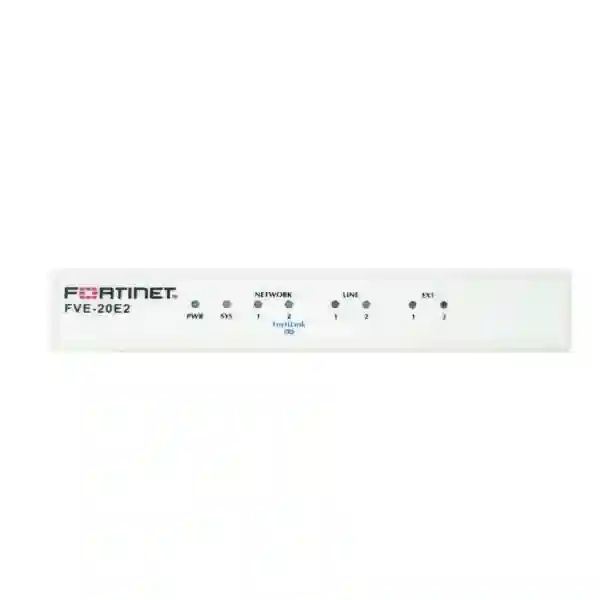
FortiVoice FVE-20E2 Tanzania
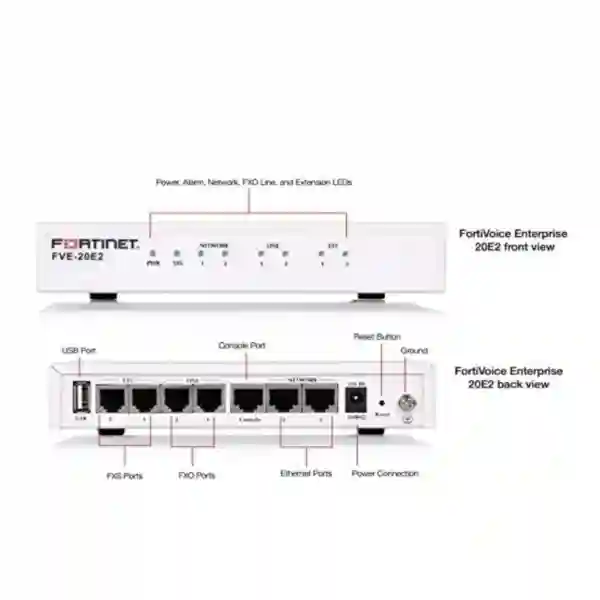
FortiVoice FVE-20E2 is a compact Fortinet business phone-system appliance for organizations that want an on-premises communications platform sized for smaller offices, branches and focused voice deployments. Fortinet specifies capacity for 20 endpoints, four VoIP trunks and ten concurrent calls, with two FXO ports, two FXS ports, two network interfaces and 8 GB of storage. This combination makes the appliance relevant where a business needs both IP telephony and selected analog connectivity without moving immediately to a larger FortiVoice platform. For Tanzania procurement, however, model selection should include a regional-availability check: Fortinet publishes market-specific availability information for its telephony products, and the FVE-20E2 is not shown as generally available for Africa in the referenced global-availability sheet. Buyers should therefore confirm current supply eligibility, telecom requirements, support entitlement and carrier integration before placing an order.
Supported endpoints for a compact office or branch deployment.
VoIP trunks for SIP-based calling arrangements, subject to provider compatibility.
Concurrent calls according to Fortinet’s current FortiVoice Enterprise data sheet.
Two FXO and two FXS interfaces for selected analog-line and analog-device requirements.
FortiVoice FVE-20E2 Overview
The FVE-20E2 belongs to Fortinet’s FortiVoice Enterprise family. Its role is not simply to provide extension registration; it brings core business calling functions into a dedicated appliance that can fit smaller environments while remaining part of a broader FortiVoice architecture. The current Fortinet data sheet identifies a desktop chassis, external power supply, 8 GB storage and two RJ45 network interfaces. Capacity figures include 20 extensions, four VoIP trunks, ten concurrent calls, five auto attendants, two conference bridges and five attendees per bridge. Supported audio codecs listed by Fortinet include G.711 μ-law/A-law, G.729a, G.722 and Opus, while H.263 and H.264 are listed for video.
The physical telephony interfaces are particularly relevant when evaluating migration from legacy telephone infrastructure. Two FXO ports can support connection scenarios involving traditional telephone lines, while two FXS interfaces can serve compatible analog endpoints or devices. These interfaces should not be treated as a guarantee that every local carrier line or analog device will work without planning. Impedance, signaling, dial plans, caller-ID behavior, number presentation, emergency-calling requirements and service-provider conditions can differ by market. A pre-deployment survey should map every outside line, extension type, SIP service, number and routing requirement.
Fortinet also documents the FVE-20E2 as a supported local survivable gateway model in centralized FortiVoice deployments. In that architecture, a suitably sized central FortiVoice platform manages branch communications while a supported branch appliance can provide local survivability when connectivity to the central system is interrupted. This capability is useful for organizations thinking beyond one standalone office, but it requires the correct central platform, topology and configuration. It should therefore be designed as an architecture rather than assumed from the presence of the appliance alone.
Verified Technical Specifications
| Model | FortiVoice FVE-20E2 |
| Network interfaces | 2 RJ45 interfaces |
| Traditional telephone lines | 2 FXO |
| Analog extensions | 2 FXS |
| Storage | 8 GB |
| Form factor | Desktop |
| Extensions | 20 |
| VoIP trunks | 4 |
| Concurrent calls | 10 |
| Auto attendants | 5 |
| Conference bridges | 2, with up to 5 attendees per bridge |
| Dimensions / weight | 29 × 116 × 172 mm; 0.61 kg |
Planning a FortiVoice FVE-20E2 Deployment
Start with call concurrency rather than employee count alone. An office may have fewer than 20 users yet regularly exceed ten simultaneous calls during sales campaigns, booking periods, customer-support peaks or coordinated outbound calling. Conversely, a 20-person administrative office may rarely approach the concurrent-call ceiling. Estimate busy-hour traffic, inbound queue behavior, internal calling, conference usage and expected growth. If the projected requirement is close to the platform limit, selecting a larger FortiVoice model at the outset can reduce redesign later.
Next, inventory connectivity. Determine whether the business intends to retain analog PSTN lines, use SIP trunks, connect analog devices through FXS, or operate a mixed environment. Document the internet circuits that will carry SIP traffic, VLAN design, DHCP and DNS dependencies, firewall policies, NAT behavior and QoS strategy. Voice quality depends on the end-to-end network, not only the PBX. Latency, jitter, packet loss, oversubscribed WAN links and poorly designed Wi-Fi can undermine otherwise correct telephony configuration.
Finally, plan lifecycle and support. Fortinet lists hardware-plus-FortiCare Premium bundles and FortiCare Premium support ordering options for this platform. Exact commercial terms, entitlement periods and orderable SKUs can change, so a quotation should identify the appliance, support term, required phones, SIP service, cabling, PoE switching, UPS protection, configuration, training and any migration work separately. This produces a more useful total-project view than comparing appliance prices alone.
Regional Availability Note for Tanzania Buyers
Fortinet’s published global availability sheet states that FortiVoice products are subject to regional telecommunications regulations. In that document, FVE-20E2 is marked for North America, the Caribbean and Europe, but not for Africa. This page therefore does not claim that FVE-20E2 is currently orderable or approved for use in Tanzania. Before procurement, request confirmation of current regional availability, applicable regulatory requirements, carrier compatibility and the appropriate Fortinet-supported alternative if FVE-20E2 cannot be supplied for the intended market.
FortiVoice FVE-20E2 Tanzania
For organizations researching FortiVoice FVE-20E2 in Tanzania, the most important task is to match the appliance to the actual communications design before treating it as a simple PBX purchase. A typical small business may need reception, departmental extensions, an auto attendant, a handful of external lines and a controlled path from legacy telephony toward SIP. The FVE-20E2’s 20-extension capacity can suit that scale, while its FXO and FXS interfaces create options for mixed analog and IP environments. The ten-concurrent-call limit should be checked against busy-hour activity, particularly for sales, reservations, clinics, professional services and customer-facing teams.
Tanzania deployments should also consider the quality and resilience of the connectivity that will carry IP voice. If SIP trunks are planned, the project team should document the provider, assigned numbers, authentication method, codec expectations, NAT requirements and failover procedure. If analog lines remain part of the design, those lines should be tested with the intended gateway interfaces. A UPS strategy is sensible for the FortiVoice appliance, switching and internet termination equipment because a PBX cannot maintain service when the surrounding network loses power.
Procurement should separate verified technical capacity from regional commercial availability. Fortinet’s published availability information does not show FVE-20E2 as generally available in Africa, so a Tanzania quotation request should explicitly ask whether the exact model can be supplied and supported for the intended installation. If not, the proposal should identify a currently available FortiVoice alternative with comparable or greater capacity. Buyers should avoid purchasing a unit from another market solely because its headline specifications appear suitable.
For broader infrastructure planning, review FourTeck Tanzania technology solutions alongside voice requirements, and use FourTeck’s wider technology portfolio when a project spans multiple markets. The goal is a supported communications design in which PBX capacity, endpoints, switching, security, internet connectivity and carrier services are treated as one working system.
FortiVoice FVE-20E2 Dar es Salaam
Dar es Salaam businesses often evaluate telephony in environments where customer calls, supplier coordination and internal communication all converge on a relatively small front-office team. For a company with up to 20 planned extensions, FVE-20E2 can be assessed as a compact appliance that combines IP calling capacity with analog interfaces. A practical design begins by listing reception, management, finance, sales, operations and shared-area phones, then reserving headroom for future users. The platform’s ten concurrent calls matter more than the extension total when the business handles many external conversations at the same time.
A Dar es Salaam deployment plan should map the office LAN before handsets are installed. Voice VLANs, PoE switch capacity, structured cabling, DHCP, DNS, firewall rules and QoS all influence user experience. Where SIP is used, the chosen provider’s technical parameters should be confirmed in advance. Where analog PSTN services are retained, the two FXO ports may be relevant, while the two FXS ports can address selected analog-extension requirements. These ports are finite resources, so the design should not assume unlimited legacy-device connectivity.
Organizations operating a head office in Dar es Salaam with remote branches should also distinguish between a standalone PBX and Fortinet’s local-survivability architecture. Fortinet documents FVE-20E2 as a supported survivable branch model, but centralized branch management requires an appropriately sized central FortiVoice system. This can be valuable where branch communications need a local fallback during WAN interruption, yet it is an architecture decision that requires compatible central equipment and correct configuration.
When requesting a quotation, include the number of users, peak concurrent calls, existing telephone lines, SIP requirements, phone models, network-switch details, internet links and desired support term. Because Fortinet’s regional availability publication does not list FVE-20E2 for Africa, ask for confirmation that the exact unit is available for Tanzania or request a supported current-model alternative. This avoids designing an office around equipment that may not be orderable in the target market.
FortiVoice FVE-20E2 Mwanza
In Mwanza, a compact phone system can be relevant for professional offices, distributors, service businesses, hospitality administration, clinics and branch operations that need a controlled extension plan without enterprise-scale capacity. FVE-20E2 supports up to 20 extensions and ten concurrent calls, so sizing should focus on how the organization actually communicates. A business with frequent supplier, logistics or customer calls may consume concurrent-call capacity quickly even when only a portion of staff have dedicated desk phones.
Network readiness is equally important. If calls traverse an internet connection, assess latency, jitter and packet loss at the times when the business is busiest. Separate voice traffic logically where appropriate and ensure the switching environment can power the selected IP phones if PoE is required. The PBX’s two network interfaces do not remove the need for a well-designed LAN. Voice quality is a chain that includes the handset, switch, router, firewall, WAN service and SIP provider.
For businesses migrating from older analog systems, the FVE-20E2’s two FXO and two FXS interfaces can help bridge selected legacy requirements. Migration should nevertheless be documented carefully: identify every incoming number, analog device, fax requirement, door phone or special line before deciding how each will connect. A staged cutover can reduce disruption, particularly where existing numbers are business-critical.
Mwanza buyers should also verify regional product availability before budgeting around this exact model. Fortinet’s published availability matrix does not mark FVE-20E2 for Africa. A procurement request should therefore ask for written confirmation of the current orderable platform, support coverage and any recommended replacement. If the requirement is primarily a 20-user voice system rather than a strict model mandate, defining the operational need gives the supplier room to propose a currently supported FortiVoice option.
FortiVoice FVE-20E2 Arusha
Arusha organizations researching FVE-20E2 may include tour operators, hospitality offices, NGOs, professional firms and growing businesses where telephone availability has a direct effect on customer response. The appliance’s five auto attendants and support for 20 extensions can be useful when calls need to be routed by department or function rather than relying on one reception handset. The design should still remain simple enough for staff to operate and administrators to maintain.
For customer-facing operations, calculate peak call demand using real business patterns. Ten concurrent calls can be adequate for many smaller offices, but reservation periods, seasonal campaigns or coordinated outbound calling may produce short peaks. Conference requirements also deserve attention: Fortinet lists two conference bridges with five attendees per bridge for this model. If large recurring conferences or contact-center workflows are central to the requirement, a different platform or collaboration service may be more appropriate.
Arusha installations should include continuity planning. Protect the PBX, PoE switches, router and internet termination equipment with suitable power backup, and define what users should do if the primary carrier or WAN circuit is unavailable. Fortinet documents FVE-20E2 as a possible local-survivability branch appliance in larger centralized FortiVoice designs, but that role depends on a compatible central system and should be engineered deliberately.
A useful quotation brief identifies extension count, call concurrency, existing numbers, analog lines, SIP trunks, network topology, handset quantity, desired support and implementation scope. It should also request confirmation of current Tanzania availability. Fortinet’s global availability sheet does not list FVE-20E2 for Africa, so a technically attractive specification should not be confused with confirmed regional orderability. Where necessary, request a currently supported FortiVoice alternative sized to the same business need.
FortiVoice FVE-20E2 Dodoma
For offices in Dodoma, FVE-20E2 can be evaluated where a modest number of staff need structured business calling, departmental routing and a mix of IP and legacy connectivity. Twenty extensions can cover a compact organization, while five auto attendants allow several automated routing contexts. Rather than allocating extensions only to individuals, planners should include reception, meeting rooms, shared desks and service points in the count. Future hiring should be considered so the system is not fully consumed on day one.
Security and administration should be part of the deployment plan. SIP credentials, administrator access, firmware maintenance, firewall policy and remote-management practices need defined ownership. Voice systems can be exposed to toll fraud and service disruption when credentials or routing policies are weak. The FortiVoice appliance should therefore sit within a broader network-security and operational-maintenance process rather than being treated as an isolated telephone box.
If a Dodoma office depends on analog carrier lines, the two FXO interfaces may be useful, while two FXS ports can support selected analog endpoints. Confirm the exact analog use case before installation, and avoid assuming that every legacy device will behave identically. If SIP trunks are preferred, validate provider interoperability and network prerequisites. The four-trunk capacity should also be checked against the planned carrier design.
Procurement documentation should request the exact appliance or an approved alternative, FortiCare support, compatible phones, configuration, user training and any migration work. Because the vendor’s published global availability sheet does not show FVE-20E2 for Africa, a Dodoma project should verify whether the unit is currently supported for Tanzania. A requirement-led quotation is preferable: state the 20-user target, concurrency, analog needs and desired features, then confirm the model that satisfies them in the local regulatory and commercial context.
FortiVoice FVE-20E2 UAE
Organizations comparing FVE-20E2 for UAE-linked operations may encounter the model in international catalogues, but Fortinet’s published global availability matrix does not mark FVE-20E2 for the Middle East. That makes regional verification essential before an organization specifies the unit for a UAE office. Technical suitability and market availability are separate questions, and telecommunications products can be affected by local regulatory and carrier requirements.
From a technical perspective, the appliance is aimed at smaller deployments: 20 endpoints, four VoIP trunks and ten concurrent calls. The two FXO and two FXS ports can be attractive when a business wants a controlled bridge between analog and IP telephony. However, a UAE project should confirm the actual service model offered by its telecom provider and whether analog interfaces are needed at all. A SIP-first design may have different gateway, SBC, security and numbering requirements.
Companies coordinating between Tanzania and the UAE should document inter-office calling objectives before choosing hardware. If the requirement is simply to reduce call handling friction between two sites, consider extension dialing, SIP connectivity, mobile clients and centralized management as part of the design. If each location must remain operational independently, resiliency and local carrier access become more important. Fortinet’s local-survivability architecture can support selected branch designs, but the central platform must meet Fortinet’s requirements.
For UAE technology planning, FourTeck UAE provides a regional starting point, while IP PBX resources for Dubai can help frame broader business-telephony requirements. Any quotation should still confirm the exact model’s current regional eligibility rather than assuming that a product offered elsewhere is appropriate for UAE deployment.
FortiVoice FVE-20E2 Uganda
Uganda buyers considering FVE-20E2 should begin with a requirement profile covering users, lines, call peaks, analog devices and branch connectivity. The appliance supports 20 extensions and ten simultaneous calls, a scale that can fit a small head office or branch. Two FXO and two FXS ports add flexibility where existing analog services need to coexist with IP telephony, while four VoIP trunks provide capacity for SIP-based service designs.
Because Fortinet’s availability document does not mark this model for Africa, procurement in Uganda should include an explicit regional-availability check. Buyers should ask whether FVE-20E2 can currently be supplied and supported for the intended use, and if not, which current FortiVoice appliance is the appropriate replacement. This is particularly important when comparing overseas ecommerce listings, because a product’s presence in an international catalogue does not establish regulatory suitability or local support.
For multi-site organizations, FVE-20E2 can also be considered in the context of Fortinet’s local survivability design. Fortinet lists the model among supported survivable branch platforms. A central FortiVoice system of the required size can distribute configuration and provide centralized control, while a branch appliance can help maintain local access when connectivity to the central system is interrupted. This design should be validated against the current FortiVoice documentation and the organization’s WAN topology.
Businesses working across East Africa can review FourTeck Uganda for Uganda-focused technology enquiries and FourTeck Kenya when a communications project extends into Kenya. A cross-border design should standardize dial plans, endpoint policy and support processes while still respecting the carrier and regulatory conditions in each country.
FortiVoice FVE-20E2 Kampala
A Kampala office assessing FVE-20E2 may be looking for a manageable on-premises PBX for a compact team. The 20-extension ceiling provides a clear sizing boundary, while ten concurrent calls define the traffic ceiling that should be tested against actual business activity. Reception-heavy organizations, customer-service teams and outbound sales groups should model peak call periods rather than assuming one call per employee.
The appliance’s analog interfaces can support migration scenarios, but they should be allocated deliberately. Two FXO ports may connect selected traditional lines and two FXS ports may serve compatible analog extensions or devices. If more analog ports are required, the project may need gateways or a different design. If the organization is moving fully to SIP, the focus shifts toward carrier interoperability, bandwidth, firewall configuration and QoS.
Kampala deployments should also define administration. Decide who owns extension changes, user onboarding, firmware maintenance, backups, call routing and incident escalation. A technically capable PBX still creates operational risk when no one is responsible for routine changes or recovery. Support entitlement should be included in the commercial discussion, with the selected FortiCare term clearly identified in the quotation.
Before committing to this exact model, request confirmation of regional availability because Fortinet’s published matrix does not list FVE-20E2 for Africa. If a different current FortiVoice appliance is proposed, compare it against the same requirement sheet rather than against model names alone. Capacity, ports, survivability role, support and integration should drive the decision.
FortiVoice FVE-20E2 Arua
For an Arua branch, the most compelling FVE-20E2 discussion may be less about feature count and more about continuity. Fortinet documents the appliance as a supported local survivable gateway model in centralized deployments. That can make it relevant to organizations that operate a larger central FortiVoice platform and want a branch to retain local calling access when the WAN connection to headquarters is interrupted. The central system must meet Fortinet’s documented requirements, so this is not a standalone failover feature that can be assumed in every installation.
If the branch is instead independent, evaluate the appliance as a 20-extension PBX with ten concurrent calls. Map users, common areas and future additions, then estimate call peaks. Four VoIP trunks and the analog interfaces can support several connectivity patterns, but the selected carrier arrangement should be tested before cutover. Branch sites may benefit from a simple, well-documented dial plan that minimizes administrative overhead.
Power and WAN resilience deserve explicit planning. A UPS should cover the PBX and the network devices required for voice, while internet redundancy may be appropriate if SIP is business-critical. Staff should know what happens when the primary connection fails, which numbers remain reachable and who is responsible for escalation. These operational details are often more important to users than the appliance specification itself.
Arua procurement should not assume that FVE-20E2 is locally orderable. Fortinet’s published availability information does not show this model for Africa. Ask the supplier to confirm current eligibility for Uganda and to propose a supported alternative if necessary. The business requirement can remain constant even if the exact appliance changes.
FortiVoice FVE-20E2 Mbarara
Mbarara organizations may use a small PBX to coordinate front-office staff, field teams, suppliers and customers without introducing an oversized communications platform. FVE-20E2’s 20-extension capacity is straightforward to understand, but the ten-concurrent-call specification should be the primary sizing checkpoint. A clinic, distributor or service office can create high call concurrency even with a modest number of desk users.
When replacing an analog PBX, create an inventory before migration. Record every telephone number, line, extension, hunt group, auto-attendant route and special analog device. The FVE-20E2 offers two FXO and two FXS interfaces, which can accommodate selected legacy requirements but may not match an older PBX with many analog ports. Where more capacity is needed, redesigning around SIP or external gateways may be preferable to forcing the old topology onto the new system.
User experience should also be planned. Decide which staff require physical phones, which features they use, how voicemail will be handled and how reception should transfer calls. Training can be short but should cover everyday tasks and outage procedures. Administration should be documented so extension changes and routing updates do not depend on one individual.
For purchasing, ask for the appliance or a current equivalent, support, endpoints, switching, configuration and migration as separate line items. Fortinet’s global availability publication does not list FVE-20E2 for Africa, so confirmation of current Uganda availability is necessary. This prevents an international product listing from being mistaken for a locally supported deployment option.
FortiVoice FVE-20E2 Gulu
In Gulu, FVE-20E2 can be assessed for small-office communications where the organization values a dedicated appliance and a clearly bounded extension count. Twenty extensions can cover staff and shared locations, while five auto attendants can support structured inbound routing. The design should keep menus concise so callers can reach the right person quickly rather than creating layers of unnecessary prompts.
The ten-concurrent-call limit is important for organizations with coordinated outreach, support or appointment workflows. If busy-hour demand may exceed that number, a larger platform should be considered before deployment. Similarly, the model is not positioned as a call-center appliance; Fortinet’s data sheet lists maximum call-center agents as not applicable for FVE-20E2. Organizations needing formal contact-center functions should define that requirement separately.
Connectivity planning should include the LAN, WAN and power environment. SIP calling requires stable IP connectivity, while IP phones may rely on PoE switching. If analog lines are retained, validate their behavior with the FXO interfaces. A backup plan should identify how essential calls are handled when a carrier, internet circuit or power source is unavailable.
Before ordering for Gulu, confirm current regional availability and support. Fortinet’s published availability sheet does not show FVE-20E2 for Africa, so a supplier should verify whether the exact model is appropriate for Uganda. If an alternative FortiVoice platform is recommended, compare the replacement’s endpoint capacity, concurrency, interfaces and support against the original business requirement.
FortiVoice FVE-20E2 Kenya
Kenya organizations researching FVE-20E2 may be comparing compact IP PBX platforms for branch offices, professional services or smaller operational teams. The model provides a defined 20-extension capacity with four VoIP trunks and ten concurrent calls. Those figures make initial sizing easy, but they should be tested against real traffic. A business with a busy reception desk and frequent outbound calls can approach concurrency limits faster than a similarly sized back-office team.
For mixed telephony environments, two FXO and two FXS ports can support selected analog requirements. If the project needs more analog interfaces, an external gateway or a different FortiVoice design may be necessary. SIP deployments should document the provider, numbering, codec, authentication and network requirements. Firewall and NAT behavior should be validated before production cutover to reduce one-way audio and registration problems.
Kenya projects that connect to Tanzania or Uganda should standardize extension numbering, calling policy and support processes where possible. Cross-border consistency can simplify administration, but each market’s carrier and regulatory conditions still need separate confirmation. Fortinet’s global availability sheet does not mark FVE-20E2 for Africa, so the exact model’s suitability for Kenya should be confirmed before purchase.
For regional enquiries, FourTeck Kenya provides a Kenya-focused route for technology discussions. A useful request for quotation should state user count, concurrency, analog requirements, SIP provider plans, handset quantity, support term and whether the system will operate independently or as part of a larger FortiVoice architecture.
FortiVoice FVE-20E2 Kuwait
Kuwait buyers evaluating FVE-20E2 should distinguish product specifications from regional telecom availability. Fortinet’s published global matrix does not mark the model for the Middle East, so the exact appliance should be confirmed as orderable and suitable before it is specified. This is especially important for voice equipment because carrier interfaces and telecom regulations can affect deployment options.
The technical profile remains useful as a requirement benchmark: 20 extensions, ten concurrent calls, four VoIP trunks, two FXO, two FXS and two network interfaces. A business can use these numbers to define the scale it needs even if a different current FortiVoice model ultimately becomes the supported choice. The same requirement sheet should include auto-attendant needs, conference usage, endpoint types and expected growth.
If the Kuwait office forms part of a multinational deployment, consider how dial plans, extension numbering and support will be coordinated with Tanzania or other locations. Centralization can simplify policy, but branch survivability, local carrier access and WAN resilience may require additional design. Fortinet documents FVE-20E2 as a survivable branch model, yet the central FortiVoice platform must be appropriately sized and configured.
For Kuwait-focused technology enquiries, FourTeck Kuwait can be used to frame regional requirements. Request confirmation of the currently supported FortiVoice platform, FortiCare term, carrier integration scope, phones and implementation services rather than relying on an overseas catalogue price.
FortiVoice FVE-20E2 Ghana
Ghana businesses considering FVE-20E2 may be looking for a compact business phone system that can combine IP extensions with a small number of analog interfaces. The 20-endpoint limit is appropriate for smaller deployments, while ten concurrent calls provide a practical traffic ceiling to evaluate. Companies with high-volume inbound or outbound calling should measure their busiest periods and avoid sizing solely by headcount.
The two FXO and two FXS interfaces can be useful during migration, but a complete analog inventory is necessary. If the existing system has more than two outside analog lines or many analog extensions, the migration design will need additional components or a different architecture. SIP can reduce dependence on analog interfaces, subject to provider availability, interoperability and network quality.
Fortinet’s published global availability sheet does not list FVE-20E2 for Africa. Ghana procurement should therefore include a current regional-availability check and should not treat specifications from foreign reseller pages as evidence of local support. If the exact model is unavailable, request a current FortiVoice alternative that meets or exceeds the documented requirements.
For projects in Ghana, FourTeck Ghana offers a regional technology contact point. Include extension count, concurrency, carrier plans, analog requirements, phone quantities, network readiness and support expectations in the enquiry so the proposed design can be evaluated on operational fit rather than product name alone.
FortiVoice FVE-20E2 Nigeria
Nigeria organizations evaluating FVE-20E2 should use its capacity figures as the foundation for a proper voice assessment. Twenty endpoints can support a compact office, but ten concurrent calls may be the limiting factor for sales, support and service businesses. If many employees routinely make external calls at the same time, sizing should move to the next appropriate platform rather than relying on the maximum extension count.
Network and power design are especially important for IP telephony continuity. The PBX, PoE switching, router and carrier equipment should be included in backup-power planning. SIP traffic should have a stable path with suitable QoS, and firewall policies should be designed around the provider’s requirements. Where analog services are retained, test them against the two FXO ports and document the two available FXS ports for any analog endpoints.
Regional availability must be confirmed. Fortinet’s global availability publication does not show FVE-20E2 for Africa, so Nigeria buyers should request verification of the exact model and an alternative recommendation if necessary. This avoids procurement based on international ecommerce listings that may not reflect local telecom rules, support entitlements or current product availability.
For Nigeria-focused enquiries, FourTeck Nigeria can support the initial requirements discussion. A quotation should cover the phone-system appliance, support, endpoints, switching, configuration, migration and training as applicable, with any assumptions about carrier services stated clearly.
FortiVoice FVE-20E2 Seychelles
Seychelles businesses evaluating FVE-20E2 may include hospitality administration, professional offices and smaller organizations that want a dedicated business phone system with a manageable endpoint count. The platform supports 20 extensions, four VoIP trunks and ten concurrent calls. Those limits can fit a compact deployment, but hospitality or reservation environments should assess seasonal call peaks carefully before selecting a model.
For island operations, continuity planning can be as important as normal-day functionality. If SIP is used, define the response to internet disruption and determine whether a secondary path is justified. Protect the PBX, network switches and carrier equipment with appropriate power backup. If analog lines provide a fallback, confirm their compatibility with the two FXO interfaces and document how inbound and outbound routing changes during an outage.
Fortinet’s published availability sheet does not mark FVE-20E2 for Africa, so Seychelles procurement should include a direct check of current regional eligibility. A project should not import the exact model solely because its feature set appears suitable. Ask for a currently supported alternative if required, and compare that platform against the same endpoint, concurrency, analog and SIP requirements.
Where the organization operates across several countries, standardize configuration principles without assuming identical carrier conditions. A shared extension-numbering scheme, documented routing policy and common support process can simplify management, while each site retains the connectivity and regulatory design appropriate to its market. This requirement-led approach remains useful even when the final appliance differs from FVE-20E2.
Buying and Quotation Checklist
State current users, expected growth, peak simultaneous calls, auto-attendant needs and conference requirements.
List SIP providers, analog lines, telephone numbers, porting requirements and any special calling rules.
Identify desk phones, reception phones, shared-area phones, analog devices and any mobility requirements.
Provide switch models, PoE capacity, VLAN plan, firewall details, internet links and power-backup arrangements.
Request the appropriate FortiCare term and define installation, migration, training and post-deployment support scope.
Confirm that the exact FortiVoice model is currently orderable and appropriate for the intended country before purchase.
FortiVoice FVE-20E2 FAQ
How many extensions does FVE-20E2 support?
Fortinet’s current FortiVoice Enterprise data sheet lists support for 20 extensions on FVE-20E2. Include shared-area devices and planned growth when deciding whether that capacity is sufficient.
How many concurrent calls can it handle?
Fortinet lists ten concurrent calls. This figure should be compared with busy-hour calling rather than total employee count.
Does FVE-20E2 have analog ports?
Yes. The official specification lists two FXO ports for traditional telephone-line connectivity and two FXS ports for analog extensions or compatible devices.
How many VoIP trunks are supported?
Fortinet lists four VoIP trunks for FVE-20E2. Confirm the intended SIP provider’s interoperability and configuration requirements before deployment.
Can FVE-20E2 be used as a survivable branch appliance?
Fortinet documentation lists FVE-20E2 among supported local survivable gateway models. A compatible, appropriately sized central FortiVoice system and correct branch architecture are required.
Is FortiVoice FVE-20E2 available in Tanzania?
Fortinet’s published global availability sheet does not mark FVE-20E2 for Africa. Current Tanzania availability and regulatory suitability should therefore be confirmed before procurement. If unavailable, request a current supported FortiVoice alternative.
What should be included in a FortiVoice quotation?
Include the appliance, support entitlement, IP phones, any required gateways, switching, cabling, SIP or analog carrier assumptions, installation, configuration, migration, training and power-protection requirements. This makes total project cost easier to evaluate.
Decision Recap
FortiVoice FVE-20E2 is a compact 20-endpoint Fortinet phone-system appliance with four VoIP trunks, ten concurrent calls, two FXO and two FXS ports. It is best evaluated against real call traffic, analog requirements, SIP-provider compatibility, network readiness and growth. Fortinet also documents it for local-survivability branch use in suitable centralized deployments.
For Tanzania and the other African markets covered on this page, regional availability requires special attention because Fortinet’s published availability matrix does not mark FVE-20E2 for Africa. Confirm the exact model before ordering and be prepared to select a current supported alternative that meets the same business requirements.
Prepare Your FortiVoice Requirement
For a useful consultation, provide your location, number of users, expected simultaneous calls, current telephone lines, SIP provider if known, analog-device requirements, existing network switches, internet links and preferred support term. FourTeck can then use those details to frame a product and deployment discussion without assuming that one model fits every site.




Reviews
There are no reviews yet.