
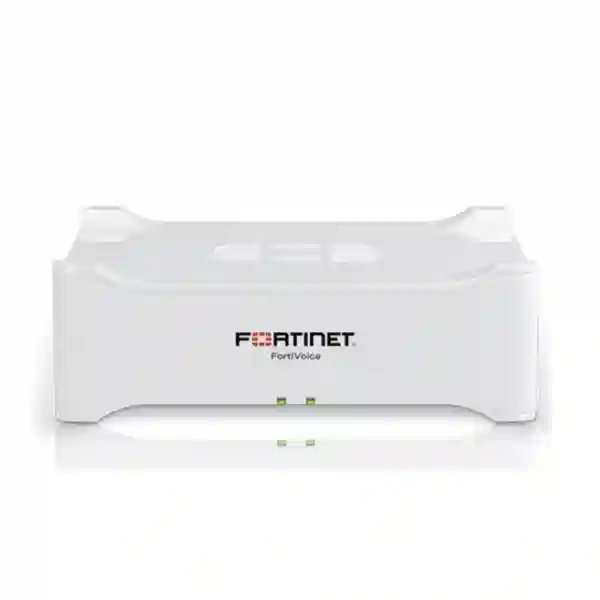
FortiVoice FVE-50G2 Tanzania
The Fortinet FortiVoice FVE-50G2 is a compact desktop IP PBX built for organizations that need a manageable business calling platform without moving immediately to a larger enterprise appliance. Fortinet specifies support for up to 50 extensions, 15 concurrent calls, 8 VoIP trunks, 2 FXO ports, 2 FXS ports and two RJ45 network interfaces. That combination makes the FVE-50G2 relevant to small and growing offices that want SIP calling while retaining selected analog lines, phones or fax devices. For Tanzanian buyers, the important purchasing question is not simply whether the appliance supports fifty extensions; it is whether its trunk capacity, simultaneous-call capacity, analog connectivity and deployment model match the actual communication pattern of the organization.
FortiVoice FVE-50G2 overview
FortiVoice brings business telephony, extension management, call routing and SIP connectivity into a purpose-built Fortinet platform. The FVE-50G2 sits in the range for offices of up to 50 users. Its desktop form factor measures 29 × 116 × 172 mm and weighs approximately 0.61 kg according to Fortinet’s enterprise phone-system data sheet. It uses an external power supply and provides 8 GB of storage. The appliance is therefore physically compact enough for an office communications area, although deployment planning should still consider protected power, ventilation, network access and controlled administrative access.
The capacity figures should be read together. Fifty extensions describe the endpoint/user scale, while fifteen concurrent calls describe how many simultaneous calls the system is designed to handle. Eight VoIP trunks describe supported trunk capacity, and the two FXO interfaces provide connectivity for traditional telephone lines. Two FXS interfaces can support analog endpoints such as analog phones or fax devices. Before procurement, a business should map peak inbound and outbound call demand rather than sizing solely from employee count.
SIP-ready calling
Eight VoIP trunks provide a practical foundation for SIP-based business telephony. Provider interoperability, numbering, authentication, codecs and firewall/NAT requirements should be confirmed with the selected carrier before cutover.
Analog continuity
Two FXO and two FXS ports can help organizations retain selected analog services while introducing IP telephony. This is useful when migration needs to be phased rather than completed in one step.
Branch resilience option
Fortinet documentation states that the FVE-50G2 can operate as a PBX or as a survivability branch in a centrally managed multi-site FortiVoice deployment, giving planners another architecture option for distributed organizations.
Verified FVE-50G2 specifications
| Specification | FVE-50G2 |
|---|---|
| Extensions | 50 |
| Concurrent calls | 15 |
| VoIP trunks | 8 |
| FXO | 2 |
| FXS | 2 |
| RJ45 network interfaces | 2 |
| Storage | 8 GB |
| Form factor | Desktop |
| Dimensions | 29 × 116 × 172 mm |
| Audio codecs listed by Fortinet | G.711 μ-law/A-law, G.729a, G.722, Opus |
Sizing before you buy
A 50-person office does not automatically require fifty simultaneous calls. Conversely, a smaller organization with a busy reception, sales team or appointment desk can generate a high concurrent-call requirement. Document the number of users, expected peak simultaneous calls, SIP channels, analog lines, fax requirements, auto-attendant flows, conference use, remote users and future headcount. If projected demand is likely to exceed 15 concurrent calls or the required architecture needs capabilities beyond this model, compare the next FortiVoice platforms before finalizing procurement.
Compatibility, network and deployment planning
A reliable voice deployment depends on more than the PBX. IP phones, switches, VLANs, DHCP options, DNS, internet connectivity, SIP service, firewall policy, quality of service and power protection can all influence the user experience. Separate voice traffic logically where appropriate, prioritize latency-sensitive traffic, and validate the SIP provider’s requirements. Where remote extensions or softclients are planned, review secure remote-access design and the relevant FortiVoice release documentation rather than relying on generic SIP assumptions.
Fortinet lists FortiFone Softclient and call-trunk options alongside the FVE-50G2. Exact licensing, service availability and regional telecommunications requirements can change, so quotation preparation should identify the intended country, carrier and calling plan. Fortinet also publishes a global availability document noting that phone-system availability is subject to regional telecommunications regulations. FourTeck therefore recommends confirming current model availability and service compatibility for the intended deployment before purchase.
FortiVoice FVE-50G2 Tanzania
Organizations evaluating the FortiVoice FVE-50G2 in Tanzania are commonly trying to solve a practical communications problem: modernize office calling without creating an oversized or unnecessarily complex voice environment. For a business with up to 50 extensions, the appliance offers a defined capacity envelope that makes planning straightforward. The procurement team can begin with user count, then validate the more important peak-call requirement against the system’s 15 concurrent-call capacity. A business that has 35 users but regularly handles many simultaneous customer calls may need a different sizing decision than a 50-user professional office where only a small portion of staff are on external calls at once.
Tanzanian deployments should also examine the transition between analog and SIP services. The FVE-50G2 includes two FXO ports and two FXS ports, which can be useful when an organization wants to retain selected traditional lines or analog endpoints while adopting SIP trunks and IP phones. This does not remove the need for carrier validation. SIP credentials, numbering, inbound routing, caller ID presentation, emergency-calling obligations and codec compatibility should be agreed with the telecommunications provider. If analog fax is business-critical, test it in the intended network and service environment rather than assuming every IP voice path will behave identically.
Network readiness is another important Tanzania buying consideration. A voice system benefits from stable LAN switching, appropriate VLAN design, QoS planning, dependable DNS and protected power. Where internet-based SIP services are used, connectivity quality matters because voice is sensitive to packet loss, latency and jitter. Businesses with multiple links may also want to define how voice traffic behaves during an ISP outage. That design sits outside the PBX alone and should be considered together with the firewall, WAN and switching environment.
For procurement, prepare a concise requirements sheet covering the number of extensions at launch, growth over the next planning period, maximum expected simultaneous calls, number of analog lines, number of analog endpoints, SIP provider, handset quantity, remote-user requirement and branch-office requirement. FourTeck can use this information to help structure a quotation discussion without assuming stock, carrier compatibility or licensing details that have not been verified. Customers planning a broader Fortinet environment can also explore FourTeck Tanzania technology solutions and the wider FourTeck Africa portfolio when coordinating voice with networking and security.
FortiVoice FVE-50G2 Dar es Salaam
For businesses in Dar es Salaam, the FVE-50G2 can suit headquarters, professional offices, trading companies, clinics, education offices and growing service organizations that need structured extension dialing and external call routing. The key is to translate business workflows into a voice design. Reception may need an auto-attendant and ring groups; sales teams may need direct extension access; managers may need forwarding or mobility options; and administration may need controlled outbound dialing. Those requirements should be documented before configuration so the extension plan remains understandable as the organization grows.
A Dar es Salaam deployment should consider how the PBX connects to the selected carrier. If the organization is moving from conventional lines, the two FXO ports can support a limited analog-line requirement while the business evaluates or adopts SIP services. The eight VoIP-trunk capacity provides a defined framework for IP-based trunking. The carrier must still confirm service details, supported registration method, numbers and any network prerequisites. Avoid scheduling a cutover until inbound and outbound test plans are agreed, including reception numbers, after-hours routing and failover behavior.
Office network preparation is equally important. Voice endpoints should receive consistent addressing and configuration, switching should support the required endpoint count, and QoS should be considered when data and voice share links. If staff use cloud applications heavily, a congested WAN can affect calls even when the PBX itself is correctly configured. Protected power for the PBX, switches, router/firewall and phones can also reduce disruption during short power events, subject to the organization’s UPS design.
When requesting a Dar es Salaam quotation, provide the number of desk phones, analog devices, external numbers, SIP channels, remote users and expected simultaneous calls. Also identify whether this is a new installation or a migration from an existing PBX. This helps distinguish hardware requirements from configuration and migration tasks. Businesses coordinating voice and security can review FourTeck’s Fortinet-focused solution information for broader ecosystem context, while final Tanzanian availability and telecommunications compatibility should be confirmed for the local project.
FortiVoice FVE-50G2 Mwanza
Mwanza organizations evaluating a business IP PBX often need a system that is compact enough for a single office yet structured enough to support departments and future growth. The FVE-50G2’s fifty-extension ceiling can accommodate a substantial small-office deployment, but planners should reserve capacity for near-term additions instead of consuming every extension on day one. Create an extension-numbering plan that groups departments logically and leaves room for expansion. This makes administration easier and reduces the need for disruptive renumbering later.
Concurrent-call analysis deserves special attention. Fifteen concurrent calls may be ample for many offices, but organizations with customer-service, reservations, dispatch or sales functions should estimate busy-hour demand. Review inbound and outbound traffic together and include conference usage. The model supports two conference bridges with up to five attendees per bridge according to Fortinet’s published specifications. If conferencing or high-volume customer calling is central to the operation, validate that the complete capacity profile matches the intended workload.
For connectivity, identify whether the organization will use analog PSTN lines, SIP trunks or a mixed migration. The two FXO and two FXS interfaces can be useful for limited analog requirements. SIP deployments should be tested with the selected provider and firewall design. Network teams should also consider voice VLANs, switch port capacity, endpoint power requirements and WAN quality. Where branch links are involved, document how voice should behave if connectivity to another site is lost.
A useful Mwanza procurement request includes an endpoint schedule, floor or department plan, external number list, carrier details and migration timeline. Include any analog fax or legacy device that must remain operational. This reduces ambiguity during quotation and deployment planning. FourTeck can help align the FVE-50G2 with the surrounding communications environment; for broader regional infrastructure planning, the FourTeck Africa technology portfolio provides context for related networking and enterprise IT requirements.
FortiVoice FVE-50G2 Arusha
Arusha businesses in hospitality support, tourism administration, professional services, education and general commerce may require a straightforward office telephony platform with predictable capacity. The FVE-50G2 is positioned for offices with up to 50 extensions and can support a combination of IP telephony and limited analog connectivity. Buyers should separate general office PBX needs from specialized hotel-management or high-volume contact-center requirements; Fortinet positions larger FortiVoice models with additional capabilities for those scenarios, so requirements should be mapped before selecting the appliance.
For an office deployment, start by identifying call destinations and user roles. Reception, finance, management and operational teams may need different dialing privileges and routing rules. Build auto-attendant menus around actual customer journeys rather than internal organizational language. Keep menus short, provide a clear reception route and test after-hours behavior. The FVE-50G2 supports five auto attendants, providing room for structured routing within its target office scale.
Arusha organizations with analog lines can evaluate the two FXO interfaces, while the two FXS interfaces support analog phones or fax endpoints. These ports are valuable only when they match the migration plan; they should not substitute for a proper carrier and network assessment. If SIP trunks are planned, confirm provider interoperability and the required firewall settings. Where internet connectivity carries voice, monitor link quality and ensure business-critical calls are not competing uncontrolled with large backups or downloads.
Quotation preparation should include present user count, twelve-to-twenty-four-month growth assumptions, call concurrency, handset requirements and whether remote users need softclient functionality. Fortinet lists FortiFone Softclient as an add-on for this platform; current licensing and regional availability should be confirmed at quotation stage. A requirements-led approach helps Arusha buyers avoid both under-sizing and unnecessary oversizing while creating a cleaner implementation path.
FortiVoice FVE-50G2 Dodoma
In Dodoma, offices procuring a new business phone system can use the FVE-50G2 as a defined platform for up to fifty extensions where call concurrency remains within the appliance’s fifteen-call capacity. Administrative offices, consulting businesses, education organizations and growing enterprises can benefit from planning extensions around departments and responsibilities. Before purchase, count people, shared-area phones, reception devices, meeting-room phones, fax endpoints and any spare extensions required for growth.
Organizations should also document inbound-number strategy. Determine which public numbers terminate at reception, departments or specific users, and define after-hours routing. SIP provider capabilities can affect how direct numbers and caller ID are handled. If existing analog lines remain part of the design, the two FXO ports provide limited traditional-line connectivity. The two FXS ports can support analog devices, which may simplify migration for a fax machine or legacy phone where replacement is not immediately practical.
For multi-site organizations, Fortinet documentation is notable because the FVE-50G2 can be configured in PBX mode or as a survivability branch managed by a main-office FortiVoice system. That architecture should be designed from the central system outward and validated against the FortiVoice software release in use. A survivability design is not the same as simply installing independent PBXs at each branch, so organizations should decide whether centralized management and branch resilience are actual project requirements.
Dodoma procurement teams can improve quotation accuracy by providing network diagrams, site counts, user counts, carrier details and existing phone-system information. If a firewall or WAN redesign is happening at the same time, coordinate the projects because NAT, QoS, VLAN and routing choices can directly affect voice. FourTeck’s broader enterprise technology portfolio can provide context when telephony forms part of a larger infrastructure refresh.
FortiVoice FVE-50G2 UAE
Organizations evaluating the FVE-50G2 for the UAE should begin with the same verified platform limits—50 extensions, 15 concurrent calls, 8 VoIP trunks, 2 FXO and 2 FXS ports—then confirm telecommunications and service requirements for the intended emirate and carrier. Fortinet’s published global availability material emphasizes that phone systems are subject to regional telecommunications regulations. A quotation should therefore distinguish appliance capability from carrier service availability and regulatory requirements.
The platform can be attractive for branch offices and smaller business sites that need a compact FortiVoice deployment. Where a company already operates a larger central FortiVoice system, the survivability-branch option can be evaluated for an appropriate architecture. Where the UAE office is independent, PBX mode may be the relevant design. In either case, extension plans, call routes and SIP services should be documented before configuration.
UAE buyers should also review handset and softclient requirements. Desk-phone selection should consider user roles, line-key needs and network power design, while softclient planning should include licensing and remote connectivity. If analog devices remain necessary, identify them explicitly because only two FXS interfaces are provided. Likewise, two FXO ports define the available direct analog-line connectivity on the appliance.
For UAE-specific solution discussions, customers can review FourTeck UAE and FourTeck IP PBX resources. These regional resources are useful when comparing telephony deployment approaches, while exact FVE-50G2 availability, service subscriptions and carrier interoperability should be confirmed for the project.
FortiVoice FVE-50G2 Uganda
Ugandan organizations considering the FVE-50G2 can use its fifty-extension capacity as the starting point for an office voice plan, but busy-hour calling should determine whether the fifteen-concurrent-call limit is appropriate. Professional offices, NGOs, education teams, clinics and commercial branches can have very different traffic profiles despite similar employee counts. A pre-sales discovery process should therefore ask how many calls are normally active at the busiest time and whether growth is expected.
SIP migration is another important design topic. The FVE-50G2 supports eight VoIP trunks and includes two FXO ports for traditional telephone lines. A mixed environment can be useful during transition, but each carrier connection needs validation. The business should document public numbers, inbound destinations, outbound caller ID and fallback behavior. Testing should cover both normal operation and expected failure conditions.
The LAN should be prepared for voice endpoints. Review switching, VLANs, DHCP, QoS and power. If phones are powered through network switches, confirm the PoE budget of the selected switching platform; the PBX specification itself does not determine phone power. If staff work remotely, define whether they use softclients and how secure remote connectivity is handled. These choices can affect licensing and security architecture.
Ugandan customers can explore FourTeck Uganda for regional technology context. For a precise FVE-50G2 quotation, provide user quantity, phone quantity, SIP or analog carrier details, site count, existing PBX information and expected project timing. Availability should be confirmed rather than assumed.
FortiVoice FVE-50G2 Kampala
Kampala offices often need telephony that can support reception, departmental extensions and customer-facing teams without introducing enterprise-scale complexity. The FVE-50G2 fits a defined small-office segment and provides enough extension capacity for up to fifty users or endpoints. The fifteen-concurrent-call specification is the figure to examine for call-heavy environments. If reception, sales and support regularly handle many simultaneous calls, model the busy hour before choosing the platform.
The appliance’s two FXO and two FXS interfaces can simplify certain migration projects. Existing analog lines may be retained within the available FXO capacity, while an analog fax or phone can use an FXS interface. Businesses should inventory legacy devices early because discovering an unsupported analog requirement during installation can delay cutover. SIP trunk configuration should be based on provider-specific details rather than generic templates.
A well-designed Kampala deployment also includes an extension-number plan, inbound-call map and after-hours policy. Decide which calls reach an auto attendant, which go directly to groups and how unanswered calls are handled. The platform supports five auto attendants, allowing multiple structured menus, but simplicity usually improves caller experience. Record prompts professionally and keep routes aligned with business hours and staffing.
Network readiness should be verified before phones are deployed. Check switch capacity, cabling, VLAN design, WAN stability and power protection. When the voice project is part of a broader infrastructure refresh, coordinate firewall and switching changes with PBX testing so that SIP and media traffic are validated end to end.
FortiVoice FVE-50G2 Arua
For an Arua branch or office, a compact PBX can be valuable when the business wants local extension calling and structured external communications. The FVE-50G2’s desktop form factor reduces physical installation demands, but the system should still be placed in a controlled environment with protected power and reliable network connectivity. Include the router/firewall and switching infrastructure in power-continuity planning, because keeping only the PBX powered does not maintain IP calling if the rest of the network is unavailable.
Where Arua is part of a multi-site organization, the FVE-50G2’s documented survivability-branch capability may be worth evaluating. In that mode, a main-office FortiVoice system manages the branch. This requires architecture planning and should be designed using Fortinet’s current deployment documentation. If the site instead needs a standalone phone system, PBX mode is available. The choice should follow the organization’s management and resilience requirements.
Carrier connectivity should be evaluated early. The system offers eight VoIP trunks and two FXO ports, giving options for SIP and limited analog service. Determine which connectivity is realistically available at the site and how many simultaneous external calls are expected. Where WAN quality is variable, voice performance should be tested under normal business load rather than only during an idle network test.
For quotation preparation, list every endpoint and its role, including reception, shared spaces, managers, fax and remote staff. Include the existing public numbers and the intended migration approach. This information allows the project team to identify dependencies before installation and reduces the risk of buying hardware before the telephony design is understood.
FortiVoice FVE-50G2 Mbarara
Mbarara organizations can evaluate the FVE-50G2 when their requirement falls within a fifty-extension office scale and they want a Fortinet business-phone platform. Rather than treating fifty extensions as a target to fill, keep capacity available for new hires, meeting rooms and shared devices. A sensible numbering plan can reserve ranges for departments and future users, helping the system remain manageable as the organization changes.
Call concurrency should be estimated from real working patterns. Fifteen simultaneous calls may be sufficient for many administrative offices, but a sales-driven operation can reach that level with far fewer than fifty staff. If call recording, contact-center workflows or specialized hospitality functions are requirements, confirm whether this model and its licensing fit those needs or whether another FortiVoice platform is more appropriate.
The analog interfaces can support migration scenarios: two FXO ports for traditional lines and two FXS ports for analog endpoints. Treat these as finite resources. If more analog connectivity is required, the architecture needs to be reconsidered rather than assuming ports can be added without validation. SIP trunks should be tested with the provider and network security design.
A complete Mbarara request for quotation should specify extension quantity, peak calls, carrier type, analog lines, analog devices, handset requirements, remote users and expected growth. It should also state whether configuration, migration and user onboarding are part of the requested scope. Clear requirements make product comparison more meaningful and reduce ambiguity between appliance pricing and complete project cost.
FortiVoice FVE-50G2 Gulu
In Gulu, the FVE-50G2 can be considered for organizations seeking a compact IP PBX for a small or medium office. The hardware itself is only one component of the voice service. A dependable deployment also needs suitable handsets, switching, addressing, carrier connectivity and operational procedures. Planning these together is especially important where the organization has limited on-site IT resources and wants administration to remain straightforward.
Start with a user and call-flow workshop. Identify the main published number, reception workflow, departments, direct numbers, after-hours routing and emergency contacts. Map those requirements to extensions and auto attendants. Fortinet specifies five auto attendants on the FVE-50G2, but multiple menus should only be used when they improve caller navigation. Excessive menu depth can make a technically capable system harder for customers to use.
For external service, the system supports eight VoIP trunks and two analog FXO lines. Determine whether SIP, analog or a mixed approach is appropriate at the site. The two FXS ports can serve analog phones or fax devices. Where fax remains important, include it in acceptance testing. Carrier, codec and network conditions can affect real-world operation.
Organizations with a central office elsewhere can also investigate the survivability-branch deployment mode documented by Fortinet. This can provide a structured branch role within a centrally managed FortiVoice environment. It should be designed against the current software documentation and the capabilities of the main-office system. For independent sites, use the standard PBX design process and size from actual call demand.
FortiVoice FVE-50G2 Kenya
Kenyan buyers evaluating the FVE-50G2 should treat the published capacities as design boundaries: 50 extensions, 15 concurrent calls, 8 VoIP trunks, 2 FXO and 2 FXS interfaces. Those figures suit many branch and professional-office scenarios, but they should be compared with actual traffic. Organizations with customer-service teams should pay particular attention to concurrency rather than simply counting users.
A SIP-based deployment requires coordination with the service provider. Confirm numbers, registration, codecs, inbound and outbound routing, and any firewall requirements. If analog lines remain in use, document which lines will connect to the two FXO ports. If analog endpoints remain, reserve the two FXS ports accordingly. A written port and number schedule makes installation and testing faster.
Network design should support voice quality. Segment traffic where appropriate, prioritize voice, and ensure switching and WAN capacity are sufficient. Remote users should be included in the security design and licensing review. FortiFone Softclient is listed as an add-on for the FVE-50G2, but current entitlement and regional availability should be checked during quotation.
Customers seeking regional information can visit FourTeck Kenya. When requesting the FVE-50G2, include the number of users, expected peak calls, handset types, carrier details, site count and migration requirements. This creates a clearer basis for confirming whether the model fits the project.
FortiVoice FVE-50G2 Kuwait
Kuwait deployments should begin with a regulatory and carrier check because enterprise phone systems interact directly with telecommunications services. The FVE-50G2 provides a compact 50-extension platform with 15 concurrent calls and eight VoIP trunks, but service availability and provider interoperability must be confirmed for the intended project. Avoid assuming that a configuration used in another country can be copied without adjustment.
For offices transitioning from traditional telephony, two FXO ports allow limited analog-line connectivity and two FXS ports support analog endpoints. These can reduce migration friction where a small number of legacy devices must remain. If the business expects more analog connectivity, identify that requirement before purchase because the physical port count is fixed.
SIP deployments should be accompanied by a clear firewall and QoS design. Voice media can be affected by congestion, packet loss and incorrect NAT handling. The IT team should test inbound, outbound, transfer, hold, conference and after-hours scenarios. If remote users are included, add those workflows to the acceptance plan and verify licensing.
For regional context, customers can review FourTeck Kuwait. A quotation request should include extension count, concurrency, carrier, analog requirements, phone quantity and project scope so the solution can be evaluated against the FVE-50G2’s verified capacities.
FortiVoice FVE-50G2 Ghana
Ghanaian organizations looking for a business IP PBX can evaluate the FVE-50G2 where office scale remains within fifty extensions. The model’s fifteen concurrent calls are a separate constraint and should be checked against the busiest calling period. Professional services, distributed enterprises and administrative offices often have moderate concurrency, while sales or support teams may require more call capacity than employee count suggests.
The platform supports eight VoIP trunks and limited analog integration through two FXO and two FXS ports. Before deployment, confirm the selected provider’s SIP service details and test number presentation, inbound routing and outbound dialing. If analog services remain, label each line and endpoint in the migration plan so technicians know exactly what must remain operational.
The network should be reviewed for voice readiness. Cabling, switching, VLANs, QoS, DNS and WAN connectivity all matter. Where multiple offices communicate across WAN links, decide whether the system is standalone or part of a centralized FortiVoice architecture. The FVE-50G2 supports survivability-branch operation when managed by an appropriate main-office FortiVoice system.
Customers can visit FourTeck Ghana for regional technology information. For accurate planning, provide user numbers, expected simultaneous calls, carrier details, phone requirements and growth assumptions before requesting a final configuration.
FortiVoice FVE-50G2 Nigeria
Nigerian businesses considering the FVE-50G2 should assess both current and future calling patterns. A 50-extension limit can accommodate many offices, but the fifteen-concurrent-call capacity may become the deciding factor in customer-facing operations. Estimate busy-hour traffic using real observations where possible and include inbound queues, outbound sales calls and conferences in the calculation.
SIP services can provide flexible business calling, and the FVE-50G2 supports eight VoIP trunks. Provider requirements should be confirmed before configuration. The two FXO ports can accommodate limited analog lines, while two FXS ports support analog endpoints. If the migration includes existing fax or legacy equipment, test those devices as part of project acceptance rather than treating them as an afterthought.
Power and network resilience deserve attention. The PBX, switching, firewall/router and any PoE infrastructure must work together for IP calling to remain available. A UPS strategy should therefore cover the relevant communications chain. For internet-based voice, define how calls behave during WAN disruption and whether secondary connectivity is part of the broader network design.
For Nigerian regional information, see FourTeck Nigeria. Procurement teams should provide a complete bill-of-requirements rather than asking only for the appliance: include handsets, softclient users, carrier services, analog devices, configuration and migration needs so project scope is clear.
FortiVoice FVE-50G2 Seychelles
Seychelles organizations evaluating the FVE-50G2 can consider it for office telephony where requirements fit its compact 50-extension, 15-concurrent-call profile. Hotels and hospitality environments should be especially careful to distinguish ordinary administrative-office telephony from specialized hotel-management requirements. Fortinet positions larger FortiVoice models with additional capabilities, so the selected system should reflect the actual operational scope.
For a standard office, plan extension groups, reception, auto attendants and external calling first. If the site uses SIP, verify service compatibility with the local provider. If it retains traditional lines, two FXO ports are available. Two FXS ports can connect analog phones or fax devices. These physical limits should be included in the design from the beginning.
Connectivity quality matters for island deployments just as it does elsewhere. Where external calls depend on IP services, monitor latency, jitter and packet loss, and prioritize voice appropriately. If the business depends heavily on phone availability, document power and WAN contingencies. A resilient communications design is broader than the PBX appliance alone.
When seeking a quotation for Seychelles, specify whether the requirement is a standalone office, a branch of a larger organization or a hospitality-related administrative system. Include endpoint counts, simultaneous-call estimates, provider information and migration requirements. This enables a fit assessment without making unsupported assumptions about local service availability.
Related planning for a Fortinet communications environment
Voice projects often touch the same network used for business applications, security and remote access. If the FVE-50G2 is being introduced alongside a firewall refresh, review SIP handling, VLAN design and QoS as one project. For organizations exploring Fortinet security alongside telephony, FourTeck Fortinet resources can help frame the wider platform discussion. Customers with broader regional operations can also use FourTeck Africa to coordinate requirements across markets.
The correct handset mix is another design choice. Receptionists may need more programmable keys than ordinary users, while meeting rooms and shared areas can require different endpoint types. Remote staff may be candidates for softclients rather than physical phones. Build the endpoint schedule from job roles and workflows, then validate compatibility and licensing against the current FortiVoice release.
Quotation checklist for FortiVoice FVE-50G2
✓ Number of extensions required now and expected growth
✓ Peak simultaneous external calls
✓ SIP trunk/provider information
✓ Existing analog lines and numbers
✓ Analog phones or fax devices
✓ Desk-phone quantity and user roles
✓ Remote or softclient users
✓ Reception and auto-attendant call flow
✓ Branch-office requirements
✓ Existing PBX migration details
✓ LAN, switching and VLAN information
✓ Installation, configuration and training scope
FortiVoice FVE-50G2 FAQs
How many extensions does the FVE-50G2 support?
Fortinet specifies up to 50 extensions for the FVE-50G2. Extension count should be planned together with its 15-concurrent-call capacity.
How many simultaneous calls can it handle?
Fortinet lists 15 concurrent calls. Businesses with call-heavy teams should estimate peak demand before selecting the model.
Does the FVE-50G2 support analog lines?
Yes. The appliance includes two FXO ports for traditional telephone lines and two FXS ports for analog endpoints such as analog phones or fax machines.
Can the FVE-50G2 use SIP trunks?
Yes. Fortinet specifies eight VoIP trunks. Exact SIP-provider interoperability and service configuration should be confirmed for the selected carrier.
Can it be used at a branch office?
Fortinet documents PBX and survivability-branch deployment modes for the FVE-50G2. A survivability branch is managed by a main-office FortiVoice system and should be designed using the current Fortinet deployment documentation.
Is FortiFone Softclient available?
Fortinet lists FortiFone Softclient as an add-on for the FVE-50G2. Current licensing and regional availability should be verified during quotation.
What should I provide for a Tanzania quotation?
Provide extension quantity, peak simultaneous calls, phone quantity, carrier details, analog lines and devices, remote users, branch requirements, existing PBX information and the required implementation scope.
Decision recap
Choose the FVE-50G2 when the verified capacity profile fits the project: up to 50 extensions, up to 15 concurrent calls, 8 VoIP trunks, two analog FXO lines and two FXS analog endpoints. Do not choose it from user count alone. Validate busy-hour calls, carrier service, analog requirements, handset mix, remote users and branch architecture. If any of those requirements exceed the platform’s published capacity or call for specialized functions, compare an appropriate larger FortiVoice system before ordering.
Plan your FortiVoice FVE-50G2 deployment
FourTeck can help structure the pre-sales requirements for a FortiVoice FVE-50G2 project in Tanzania, including extension sizing, concurrent-call planning, analog migration, SIP trunk requirements, handset selection and surrounding network considerations. Availability, licensing and telecommunications compatibility should be confirmed for the specific project and region before purchase.




Reviews
There are no reviews yet.