
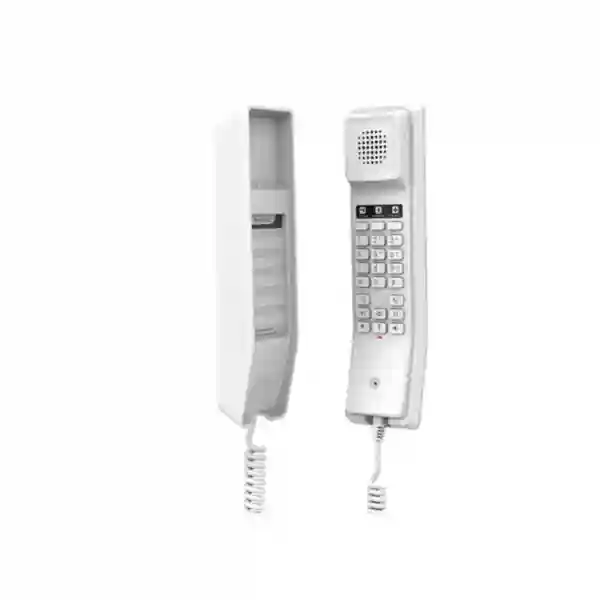
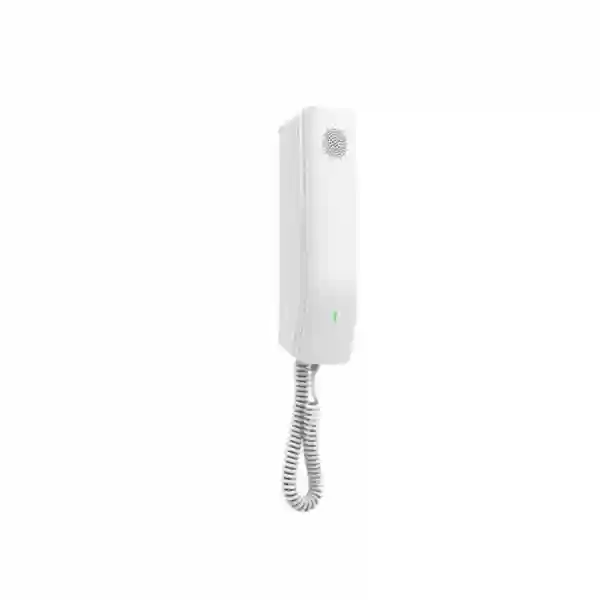
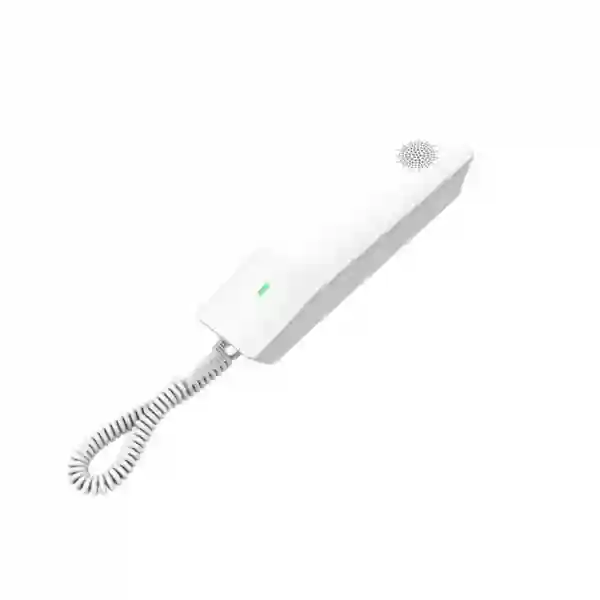
Grandstream GHP610 Hotel IP Phone in Tanzania
The Grandstream GHP610 is a compact white hotel IP phone created for rooms and other managed spaces where callers need a familiar handset, fast access to important extensions and uncomplicated day-to-day operation. It supports two SIP accounts and two lines, an HD handset, ten configurable speed-dial positions, three programmable keys, three-way voice conferencing, full-band Opus and other common voice codecs, a 10/100 Mbps Ethernet interface, Power over Ethernet and centralized provisioning through Grandstream Device Management System. The slim body can be used on a desktop or mounted on a wall, making it practical for guest rooms, wards, serviced apartments, dormitories, residences, retail points and similar deployments.
For a Tanzania project, the purchasing decision should go beyond the handset model. A reliable rollout also depends on SIP/PBX compatibility, switch PoE capacity, cabling condition, voice VLAN and QoS design, extension numbering, emergency and service-key planning, firmware policy, labeling, room-by-room commissioning and the support process that will be used after handover. FourTeck can help buyers structure these questions before quotation so that the phone is matched to the actual property environment rather than ordered as an isolated endpoint.
Best suited to: hotel rooms, healthcare rooms, serviced apartments, dormitories and other managed spaces that need a simple SIP handset.
Network: one auto-negotiating 10/100 Mbps Ethernet port with PoE support on the GHP610.
Voice: two SIP accounts/lines, HD handset audio and three-way conferencing.
Management: web provisioning, GDMS, TR-069 and encrypted XML provisioning options.
Two SIP accounts and two lines provide straightforward room calling with flexibility for a second configured service or line arrangement.
The wired GHP610 uses a 10/100 Mbps network interface with integrated PoE, allowing network and power to share one compatible Ethernet connection.
Ten configurable speed-dial positions and three programmable keys can be mapped to commonly used hotel or facility destinations.
Grandstream GDMS can centralize provisioning, monitoring, configuration and firmware tasks across larger endpoint deployments.
What the Grandstream GHP610 solves
A guest-room phone has a different role from an executive desk phone. It should be immediately recognizable, easy to use without training, compact enough for a bedside table or wall position and simple for the property IT team to replicate across many rooms. The GHP610 addresses that requirement by keeping the interface focused. Core call actions such as redial, hands-free, voicemail, hold, mute and volume control are available without requiring a large display. Service destinations can be prepared through speed-dial and programmable-key configuration so a guest, resident or patient can reach reception, housekeeping, security, nursing, maintenance or another assigned extension without learning an internal numbering plan.
The wired network model is also useful where structured cabling and PoE switching are already part of the building design. One Ethernet run can carry voice traffic and provide electrical power from a compatible PoE switch. In a properly designed system, this can simplify room installation, reduce dependence on local power adapters and make it easier to protect the voice network through centrally backed-up switching infrastructure. The phone supports Layer 2 and Layer 3 quality-of-service mechanisms, which can be included in a wider voice VLAN and QoS plan when IP telephony shares the LAN with guest internet, staff systems, CCTV or building applications.
Central provisioning is particularly important in multi-room projects. Manually configuring each handset is slow and prone to inconsistency. The GHP610 supports GDMS, TR-069 and encrypted XML provisioning approaches, allowing a deployment team to work from standardized profiles, naming conventions, extension assignments and firmware rules. Buyers can review the broader FourTeck Tanzania technology shop when a project also needs PoE switching, PBX hardware, cabling, firewalling or related infrastructure, because a room phone is only one component of a complete voice environment.
Verified GHP610 feature and specification overview
Model suffix matters. The GHP610 is the white wired model. Buyers looking for built-in wireless connectivity should evaluate the GHP610W separately and verify hardware version because current Grandstream documentation distinguishes Wi-Fi and PoE behavior by model and hardware revision. A quotation should therefore name the exact model and required connectivity rather than treating GHP610 and GHP610W as interchangeable.
Compatibility, PBX integration and rollout planning
PBX and SIP
Confirm SIP registration, codecs, DTMF method, voicemail behavior, transfer features, dial plan and any property-specific call routing before mass deployment. A pilot handset is valuable where the existing PBX or hosted platform has not previously used this model.
PoE and switching
Count phones by switch, confirm available PoE budget and ports, review uplink capacity and decide whether voice will use a dedicated VLAN. The phone itself is modest in bandwidth terms, but a multi-room property still benefits from organized switching and documentation.
Provisioning
Prepare templates for SIP accounts, time, dial plan, speed dials, programmable keys, security settings and firmware. Standardized naming and room mapping make future replacement and troubleshooting easier than configuring every phone independently.
Physical placement
Decide whether the phone will sit on a bedside table, desk, wall or service counter. Confirm cable path, faceplate location, handset reach and guest accessibility. Wall mounting can be useful where furniture space is limited or where a fixed room position is preferred.
For projects that combine telephony with switching, Wi-Fi, firewalls, cabling or support, review the FourTeck Tanzania services overview. The goal is to align the handset with the network and PBX environment rather than assuming that successful SIP registration alone proves the room communication system is ready for production.
Grandstream GHP610 Tanzania
Tanzania buyers evaluating the Grandstream GHP610 are typically solving a multi-room communication requirement rather than choosing a conventional office desk phone. Hotels, lodges, serviced apartments, healthcare facilities, student accommodation and managed residences need endpoints that are simple for temporary users while still fitting an administrator-controlled SIP environment. The GHP610 is relevant because it combines a compact white housing with a wired Ethernet connection, integrated PoE, two SIP accounts and lines, configurable service dialing and centralized provisioning. For a Tanzania deployment, start by documenting the property size, number of rooms, PBX or hosted SIP platform, current switch estate, cabling condition and the departments that guests or residents must reach directly.
Infrastructure conditions can vary significantly between a city hotel, safari lodge, healthcare site, educational residence and remote accommodation property. A practical design should therefore consider power stability, UPS protection for core switches and PBX equipment, cable quality, rack environment and internet dependency where the SIP service is cloud-hosted. If calls remain internal to an on-premises PBX, the local LAN may carry much of the traffic even when the internet is unavailable; if the service depends on a hosted platform or external SIP trunk, WAN reliability becomes more important. Buyers should confirm this architecture before estimating resilience requirements. Voice VLANs, QoS and suitable firewall policies can reduce competition between telephony and other business traffic on converged networks.
The guest experience should be planned alongside the network. Decide which speed-dial destinations matter: reception, housekeeping, room service, security, emergency assistance, maintenance or another service. The configurable faceplate and labeling approach should use clear language and consistent numbering. During commissioning, test every programmed destination from representative rooms, verify inbound and outbound behavior where required, check voicemail or message indication if used, and document room-to-extension mapping. For large properties, centralized GDMS provisioning can reduce repetitive work, but administrators should still maintain a controlled template and change process.
Procurement teams in Tanzania should request the exact GHP610 wired model if PoE Ethernet is the intended design, and separately discuss the GHP610W if Wi-Fi is required. Quantity, project schedule, PBX details, switch information, faceplate needs and destination should be included in the quotation request. Avoid assuming stock, delivery time or warranty route before these are confirmed for the order. The most useful quotation is one that distinguishes handset quantity, any required switching or cabling, configuration scope, testing responsibilities and after-sales process so there are no hidden dependencies at installation time.
Grandstream GHP610 Dar es Salaam
In Dar es Salaam, the GHP610 can fit hospitality and property projects where room density, structured cabling and centralized administration are more important than advanced desk-phone features. Business hotels, serviced apartments, hospitals and mixed-use properties may operate many endpoints across multiple floors, which makes consistency essential. Before ordering, map the number of rooms by floor, identify the nearest telecommunications rooms and determine whether each location already has a usable Ethernet outlet. A GHP610 deployment is simplest when PoE switches and cabling are planned as part of the building network rather than added room by room after furniture and finishes are complete.
For multi-floor properties, review switch capacity and PoE budget at each access layer. Voice endpoints may share physical switches with wireless access points, cameras and computers, but they should not be treated as invisible additions. Count ports, reserve capacity for replacements or room changes and document patch-panel assignments. If the network is already busy, apply VLAN and QoS policies so call traffic is less affected by large data transfers or guest internet usage. The GHP610 supports common quality-of-service mechanisms, but those markings create value only when the connected switches, routers and firewalls are configured to honor the design.
Dar es Salaam properties also benefit from disciplined room provisioning. A standardized phone template can carry SIP server information, codec choices, time settings, emergency destinations and service keys. Room-specific data such as extension number and account credentials can then be assigned systematically. Use naming that links the extension to the property room or ward without exposing unnecessary sensitive information. During acceptance, place calls from a sample of rooms on every floor, test reception and service destinations, verify transfer behavior and confirm that a replacement handset can be provisioned predictably. This makes maintenance easier when housekeeping, engineering or IT reports a faulty room phone later.
When requesting a Dar es Salaam quotation, share the room count, number of buildings or floors, existing PBX platform, switch models, available PoE ports, cabling status and whether wall mounting is required. If the project is a renovation, identify which rooms already have analog telephone cabling versus Ethernet so the migration scope is clear. The GHP610 is an IP endpoint and depends on Ethernet network connectivity; it should not be assumed to drop into an analog room-phone circuit without network changes. A well-defined bill of materials should therefore cover the endpoints and the supporting LAN work needed for a reliable rollout.
Grandstream GHP610 Mwanza
Mwanza hospitality, healthcare and accommodation projects may use the Grandstream GHP610 where simple room communication must be integrated into a managed IP network. The procurement conversation should begin with the property layout rather than the handset alone. Determine how many guest rooms, wards or residences need a phone, how those spaces are connected to network closets and whether the current switching platform can deliver PoE on the required ports. Where older analog telephone cabling is still in service, the installer must assess whether new Ethernet runs are required because the GHP610 is a SIP endpoint that connects through the data network.
For projects outside the largest metropolitan network environments, operational simplicity can be particularly valuable. Standardize the handset configuration, use centralized provisioning where appropriate and keep a clear inventory linking room number, extension, MAC address and installation date. That record supports remote troubleshooting and reduces unnecessary site visits when an endpoint is replaced. Firmware should be managed deliberately rather than updated randomly across rooms. Test a representative group before broad rollout, confirm PBX compatibility and retain a known-good configuration template so a replacement unit can be brought into service with the same expected behavior.
Power continuity also deserves planning. Because the GHP610 can be powered from PoE, the room does not necessarily need a separate phone adapter, but the switch providing that power becomes part of the voice-service dependency chain. If a property wants calls to remain available through short outages, assess UPS capacity for access switches, core networking, the PBX and any gateway or internet equipment the calling path requires. A UPS does not create unlimited runtime, so critical extensions and expected outage duration should guide the power design. Labeling and rack organization matter because rapid troubleshooting is much easier when switch ports and patching correspond to documented room endpoints.
For a Mwanza quotation, provide quantity, property type, PBX or SIP service, expected call destinations, wall-versus-desk placement, available network infrastructure and target deployment phase. If the project includes more than one site, separate the quantities and infrastructure details by location. Buyers should also state whether they need phone supply only or a wider package covering switching, cabling, PBX configuration and commissioning. This prevents a price comparison from mixing very different scopes and helps the supplier identify dependencies before equipment is committed to the project.
Grandstream GHP610 Arusha
Arusha has a strong hospitality use case for compact room telephony because hotels, lodges, guest houses and tourism-related accommodation often need straightforward communication between guests and service teams. The GHP610 can support that role with a familiar corded handset, programmable keys and speed-dial positions that can be aligned with front desk, housekeeping, security, restaurant or maintenance functions. The right configuration should reflect the property’s service model. A small lodge may only require reception and emergency dialing, while a larger hotel may want several clearly labeled destinations and a more formal PBX call flow.
For properties with rooms spread across separate buildings, cottages or wings, network topology becomes a primary design question. Ethernet distance limits, fiber links between buildings, outdoor cable protection, switch placement and power backup can matter more than the endpoint specification. The GHP610 should connect to a stable LAN segment with suitable QoS and PoE. Where a remote room block is connected through an intermediate network switch, verify that upstream links and power are resilient enough for the expected service level. Outdoor runs should be engineered with appropriate protection rather than improvised solely to reach the phone location.
Hotels serving international guests should keep the room phone interface simple. The GHP610 supports customizable labeling, so properties can design a concise faceplate that uses understandable service names and avoids unnecessary technical terms. Administrators should test all programmed numbers after PBX changes because a speed-dial key is useful only when the target route remains valid. If the property uses emergency procedures, ensure that the configured number follows the site’s documented process and that staff understand how such calls are handled. The phone can support secure SIP signaling and media options, but the PBX, certificates, network policy and provisioning system must be configured consistently for those protections to function.
Arusha procurement requests should include room count, building layout, existing data cabling, switch and PBX details, desired service keys and whether implementation will happen in one phase or around occupancy. If rooms cannot all be taken out of service at once, a phased rollout plan can reduce disruption. The phone itself is compact and wall mountable, but mounting height, cable presentation and guest accessibility should be reviewed using a sample room before repeating the installation across the property.
Grandstream GHP610 Dodoma
In Dodoma, the Grandstream GHP610 can serve hotels, institutional accommodation, healthcare environments, residences and other facilities that need a managed SIP handset without the complexity of a full office phone. Its two SIP accounts and two lines provide room for simple extension design, while programmable and speed-dial functions can be used to expose only the services a guest or occupant actually needs. This focused interface reduces the chance that temporary users must navigate a feature-rich display or unfamiliar corporate directory just to contact reception or support staff.
Government, education, healthcare and hospitality projects may have formal approval and documentation requirements. Procurement teams can improve accuracy by recording the exact model, quantity, placement, PBX interface, PoE requirement and intended configuration in the bill of materials. Avoid substituting the GHP610W automatically when a wireless model is mentioned, because the wired GHP610 and Wi-Fi variant have different connectivity considerations. Confirm model suffix, current hardware revision, included accessories and power method on the supplier quotation. This is especially important when orders are split into phases or sourced at different times.
Commissioning should include more than a dial-tone check. Verify registration, inbound and outbound routes relevant to the room, service speed dials, transfer behavior, voicemail if used, time synchronization, firmware version and voice quality under normal network load. Check the PoE switch logs for unstable ports and record the installed phone against the room or department. If secure signaling is enabled, confirm the PBX certificate and TLS/SRTP profile rather than assuming encryption from the handset capability alone. A useful acceptance checklist becomes part of the handover documentation and gives support staff a baseline when troubleshooting later.
Dodoma buyers should share whether they are replacing analog phones, extending an existing IP PBX or opening a new property. Each scenario changes the scope. A replacement project may require new structured cabling and switching; an IP PBX extension may mainly require licenses or extension configuration; a new building may allow the phone design to be coordinated with room data outlets from the start. Stating these conditions before quotation makes it easier to separate device cost from infrastructure and configuration work and helps the customer evaluate proposals on a like-for-like basis.
Grandstream GHP610 UAE
UAE hospitality projects often involve dense room counts, structured low-voltage infrastructure and formal coordination between the hotel operator, consultant, systems integrator and IT team. The Grandstream GHP610 can fit projects that need a compact wired SIP room phone with PoE and centralized management. Its simple handset-centric design is suitable where the guest should see only the functions necessary for daily service calls, while the network and PBX teams retain control of SIP accounts, dial plans, security settings and firmware. For regional project coordination, buyers can also review FourTeck UAE IT and IP telephony solutions when the phone requirement is part of a wider hotel technology scope.
New-build and refurbishment projects should coordinate the phone outlet with furniture and room design. A wall-mounted phone near the bed or entrance has different cabling requirements from a desktop unit on a side table. Confirm final furniture drawings, wall finishes and outlet heights before mass installation. The PoE design should account for all room phones on each access switch together with other powered devices such as wireless access points and cameras. Reserve enough switch power and port capacity for the final installed count plus sensible service headroom. In larger properties, use clear patch-panel and switch-port documentation so facilities and IT teams can identify a room endpoint without tracing cables manually.
The PBX configuration should reflect hotel operations. Program destinations such as front desk, housekeeping, concierge, restaurant or security only when they match the property call flow. If a property management system or specialized hospitality PBX workflow is involved, confirm interoperability at the platform level; the handset itself is a SIP endpoint and does not by itself provide every hotel integration function. Test wake-up, billing, room status or other hotel features through the actual PBX/PMS solution where these are part of the project, instead of attributing them directly to the phone.
UAE procurement often compares multiple quotations, so scope clarity matters. Ask each supplier to identify exact model, quantity, VAT basis if relevant, delivery scope, warranty route, configuration services, mounting, labeling and testing responsibilities. Do not compare a bare handset price with a fully commissioned solution as if they were equivalent. If the phones will also be deployed in African branches, standardize the model and configuration where practical while documenting country-specific supply, power, telecom and support assumptions separately.
Grandstream GHP610 Uganda
Uganda hotels, hospitals, apartments and institutional residences can use the Grandstream GHP610 where a straightforward wired SIP endpoint is preferable to a feature-heavy office phone. The first design decision is whether every intended room has usable Ethernet and whether the switching layer provides enough PoE capacity. A property migrating from analog telephones may discover that existing two-wire phone cabling cannot be reused directly for an Ethernet SIP handset. The migration plan should therefore include cable pathways, access switches, rack space and power protection, not just a phone quantity.
For organizations with IT teams in Kampala or centralized regional support, GDMS can help standardize configuration across endpoints, but the operational process should still define who owns templates, firmware approvals and room mapping. Keep administrator credentials controlled and avoid using the same weak local password across all units. The phone supports secure boot, TLS, SRTP, 802.1X and encrypted configuration capabilities, yet security depends on the surrounding network and PBX implementation. A sensible deployment separates guest data from voice and administrative management paths, uses appropriate firewall rules and keeps provisioning services limited to authorized devices.
Uganda properties with branch locations should also think about support logistics. Keep a documented spare strategy based on the size and criticality of the deployment rather than assuming immediate replacement stock will always be nearby. A spare unit is useful only if the configuration can be restored quickly, so retain the approved phone profile and extension assignment process. When a fault is reported, support staff should be able to determine whether the issue follows the handset, switch port, cable, PBX account or upstream service. This structured troubleshooting reduces unnecessary device swaps.
For regional planning, FourTeck Uganda IP PBX and VoIP solutions provide a local-country context for communication infrastructure. A GHP610 request should include quantity, deployment city, PBX details, connectivity method, room type, desired service keys and any cabling or switch work. Availability, delivery timing and warranty should be confirmed against the actual quotation rather than inferred from another market.
Grandstream GHP610 Kampala
Kampala projects may range from a small serviced residence to a multi-floor business hotel or hospital. The GHP610 is most compelling where the organization wants a standardized wired endpoint that can be configured consistently at scale. Before procurement, classify room types and identify whether every room needs the same calling permissions. Guest rooms may be limited to internal services and selected external dialing, while staff or clinical rooms may require different routes. These policies are usually controlled at the PBX, so the handset configuration should complement the platform dial plan rather than attempt to solve every restriction locally.
Kampala properties with busy converged networks should confirm that voice traffic is not left to compete uncontrolled with backups, surveillance or guest internet usage. The phone supports QoS markings, but the switch and router architecture must carry those policies end to end. A voice VLAN can simplify addressing and security while allowing network administrators to apply dedicated DHCP, DNS, NTP and access-control policies. Where 802.1X is used, test authentication behavior with the exact switch configuration before broad rollout. The goal is a predictable phone boot and registration sequence, not a technically complex design that is difficult to support.
The physical setup should be validated in a representative room. Confirm that the handset cord reaches comfortably, the base is stable, the wall-mount option is appropriate if chosen and the Ethernet outlet is not hidden behind furniture in a way that strains the cable. If housekeeping or clinical cleaning routines are intensive, include device handling and inspection in the maintenance process. Grandstream lists an antimicrobial casing tested according to ISO 22196:2011 on the product datasheet, but that feature does not replace the property’s approved cleaning and hygiene procedures or chemical compatibility guidance.
A Kampala quotation should distinguish hardware supply from configuration, PBX changes, cabling, PoE switching, labeling and installation. If the site already has a Grandstream UCM or another SIP platform, provide the model and software version for compatibility review. If the PBX is new, define the total extension count, trunks, IVR, reception workflow, call recording and redundancy requirements separately from the room-phone quantity. This avoids selecting a PBX solely because it can register the phones without considering the wider call-processing requirement.
Grandstream GHP610 Arua
For Arua hotels, clinics, residences and institutional facilities, the GHP610 can offer a manageable room-phone standard when the supporting LAN is planned correctly. In locations where technical support may not always be immediately on site, the deployment should prioritize simple configuration, clear documentation and remote manageability. Record each handset against its room or department, use a consistent extension numbering scheme and keep configuration backups under controlled administrator access. These practices help remote support distinguish between a phone issue and a network or PBX problem before dispatching personnel.
Connectivity should be assessed realistically. The GHP610 communicates over Ethernet, so every endpoint depends on local cabling and switching even if most calls are internal. If the PBX or SIP service is hosted remotely, WAN uptime and latency become additional dependencies. A hotel can improve resilience by understanding which calls must remain possible during an internet interruption. For example, local room-to-reception calls may continue if the PBX is on site and the LAN remains powered, whereas cloud-registered calls may depend on external connectivity. The project team should document this behavior instead of assuming all VoIP services fail or survive together.
Power design is similarly important. PoE simplifies the room installation but concentrates phone power at the network switch. Assess UPS capacity for the switches that serve guest rooms and for the core network components they rely on. If the property uses multiple small switches distributed across buildings, identify which ones are essential for room communications and make their power feeds easy to trace. This can be more valuable operationally than adding complex endpoint features. The phone’s compact form and wall-mount capability can also help where rooms have limited furniture space, provided the mounting location is accessible and the cable is protected.
Arua buyers should provide the number of rooms, building count, existing network condition, PBX type and target implementation schedule when requesting a quote. If the project will be supplied from another city or country, clarify shipping destination, site access and who will perform installation and acceptance. Do not assume local stock or same-day replacement. A defined spare and support plan is preferable to relying on uncertain logistics after the system is already in service.
Grandstream GHP610 Mbarara
Mbarara accommodation, healthcare and education environments can consider the GHP610 when they need a room endpoint that emphasizes direct calling over advanced desktop productivity features. Its ten configurable speed-dial positions can be aligned with a small set of high-value services, while three programmable keys offer additional flexibility. The property should first define which departments must be reachable and who is responsible for maintaining those destinations if organizational numbers change. Service-key labeling should be part of the phone configuration process, not an afterthought left to individual rooms.
Network planning should start with a port and PoE audit. Count occupied and free ports on each relevant switch, verify the available PoE budget and identify whether uplinks have enough capacity for all converged services. The GHP610 itself is a voice endpoint, but many properties also run cameras and Wi-Fi access points from the same PoE infrastructure. A switch may have enough physical ports but insufficient power budget once all devices are connected. Recording this before procurement prevents surprises when phones are installed and some ports cannot deliver power.
Voice quality should be tested under realistic network load. The handset supports wideband audio and codecs including Opus and G.722, together with echo cancellation, adaptive jitter buffering and packet-loss handling features, but those capabilities cannot compensate for every network fault. Check cabling errors, duplex or port issues, congested uplinks, unstable WAN links and incorrect QoS policies if calls break up. A controlled pilot using a few rooms is a practical way to tune the environment before the full batch is installed.
For Mbarara procurement, send the model requirement as GHP610 if the wired white version is intended, identify the number of units and include PBX, switch and cabling information. If wireless room phones are being considered because cabling is limited, evaluate the GHP610W separately rather than assuming the wired unit can connect to Wi-Fi. The final quote should state which party will provision SIP accounts, program service keys, mount the phones, test rooms and provide handover documentation, because those activities can materially change project scope.
Grandstream GHP610 Gulu
Gulu buyers looking for a Grandstream GHP610 should treat the handset as part of a complete communication path: room cable, access switch, VLAN and DHCP services, PBX account, call-routing rules and the destination department all have to work together. This is particularly important for hotels and health facilities where a failed phone may affect guest service or operational communication. During design, identify critical destinations such as reception, security or nursing and test them from multiple rooms, not just from a technician’s desk near the network cabinet.
A standardized deployment reduces support complexity. Create a common configuration profile for codec preferences, time settings, QoS, security, provisioning and service-key behavior. Separate room-specific SIP credentials from the shared template. GDMS can assist with central management and monitoring of Grandstream endpoints, but organizations should decide who has administrative access, how changes are approved and how configuration history is recorded. Central tools are most useful when paired with disciplined operational ownership.
For buildings with limited network infrastructure, conduct a cabling survey before committing to quantities. If a room has only legacy analog cabling, the solution may require new Cat6/Cat6A or other suitable structured Ethernet cabling and a network outlet. If there is Ethernet but no PoE, the switch may need upgrading or another power approach considered according to the exact supported model/hardware revision. Avoid using undocumented power adapters or improvised injectors without confirming compatibility. Proper switching also makes it easier to apply voice VLANs, monitoring and port-level troubleshooting.
Gulu procurement teams can improve quotation accuracy by sending floor plans or a simple room list, existing PBX details, switch count, available PoE ports, expected deployment date and the service-key plan. If the system is phased, request consistent model and configuration standards across phases while recognizing that hardware revisions may change over time. Each received batch should be checked against the approved specification before deployment, especially when a project spans many months.
Grandstream GHP610 Kenya
Kenya hospitality and accommodation operators can use the GHP610 as a compact room endpoint where SIP calling, PoE and centralized administration are priorities. In hotels with many endpoints, the main economic advantage often comes from operational consistency rather than from one phone feature. A standard handset, standard faceplate, known firmware, repeatable provisioning template and documented extension map reduce the time needed to open new rooms or replace faulty units. Buyers coordinating a Kenya deployment can review FourTeck Kenya VoIP and IP PBX solutions when the requirement also includes PBX or network infrastructure.
For Nairobi hotels or large commercial properties, network segmentation is worth planning early. Guest Wi-Fi, surveillance, staff data and voice may share the same physical switching platform but should not necessarily share one flat network. A voice VLAN can simplify address management and access control, and QoS can prioritize call traffic through congestion points. The GHP610 supports 802.1Q and 802.1p as well as Layer 3 QoS markings, but the design must be implemented consistently on the switches and routing path to have an effect.
Properties in other Kenyan cities or tourism areas may focus more on deployment logistics and power resilience. PoE centralizes phone power at the switch, so protecting network equipment with an appropriately sized UPS can help preserve internal calling during brief interruptions. Where buildings are spread across a campus, determine whether fiber uplinks or additional access switches are needed and avoid stretching copper beyond normal design limits. If rooms already have analog telephone wiring, budget for the network migration instead of assuming those pairs can carry Ethernet without assessment.
A Kenya quotation should list exact model, color, quantity, PBX platform, deployment city, mounting preference and required service-key destinations. Also state whether the customer needs only supply or a complete scope with configuration, installation and testing. Prices, stock, delivery terms and warranty can change by supplier and order route, so they should be confirmed on the current commercial offer. If comparing GHP610 with other hotel phone models, focus on wired-versus-wireless connectivity, user interface, management method, key requirements and room design rather than simply choosing the lowest device price.
Grandstream GHP610 Kuwait
Kuwait hotels, serviced apartments, hospitals and residential facilities may choose the GHP610 where a discreet wired room phone is preferable to a large desktop model. The compact design can sit on a bedside surface or be wall mounted, while the programmable and speed-dial functions can present common service destinations without requiring users to navigate menus. For a hospitality project, the design team should coordinate the handset location with the room interior and network outlet. This reduces visible cabling and ensures the phone remains accessible after furniture is installed.
Central air-conditioned properties may still have network closets with significant heat loads from PoE switching, UPS systems and other equipment. Room-phone planning should therefore include the network environment that powers the devices. Verify switch PoE capacity, ventilation and backup power, and reserve enough ports for the final room count. If the same switches power access points or cameras, calculate the total power budget rather than assuming each PoE-labeled switch can energize all ports at maximum simultaneously. The phone uses a 10/100 Mbps interface, so port speed is not the limiting factor; stable switching and QoS configuration are more relevant for voice.
Security-minded deployments can use supported mechanisms such as TLS, SRTP and 802.1X as part of a broader policy. These features require coordinated PBX and network configuration. Certificates, trust settings, credentials and provisioning access should be tested before rollout. Avoid exposing phone administration interfaces unnecessarily to guest networks. If remote management is used, keep administrator roles controlled and document how firmware is approved and deployed. Central management should reduce inconsistency rather than create an uncontrolled path for changes.
For Kuwait procurement, include the property name or project type, exact GHP610 quantity, PBX details, switch and PoE information, desired labeling and deployment schedule. If multiple properties are being standardized, request a common configuration profile and identify what can vary by site, such as extension ranges or service numbers. Commercial terms such as availability, delivery and warranty should be confirmed in the live quotation, while the technical acceptance plan should be agreed before installation starts.
Grandstream GHP610 Ghana
Ghana hospitality and managed accommodation projects can use the GHP610 for simple room telephony on a SIP platform. The model is best assessed in the context of the property’s communication workflow. List the destinations a guest or resident should reach, decide whether external dialing is permitted and define what happens when reception is busy or closed. Those call-routing rules belong primarily in the PBX, while the handset provides the user-facing keys and SIP endpoint. A clear call-flow diagram is more useful than configuring many buttons without knowing who will answer them.
A property upgrading from analog phones should compare the cost and benefit of new Ethernet infrastructure. The GHP610 can be powered by PoE, which reduces room-level adapters, but every phone still requires a supported network path back to a switch. Structured cabling, patch panels, racks and PoE switches may therefore form a significant portion of the project. On the positive side, once the network is in place it can support centralized management and easier endpoint moves, adds and changes. The same infrastructure may also serve other IP devices, although network segmentation and capacity planning should keep those services organized.
For large hotels in Accra or resort properties elsewhere, deployment staging can reduce operational disruption. Configure and label phones before entering guest rooms, test a sample set on the production PBX and then install by floor or wing. Keep a commissioning sheet that records extension, room, MAC address and test result. If the property operates continuously, coordinate installation with housekeeping and front-office teams so rooms are not unexpectedly taken out of service. The compact phone is quick to place physically, but the overall rollout quality depends on this coordination.
Ghana buyers should ask suppliers to specify whether the quote covers hardware only or also provisioning, PBX configuration, cabling, switching and handover. Confirm model suffix because the wired GHP610 should not be confused with the GHP610W wireless version. Warranty, availability and shipping are commercial variables and should be documented for the actual order. If the organization is standardizing across West African properties, maintain the same model and service-key logic where practical while allowing local extension and telecom rules to differ by site.
Grandstream GHP610 Nigeria
Nigeria has a wide range of hospitality, healthcare, residential and institutional environments where a compact SIP room phone can be useful. The GHP610 supports a straightforward wired design with PoE, which can be attractive for properties that want centrally powered room endpoints and consistent configuration. In larger cities, multi-floor hotels may focus on structured cabling and switch capacity; in distributed resorts or campuses, building-to-building links and power resilience may require more attention. The endpoint choice is the same, but the infrastructure behind it should be adapted to the property.
Because power continuity is an operational concern for many facilities, a PoE design should be evaluated together with UPS and generator strategy. The room phone receives power from the switch, so protecting the access switch, core network and PBX can provide a more centralized resilience approach than relying on independent adapters. However, uptime depends on the complete calling path. A hosted SIP service may also require the internet router and WAN link, while an on-premises PBX can support some internal calling locally. Define which communications are essential during outages and design backup power around those requirements rather than assuming every phone must remain active indefinitely.
Security and fraud prevention should be included in the PBX policy. A guest-room endpoint normally does not need unrestricted international calling or administrative access. Use PBX class-of-service rules, strong SIP credentials, controlled provisioning and suitable network segmentation. The GHP610 supports secure SIP mechanisms, but credential and routing policy are just as important. Monitor unusual calling patterns at the PBX or service-provider level where those tools are available. If rooms are frequently reconfigured, keep account assignment and reset procedures documented so retired credentials are not left active unnecessarily.
Nigeria procurement teams should provide the exact deployment city, room count, PBX model or hosted provider, network readiness and project schedule. Separate each site in multi-property orders because logistics, cabling and implementation responsibility may differ. Confirm commercial details such as availability, shipment, taxes and warranty on the current quotation. For the technical scope, require a pilot, approved configuration template and acceptance checklist when the quantity is significant; these controls reduce the risk of repeating a configuration mistake across hundreds of rooms.
Grandstream GHP610 Seychelles
Seychelles hospitality projects often involve resorts, villas and guest accommodation where room technology should be unobtrusive and reliable. The GHP610’s compact white format and wall-or-desktop placement can suit this environment, particularly when a property already uses structured Ethernet and PoE. The key planning question is how room clusters connect back to the communications core. In spread-out resort layouts, villas or separate buildings may require fiber uplinks, intermediate switches or protected outdoor cable pathways. The room phone should be the final endpoint of a well-designed network, not the reason for improvised cabling between buildings.
Island logistics can make spare planning more important. Rather than relying on an urgent replacement shipment, properties can keep a small controlled spare pool sized to their deployment and service expectations. Those units should be stored safely and have a documented provisioning process so a technician can replace a failed handset without recreating configuration from memory. Centralized GDMS support can help maintain standards, but the property should also retain local documentation of extensions, service destinations and network ports because cloud management alone does not explain physical room wiring.
Guest-facing labeling deserves careful attention in resort environments. Use concise service names that fit the property’s guest journey, such as reception, concierge, housekeeping, restaurant or emergency assistance. If several languages are important to the property, design the physical label so the meaning remains clear rather than overloading the phone with text. Test the programmed destinations after any PBX call-flow change. A phone can remain registered while a speed dial points to an outdated extension, so functional room tests should be part of maintenance and major system updates.
Seychelles buyers should include destination island, property layout, building count, room quantity, existing PBX, switch infrastructure and desired deployment date in the RFQ. Clarify who will handle customs, site delivery and installation rather than assuming the hardware supplier covers every logistics stage. Warranty handling should also be confirmed before purchase. A technically suitable handset is only part of a successful resort rollout; the complete project needs shipping, spares, configuration, network power and operational ownership to be defined in advance.
Selection guide: GHP610 or another GHP variant?
Choose the GHP610 when the project needs the white compact wired model with Ethernet and PoE. Consider the GHP611 if the same compact format is preferred in black. Evaluate the GHP610W or GHP611W when built-in Wi-Fi is specifically required, but verify current hardware revision and power behavior against the latest Grandstream documentation because wireless and PoE capabilities vary by version. GHP620/GHP621 and GHP630/GHP631 families provide different desktop-style layouts and features, so they may be better where the room or service point needs a larger traditional base or display-oriented interface.
The most useful comparison criteria are physical placement, wired versus wireless connectivity, available PoE, guest interface, number of programmable controls, color, PBX interoperability, management method and the property’s support process. Avoid choosing solely from a product photo or headline price. A model that fits the room wiring and operational workflow usually reduces installation and support effort over the life of the deployment.
Related infrastructure for a complete hotel phone deployment
IP PBX / SIP platform
Handles extensions, call routing, IVR, voicemail, classes of service and any hotel-specific communication workflow provided by the selected platform.
PoE switching
Provides the wired network and electrical power to the GHP610. Confirm port count, PoE budget, VLAN support and uplinks for the total property.
Structured cabling
Connects room outlets to switches. Existing analog phone wiring should not be assumed to support Ethernet without assessment and, where necessary, recabling.
UPS and network power
Protects switches, PBX and core network components for short power interruptions according to the property’s required runtime and critical calling plan.
Organizations operating across East Africa can coordinate similar telephony standards while accounting for local project conditions. FourTeck’s Kenya communications platform and Uganda IP PBX services can be used for regional context, while the Tanzania project should still be quoted against its own destination, infrastructure and implementation scope.
Quotation checklist for Grandstream GHP610
Grandstream GHP610 FAQs
Is the Grandstream GHP610 a Wi-Fi phone?
No. The GHP610 is the wired white model. It uses a 10/100 Mbps Ethernet interface with PoE. Grandstream provides the GHP610W as the related Wi-Fi model. When wireless connectivity is required, verify the exact model and hardware revision because current documentation distinguishes wireless and power capabilities by version.
How many SIP accounts does the GHP610 support?
The GHP610 supports two SIP accounts and two lines. The PBX or hosted SIP platform must be configured with the appropriate credentials, dial plan and permissions for the room.
Can the GHP610 be powered with PoE?
Yes. The wired GHP610 includes an auto-negotiating 10/100 Mbps Ethernet port with PoE support. The network design should confirm a compatible PoE switch, sufficient total power budget and suitable UPS protection where continuity is required.
Can it be wall mounted?
Yes. Grandstream documents desktop and wall installation for the GHP610 family. The project should confirm mounting location, cable route, room accessibility and final furniture layout before repeating the installation across multiple rooms.
Does the GHP610 work only in hotels?
No. Grandstream positions the compact GHP series for hotels and other similar environments such as hospitals, apartments, dormitories, retail and managed residential settings where simple SIP calling and centralized provisioning are useful.
What should I verify before ordering?
Verify the exact model, room quantity, PBX/SIP compatibility, Ethernet cabling, PoE switch capacity, mounting method, service-key plan, provisioning method, implementation scope and commercial terms such as availability, warranty and delivery for the actual destination.
Decision recap
The Grandstream GHP610 is a strong fit when the requirement is a compact white wired hotel-style SIP phone with PoE, two SIP accounts and lines, guest-friendly programmable access, HD handset audio and centralized management. It is not intended to replace a feature-rich executive desk phone, nor should it be selected without checking room cabling, PoE infrastructure and PBX configuration. The practical value comes from using a simple endpoint as part of a well-standardized room communication system.
For Tanzania projects, prepare the room count, property type, PBX details, PoE and cabling status, preferred mounting and desired service keys before requesting a quotation. This enables a more accurate discussion of hardware, configuration and deployment responsibilities. FourTeck can then help structure the requirement around the full communication environment rather than treating the phone as a standalone purchase.
Plan your GHP610 deployment with FourTeck
Share your property type, city, room quantity, existing PBX, network switches, available PoE, cabling status and target schedule. FourTeck can use those details to help frame the product requirement and identify related infrastructure such as switching, cabling or IP PBX work. For broader multi-country projects, regional FourTeck platforms can support communication planning in UAE, while East African requirements can be coordinated through the corresponding FourTeck country sites.
No stock, delivery, price, authorization or warranty assumption is made on this page. These commercial points should be confirmed for the exact order, destination and project quantity. Technical specifications are based on current Grandstream product documentation, and project compatibility should be validated against the customer’s actual PBX and network before mass deployment.



Reviews
There are no reviews yet.