
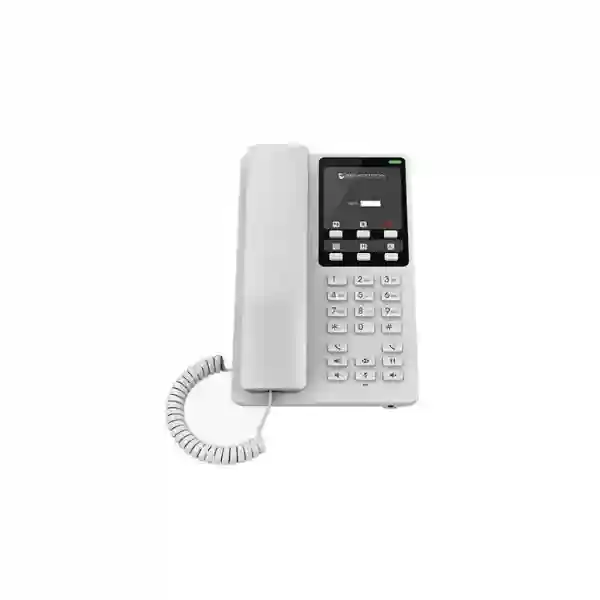
Grandstream GHP620W Tanzania
Grandstream GHP620W Tanzania is a compact, hotel-focused SIP phone designed for guest rooms and other environments where straightforward calling, programmable service access and centralized administration matter more than a large screen. Grandstream positions the GHP620W within its GHP hotel-phone family for hotels, apartments, dormitories, hospitals, retail and similar deployments. The model supports two SIP accounts and two lines, six programmable keys, ten speed-dial keys, three-way voice conferencing, an HD handset, full-band Opus support and centralized provisioning through the Grandstream Device Management System (GDMS). For projects using newer hardware revisions, Grandstream documentation identifies dual-band Wi-Fi 6 support on hardware version 5.0 and above; earlier revisions use dual-band 802.11a/b/g/n/ac Wi-Fi. Buyers should therefore confirm the hardware revision supplied when Wi-Fi 6 is a requirement.
For a Tanzanian hospitality project, the value of the GHP620W is not simply that it is a phone with Wi-Fi. The larger consideration is how the endpoint fits the property’s call flows, wireless coverage, SIP platform, guest-service workflow, emergency calling policy, VLAN design, provisioning process and support model. A hotel may want dedicated keys for reception, housekeeping, room service, concierge, security or reservations. A hospital or serviced apartment may use similar shortcuts for nursing, reception, maintenance or facilities. Because the phone can be centrally provisioned and monitored through GDMS, it can fit projects where administrators need repeatable configuration across many rooms without treating every handset as a one-off device.
Two SIP accounts and two lines support practical hotel and shared-space calling workflows.
Map frequently used guest or facility services to labeled keys for faster access.
Wireless connectivity can simplify placement where running a dedicated data cable to every phone is impractical.
Centralized provisioning and monitoring can reduce the administration burden in multi-room deployments.
What the Grandstream GHP620W is designed to solve
Hospitality phones have different priorities from ordinary executive desk phones. A guest should be able to pick up the handset, reach hotel services quickly, understand the labeled service buttons and complete a call without navigating complicated menus. Administrators, on the other hand, need predictable provisioning, extension registration, firmware control and configuration consistency. The GHP620W addresses these two sides of the requirement with a compact no-display design, programmable service keys, speed-dial capacity and centralized management. It is especially relevant when the hotel wants a purpose-built endpoint rather than deploying a general office phone in every room.
The six programmable keys can be assigned according to the property’s own call-flow plan. A resort may prioritize reception, restaurant, spa, housekeeping, security and concierge. A business hotel may prefer front desk, reservations, room service, housekeeping, operator and emergency assistance. A hospital ward could adapt the same concept for reception, nurse station, billing, pharmacy, security and facilities. Because labels and functions can reflect the operational environment, the handset becomes part of the service workflow rather than only an extension number.
Verified Grandstream GHP620W feature highlights
| Area | Verified capability | Why it matters |
|---|---|---|
| SIP | 2 SIP accounts, 2 lines | Supports practical extension and line planning for guest-room or shared-area use. |
| Keys | 6 programmable keys and 10 speed-dial keys | Useful for one-touch hotel services and familiar operational shortcuts. |
| Audio | HD handset, wideband audio, full-band Opus codec support | Supports clearer voice communication when the network and PBX path are correctly configured. |
| Conferencing | Up to 3-way audio conferencing | Allows simple multi-party voice conversations without a separate conference device. |
| Wireless | Dual-band 2.4GHz and 5GHz Wi-Fi; newer hardware revisions support Wi-Fi 6 | Gives deployment flexibility while still requiring proper hospitality Wi-Fi planning. |
| Management | GDMS centralized provisioning, configuration and monitoring | Useful for standardizing large room counts and reducing per-device administration. |
| Security | Secure boot, device certificates, encrypted configuration, SRTP/TLS and 802.1X support | Supports more controlled endpoint deployment when security features are properly integrated. |
| Installation | Desktop or wall-mounted deployment | Allows room layouts to determine placement rather than forcing one mounting style. |
Grandstream also documents an advanced jitter-resilience algorithm designed to tolerate up to 30% packet loss without impacting voice quality under the vendor’s stated conditions. This should not be treated as permission to ignore network quality. In a real hotel, good voice performance still depends on wireless signal, interference, roaming behavior, latency, SIP service, firewall rules, QoS design and internet or WAN quality where calls leave the property.
Wi-Fi deployment and hardware-revision planning
The GHP620W is the wireless variant of the GHP620 family. Grandstream’s current documentation distinguishes hardware revisions: devices below hardware version 5.0 use dual-band 802.11a/b/g/n/ac Wi-Fi, while current documentation and datasheets identify Wi-Fi 6 support for hardware version 5.0 and above. Procurement teams that specifically require 802.11ax should include the hardware revision in the quotation request and verify it before deployment. This avoids assuming that every unit carrying the same retail model name has identical radio capability.
Wireless hotel phones should also be treated as managed clients, not as isolated consumer devices. Before a large room rollout, survey the property for 2.4GHz and 5GHz coverage, channel use, access-point placement and expected client density. Voice traffic benefits from consistent signal quality and stable roaming behavior. Guest Wi-Fi, staff Wi-Fi and operational voice devices may need different SSIDs or VLANs, depending on the architecture. For broader wireless design, FourTeck Tanzania’s Wi-Fi and wireless access point guidance explains why coverage, capacity, segmentation and wired backhaul should be considered together.
PBX compatibility and call-flow design
The GHP620W is a SIP endpoint, so the PBX or hosted voice platform must support the required SIP registration, codecs, dial plan and call features. Grandstream UCM systems are a natural ecosystem pairing, but buyers should still validate the exact deployment design, especially when using third-party PBX platforms or SIP trunks. A hotel may need room extensions, front-desk supervision, wake-up calling through the PBX or property-management workflow, emergency routing, voicemail rules, room-status processes and outbound call restrictions. Those features depend on the communications platform and configuration, not the handset alone.
For Tanzania projects that include a new or replacement phone system, review FourTeck Tanzania’s IP PBX and VoIP solution planning alongside the handset purchase. The PBX design should define extension ranges, trunk capacity, IVR, queues, after-hours routing, room dialing rules, service short codes, recording policy where applicable and resilience. A clear plan makes handset provisioning easier because every device follows a known template.
Who should consider the GHP620W?
Hotels and Resorts
Guest rooms can use dedicated buttons for front desk, reservations, restaurant, housekeeping, concierge, security and other services.
Serviced Apartments
Properties that want a compact room phone without a large display can standardize a simple endpoint across apartments.
Hospitals and Clinics
Rooms, wards or patient areas can use direct service keys where a simple voice endpoint is preferred.
Dormitories and Residences
Shared accommodation can use centrally managed SIP endpoints for reception, security and facilities communication.
Grandstream GHP620W Tanzania
For buyers searching Grandstream GHP620W Tanzania, the strongest use case is a hospitality or shared-accommodation project that needs simple room calling with centralized management. Tanzania has a wide range of hotel formats, from city business hotels and serviced apartments to safari lodges, coastal properties, hospitals, student residences and institutional accommodation. These environments do not all have the same cabling, wireless coverage or PBX architecture, so the handset decision should begin with the site rather than with a product list. Confirm the number of rooms, extension plan, service-button layout, PBX platform, SIP trunk arrangement, Wi-Fi coverage, power method, mounting style and support responsibility before quantity is finalized.
In a new-build Tanzanian hotel, the GHP620W may reduce dependence on a dedicated Ethernet drop at the bedside when a professionally designed Wi-Fi network is already part of the project. In an existing property, it may be useful where pulling new cable would disrupt finished rooms. That flexibility does not remove the need for reliable power and strong wireless design. Room construction, reinforced walls, corridors, lifts, kitchens and service areas can affect radio performance. A pilot room or sample floor is often valuable before mass rollout because it validates signal quality, provisioning and guest-service key behavior under real conditions.
Procurement teams should request the exact model, colour, hardware revision, quantity, power accessories, faceplate requirements, PBX details and deployment location. If Wi-Fi 6 is part of the specification, ask for hardware-version confirmation rather than assuming it from the GHP620W model name alone. FourTeck Tanzania can align the phone with broader business technology purchasing, including voice-ready networking, Wi-Fi access points, switches, PBX platforms, UPS protection and structured cabling. The objective should be a complete room-communications design that remains manageable after installation, not simply a shipment of handsets.
Grandstream GHP620W Dar es Salaam
Grandstream GHP620W Dar es Salaam projects are likely to be driven by hotels, serviced residences, hospitals, corporate accommodation and hospitality developments that need a repeatable room-phone standard. In a dense urban environment, Wi-Fi planning deserves particular attention because neighbouring networks, multiple access points, meeting spaces, guest devices and back-office systems may all share the radio environment. A hotel deploying wireless guest-room phones should assess 5GHz coverage carefully rather than relying on lobby or corridor measurements. The actual room location, handset position, wall materials and door construction can change signal quality significantly.
Dar es Salaam properties also benefit from designing the phone around the guest journey. Six programmable keys can be assigned to the functions guests genuinely use, while the ten speed-dial positions can support additional shortcuts according to the hotel’s operating model. The labels should match the call destinations programmed in the PBX, and front-desk staff should have a clear reference for how each room phone behaves. When rooms are renumbered or floors are renovated, centralized templates through GDMS can make updates easier than manually rebuilding every handset.
Before requesting a quotation in Dar es Salaam, identify room count, spare-unit strategy, PBX type, SIP trunk provider, wireless SSIDs, VLAN requirements, access-point model, expected hardware revision and whether phones will be placed on desks or walls. If the property already has IP phones, a small compatibility test can confirm codecs, DTMF, transfers, voicemail access and service buttons. Where the project also includes switching and wireless infrastructure, FourTeck Tanzania can review the room endpoints together with network, telephony and deployment services so the voice system is designed as one operational platform rather than separate purchases.
Grandstream GHP620W Mwanza
Grandstream GHP620W Mwanza requirements can come from hotels, lakeside hospitality properties, health facilities, residences and organizations that want a compact SIP phone with wireless deployment flexibility. The first design question should be whether the room environment already has dependable business-grade Wi-Fi. A phone that depends on wireless connectivity should be tested at the final installation position, not only near an access point. Multi-storey buildings, concrete structures, service corridors and back-of-house areas can create coverage differences, and a voice endpoint needs stable connectivity throughout normal operation.
For a Mwanza hotel, service-button planning can reduce unnecessary reception transfers. Dedicated programmable keys can make front desk, housekeeping, restaurant, maintenance or security easier to reach. The PBX must then route each shortcut correctly according to operating hours and staffing. A service key that points to an unanswered extension creates frustration, so button design should follow actual workflow. Properties with different service patterns between day and night can use PBX time conditions to keep the guest-facing phone simple while the backend routing changes automatically.
Procurement should also include lifecycle questions. Ask how devices will be provisioned, how firmware will be managed, who maintains the extension database and how a failed handset is replaced without manual rebuilding. GDMS support makes centralized configuration possible, which is particularly helpful when the property has many rooms or more than one site. Quantity planning should include a sensible number of spare units based on the operational criticality of guest-room calling. Buyers can use FourTeck Tanzania’s integrated IT and telecom overview to coordinate phones with wireless, switching, security and supporting infrastructure instead of handling each layer separately.
Grandstream GHP620W Arusha
Grandstream GHP620W Arusha deployments are especially relevant to hotels, lodges, tourism businesses, hospitals, serviced accommodation and institutional residences that want simple room communications. Hospitality sites around Arusha can vary from compact city hotels to larger resort-style properties, so one phone configuration should not be copied blindly across every project. A small hotel may use one PBX, one voice VLAN and a straightforward set of service keys, while a larger lodge may need multiple buildings, wireless backhaul considerations, separate network zones and more detailed extension routing.
Wireless design is particularly important when rooms are distributed across several blocks or buildings. The GHP620W can reduce the need for a data cable at every handset position, but the voice service still depends on the access-point network. Outdoor paths, detached rooms and thick construction materials can create dead zones. A site survey and pilot deployment should validate actual call quality and roaming behaviour where relevant. If a property uses satellite, fixed wireless or another WAN service for external SIP traffic, the PBX and firewall design should also account for latency, jitter and resilience.
Arusha buyers should prepare quotations with room count, spare count, PBX make and model, extension numbering, required service labels, Wi-Fi standard, access-point inventory and installation method. If the property wants consistent branding, the GHP family’s swappable faceplate concept may support customized presentation, subject to vendor ordering options and artwork requirements. The goal is to give guests an intuitive handset while administrators retain centralized control. FourTeck can also coordinate the phone requirement with switching, Wi-Fi, PBX and infrastructure selection for a more complete hospitality technology bill of materials.
Grandstream GHP620W Dodoma
Grandstream GHP620W Dodoma projects may serve hotels, government-linked accommodation, hospitals, educational residences, serviced apartments and business facilities where simple SIP room phones are preferred. The compact design can be useful when the handset must fit bedside tables, wall positions or smaller room furniture. Because the phone is intended for straightforward operation, the larger intelligence sits in the PBX, provisioning platform and network. That makes design documentation important: administrators should know which extension belongs to each room, what each programmable key does and how the device is re-provisioned after replacement.
For wireless deployment in Dodoma, verify access-point coverage under real room conditions. A successful guest Wi-Fi installation does not automatically guarantee ideal voice behavior because voice is sensitive to packet delay and interruptions. Separate operational SSIDs or VLAN policies may be appropriate depending on the network design. QoS settings can also help prioritize voice traffic across managed switches and routers, but QoS should be applied end to end and tested rather than configured as a checkbox.
When buying for a new facility, include the GHP620W in the broader room-technology schedule alongside access points, switches, firewall, PBX, racks, UPS and cabling. Even a Wi-Fi phone still needs dependable electrical power, and the network supporting it should have backup if telephone availability is important during short outages. Ask suppliers to state exactly what is included with the phone and confirm the hardware revision where Wi-Fi 6 is required. A clear quotation should separate handset quantity, any optional faceplate customization, network equipment, PBX work, provisioning and installation so project teams can compare scope rather than only unit price.
Grandstream GHP620W UAE
Grandstream GHP620W UAE demand commonly fits hotels, hotel apartments, resorts, hospitals, dormitories and large residential developments where a purpose-built room phone is more appropriate than a feature-heavy office handset. In the UAE, many hospitality properties operate dense managed Wi-Fi environments, and the GHP620W can be integrated as an operational wireless client when the design provides dependable room-level coverage. Newer hardware revisions support Wi-Fi 6 according to Grandstream documentation, while earlier units use 802.11ac-era dual-band Wi-Fi, so project specifications should state the expected revision where radio standard matters.
The phone’s six programmable keys can support room-service workflows, but the key labels should be tied to real PBX routing and staffing rules. A multilingual guest population may also influence how labels, printed faceplates and room instructions are presented. The handset itself supports a simple no-display experience, so properties should place essential guest guidance on the faceplate or nearby room information rather than expecting users to navigate on-screen menus.
For multi-property groups operating between Tanzania and the Gulf, standardization is one of the strongest benefits of a consistent endpoint family. Extension templates, firmware policy, key layouts and provisioning processes can be repeated while local trunks and room numbering remain site specific. UAE customers can explore the broader FourTeck UAE technology portfolio, while groups standardizing Grandstream hospitality systems across regions can use a common specification and then validate local PBX, network, regulatory and procurement details at each property.
Grandstream GHP620W Uganda
Grandstream GHP620W Uganda projects can serve hotels, lodges, hospitals, apartments, residences and institutions that need reliable room-to-service calling with centralized SIP management. The wireless model can be useful where a property has good managed Wi-Fi but limited room cabling, particularly during renovation projects. Before choosing Wi-Fi as the primary transport, teams should test signal coverage in representative rooms and check whether the existing access points support the expected number of operational and guest devices without congestion.
The phone should be designed as part of a full voice system. Two SIP accounts provide flexibility, but most guest-room deployments will still depend on PBX features such as room extensions, internal dialing, service groups, time-based routing and outbound restrictions. Six programmable keys are valuable only when the backend call destinations are maintained. If a housekeeping or restaurant extension changes, centralized provisioning should update the affected phones consistently rather than relying on manual edits.
Uganda buyers should specify whether the project is a new hotel, replacement of analog room phones or extension of an existing IP PBX. Existing sites may need a staged migration so old and new extensions coexist during renovation. New-build sites should plan the phone together with wireless, switching and power backup. For wider regional coordination, the FourTeck network provides East African project context through its Uganda technology site and Tanzania resources, allowing procurement teams to discuss standardization without assuming identical logistics or service conditions in each country.
Grandstream GHP620W Kampala
Grandstream GHP620W Kampala is relevant to city hotels, serviced apartments, hospitals, education accommodation and business residences that want a compact guest or room phone with wireless networking. Kampala properties often combine guest Wi-Fi, staff devices, CCTV, point-of-sale terminals, building systems and voice endpoints on shared network infrastructure, so segmentation and capacity planning become important. A dedicated operational SSID or VLAN can keep the phone estate logically separate from guest devices, while firewall and switching policies control access to the PBX and management services.
A pilot deployment is useful before a large rollout. Configure several rooms on different floors, test incoming and outgoing calls, service keys, voicemail access, conferencing, DTMF and failover behaviour, and then validate signal strength during busy network periods. This catches issues that a desk test near the IT room will miss. It also gives front-desk and housekeeping teams an opportunity to review the key labels before custom faceplates are ordered or large-scale configuration is locked in.
Kampala procurement teams should request exact quantities, spare units, hardware revision, included power accessories, expected colour, PBX details and required deployment support. Do not evaluate the quotation only by handset price. Wireless access-point upgrades, PBX licensing or capacity, configuration services and power continuity may affect the real project cost. A room phone works best when infrastructure dependencies are budgeted at the beginning rather than discovered after delivery.
Grandstream GHP620W Arua
Grandstream GHP620W Arua can suit hotels, healthcare facilities, NGO accommodation, residences and institutional sites that want a manageable SIP phone for rooms or shared spaces. In locations where specialized support resources may not always be physically close, centralized provisioning becomes particularly valuable. GDMS can provide a consistent method to configure and monitor Grandstream endpoints, while documented PBX templates allow replacement phones to be prepared without rebuilding every setting from memory.
Arua deployments should pay careful attention to the reliability of the local network and power environment. Wireless phones depend on access points, switches, routers, firewall and PBX services even if there is no Ethernet cable at the handset. Critical network equipment should be connected to appropriate power protection and backup according to the site’s continuity requirement. If external calling relies on an internet-based SIP trunk, the WAN link and failover approach should also be reviewed. Internal extension calling may continue during an internet outage if the PBX is local and the LAN remains powered, depending on the architecture.
When preparing a quotation, describe the building layout, room count, current Wi-Fi infrastructure and PBX platform. If the project is a renovation, identify which rooms are completed first and whether old analog phones must remain active temporarily. A phased rollout can reduce operational disruption and gives the team time to standardize provisioning, key labels and support procedures before every room is converted. The GHP620W is most effective when deployment discipline is treated as part of the product decision.
Grandstream GHP620W Mbarara
Grandstream GHP620W Mbarara deployments may be appropriate for hotels, hospitals, educational residences and growing hospitality properties that want SIP room phones without installing a large-screen office handset in every room. The product’s compact format and programmable service keys can make guest interactions simpler, while administrators gain centralized provisioning and standard configuration. For a hotel, this division of responsibility is useful: the guest sees only the essential calling experience while IT staff retain control of accounts, network settings and firmware.
Wireless planning should include room-by-room signal conditions, not only theoretical coverage maps. Furniture, walls and building extensions may affect 5GHz performance, while crowded 2.4GHz channels can create interference. The access-point design should therefore provide adequate signal and capacity at the phone location. Voice networks can also benefit from carefully designed QoS and VLAN segmentation, particularly when the same uplinks carry guest internet, CCTV and business data.
Mbarara buyers should clarify whether the GHP620W is being added to an existing PBX or delivered with a new communication system. Existing PBX projects need SIP compatibility confirmation and a test extension. New systems should be sized for room count, staff extensions, call concurrency and future growth. Spare handsets and standardized configuration backups can simplify maintenance. A good proposal should explain not only the unit quantity but also how the phones will be provisioned, tested, labeled, documented and supported after handover.
Grandstream GHP620W Gulu
Grandstream GHP620W Gulu is a practical consideration for hospitality, health, education and accommodation projects that need straightforward SIP voice access in rooms. The lack of a large display can be an advantage where the desired user experience is intentionally simple. Guests or residents can use labeled keys for specific services instead of navigating menus, while standard dial keys still support normal extension or external calling according to PBX permissions.
For a Gulu property with limited structured cabling to individual rooms, the Wi-Fi model may simplify endpoint placement if the existing wireless infrastructure is strong enough. However, project teams should resist using wireless only because it appears easier. A building may need additional access points or a redesign of channel and power settings to support dependable voice clients. The cost of those changes should be compared with any cabling work that would otherwise be required. The best transport choice is the one that delivers predictable service and manageable support.
Operational planning should include device naming, room-extension mapping, password policy, firmware process and escalation contacts. Centralized tools reduce effort only when administrators maintain an accurate device inventory. During commissioning, every room should be tested for dial tone, inbound calling, service keys, volume, mute, hold and any PBX-specific functions. A signed room-by-room checklist can make handover clearer for hotel management and technicians.
Grandstream GHP620W Kenya
Grandstream GHP620W Kenya projects fit hotels, serviced apartments, resorts, hospitals and student accommodation that need a compact Wi-Fi SIP endpoint with hotel-oriented controls. Kenya has a diverse hospitality market ranging from Nairobi business hotels and coastal resorts to safari properties and institutional accommodation. The deployment architecture should reflect the site: an urban hotel may have dense Wi-Fi and fiber internet, while a remote lodge may depend on wireless or satellite WAN links. In both cases, internal room communication should be designed to remain as stable as the local infrastructure allows.
The GHP620W’s programmable keys are particularly valuable when properties want one-touch service access. PBX design should support clear groups for front desk, reservations, housekeeping, restaurant, security and maintenance. If several hotels in a group use the same endpoint, templates can standardize key positions while extension numbers remain local. GDMS can support centralized management across Grandstream endpoints, which helps when IT responsibilities span several sites.
Kenyan buyers can review complementary project categories through the FourTeck Kenya technology site. A complete quote should list handset quantity, spares, Wi-Fi hardware revision, PBX capacity, access-point readiness, provisioning scope, installation and testing. Hotels planning future renovations should also retain configuration records so replacement or additional phones follow the same room standard. The endpoint purchase becomes more valuable when it is part of a documented, repeatable hospitality communications design.
Grandstream GHP620W Kuwait
Grandstream GHP620W Kuwait is relevant to hotels, hotel apartments, hospitals, residences and accommodation facilities that need a compact SIP room phone with wireless connectivity. Properties with modern managed Wi-Fi can use the wireless model where cable access to the handset position is limited or where room layouts change. Radio design should still separate operational reliability from guest convenience: the phone should connect to a controlled wireless profile with appropriate authentication, network access and quality policies rather than simply sharing an unrestricted guest network.
In large hospitality properties, centralized configuration can simplify moves, replacements and renovations. Administrators can maintain a template for language-independent service labels, line registration, codecs and call behavior while each room receives its own extension details. Where faceplate customization is used, artwork should match the final PBX key mapping before production. This reduces the risk that a printed “Housekeeping” key points to a changed or incorrect destination after commissioning.
Kuwait procurement teams should confirm the exact hardware revision, power requirements, included accessories and any regional compliance documentation required by the project. Do not assume that a published online price includes the same accessories, warranty channel or services as a project quotation. The full evaluation should include PBX, wireless capacity, deployment labour, provisioning, testing, documentation and support responsibility. For multi-country groups, the same phone model can be standardized while local telecom and procurement requirements are handled separately.
Grandstream GHP620W Ghana
Grandstream GHP620W Ghana projects can support city hotels, coastal hospitality, hospitals, apartments, dormitories and business accommodation where a simple Wi-Fi SIP phone is preferred. The model’s two SIP accounts, programmable keys and GDMS support make it suitable for standardized room deployment, but the network environment should be validated first. Wireless calling depends on signal coverage, interference and access-point capacity, and external SIP services may additionally depend on the quality of the internet connection.
For hotels in Ghana, procurement should start with operational questions. How many rooms need phones? Which guest services deserve one-touch keys? Is the PBX on site, hosted or managed by a service provider? Will the phones use one SSID across the property? Who will update extensions when rooms are renovated? These answers define the deployment more accurately than choosing the handset only from its feature list.
The FourTeck Ghana technology site can provide regional context for broader business technology requirements. For a hotel group operating in both Ghana and Tanzania, a shared endpoint standard may simplify training and spares, while each site keeps its own PBX numbering, trunks and network policies. A pilot floor, documented configuration and spare-unit procedure can reduce rollout risk and make long-term support more consistent.
Grandstream GHP620W Nigeria
Grandstream GHP620W Nigeria is suited to hospitality groups, serviced apartments, hospitals, residences and facilities that want a compact SIP endpoint with Wi-Fi flexibility. In larger Nigerian properties, the phone may sit on the same physical infrastructure as access points, CCTV, guest internet, payment systems and back-office applications. Proper VLAN design and network documentation help keep voice traffic controlled and easier to troubleshoot. The phone’s security features, including secure boot, encrypted configuration support, SRTP and TLS capability, should be incorporated into the broader security policy rather than treated as automatic protection.
Because many hospitality organizations operate multiple sites, centralized management can be particularly useful. Templates can standardize service keys and phone behavior while each property receives local extension ranges. When a unit fails, a documented replacement workflow can restore service quickly. That process should cover inventory, room assignment, configuration, testing and final update of the device list. Without documentation, even a centrally managed phone estate can become inconsistent over time.
Nigeria buyers can explore regional business technology through the FourTeck Nigeria site. A procurement request should include quantity, building type, PBX information, Wi-Fi details, service-key plan, hardware-revision requirement and expected installation scope. Comparing quotations on this common basis makes it easier to distinguish a handset-only offer from a complete deployment proposal.
Grandstream GHP620W Seychelles
Grandstream GHP620W Seychelles is a natural fit for resorts, hotels, serviced accommodation and hospitality properties where room communications must remain simple for guests while being manageable for technical teams. Resort environments can include detached villas, multi-building layouts and outdoor pathways, all of which make wireless design more complex than a conventional office floor. If the GHP620W is used over Wi-Fi, the access-point plan should verify signal inside actual guest rooms and villas, not only in shared areas.
A resort may want programmable keys for reception, concierge, restaurant, housekeeping, spa and security. Those keys should be tied to resilient PBX destinations, such as ring groups or queues, rather than single staff extensions where appropriate. If the property operates around the clock, after-hours routing should be defined so service buttons continue to reach an active team. The handset can stay simple while the PBX manages time conditions and failover.
Seychelles procurement may also require careful spare planning because replacement lead times can be more significant for island operations. Properties should keep an appropriate number of pre-approved spare units and maintain configuration templates so a failed phone can be replaced predictably. Where Wi-Fi 6 is specified, confirm hardware revision before shipment. The full project should account for phone quantities, spares, wireless coverage, PBX, power continuity, configuration, testing and support documentation rather than focusing only on unit cost.
Related FourTeck Tanzania solutions
IP PBX and VoIP
The room phone needs a SIP platform, extension plan, trunks and call routing. Review FourTeck Tanzania’s telephony and communications services when the PBX is part of the project.
Wi-Fi and Networking
Wireless room phones depend on access-point coverage, switching, VLANs and routing. Use the FourTeck Tanzania shop and category guidance to plan supporting infrastructure.
Integrated Project Support
Phones, PBX, Wi-Fi, switching and UPS should be designed together. The FourTeck Tanzania company overview explains the integrated business-technology approach.
Buying and sizing guidance
Before placing an order, create a room schedule that lists every extension location, room number, handset model, mounting type and required key labels. Add staff or public-area phones separately because they may need different capabilities. Then map the room schedule to the PBX extension list. This simple process prevents duplicate numbers, missing rooms and last-minute labeling changes. It also creates a useful commissioning checklist.
Next, confirm the wireless architecture. Record the SSID, authentication method, VLAN, IP addressing approach and access-point coverage at each floor or building. If the property uses a mix of older and newer access points, test the actual hardware revision of the GHP620W that will be delivered. Do not assume Wi-Fi 6 is necessary for good voice performance; coverage and stability are more important, but if 802.11ax is a formal project requirement the hardware version must match.
Finally, separate device procurement from service scope. A handset-only quotation is not the same as a complete room-phone deployment. Installation can include unpacking, labeling, mounting, power connection, network association, SIP registration, key programming, firmware update, test calls and documentation. Decide which of those tasks are required and who owns them. This makes supplier comparisons more accurate and reduces gaps at handover.
Quotation checklist for Grandstream GHP620W
Include these details when requesting a quote:
- Required quantity and number of spare units.
- Project city and property type.
- Existing or proposed PBX platform.
- Number of guest rooms and staff extensions.
- Required hardware revision where Wi-Fi 6 is mandatory.
- Service-key labels and destinations.
- Wi-Fi SSID, security and VLAN design requirements.
- Wall or desktop mounting preference.
- Provisioning, installation and testing scope.
- Any faceplate branding requirement.
- Required project timeline and phased-rollout plan.
Frequently asked questions
Does the Grandstream GHP620W support Wi-Fi 6?
Grandstream’s current documentation states that newer hardware revisions support dual-band Wi-Fi 6, while earlier hardware revisions use dual-band 802.11a/b/g/n/ac. If Wi-Fi 6 is mandatory, request confirmation of the hardware revision before purchase.
How many SIP accounts does the GHP620W support?
The GHP620W supports two SIP accounts and two lines. The actual PBX features available depend on the SIP platform and configuration used in the deployment.
Can hotels program direct keys for reception and housekeeping?
Yes. The phone provides six programmable keys plus ten speed-dial positions. Properties can map keys to services according to the PBX call-flow design and chosen labeling.
Can the phone be centrally managed?
Yes. Grandstream supports centralized provisioning, configuration and monitoring through GDMS. Central management is especially useful for multi-room or multi-site deployments.
Is the GHP620W only for hotels?
No. Grandstream also positions the GHP family for apartments, dormitories, hospitals, retail and other environments that benefit from a compact, simple SIP endpoint.
Can it work with a Grandstream UCM PBX?
The GHP620W is a Grandstream SIP endpoint and is suitable for integration with Grandstream UCM deployments. The exact call features, extensions, trunks and room workflows should still be designed and tested for the project.
Should I use Wi-Fi or a wired hotel phone?
It depends on room cabling, access-point coverage, renovation constraints and operational preference. Wi-Fi can simplify placement, while wired endpoints may be preferred where structured cabling already exists. Compare the full infrastructure requirement rather than the phone alone.
How do I request Grandstream GHP620W pricing in Tanzania?
Provide FourTeck Tanzania with the quantity, project location, PBX details, room count, hardware-revision requirement, installation scope and any faceplate or key-label requirements. A detailed request makes the quotation easier to compare and reduces missing components.
Decision recap
Choose the Grandstream GHP620W when the project needs a compact white hotel-style SIP phone with wireless connectivity, two SIP accounts, six programmable keys, ten speed-dial keys, HD audio, three-way conferencing and centralized GDMS management. Confirm the hardware revision if Wi-Fi 6 is required. Treat the handset as one component of the hospitality communications system: PBX design, wireless coverage, VLANs, SIP trunks, power continuity, provisioning and operational call flows will determine the real user experience.
Plan your GHP620W deployment with FourTeck Tanzania
Share your hotel or facility location, room count, required quantity, PBX platform, Wi-Fi environment and installation scope. FourTeck can help structure the product requirement and supporting infrastructure discussion before quotation.



Reviews
There are no reviews yet.