
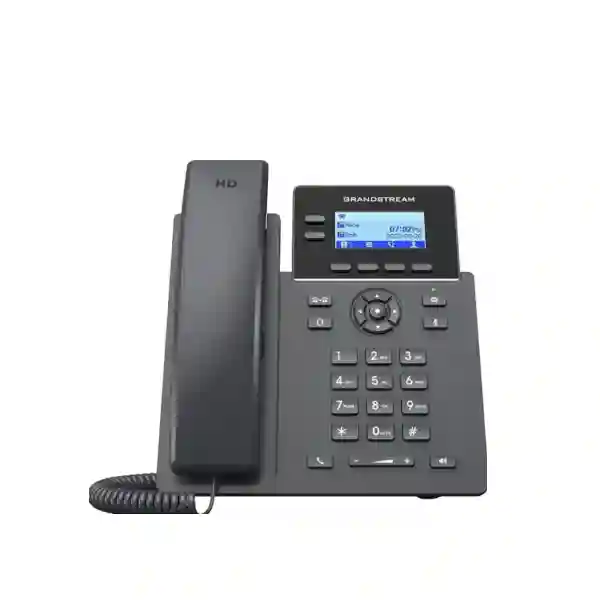
Grandstream GRP2602W Tanzania
The Grandstream GRP2602W is an essential 2-line IP phone designed for manageable, repeatable SIP deployments. It supports four SIP accounts, HD audio, 5-way audio conferencing, centralized Grandstream Device Management System administration and integrated dual-band Wi-Fi 6 on hardware version 5.0 and above. For organizations in Tanzania that want to place business desk phones where a dedicated Ethernet connection is inconvenient, the GRP2602W combines familiar desktop calling with wireless network flexibility.
Lines: 2
SIP accounts: 4
Display: 132 × 48 backlit graphical LCD
Wi-Fi: Dual-band 2.4/5 GHz Wi-Fi 6 on hardware version 5.0+
Management: GDMS
What the Grandstream GRP2602W is designed to solve
Business telephony projects often become difficult at the endpoint layer. A company may have a capable IP PBX and a good SIP service, but the desk phones still need to be easy to deploy, straightforward for users and manageable for administrators. The GRP2602W addresses that requirement as a compact business endpoint that can operate on wired Ethernet while also offering integrated wireless connectivity. This is particularly useful where office layouts change frequently, where desks are not close to network outlets, or where a branch wants to avoid extending structured cabling solely for a small number of voice endpoints.
The phone belongs to Grandstream’s GRP essential series. It supports two lines and four SIP accounts, allowing one device to register multiple SIP identities while keeping daily call handling familiar. Grandstream also supports the model through GDMS, its centralized device-management platform. That gives administrators a practical route to provisioning, configuration, firmware maintenance, monitoring and fleet management, which becomes more important when a project moves from a few phones to dozens or hundreds.
For buyers, the key point is that the GRP2602W should be evaluated as part of the complete voice environment. The phone needs a compatible SIP service or IP PBX, reliable network connectivity, correct call routing, sensible security settings and appropriate Quality of Service policies where the network is busy. FourTeck’s Tanzania services overview explains the wider design approach for IP PBX, phones, switching, Wi-Fi and lifecycle support. The FourTeck Tanzania technology shop is useful when the phone needs to be considered together with switches, wireless access points, firewalls or other business infrastructure.
Grandstream GRP2602W key verified features
2 lines and 4 SIP accounts
The GRP2602W supports two lines and up to four SIP accounts, giving organizations flexibility to assign multiple identities or services to one endpoint while maintaining a simple two-line desktop workflow.
Integrated Wi-Fi 6
Grandstream’s current datasheet states that GRP2602W hardware version 5.0 and above includes integrated dual-band 2.4 GHz and 5 GHz Wi-Fi 6 supporting 802.11a/b/g/n/ac/ax. Confirm hardware revision when Wi-Fi 6 is a mandatory procurement requirement.
HD audio and noise reduction
The phone provides HD audio on the handset and full-duplex speakerphone. Grandstream also lists Noise Shield technology and AI noise reduction for the current GRP2602 family, helping minimize distracting background noise in compatible deployments.
5-way audio conferencing
Built-in support for 5-way audio conferencing enables small teams to create voice conferences directly from the phone without needing a separate conference endpoint for every discussion.
GDMS management
Grandstream Device Management System support allows centralized provisioning, configuration, monitoring and firmware control. This can reduce repetitive manual setup across multi-phone deployments and improve consistency between sites.
Enterprise security functions
Grandstream documents secure boot, dual firmware images and encrypted data storage for the GRP series, along with SIP and media security capabilities such as TLS and SRTP in the GRP2602 specification.
GRP2602W technical specification highlights
| Category | Verified detail |
|---|---|
| Lines / SIP accounts | 2 lines, 4 SIP accounts |
| Display | 132 × 48 backlit graphical LCD |
| Network interfaces | Dual switched auto-negotiation 10/100 Mbps Ethernet ports on GRP2602W |
| Wi-Fi | Integrated dual-band 2.4 GHz / 5 GHz Wi-Fi 6, 802.11a/b/g/n/ac/ax, on hardware version 5.0+ |
| Audio | HD handset and full-duplex HD speakerphone; codecs include G.722 and Opus among others |
| Conferencing | 5-way audio conference |
| Headset | RJ9 headset port with EHS support documented for Plantronics, Jabra and Sennheiser headsets |
| Management | GDMS, TR-069 and encrypted XML configuration support |
| Security | Secure boot, dual firmware images, encrypted data storage, TLS, SRTP, 802.1X and documented authentication options |
| Operating environment | 0°C to 40°C operating temperature; 10% to 90% non-condensing humidity |
| Dimensions / unit weight | 208 × 180 × 63.4 mm with handset; unit weight 670 g |
Procurement note: The GRP2602W does not inherit every feature of the GRP2602P or GRP2602G variants. In particular, the current Grandstream specification lists 10/100 Mbps Ethernet for the GRP2602W and does not list integrated PoE for this variant. If PoE or Gigabit Ethernet is mandatory, compare the correct GRP2602 family model before ordering.
Deployment, compatibility and buying guidance
A business desk phone should be selected with the call platform, network and user role in mind. The GRP2602W is SIP-based, so deployment normally starts with confirming the IP PBX or hosted SIP platform, the number of required extensions, the authentication details, outbound routing and any feature expectations such as voicemail, call transfer, ring groups or queues. SIP interoperability can depend on the server implementation and enabled features, so a proof-of-concept deployment is sensible when an organization is introducing the model into an unfamiliar third-party PBX environment.
Wi-Fi deployment deserves particular attention. Wireless connectivity removes the need for a dedicated network cable to every desk, but voice still requires stable latency, acceptable packet loss and strong radio coverage. In busy offices, the phone should associate to a business-grade wireless network with appropriate coverage and capacity. A voice VLAN or dedicated SSID can simplify policy control, but the exact architecture depends on the access-point platform and network design. FourTeck’s Tanzania technology solutions page covers the relationship between voice, Wi-Fi, switching, security and structured infrastructure.
For large fleets, centralized provisioning reduces variation between phones. Naming conventions, extension templates, firmware policy, local settings and administrator credentials can be standardized. GDMS can support this operating model, while the organization should still maintain change control and document which settings are applied centrally. Where handsets are deployed across multiple branches, standardized configuration also makes troubleshooting easier because every site follows a predictable baseline.
Before requesting a quotation, prepare the quantity, preferred hardware revision if Wi-Fi 6 is essential, IP PBX or SIP platform, expected SIP account configuration, headset requirements, power arrangement, wired versus wireless placement, and any centralized management requirement. The FourTeck Tanzania company page provides context on the broader solution approach, while the Tanzania contact page is the verified destination for a product or deployment enquiry.
Related FourTeck regional and specialist resources
Regional technology sourcing and solution context for Uganda deployments.FourTeck Kenya
Regional IT and communication requirements for organizations operating in Kenya.Grandstream UAE specialist site
Useful for Grandstream-focused requirements in the UAE.FourTeck IP phone solutions
Specialist context for IP desk phones and related telephony endpoints.FourTeck Africa
Cross-market technology sourcing context for African regional projects.
Regional buying and deployment guidance
Grandstream GRP2602W Tanzania
Organizations evaluating the Grandstream GRP2602W in Tanzania are usually trying to solve one of three practical problems: replacing aging analog handsets with SIP endpoints, extending an existing IP PBX with manageable desk phones, or deploying phones in areas where structured Ethernet is limited. The GRP2602W fits the third scenario particularly well because its wireless capability can reduce dependence on a dedicated data outlet at every desk. The phone still needs dependable network quality, however, so wireless convenience should be paired with proper access-point coverage, sensible channel planning and an internet or WAN path that can sustain voice traffic.
For a Tanzania rollout, procurement teams should define whether the phones will register to an on-premises PBX, a hosted SIP service or a multi-site communication platform. This affects firewall rules, DNS, provisioning and redundancy planning. The model supports several voice codecs and standard SIP functions, but actual features such as call queues, recording, IVR and extension mobility are often controlled by the PBX rather than the handset. Buyers should therefore separate endpoint capability from phone-system capability when comparing quotations.
A multi-branch Tanzania project can benefit from GDMS because administrators can manage configuration and firmware more consistently across locations. Create a standard template for extensions, time settings, programmable keys, security policy and user options, then vary only what each branch requires. If Wi-Fi 6 is a decisive requirement, confirm that supplied units are hardware version 5.0 or above, because Grandstream ties that specification to the newer hardware revision. For a quotation, include quantity, branch locations, PBX details, preferred network method, headset requirements and whether FourTeck is expected to provide only the handsets or also configuration, Wi-Fi, switching and IP PBX assistance.
Grandstream GRP2602W Dar es Salaam
In Dar es Salaam, the GRP2602W is relevant to offices, professional services, hospitality sites, logistics businesses, retail operations and branch environments that need business calling without adding unnecessary cabling at every user position. High-density offices can make wireless deployment attractive, but they also make radio planning more important. If many phones, laptops and mobile devices share the same wireless infrastructure, access-point capacity, airtime use and interference should be reviewed so voice does not become unstable during busy periods.
For reception and front-office users, two lines and four SIP accounts can be practical when the user needs more than one identity but does not require a large executive phone with many programmable keys. For supervisors or users who spend much of the day on calls, headset compatibility should be checked against the exact headset model and required EHS workflow. The GRP2602W includes an RJ9 headset interface and Grandstream documents EHS support for major professional headset brands, but the complete accessory combination should be validated before bulk purchase.
Dar es Salaam deployments also benefit from power and continuity planning. Because the GRP2602W variant is not specified with integrated PoE, buyers should account for the supplied power arrangement and protect the network path that the phone depends on. A UPS-backed wireless controller, access point, firewall and PBX can be more important to call continuity than the handset itself. When requesting a quotation, include whether the site uses existing Grandstream UCM, another SIP PBX or a hosted platform, and note any requirement for installation, extension configuration, GDMS enrollment or user handover. That information lets the phone be quoted as part of a functioning voice environment rather than as an isolated device.
Grandstream GRP2602W Mwanza
For businesses in Mwanza, the GRP2602W can suit branch offices, trading companies, hotels, clinics, education environments and distributed operations that want a simple SIP desk phone with wireless placement flexibility. A common branch challenge is that voice requirements grow after the network has already been installed. Instead of adding a new cable run for every additional desk, wireless phones can be considered where the existing Wi-Fi network is strong enough and business-grade security is in place.
The most important planning step is to verify the path between the phone and the PBX. For an on-site PBX, this may be entirely local apart from external trunking. For a cloud-hosted voice service, internet performance becomes part of every call. For a PBX hosted at a head office, WAN connectivity and firewall policy determine whether branch extensions remain reachable. Quality of Service can help prioritize voice where links are congested, but QoS cannot compensate for unstable connectivity or severe packet loss. A site assessment should therefore look at the full chain rather than focusing only on the endpoint.
The GRP2602W’s GDMS support is useful when the Mwanza site is one part of a larger organization. Central IT can apply configuration standards without sending a technician to every desk for routine changes. That can include account settings, firmware policy and monitoring. Procurement teams should still document hardware revision, power requirements, Wi-Fi credentials, extension assignments and administrator ownership. If the site expects future expansion, request a quotation that also considers PBX extension capacity, SIP trunk requirements, Wi-Fi coverage and any need for managed switching. Buying the handset together with the supporting architecture reduces the risk that an apparently simple phone purchase becomes a troubleshooting problem after installation.
Grandstream GRP2602W Arusha
The Grandstream GRP2602W can be a practical business phone for Arusha organizations in hospitality, tourism, professional offices, education, NGOs and branch operations. These environments often mix fixed reception desks, back-office users, shared workspaces and temporary or reconfigured staff positions. Integrated Wi-Fi gives planners more freedom to place an extension where a reliable wireless signal exists, while two lines and four SIP accounts provide enough flexibility for many everyday office roles.
Hospitality and guest-facing businesses should think carefully about call workflow. A front desk may need ring groups, transfer behavior, voicemail or multiple departmental extensions. Those functions are mainly controlled by the PBX, while the phone provides the user interface. Before selecting the GRP2602W for reception or reservations staff, confirm whether the two-line layout is sufficient or whether a higher-end model with more programmable keys would be better. Standard guest-room applications may have very different requirements from administrative desks, so one model does not have to be used everywhere.
For Arusha sites that use wireless connectivity, voice quality should be tested at the actual desk position, not only next to the access point. Walls, floor layout and neighboring networks can influence performance. If the building has several floors or separated wings, roaming behavior and SSID design can also matter for maintenance. GDMS can simplify centralized management when many endpoints are deployed. A useful quotation request should state user roles, quantities by department, PBX model or provider, whether the phones will be wired or wireless, and any need for headsets or remote provisioning. That lets the deployment be designed around real operations instead of assuming every desk has the same call pattern.
Grandstream GRP2602W Dodoma
In Dodoma, organizations considering the GRP2602W may include public-sector offices, contractors, consultancies, education institutions, healthcare operations and private businesses that need standardized SIP handsets. The phone’s combination of straightforward desktop controls, centralized management and wireless connectivity can suit projects where administrators want predictable endpoints without over-specifying every user position. The model is especially relevant to general office staff who need reliable extension calling, transfer, conferencing and headset support rather than a large color-screen executive endpoint.
Procurement should begin with a call-flow and network checklist. Count the required extensions, identify which users need more than one SIP identity, confirm whether the PBX supports the expected features, and note whether the handsets will connect by Ethernet or Wi-Fi. For wireless placement, test the signal and capacity at each intended work area. For wired placement, remember that the GRP2602W itself is specified with 10/100 Mbps Ethernet and not integrated PoE, so power and switch design should reflect the correct model rather than assumptions borrowed from the GRP2602P or GRP2602G.
Standardization can be valuable in multi-building or multi-department Dodoma projects. Create a device naming scheme, assign extension profiles, centralize firmware policy and maintain a current list of endpoints. GDMS can support the administration layer, while local documentation should record who owns the PBX and network configuration. If an organization is replacing analog phones, the project may also require SIP gateway, trunk or PBX changes; the handset alone does not convert an analog telephony environment into an IP system. A quotation should therefore distinguish handset supply, PBX configuration, cabling or Wi-Fi work, user programming, testing and post-deployment support so decision-makers can compare like-for-like proposals.
Grandstream GRP2602W UAE
For organizations operating in the UAE, the GRP2602W is useful when a consistent Grandstream endpoint standard is required across offices, retail branches, service centers, hospitality sites or distributed teams. The phone’s four SIP accounts and two-line interface suit general business users, while GDMS can help administrators manage devices across more than one location. Organizations with operations in both Tanzania and the UAE can also benefit from using a common configuration baseline, even if local SIP services and network policies differ.
The UAE market often includes highly managed office networks with separate VLANs for voice, centrally controlled Wi-Fi and strict security policies. The GRP2602W supports enterprise network functions including 802.1X and documented TLS/SRTP capabilities, but the final security posture depends on the PBX, certificates, provisioning and network configuration. If the phone will use Wi-Fi 6, procurement should confirm the hardware version specified by Grandstream. Existing inventory from older hardware revisions should not be assumed to have the same wireless capability simply because the model name is identical.
Cross-border projects should also avoid mixing regional availability, warranty or service assumptions. A configuration that works technically in one office may still need different commercial terms or support arrangements in another country. Use the FourTeck Grandstream UAE resource for UAE-focused discussion, while keeping Tanzania procurement on the Tanzania site. When requesting a quote for a multi-country rollout, provide a country-by-country quantity, PBX environment, required firmware baseline, headset model, power method and deployment schedule. That creates a clear basis for standardization without assuming stock, delivery or service coverage that has not been confirmed.
Grandstream GRP2602W Uganda
Uganda buyers considering the Grandstream GRP2602W typically need a business SIP endpoint that balances essential features with centralized management. The phone can work well for branch staff, administrative offices, reception support positions and service teams that do not need a large number of physical line keys. Wireless connectivity can be helpful in leased offices, expanding branches and layouts where desk positions move more frequently than the cabling infrastructure.
Before rollout, confirm how the endpoint reaches the voice platform. A local PBX reduces dependence on the internet for internal calls, while a hosted or head-office PBX makes WAN quality more important. Wireless voice should be tested under realistic load, because an access point that works well for occasional web browsing may behave differently when many simultaneous real-time clients are active. Where appropriate, prioritize voice traffic and keep the wireless design clean rather than adding multiple overlapping SSIDs.
For organizations with sites in both Uganda and Tanzania, standard handset models can simplify user training and administration. GDMS provides a common management layer, while country-specific extension numbering, SIP trunks and network settings can be applied separately. FourTeck’s Uganda regional site can support Uganda-focused enquiries. A useful purchasing brief should include the number of phones, locations, expected SIP accounts per user, PBX vendor, wireless or wired preference and any installation requirement. Do not base the purchase only on unit price; compare included power supplies, configuration scope, support expectations and the infrastructure required to make the phones perform consistently.
Grandstream GRP2602W Kampala
Kampala businesses may use the GRP2602W in corporate offices, service desks, retail branches, logistics operations and professional environments where SIP telephony needs to be deployed with minimal disruption to office layouts. The integrated wireless option is useful for desks without convenient data outlets, but buyers should not treat Wi-Fi as a substitute for network planning. Call quality still depends on stable radio coverage, appropriate access-point density and reliable connectivity to the PBX or SIP provider.
The model’s two-line layout is well suited to standard users, but not every role is standard. A receptionist handling many simultaneous calls may need a handset with more programmable keys, while a general employee may value the GRP2602W’s simplicity. Managers who use headsets should confirm accessory compatibility and EHS requirements. Procurement teams can reduce variation by defining a few user profiles—standard desk, reception, supervisor, conference room—and assigning the right endpoint to each profile rather than forcing one device into every role.
For larger Kampala fleets, centralized configuration can save support time. GDMS can assist with provisioning and monitoring, while a documented site profile should cover extension numbering, wireless SSID, DNS, NTP, firmware and security settings. If the organization operates multiple Kampala branches, keep the voice configuration repeatable so new locations can be brought online with fewer manual changes. A quotation request should state whether the buyer needs hardware only or also SIP account setup, PBX integration, Wi-Fi readiness checks and administrator handover. Clear scope is important because many telephony problems appear to be handset faults when the actual issue lies in DHCP, DNS, firewall policy, wireless congestion or PBX configuration.
Grandstream GRP2602W Arua
For organizations in Arua, the GRP2602W can provide a standardized SIP desk phone for branch offices, NGOs, healthcare operations, schools, hotels and commercial sites. Wireless placement may be particularly attractive where existing offices have limited structured cabling or where a branch has expanded beyond the original network design. The endpoint can connect through business Wi-Fi while still providing familiar handset, speakerphone and headset workflows for staff.
Remote branch planning should emphasize resilience. If the phone registers to a PBX in another city or country, the WAN connection becomes part of the voice service. IT teams should understand what happens during internet interruption, whether local dialing remains available, and whether the PBX supports failover or alternate routing. The GRP2602W supports server redundancy and failover functions at the endpoint level, but these features only help when the wider system is designed to use them. Testing should therefore cover actual failure scenarios rather than only successful registration.
Central management is also valuable when technical staff are not permanently based at the branch. GDMS can support remote provisioning, monitoring and firmware management, reducing the need for desk-by-desk intervention. However, secure administrator access and clear ownership of the device fleet remain important. For an Arua quotation, provide branch size, number of extensions, current PBX, internet links, Wi-Fi platform, power arrangement and expected support model. If the branch is part of a wider Uganda rollout, use common phone templates and naming standards while allowing local network parameters to differ. This approach makes it easier to troubleshoot remotely and to add new endpoints later without rebuilding the configuration from scratch.
Grandstream GRP2602W Mbarara
The Grandstream GRP2602W can support Mbarara businesses that want compact SIP endpoints for office staff, reception support, retail administration, hospitality operations or branch communications. Its four SIP accounts give organizations flexibility to assign multiple identities to one device, while the two-line design keeps the physical interface simple. This is useful where staff need dependable call handling without a large number of programmable keys or a complex touchscreen interface.
Wireless deployment should be planned around voice quality rather than convenience alone. A phone installed at the edge of coverage may register successfully but still experience jitter or dropped audio during a call. Before bulk installation, test representative locations at busy times and confirm that the 2.4 GHz or 5 GHz band being used is suitable for the environment. Where the organization has a modern Wi-Fi 6 infrastructure, verify that the GRP2602W units are hardware version 5.0 or later to match Grandstream’s current Wi-Fi 6 specification.
Mbarara projects should also account for support after installation. Document extension numbers, assigned users, MAC addresses, PBX credentials, wireless network settings and firmware versions. If GDMS is used, record the site and template structure so future administrators understand how devices are controlled. Procurement teams should request clarity on what is included: phone hardware, power supply, network cable, configuration, PBX changes, user training and after-sales support may be separate line items. This makes quotations easier to compare and prevents a low handset price from hiding missing deployment work. For branch networks, also review firewall and DNS settings so phones can reliably reach their SIP servers and management services.
Grandstream GRP2602W Gulu
Gulu organizations seeking a manageable business voice endpoint can consider the GRP2602W when they need standard SIP functionality, wireless placement flexibility and centralized device administration. The phone is well suited to general office roles where two active lines and four SIP accounts are sufficient. It can also serve branch staff who need a consistent interface with other Grandstream GRP endpoints used elsewhere in the organization.
A common planning mistake is to evaluate the handset separately from the phone system. Features such as extension dialing, IVR, queues, office-hour routing and call recording are usually PBX functions. The handset exposes those services to the user, but it does not create them by itself. Before ordering, confirm the existing PBX model, available extension capacity and SIP compatibility. If the organization is migrating from analog lines, additional gateways, trunk configuration or number-porting work may be required depending on the chosen architecture.
For Gulu branches connected to a central PBX, WAN performance should be measured. Even a small number of concurrent calls can be sensitive to packet loss and instability. Wireless deployments should also use reliable business access points rather than consumer repeaters where voice is operationally important. GDMS can simplify remote management, particularly if local IT staffing is limited. A strong quotation request should list the exact number of users, desk locations, wired versus wireless connectivity, headset needs, PBX type, branch connectivity and desired configuration scope. If future growth is expected, include the anticipated extension count so the wider voice system is not sized only for the initial batch of phones.
Grandstream GRP2602W Kenya
Kenya buyers can use the GRP2602W for office telephony, hosted SIP deployments, retail branches, service centers and organizations that need a repeatable desk-phone standard. The model’s wireless capability can be useful in co-working environments, temporary office layouts and locations where cabling changes are expensive. For fixed high-density offices, wired Ethernet may still be preferred where convenient because it reduces dependence on radio conditions, but the GRP2602W gives deployment teams both options.
Commercial comparisons in Kenya often focus on handset price, but buyers should compare the complete deployment cost. Check whether the quote includes the power supply, whether configuration is included, what warranty terms apply, whether headsets are part of the scope and whether the PBX needs additional licenses or capacity. The GRP2602W itself does not require a separate subscription merely to function as a SIP phone, but hosted voice services or PBX platforms may have their own licensing and service charges.
The phone’s GDMS support is valuable for multi-site Kenyan organizations because administrators can standardize settings and firmware across branches. For Wi-Fi 6 requirements, confirm hardware version 5.0 or higher rather than relying only on reseller descriptions, as older web listings sometimes show earlier wireless specifications. FourTeck’s Kenya regional site can be used for local project discussions. When standardizing across Kenya and Tanzania, align extension templates, device naming, security settings and user training while keeping local SIP trunks and network details separate. This creates a consistent operating model without assuming that commercial or telecom conditions are identical in both countries.
Grandstream GRP2602W Kuwait
For Kuwait offices, the GRP2602W can serve as an essential SIP endpoint for standard users, branch staff, support teams and administrative desks. Integrated dual-band wireless connectivity offers flexibility where Ethernet outlets are not available at every position, while the two-line interface keeps day-to-day operation straightforward. Organizations with Grandstream systems in multiple countries can also use the model as part of a common endpoint standard, provided each site’s PBX and network configuration is validated separately.
Enterprise environments should evaluate authentication and security requirements before deployment. The GRP2602W supports common SIP and network security technologies including TLS, SRTP and 802.1X, while Grandstream’s platform also includes secure boot and encrypted data storage. Actual use of these features depends on the PBX, certificates, provisioning server and network policy. Security is therefore a system design task rather than a checkbox on the handset specification.
For procurement, distinguish the GRP2602W from sibling models in the GRP2602 family. The wireless model is not the PoE or Gigabit variant, so compare the exact product code and required power method. If Wi-Fi 6 is required, confirm hardware version 5.0 or later. When requesting a Kuwait quotation, provide quantity, intended user profile, PBX or hosted voice platform, headset requirements, Wi-Fi environment and any need for remote provisioning. If the deployment is part of a broader regional standard, ask for consistent configuration documentation so administrators can reproduce the same user experience across sites without copying country-specific SIP or network settings blindly.
Grandstream GRP2602W Ghana
In Ghana, the GRP2602W can be used by companies modernizing office telephony, deploying SIP extensions in new branches or adding endpoints to an existing Grandstream environment. The built-in wireless option is useful where office changes outpace structured cabling, but the design should still prioritize dependable voice performance. Wireless coverage should be measured at the actual handset location, and the network should avoid overloading a single access point with more real-time clients than it can handle consistently.
The phone supports four SIP accounts, which can be useful when staff need more than one identity or service on a single desk endpoint. Organizations should define how those accounts map to PBX extensions, direct numbers or service lines and how users are expected to switch between them. Features such as call pickup, transfer, forwarding and conferencing can then be configured around real workflows rather than simply enabling every available option.
Central management through GDMS becomes more valuable as the fleet grows or spreads across multiple branches. Create a Ghana site template with approved firmware, security settings, time configuration and programmable keys, then document exceptions rather than configuring each phone independently. For purchasing, confirm exact hardware revision, included accessories and support scope. Avoid assuming that the lowest advertised price represents the same package from every supplier. A complete quotation should clarify handset quantity, power, configuration, PBX integration, network readiness and after-sales responsibilities. If the organization also has Tanzania or other African branches, a common GRP2602W standard can simplify user training, but each country’s SIP trunk, numbering and commercial arrangements still need separate validation.
Grandstream GRP2602W Nigeria
Nigeria organizations can consider the GRP2602W for distributed offices, customer-support environments, professional services and branch networks that need a standardized SIP handset with wireless flexibility. In larger deployments, the value of the model is not only its feature list but the ability to provision and manage devices consistently. GDMS can help IT teams organize phones by site and apply repeatable settings, reducing the risk of configuration drift across a large endpoint estate.
Voice deployment should be designed around connectivity conditions. If the PBX is hosted in the cloud or in another city, internet and WAN stability directly affect call quality. Consider redundancy where voice is business-critical, and test failover behavior before relying on it. The phone supports server redundancy and failover-related telephony functions, but these need compatible upstream services. For wireless use, choose business access points with adequate capacity and use 5 GHz where appropriate to reduce congestion, while recognizing that building materials and distance still influence performance.
Procurement teams should verify the exact GRP2602W revision because Grandstream specifies Wi-Fi 6 for hardware version 5.0 and later. They should also distinguish this model from PoE and Gigabit variants in the same family. A useful Nigeria quotation request includes phone quantity, site count, PBX platform, SIP provider, expected concurrent calls, headset requirements, power method and whether centralized management configuration is required. If the organization is standardizing endpoints across Nigeria, Ghana, Tanzania or other countries, define a common base template but leave local numbering plans, trunks and emergency-call policies under country-specific control. This balances consistency with the operational realities of each market.
Grandstream GRP2602W Seychelles
For businesses in Seychelles, including hospitality, professional services, retail and multi-site operations, the GRP2602W offers a compact SIP phone with wireless placement flexibility. Hotels and resorts in particular may have administrative offices where additional Ethernet cabling is inconvenient, while reliable Wi-Fi is already available. In these areas, the phone can provide a business extension without requiring a new data run, provided the wireless network is engineered for dependable real-time traffic.
Hospitality environments should differentiate guest-room telephony from staff and management requirements. The GRP2602W may be appropriate for back-office, reservations, security or administrative desks, but the best model for guest rooms can depend on the hotel PBX, required keys and room-service workflows. For front desk positions, evaluate whether two lines are sufficient or whether a larger multi-line endpoint is more suitable. Endpoint selection should follow each role rather than using one phone everywhere merely for purchasing simplicity.
Seychelles deployments that depend on cloud PBX services should give special attention to internet resilience and local network design. Voice traffic is sensitive to unstable latency even when general web access appears acceptable. Where service continuity is important, consider redundant internet paths and document what happens to internal and external calling during an outage. GDMS can reduce the management burden for phones spread across separate buildings or properties. A quotation should state property or branch count, phone quantity by role, PBX environment, wireless coverage status, headset needs and required configuration support. If the phones are part of a wider regional standard, keep firmware, naming and security policies consistent while validating local telecom requirements independently.
Quotation checklist for the Grandstream GRP2602W
For a useful quotation, provide the exact quantity, deployment country and city, number of branches, existing PBX or hosted SIP platform, required SIP accounts per user, wired or wireless preference, desired hardware revision, headset requirements, power arrangement, and whether configuration or installation is required.
Also identify any supporting requirements such as IP PBX capacity, SIP trunking, Wi-Fi access points, switching, firewall rules, VLANs, UPS protection, structured cabling or remote management. If the request is for a replacement project, provide the current phone model and the reason for replacement so compatibility risks can be identified early.
Do not assume price, stock, lead time, warranty or service coverage from a web page. These are commercial variables and should be confirmed in the active quotation for the destination and quantity required.
Grandstream GRP2602W FAQs
Does the GRP2602W support Wi-Fi 6?
Yes, Grandstream’s current official specification states that GRP2602W hardware version 5.0 and above supports integrated dual-band 2.4 GHz and 5 GHz Wi-Fi 6 using 802.11a/b/g/n/ac/ax. Buyers should confirm the hardware revision when Wi-Fi 6 is mandatory.
How many SIP accounts does the GRP2602W support?
The phone supports four SIP accounts and two lines. This allows multiple SIP identities to be registered on one endpoint while using a compact two-line desktop interface.
Does the GRP2602W support PoE?
Grandstream’s current specification does not list integrated PoE for the GRP2602W. PoE is associated with the GRP2602P and GRP2602G variants. If PoE is required, compare the correct model before purchase.
Can the GRP2602W work with a third-party IP PBX?
The phone is standards-based and supports SIP, but exact interoperability depends on the PBX, firmware, provisioning method and features required. A compatibility check or pilot deployment is recommended when using an unfamiliar third-party platform.
What is GDMS and why does it matter?
GDMS is Grandstream’s centralized device-management platform. It can help administrators provision, configure, monitor and update compatible Grandstream devices, which is particularly useful for larger or multi-site deployments.
Is the GRP2602W suitable for reception desks?
It can suit light to moderate reception use, but receptionists who need many programmable keys or simultaneous line appearances may be better served by a higher-end endpoint. Define the call workflow before choosing the handset.
Does the phone support headsets?
Yes. The specification includes an RJ9 headset connection and EHS support for selected professional headset brands. Confirm the exact headset and cable or EHS accessory combination before bulk deployment.
What should I send when requesting a quote?
Send the quantity, city or country, PBX or SIP platform, number of branches, wired or wireless preference, hardware-revision requirement, headset needs and whether you require configuration, installation or related network work. This enables a more accurate solution discussion.
Decision recap
Choose the Grandstream GRP2602W when the requirement is a compact 2-line SIP phone with four SIP accounts, strong centralized management options and wireless deployment flexibility. Confirm hardware version 5.0 or above when Wi-Fi 6 is required, and do not assume PoE or Gigabit Ethernet features from other GRP2602 variants.
For the best result, treat the phone as part of the wider voice architecture. Verify the PBX, SIP service, network quality, Wi-Fi coverage, security policy, headset requirements and support scope before finalizing the order.
Consult FourTeck Tanzania
If you are planning one phone, a branch rollout or a larger SIP deployment, FourTeck can review the endpoint requirement together with the PBX, wireless network, switching and security dependencies. Share the model, quantity, location and existing communication platform so the quotation can be aligned with the actual deployment.



Reviews
There are no reviews yet.