
Grandstream GRP2610 Tanzania
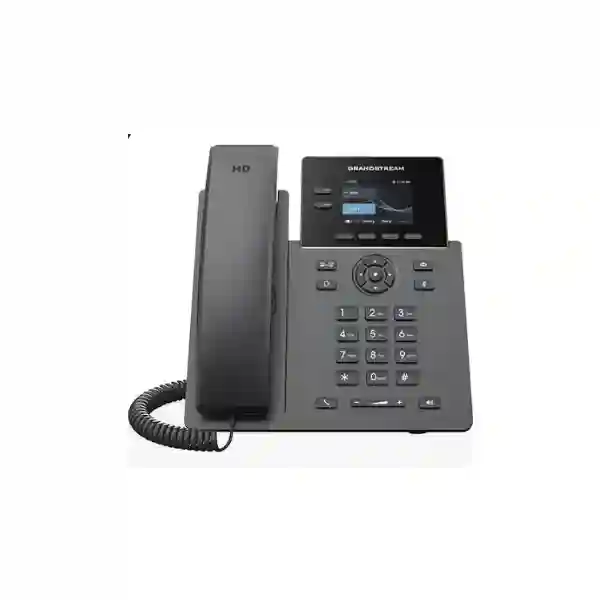
The Grandstream GRP2610 is a 2-line carrier-grade IP phone designed for organisations that want a practical desktop voice endpoint with centralized provisioning, enterprise security and straightforward day-to-day calling. It supports 2 SIP accounts, 2 multi-purpose line keys, up to 8 digital BLF or speed-dial functions, a 2.4-inch 320×240 TFT color display, HD audio, noise shield technology and 5-way audio conferencing. For larger rollouts, Grandstream Device Management System (GDMS) provides a centralized way to configure, provision, manage and monitor compatible endpoints.
Quick answer
GRP2610 is best understood as a professional two-account SIP desk phone for standard business users who need color-screen usability, clear audio, programmable call-control functions and centrally managed deployment without moving into a larger premium handset class.
Power choice
The GRP2610 uses dual 10/100 Mbps Ethernet ports and is supplied with a 5V power adapter. The closely related GRP2610P adds integrated IEEE 802.3af PoE. Buyers should confirm the exact variant before ordering so that desk power and switching design match the intended installation.
Deployment fit
Typical roles include general office desks, administrative staff, branch users, shared workspaces and other positions that need two SIP identities and routine call handling. Reception or contact-centre users with many monitored extensions may need a higher-key-count model.
What the GRP2610 solves for business users
Business telephony becomes difficult to support when every handset is configured differently, firmware is inconsistent and users have no predictable way to reach common call functions. The GRP2610 addresses that problem by combining a familiar desk-phone layout with centralized management through GDMS. For an IT team, that can make it easier to prepare multiple phones using standard configuration profiles, maintain a repeatable extension setup and monitor a larger endpoint estate. For the end user, the focus remains simple: make and receive calls, transfer, hold, use speakerphone or headset, monitor programmed contacts and access common calling functions without unnecessary complexity.
The phone supports 2 SIP accounts and 2 line keys. Those line keys can be digitally programmed with virtual multi-purpose key behavior, providing up to 8 BLF or fast-dial functions through pagination. This is useful when a standard user needs a few monitored colleagues, speed dials or shared call functions but does not require the much larger key field associated with an executive or receptionist console.
Audio quality is also a practical purchasing criterion. Grandstream specifies HD audio for the handset and speakerphone, wideband codec support including G.722 and Opus, and noise shield technology designed to reduce background noise. These capabilities are useful in open offices, shared rooms and other environments where voice clarity can otherwise be affected by nearby conversations or general workplace activity.
Verified GRP2610 technical specification
| SIP / line support | 2 SIP accounts, 2 multi-purpose line keys |
|---|---|
| Display | 2.4-inch 320×240 TFT color LCD |
| Virtual keys | Up to 8 digital BLF / fast-dial functions |
| Network | Dual switched auto-sensing 10/100 Mbps Ethernet ports |
| Power | GRP2610: 5V power adapter; GRP2610P: integrated IEEE 802.3af PoE |
| Audio | HD handset and speakerphone; wideband G.722 and Opus among supported codecs; noise shield technology |
| Conference | 5-way local audio conferencing |
| Headset | RJ9 headset jack with EHS support for compatible Plantronics headsets |
| Management | GDMS, TR-069 and encrypted XML provisioning options |
| Security | Secure boot, encrypted configuration storage, TLS, SRTP, 802.1X, user/admin authentication and dual-firmware-image protection |
| Mounting | Two stand positions; wall mounting supported with separately sold wall-mount accessory |
GRP2610 or GRP2610P?
Choose by power architecture rather than by name alone. The GRP2610 uses an external 5V adapter and 10/100 Ethernet. The GRP2610P keeps the same basic phone concept but adds integrated PoE over its 10/100 Ethernet connection. For an office with PoE access switches and UPS-backed network power, the PoE variant can simplify desk cabling. Where PoE is not available, the non-PoE GRP2610 can be easier to introduce without replacing the switch.
Compatibility planning
Grandstream documents broad interoperability with third-party SIP devices and SIP/NGN/IMS platforms, but production deployment should still validate registration, codecs, dial plan, transfer behavior, voicemail indicators, BLF subscriptions, NAT traversal, SIP trunk policies and any platform-specific provisioning requirements. A short pilot with the intended PBX and network is preferable to assuming every advanced function behaves identically across platforms.
Internal Tanzania resources related to an IP phone deployment
Grandstream GRP2610 Tanzania
For organisations buying the Grandstream GRP2610 in Tanzania, the most useful way to evaluate the phone is to place it inside the complete voice environment rather than treat it as a standalone desk accessory. The handset requires a SIP account, network connectivity, reliable power and a PBX or hosted voice platform that can provide the call features the user needs. In a new office, this may mean planning the GRP2610 at the same time as extension numbering, SIP trunking, VLANs, Quality of Service, switching, firewall policies and structured cabling. In an existing office, the first task is usually simpler: confirm whether the current PBX accepts standard SIP endpoints, whether the access switch has available ports, and whether users need the non-PoE GRP2610 or the PoE-capable GRP2610P.
The model is especially relevant to standard office roles where two SIP identities and a modest number of monitored or speed-dial contacts are enough. Finance staff, administrators, managers, sales desks, branch personnel and shared back-office positions can benefit from a color display, HD audio, headset support and the ability to map frequently used functions without moving to a larger multi-line phone. For businesses deploying many handsets, GDMS becomes important because centralized provisioning can reduce the amount of manual configuration performed at each desk and can support a more consistent device baseline.
Procurement teams in Tanzania should ask for the exact model variant, quantity, included power accessories, expected firmware level, PBX compatibility, delivery scope and configuration responsibility. If the phones will be deployed across multiple branches, it is also useful to document an extension template, user naming convention, VLAN assignment, phonebook source and firmware policy before the first site is completed. That turns the first installation into a repeatable standard rather than a one-off configuration.
FourTeck Tanzania can be approached for the handset requirement together with the wider IP telephony and network context. A quotation request is more actionable when it states whether a customer already has a PBX, which SIP platform is in use, how many extensions are required, whether desk ports provide PoE, whether users require headsets, and whether installation or remote configuration is expected. Buyers comparing national or regional options can also review the wider FourTeck Uganda communications portfolio, FourTeck Kenya VoIP and IT solutions, FourTeck Ghana business telephony resources, FourTeck Nigeria IT services and FourTeck Kuwait communications and network solutions when coordinating standards across countries.
Grandstream GRP2610 Dar es Salaam
A Grandstream GRP2610 deployment in Dar es Salaam often begins with a familiar business requirement: replace scattered analog extensions or inconsistent desk phones with a more manageable SIP-based environment. Offices in commercial buildings, professional services firms, logistics teams, hospitality administration, education, healthcare and multi-branch companies can use a standardized phone profile so users have a predictable calling experience. For these settings, the GRP2610’s two SIP accounts are suitable where a user needs one primary extension plus a secondary identity, shared line or service account, while the virtual multi-purpose keys can be assigned to commonly monitored colleagues or speed dials.
The network preparation should receive as much attention as the handset. Voice traffic is sensitive to packet loss, jitter and congestion, so a stable wired LAN, correctly configured VLANs and suitable Quality of Service policies can have more influence on user experience than simply choosing a phone with a long feature list. If the Dar es Salaam office uses PoE access switches, procurement should consider whether the GRP2610P is the more appropriate variant because it can draw power from the network. If the current switch is non-PoE or desks already have convenient power points, the standard GRP2610 with its external adapter may fit the existing infrastructure without forcing a switching upgrade.
For sites with reception teams, shared departments or several floors, buyers should map user roles before ordering. A general office user may be well served by the GRP2610, while a receptionist who needs to monitor dozens of extensions may require a different model with more visible keys or expansion support. This role-based approach reduces unnecessary cost and prevents standard users from receiving over-specified devices while call-handling staff are under-equipped.
A well-prepared Dar es Salaam quotation should specify phone quantity, PBX or hosted SIP platform, required SIP identities, PoE availability, headset requirements, whether wall mounting is needed, and whether configuration should be performed centrally. If the project includes a branch-office link, internet failover or a firewall change, the voice design should be tested alongside those dependencies. The goal is not just to deliver phones; it is to ensure extensions register correctly, calls route as expected, audio remains stable during busy periods and the support team has documentation that makes future moves and changes straightforward.
Grandstream GRP2610 Mwanza
Businesses considering the Grandstream GRP2610 in Mwanza may be planning a new office, refreshing an existing PBX environment or standardizing phones across a headquarters-and-branch structure. In each case, the handset is most effective when the purchasing decision begins with call behavior rather than a feature checklist. Determine how many users need individual extensions, which roles use headsets, whether staff transfer calls frequently, which colleagues need to be monitored through BLF, and whether any users require a second SIP identity. The GRP2610’s two-account design and up to eight digital BLF or fast-dial functions suit many routine desk positions without creating a complicated user interface.
Mwanza deployments that depend on centralized administration can benefit from GDMS because device profiles can be managed consistently rather than configured as isolated phones. This is particularly valuable where an organisation has a small local technical team but wants a repeatable standard shared with other offices. Before rollout, administrators can define account templates, dial plans, time settings, firmware policy, programmable keys and security settings. A pilot group can then verify registration, transfer behavior, caller ID, voicemail notifications, codecs and any platform-specific features before the same configuration is applied more widely.
Power planning should be explicit. The standard GRP2610 uses a supplied adapter, while the GRP2610P adds integrated PoE. In a location where network equipment is protected by UPS, PoE can help keep endpoints powered during short interruptions as long as the switch and upstream systems remain available. With adapter-powered phones, continuity depends on the local power arrangement at each desk. Neither method is automatically better; the correct choice depends on how the building is cabled and how critical voice continuity is to operations.
For procurement, include the expected number of handsets, the current PBX brand and version, switch model, available ports, PoE status, existing VLAN design, internet or SIP trunk arrangement and rollout schedule. This helps distinguish a simple handset supply request from a broader telephony project. Buyers should also confirm exact model numbers and avoid assuming the PoE feature applies to every GRP2610 label. Clear documentation at the ordering stage makes deployment smoother and reduces the chance that phones arrive before the network or PBX is ready to support them.
Grandstream GRP2610 Arusha
The Grandstream GRP2610 can be a practical fit for Arusha offices, hospitality administration, tour operators, schools, clinics, professional firms and branch locations where employees need dependable desk calling without the complexity of a high-end executive phone. Its value comes from combining common telephony controls with deployment-oriented features such as centralized management and security protections. A 2.4-inch color display gives users clearer visual feedback than a basic monochrome handset, while HD audio, Opus support and noise shield technology are useful for offices where conversations and background activity occur close together.
When the phone is part of a hospitality or customer-service workflow, extension design becomes important. Front-office staff may need rapid transfer destinations, reservations or operations teams may use dedicated speed dials, and managers may need a second SIP account or shared identity. Up to eight virtual multi-purpose functions can cover a modest number of monitored contacts, but teams that need a large operator-style key field should be assessed separately. Matching phone models by role is usually more effective than putting the same handset on every desk simply for visual consistency.
Arusha projects should also consider how the PBX reaches external callers. If SIP trunks or hosted telephony depend on the internet, voice quality and availability are connected to firewall rules, WAN stability, DNS, NAT handling and QoS. A phone can be correctly configured and still deliver poor service if the wider network is congested or unstable. For that reason, a deployment test should include internal calls, outbound and inbound calls, transfers, conferencing, voicemail, busy conditions and failover behavior where a backup link exists.
A clear purchase request should describe the existing voice platform, handset quantity, power method and user profiles. If the site is new, include the network switch and structured cabling status. If the site is an upgrade, state which features must continue working from the old environment. For a multi-site business operating between Arusha and other Tanzanian cities, it is useful to create one configuration standard covering extension ranges, BLF behavior, firmware, security, phonebook sources and support escalation. The GRP2610 is strongest when it becomes part of that repeatable operational standard rather than another independently configured endpoint.
Grandstream GRP2610 Dodoma
For a Grandstream GRP2610 deployment in Dodoma, the purchasing decision can be organized around three questions: what does each user need to do, how will the phone register to the voice platform, and how will the device remain manageable after installation? The GRP2610 is designed for professional mass deployment and standard desk work, so it fits users who need two SIP accounts, routine transfer and hold functions, speakerphone, headset support and a small set of programmable monitored contacts. Its GDMS compatibility adds value where administrators want a centralized view of multiple Grandstream endpoints instead of relying on desk-by-desk changes.
Government-facing suppliers, professional offices, education organisations, NGOs and distributed businesses in Dodoma may have structured approval and procurement workflows. The product specification should therefore be unambiguous: GRP2610 and GRP2610P share core telephony features, but power differs. The GRP2610 uses an external 5V adapter; the GRP2610P adds PoE. State the selected variant on the quotation and purchase order, together with the number of units and any accessories. This avoids a common deployment problem in which the network team expects PoE while the ordered handset requires local power, or vice versa.
Security configuration should also be planned. Grandstream lists secure boot, encrypted configuration, TLS, SRTP and 802.1X among the supported security capabilities. Whether each feature can be used depends on the PBX, certificates, network authentication design and local policy. The best approach is to define what the organisation actually requires and test it. For example, encrypted signaling and media may need compatible server settings; 802.1X requires coordination with the switching and authentication environment.
A deployment checklist for Dodoma should include network port readiness, DHCP or static addressing policy, NTP, DNS, VLAN configuration, PBX credentials, firmware baseline, handset naming, emergency and external dialing rules, call forwarding policy, voicemail and user training. Even a relatively simple two-line phone can become difficult to support if these details are undocumented. Conversely, a modest endpoint becomes very manageable when standard templates and labeling are in place. The GRP2610 should therefore be purchased as part of a defined voice-service process, not only as a piece of desktop hardware.
Grandstream GRP2610 UAE
Organisations evaluating the Grandstream GRP2610 in the UAE may be standardizing branch telephony, adding seats to a SIP platform or replacing older desktop endpoints. The model is useful where a user needs a professional color-screen phone with two SIP accounts and a controlled number of BLF or speed-dial functions. Its centralized GDMS support is particularly relevant for regional businesses that need to apply consistent settings across offices rather than maintain unique configurations at each site.
For UAE projects, integration with the existing voice architecture should be confirmed before quantity procurement. The phone uses standard SIP and supports a broad range of telephony and network protocols, but practical interoperability includes more than basic registration. Test call transfer, caller ID, voicemail notifications, attended and blind transfer behavior, BLF subscriptions, call pickup, conferencing, directory access and any PBX-specific feature codes. If the system is hosted, confirm that firewall and NAT policies allow stable registration and media flow; if it is on premises, review VLAN and QoS settings across the LAN.
The distinction between GRP2610 and GRP2610P is again important because modern UAE offices often use PoE switching to reduce desk-level power adapters. The GRP2610P supports integrated PoE, whereas the GRP2610 relies on its power adapter. When the switching estate already provides 802.3af PoE and is backed by centralized UPS power, the PoE model can simplify cabling. If the office uses non-PoE switches, the standard model may avoid an unnecessary network upgrade.
Regional procurement teams should request a quotation that identifies the exact model, quantity, compatibility assumptions, configuration scope and delivery destination. Businesses with sites in the UAE and East Africa can also use one logical endpoint template for naming, dial plans, time zones, firmware and security while keeping local SIP carrier settings separate. That approach helps an IT team support users consistently even when trunks, numbering plans and network providers differ by country. The phone itself is only one part of that design; disciplined configuration and documentation are what turn a hardware purchase into a scalable telephony standard.
Grandstream GRP2610 Uganda
A Grandstream GRP2610 rollout in Uganda can support businesses that want a consistent desktop calling experience across headquarters, branches and smaller operational sites. The phone’s two SIP accounts are appropriate for standard users, while GDMS helps administrators centralize provisioning and monitoring. For organisations already using a Grandstream ecosystem, this can reduce the number of manual steps required to prepare phones and can support a common configuration baseline across different locations.
Planning should begin with the PBX and network rather than with the handset count. Confirm which platform will register the phones, how extensions are allocated, whether remote branches reach the PBX over VPN or public internet, and whether voice traffic receives appropriate Quality of Service treatment. A branch with limited or variable WAN capacity may need more attention to codec choices, contention and failover than a headquarters connected by a strong private link. Grandstream supports wideband codecs including G.722 and Opus, but the selected codec must also be supported by the PBX and the wider call path.
For power, verify the actual switch capability. The GRP2610 uses an external adapter; the GRP2610P adds PoE. In a new branch build, PoE can simplify desk installation and allow phones to share centrally protected network power. In an existing office with functional non-PoE switching, adapter power may be more economical. Procurement should avoid mixing variants accidentally because deployment teams can otherwise arrive with an incorrect assumption about how each desk will be powered.
Uganda buyers can review the FourTeck Uganda portfolio for IP PBX, VoIP and networking when the requirement extends beyond handset supply. A useful project brief includes handset quantity, city or branch locations, PBX details, trunk provider, PoE status, headset use, programmable-key needs and the desired configuration responsibility. With that information, the GRP2610 can be evaluated as part of a working communications system instead of simply compared by unit price.
Grandstream GRP2610 Kampala
For offices in Kampala, the Grandstream GRP2610 fits the common requirement for a business-class desk phone that is easy for ordinary users to learn and practical for IT teams to manage. It provides a color display, two SIP accounts, two line keys, up to eight virtual BLF or fast-dial assignments, speakerphone, headset connectivity and 5-way local conferencing. Those capabilities cover many administrative, finance, sales, managerial and shared-office roles without forcing the organisation into a larger multi-line endpoint.
A Kampala deployment should classify users before buying. Standard users may need only a primary extension and a few quick keys. Team supervisors may need more monitored extensions. Reception staff may need a device with a larger visible key field or expansion support. Creating these profiles avoids treating the handset decision as one-size-fits-all. It also gives procurement a cleaner bill of materials because each role is linked to a reasoned feature requirement.
Network preparation is equally important. A phone connected to an overloaded switch or poorly configured VLAN cannot deliver consistent voice simply because the endpoint supports HD codecs. Check port availability, PoE if using GRP2610P, DHCP, DNS, time synchronization, firewall policies and WAN conditions. Where the PBX is remote, conduct tests during realistic business traffic to see whether jitter or loss affects calls. The phone supports Layer 2 and Layer 3 QoS markings, but the network must be configured to respect and preserve the traffic policy.
For multi-floor or multi-branch businesses in Kampala, GDMS can help standardize phone configuration. Administrators can prepare templates for account settings, programmable keys and firmware, then document which profile applies to each department. A quotation request should state the PBX platform, required quantity, phone variant, power approach and any installation expectations. If branch connectivity, firewall changes or SIP trunking are also required, include them in the same technical discussion so responsibilities are clear and the voice system is tested end to end.
Grandstream GRP2610 Arua
The Grandstream GRP2610 can serve an Arua branch or operational office where a small-to-medium number of users need reliable SIP desk calling and centralized configuration. Branch environments often benefit from standardization because on-site technical resources may be limited. By preparing phone profiles centrally and keeping endpoint settings consistent, an organisation can reduce the number of individual troubleshooting variables when users report registration, audio or feature problems.
Before the phones are deployed, establish how the branch reaches the PBX. If the PBX is hosted or located in another city, the quality of the WAN link matters. Voice traffic uses relatively modest bandwidth per call compared with video, but it is sensitive to delay and loss. The project should therefore test normal and busy-hour conditions, identify whether data backups or cloud applications compete with voice, and confirm whether the router or firewall can prioritize the relevant traffic. If a VPN is used, include encryption overhead and failover behavior in the test plan.
The GRP2610’s two SIP accounts may suit users who need a main extension plus a secondary line identity. Its virtual key design provides up to eight programmable BLF or speed-dial functions, enough for a modest team without turning the phone into a console. Headset users can connect through the RJ9 interface, with EHS support available for compatible Plantronics headsets. Where several users spend long periods on calls, headset selection should be tested for comfort and call-control compatibility rather than treated as an afterthought.
For Arua procurement, confirm power and accessories. The non-PoE GRP2610 uses a 5V adapter; the GRP2610P is the PoE version. Document the choice in the quotation and deployment plan. Also record extension numbers, assigned user names, MAC addresses, switch ports and the configuration profile used for each phone. This small amount of documentation can significantly reduce support time later, especially when devices are moved between desks or when a branch expands.
Grandstream GRP2610 Mbarara
Businesses considering the Grandstream GRP2610 in Mbarara can use it as a standard endpoint within an IP PBX deployment where simplicity and manageability matter more than a large number of physical line keys. The phone provides two SIP accounts, a clear color interface and standard call handling such as transfer, hold, forward, pickup and conferencing. This makes it suitable for general business users, branch administration and departmental desks that need a reliable fixed phone alongside email and mobile communication.
The selection process should distinguish endpoint capability from PBX capability. A phone may support a feature, but the server must also provide and correctly provision it. BLF, shared call appearance, voicemail notification, call park, directories and encryption are examples that depend on the complete system. Before a large Mbarara order, configure a pilot handset on the actual PBX and verify the functions that matter to users. Record any platform-specific settings so they can be turned into a reusable template.
Power and network design can influence operational resilience. If a site already has PoE switches and UPS protection, GRP2610P may simplify the desk setup. If the site has standard Ethernet and adequate desk power, GRP2610 can be deployed with its adapter. The switch port should still be reviewed for voice VLAN settings, QoS and security policy. Separating voice from general user data can make troubleshooting and policy control cleaner, especially as the number of endpoints grows.
When requesting a quotation in Mbarara, provide the number of phones, user roles, PBX platform, SIP trunk details if relevant, PoE availability, headset requirements and whether configuration is included. If the branch will communicate with Kampala or other sites through private or internet-based links, include that topology as well. The GRP2610 is an endpoint designed to be deployed at scale, and its biggest operational advantage is realized when the organisation applies consistent settings, naming, firmware and support procedures across every handset.
Grandstream GRP2610 Gulu
A Grandstream GRP2610 installation in Gulu can support offices, institutions, branches and service organisations that want a professional SIP handset without unnecessary complexity. The color display and familiar keypad help everyday users, while IT teams gain centralized management options through GDMS. For businesses standardizing a voice system across Uganda, using the same endpoint profile in several cities can simplify training and troubleshooting, provided local network and carrier differences are documented separately.
The phone should be evaluated by role. Two SIP accounts and up to eight digital BLF or speed-dial functions are sufficient for many staff members, but not every function should be programmed simply because capacity exists. Keys are most valuable when assigned to frequently used actions such as monitoring a supervisor, calling reception or accessing a shared service. A clean configuration reduces user confusion and makes training quicker. Users who answer a high volume of calls may also benefit from a compatible headset through the RJ9 interface.
For a Gulu branch connected to a remote PBX, the WAN and firewall path should be tested carefully. Verify that SIP registration remains stable, voice media is not blocked or unnecessarily translated, and QoS policies do not disappear across routed links. If the site uses backup internet, simulate failure so the support team knows what happens to active and new calls. The phone’s own server redundancy features can help in suitable architectures, but the PBX and network design determine how failover works in practice.
Procurement should be specific about the GRP2610 versus GRP2610P variant, because only the P model adds integrated PoE. Include wall-mount accessories only if the installation requires them, since the wall mount is not part of the standard phone package. A useful quote request lists quantity, installation address, PBX, switch model, available PoE, desired key programming, headset needs and expected configuration scope. These details let suppliers and technical teams plan the complete requirement instead of discovering power or compatibility issues after delivery.
Grandstream GRP2610 Kenya
For Kenyan organisations, the Grandstream GRP2610 can be used as a standardized desk phone for routine business communication across offices, branches and departments. The phone’s 2 SIP accounts, color screen and programmable virtual keys suit users who need a professional endpoint but do not need the broader line capacity or wireless features of higher GRP models. When a business is replacing older phones, the decision should consider not only the handset specification but also the current PBX, licensing model, switch infrastructure and user workflow.
Kenya-based deployments with several locations can benefit from a consistent configuration policy. Create a standard extension format, phone naming convention, firmware baseline, programmable-key template and support procedure, then adapt only the details that must vary by branch. GDMS supports centralized device management, which can reduce manual configuration effort and provide a more structured approach to firmware and endpoint administration. A pilot in one office should verify the full call path before a wider rollout.
The GRP2610 uses 10/100 Ethernet and external power; the GRP2610P provides the PoE alternative. Network teams should verify whether the access switch has PoE capacity and whether the phone’s two-port arrangement will also be used to pass a connection to a workstation. In voice-sensitive environments, confirm VLAN and QoS behavior on that switch port and avoid assuming the default network configuration is suitable for every PBX.
Buyers can explore the FourTeck Kenya IT and VoIP solutions portfolio when the project includes PBX, switching or network-security requirements in addition to phones. A strong quotation request includes phone quantity, exact model variant, PBX platform, expected features, delivery locations, configuration responsibility and whether installation is part of the scope. That level of detail makes it easier to compare proposals on the same assumptions rather than comparing unit prices that include different services or accessories.
Grandstream GRP2610 Kuwait
The Grandstream GRP2610 can fit Kuwait offices that need a compact professional SIP phone for standard desks, branch users and administrative teams. It combines two SIP accounts with a color display, HD audio, virtual BLF keys and common telephony functions, while GDMS provides the management layer needed for repeated deployments. This makes the model relevant to organisations that want predictable endpoints across several departments but do not require wireless connectivity or a large number of dedicated line keys on every phone.
In Kuwait, the network design may already include managed PoE switching, segmented VLANs and centralized firewalls. If so, the GRP2610P variant can use integrated PoE and keep desk cabling simpler. Where existing switch ports do not provide PoE, the standard GRP2610 can use its power adapter. The choice should be made before procurement because power design affects the bill of materials and may also affect how voice is protected by UPS during short electrical interruptions.
PBX compatibility should be tested with the specific features the organisation expects. Standard SIP registration is only the start. Validate attended and blind transfers, BLF, call pickup, park, voicemail indication, directory behavior, conferencing, caller ID and any encrypted signaling or media. If phones are deployed behind multiple firewalls or across VPN links, verify that SIP and RTP handling remains stable and that the selected security configuration does not introduce one-way audio or registration expiry issues.
Regional teams can refer to FourTeck Kuwait IT, VoIP PBX and network-security solutions when coordinating a broader communication project. A procurement brief should include phone quantity, desired variant, PBX model, line and feature requirements, PoE availability, headset use and site count. This allows the GRP2610 to be evaluated as part of a complete communications platform and creates a clearer basis for deployment, support and future expansion.
Grandstream GRP2610 Ghana
Ghanaian businesses evaluating the Grandstream GRP2610 can use the phone for standard office positions where users need reliable SIP calling, simple call handling and a modest number of programmable contacts. The two-account design is appropriate for a primary extension plus a secondary identity or shared service in compatible PBX environments. The 2.4-inch color display gives users a clearer interface for call status and menu navigation than a basic entry handset, while HD audio and wideband codec support improve the potential voice experience when the rest of the call path supports those codecs.
For organisations with multiple branches, GDMS can help establish a central endpoint-management practice. Instead of setting each phone independently, administrators can build profiles, control configuration and monitor compatible devices from one management environment. The deployment should still begin with a pilot because PBX-specific behavior varies. Test registration, BLF subscriptions, transfers, conferencing, phonebook access, time settings and firmware before converting the pilot into a production template.
Power planning is straightforward but must be accurate. GRP2610 relies on an external 5V adapter, while GRP2610P includes integrated PoE. A PoE design can be attractive where the access switch and UPS are already sized for phones, but adapter power remains practical for smaller offices or existing LANs without PoE. The switch itself should be checked for voice VLAN, port security and Quality of Service policies, particularly when phones and computers share the same physical desk connection.
The FourTeck Ghana business communication and IP phone portfolio provides a related regional reference for organisations planning phones together with PBX, switching and other IT infrastructure. When requesting a GRP2610 quotation, include model variant, quantity, PBX, user roles, power method, site locations and any installation scope. This produces a more useful response than asking only for a unit price because it surfaces compatibility, cabling and configuration requirements before they become deployment delays.
Grandstream GRP2610 Nigeria
In Nigeria, the Grandstream GRP2610 can support businesses that are moving toward standardized SIP telephony or expanding an existing IP PBX. Its feature set is well aligned with general office users: two SIP accounts, two line keys, a color display, up to eight virtual BLF or speed-dial functions, HD audio, speakerphone, headset support and conferencing. Larger operator roles should be assessed separately, but for ordinary desks the GRP2610 provides a balance between usability and centralized deployment capability.
Multi-site Nigerian organisations should pay particular attention to the relationship between voice and WAN connectivity. If branches register to a central PBX, the network path must support stable signaling and predictable media performance. Configure QoS where appropriate, check firewall and NAT behavior, and test calls during normal data usage rather than only on an idle link. If a backup circuit is available, simulate a failover and document whether phones re-register automatically, whether active calls drop and how long service restoration takes.
The GRP2610 and GRP2610P should not be treated as interchangeable in purchasing documentation. The standard GRP2610 uses external power, while GRP2610P adds PoE. This affects desk cabling, UPS strategy and switch requirements. If phones share a network connection with PCs, also confirm that 10/100 Mbps access is sufficient for the workstation use case; environments that expect Gigabit pass-through may be better served by a different handset model.
For broader project planning, buyers can review FourTeck Nigeria IT services and communications solutions. A quote request should identify the current PBX, SIP provider if relevant, handset quantity, branch count, PoE availability, required programmable features, headsets and desired configuration support. That information helps determine whether the GRP2610 is the correct endpoint for every role or whether a mixed-model deployment would provide a better operational fit.
Grandstream GRP2610 Seychelles
The Grandstream GRP2610 can be considered for Seychelles offices, hospitality administration, professional services and branch operations that need a managed SIP desk phone with a straightforward feature set. Two SIP accounts and a small set of virtual BLF keys are enough for many employees who make routine internal and external calls, transfer callers and occasionally use local conferencing. The color display, HD handset and speakerphone, and noise shield technology can improve day-to-day usability in shared office environments.
Seychelles deployments should evaluate the complete call path, particularly where a PBX or SIP service is hosted outside the local site. International or off-island hosting can make WAN resilience and latency more visible to users. Before buying a large quantity of phones, test the selected voice service under representative connectivity conditions, verify codec negotiation and ensure firewall or NAT policies do not create intermittent registration or one-way audio. A stable wired LAN, good DNS and time synchronization remain basic prerequisites.
For sites using managed PoE switching, GRP2610P can simplify power at the desk. The standard GRP2610 is suitable where local adapters are acceptable. Hospitality or distributed properties should also think about where phones are placed: offices and administrative desks may fit the GRP2610 well, while guest-room or specialized environments may require a different endpoint category. The device should be selected by user workflow, not by applying a single model everywhere.
A Seychelles quotation request should include quantity, exact model variant, delivery location, PBX platform, SIP account design, switch and PoE details, headset needs and any requirement for preconfiguration. For multiple properties or branches, define a standard template for naming, extension ranges, key programming and firmware. This makes the rollout easier to support and helps future expansion follow the same structure. The GRP2610’s centralized management orientation is most valuable when the organisation uses it within such a documented and repeatable process.
Buying and deployment guidance
1. Confirm user role
Decide whether each desk needs two SIP accounts, up to eight monitored contacts and standard call controls. Do not use a general-user model for a receptionist who needs a large extension view.
2. Confirm PBX fit
Test registration and the specific PBX features your users depend on, including transfer, BLF, voicemail, directories, call pickup and any encryption requirements.
3. Choose power method
Use GRP2610 where adapter power is intended. Choose GRP2610P when integrated PoE is required and the switch can provide suitable 802.3af power.
4. Prepare the network
Check switch ports, VLANs, QoS, DHCP, DNS, NTP, firewall handling and WAN stability. Voice quality depends on the network as much as on the endpoint.
Grandstream GRP2610 FAQs
Does the Grandstream GRP2610 support PoE?
The standard GRP2610 uses its 5V power adapter. Integrated IEEE 802.3af PoE is specified for the GRP2610P variant. Confirm the exact model suffix before ordering.
How many SIP accounts does the GRP2610 support?
It supports 2 SIP accounts and 2 multi-purpose line keys. The line-key design can provide up to 8 virtual BLF or fast-dial functions through digital pagination.
Can the GRP2610 be managed remotely?
Yes. Grandstream supports the model through GDMS for centralized provisioning, configuration, management and monitoring. TR-069 and encrypted XML configuration methods are also documented.
Does the GRP2610 work with third-party SIP PBX systems?
Grandstream documents broad interoperability with third-party SIP devices and leading SIP/NGN/IMS platforms. For production use, test the exact PBX and features you need because advanced behavior can vary by platform and configuration.
What display does the phone use?
The GRP2610 has a 2.4-inch 320×240 TFT color LCD. Grandstream also supports a swappable faceplate for logo customization.
What should I include in a quotation request?
Include the number of phones, GRP2610 or GRP2610P preference, PBX platform, SIP provider if applicable, PoE availability, headset needs, required programmable keys, installation location, configuration scope and expected deployment schedule.
Quotation checklist
Decision recap
The Grandstream GRP2610 is a focused professional desk phone for organisations that need two SIP accounts, HD audio, a color display, a small set of programmable BLF or speed-dial functions and centralized device management. It is most appropriate when the user does not need integrated Wi-Fi, Gigabit desktop pass-through or a large physical key field. The GRP2610P should be considered when PoE is part of the access-network design.
The strongest deployment is one where PBX compatibility, network quality, power, provisioning and user roles are confirmed before the phones are ordered. That approach creates a supportable voice platform rather than a collection of independently configured handsets.
Consultation panel
For a GRP2610 requirement, share your quantity, location, current PBX or hosted SIP platform, preferred power method, headset needs, user roles and whether you want supply only or configuration and integration. These details make it possible to prepare a more accurate technical and commercial response without inventing assumptions about stock, delivery dates, pricing or compatibility.



Reviews
There are no reviews yet.