
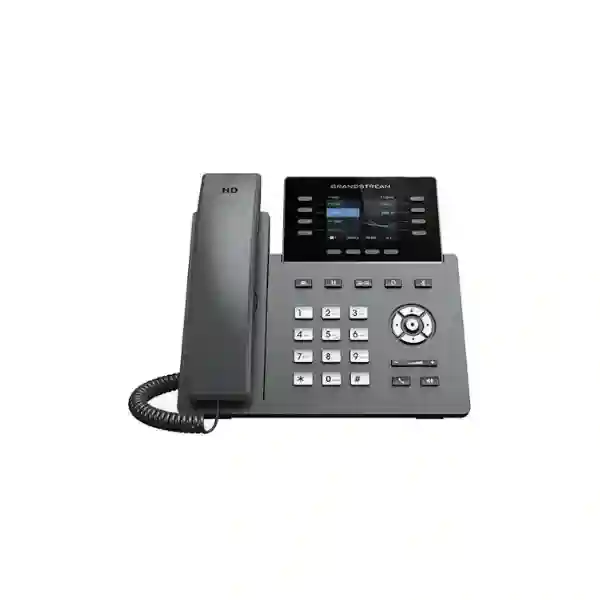
Grandstream GRP2624 Tanzania
The Grandstream GRP2624 is an 8-line professional carrier-grade IP phone built for organizations that need dependable desk telephony, centralized provisioning and efficient call handling. Grandstream specifies support for up to 12 SIP accounts, a 2.8-inch 320×240 color display, dual switched Gigabit Ethernet ports with integrated PoE, Bluetooth, 5-way audio conferencing, HD audio, headset connectivity and compatibility with the GBX20 expansion module. Current Grandstream documentation also identifies dual-band Wi-Fi 6 support on hardware version 5.0 and above, while earlier hardware supports the prior dual-band Wi-Fi implementation. This makes hardware revision verification important when wireless capability is part of the project requirement.
A strong fit for receptionists, managers, support teams, branch offices and enterprises that need multiple line appearances, programmable keys, headset options, centralized device administration and reliable SIP-based calling.
Grandstream GRP2624 overview
Grandstream positions the GRP2624 within its professional GRP series for mass deployment and easy management. The phone combines familiar desktop calling controls with centralized provisioning through Grandstream Device Management System (GDMS). For organizations deploying many phones, that management model is important because administrators can standardize configuration, reduce manual setup and maintain a clearer endpoint inventory. The handset supports 8 line keys and up to 12 SIP accounts, making it suitable for users who handle more than one extension, shared lines, departmental call flows or high volumes of internal and external calls.
The device uses a 2.8-inch 320×240 TFT color LCD, provides dual switched 10/100/1000 Mbps Ethernet interfaces and integrated 802.3af Power over Ethernet, and supports Bluetooth. Grandstream documentation lists full-duplex speakerphone operation with HD audio, noise-shield technology, EHS headset support, USB headset support and 5-way audio conferencing. It can also work with the GBX20 extension module; Grandstream states that one module adds up to 40 contacts and that as many as four modules can be connected for up to 160 contacts or extensions. These capabilities are especially relevant when the GRP2624 is assigned to a reception desk, executive assistant, dispatch desk, customer-support station or other role where users regularly monitor many extensions.
8 lines / 12 SIP accounts
Supports multi-line business calling and multiple SIP identities for departments, branches or user roles.
Gigabit Ethernet + PoE
Dual Gigabit ports help integrate the phone into modern office LANs, while PoE can simplify desk power when the switch provides compatible power.
Bluetooth and Wi-Fi
Integrated Bluetooth supports compatible accessories. Current hardware version 5.0+ adds dual-band Wi-Fi 6 according to Grandstream.
GDMS management
Grandstream Device Management System supports centralized configuration, provisioning, management and monitoring of compatible endpoints.
Verified technical highlights
| Lines / SIP | 8 lines, up to 12 SIP accounts |
| Display | 2.8-inch 320×240 TFT color LCD |
| Network | Dual switched auto-sensing 10/100/1000 Mbps Gigabit Ethernet ports |
| Power | Integrated IEEE 802.3af PoE; power adapter is also listed in the official package contents |
| Wireless | Integrated Bluetooth; dual-band Wi-Fi, with Wi-Fi 6 (802.11a/b/g/n/ac/ax) on hardware version 5.0 and above |
| Conference | 5-way audio conferencing |
| Audio | HD handset and speakerphone with wideband audio support; noise-shield capability |
| Headsets | RJ9 headset jack with EHS support and USB support for Grandstream GUV Series and other compatible USB headsets |
| Expansion | Compatible with GBX20; up to four modules, providing up to 160 contacts/extensions in Grandstream’s stated configuration |
| Management / security | GDMS provisioning and management; security features include secure boot, dual firmware images, encrypted data storage, TLS and SRTP support |
What the GRP2624 solves for business users
A business phone is most useful when it matches the call pattern of the person using it. The GRP2624 is not intended only as a basic extension handset. Its eight line keys, programmable functions and expansion-module compatibility make it more appropriate for users who need quick access to colleagues, queues, shared lines or frequently dialed destinations. A receptionist can map important extensions and call-handling functions for faster transfer. A manager can maintain several SIP identities or monitor key colleagues. A service desk can use a wired or compatible wireless headset while preserving access to line controls. These practical workflows matter more than simply comparing the number of buttons on the front panel.
For IT teams, centralized administration is equally important. The more phones an organization deploys, the more costly manual configuration becomes. GDMS support allows compatible Grandstream endpoints to be provisioned and monitored centrally. In a well-designed deployment, administrators can standardize account settings, time zones, language, network behavior, firmware policies and user-facing controls. The GRP2624 also supports common enterprise network mechanisms including LLDP, VLAN/QoS-related functions, 802.1x, TLS and SRTP. Those capabilities do not remove the need for secure network design, but they give administrators options for integrating the phone into managed voice environments.
Compatibility, PBX integration and deployment planning
The GRP2624 is a SIP endpoint, so deployment normally involves an IP PBX, hosted PBX or SIP service. Before procurement, buyers should confirm the intended PBX platform, SIP-account quantity per user, call-flow design, codec requirements, provisioning method, network VLAN strategy and PoE availability. Grandstream describes broad interoperability with SIP platforms, but project-level compatibility should still be validated against the actual PBX version and the specific features the customer expects to use. Basic registration may work while advanced items such as BLF, shared lines, call recording indicators, remote directories or special provisioning templates require additional validation.
The network also determines call quality. Voice traffic benefits from stable latency, controlled jitter, adequate bandwidth and sensible Quality of Service. When computers are connected through a phone’s switch port, VLAN and port configuration should be planned so that voice and data traffic are assigned correctly. Where Wi-Fi will be used, verify the phone hardware revision, wireless coverage, roaming expectations and radio capacity. Wired Ethernet with PoE is often simpler for fixed desks, while Wi-Fi can be valuable where cabling is impractical or where the workspace needs greater flexibility.
FourTeck Tanzania’s verified business technology solutions overview explains how IP phones share infrastructure with switches, Wi-Fi, firewalls and cabling. The Tanzania technology shop provides wider category-level buying guidance, while the services page outlines implementation and support capabilities. Buyers can also review the FourTeck Tanzania company overview or use the verified Tanzania contact page to prepare a quotation request. At the time this content was prepared, these were the distinct relevant internal URLs that could be verified; the telephony category links visible on the homepage resolve to homepage sections rather than separate standalone URLs, so no unverified internal paths have been invented.
Grandstream GRP2624 Tanzania
Organizations searching for the Grandstream GRP2624 in Tanzania are usually evaluating more than a desk phone. They are deciding how voice extensions will fit into office networking, PBX administration, reception workflows, branch communication and future growth. The GRP2624 suits that broader requirement because it combines multi-line SIP calling with centralized management, Gigabit networking, PoE, headset connectivity and expansion options. For Tanzanian offices with a mix of reception users, supervisors and managers, the product can be assigned selectively to the people who need higher call-handling capacity while simpler endpoints are used elsewhere. This role-based approach is often more efficient than buying the same model for every employee.
Before ordering, Tanzanian customers should confirm whether the intended deployment will use wired Ethernet or Wi-Fi, whether the access switch can provide the required PoE budget, and whether the PBX platform already has a tested provisioning profile for the GRP series. If Wi-Fi 6 is required, the hardware revision must be checked because Grandstream’s current documentation specifies Wi-Fi 6 for hardware version 5.0 and above. Buyers should also decide whether Bluetooth or USB headsets will be used and whether any receptionist or operator needs one or more GBX20 expansion modules. These details should be captured in the quotation rather than assumed after delivery.
For larger deployments across Tanzania, centralized device management can reduce repetitive setup. Naming conventions, extension plans, VLAN settings, firmware policy, phonebook sources and call-feature assignments should be documented. Organizations with sites in more than one city can standardize a common profile while still allowing local extensions and site-specific routing. Power planning is also relevant: PoE switches backed by appropriate UPS capacity can help phones remain powered through short interruptions, subject to the uptime of the PBX, router, firewall and internet/SIP service. The phone alone cannot preserve communication if the rest of the voice path is unavailable.
A useful GRP2624 Tanzania quotation request therefore includes quantity, user roles, PBX or hosted voice platform, SIP-account requirement, headset preference, switch/PoE details, Wi-Fi requirement, expansion-module quantity and installation scope. FourTeck can then align the phone with the surrounding voice and network environment instead of treating it as an isolated handset purchase.
Grandstream GRP2624 Dar es Salaam
In Dar es Salaam, the GRP2624 is relevant to headquarters, professional offices, hotels, logistics operations, clinics, schools, service companies and multi-department businesses that handle significant daily call traffic. Dense office environments often combine voice, data, Wi-Fi, CCTV and cloud applications on the same LAN. In that setting, the phone’s dual Gigabit interfaces and integrated PoE are useful because they can fit into a structured access-layer design without forcing each desk to rely on a separate power adapter. The important design task is ensuring that switch ports, VLANs and QoS policies are configured consistently across the office.
Reception desks in Dar es Salaam can benefit from the GRP2624’s multiple line keys and expansion capability. A front-office user may need direct visibility of managers, departments, security, warehouse staff or multiple branches. The GBX20 option can extend the number of monitored contacts when the built-in programmable controls are not enough. Managers may prioritize Bluetooth headset support, while contact-heavy users may prefer a USB headset. The choice should reflect actual working behavior, because headset comfort and button layout often affect productivity more than an abstract feature list.
For businesses moving from analog extensions to IP telephony, the GRP2624 can be part of a staged migration. Existing switches should be reviewed for PoE capacity and VLAN support, and the PBX should be tested with the features expected by users. If internet-based SIP trunks are used, the firewall and WAN design should be checked for stable call handling. A backup internet link may improve resilience, but failover behavior must be tested because a surviving internet path does not automatically guarantee that SIP sessions will re-register exactly as expected.
Dar es Salaam buyers should request a quotation that separates handsets, any GBX20 modules, headsets, PoE switching requirements, PBX configuration and installation services. That structure makes comparison easier and prevents a phone-only price from hiding the cost of missing infrastructure. For organizations with regional branches, configuration templates can also be standardized so phones in Dar es Salaam and other cities follow the same extension naming, security and provisioning rules.
Grandstream GRP2624 Mwanza
For businesses in Mwanza, the Grandstream GRP2624 can support structured voice communication in offices, hospitality properties, healthcare environments, education facilities, distribution businesses and branch operations. The phone is especially useful where users need to manage several active lines, call transfers or departmental extensions from one desk. Instead of installing a high-function model everywhere, organizations can reserve the GRP2624 for reception, administration, managers and support personnel while matching other users with simpler endpoints. That approach keeps the phone estate aligned with job roles and makes future replacement planning easier.
Network readiness is a central consideration in Mwanza deployments. A GRP2624 connected by Ethernet can receive both data and power from a compatible PoE switch, reducing desk cabling and centralizing power. However, the switch must have enough total PoE budget for all phones and other powered devices such as access points or cameras. If the same network carries voice and data, managed switching and logical separation are often beneficial. Voice VLAN settings, DHCP options, QoS and PBX routing should be tested before mass deployment so that each handset can be installed using a repeatable process.
Where wireless placement is needed, the GRP2624’s Wi-Fi capability can be considered, but the hardware revision and wireless network design should be verified. A phone used in a fixed office normally benefits from predictable wired connectivity, while Wi-Fi can be useful for locations where running a cable is difficult. Bluetooth may also be valuable for executives or administrators using compatible headsets. When many phones are deployed, GDMS can help centralize provisioning and monitoring, reducing the need to configure each phone manually at the desk.
A Mwanza procurement request should therefore define user count, quantities by role, PBX platform, existing switch model, PoE availability, network topology, headset requirements and whether installation or remote configuration support is needed. These details allow the GRP2624 to be priced and planned as part of the full voice environment rather than as a standalone device with unknown dependencies.
Grandstream GRP2624 Arusha
Arusha organizations may use the GRP2624 in tourism, hospitality, professional services, NGOs, education, healthcare, administration and multi-site business operations. These environments often value clear call transfer, reliable reception handling and the ability to connect internal extensions across departments. With eight line keys, multiple SIP accounts, Bluetooth, PoE and expansion-module support, the GRP2624 can serve users who spend a significant portion of the day coordinating calls rather than merely answering an occasional extension.
Hospitality and service businesses in Arusha should map the handset to their call flow before finalizing quantities. Reception may need quick access to reservations, management, housekeeping, security and transport teams. An office may need different keys for sales, accounts and branch extensions. The GRP2624’s programmable controls are most useful when they are configured around those real workflows. A generic configuration that leaves useful keys unused misses much of the benefit of choosing a professional multi-line model.
Infrastructure should be reviewed at the same time. The phone supports Gigabit Ethernet and PoE, making it appropriate for modern managed LANs. Where a PC shares the desk network connection through the phone, port configuration and VLAN policy should preserve both data access and voice quality. If the phone is deployed over Wi-Fi, confirm the exact hardware version and test coverage at the intended desk. Wireless voice is more sensitive to roaming, interference and congestion than casual web browsing, so a strong signal indicator alone is not enough to guarantee call quality.
For Arusha projects, buyers should request clear scope for device supply, programming, extension creation, PBX integration, headset setup, network changes and user handover. This helps distinguish a hardware quote from a complete communication solution. Organizations with offices elsewhere in Tanzania can also define one standard GRP2624 template and replicate it where appropriate, reducing training and support differences between sites.
Grandstream GRP2624 Dodoma
In Dodoma, the GRP2624 can support government-facing businesses, professional offices, institutions, education, healthcare, NGOs and organizations managing multiple departments or regional branches. Its value is strongest where users need structured call handling, several SIP identities or frequent transfers. The color display, programmable line keys and optional GBX20 expansion module can make daily calling more efficient for administrative staff and reception teams who need fast access to a larger extension directory.
A successful Dodoma deployment begins with the PBX design. Organizations should decide the extension numbering plan, incoming call routing, ring groups, queues, after-hours behavior and voicemail policy before programming individual phones. The GRP2624 can then be configured around those decisions. When several phones are being installed, GDMS or another supported provisioning approach can help keep configuration consistent. Central management is particularly useful when IT staff support users across more than one building or branch.
Network and power continuity also matter. PoE simplifies phone power when compatible switching is available, but the phone depends on the switch, router, PBX and upstream connectivity. If calling is operationally important, UPS planning should include the network stack and not just the phone endpoint. Similarly, if an organization expects to use SIP trunks over the internet, WAN reliability and firewall configuration should be tested under real call conditions. QoS can help prioritize voice within the local network, but it cannot repair congestion or packet loss that occurs outside the organization’s control.
Dodoma procurement teams can improve quotation accuracy by specifying phone quantity, required SIP accounts, whether GBX20 modules are needed, headset types, PoE switch capacity, PBX platform, installation sites and expected support scope. This produces a more useful bill of materials and reduces the chance that essential accessories or configuration work will be discovered only after the phones arrive.
Grandstream GRP2624 UAE
For organizations evaluating the Grandstream GRP2624 in the UAE, the same core design priorities apply: PBX interoperability, structured provisioning, PoE capacity, headset needs and a network that is engineered for voice. The UAE market includes multi-site corporate offices, hospitality, retail, logistics, professional services and regional headquarters where centralized endpoint management can be particularly valuable. The GRP2624’s 8-line design, SIP support, Bluetooth, Gigabit networking and GDMS compatibility allow it to fit into both single-office and larger standardized phone deployments.
Regional organizations often want the same desk-phone experience across different countries. If a group operates in Tanzania and the UAE, it can standardize user roles, button layouts, extension naming and security policies while adapting trunks and numbering to each location. The phone’s configuration should not be copied blindly between countries because SIP providers, PBX instances, emergency calling rules and network environments can differ. A common template should contain only the settings that truly belong to the corporate standard.
UAE buyers should also confirm the hardware revision if Wi-Fi 6 is a stated requirement, because Grandstream currently ties Wi-Fi 6 support to hardware version 5.0 and above. For fixed desks, wired Gigabit Ethernet with PoE remains a straightforward deployment method. Bluetooth and USB headset support can be useful for receptionists and contact-heavy users, while the GBX20 can extend visibility for users monitoring larger groups of colleagues or departments.
FourTeck’s verified UAE technology solutions site provides regional context for IT and IP telephony projects. Organizations coordinating Tanzania and UAE offices can use the Tanzania contact path for the local requirement and the UAE site for that market, keeping technical standards aligned while letting procurement and service scope follow each country’s actual project conditions.
Grandstream GRP2624 Uganda
Businesses considering the Grandstream GRP2624 in Uganda can use it as part of a SIP-based office communication platform for reception, administration, customer service and managerial users. Its multiple line keys and support for up to 12 SIP accounts make it suitable for people who need more flexibility than a basic two-line endpoint. The phone can be deployed with compatible IP PBX or hosted voice platforms, but organizations should confirm feature-level interoperability, especially when they depend on BLF, shared lines, remote directories or specific provisioning workflows.
For multi-branch organizations, centralized provisioning through GDMS can reduce deployment effort. A standard template can define network, security and button behavior while site-specific information such as extensions and SIP credentials is assigned separately. This approach can be useful for organizations operating in Uganda and Tanzania because administrators can preserve a consistent user experience without assuming that every site has identical network or telecom conditions.
The physical network remains fundamental. PoE-capable switches can supply phone power and simplify desk installation, while Gigabit pass-through connectivity can suit workstations sharing the network drop. If voice shares infrastructure with Wi-Fi, CCTV and business data, managed switching and segmentation should be planned to avoid unnecessary contention. Wireless phone deployment should be tested carefully, and Wi-Fi 6 expectations should be matched to the exact GRP2624 hardware revision.
The verified FourTeck Uganda site covers IP PBX, VoIP and related business IT services for that market. Procurement teams working across Uganda and Tanzania can use a common technical checklist—PBX platform, endpoint roles, PoE, VLANs, headsets, expansion modules and support scope—while keeping pricing, delivery and service arrangements specific to the project being quoted.
Grandstream GRP2624 Kampala
Kampala offices often require a practical mix of standard desk phones and higher-function devices for reception, management and customer-facing teams. The GRP2624 can fill the higher-function role with eight line keys, multiple SIP accounts, headset connectivity, Gigabit networking and centralized management. For a front desk, programmable keys can reduce the steps needed to reach departments or frequently contacted staff. For supervisors or managers, multiple SIP identities can support departmental or branch calling patterns where the PBX design allows them.
Before deployment, organizations should identify how calls enter the business and what users do with them. If most calls are transferred from reception, the receptionist’s phone should expose the most useful BLF and transfer destinations. If teams operate in queues, the PBX must handle queue logic while the handset provides the user interface. If managers frequently use headsets, headset compatibility should be confirmed before standardizing accessories. The phone’s Bluetooth and USB options create flexibility, but model-specific headset behavior is still worth testing.
Kampala businesses also need to consider the network behind the phone. A PoE switch may power the handset and simplify cable management, but capacity must account for all powered endpoints. Voice VLANs and QoS can improve organization and prioritization inside the LAN. Reliable internet remains important for hosted PBX or SIP trunk deployments, and firewall rules should be configured intentionally rather than opened broadly. Central provisioning can then make adds, moves and changes more predictable as staff or offices grow.
A useful Kampala GRP2624 request should include the number of users, desired line appearances, PBX type, current switch and router/firewall information, headset preference and whether the project includes installation. This gives the supplier enough context to distinguish a simple handset purchase from a full voice deployment and helps avoid under-scoping the network work required for good call quality.
Grandstream GRP2624 Arua
For Arua businesses and institutions, the GRP2624 can be considered where a professional user needs several line appearances, clear call controls and centralized administration. Branch offices, healthcare facilities, NGOs, hotels and operational sites can all benefit from a structured IP telephony design, but the endpoint should be selected only after the wider communication path is understood. The phone depends on a PBX or SIP platform, network switching, power and potentially internet connectivity, so those dependencies should be included in project planning from the start.
In locations where technical support resources may not be concentrated on site, standardized provisioning becomes particularly useful. IT teams can prepare configuration templates, extension naming and security settings centrally, then deploy phones with less manual variation. GDMS support is one of the reasons the GRP2624 is positioned for larger deployments. It can help administrators manage compatible Grandstream endpoints from a centralized interface, although organizational access controls and operational procedures still need to be defined carefully.
Arua deployments should also consider resilience. PoE switching can reduce the number of local power adapters, but a power interruption at the switch affects connected phones. UPS capacity should therefore be assessed for the network equipment required to keep calls operating. If the PBX or trunk is cloud-based, internet resilience may be equally important. A second WAN path can be valuable, but failover behavior should be validated end-to-end with the SIP service rather than assumed from general internet connectivity.
When requesting a GRP2624 quotation for Arua, specify whether phones will be shipped as hardware only or configured as part of a complete system. Include quantities, extension plan, PBX platform, switch/PoE condition, desired headsets, Wi-Fi needs and any branch-to-branch dialing requirements. Clear scope helps the project team select supporting components and avoids treating endpoint price as the only decision factor.
Grandstream GRP2624 Mbarara
Mbarara organizations planning an IP telephony upgrade can use the GRP2624 for users who need higher call-handling capacity than a basic desk handset. The eight line keys, 12 SIP-account support, 5-way conferencing and headset options are suited to reception, service desks, administrators and managers. Businesses should still avoid over-specifying every desk. A role-based endpoint plan can pair GRP2624 units with simpler models for users who only need one extension and basic transfer or voicemail functionality.
The phone’s dual Gigabit interfaces make it practical for desks with one network drop where a PC may connect through the phone, but network policy should be reviewed. Voice and data VLAN behavior, switch port configuration, LLDP, DHCP and QoS can influence deployment consistency. PoE is convenient when compatible switching exists and can simplify centralized backup power. If existing switches are not PoE-capable, the included power-adapter option listed by Grandstream may be used, subject to local power arrangements and project standards.
Mbarara customers considering Wi-Fi should verify the device hardware revision. Grandstream’s current specification states that hardware version 5.0 and above supports integrated dual-band Wi-Fi 6, while earlier documentation described the prior dual-band Wi-Fi implementation. For a fixed business desk, Ethernet remains the more predictable option in many environments, but wireless can be useful where structured cabling is unavailable or workspace layouts change frequently.
A complete quotation should identify handset quantity, PBX or hosted-voice platform, trunk provider if applicable, PoE requirements, headset needs, button programming and support expectations. If Mbarara is one site in a wider organization, endpoint templates can be standardized across branches, but local connectivity and power conditions should be checked separately. This keeps the user experience consistent without assuming infrastructure is identical at every location.
Grandstream GRP2624 Gulu
In Gulu, the GRP2624 can support structured communication for offices, institutions, hotels, health services, NGOs and branch businesses that require a professional multi-line IP phone. Users who handle frequent transfers or monitor multiple colleagues can make good use of the line keys and optional expansion module. Organizations should map the phone to actual workflows: which extensions need one-touch access, which staff require headsets, which users need several SIP identities and which call features are provided by the PBX rather than by the endpoint itself.
For branch deployments, remote manageability can be valuable. GDMS can centralize provisioning and monitoring of supported Grandstream devices, reducing the amount of desk-by-desk configuration. A branch template can contain common settings while unique extension credentials are assigned per device. IT teams should also establish a firmware process so phones are not upgraded unpredictably during business hours and configuration changes are documented.
The network should be prepared for real-time voice. Managed switching, suitable PoE capacity and sensible VLAN/QoS policy help create a cleaner deployment. If the phone shares a network port with a workstation, both voice and data paths need to be tested. If internet connectivity is used for the PBX or trunk, monitor latency, jitter and packet loss rather than relying only on headline bandwidth. A high-speed connection can still produce poor voice quality if the path is unstable.
Gulu buyers can improve procurement decisions by asking for a solution-level quote when needed. Hardware-only purchasing may be appropriate when the organization already has a trained PBX and network team. Where that expertise is not available, the quotation should include provisioning, switch configuration, PBX integration, call-flow programming, testing and basic user handover. This distinction keeps responsibility clear and reduces the risk of receiving phones that are technically correct but not ready for the intended environment.
Grandstream GRP2624 Kenya
Kenyan businesses evaluating the GRP2624 may include corporate offices, hospitality groups, schools, healthcare providers, logistics organizations and companies with branch networks across East Africa. The phone’s combination of eight line keys, multiple SIP accounts, Bluetooth, PoE and centralized management supports users who need richer call handling than an entry-level endpoint. For regional companies, standardizing on a consistent set of Grandstream endpoints can simplify user training and configuration, provided each country’s PBX, trunking and support requirements are validated individually.
Cross-border organizations should distinguish between endpoint standardization and telecom standardization. The GRP2624 can use the same button layout and provisioning principles in Tanzania and Kenya, but SIP providers, number ranges, routing policies and internet conditions may differ. A common corporate template can define security, codecs, display behavior and general key use, while local profiles handle account credentials and site-specific dialing.
The network design should account for PoE budget, VLAN segmentation, QoS and user growth. Where a desk PC connects through the phone, the switch configuration should preserve the intended traffic separation. If Wi-Fi is required, buyers should verify hardware version because Wi-Fi 6 support is associated with GRP2624 hardware version 5.0 and above in the current Grandstream specification. Headset requirements should also be tested, especially for reception and contact-center-like roles that spend long periods on calls.
The verified FourTeck Kenya site covers VoIP business phones, IP PBX communication and broader business IT solutions. Regional procurement teams can use the Kenya and Tanzania sites as separate commercial entry points while maintaining a shared technical specification for GRP2624 deployments across both markets.
Grandstream GRP2624 Kuwait
For businesses in Kuwait, the Grandstream GRP2624 can be deployed as a professional SIP desk phone for reception, management, administration and teams that need multiple lines. Its 2.8-inch color display, integrated PoE, Bluetooth, Gigabit networking and expansion-module compatibility make it suitable for structured office voice environments. Organizations should define user profiles first, because a high-function handset provides the most value when its programmable controls and multiple accounts are actively used rather than left unconfigured.
Central provisioning can be important in Kuwait deployments that involve multiple floors, branches or franchises. GDMS support allows compatible Grandstream endpoints to be configured and monitored through a centralized platform. Administrators can create standard settings and reduce manual variation, but they should still maintain clear change control. Firmware updates, SIP credentials, administrator passwords and directory sources should be governed as part of the voice-system lifecycle rather than managed informally at individual desks.
Infrastructure planning should include PoE switching, voice VLANs, firewall behavior and PBX connectivity. If the phone is used with a hosted PBX, internet reliability and security become part of the call path. Where Wi-Fi is preferred, confirm the hardware revision and validate coverage at the desk. Wired Ethernet with PoE remains a straightforward option for fixed office users because it reduces dependence on radio conditions and can centralize power through the network rack.
The verified FourTeck Kuwait site provides regional IT and VoIP context for that market. Companies coordinating Kuwait and Tanzania branches can standardize endpoint configuration and user training while keeping local SIP services, support arrangements and procurement terms aligned with each country’s actual requirements.
Grandstream GRP2624 Ghana
Ghanaian organizations can consider the GRP2624 for users who need multi-line calling, programmable controls and enterprise-style endpoint management. Reception teams, managers and service personnel may benefit from its eight line keys and support for up to 12 SIP accounts, while the GBX20 expansion option can extend monitoring for larger extension lists. The phone’s HD audio, 5-way conferencing and headset options also make it practical for users who spend significant time in voice communication.
A GRP2624 purchase should be aligned with the PBX and network rather than treated as a commodity handset. The SIP platform should be checked for the required features, and the switching environment should provide the correct VLAN and PoE configuration. If the phone will share the network drop with a workstation, both devices should be tested under the intended switch-port settings. Network quality should be measured with attention to latency, jitter and packet loss because voice is more sensitive to short disruptions than ordinary browsing.
Organizations with several offices can use centralized provisioning to maintain consistent user experience. That can include date/time settings, language, key templates, directory configuration and security controls. However, unique credentials and site-specific routes should remain separated. If wireless deployment is planned, verify GRP2624 hardware version because Grandstream specifies Wi-Fi 6 on version 5.0 and later hardware.
The verified FourTeck Ghana site includes business telephony, IP phones, networking and infrastructure guidance. Regional organizations that also operate in Tanzania can use shared endpoint standards while allowing Ghana-specific PBX, trunking and support arrangements to be quoted independently.
Grandstream GRP2624 Nigeria
Nigeria has a wide range of organizations that can benefit from structured IP telephony, including corporate offices, financial services, hospitality, education, healthcare, logistics, retail and multi-branch operations. The GRP2624 is suited to selected users within these environments who need richer call handling, multiple line appearances and reliable headset options. Its support for 12 SIP accounts can accommodate flexible account design, although the actual number used should reflect the PBX architecture and user role rather than simply maximizing the specification.
For larger deployments, GDMS support can help reduce manual phone configuration. Standard templates can be prepared for user groups such as reception, management, accounts and customer service. A reception template might emphasize BLF and transfer destinations, while a manager template may prioritize headset and conferencing controls. Central administration also makes it easier to apply consistent firmware and security settings when the organization has devices spread across several branches.
Network resilience deserves careful attention. PoE switching can centralize phone power, but the switches themselves need suitable power protection if voice availability matters. Hosted voice solutions also depend on internet and firewall stability. Dual-WAN architectures may add resilience, but organizations should test how SIP registration and active calls behave during failover. For fixed desks, wired Ethernet is generally predictable; Wi-Fi can be considered where cabling is difficult, with hardware-version verification for Wi-Fi 6 capability.
The verified FourTeck Nigeria site provides a regional point of reference for IT and communication requirements. Businesses operating in both Nigeria and Tanzania can keep a shared GRP2624 endpoint standard while sourcing and configuring each site according to local telecom, network and support conditions.
Grandstream GRP2624 Seychelles
In Seychelles, the GRP2624 can be appropriate for hospitality, tourism, professional services, public-facing offices and organizations that need structured internal communication. A hotel front desk or administrative team may need fast transfer to departments, managers or operational areas, while a corporate user may need multiple SIP identities or quick access to colleagues. The GRP2624’s line keys and expansion capability can support those workflows when the key layout is designed around actual call patterns.
Island and multi-site operations can benefit from careful remote-management planning. If IT support is centralized elsewhere, GDMS provisioning can help standardize compatible Grandstream endpoints and reduce the need for manual configuration at every desk. Administrators should still define secure access, firmware policy, credential handling and configuration backup practices. A well-managed phone environment is easier to troubleshoot because device names, extensions and site roles are documented consistently.
Connectivity and power remain part of the telephony solution. A PoE switch can simplify installation and, when protected by suitable UPS capacity, help maintain service through brief local interruptions. Cloud PBX or SIP trunk calls depend on the internet path, so latency and stability should be considered along with bandwidth. If Wi-Fi deployment is planned, confirm the GRP2624 hardware version and test wireless performance in the intended location; hospitality environments can have high client density and radio congestion that affects real-time voice.
A Seychelles quotation request should include quantity, user roles, PBX platform, headset requirements, expansion-module needs, PoE and switching status, wireless requirement and whether remote or onsite configuration is expected. This produces a clearer scope and makes it easier to coordinate the GRP2624 with the rest of the communication and network infrastructure.
How to choose the GRP2624 configuration
Reception / operator
Prioritize programmable keys, BLF layout, headset comfort and whether one or more GBX20 modules are needed for extension visibility.
Manager / executive
Consider Bluetooth, conferencing, multiple SIP identities and quick access to assistants or departments.
Service desk
Validate headset compatibility, queue features provided by the PBX, call transfer workflow and any directory integration.
Multi-site deployment
Plan GDMS provisioning, site templates, VLAN/QoS policy, firmware management, extension naming and branch-specific SIP settings.
Regional FourTeck network references
Organizations managing technology across multiple countries may need different commercial contacts while preserving common technical standards. FourTeck maintains verified regional sites for UAE IT and telecom solutions, Kenya business IT and VoIP, Uganda IP PBX and VoIP solutions, Ghana business telephony and infrastructure, Nigeria IT services and communication solutions, and Kuwait IT and VoIP solutions. These links are provided as regional references rather than as claims of stock or immediate delivery for the GRP2624.
GRP2624 quotation checklist
Quantity and user roles: total phones, receptionists, managers, service desks and general users.
PBX platform: on-premises, hosted or cloud PBX, plus software/version where known.
SIP requirements: number of accounts, trunks, shared lines or special call flows.
Network: PoE switch availability, VLAN design, Gigabit requirement, internet connectivity and firewall model.
Wireless: whether Wi-Fi is required and whether Wi-Fi 6 hardware revision is mandatory.
Accessories: Bluetooth, RJ9/EHS or USB headset requirements and GBX20 expansion modules.
Services: hardware supply only, preconfiguration, PBX programming, installation, testing, user handover or ongoing support.
Frequently asked questions
How many lines and SIP accounts does the Grandstream GRP2624 support?
Current Grandstream documentation lists 8 lines and up to 12 SIP accounts for the GRP2624. The way those accounts are used depends on the PBX and user configuration.
Does the GRP2624 support Wi-Fi 6?
Grandstream’s current specification states integrated dual-band Wi-Fi 6 for GRP2624 hardware version 5.0 and above. Earlier hardware documentation described dual-band 802.11a/b/g/n/ac Wi-Fi, so verify the hardware revision when Wi-Fi 6 is required.
Can the GRP2624 use Power over Ethernet?
Yes. Grandstream lists integrated IEEE 802.3af PoE. The network switch must provide compatible PoE and enough total power budget for all connected powered devices.
Does the GRP2624 work with headsets?
Yes. Official specifications list an RJ9 headset jack with EHS support and USB support for Grandstream GUV Series and other compatible USB headsets. Bluetooth is also integrated. Specific accessory compatibility should be confirmed before large deployments.
Can I add more programmable keys?
The GRP2624 supports the Grandstream GBX20 extension module. Grandstream states that a module can provide up to 40 contacts and that up to four modules can be connected for as many as 160 contacts/extensions.
What PBX can I use with the GRP2624?
The GRP2624 is a SIP phone and Grandstream describes broad interoperability with SIP platforms. Exact compatibility should be validated with the intended PBX version and required features such as BLF, shared lines, directories, provisioning and call-center functions.
Is GDMS required?
No. The phone can be configured using supported provisioning and administration methods, but GDMS is useful for centralized configuration, provisioning, management and monitoring of compatible Grandstream devices, especially in larger deployments.
What should I provide for a Tanzania quotation?
Provide quantity, city or site location, PBX platform, number of extensions, PoE availability, headset requirements, Wi-Fi need, GBX20 quantity if any, and whether you need supply only or configuration and installation support.
Decision recap
Choose the Grandstream GRP2624 when the user needs a professional multi-line SIP phone with 8 line keys, up to 12 SIP accounts, Gigabit Ethernet, PoE, Bluetooth, headset support, 5-way conferencing and centralized management through GDMS. Consider the GBX20 where receptionists or operators need more visible contacts. Verify hardware version when Wi-Fi 6 is required, and validate PBX interoperability for the exact features your organization plans to use.
The best purchasing decision is based on the full voice environment: PBX, SIP service, network, PoE, VLANs, headsets, expansion needs, provisioning and support. That approach produces a phone deployment that is easier to operate and maintain than simply ordering endpoints by model number.
Talk to FourTeck Tanzania about the GRP2624
Share your quantity, PBX platform, user roles and current network details. FourTeck can use that information to prepare a more relevant quotation and identify whether you also need PoE switching, headsets, extension modules, provisioning or PBX integration.




Reviews
There are no reviews yet.