
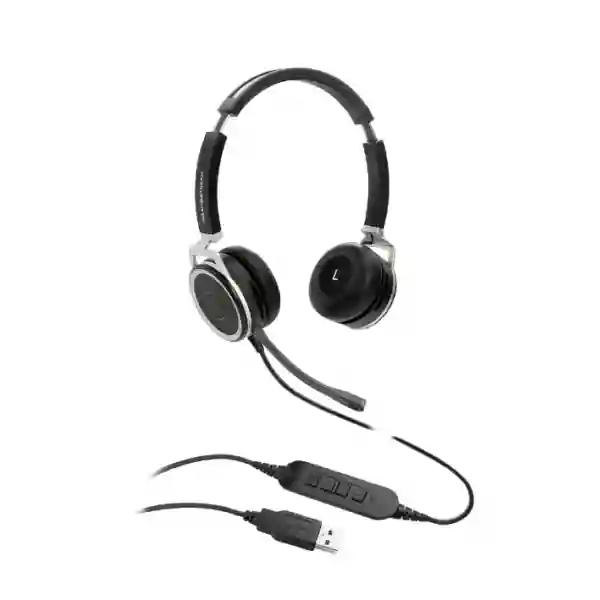
Grandstream GUV3005 Tanzania
The Grandstream GUV3005 is a professional corded USB headset created for users who spend significant time on business calls, online meetings, softphones and IP telephony. Its practical design combines USB 2.0 Type-A connectivity, HD audio, a noise-cancelling cardioid microphone, inline controls and an integrated busy light. For organisations in Tanzania evaluating a headset for reception teams, contact-centre agents, sales desks, support staff, remote workers or hybrid-office users, the GUV3005 can fit environments where a simple wired connection and clear two-way audio are more important than wireless mobility.
Grandstream currently labels the GUV3005 quick-user-guide resource as EOL, so this page treats the model as a legacy product rather than implying current production or guaranteed stock. Procurement teams should confirm availability, exact compatibility and any recommended successor before placing an order. FourTeck can help compare the requirement against current communication endpoints and related headset options.
USB 2.0 with USB-A connector for compatible PCs, laptops and supported IP-phone environments.
Cardioid noise-cancelling microphone designed to reduce distracting background sound during calls.
Inline controls provide quick access to volume, mute and supported call-control functions.
Integrated busy light helps nearby colleagues see when the wearer is engaged on a call.
Grandstream GUV3005 overview
Grandstream positions the GUV series for remote workers, contact centres and other busy communication environments. The GUV3005 is the more feature-rich of the original GUV3000/GUV3005 wired pair, adding an integrated busy light and broader speaker frequency response. It uses a binaural-style adjustable headband arrangement and a microphone boom that can be positioned for left- or right-side wearing. The wired approach removes battery charging from the daily workflow and can be useful where users work from a fixed desk or assigned workstation.
The official datasheet lists a 27 mm speaker, 32 ohm nominal impedance tolerance, 94 dB sensitivity at 1 kHz/1 mW and a 20 Hz to 20 kHz speaker frequency response for the GUV3005. Microphone specifications include cardioid directivity, a 100 Hz to 10 kHz response, sensitivity of -44 ±3 dB at 1 kHz and a signal-to-noise ratio of at least 55 dB under the stated test conditions. Cable length is listed as 2 metres and headset weight as 192 g. The product was certified for CE and FCC compliance in its published materials.
Application compatibility is one of the main practical reasons buyers may still search for this model. Grandstream documentation names popular communication applications such as Zoom, Microsoft Teams, Webex, Slack, Grandstream Wave, IPVideoTalk, CounterPath and 3CX softphones. Compatibility with particular features can vary by host device, software version and IP-phone firmware, so advanced call control should be verified rather than assumed. Grandstream has also published USB-headset compatibility references for selected GRP, GXP and GXV phone families where the GUV3005 appears in supported-device lists.
Important lifecycle note: GUV3005 is a legacy EOL model
Grandstream’s documentation centre identifies the GUV3005 quick user guide as EOL. EOL status matters for procurement because production, distribution, replacement availability and long-term support expectations may differ from a current-generation product. FourTeck does not present this page as a guarantee that new units are in stock. If your specification explicitly calls for GUV3005, request a quotation with quantity, intended host device and deployment location so availability can be checked. If the goal is simply a professional Grandstream-compatible USB headset, ask for a current alternative comparison as part of the same enquiry.
Verified technical specifications
| Specification | Grandstream GUV3005 |
|---|---|
| Connection | USB 2.0, USB-A |
| Wearing style | Adjustable headband |
| Speaker diameter | 27 mm |
| Speaker impedance | 32 (±15%) Ω |
| Speaker sensitivity | 94 dB at 1 kHz, 1 mW |
| Speaker frequency response | 20 Hz to 20 kHz |
| Microphone directivity | Cardioid |
| Microphone frequency response | 100 Hz to 10 kHz |
| Microphone sensitivity | -44 ±3 dB, f=1 kHz, Pin=1 Pa |
| Microphone boom rotation | 235° |
| Busy light | Integrated |
| Cable length | 2 metres |
| Weight | 192 g |
| Published certifications | CE, FCC |
Business use cases and buying guidance
A wired headset is often a sensible choice for desks where users remain close to the workstation and need predictable connection behaviour. Contact-centre agents can benefit from an always-connected audio device that does not require pairing or battery management. Reception staff may value the visible busy light because it communicates call status to nearby colleagues. Sales and service teams can use the microphone and inline controls for frequent softphone calls, while remote workers can keep the same basic audio interface across conferencing applications.
Before purchasing, identify the exact endpoint. If the headset will connect to a Windows or macOS computer, confirm available USB-A ports or whether a suitable adapter is required. If it will connect directly to a Grandstream IP phone, verify the phone model and firmware against Grandstream’s compatibility guidance. USB presence alone does not guarantee every call-control function behaves identically. Volume indication, answer/end-call behaviour and software integration can vary between platforms.
Because this product is EOL, organisations planning a large rollout should also evaluate lifecycle risk. A few replacement units for an existing standard may be reasonable if compatible stock can be sourced, but a new multi-site deployment may benefit from a current model that offers a longer support runway. Include user count, preferred communication platform, phone models, required connector type, expected daily call duration and any compliance requirements in the quotation request.
Related FourTeck Tanzania solutions
The GUV3005 is an endpoint accessory, so the surrounding voice and collaboration environment matters. Explore FourTeck Tanzania technology solutions when the requirement includes broader workplace IT, telecom and collaboration planning. For deployment, migration or integration work, the FourTeck Tanzania services page outlines solution design, installation, configuration and support capabilities. Organisations operating regionally can also reference FourTeck Uganda and FourTeck Kenya for related country requirements. These links are useful when headset procurement is part of a wider IP-PBX, IP-phone, collaboration or multi-branch standardisation project.
Grandstream GUV3005 Tanzania
For buyers searching for the Grandstream GUV3005 in Tanzania, the central procurement issue is no longer only feature comparison; it is lifecycle-aware sourcing. Grandstream has documented the GUV3005 as an EOL model, so organisations should distinguish between a requirement to match an installed headset standard and a requirement for a new professional USB communications headset. Existing users may want replacement units to keep desk setups consistent, while a new office may be better served by evaluating current alternatives. In either case, the technical baseline remains clear: the GUV3005 uses USB-A, provides HD audio, includes a cardioid noise-cancelling microphone, offers inline controls and adds an integrated busy light.
Tanzanian businesses commonly deploy headsets alongside laptops, desktops, softphones and IP telephony. A useful procurement checklist should therefore capture the number of users, whether each desk has USB-A available, the communication applications in use and whether direct IP-phone connection is required. Teams using Microsoft Teams, Zoom, Webex, 3CX, Grandstream Wave or other softphones should validate control behaviour in the exact environment. For Grandstream desk phones, the phone family and firmware level should be checked because USB-headset functionality differs by model.
For multi-user deployments, comfort and operational simplicity deserve the same attention as audio specifications. A wired design can be attractive where employees stay at assigned workstations, where charging wireless devices would add support overhead or where IT wants a straightforward peripheral policy. The two-metre cable provides desk reach, while the busy light can reduce interruptions in open offices. Procurement teams should also consider spare-unit strategy, because an EOL model may become harder to standardise over time.
A quotation request for Tanzania should state whether the GUV3005 model itself is mandatory or whether an equivalent current-generation option is acceptable. Include destination, quantity, application, host device and required deployment date. This gives the sales and technical team enough context to check practical availability without making unsupported promises about stock, delivery or warranty conditions.
Grandstream GUV3005 Dar es Salaam
Dar es Salaam organisations looking for the Grandstream GUV3005 are often evaluating headsets for higher-volume communication roles: reception desks, customer service teams, sales operations, logistics coordinators, professional-services staff and office users who participate in frequent online meetings. In these environments, a USB headset must do more than produce sound. It has to fit the user’s workstation, work with the chosen application and remain predictable across repeated calls. The GUV3005’s wired USB-A connection is simple for computers with native USB-A ports, while the integrated busy light can be particularly useful in open-plan workplaces where visual call status reduces unnecessary interruptions.
The correct buying approach begins by separating device compatibility from software compatibility. A laptop may recognise the headset as a USB audio device, but call-control functions can still depend on the conferencing or softphone platform. Likewise, a Grandstream IP phone with a USB interface may require a particular firmware level before specific headset functions are supported. For a business deploying multiple seats in Dar es Salaam, test one unit with the exact software image, phone model and workflow before expanding the rollout where practical.
Lifecycle status is equally important. Since Grandstream’s documentation marks the GUV3005 as EOL, a procurement team should decide whether it is maintaining an existing estate or designing a new standard. Replacing a failed headset with the same model can reduce training and support changes, but a new contact centre or newly equipped office should compare available current models before locking in a legacy device. This is especially relevant when future expansion across departments or branches is expected.
When requesting a quote in Dar es Salaam, specify user quantity, endpoint models, whether the headset will connect to PCs or IP phones, and the collaboration tools in use. If you have a required headset policy, attach it. If not, describe the business role and call pattern so the product choice can be aligned with daily use rather than selected only by model number.
Grandstream GUV3005 Mwanza
Businesses in Mwanza may search for the Grandstream GUV3005 when standardising voice accessories for administrative offices, retail operations, hospitality teams, healthcare facilities, education organisations, distribution businesses and branch offices. The headset’s practical value comes from its fixed USB-A interface, binaural listening, noise-cancelling microphone and call-status light. These features suit desks where employees need to hear both sides of a business conversation clearly while reducing the amount of ambient sound picked up by the microphone.
For Mwanza deployments, consider the full endpoint chain. A headset connected to a laptop relies on the operating system and application audio settings; one connected to an IP phone relies on supported USB-headset behaviour in the phone firmware. Grandstream has listed the GUV3005 in compatibility references for several phone families, but model-level verification remains important. If users move between desk phones and laptops, document which device each headset will normally serve and whether users expect answer/end controls to behave the same way on both platforms.
Environmental noise is another practical consideration. The GUV3005 uses a cardioid microphone pattern and Grandstream describes the product as using noise-cancelling technology. This can help keep the user’s speech more focused in typical busy-office conditions, but it should not be interpreted as complete elimination of surrounding sound. Desk layout, proximity to colleagues, hard reflective surfaces and user microphone positioning all influence real-world call quality. Training users to position the microphone consistently can be as important as the hardware choice.
Because the model is EOL, buyers in Mwanza should request confirmation of availability rather than assuming continuous supply. If the intention is to equip a new team, ask for a comparison with a current supported headset. If the goal is to replace units already deployed, include the existing phone or software platform in the enquiry so compatibility can be preserved. A structured quote request reduces the risk of buying a headset that works as basic audio but does not meet the required call-control workflow.
Grandstream GUV3005 Arusha
Arusha organisations frequently balance office communications with customer-facing, hospitality, travel, education, NGO and professional-services workflows. For users in these environments, the Grandstream GUV3005 can be relevant where a stable wired headset is preferred over a battery-powered wireless model. USB-A connectivity supports a straightforward workstation setup, while the microphone, dual-ear listening and integrated busy light are designed around frequent calls and online collaboration. The headset can therefore fit fixed desks used for reservations, administration, support, sales, coordination or remote meetings.
The most useful purchasing question is whether GUV3005 is being requested because of an existing standard or simply because its specification fits the job. If the model is already used across an Arusha office, purchasing matching replacements may reduce user retraining and help IT keep a familiar support profile. If the project is a brand-new deployment, the EOL designation published by Grandstream should trigger a comparison with current alternatives. A current model may offer a better lifecycle for phased expansion even when the older GUV3005 still meets basic functional needs.
Compatibility should be documented before rollout. For computer users, note operating system, conferencing platforms and whether USB-A ports are directly available. For IP-phone users, provide the exact Grandstream phone model and firmware. A USB port is not a universal promise of identical headset control, and feature support may vary between models. Pilot testing is especially useful where staff rely on hardware answer/end buttons, mute state visibility or application-specific controls.
For quotation preparation in Arusha, list the number of headsets, deployment role, host devices, primary communication application and whether the requirement allows a current substitute. If the organisation also needs IP phones, PBX configuration or broader collaboration integration, the headset should be evaluated as one component in the user’s complete call path. That approach improves consistency and reduces fragmented procurement.
Grandstream GUV3005 Dodoma
The Grandstream GUV3005 can be relevant to offices in Dodoma that require dependable USB audio for administrative calling, reception, support desks, public-facing communication, remote meetings and internal coordination. Its wired format is simple to manage because it does not depend on charging cycles or Bluetooth pairing. For organisations with controlled desktop environments, that simplicity can reduce day-to-day user issues. The integrated busy light also adds a visible cue in shared offices where colleagues need to know when a user is actively engaged on a call.
A structured deployment should start with the communication platform. Staff may use browser meetings, Microsoft Teams, Zoom, Webex, 3CX, Grandstream Wave or another softphone. Grandstream lists broad application compatibility, but buyers should test the exact combination they plan to use, particularly where inline call controls are business-critical. Audio input and output may work even when a specific answer/end action is handled differently by a particular application. The same principle applies to direct connection with Grandstream IP phones.
Dodoma procurement teams should also account for the GUV3005’s EOL status. Government, institutional and enterprise buyers often require repeatability over multiple purchasing cycles. If a project will expand in phases, selecting a legacy model may complicate future matching. Conversely, if the organisation already has a deployed base and needs limited replacements, maintaining the same model can be operationally convenient when suitable supply exists. The right choice depends on project horizon rather than on the headset specification alone.
When requesting pricing for Dodoma, include whether the model number is fixed by an existing bill of materials, whether alternatives are acceptable, how many users need headsets and which endpoint will host them. For larger installations, include any need for IP telephony design, call-centre configuration or user onboarding. FourTeck can then frame the headset requirement within the broader communications environment without making assumptions about stock or support coverage.
Grandstream GUV3005 UAE
Organisations in the UAE may encounter the Grandstream GUV3005 in existing Grandstream telephony deployments, legacy bills of material or headset replacement requests. The product remains technically straightforward: USB-A connection, HD audio, noise-cancelling cardioid microphone, inline controls, adjustable headband, two-metre cable and integrated busy light. These characteristics suit fixed office desks, call-handling roles and softphone users who prefer a wired connection. The key commercial consideration is that Grandstream now identifies the model documentation as EOL, so new deployments should be evaluated against currently supported options.
For a UAE branch with mixed communication platforms, begin by documenting whether users connect through computers, Grandstream desk phones or both. Microsoft Teams, Zoom, Webex, 3CX, Grandstream Wave and other applications may recognise the headset for audio, while control behaviour can vary by software. In larger offices, standardising one approved headset and one configuration can reduce support variation. However, an EOL model should not automatically become the new standard simply because it has been used before.
Multi-country companies can use the headset requirement as part of a broader endpoint-standardisation exercise. A headquarters team may define acceptable connector types, approved communication applications, microphone performance expectations, spare ratios and lifecycle rules. Branches can then procure compatible equipment while preserving a common user experience. This is particularly useful when the same business operates in the UAE, Tanzania, Kenya or Uganda and wants consistent telephony processes across locations.
A UAE quotation request should state the quantity, exact host devices, communication software and whether replacement models are acceptable. Where the GUV3005 is requested only because of its integrated busy light, wired format or Grandstream ecosystem fit, a current alternative may satisfy the requirement with a better lifecycle. Where exact model matching is essential, availability should be checked specifically rather than inferred from historic product information.
Grandstream GUV3005 Uganda
Ugandan organisations looking for the Grandstream GUV3005 may be supporting existing IP-telephony estates, call-handling users or computer-based collaboration teams. The headset’s design is oriented toward voice-intensive desk work: a fixed USB-A connection, binaural listening, a noise-cancelling cardioid microphone, inline controls and an integrated busy light. For businesses that do not require wireless movement, a corded headset can be attractive because it avoids charging and pairing processes and provides a consistent physical connection to the endpoint.
The GUV3005 should be matched to the actual workflow. A customer-service agent using a desktop softphone has different requirements from an executive connecting occasionally to online meetings or a receptionist using a Grandstream IP phone. For computer users, verify application behaviour and available ports. For phone users, check the exact model and firmware against Grandstream’s headset documentation. Feature support can differ even inside one product family, so procurement based only on the presence of a USB socket can create avoidable issues.
EOL status is central to the decision. If the business already owns many GUV3005 units, sourcing a limited quantity for replacements may help maintain a consistent user setup. For a new Ugandan rollout, however, a current headset model may make more sense for long-term support and repeat purchasing. This is particularly important for branch networks or organisations planning growth over several years.
For regional coordination, buyers can also review FourTeck Uganda for Uganda-focused technology requirements. When asking for a headset quotation, include quantity, city, preferred model, host device, communications software and whether an equivalent current model can be proposed. That information helps distinguish a simple replacement request from a broader workplace-communications project.
Grandstream GUV3005 Kampala
Kampala businesses with customer-service desks, shared offices, sales teams, financial services, education, healthcare or technology operations may search for the GUV3005 when they need a professional wired Grandstream headset. The integrated busy light is valuable in open workplaces because it gives colleagues a simple visual signal that the wearer is occupied. The cardioid microphone is intended to focus on the user’s speech and reduce surrounding noise pickup, while inline controls reduce the need to reach repeatedly for software volume and mute functions.
In practical deployment, the headset should be considered part of a complete audio chain. The user’s microphone placement, application audio settings, network quality and softphone configuration can all influence the experience. A clear headset cannot compensate for packet loss or unstable internet on a VoIP call. Likewise, good network quality cannot correct poor microphone positioning. For contact-centre and service teams, a short pilot with real calls is useful for confirming both acoustic comfort and software control behaviour.
Kampala procurement also needs a lifecycle decision. Grandstream identifies the GUV3005 documentation as EOL, which means buyers should not assume indefinite supply. Existing deployments may have a legitimate need for matching units, but new projects should compare current alternatives before standardising. If headset replacement is tied to an IP-phone upgrade, it may be more efficient to evaluate the endpoint and headset together instead of preserving the older accessory by default.
A complete request for quote should include phone models or computer types, number of users, calling applications and whether hardware call-control functions are mandatory. If the organisation operates multiple Kampala sites, add the deployment phases and expected growth. This gives technical teams enough context to recommend either GUV3005 where specifically required and available or a more suitable current solution for the new standard.
Grandstream GUV3005 Arua
Arua organisations may require business headsets for administrative offices, remote collaboration, support desks, education environments, healthcare coordination, NGO operations or branch communications. The Grandstream GUV3005 is designed as a professional wired USB headset rather than a consumer entertainment headset. Its USB-A connection, 2 metre cable, noise-cancelling cardioid microphone and integrated busy light suit users who remain near their workstation and need repeatable call handling throughout the day.
When connectivity conditions vary, it is important to separate headset performance from network performance. The GUV3005 manages local audio capture and playback, but cloud meetings and VoIP calls still depend on LAN stability, internet quality and application configuration. If users report poor call quality, troubleshooting should therefore include the headset, USB connection, application settings, network latency and packet loss rather than assuming one component is responsible. This systems approach is particularly useful for branch offices where remote support may be involved.
For direct connection to an IP phone, model-specific compatibility should be checked. Grandstream publishes headset compatibility information for various phone families and lists the GUV3005 in supported USB-headset tables for selected models. That does not mean every Grandstream phone supports every USB function. Procurement should record exact phone models and firmware before ordering multiple headsets.
The EOL designation also changes the sourcing strategy for Arua buyers. If the objective is to replace one failed unit in a standardised office, the exact legacy model may be appropriate when available. If the organisation is equipping a new site, specify the business requirement rather than only the model number so a current alternative can be considered. Include quantity, endpoint, software platform and deployment schedule in the quotation request. This supports a more durable purchasing decision and avoids treating legacy availability as guaranteed.
Grandstream GUV3005 Mbarara
For businesses in Mbarara, the Grandstream GUV3005 can be relevant wherever staff handle frequent digital voice communications from a desk. Typical roles include front-office staff, admissions or reservations teams, sales personnel, service coordinators, customer-support agents and managers who spend a substantial part of the day in meetings. A wired USB headset gives these users an uncomplicated endpoint: connect it to a compatible USB-A host, choose it as the audio device and use the physical controls for common functions supported by the application.
The published 20 Hz to 20 kHz speaker range is broader than narrowband telephone audio, while the microphone is specified for 100 Hz to 10 kHz and uses a cardioid pickup pattern. These specifications help explain the headset’s suitability for speech and collaboration, but real-world intelligibility still depends on application codec, network conditions and environmental noise. In a busy office, placing users away from loud printers, public counters or hard reflective walls can improve call quality even when a noise-cancelling microphone is used.
Mbarara buyers should also plan for lifecycle continuity. Since the GUV3005 is EOL, a multi-year equipment standard based on this exact model may be difficult to sustain. For a small replacement requirement, exact matching may be valuable. For a new rollout, comparing a current model against the same needs—wired connection, microphone quality, comfort, control support and platform compatibility—can produce a stronger long-term result.
For procurement, include the number of seats, whether headsets are assigned or shared, computer or phone model, preferred software platform and any hygiene or spare-unit policy. Shared headsets may need a different operational process from assigned equipment. A complete requirement helps the supplier advise on both product choice and deployment practice rather than treating the order as a simple accessory purchase.
Grandstream GUV3005 Gulu
Gulu offices and institutions may use USB headsets to support remote meetings, softphone calling, centralised customer contact or communication with other branches. The Grandstream GUV3005 provides a professional wired option with USB-A, a noise-cancelling cardioid microphone, dual-ear listening, inline controls and a busy indicator. For users who spend most of their working day at a fixed workstation, this format avoids battery management and helps keep the audio peripheral permanently ready for use.
A practical rollout should include a configuration baseline. On computers, standardise which microphone and speaker device the communication application should select. On Grandstream IP phones, verify that the exact model and firmware support the headset functions needed by the user. If teams rely on answering or ending calls from the headset itself, test that function before volume purchasing. Advanced behaviour can vary even when basic USB audio is working correctly.
The integrated busy light can add value in shared rooms because it gives a visual indication of call activity, but office culture still matters. Teams should agree on how to handle walk-up questions, shared desks and headset storage. For high-call-volume users, comfort should also be tested during realistic sessions rather than judged from specifications alone. The adjustable headband and left/right wearing flexibility can help, but individual fit preferences differ.
EOL status should be stated clearly in any Gulu procurement decision. The GUV3005 may remain useful for maintaining existing environments, yet organisations starting from zero should ask whether a current headset offers better continuity. A quote request should therefore specify whether exact model matching is mandatory. Add quantity, endpoint, application and destination information, and identify any planned expansion. This makes it easier to separate immediate replacement needs from a longer-term communications standard.
Grandstream GUV3005 Kenya
Kenyan businesses with Grandstream telephony or softphone environments may search for the GUV3005 as a replacement headset or as part of an older endpoint standard. The unit provides USB-A connectivity, HD audio, an adjustable headband, inline controls, a cardioid microphone with noise-cancelling design and an integrated busy light. These features are well suited to fixed desks in service teams, professional offices and call-intensive departments where dependable wired operation is preferred over the mobility of Bluetooth or DECT alternatives.
For new projects in Kenya, the EOL designation published by Grandstream deserves priority in the evaluation. A product can remain functionally suitable while no longer being ideal for a fresh standardisation programme. If the business expects to add users next year, open more offices or keep one model for a long replacement cycle, a current-generation headset may offer a more sustainable path. On the other hand, replacing a few units in an existing GUV3005 fleet can preserve consistency and minimise change when supply is available.
Compatibility should be verified at two levels: hardware and application. On computers, confirm USB-A availability and test the calling platform. On IP phones, confirm the exact Grandstream phone model and firmware. For teams using call queues or CRM-integrated softphones, also test whether mute and call-control actions behave as required within the workflow. This is more reliable than assuming all supported applications expose identical functions.
Regional procurement teams can reference FourTeck Kenya when the deployment is centred in Kenya. For cross-border projects, submit a consolidated requirement showing quantities by country, endpoints and preferred standards. This gives the supplier the context needed to advise whether maintaining GUV3005 is justified or whether transitioning to a current headset standard would reduce future sourcing risk.
Grandstream GUV3005 Kuwait
Kuwait-based organisations may encounter the Grandstream GUV3005 in legacy Grandstream communications deployments, regional corporate standards or older procurement documents. Its business headset design remains easy to understand: USB-A connection, two-ear audio, microphone boom, inline controls and an integrated busy light. For receptionists, help-desk staff, sales teams and office users who remain at a workstation, wired headsets can offer a dependable alternative to battery-based wireless models.
Because the GUV3005 is listed as EOL by Grandstream documentation, a Kuwait procurement team should first identify why this exact model is requested. If the requirement comes from a compatibility-tested environment and only a limited replacement quantity is needed, matching the existing device may be rational. If the request is for a new office or a growing contact operation, a current alternative should be assessed before creating a new standard around discontinued hardware.
Compatibility testing should include the actual collaboration stack. Grandstream publishes broad compatibility with major communication platforms and softphones, but the user experience can depend on application versions and host configuration. For direct IP-phone use, Grandstream model and firmware should be checked. In enterprise environments, IT may also want to confirm operating-system device recognition, virtual desktop behaviour where applicable and whether USB restrictions or endpoint policies affect the headset.
Quotation requests should describe quantity, usage profile, endpoint type and the need for exact model continuity. If the same company operates in Tanzania, Uganda, Kenya or the UAE, consider whether one current headset standard could serve multiple branches. A common model can simplify spares, user guidance and support, provided local availability and compatibility are checked for each deployment. That wider view is often more valuable than choosing a headset one country at a time.
Grandstream GUV3005 Ghana
Ghanaian organisations searching for the Grandstream GUV3005 may be supporting users on softphones, collaboration platforms or compatible Grandstream IP phones. The GUV3005 is designed for professional voice use, with a USB-A connection, adjustable headband, noise-cancelling cardioid microphone, inline controls and a busy light. This combination suits service desks, branch administration, sales teams and remote workers who prefer the simplicity of a wired headset and spend extended periods on calls.
When comparing headsets, microphone behaviour should be evaluated in the actual working environment. Noise-cancelling design helps reduce unwanted background pickup, but no headset can fully isolate a user from a very loud room. Desk spacing, acoustic surfaces and microphone position all matter. Users should also avoid excessive listening volume during long sessions. Grandstream’s user guidance includes a caution about prolonged use and high volume because safe listening practice remains important regardless of model.
For Ghana procurement, the biggest strategic issue is that the GUV3005 is an EOL product. Legacy availability can fluctuate and should be checked at the time of quotation. Existing users may seek exact replacements, but new deployments should compare a current equivalent for long-term continuity. This is particularly important where the project includes dozens of users, several branches or phased purchasing over a long period.
A strong quotation request should include required quantity, city, communication platform, device type, desired call-control functions and whether substitutions are allowed. If the headset will be part of a Grandstream IP-PBX and phone rollout, include those models in the same requirement so compatibility is treated as one system. Procurement teams should also separate mandatory technical requirements from preferences; doing so gives more flexibility to propose a supported current product where the GUV3005 is no longer the best operational choice.
Grandstream GUV3005 Nigeria
Nigeria has a wide range of organisations using softphones, cloud meetings, contact-centre applications and IP telephony, making professional headsets an important part of user experience. The Grandstream GUV3005 targets this type of desk-based communication with USB-A connectivity, HD audio, an adjustable headband, cardioid noise-cancelling microphone, inline controls and an integrated busy light. For users who take frequent calls from a fixed computer or supported phone, wired connectivity can reduce the operational friction associated with charging and wireless pairing.
Deployment quality depends on more than the headset. Contact centres should test the device with their softphone, browser, CRM integration and call-control workflow. General office users should confirm conferencing-platform behaviour. Grandstream IP-phone users should verify phone model and firmware support before ordering. Large estates benefit from a written endpoint matrix showing which headset is approved for each phone or computer configuration.
The model’s EOL status means Nigerian buyers should avoid treating historic availability as a promise of current supply. If the GUV3005 is needed to maintain an installed base, request exact-model availability and quantity confirmation. If the project is new, use the GUV3005 specification as a reference point and invite a current alternative. Long-term procurement, spare coverage and future expansion can be easier when the chosen model remains actively supported.
For multi-site Nigerian operations, state quantities by location and user group. A support desk may need more durable standardisation and spare units than occasional meeting users. Where several countries are involved, consider a regional headset standard that can be validated against local endpoint requirements. The objective should be predictable communication quality, manageable support and a procurement path that remains practical as the organisation grows, not merely matching an older model number.
Grandstream GUV3005 Seychelles
Seychelles businesses in hospitality, professional services, government, education and customer-facing operations may need professional headsets for reservations, administration, online meetings, remote support and voice applications. The Grandstream GUV3005 provides a wired USB-A connection with an adjustable headband, noise-cancelling cardioid microphone, inline controls and integrated busy light. For staff who work from fixed desks, this can be a straightforward setup that avoids batteries and reduces the need to manage wireless pairing.
In island or distributed operations, procurement continuity can matter as much as initial function. A hotel group, service company or public organisation may want the same device across multiple properties or departments. Since Grandstream identifies the GUV3005 as EOL, a new standard based on this exact model should be assessed carefully. Exact replacement units may still be requested for existing environments, but a current supported model may be more suitable where future additions are likely.
Compatibility should be confirmed with the actual equipment. Computers should have the required port or approved adapter, and the chosen meeting or softphone application should be tested. Direct connection to Grandstream IP phones requires model-level verification because USB-headset features differ across phone families and firmware revisions. For critical service desks, pilot testing helps confirm comfort, mute behaviour, call controls and audio levels before wider deployment.
When requesting a quotation for Seychelles, provide quantity, destination island or site, host devices, software platform and whether an alternative model is acceptable. If procurement includes IP phones, PBX upgrades or collaboration software, combine these requirements so compatibility can be evaluated end to end. This approach gives buyers a clearer basis for choosing between maintaining the legacy GUV3005 and moving to a current headset standard that better supports long-term operational needs.
Compatibility and deployment checklist
Record whether the headset connects to a laptop, desktop or Grandstream IP phone, and capture the exact phone model where relevant.
The GUV3005 uses USB-A. Thin laptops with only USB-C may require a suitable adapter or dock, which should be tested.
Confirm microphone, speaker, mute, volume and any required answer/end functions in the exact softphone or meeting platform.
Because the product is EOL, decide whether the project is a legacy replacement or whether a current headset should become the new standard.
Quotation checklist for Grandstream GUV3005
For a faster and more accurate commercial response, include the following information in your enquiry: exact model requested; required quantity; deployment city and country; laptop, desktop or IP-phone host; exact Grandstream phone model and firmware where known; primary communication platform; whether users require hardware answer/end controls; whether USB-C adapters are needed; whether the request is for replacement of existing GUV3005 units; and whether a current alternative can be quoted. For larger projects, add rollout phases and expected future expansion.
Frequently asked questions
Is the Grandstream GUV3005 still a current product?
Grandstream’s documentation centre marks the GUV3005 quick user guide as EOL. Buyers should therefore confirm availability and consider current alternatives for new deployments.
Does the GUV3005 connect by USB?
Yes. Grandstream specifies USB 2.0 with a USB-A connector. Computers without USB-A may need an appropriate adapter or docking solution.
Does the GUV3005 have a busy light?
Yes. The GUV3005 includes an integrated busy light designed to indicate that the user is on a call.
Can it work with Microsoft Teams, Zoom or Webex?
Grandstream lists major third-party platforms and applications, including Teams, Zoom and Webex, among supported communication environments. Exact control behaviour should still be tested with the specific software version and host device.
Can the GUV3005 connect to Grandstream IP phones?
Grandstream publishes compatibility references that include the GUV3005 for selected GRP, GXP and GXV models. Support varies by phone and firmware, so verify the exact endpoint before ordering.
Is the microphone noise cancelling?
Grandstream describes the headset as using noise-cancelling technology and specifies a cardioid microphone. This is intended to reduce background pickup, not to guarantee complete elimination of surrounding sound.
What should I send for a quotation?
Send quantity, delivery location, host device, communication application and whether GUV3005 is mandatory or an equivalent current model is acceptable. This is especially important because the GUV3005 is EOL.
Decision recap
Choose the Grandstream GUV3005 when an existing deployment specifically requires this model, compatibility has already been validated and suitable supply can be confirmed. For a new deployment, use its functional profile—wired USB-A, professional voice audio, cardioid noise-cancelling microphone, inline controls and busy light—as the baseline for comparing a current-generation alternative. This protects the organisation from building a new standard around an EOL product while still supporting legitimate replacement requirements.
Talk to FourTeck about your headset requirement
If you need the Grandstream GUV3005 for an existing system, share the required quantity and host device so availability and compatibility can be reviewed. If you are planning a new office, contact centre or Grandstream phone deployment, ask for a current headset comparison as part of the same discussion. The goal is to select an audio endpoint that fits the users, applications and lifecycle of the project.




Reviews
There are no reviews yet.