
GWN7801P Pro Tanzania
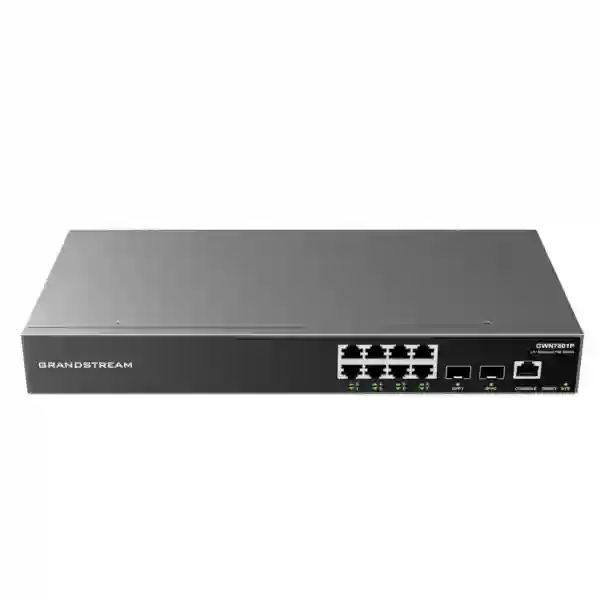
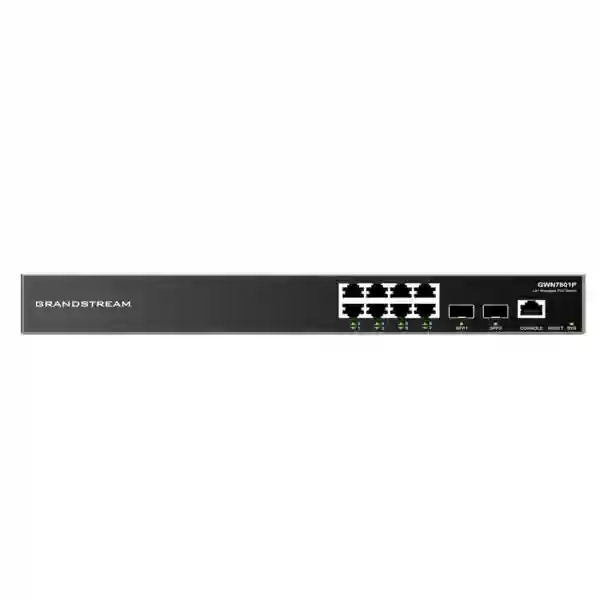
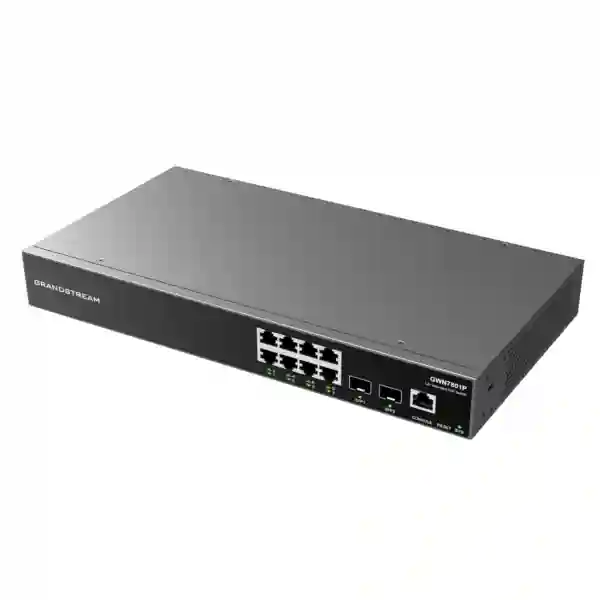
The Grandstream GWN7801P Pro is a compact Layer 2++ managed PoE switch built for organizations that want stronger control, cleaner power delivery and better uplink flexibility than an unmanaged access switch can provide. It combines eight Gigabit Ethernet PoE/PoE+ ports with two 2.5G SFP uplink ports, a 26 Gbps switching capacity and a 130 W documented PoE budget. For Tanzanian offices, hotels, schools, retail environments, clinics, branches and security deployments, that makes it useful where IP phones, cameras, wireless access points and other network endpoints need both data and power from a centrally managed switch.
Advanced switching functions support segmented, policy-driven business LANs with VLAN, routing-related capabilities, traffic controls and resilient topology features.
Eight PoE/PoE+ access ports can power compatible IP phones, cameras and wireless access points while keeping cabling and power architecture easier to manage.
Use the embedded Web UI, GDMS Networking, GWN Manager, compatible GWN routers or CLI according to the operational model preferred by your IT team.
ARP inspection, IP source guard, DHCP snooping, port security, AAA options and other controls help reduce avoidable risks on the access layer.
What the GWN7801P Pro solves
A small business network can become difficult to operate when phones, cameras, access points, printers and user devices are all connected through basic unmanaged switches. Troubleshooting becomes guesswork, broadcast traffic can spread unnecessarily, voice and video compete with bulk data, and every powered endpoint may need its own local adapter. The GWN7801P Pro addresses that problem by combining managed switching and Power over Ethernet in a compact form factor. Administrators can create VLANs to separate departments or device classes, apply quality-of-service policies, inspect port behavior, control edge access and use uplinks that are faster than the individual Gigabit access ports.
The two 2.5G SFP uplinks are particularly useful for a branch or floor access switch because the combined traffic from several Gigabit endpoints can be carried toward an upstream switch, router or network core over optical or compatible SFP connectivity. The 26 Gbps switching capacity published for the model gives the device enough internal switching capability for its intended port density. Eight access ports also make it easier to deploy the switch in focused locations such as a reception area, camera cluster, small office, executive floor, meeting-room zone or wireless coverage segment without buying a larger chassis simply to obtain managed PoE.
For organizations using other Grandstream networking products, centralized management options can simplify operations. For mixed-vendor environments, the switch still uses standard Ethernet, VLAN, PoE and management concepts, so the design can be evaluated on normal network requirements rather than locked to one endpoint family. The important procurement step is to calculate endpoint count, required PoE draw, uplink type, VLAN plan and future expansion before deciding whether eight ports are sufficient.
Verified GWN7801P Pro technical highlights
| Access interfaces | 8 Gigabit Ethernet ports |
| PoE | 8 PoE/PoE+ ports, up to 30 W per compatible port; current documented total PoE budget 130 W |
| Uplinks | 2 × 2.5G SFP ports |
| Switching capacity | 26 Gbps |
| Processor / memory | Single 1 GHz CPU and 128 MB RAM |
| Management | Embedded Web UI, GDMS Networking, GWN Manager, GWN Series Routers and CLI |
| Network support | IPv4 and IPv6 with VLAN, QoS, multicast controls and enterprise access-layer functions |
| Security examples | ARP inspection, IP/IPv6 source guard, DHCP snooping, DoS protection, port security, AAA with RADIUS/TACACS+ and related controls |
Buying guidance before requesting a quote
Count every device that needs a wired port, then separate devices that also need PoE. Add the estimated maximum PoE draw for cameras, access points and phones rather than assuming every device uses the same wattage. Check whether uplinks require fiber, what SFP type is appropriate for the distance and medium, and whether the upstream device can support the selected speed. Define VLANs, IP addressing, management access and redundancy before installation. If eight access ports leave no expansion margin, compare a larger GWN7800 Pro model instead of filling every port on day one. For broader infrastructure planning, FourTeck Tanzania also covers networking, Wi-Fi, IP telephony, surveillance and integrated IT infrastructure, allowing switch sizing to be evaluated together with the endpoints it will support.
GWN7801P Pro Tanzania
In Tanzania, the GWN7801P Pro is a practical choice for organizations that need a compact managed access switch rather than a high-port-density core platform. A typical deployment may involve a branch office with IP phones, two or three wireless access points, a small CCTV segment and a few business devices. In that environment, the value of the switch is not simply that it offers eight ports. The more important benefit is that those ports can be organized, monitored and powered centrally, while the two 2.5G SFP uplinks provide a faster path toward an upstream network layer. This helps an IT team build a cleaner design for voice, data, Wi-Fi and security traffic instead of connecting everything to an unmanaged edge switch.
Tanzanian buyers should begin by mapping the physical site. Count endpoint locations, confirm copper cable routes, determine whether fiber is needed between rooms or buildings, identify the rack or cabinet position and check available power protection. The GWN7801P Pro can power compatible PoE and PoE+ endpoints, but a quotation should still include the actual power requirement of each device. A Wi-Fi access point, fixed IP phone and motorized camera may have very different power demands. The 130 W total PoE budget provides a clear planning boundary; it should be treated as a design figure rather than an invitation to run every port at the highest possible draw without margin.
For businesses operating several Tanzanian locations, centralized management can reduce the effort required to inspect switch status, standardize settings and troubleshoot remote sites. GDMS Networking provides a cloud management option, while GWN Manager supports an on-premise approach. Organizations with stricter operational policies can decide which management path fits their security and internet-dependency requirements. VLANs can separate staff devices, voice endpoints, cameras and guest infrastructure; QoS can prioritize sensitive traffic; and access-layer security controls can reduce common risks associated with unmanaged edge ports.
Procurement should also account for transceivers, patch leads, rack accessories, UPS capacity, labeling and configuration effort. These items are often small compared with the switch itself but determine whether the finished installation is reliable and maintainable. Buyers can use FourTeck’s wider regional technology network as a reference point for integrated IT and communications planning while using the Tanzania operation for market-specific requirements and quotation discussions.
GWN7801P Pro Dar es Salaam
Dar es Salaam organizations often combine dense office environments with customer-facing spaces, warehouses, retail areas, hospitality sites and multi-floor commercial buildings. In these environments, an eight-port managed PoE switch can be useful as a localized access layer. Rather than running long copper paths back to one central switch for every endpoint, a properly designed network can place compact managed switching closer to device groups, then use fiber or another suitable uplink method toward the main rack. The GWN7801P Pro’s two 2.5G SFP uplinks make that architecture attractive where several Gigabit endpoints need to share a faster upstream connection.
A Dar es Salaam deployment should be planned around the actual building. Offices with IP telephony may prioritize voice VLAN and QoS. Hotels and serviced apartments may focus on wireless access points and security cameras. Retail sites may need POS connectivity, surveillance and staff Wi-Fi separated from guest traffic. Clinics and professional services offices may prioritize secure segmentation and controlled management access. The switch supports the features needed to create these logical boundaries, but the quality of the outcome depends on the addressing, VLAN and security design applied during commissioning.
Power reliability is another practical consideration. PoE centralizes endpoint power at the switch, which means a UPS protecting the network rack can help keep several connected devices active during short interruptions, subject to the UPS design and endpoint load. That can be cleaner than using separate power adapters distributed throughout the site. However, PoE budgeting must be calculated correctly. If a project includes high-power cameras or several access points, the design should total expected consumption and preserve reasonable headroom under the 130 W switch budget.
When requesting a quote in Dar es Salaam, include the number and type of endpoints, whether rack mounting is preferred, expected uplink medium and distance, existing firewall or router, VLAN requirements and any need for centralized monitoring. This information makes it easier to determine whether the GWN7801P Pro is the correct size or whether a 16-, 24- or 48-port model would provide a better expansion path.
GWN7801P Pro Mwanza
For businesses in Mwanza, the GWN7801P Pro can serve as a manageable edge switch for branch offices, shops, hospitality properties, educational environments and operational facilities that do not require dozens of access ports at one location. Its compact eight-port design is especially useful when the network must remain structured but the endpoint count is modest. The advantage over an unmanaged switch becomes clearer when the site uses multiple traffic types: office data, IP voice, surveillance video and wireless access can be separated into VLANs and given appropriate priorities and access rules.
The two 2.5G SFP uplinks also provide design flexibility for sites where the switch is not located beside the core router. Fiber can be useful for longer runs, inter-building links or electrical environments where copper is less desirable, provided the correct SFP modules and fiber type are selected. Procurement teams should avoid choosing transceivers by connector appearance alone. The optical standard, wavelength, fiber mode, distance and peer device must match. These details should be captured in the bill of materials together with patch cords, rack hardware and labeling.
A Mwanza security or hospitality project may use several PoE endpoints. The GWN7801P Pro can power compatible devices across all eight access ports, but the total 130 W budget remains the controlling limit. A proper survey should identify each endpoint’s maximum draw and account for future changes. An access point upgrade, for example, may consume more power than the unit it replaces. Good design therefore leaves electrical and port capacity for maintenance or expansion rather than operating permanently at the edge of the switch’s capabilities.
Management choice is also important for remote sites. Cloud management through GDMS Networking can be convenient when administrators support multiple locations, while GWN Manager offers an on-premise alternative. Local Web UI and CLI remain useful for direct administration. The correct approach depends on internal policy, connectivity and support workflow, not merely convenience.
GWN7801P Pro Arusha
Arusha businesses often include tourism, hospitality, professional services, education, logistics and organizations supporting regional operations. In these environments, reliable edge networking matters because guest Wi-Fi, staff systems, cameras and IP telephony may all share the same physical cabling infrastructure while requiring different logical treatment. The GWN7801P Pro can be positioned as a managed access switch for a small zone or branch, providing eight Gigabit PoE/PoE+ ports plus faster SFP uplinks toward the rest of the network.
For a lodge, office or training facility, VLAN design can keep guest traffic separate from business systems and surveillance devices. QoS can help protect voice or other latency-sensitive applications when the local network is busy. DHCP snooping, port security, ARP inspection and source-guard functions can provide additional controls at the access layer. These features are most valuable when they are configured as part of a documented security design; simply enabling settings without understanding the network can create outages or block legitimate equipment.
The switch’s PoE capability can simplify installation by delivering data and power over one Ethernet cable to compatible endpoints. That is useful for ceiling access points, wall-mounted phones and cameras located away from convenient electrical outlets. Centralized rack power can also make UPS planning more coherent. The design team should still inspect cable category, distance, termination quality and environmental conditions, because PoE does not correct poor cabling.
For Arusha procurement, a useful quotation request should state the site type, port count, PoE device models, intended uplink destination, fiber distance if applicable, current router or firewall, rack availability and growth expectation. If the installation is likely to exceed eight ports soon, a larger switch may be more economical than adding a second device later. The GWN7801P Pro is strongest where its compact size, managed control and PoE budget align with a clearly bounded access-layer requirement.
GWN7801P Pro Dodoma
In Dodoma, the GWN7801P Pro can fit government-adjacent offices, professional organizations, schools, branches, clinics and growing businesses that need structured network management without deploying a large access switch at every location. Eight Gigabit PoE ports are enough for many focused endpoint groups, while the dual 2.5G SFP interfaces allow the switch to connect toward a central rack with more uplink capacity than a single Gigabit path. That can be useful when several devices transfer data simultaneously or when the switch supports wireless and surveillance traffic in addition to normal office use.
A well-designed Dodoma network should distinguish between switching capacity and internet speed. The GWN7801P Pro handles local Ethernet traffic inside the LAN; internet performance still depends on the WAN circuit, firewall, router, application behavior and provider conditions. This distinction matters because many perceived network problems originate outside the access switch. Managed switching helps administrators isolate issues by providing visibility into ports, VLANs and traffic behavior, making troubleshooting more systematic than with an unmanaged device.
For IP phone deployments, PoE reduces desk-level power adapters and voice VLAN features can support cleaner separation. For CCTV, PoE simplifies camera cabling, while the uplink design should account for aggregate video bandwidth. For Wi-Fi, the wired uplink and VLAN configuration must align with the SSIDs and controller settings. These use cases demonstrate why the switch should be purchased as part of an architecture rather than as a standalone box.
Before ordering, document the existing network, desired VLANs, number of powered endpoints, fiber requirements, rack layout and UPS plan. Also decide who will administer the switch after installation and whether cloud, on-premise or local management is preferred. A configuration backup, port map and labeling schedule should be part of handover so that future support does not rely on memory.
GWN7801P Pro UAE
For UAE projects, the GWN7801P Pro is relevant to branch offices, retail stores, small hospitality zones, surveillance clusters and communication deployments that need managed PoE at the network edge. Eight Gigabit access ports can support a compact device group, while dual 2.5G SFP uplinks allow connection toward an aggregation switch or main communications room. The design is particularly useful when an organization wants standardized switching across several branches but does not require a 24- or 48-port switch in every cabinet.
UAE environments often involve structured racks, fiber backbones, multiple VLANs and centralized IT administration. In that context, the GWN7801P Pro’s VLAN, QoS, multicast and security functions support normal enterprise access-layer practices. PoE can power compatible access points, phones and cameras, reducing separate power supplies at endpoint positions. The switch’s 130 W total PoE budget should be checked against the actual device schedule, especially where cameras with heaters, PTZ functions or high-performance wireless access points are involved.
Organizations operating between the UAE and East Africa may also value consistent configuration templates and management methods across sites. GDMS Networking provides a cloud-based option, while GWN Manager supports on-premise control. Local administration remains possible through the Web UI or CLI. A multi-site standard should define VLAN numbering, port naming, management addresses, firmware policy, backup procedures and change control so that the switches remain easier to support over time.
For UAE-specific procurement and related infrastructure, buyers can also review FourTeck UAE technology solutions. A useful quotation should state port count, PoE endpoints, fiber type and distance, rack requirements, upstream switch compatibility and whether installation or configuration services are needed. Avoid assuming that a listed transceiver or accessory is automatically suitable; optical interfaces should be matched end to end.
GWN7801P Pro Uganda
In Uganda, the GWN7801P Pro can serve small offices, clinics, shops, education sites, hospitality properties and branch networks that need a compact managed PoE access layer. The eight-port format helps avoid oversizing when a site has only a small cluster of endpoints, while the two 2.5G SFP uplinks create a useful path to a central switch or router. This makes the model suitable for architectures where localized edge switching connects back to a larger network over fiber.
Network planning should begin with services, not ports. A branch with IP phones may need voice VLAN and QoS. A surveillance location may prioritize PoE budget, camera traffic and secure management. A Wi-Fi deployment may require several tagged VLANs on the access-point uplinks. A mixed office may need all three simultaneously. The GWN7801P Pro provides the managed features to support these designs, but configuration should be documented and tested before production use.
For remote or distributed Ugandan sites, centralized visibility can make operations easier. Administrators can choose cloud-based GDMS Networking or GWN Manager on premises, depending on policy and connectivity. The device also supports local Web UI and CLI administration. A sensible deployment process includes changing default credentials, limiting management access, configuring time and monitoring, applying VLANs and security policies, backing up the configuration and recording port assignments.
Ugandan customers can review the wider FourTeck Uganda technology portfolio when the switch forms part of a larger voice, wireless, security or infrastructure project. The quote should include endpoint models and power draw, not just quantities, so the 130 W PoE budget can be checked accurately.
GWN7801P Pro Kampala
Kampala offices and commercial sites can use the GWN7801P Pro as a managed edge switch for small network zones where power and segmentation are important. A professional-services office might connect IP phones, access points and a few wired workstations. A retail site might connect cameras, a POS back-office device and staff wireless. A school may use it for a small administrative block or classroom technology area. In each case, the switch is most valuable when it is configured to separate traffic and provide predictable uplink behavior rather than simply acting as an eight-port connector.
The 2.5G SFP uplinks are useful when several 1G endpoints feed one upstream path, but the end-to-end design must support the chosen optical speed. The transceiver, fiber cable and peer port should be compatible. For campuses or multi-floor buildings, this can provide a cleaner distribution approach than long copper runs. The physical installation should also consider rack space, grounding, airflow, UPS protection and cable management so that maintenance can be performed without disturbing unrelated services.
From a security perspective, managed edge ports allow tighter control than unmanaged switches. DHCP snooping can help protect address assignment, ARP inspection can reduce certain spoofing risks, port security can restrict endpoint behavior and VLANs can separate trust zones. These controls should be enabled according to a tested policy. The objective is to reduce risk without making legitimate changes unnecessarily difficult.
For Kampala buyers, the decision question is whether eight access ports and 130 W of total PoE are enough for the expected lifecycle of the site. If the project already requires seven or eight powered endpoints, future expansion may justify a larger model. If the requirement is a bounded network zone, the GWN7801P Pro can provide a strong balance between managed functionality, PoE and compact deployment.
GWN7801P Pro Arua
Arua deployments may involve branch offices, NGOs, clinics, schools, retail sites or operational facilities where local IT resources are limited and the network must be straightforward to support. The GWN7801P Pro can be useful in this context because it combines endpoint power, switching and management in one small device. Eight PoE/PoE+ ports can support a focused group of phones, cameras or access points, while managed features allow the site to follow the same network policy used elsewhere in the organization.
Remote support considerations are important. A clear management IP, secure administrator access, configuration backups and consistent port naming can significantly reduce troubleshooting time. If cloud management is appropriate for the organization’s policy, GDMS Networking can provide centralized visibility. If the organization prefers local infrastructure control, GWN Manager can be used on premises. Either approach benefits from documented VLANs and a standard configuration template.
PoE planning should include not only total wattage but also what happens during outages. A UPS sized for the switch and its powered endpoints can help preserve connectivity for a limited period, but runtime depends on the total load and battery capacity. Critical devices such as a core access point, phone or camera may be prioritized depending on business requirements. Cabling should be tested because poor terminations can cause intermittent faults that are mistaken for switch or endpoint failures.
For a quotation in Arua, include the site layout, number of endpoints, PoE device types, existing internet/router equipment, preferred uplink medium and whether the switch will be rack, wall or desktop mounted. If future expansion is uncertain, compare the cost of a larger switch now with the operational complexity of adding another switch later. The correct decision is based on the full deployment, not the lowest initial port count.
GWN7801P Pro Mbarara
Mbarara businesses can use the GWN7801P Pro to build a compact but controlled network edge for offices, hospitality properties, healthcare environments, schools and commercial operations. The switch’s eight Gigabit PoE ports are appropriate where endpoint counts are modest, while the dual 2.5G SFP interfaces support higher-speed uplinks toward a distribution switch. This combination can help keep local copper runs short and provide an organized fiber path from a remote cabinet to the main network room.
For wireless deployments, the switch can carry tagged VLANs to access points so staff, guest and device traffic remain separated. For voice deployments, QoS and voice-oriented VLAN design can help prioritize call traffic. For CCTV, administrators can isolate camera networks and monitor the PoE status of powered devices. These are different workloads, and the configuration should reflect their needs rather than placing every endpoint in one flat broadcast domain.
The 130 W PoE budget is generous for many eight-port business scenarios, but it still needs calculation. A project should list maximum endpoint consumption and allow operating headroom. If future devices may require more power, that should be considered at procurement time. The same applies to uplinks: if the upstream switch does not support the required SFP speed or optical standard, a theoretically fast port will not produce the expected result.
Operational handover is also important. Document switch IP, administrator ownership, firmware process, VLAN IDs, port descriptions, uplink details and connected endpoints. Keep a configuration backup after commissioning. These simple practices make the GWN7801P Pro easier to maintain over its life and reduce dependence on the person who originally installed it.
GWN7801P Pro Gulu
In Gulu, a managed PoE switch such as the GWN7801P Pro can support organizations that need dependable edge connectivity without a large chassis. Eight Gigabit access ports suit small branches and device clusters, while the two 2.5G SFP uplinks provide a useful route toward the network core. The model can therefore fit offices, education facilities, health services, NGO sites, hospitality environments and security installations where central management and VLAN separation are more important than sheer port count.
One practical use is consolidating power for remote endpoints. PoE allows compatible cameras, access points and phones to receive power from the network switch. When the rack is protected by a properly sized UPS, multiple critical endpoints can benefit from the same backup-power strategy. This does not eliminate the need for power planning: the switch itself, its PoE load and the uplink equipment all contribute to UPS runtime and should be considered together.
The switch’s management and security functions also support more disciplined operation. VLANs can limit broadcast domains, QoS can prioritize important applications, port security can control edge behavior and DHCP/ARP protections can reduce specific local-network attacks. Remote management through approved platforms can help administrators support Gulu sites from another location, but secure access controls and configuration backups should be part of the deployment standard.
A procurement request should specify whether fiber is already installed, the expected distance, connector and transceiver requirements, endpoint count, PoE demand, rack location and growth forecast. If there is a possibility that the site will add many cameras or access points, selecting a higher-port model may create a cleaner expansion path. Where the requirement is stable and compact, the GWN7801P Pro offers a well-defined access-layer footprint.
GWN7801P Pro Kenya
Kenyan organizations can deploy the GWN7801P Pro in branch offices, retail sites, hospitality locations, schools, clinics and compact commercial networks where an eight-port managed PoE switch provides enough endpoint capacity. The model’s dual 2.5G SFP uplinks are useful when an access switch must connect into a larger structured network, particularly across fiber backbones in multi-floor or multi-building environments. Its Layer 2++ feature set also supports segmentation and policy controls expected in professionally managed LANs.
A Nairobi office may use the switch for IP phones and access points, while a hotel or branch may use it for a mix of cameras, Wi-Fi and operational devices. In each case, VLAN design should be driven by trust and traffic requirements. Guest traffic should not automatically have access to internal business systems. Cameras may be isolated to their recorder or management platform. Voice traffic can receive appropriate QoS. Management interfaces should be accessible only from approved networks.
PoE planning remains central. The published 130 W total budget should be compared with device specifications before installation. Even if eight endpoints fit physically, they must fit electrically. The uplink plan should likewise confirm SFP compatibility and the capabilities of the upstream switch. A complete bill of materials may include optical modules, fiber patch cords, rack accessories, grounding, UPS and labeling in addition to the switch itself.
For local and regional solution context, visit FourTeck Kenya. Organizations operating in both Kenya and Tanzania can benefit from using common VLAN conventions, configuration templates and management policies across branches, reducing support complexity and making network changes more predictable.
GWN7801P Pro Kuwait
For Kuwait deployments, the GWN7801P Pro is best considered as a compact managed access switch for businesses that need PoE, VLAN control and high-speed optical uplinks in a limited port footprint. Small offices, retail outlets, meeting-room zones, hospitality areas and security cabinets can all benefit from an eight-port switch when the endpoint count is known and future expansion is limited. The model supports a more structured design than an unmanaged switch because the administrator can define traffic segmentation and security policies at the edge.
In modern commercial buildings, fiber often connects floors or communications rooms. The GWN7801P Pro’s two 2.5G SFP uplinks can fit such designs, but optical modules must be selected to match the peer interface and fiber type. Uplink redundancy and topology should also be planned carefully. Managed network features provide tools for loop prevention and resilient design, but a documented architecture is still required to avoid accidental paths that can disrupt a LAN.
PoE simplifies endpoint power for IP phones, cameras and wireless access points. The benefit is operational as well as aesthetic: centralized rack power can be monitored and protected more easily than many distributed adapters. However, the total endpoint draw must remain inside the 130 W budget. Where high-power endpoints are planned, the design should preserve headroom for startup conditions and future device replacement.
Kuwait buyers should request a technical bill of materials rather than a switch-only price. The BOM should identify SFP modules, patch leads, rack mounting, UPS, cable testing and configuration where required. This provides a clearer view of the complete installed network segment and reduces the risk of discovering incompatible accessories during deployment.
GWN7801P Pro Ghana
Ghanaian organizations can use the GWN7801P Pro for compact branch networking where managed features and PoE are required. An eight-port footprint is suitable for focused endpoint groups such as an office wing, reception area, surveillance cluster or small wireless zone. Dual 2.5G SFP uplinks make it possible to connect the access layer back to a distribution device with more capacity than any individual Gigabit endpoint requires, which is useful when several devices are active at the same time.
A key planning benefit is traffic segmentation. Businesses can place voice devices, cameras, employee systems and guest services on separate VLANs, then enforce routing and firewall policy upstream. QoS can help prioritize latency-sensitive applications. Managed port controls also support troubleshooting because administrators can review link status and configuration instead of physically tracing every issue as they might with unmanaged switching.
PoE should be treated as a shared resource. The switch supplies compatible PoE and PoE+ devices, but total power consumption across all connected endpoints must be kept within the 130 W budget. The design should include the maximum rated draw of each endpoint, not merely its normal average. This is especially important in security and wireless projects where replacement devices may later require more power than the original hardware.
For Ghana procurement, include network diagrams or at least a written description of the upstream router/switch, fiber requirements, rack environment, VLAN plan and device list. A well-defined request allows the switch, accessories and configuration effort to be quoted together. For multi-country organizations, using a common access-switch configuration standard can make Ghana and Tanzania branches easier to support from one IT function.
GWN7801P Pro Nigeria
Nigeria’s wide range of business environments makes compact managed PoE switching relevant to many branch and departmental networks. The GWN7801P Pro can support a small office, retail branch, security cabinet, meeting suite or wireless zone where eight powered Gigabit ports are sufficient. Rather than using several independent power adapters and an unmanaged switch, the organization can centralize endpoint power, create VLANs, apply QoS and monitor network ports from a managed platform.
The two 2.5G SFP uplinks provide additional flexibility for connections toward the network core. A Lagos or Abuja office with structured fiber may use the switch at the edge of a floor or department, while a remote branch can use it as the primary access switch. In both cases, SFP selection should be based on the actual optical standard and distance. The upstream device must be compatible with the selected speed and transceiver type.
Security features should be configured according to an organization’s threat model and operating procedures. DHCP snooping, ARP inspection, source guard, port security and AAA integration can all contribute to a stronger LAN edge. VLAN separation can reduce unnecessary trust between cameras, phones, guests and business devices. Firmware management and configuration backup are equally important because an advanced feature set provides little value if the device is left unmanaged after installation.
Nigeria procurement teams should evaluate both present and projected endpoint counts. If the site is expected to add cameras, phones or access points quickly, a larger model can reduce future switch sprawl. If the scope is stable, the GWN7801P Pro’s eight-port format offers a focused solution with enterprise-oriented management. Quotations should cover accessories, power protection and configuration requirements in addition to the switch hardware.
GWN7801P Pro Seychelles
In Seychelles, the GWN7801P Pro can suit hospitality, office, retail and security environments where a compact managed PoE switch is preferable to a larger high-port-density unit. Island properties and distributed buildings often benefit from carefully planned fiber backbones with localized access switching. The switch’s two 2.5G SFP uplinks can support that type of architecture, while eight Gigabit PoE/PoE+ ports connect nearby access points, phones, cameras and other Ethernet endpoints.
Hospitality networks are a strong example. Guest Wi-Fi, staff systems, CCTV and voice services may share physical infrastructure but should not share unrestricted logical access. VLANs can separate those services, while QoS can help sensitive applications receive appropriate priority. PoE simplifies ceiling and wall-mounted devices where local power outlets may be inconvenient. The overall design should still consider cable distance, environmental exposure, rack ventilation and grounding.
Because replacement logistics can be more complex in island markets, documentation and configuration discipline are particularly useful. Keep a current port map, save configuration backups, label fiber links and record the exact transceiver types in use. If a replacement is needed later, this information reduces uncertainty and helps avoid ordering an incompatible optical module or re-creating configuration from memory.
The switch’s 130 W PoE budget should be checked against the endpoint schedule. High-demand wireless access points or cameras may consume substantially more than basic phones. A quotation should therefore list device models where possible. For mixed deployments, preserve both port and power headroom so that service changes can be made without immediately replacing the access switch.
Compatibility, deployment and integration guidance
The GWN7801P Pro uses standard Ethernet and PoE technologies, so it can be integrated with a broad range of compatible IP endpoints rather than only Grandstream devices. Compatibility should still be confirmed at the feature level. An IP phone may work at basic Ethernet level but require specific VLAN, LLDP or provisioning settings. A wireless access point may need tagged VLANs and a PoE class that fits the available port power. A camera system may require isolated VLANs and sufficient uplink capacity to carry aggregate video traffic.
For deployment, first establish management access and secure administrator credentials. Set the management IP according to the network plan, configure VLANs and uplinks, define access-port behavior, apply PoE priorities if necessary, then add QoS and security controls. Test one endpoint type at a time before moving the complete site. This staged process reduces troubleshooting complexity. After commissioning, save a configuration backup and record firmware, management method, IP address, VLAN IDs, port descriptions and connected devices.
The current Grandstream Pro documentation also includes support for Pro AV workflows and IEEE 1588 PTP in the GWN780x Pro family. Organizations considering AV-over-IP should verify the exact protocol and template requirements of their chosen audiovisual platform before relying on any switch feature. Multicast behavior, timing, QoS and endpoint certification can be critical in professional AV networks.
Who should choose the GWN7801P Pro?
Small branches, camera clusters, IP telephony groups, Wi-Fi zones, meeting areas and compact business networks that need eight managed Gigabit PoE ports with fiber uplinks.
Sites already close to eight ports, projects with rapid expansion, higher aggregate PoE requirements or environments where more high-speed uplinks are required.
Confirm endpoint count, maximum PoE draw, SFP compatibility, fiber type and distance, VLANs, management method, rack requirements, UPS and future growth.
Quotation checklist
Frequently asked questions
How many PoE ports does the GWN7801P Pro have?
It has eight Gigabit Ethernet access ports and all eight support PoE/PoE+. The current Grandstream documentation lists a total PoE budget of 130 W for the GWN7801P Pro.
What uplink ports are available?
The GWN7801P Pro includes two 2.5G SFP ports. Transceiver compatibility, fiber type, distance and the peer device should be confirmed before purchase.
Can it power IP phones, cameras and Wi-Fi access points?
Yes, compatible PoE/PoE+ endpoints can be powered from the switch. The project must remain inside the per-port and total PoE limits, so actual endpoint power specifications should be checked.
How can the switch be managed?
Grandstream supports the embedded Web UI, GDMS Networking cloud management, GWN Manager on-premise software, compatible GWN routers and CLI. The preferred method depends on the organization’s operational and security model.
Does it support VLANs and QoS?
Yes. The Pro series supports advanced VLAN functions and QoS for traffic segmentation and prioritization. These features are useful for separating voice, data, cameras, guests and other endpoint classes.
Is the GWN7801P Pro suitable as a core switch?
It is primarily attractive as a compact managed access switch because it provides eight Gigabit access ports. Whether it can act as the main switch for a very small site depends on topology and requirements, but larger networks normally use higher-port or higher-capacity devices for aggregation and core roles.
What information is needed for an accurate Tanzania quotation?
Provide endpoint count, PoE device models, fiber/uplink requirements, rack location, management preference, installation scope and anticipated growth. This allows the switch and its required accessories to be assessed as a complete solution.
Decision recap
Choose the GWN7801P Pro when you need a compact eight-port managed PoE switch with dual 2.5G SFP uplinks, a 26 Gbps switching capacity, a 130 W PoE budget, flexible Grandstream management options and strong access-layer controls. The purchase decision should be based on endpoint count, PoE demand, uplink design and future expansion. If eight ports provide comfortable headroom, the model offers a focused way to add managed switching for phones, cameras, Wi-Fi and business devices. If the design is already at the edge of the port or power budget, compare larger Pro-series models before finalizing the bill of materials.
Talk to FourTeck about GWN7801P Pro Tanzania
FourTeck can help translate a switch request into a practical network bill of materials covering ports, PoE, uplinks, VLANs, optics, rack requirements and related infrastructure. For larger projects, the switch can be reviewed together with wireless access points, IP phones, cameras, firewalls and cabling so that the power, bandwidth and segmentation plan is consistent across the site.
Use the FourTeck Tanzania contact page to share your device list, site requirements and quotation details.



Reviews
There are no reviews yet.