
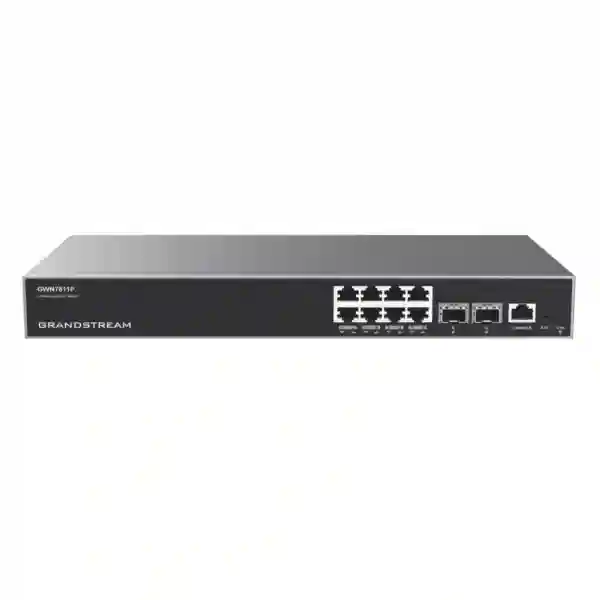
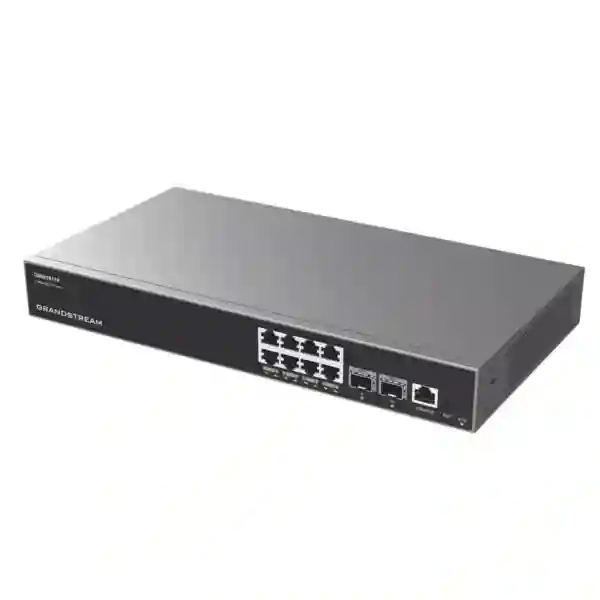
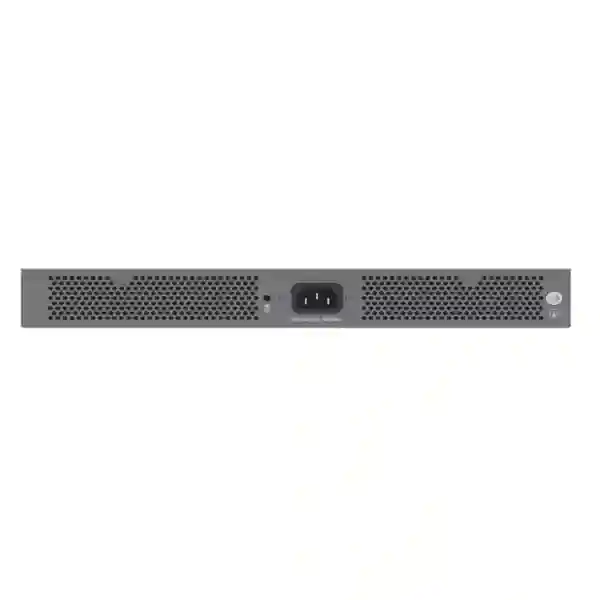
ENTERPRISE LAYER 3 MANAGED PoE+ SWITCH
Grandstream GWN7811P Tanzania
The Grandstream GWN7811P is a compact enterprise Layer 3 managed switch designed for organizations that need eight Gigabit Ethernet access ports with PoE/PoE+ power and fast 10Gbps SFP+ uplinks. With a 120W PoE budget, advanced VLANs, routing features, QoS, network security controls and centralized management options, it can serve offices, branch sites, hospitality environments, schools, clinics, retail operations and other professional networks that need to connect and power IP phones, wireless access points, IP cameras and similar Ethernet devices.
8 × Gigabit Ethernet PoE/PoE+ ports
2 × 10Gbps SFP+ uplinks
120W total PoE budget
Layer 3 routing, VLAN, QoS and security
Why this model matters
The GWN7811P combines PoE access switching with Layer 3 capabilities and 10Gbps uplink connectivity in an eight-port format. That makes it useful where a site has a limited endpoint count but still needs professional segmentation, traffic control, centralized administration and room to connect toward a faster aggregation or core layer.
What it can power
The eight copper ports support PoE/PoE+ with up to 30W per port and a total switch budget of 120W. Typical endpoint classes include SIP phones, compatible IP cameras, wireless access points and other IEEE 802.3af/at powered devices. The total connected load must remain within the switch power budget.
Where it fits
Use cases include small network closets, branch-office access layers, executive floors, meeting facilities, surveillance zones, retail sites and distributed locations where eight powered access ports are enough but unmanaged switching would not provide the visibility, VLAN design, routing control or security policy required.
Grandstream GWN7811P verified technical overview
Grandstream positions the GWN7811P within its GWN7810 enterprise Layer 3 managed switch family. The model provides eight 10/100/1000Mbps Ethernet ports, two 10Gbps SFP+ ports, eight PoE-capable access ports, a 120W total PoE output budget, 28Gbps non-blocking throughput, 56Gbps switching capability and a forwarding rate of approximately 41.644 million packets per second. The switch supports IPv4 and IPv6 networks and a broad collection of Ethernet, VLAN, spanning-tree, authentication, PoE and link-aggregation standards.
For network segmentation, the platform supports advanced VLAN functions, including IEEE 802.1Q tagging and voice-oriented VLAN features. For business traffic control, built-in Quality of Service helps administrators prioritize latency-sensitive or operationally important flows. Multicast support includes IGMP and MLD snooping, which can be useful where the LAN carries multicast streams. Layer 3 capabilities include static and dynamic routing functions documented by Grandstream for the series, giving network teams more design flexibility than a basic Layer 2 access switch.
Security controls include features such as ARP inspection, IP Source Guard, DHCP snooping, port security, 802.1X authentication and protections intended to reduce common local-network attack or misconfiguration risks. These controls are most valuable when they are configured as part of a documented LAN policy rather than simply enabled without planning. For example, DHCP snooping and IP source validation work best when trusted uplinks, expected address assignment and endpoint roles are clearly understood.
Management options include the local web interface and command-line access, plus Grandstream centralized network-management options. The GWN7810 family can be managed through Grandstream’s cloud and on-premise management platforms, allowing organizations to standardize configuration and monitoring across compatible Grandstream networking devices. Selection should still be based on the exact site design, because port count, PoE demand, uplink distance, transceiver choice, redundancy expectations and network growth can determine whether the GWN7811P is the right access-switch size.
Business benefits of the GWN7811P
Compact PoE access layer
Eight powered Gigabit ports let a small site connect several PoE endpoints without using individual power adapters at each device. This can simplify installation and make it easier to place phones, access points or cameras where network cabling already reaches the endpoint.
10Gbps uplink headroom
Two SFP+ ports provide a high-speed path toward an aggregation switch, core switch or another suitable network device. They are valuable where Gigabit access traffic from multiple users or powered endpoints should not be constrained by a single 1Gbps uplink.
Segmentation and routing
Layer 3 and VLAN capabilities support cleaner separation between voice, surveillance, staff, wireless, management and other traffic classes. Proper segmentation can improve manageability and reduce unnecessary exposure between device groups.
Centralized administration
Grandstream management tools can help administrators configure and monitor compatible network devices from a centralized platform. This is useful for organizations that want consistent configuration across multiple switches, access points or sites.
Planning a GWN7811P deployment in Tanzania
A switch should be selected from the network design rather than from port count alone. Start by listing every device that will connect directly to the GWN7811P and mark whether it requires PoE. Record the maximum or expected power requirement for each powered endpoint and compare the total with the 120W switch budget. Eight low-power endpoints may fit comfortably, while a mix of higher-power devices can consume the available budget sooner. Keeping a power margin can make future replacement or expansion easier.
Next, decide how the two SFP+ ports will be used. They can provide higher-speed uplinks, but the correct optical or copper module and media depend on the target equipment, distance and cabling plant. A short rack-to-rack connection has different requirements from a fiber path between floors or buildings. The transceiver and fiber type should be confirmed against both ends of the link before procurement.
Then define VLANs and endpoint roles. IP phones may need a voice VLAN and QoS treatment. Cameras may be separated from user computers and permitted to communicate only with required recording or management systems. Wireless access points may carry multiple SSIDs mapped to different VLANs. Infrastructure management interfaces can be placed in a restricted administrative segment. These policies should be documented before the switch is installed so that cabling, DHCP, firewall policy and routing align with the same plan.
Finally, consider power protection, rack placement, grounding, ventilation and configuration backup. The best switch configuration cannot compensate for poor rack conditions or unstable power. A properly sized UPS, clean cabling, labelled ports and saved configuration records reduce recovery time when maintenance is required.
FourTeck Tanzania network planning resources
For a broader view of managed switching, PoE design, uplinks and LAN architecture, visit the FourTeck Tanzania technology solutions overview. It explains how switches interact with Wi-Fi, IP phones, surveillance, firewalls, servers and supporting infrastructure.
The FourTeck Tanzania business technology shop provides category-level buying guidance for network switches, access points, firewalls, phones, cameras and related IT equipment. It is useful when the GWN7811P is one component within a larger bill of materials.
Organizations planning installation, configuration or broader lifecycle work can also review FourTeck Tanzania services for the surrounding project scope. Regional customers can use FourTeck Kenya and FourTeck Uganda when coordinating related East African networking requirements.
Grandstream GWN7811P Tanzania
For organizations searching for the Grandstream GWN7811P in Tanzania, the main buying question is whether an eight-port Layer 3 PoE+ switch matches the number of endpoints, power demand and uplink design at the intended site. The model is particularly attractive when a location needs a compact managed access switch rather than a high-port-density chassis. A branch office, secure department, meeting facility, reception area, retail outlet, clinic wing, school block or remote operations room may have only a handful of network devices but still need VLAN separation, quality-of-service controls, Gigabit access and a fast uplink toward the wider network.
In Tanzania, project planning should account for the complete environment around the switch. The GWN7811P can power compatible IP phones, wireless access points and cameras, but the actual PoE design depends on how many devices are connected and how much power each one requires. A 120W total budget should be treated as a shared resource, not as 30W guaranteed simultaneously on every port. For example, a site mixing several access points and cameras should calculate the expected draw before finalizing the bill of materials, especially if future expansion is likely.
The two 10Gbps SFP+ ports can be valuable in Tanzanian offices and campuses where access traffic needs to aggregate cleanly into a core or distribution layer. Fiber can also be useful between floors or buildings where copper distance is unsuitable. The correct SFP+ module, fiber type and peer interface must be selected for the actual link. Buyers should therefore include uplink distance, existing switch model, rack location and available fiber in the quotation request instead of ordering transceivers separately without compatibility checks.
Management requirements are equally important. A small site may use the local interface, while a larger organization may prefer centralized network management so multiple switches and compatible Grandstream devices can be monitored consistently. Configuration standards for VLANs, management IP addressing, QoS, authentication, port labels, spanning tree and uplinks can make branch support far easier. For multi-site Tanzanian businesses, a repeatable template also reduces differences between offices and shortens troubleshooting.
When requesting a Grandstream GWN7811P quotation in Tanzania, provide the number and type of powered endpoints, expected PoE load, uplink requirements, VLAN plan, rack preference, fiber distance, management method and any existing Grandstream network components. That information helps determine whether the GWN7811P is correctly sized or whether a higher-port model would produce a cleaner long-term design.
Grandstream GWN7811P Dar es Salaam
Businesses evaluating the Grandstream GWN7811P in Dar es Salaam often need a switch that can serve a compact but feature-rich office network. Commercial offices, professional firms, retail sites, hotels, clinics, education facilities and branch locations can require several powered endpoints without needing twenty-four or forty-eight access ports. In this context, eight Gigabit PoE/PoE+ ports provide a practical footprint when the connected device list is known and controlled.
A typical Dar es Salaam deployment might connect a combination of desk phones, ceiling-mounted Wi-Fi access points and IP cameras. These devices should not automatically share the same logical network. The GWN7811P’s VLAN and Layer 3 features can support segmentation so voice, wireless, surveillance and management traffic remain organized. Firewall policy can then determine which segments communicate with servers, cloud applications or the internet. This is especially useful for businesses that have grown from a flat network and now need clearer control without replacing every connected endpoint at once.
Bandwidth planning matters when the switch is used for surveillance or wireless traffic. An access point serving many users can generate bursts of traffic, while multiple cameras produce continuous streams. The two 10Gbps SFP+ uplinks give network designers options for avoiding a narrow aggregation path, provided the upstream equipment supports the chosen connection. In a multi-floor office, fiber may also create a cleaner link between a local access cabinet and the main communications room.
Power quality and rack conditions should be part of the Dar es Salaam installation plan. The switch, upstream firewall or router, network controller and other critical devices should be placed in an appropriate rack or secure cabinet with ventilation and power protection. A UPS can help ride through short interruptions and give administrators time to respond during longer outages. Cabling and patch panels should be labelled so PoE endpoints can be identified quickly without trial and error.
Procurement teams in Dar es Salaam should ask for a solution-level quotation rather than only a unit price when the switch is part of a new site or upgrade. Useful details include the number of access points, phone extensions, cameras, uplink distance, existing switch or firewall interfaces, rack space and desired management approach. This reduces the risk of discovering after purchase that additional transceivers, patching, UPS capacity or a different port count is required.
Grandstream GWN7811P Mwanza
The Grandstream GWN7811P can suit Mwanza businesses and institutions that need a managed switch for a defined group of powered network devices. A branch office, school administration block, clinic department, retail location or hospitality area may need professional network controls even when the endpoint count is modest. Eight PoE/PoE+ access ports provide enough capacity for carefully planned small deployments, while the 10Gbps SFP+ interfaces create an upgrade path toward faster uplinks or fiber-based connectivity.
For sites where IP phones are important, the network can use voice VLAN and QoS features to keep signaling and media organized relative to ordinary data traffic. This does not remove the need for sufficient WAN bandwidth or a properly configured PBX, but it gives the access layer the tools to identify and prioritize traffic according to policy. When Grandstream phones or PBX equipment are part of the environment, administrators can also consider whether a broader Grandstream management strategy would simplify provisioning and support.
For camera deployments in Mwanza, PoE power and uplink capacity should be calculated together. Cameras may have different power needs depending on model and features such as infrared illumination, heaters, motorized lenses or analytics. Their video streams also create continuous traffic. A network plan should define where recording occurs, which VLAN carries camera traffic, whether streams cross the uplink and how remote viewing is secured. The GWN7811P offers switch-level capabilities that can support this architecture, but the overall result depends on correct system design.
Wireless projects should likewise examine both power and bandwidth. Access points may draw more power under load and may serve many client devices even though they occupy only one switch port. A site can therefore have fewer than eight connected endpoints and still place significant demand on uplink capacity. The SFP+ ports can be valuable when the upstream switch supports 10Gbps and the access point traffic warrants the capacity.
When preparing a GWN7811P requirement for Mwanza, include a simple port schedule. List each planned device, its location, whether it uses PoE, expected VLAN, and whether redundancy or future expansion is required. This small amount of documentation helps confirm that the eight-port model is appropriate and makes installation, testing and future troubleshooting more predictable.
Grandstream GWN7811P Arusha
Organizations looking for the Grandstream GWN7811P in Arusha may include hotels, tour and travel businesses, professional offices, educational facilities, healthcare sites, retail operations and branch offices. These environments often combine voice, wireless, surveillance and ordinary data services on the same physical network. A managed Layer 3 switch provides the tools to separate those services logically and to control how traffic moves between them.
Hospitality and guest-facing environments deserve particular attention to segmentation. Guest Wi-Fi should generally be isolated from business systems, while back-office users, payment systems, cameras and infrastructure management may require different access policies. The GWN7811P supports VLAN functions that can contribute to this separation. Wireless SSIDs can map to VLANs through compatible access points, and upstream firewall rules can then enforce internet-only access or controlled communication where required.
PoE planning can simplify installations because access points, phones and many cameras can receive power over the network cable. However, the 120W shared power budget must be checked against the full endpoint list. A design that looks acceptable by port count can still exceed the power budget if several devices approach the upper PoE+ range. Arusha buyers should provide exact device models where possible so the expected PoE draw can be assessed before purchase.
The two 10Gbps SFP+ interfaces also make the switch useful where an access cabinet needs a fast or fiber uplink back to a main rack. In larger properties, fiber can provide distance and electrical isolation advantages between network areas. The transceiver choice should match fiber type, connector, link distance and the upstream switch. A procurement request that includes those details can avoid last-minute changes during installation.
For Arusha projects, the GWN7811P is best evaluated as part of the complete network design. Ask whether eight access ports leave enough room for growth, whether 120W is sufficient for all powered devices, whether a 10Gbps uplink is required immediately or reserved for future use, and how the switch will be managed and backed up. Clear answers to those questions produce a more dependable deployment than choosing a switch only because its headline specifications appear attractive.
Grandstream GWN7811P Dodoma
For Dodoma offices, institutions and branch environments, the Grandstream GWN7811P offers a compact access-switch format with enterprise management features. Government-related offices, professional organizations, education sites, clinics and businesses may need only a limited number of directly connected endpoints in one network zone, yet still require managed VLANs, access control, monitoring and reliable uplinks. This is the design space where an eight-port Layer 3 PoE+ switch can be useful.
A common requirement is to support mixed endpoint types from one wiring cabinet. Phones may need voice-priority treatment, cameras may require an isolated surveillance VLAN, wireless access points may carry several SSIDs, and administrative computers may need access to internal applications. The GWN7811P provides the switching features needed to organize these groups. A firewall or routing policy can then enforce which networks are allowed to communicate, limiting unnecessary lateral access.
The switch’s PoE capability can reduce reliance on local power outlets at endpoint locations, which is useful for ceiling-mounted access points and cameras. Nevertheless, central power becomes more important because several endpoints depend on the switch. Appropriate UPS sizing should therefore consider the switch and the powered devices it supports. If the switch remains on but the upstream router, firewall or fiber equipment loses power, users may still lose service, so power protection should cover the complete critical path.
Dodoma deployments that connect back to a central rack can use the 10Gbps SFP+ interfaces where the network design supports them. Even when current traffic does not require 10Gbps, a fiber uplink may be chosen for distance, cable pathway or future-capacity reasons. The peer equipment and transceiver specification should be confirmed before ordering accessories.
A strong quotation request should identify current devices and planned growth for the next replacement cycle. If six or seven access ports will be used from day one, an eight-port model may leave little room for additions. In that case, a higher-port model might be more economical than adding another switch later. FourTeck Tanzania can help compare the practical requirement with the GWN7811P’s port, PoE and uplink profile before procurement.
Grandstream GWN7811P UAE
The Grandstream GWN7811P is also relevant to organizations coordinating network standards between Tanzania and the UAE. Companies with branches, project offices, warehouses or partner sites in both markets may want a common switch platform so VLAN structures, management methods, security settings and documentation can be repeated across locations. Standardization can reduce configuration differences, but each site still needs its own port, PoE and uplink sizing.
In a UAE branch, the GWN7811P can serve a compact access layer for IP phones, cameras and wireless access points while connecting upward through 10Gbps SFP+ ports. The same model can be used in a Tanzanian branch when the endpoint count is similar. A shared configuration template might define voice, staff, guest, camera and management VLANs, along with standard naming, spanning-tree behavior and administrative access. Local IP address ranges and ISP details can then vary by site without changing the overall design philosophy.
Multi-country procurement teams should avoid assuming that identical equipment automatically produces identical deployments. Rack depth, power conditions, available fiber, transceiver type, upstream firewall interfaces and endpoint models can differ. The GWN7811P’s 120W PoE budget must be checked at each site because a branch with four phones and two access points may have a very different power profile from a branch with eight cameras.
Centralized management can become more valuable when the switch is deployed across multiple branches. Administrators benefit from consistent visibility and from documenting firmware, configuration backups, VLAN assignments and uplink status. Remote management should still be secured through appropriate authentication and network-access policy rather than exposed indiscriminately to the internet.
For UAE-related requirements, FourTeck’s regional network can help keep the project conversation connected. The goal should be to standardize the parts that improve support while preserving site-specific engineering. When requesting a quote, include the UAE site device count, PoE demand, uplink medium, existing core switch, rack environment and whether the design should match a Tanzania branch standard.
Grandstream GWN7811P Uganda
For organizations considering the Grandstream GWN7811P in Uganda, the model can be a practical managed access switch for a branch, department or specialized network zone. It supports eight Gigabit PoE/PoE+ access ports and two 10Gbps SFP+ uplinks, giving network teams a compact platform for powered endpoints and high-speed aggregation. The deciding factors should be endpoint quantity, total PoE demand, uplink design and the level of Layer 3 control required.
Ugandan offices frequently combine voice, wireless and surveillance requirements in the same rack. Rather than creating one flat LAN, network administrators can use VLANs to separate business users, phones, guest Wi-Fi and cameras. QoS can prioritize traffic classes according to operational importance. DHCP snooping, port security and related controls can strengthen the access layer when they are configured against a documented network policy.
If the switch powers all local endpoints, PoE capacity should be treated as an engineering limit. The 120W total budget is shared across the eight PoE/PoE+ ports. Low-power phones may leave substantial headroom, while higher-power access points or cameras can consume more of the budget. A proper bill of materials should include each powered device model and its expected maximum demand so there is no surprise during commissioning.
The SFP+ ports can support fiber or other compatible uplink options depending on the selected transceivers. This is helpful for sites that connect an access rack to another floor, building or core switch. The design should verify link distance, fiber type, connectors and compatibility on both ends. Using a 10Gbps-capable uplink also gives aggregation headroom when several access devices are active simultaneously.
Businesses coordinating Tanzania and Uganda deployments can benefit from a repeatable switch configuration standard. FourTeck Uganda provides a regional point of reference for broader IT and networking requirements, while FourTeck Tanzania can align the local project. A shared template for VLANs, management, QoS, naming and documentation can simplify cross-border support without making unsupported assumptions about identical site conditions.
Grandstream GWN7811P Kampala
In Kampala, the Grandstream GWN7811P can fit offices, retail sites, clinics, education facilities, hospitality properties and branch networks where professional management is needed but the immediate access-port requirement is limited. Eight Gigabit PoE/PoE+ ports can serve a compact endpoint group, and the two 10Gbps SFP+ uplinks allow the switch to connect to a faster distribution or core layer without forcing all aggregated traffic through a single Gigabit link.
A practical Kampala deployment begins with a port map. If the site requires three IP phones, two access points and two cameras, seven ports are already allocated and the remaining port becomes the growth margin. If an additional printer, workstation or control device is expected, the designer should consider whether another model with more ports would be cleaner. The GWN7811P is strongest when its compact port count matches a deliberate design rather than when it is stretched to serve a larger site.
VLAN design should reflect business roles. Voice traffic can be separated from user data, guest wireless can be isolated, surveillance traffic can be restricted to recorders or viewing stations, and management access can be limited to administrators. Layer 3 functions give additional flexibility, but routing policy must coordinate with the firewall and wider network architecture. Overlapping or undocumented routing can make troubleshooting more difficult than a simpler design.
The 120W PoE budget is sufficient for many eight-port deployments but should be verified device by device. Access points and cameras may have different operating and peak requirements. When UPS backup is required, the UPS should be sized not only for the switch itself but also for the PoE load passing through it. This is especially important when phones or security devices need to remain available during short power interruptions.
Kampala buyers should include transceiver, fiber, rack and installation requirements in the quotation request if the project uses SFP+ uplinks. A complete request reduces procurement fragmentation and makes it easier to confirm compatibility before deployment. For regional support context, FourTeck Uganda can be referenced alongside the Tanzania project team when organizations operate across both markets.
Grandstream GWN7811P Arua
The Grandstream GWN7811P can be considered for Arua locations that need a compact managed switch for a defined collection of business endpoints. Remote or branch environments often benefit from standardization because on-site troubleshooting resources can be more limited than at a headquarters. A switch with centralized management options, documented VLANs and clear port assignments can make remote support more efficient when the architecture is planned before deployment.
For an Arua branch, the eight PoE/PoE+ ports may connect phones, cameras and wireless access points while the 10Gbps uplinks connect toward a router, firewall or aggregation device. Whether 10Gbps is necessary depends on the local traffic profile and upstream equipment, but the interfaces provide design flexibility. If fiber is used between buildings or network cabinets, the correct optics and cable type should be selected for the actual distance rather than assumed from the switch specification alone.
Remote-support planning should include a management IP, secure administrative access, configuration backups, standardized credentials policy and clear labels for every port. Features such as LLDP, monitoring, VLANs, QoS and security controls are most valuable when they help an administrator understand the network without being physically present. Avoid configurations that are so complex that a minor change requires specialist intervention every time.
Power protection is also important at branch sites. If the switch supplies PoE to phones or cameras, losing switch power can take several services offline simultaneously. A suitable UPS can maintain operation during short outages, but runtime should be calculated from the combined switch and endpoint load. Surge protection, grounding and a secure, ventilated cabinet should also be part of the physical design.
When requesting a GWN7811P quotation for Arua, provide the complete endpoint list, expected PoE load, uplink medium, WAN design and remote-management needs. If the branch must follow the same standards as Kampala, Tanzania or another site, include that requirement so VLAN naming, switch configuration and documentation can be aligned from the beginning.
Grandstream GWN7811P Mbarara
Mbarara businesses considering the Grandstream GWN7811P may be looking for a managed switch that supports modern IP services without the footprint of a large access switch. The eight powered Gigabit ports are well suited to smaller network zones, while the 10Gbps SFP+ ports provide faster uplink options for sites that need to aggregate user, wireless, voice or surveillance traffic into a central rack.
A clinic, school, hotel area, retail location or business branch can use the GWN7811P to power selected endpoints and apply structured network policy. Voice phones can receive appropriate QoS treatment, Wi-Fi access points can carry VLAN-tagged SSIDs, and cameras can operate in a surveillance segment. The switch’s Layer 3 features can support routing design where appropriate, although many sites may still choose to centralize inter-VLAN security policy at the firewall.
The physical installation should be treated as part of network reliability. Place the switch in a secure rack or cabinet with appropriate ventilation and cabling access. Use organized patching and labels so technicians can identify each port quickly. If SFP+ links are used, maintain fiber bend radius and clean connectors. A poorly handled fiber patch can cause intermittent problems that look like switch faults.
PoE budgeting should be documented. The GWN7811P provides up to 30W per PoE port with a 120W overall budget, so the endpoint mix determines the practical limit. A deployment with several modest phones may leave room for access points, while a camera-heavy installation may consume the budget faster. Future endpoint replacements may also draw different power, making headroom valuable.
For Mbarara procurement, ask for the switch together with any required SFP+ modules, patch leads, rack accessories, UPS protection and configuration scope. This approach makes it easier to compare the total deployed solution rather than comparing only the base hardware price. If the organization has multiple Ugandan or East African branches, define a standard configuration template so the Mbarara switch fits into the same operational model.
Grandstream GWN7811P Gulu
The Grandstream GWN7811P can support Gulu branch networks and departmental deployments where eight managed PoE ports are enough for the immediate endpoint requirement. The model is not simply an unmanaged PoE source; it brings Layer 3 features, VLANs, QoS, security controls and centralized management options to a compact switch. That combination can help organizations build a more structured LAN at sites where network growth is expected but current device count remains moderate.
Consider a site with phones, wireless access points and security cameras. Each device class has different operational priorities. Phones require predictable latency, access points carry multiple user sessions, and cameras send continuous traffic toward recording systems. VLAN separation and QoS can keep these flows organized. The uplink design should then ensure aggregated traffic reaches the firewall, server or core network without creating a bottleneck.
The two SFP+ ports can provide 10Gbps connectivity where peer equipment and cabling support it. This may be useful for a backbone connection between a local access rack and a main network room. Fiber can also extend links beyond normal copper Ethernet distances. The optical module should match the installed fiber and the interface at the other end, and it should be included in compatibility checks rather than treated as a generic accessory.
Power planning deserves attention because every PoE endpoint depends on the switch’s power supply. The 120W budget should be compared with the endpoint maximums, and a UPS should be sized for the combined load if continuity is required. In a remote-support scenario, it can also be useful to document which port powers which device so an administrator can troubleshoot or cycle a specific endpoint without affecting unrelated equipment.
Gulu buyers should evaluate future growth before finalizing the eight-port model. If most ports are already committed, moving to a larger GWN series switch may be more practical. If the site needs only five or six powered endpoints and values compact size, Layer 3 control and fast uplinks, the GWN7811P can be a well-matched option. A quotation should reflect the complete site requirement, including optics, cabling, power protection and configuration.
Grandstream GWN7811P Kenya
For organizations with operations in Kenya and Tanzania, the Grandstream GWN7811P can be evaluated as a common access-switch platform for compact branch sites. Using the same model across countries can simplify spare planning, configuration standards and administrator familiarity, but the design should still be validated at each location. Device count, PoE demand, existing fiber, rack conditions and upstream switch interfaces may differ significantly between sites.
A Kenya branch can use the eight Gigabit PoE/PoE+ ports for phones, access points and cameras while reserving the SFP+ interfaces for high-speed uplinks. The Layer 3 and VLAN features allow the site to follow a consistent segmentation model. For example, an organization might define standard VLAN roles for staff, voice, guest Wi-Fi, CCTV and infrastructure management. Address ranges can change by branch while names and access policies remain consistent.
Standardization also helps documentation. A port schedule, switch naming convention, VLAN matrix, uplink diagram and saved configuration can be reused as templates. This makes it easier for a support team in one country to understand a network in another. However, administrators should avoid copying settings blindly. Spanning-tree priorities, routing, DHCP helpers, management addresses and uplink parameters must be adapted to the local topology.
The 120W PoE budget should be reviewed independently for each branch. A Kenya office with high-power wireless access points may require more capacity than a Tanzania branch dominated by desk phones. If the expected endpoint load approaches the limit, choosing a larger PoE model can provide safer headroom. The same logic applies to port count: standardization is useful only when the standard model fits the site.
FourTeck Kenya provides a regional technology context for customers coordinating cross-border projects. A procurement brief should state whether the Kenya site must mirror a Tanzania network standard, whether centralized management is required, and whether the same optics and accessories are expected. This information helps create a repeatable architecture without treating every branch as physically identical.
Grandstream GWN7811P Kuwait
Organizations coordinating East African and Kuwait operations may consider the Grandstream GWN7811P where a small site needs enterprise switch management and PoE. The model’s eight Gigabit powered ports can connect a defined group of phones, cameras or access points, while the two 10Gbps SFP+ ports support faster aggregation. A common hardware model can simplify management standards across countries, but local site design remains essential.
In Kuwait offices, dense wireless usage or IP telephony may place different demands on the switch than at a remote East African branch. Endpoint count alone does not describe network load. A single wireless access point can serve many active users, while a camera can generate steady traffic for long periods. The uplink should therefore be sized from traffic patterns and the capabilities of the upstream network rather than from the number of access ports only.
The GWN7811P’s VLAN and QoS features can support a standardized multi-site policy. Voice can be separated and prioritized, guest access can be isolated, cameras can be restricted, and infrastructure management can be limited to authorized administrators. Layer 3 routing features provide flexibility when local routing is required, while firewall policy can remain the primary security boundary when that architecture is preferred.
PoE budget calculations should include the exact powered-device models. The 120W total is shared across the eight PoE/PoE+ ports. An installation that changes endpoint models later should recheck the budget, especially if higher-power access points or cameras are introduced. UPS sizing should likewise account for the switch and the load it powers.
For a Kuwait requirement linked to a Tanzania project, provide both sites’ device lists and identify which elements should be standardized. FourTeck Kuwait can support regional project coordination, while the Tanzania site can focus on the local deployment. The aim is a common operational model—consistent naming, VLAN roles, security controls and documentation—without forcing identical bills of materials where conditions differ.
Grandstream GWN7811P Ghana
The Grandstream GWN7811P can serve Ghanaian branch and departmental networks that need eight managed PoE access ports with enterprise controls. For organizations operating in Ghana and Tanzania, the product is especially relevant when the IT team wants to standardize small-site switching around a common platform. Standardization can reduce training requirements and make configuration templates reusable across locations.
A Ghana site might use the switch for business phones, Wi-Fi access points, cameras and selected wired devices. VLANs can separate these roles, while QoS can protect latency-sensitive traffic. Security features such as DHCP snooping, port security and authentication can strengthen access control when properly integrated with the wider network. The design should document trusted ports, management access and expected endpoint behavior so security controls do not create unexpected outages.
The SFP+ ports are useful where the site needs a 10Gbps connection toward aggregation or where fiber provides the correct physical path. Optical choices vary by distance and fiber type, so the transceiver should be selected from the actual link specification. For multi-building sites, fiber can be preferable to long copper runs, while shorter same-rack links may use other supported options depending on peer interfaces.
PoE remains a key sizing factor. A 120W total budget is suitable for many eight-port applications, but it is not unlimited. If each connected device requires substantial power, the combined requirement can exceed the budget before all eight ports are occupied. Procurement should therefore gather power data along with port count. This also helps size UPS protection accurately.
FourTeck Ghana can be used as a regional reference point when an organization needs related networking or IT coordination in Ghana, while FourTeck Tanzania can manage the Tanzanian requirement. A shared configuration template and documentation format can improve multi-country support, especially when IT staff need to troubleshoot branches remotely and cannot rely on local knowledge of every site.
Grandstream GWN7811P Nigeria
The Grandstream GWN7811P can be considered for Nigerian offices and branch sites that need a compact Layer 3 PoE switch with fast uplinks. Eight Gigabit access ports make the model easy to place in small network zones, while two 10Gbps SFP+ interfaces provide a path toward higher-capacity aggregation. Its value is strongest where administrators need VLANs, QoS, routing capability, security functions and centralized management rather than basic plug-and-play connectivity.
In a multi-service office, phones, wireless access points and surveillance devices can coexist on the same physical switch while remaining logically separated. This makes cabling efficient without forcing every device class into the same broadcast and security domain. A carefully designed VLAN strategy can reduce accidental exposure and make troubleshooting easier because each device group has a defined purpose and policy.
The switch’s 120W PoE budget should be verified against endpoint demand. If the site has several higher-power access points or cameras, the total can become the limiting factor even with free ports available. A project should therefore list endpoint models, expected peak power and whether any new devices are likely to be added. Choosing the switch with appropriate headroom is more reliable than operating continuously at the edge of the power budget.
The two SFP+ ports can support a resilient or higher-speed network design depending on the topology, but uplink redundancy should be planned with spanning tree, link aggregation or routing behavior in mind. Simply connecting two links without the correct protocol can create loops. Network teams should decide whether the second SFP+ port is for redundancy, separate traffic, another downstream connection or future use.
Organizations operating in both Nigeria and Tanzania can standardize configuration conventions while allowing the bill of materials to vary. FourTeck Nigeria provides regional context for Nigerian projects, and FourTeck Tanzania can align the local requirement. A good multi-country standard defines VLAN roles, naming, management access, firmware policy, backups and documentation rather than insisting that every branch use exactly the same switch regardless of size.
Grandstream GWN7811P Seychelles
The Grandstream GWN7811P can be useful in Seychelles environments such as hospitality properties, offices, retail operations and remote business sites that need a compact managed PoE switch. An eight-port access layer is often appropriate for a defined room, floor, villa, reception area or network zone where only a limited number of devices need direct connection. The 10Gbps SFP+ uplinks can then carry aggregated traffic toward the wider site network.
Hospitality and guest-service networks benefit from clear segmentation. Guest wireless, property systems, staff devices, cameras, phones and infrastructure management should not necessarily share unrestricted access. The GWN7811P’s VLAN capabilities can help separate these roles, while upstream firewall policy controls communication between them. QoS can help prioritize voice or other operational traffic when congestion occurs.
In island environments, network planning should also consider how easily equipment can be replaced or expanded. A clear configuration backup, labelled patching and documented VLAN plan can reduce recovery time. Keeping reasonable PoE and port headroom can also be valuable because adding another switch later may be less convenient than at a large urban office. If seven or eight ports are already expected from the start, a larger model may provide a better lifecycle fit.
The GWN7811P’s 120W PoE budget can support a useful mix of endpoints, but designers should calculate actual requirements for access points and cameras, which may draw more power than simple desk phones. UPS capacity should be calculated from the combined switch and PoE load if continuity is important. The upstream firewall, router and optical equipment should also be included in critical power planning.
When requesting a GWN7811P quotation for Seychelles, provide details about site type, endpoint models, PoE needs, cabling, uplink distance, fiber type, rack environment and whether the deployment must align with a Tanzania or wider regional standard. A complete specification allows the switch, optics and supporting infrastructure to be assessed together rather than as disconnected purchases.
Compatibility and integration guidance
The GWN7811P uses standards-based Ethernet and PoE/PoE+ functions, so it can connect many compliant endpoints from Grandstream and other vendors. Compatibility still needs to be checked at the feature level. A powered device should support the relevant IEEE PoE standard and remain within the switch’s per-port and total power limits. VLAN tagging, link aggregation, routing protocols, transceiver interoperability and management integration should likewise be confirmed against the specific peer equipment.
For Grandstream environments, the switch can complement IP phones, wireless access points and other compatible network devices. Centralized management can simplify administration when the selected products are supported by the same Grandstream management platform. In mixed-vendor networks, SNMP, standard VLANs, spanning-tree protocols and routing capabilities can still make the switch manageable, but the exact monitoring and automation workflow may differ from a single-vendor environment.
Do not assume that an SFP+ module works merely because it fits mechanically. Optical wavelength, reach, fiber mode, connector, digital diagnostics, peer compatibility and vendor behavior can all matter. The safest approach is to specify the exact link and select optics for both ends as part of the network design.
GWN7811P buying and sizing checklist
1. Count access ports
List every device that will connect now and during the expected growth period. If eight ports leave no spare capacity, compare a larger model before purchase.
2. Calculate PoE
Record each powered device’s expected maximum draw and keep the combined load within the 120W budget with sensible headroom.
3. Define uplinks
Specify whether uplinks are copper or fiber, the required speed, distance, peer equipment and transceiver type.
4. Plan VLANs
Decide how voice, staff, guest, camera and management traffic should be separated before installation.
5. Plan power protection
Size UPS protection for the switch and its PoE load, not only the switch chassis.
6. Define management
Choose local, CLI or centralized management and document backups, credentials, monitoring and change control.
Quotation checklist for Grandstream GWN7811P Tanzania
To prepare a useful quotation, include the number of switches required, quantity and model of PoE endpoints, required SFP+ uplinks, fiber type and distance, rack or desktop installation preference, UPS requirement, VLAN and routing requirements, existing firewall or core switch model, management preference and target deployment locations. If installation or configuration is needed, describe the site count and whether existing cabling and racks can be reused.
Do not rely on an assumed stock position, delivery date or price from another market. Availability and commercial terms should be confirmed for the specific Tanzania requirement at the time of quotation.
Frequently asked questions
How many PoE ports does the Grandstream GWN7811P have?
The GWN7811P has eight Gigabit Ethernet PoE/PoE+ ports. Each PoE port can provide up to 30W, while the total PoE budget for the switch is 120W, so the combined endpoint load must remain within that total.
Does the GWN7811P support 10 Gigabit uplinks?
Yes. It includes two 10Gbps SFP+ ports. The appropriate SFP+ modules and fiber or cabling must be selected for the actual distance and peer equipment.
Is the GWN7811P a Layer 3 switch?
Yes. Grandstream classifies the GWN7811P within its enterprise Layer 3 managed switch family. It supports VLAN, routing, QoS, multicast and security capabilities suitable for structured business networks.
Can the GWN7811P power IP phones and Wi-Fi access points?
It can power compatible IEEE 802.3af/at devices such as many IP phones, access points and cameras, subject to each device’s power requirement and the switch’s 120W shared PoE budget.
Can the GWN7811P be centrally managed?
Grandstream supports centralized management options for the GWN7810 switch family through its network-management platforms, in addition to local web and command-line administration.
Is eight ports enough for my office?
That depends on the number of wired and PoE endpoints today and expected growth. If most or all eight ports will be used immediately, a higher-port model may provide better expansion headroom and a cleaner long-term design.
What should I provide for a Tanzania quotation?
Provide switch quantity, endpoint models, PoE requirements, uplink type and distance, rack details, VLAN requirements, existing core or firewall equipment, installation scope and deployment location. This information helps confirm that the GWN7811P and its accessories fit the project.
Decision recap
Choose the Grandstream GWN7811P when the site needs up to eight Gigabit PoE/PoE+ access ports, a 120W shared PoE budget, enterprise Layer 3 management and the option for two 10Gbps SFP+ uplinks. It is particularly suitable for compact business access layers where VLANs, QoS, security controls and centralized management are more important than having a large number of ports.
Compare a larger switch when eight ports provide little growth margin, when the PoE load approaches 120W, or when the site needs more physical uplinks. The correct decision should be based on the complete endpoint and network design, not only on the switch’s headline specification.
Plan your GWN7811P deployment with FourTeck Tanzania
FourTeck Tanzania can help review port count, PoE demand, VLAN requirements, SFP+ uplinks, fiber, rack layout, UPS protection and the surrounding firewall, Wi-Fi, voice or surveillance infrastructure before you finalize the order. This approach helps turn the switch into a properly integrated part of the business network rather than an isolated hardware purchase.



Reviews
There are no reviews yet.