


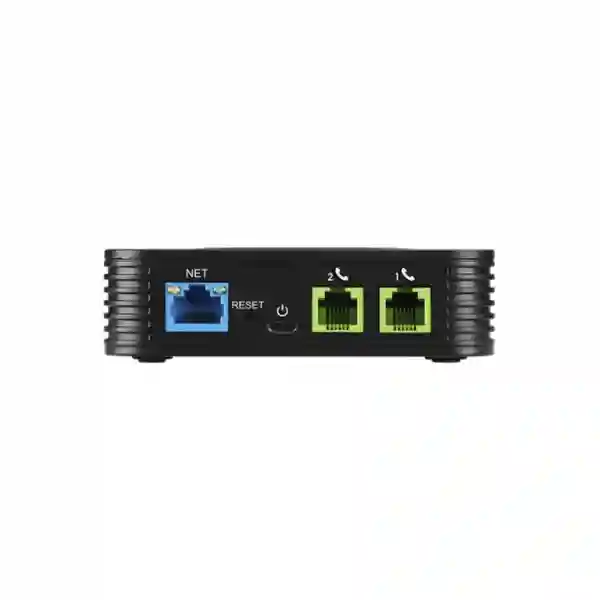
Grandstream HT802 v2 Tanzania
The Grandstream HT802 v2 is a compact two-port analog telephone adapter designed for businesses, service providers and users that want to keep useful analog telephones or fax equipment while moving voice service onto a SIP-based IP network. It provides two RJ11 FXS ports, two SIP profiles and a single 10/100Mbps Ethernet connection, creating a practical bridge between established analog endpoints and modern VoIP infrastructure. For Tanzania buyers, the key value is not simply that the device converts analog voice to IP. It gives procurement and IT teams a manageable way to retain familiar handsets, connect legacy devices to an IP PBX, support selected fax workflows and standardize provisioning without replacing every endpoint at once.
Choose the HT802 v2 when you need two FXS ports for analog phones or fax devices, SIP registration, secure signalling and media, T.38 fax capability, centralized provisioning options and a small desktop footprint without an integrated router.
Connect two analog telephones or compatible fax devices using RJ11 interfaces.
Register voice services through SIP and map the analog ports to planned extensions or accounts.
Supports T.38 Group 3 fax relay with G.711 pass-through fallback capability.
Supports protected SIP control and encrypted media when used with compatible services and configuration.
What the Grandstream HT802 v2 is designed to solve
Many organizations still have analog devices that work well: reception handsets, simple desk phones, fax machines, emergency-use extensions, lift or service-area phones, workshop handsets and other endpoints that do not justify immediate replacement. The HT802 v2 gives these devices a path into an IP telephony environment by converting the analog FXS interface into SIP-based communication over Ethernet. This can be useful during a phased PBX migration, when a company is replacing an older telephone system but wants to preserve selected devices, or when a cloud or on-premises SIP service needs to reach analog endpoints.
The unit does not include routing functionality, so network planning remains important. Its single 10/100Mbps Ethernet port connects to a router, switch or modem that provides IP connectivity. In a business network, administrators should confirm addressing, VLAN policy, firewall behaviour, QoS, SIP service settings and upstream internet quality. The adapter then handles the analog-to-SIP edge function. This separation is often helpful because the ATA can remain simple while the network handles routing, segmentation and security policy.
For buyers comparing an ATA with an IP phone, the decision is about the endpoint you want to keep. If the goal is to replace an analog phone with a modern SIP desk phone, review the broader telephony options in the Fourteck Tanzania technology shop, where IP phones, IP PBX hardware and related business technology can be considered together. If the analog handset or fax device is still suitable, the HT802 v2 can be the more targeted migration component.
Verified Grandstream HT802 v2 features and specifications
| Telephone interfaces | Two RJ11 FXS ports |
| SIP capacity | Two SIP profiles |
| Network interface | One 10/100Mbps auto-sensing RJ45 Ethernet port |
| Voice codecs | G.711, G.722, G.723.1, G.729A/B, G.726-32, iLBC and Opus, plus dynamic jitter buffer and echo-cancellation functions |
| Fax | T.38 Group 3 Fax Relay up to 14.4kbps and G.711 fax pass-through fallback |
| Security | SRTP media; TLS/SIPS/HTTPS control options |
| Provisioning | HTTP, HTTPS, SSH, TFTP, TR-069, secure automated provisioning with AES encryption and syslog |
| QoS | Layer 2 802.1Q VLAN and 802.1p; Layer 3 ToS, DiffServ and MPLS support |
| Dimensions | 100mm × 100mm × 29.5mm |
| Weight | 114g without package |
Grandstream also documents advanced telephony functions including caller ID display or block, call waiting, flash, blind and attended transfer, call forwarding, hold, do not disturb and three-way conferencing. A failover SIP server can automatically switch to a secondary server if the primary loses connection. The HT802 v2 can also be used with Grandstream UCM series IP PBXs for Zero Configuration provisioning.
Deployment and compatibility planning
Before ordering, confirm the device being connected is truly an analog endpoint that expects an FXS interface. Standard analog telephones and many fax machines can be appropriate candidates. The HT802 v2 provides the FXS side; it is not an FXO gateway for bringing a conventional analog PSTN line into a PBX. That distinction matters because FXS and FXO ports serve different roles even though both can use RJ11 connectors.
For a managed business rollout, document the SIP server address, extension credentials, authentication details, dial plan, DTMF method, codec order, caller ID requirements, NAT behaviour and fax requirements before deployment. This reduces troubleshooting after the units are installed.
Firmware and lifecycle note
Grandstream publishes firmware for the HT801 v2 and HT802 v2 and warns that after an HT8xx v2 device is upgraded to firmware 1.0.9.3 or later, downgrading to 1.0.7.5 or earlier is not supported. This makes change control important for business deployments. Administrators should check the current stable firmware, release notes and compatibility requirements before carrying out mass upgrades.
For projects that also require LAN preparation, voice VLANs, firewall review or wider telecom integration, the Fourteck Tanzania services page outlines planning, installation, configuration and support activities that can be scoped around the device purchase.
Typical HT802 v2 use cases
Keep selected analog handsets in service while the PBX or trunking layer moves to SIP.
Connect a compatible analog fax device to a VoIP platform where T.38 or G.711 fax operation has been validated end to end.
Add two analog endpoints to a remote branch without deploying a separate multi-port gateway.
Use automated provisioning and remote-management methods for standardized customer deployments.
Grandstream HT802 v2 Tanzania
For organizations in Tanzania, the Grandstream HT802 v2 is most useful where the telephone migration plan includes a mix of old and new endpoints. A business may already have an IP PBX or hosted SIP service but still depend on a reception handset, analog fax unit, workshop phone or other two-wire device that does not justify immediate replacement. The HT802 v2 provides two FXS interfaces for that bridge. Rather than treating the adapter as a generic “phone box,” buyers should map each port to a defined business requirement, identify the corresponding SIP account and confirm whether the endpoint needs standard voice, fax or special dial-plan behaviour. That preparation makes configuration and support much easier.
Tanzania deployments also benefit from network-readiness checks. The HT802 v2 uses a single 10/100Mbps Ethernet port and relies on the existing router, switch or internet edge for connectivity. Voice quality therefore depends not only on the ATA, but also on LAN congestion, WAN stability, SIP service performance, QoS policy and correct firewall handling. Where several branches use similar adapters, it is helpful to standardize VLAN IDs, device naming, extension numbering, firmware policy and backup configuration. Grandstream supports TR-069 and XML-based provisioning as well as HTTPS, SSH, TFTP and other management methods, which gives service providers and IT teams options for repeatable deployment.
Procurement teams in Tanzania should quote the exact HT802 v2 model rather than assuming the older HT802 and v2 edition are interchangeable in every detail. Confirm the quantity, required power-adapter type, cabling, SIP service, fax requirement and whether the deployment will connect to a Grandstream UCM platform or another standards-based SIP environment. If the requirement expands beyond two analog ports, compare higher-port-count gateways instead of buying many two-port units without considering management overhead. Conversely, for a small branch or a limited number of analog endpoints, the two-port format can keep the solution compact and focused.
A Tanzania quotation should also identify whether supply alone is required or whether configuration, PBX integration, testing and documentation are part of the scope. Fourteck can help separate those items so the commercial proposal reflects the actual deployment rather than an assumption about what is included.
Grandstream HT802 v2 Dar es Salaam
Dar es Salaam businesses often operate in environments where headquarters, branches, warehouses, retail locations and customer-service teams share a common communications platform. The HT802 v2 can fit into that architecture when only a small number of analog endpoints need to be preserved. A branch may have two familiar analog handsets that users want to retain, while the organization standardizes the PBX, SIP trunking and call-routing logic centrally. By registering the ATA to the selected SIP service, those analog devices can participate in the IP telephony system without requiring the entire desk environment to be replaced in one project.
For Dar es Salaam sites, the implementation discussion should include internet resiliency and local network design. The HT802 v2 itself offers SIP server failover, but that feature does not replace a resilient network. If a branch loses its only internet connection, a remote hosted PBX may still be unreachable. Businesses that depend on voice for sales, reservations or support should therefore review router failover, power protection, ISP redundancy and how phones behave during a WAN outage. The ATA consumes modest network bandwidth, but latency, packet loss and jitter affect voice experience more than raw link speed. QoS policies can be helpful when the same connection carries large file transfers, cloud applications and guest traffic.
Fax is another practical consideration. The HT802 v2 supports T.38 and G.711 fax pass-through, but successful faxing requires compatibility across the ATA, SIP service, PBX and destination path. A business should not assume that plugging in a fax machine automatically guarantees reliable fax over every VoIP provider. Testing representative inbound and outbound documents before full migration is sensible. Where compliance or workflow depends heavily on fax, retain a documented fallback plan.
When requesting a quote in Dar es Salaam, include the number of analog devices, existing PBX or hosted platform, SIP provider, whether both FXS ports need separate accounts, desired caller ID behaviour, expected fax use and the switch/router environment. This information helps determine whether the HT802 v2 is the right fit or whether a larger analog gateway is more efficient.
Grandstream HT802 v2 Mwanza
In Mwanza, the HT802 v2 can be a practical component for offices, hospitality operations, clinics, educational sites and distribution businesses that are moving from conventional telephone wiring toward IP-based communication. The strongest use case is not a large analog estate; it is a targeted requirement for one or two endpoints at a location. That may be a front-desk phone, a back-office fax machine, a store-room handset or a device that users are comfortable operating and that still serves its purpose. The adapter allows those endpoints to register to SIP while the wider organization gains centralized extension numbering and call control.
A Mwanza deployment should be designed around the available network. Since the HT802 v2 has one Ethernet interface and no built-in router, it needs a stable connection to a router or managed switch. If the voice service is hosted elsewhere, internet continuity becomes part of the phone-system design. For sites using shared broadband, administrators can place voice equipment in a dedicated VLAN and apply QoS markings supported by the device. Grandstream lists 802.1Q VLAN, 802.1p, ToS and DiffServ capabilities, giving network teams mechanisms to integrate the ATA into a planned voice network rather than leaving it on an unmanaged flat LAN.
Security settings should also be aligned with the SIP platform. The HT802 v2 supports TLS for signalling and SRTP for media, but these protections require compatible configuration on the server side. Strong administrator credentials, restricted management access and current firmware remain important. If units will be deployed across several Mwanza locations, standard configuration templates can reduce errors and make replacement easier. Device labels should show location and extension ownership without exposing passwords.
Buyers should prepare a simple deployment sheet before ordering: site name, analog endpoint type, SIP account, Ethernet port, VLAN, power source and fallback procedure. This approach turns a small ATA into a documented part of the communications architecture and helps support staff troubleshoot quickly if a user reports no dial tone, failed registration, poor audio or fax problems.
Grandstream HT802 v2 Arusha
Arusha organizations in tourism, hospitality, professional services, logistics and administration may have communication needs that combine front-office calling with legacy analog devices. The Grandstream HT802 v2 can support that transition where two analog ports are enough. A property can, for example, keep a familiar desk phone in an operational area while the main telephony system moves to SIP. An office can preserve a fax workflow for counterparties that still require it. The adapter does not dictate the PBX platform; instead, it acts as a SIP endpoint that exposes analog FXS connections at the edge.
For hospitality and service businesses, call continuity deserves particular attention. Grandstream includes a failover SIP server mechanism that can switch to a secondary server if the main SIP server loses connection. That is valuable when the VoIP platform supports redundant registration targets, but the site network must still be available. A practical design considers UPS protection for the ATA, switch and router, because an analog handset connected to an ATA no longer has the same power behaviour as a traditional telephone line. If mains power fails and the IP network loses power, the analog phone may also stop working even though the handset itself does not need an AC adapter.
Arusha buyers should also review physical placement. The HT802 v2 is compact, but keeping it in a secure, ventilated area near structured cabling simplifies support. The manufacturer lists an operating range of 0°C to 40°C and 10–90% non-condensing humidity. Avoid placing the adapter in a hot enclosed ceiling void, exposed outdoor cabinet or damp area unless the surrounding enclosure and environmental controls are appropriate. Keep RJ11 and Ethernet cabling labelled so technicians can identify PHONE1, PHONE2 and network connections without trial and error.
When obtaining a quotation, Arusha customers can specify whether they need supply only, SIP configuration, UCM integration, number-porting coordination, network review or post-installation testing. Separating these tasks clarifies responsibilities and helps ensure the delivered solution matches the operating environment.
Grandstream HT802 v2 Dodoma
Dodoma offices, institutions and branch operations may use the HT802 v2 when they need to connect a small number of analog endpoints to a SIP-based phone system without replacing those devices immediately. The two FXS ports make the adapter suitable for a pair of handsets, a handset plus a fax machine, or other compatible analog combinations. Because each project has different calling rules, the purchase should start with the service requirement rather than the number of sockets alone. Confirm whether each port needs an independent SIP account, what extension numbers are required and whether the PBX will provide voicemail, call forwarding or hunt-group behaviour.
For structured public-sector or enterprise environments, management and documentation are as important as basic connectivity. Grandstream supports syslog, web management, SSH and automated provisioning methods. These tools can help an IT department maintain consistent configurations across sites, but they should be deployed according to an access-control policy. Management interfaces should not be exposed unnecessarily to the public internet, and credentials should be unique and protected. Where centralized management is required, define who can change firmware, SIP credentials and dial plans, and keep a configuration backup or template for replacement units.
The adapter also supports multiple codecs including G.722 and Opus for wideband audio, as well as widely used narrowband codecs. Actual audio quality depends on the peer system, network and chosen codec. An analog handset cannot automatically provide every benefit of a modern IP phone, so users should set expectations appropriately. The HT802 v2 is primarily a bridge that extends the life of analog equipment while the underlying call control moves to IP.
Dodoma procurement teams can reduce deployment delays by listing the required quantity, destination sites, extension plan, SIP platform, analog endpoint models, network availability, preferred provisioning method and support scope in the request for quotation. If many analog ports are needed in one location, compare a higher-density gateway so rack space, power adapters and management tasks do not multiply unnecessarily.
Grandstream HT802 v2 UAE
UAE businesses often operate mixed estates that include modern SIP phones, cloud PBX services and legacy analog devices. The HT802 v2 is relevant when the analog requirement is small but still operationally important. A clinic may retain a fax machine for a particular workflow, a warehouse may keep a rugged analog handset in a fixed position, or a branch may need two basic phones registered to a centralized PBX. The adapter provides the two FXS ports required for those endpoints while allowing the voice platform to remain IP-based.
The UAE market also includes multi-site companies that need consistent configuration. Grandstream’s automated provisioning options can be useful where many small branches each require one ATA. Rather than manually entering every SIP setting on site, an administrator can plan a controlled provisioning method, assign device identifiers, distribute configurations and maintain firmware standards. Security should be included in that design: TLS, SRTP, HTTPS and strong management practices can reduce exposure when supported by the service environment.
Organizations with UAE headquarters and East African branches should avoid assuming that one voice design will behave identically in every location. Internet latency, SIP-provider policies, emergency-calling arrangements and fax support can differ. Test the service path for each country, especially if a centrally hosted PBX is being used. For broader UAE infrastructure and telecom planning, buyers can review Fourteck UAE technology solutions alongside the Tanzania project so headquarters and branch standards can be aligned.
A useful UAE quotation request should identify whether the HT802 v2 is being purchased for a standalone SIP service, a Grandstream UCM, another PBX or a service-provider deployment. Include the number of units, analog device type, required plug or power-adapter considerations, configuration responsibility and delivery destination. That information helps prevent a simple ATA purchase from being delayed by missing service details.
Grandstream HT802 v2 Uganda
Uganda organizations can use the HT802 v2 to bring two analog endpoints into a SIP-based communications platform without undertaking a complete endpoint replacement. This is particularly useful for distributed businesses where some branches already use IP phones while others have functional analog handsets that only need access to the same extension plan. The ATA provides the conversion point and can register to a compatible SIP platform over the existing IP network.
The technical planning should start with connectivity. The HT802 v2 uses a single 10/100Mbps Ethernet port, so it connects behind the local router or switch. For branches that depend on cellular or shared broadband, voice quality should be tested during busy periods. Stable latency and low packet loss matter more than headline download speed. If the router supports traffic prioritization, voice traffic can be marked and managed so large downloads do not dominate the link. The adapter also supports 802.1Q VLAN and other QoS-related mechanisms where the network is designed to use them.
Uganda buyers with several regional sites should create a repeatable rollout template. The template can include SIP server settings, extension numbering, DNS, time source, codec policy, DTMF method, fax parameters, firmware version and support contact. This makes it easier to replace a unit or move an extension. For Uganda-focused business communications and networking requirements, Fourteck Uganda provides a regional route for IP PBX, VoIP and infrastructure discussions.
When comparing quotations, verify that the exact HT802 v2 is specified and that the scope clearly states whether configuration is included. Do not assume that SIP credentials, hosted PBX subscriptions, phone numbers or installation services are automatically bundled with the hardware. A clear commercial scope helps procurement teams compare like with like and reduces surprise during deployment.
Grandstream HT802 v2 Kampala
Kampala businesses often need practical migration paths from legacy telephony to IP communications. The HT802 v2 provides such a path for two analog devices at a time. It can be used in a small office, at a reception desk, in a retail back office or in any controlled indoor location where an analog handset or fax machine must register to a SIP platform. Because the device supports two SIP profiles, it can serve two planned lines or extensions without requiring a larger gateway.
For Kampala offices with managed switches, a voice VLAN can separate the ATA from general user traffic. This does not guarantee perfect calls by itself, but it creates a cleaner policy boundary and can simplify QoS, security and troubleshooting. The HT802 v2 supports 802.1Q VLAN and Layer 2/Layer 3 QoS mechanisms. Network teams should coordinate these settings with the switch and router rather than enabling values in isolation. Incorrect tagging can make the device unreachable, so rollout procedures should include a recovery method and local access instructions.
Fax use deserves a test plan. T.38 support is valuable, yet the complete call path has to support compatible negotiation. If the PBX or SIP carrier does not handle T.38 reliably, G.711 pass-through may be used, but performance depends heavily on network stability. Test several document types and destinations before declaring the workflow production ready. Businesses that depend on regulated or time-sensitive fax processes should also consider whether a digital fax service is a better long-term option.
Kampala buyers should include installation location, analog device count, PBX type, SIP provider, expected daily call use, fax requirement, network switch model and desired remote-management method in the quote request. That small amount of information allows a more accurate recommendation and can reveal early whether a two-port ATA is sufficient or whether a larger gateway or native IP endpoint is the better choice.
Grandstream HT802 v2 Arua
For Arua branch offices and service locations, the HT802 v2 can be useful when two analog devices must connect to a centralized SIP service over a relatively simple network. The small form factor makes it easy to place near a router or switch, but the real success of the installation depends on documenting the end-to-end service. Each FXS port should have a clearly assigned purpose: for example, a reception phone on port one and a back-office phone on port two, or a phone plus a fax device. Clear port ownership prevents confusion later when extensions are changed.
Remote support is particularly important for branch deployments. Grandstream provides web-based management, SSH, syslog and automated provisioning methods. IT teams should choose a management approach that fits the organization’s security policy and available connectivity. Avoid leaving default or weak credentials, and limit administrative access to trusted networks or controlled remote-management paths. Keep firmware versions consistent across units so troubleshooting is not complicated by differences in behaviour.
Arua sites should also consider power continuity. Because the analog phone depends on the ATA, and the ATA depends on the network, a small UPS for the router, switch and adapter may be useful where short power interruptions are common and voice continuity is important. The exact UPS size depends on the equipment load and desired runtime. This is a deployment consideration rather than a feature of the HT802 v2 itself.
For procurement, specify whether the project is a new SIP deployment or an extension of an existing PBX. Provide the current extension range, target site, expected quantity and whether devices need preconfiguration before shipment. If the branch uses a hosted PBX outside Uganda, test latency and firewall traversal in advance. A short pilot with one unit can validate audio, caller ID, DTMF, inbound and outbound calling, and fax behaviour before the wider order is released.
Grandstream HT802 v2 Mbarara
Mbarara businesses that are modernizing communications can use the HT802 v2 where only a pair of analog endpoints needs to remain in service. The adapter is especially relevant in phased projects. A company may first upgrade the PBX, SIP trunk and core network, then replace desk phones gradually. During that period, the HT802 v2 allows selected analog devices to operate as SIP extensions while avoiding an immediate all-at-once hardware replacement.
The two FXS ports support standard telephony functions such as caller ID, call waiting, transfer, forwarding, hold and three-way conferencing, depending on the connected service and configuration. Users should understand that the interface to those features still depends on the analog handset’s buttons and flash-hook behaviour. A modern IP phone may offer dedicated keys and a display, while an analog phone may require feature codes. Training and a simple user guide can therefore make a small but meaningful difference during migration.
For network administrators in Mbarara, troubleshooting should follow a layered approach. First confirm power and LED status; then confirm Ethernet link, IP address and gateway; then verify SIP registration; and finally test dial plan, media and analog handset behaviour. If audio works only one way, review NAT and firewall rules. If calls establish but keys do not operate an IVR correctly, review DTMF configuration. If fax is unreliable, check T.38 negotiation and network packet loss. This structured method avoids replacing the ATA when the problem is elsewhere in the path.
A quotation request should state the business objective, not just “need HT802 v2.” For example: two analog phones at a Mbarara branch need to register to the corporate PBX, each with its own extension, behind an existing managed router. That context lets the supplier identify configuration tasks, accessories and support expectations before the order is finalized.
Grandstream HT802 v2 Gulu
Gulu offices, education sites, NGOs, clinics and commercial branches may find the HT802 v2 useful for low-port-count analog integration. Its two FXS ports are enough for a small site that wants to preserve one or two simple handsets while connecting them to a central SIP platform. The model can also support a fax device where the end-to-end VoIP environment is compatible. Because it is a dedicated ATA rather than a full router, it fits best into a network where routing and internet access are already handled by other equipment.
For remote or lightly staffed sites, configuration consistency is valuable. The HT802 v2 supports several provisioning protocols and can be incorporated into a standardized deployment process. An IT team can define a baseline covering time zone, DNS, SIP server, codecs, DTMF, provisioning, logging and security. Site-specific values such as extension numbers and authentication credentials can then be applied separately. This reduces variation between branches and makes support calls easier because technicians know what the normal configuration should look like.
Gulu deployments should also consider what happens during failure. If the primary SIP server is unavailable and a secondary is configured, the ATA can switch to the backup. If the network itself is down, however, external SIP service may still be unavailable. Organizations with critical calling requirements should document alternate mobile or PSTN options rather than treating server failover as complete business continuity. Emergency calling also needs explicit planning because VoIP endpoints depend on the service provider and configured location information.
Before ordering, confirm the exact analog device type, number of ports required, site internet method, router/firewall ownership, PBX location and whether remote support access is permitted. A small pilot at the Gulu site can validate the full path and establish a repeatable installation checklist for additional branches.
Grandstream HT802 v2 Kenya
Kenya businesses can use the Grandstream HT802 v2 as a compact bridge between two analog endpoints and a SIP environment. This is useful for offices that have moved their call control to an IP PBX or cloud platform while still retaining certain analog phones or fax machines. The device is not intended to replace a full PBX; it sits at the edge, presents two FXS ports to the analog equipment and registers to the selected SIP service across Ethernet.
For organizations with Nairobi headquarters and branch sites, deployment standardization can make the HT802 v2 easier to manage. Define a common template for firmware, SIP server addresses, codec preference, QoS, DTMF, time settings, logging and administrator access. Then track each device by serial number, site and extension. Grandstream’s provisioning options can reduce manual effort where multiple units are deployed, but security controls should be applied so configuration files and credentials are not exposed.
If the requirement is larger than two ports, compare the operational cost of several HT802 v2 units with a higher-density gateway. Two-port devices are convenient for distributed sites because each branch can have a self-contained adapter. At one large building, however, many small units can create extra power supplies, switch ports and management entries. The right choice depends on topology rather than unit price alone. Kenya-based buyers can also review Fourteck Kenya business communication and networking solutions when coordinating a multi-country East African voice project.
For a procurement request, include quantity, destination city, required FXS use, PBX or SIP service, fax requirement, plug type, desired preconfiguration and support scope. If the ATA will be part of a cross-border corporate network, include VPN or firewall architecture so the voice path can be checked before deployment.
Grandstream HT802 v2 Kuwait
In Kuwait, the HT802 v2 suits organizations that have a modern SIP telephony platform but still need to connect two analog devices. A business may have an analog fax machine that remains part of a supplier workflow, a simple handset in a store room, or a device that cannot yet be replaced with a native IP endpoint. The ATA lets these endpoints participate in the IP system without requiring a separate analog PBX layer.
Because the HT802 v2 has no integrated router, it should be connected to an existing managed network that provides DHCP or appropriate IP configuration, DNS and a route to the SIP platform. Enterprises can use VLAN and QoS functions to integrate the unit with the voice network. Security settings such as TLS and SRTP should be coordinated with the SIP server because enabling them only on one side will not create a working secure session. Administrators should also restrict device management access and follow the vendor’s firmware guidance.
Kuwait branches that report into a UAE or African headquarters may use centralized call control. In that scenario, check WAN latency, firewall traversal and legal or carrier-specific requirements before mass deployment. The ATA may register successfully in a lab but behave differently across a production WAN if NAT, SIP ALG or security inspection changes the traffic. Pilot tests should cover inbound and outbound calls, transfer, caller ID, DTMF, voicemail access and fax where required.
A purchasing team should specify whether it needs hardware supply only or a complete configured endpoint. If configuration is required, provide the SIP credentials through a secure process rather than ordinary email where possible. The quotation should list the exact model, quantity, accessories, warranty terms, delivery scope and configuration responsibilities so there is no confusion between the ATA purchase and any separate PBX or SIP-service subscription.
Grandstream HT802 v2 Ghana
Ghana organizations moving toward SIP-based business communications can use the HT802 v2 for limited analog retention. The adapter is particularly useful where a branch has only one or two analog devices and the rest of the voice estate is already IP-based. This keeps the transition focused: the PBX, numbering plan and trunking can move to the new platform, while the analog endpoint remains connected through the ATA until replacement is justified.
For Ghana deployments, the network connection deserves careful assessment. The HT802 v2 does not need high throughput, but real-time voice is sensitive to delay variation and packet loss. A reliable low-latency link generally matters more than a high headline bandwidth figure. Where the branch shares internet with guest Wi-Fi, backups or cloud synchronization, use router and switch policies to prioritize voice appropriately. If the PBX is hosted remotely, test calls during peak business hours to capture real network conditions.
Businesses using fax should validate the complete path. T.38 is supported by the ATA, but the SIP carrier and PBX must also handle the negotiation correctly. If a fax workflow is business-critical, document the tested settings and keep them consistent between devices. For voice-only endpoints, verify caller ID format, DTMF and regional dial plan to avoid user frustration after deployment.
Ghana procurement teams should ask for the exact HT802 v2 model, not simply “two-port ATA,” because different devices may vary in firmware, provisioning and security capabilities. Include the PBX platform, analog device type, required quantity, branch locations and whether units need staging before shipment. If the project is multi-country, define one common baseline and then document local differences such as dial plan, SIP service and power arrangements rather than creating unrelated configurations in every market.
Grandstream HT802 v2 Nigeria
Nigeria businesses with distributed operations can deploy the HT802 v2 in small branches that need two analog endpoints on a centralized SIP system. This can be useful for retail chains, professional offices, logistics sites, clinics and other organizations that want a consistent extension plan while preserving a limited number of analog phones or fax devices. The compact adapter converts those endpoints to SIP without requiring a full local PBX at each site.
Power and connectivity resilience should be considered together. Once an analog phone is connected through an ATA, it depends on the adapter, switch, router and SIP path. A power outage that takes down the network also takes down the VoIP extension unless those components are protected. For branches where calling is operationally important, plan UPS runtime, secondary internet options and a mobile fallback. The HT802 v2’s SIP server failover helps with server redundancy, but it is one layer in a wider continuity plan.
Nigeria IT teams managing multiple sites can take advantage of automated provisioning, syslog and remote-management options, provided access is secured. Keep a device inventory with serial numbers, extensions, firmware and site ownership. Standardize configuration names and backup procedures so a failed unit can be replaced without rebuilding every setting from memory. If remote management crosses the public internet, use secure methods and avoid unnecessarily exposing web administration.
For quotation planning, distinguish the hardware purchase from the SIP service. The HT802 v2 does not itself supply phone numbers or carrier connectivity. Buyers should specify the existing PBX or hosted service, number of required analog ports, fax usage, local network design and expected support level. That information also helps determine whether the two-port adapter is economical or whether a multi-port analog gateway is more suitable at larger Nigerian sites.
Grandstream HT802 v2 Seychelles
Seychelles businesses in hospitality, professional services and island operations may use the HT802 v2 when a small number of analog devices needs to be preserved while call control moves to SIP. The two-port design makes sense for a reception back office, a service room, a small administrative site or a fax-dependent workflow where deploying a larger analog gateway would be unnecessary. It can also support standardized telephony across geographically separated sites when each location only needs one or two analog interfaces.
Connectivity planning is important where the SIP platform is hosted off-island or in another region. Voice quality depends on latency, jitter and packet loss across the entire WAN path. Before ordering many units, test a pilot from the actual site and at the times of day when the internet connection is busiest. Evaluate inbound and outbound calls, hold, transfer, DTMF and failover behaviour. If fax is required, test T.38 and G.711 pass-through with the specific service provider and destinations that matter to the business.
For island deployments, replacement logistics can also influence design. Keeping a standard configuration file and a spare pre-approved unit can reduce recovery time if the ATA fails. The device’s compact size makes sparing practical. Ensure the replacement procedure includes firmware compatibility, account credentials and device security rather than simply swapping cables. Label each unit with its site and extension role, but do not place passwords on the chassis.
A Seychelles quotation request should state the exact destination, unit quantity, analog endpoint types, SIP platform, power requirements and whether staging is expected before shipment. If local installation is required, confirm the service scope separately rather than assuming hardware supply includes on-site work. This distinction is especially useful for regional projects where procurement, shipping and technical responsibility may be handled by different teams.
Buying guide: when the HT802 v2 is the right choice
Choose the HT802 v2 when: you need exactly one or two analog FXS endpoints, already have routing and Ethernet connectivity, want SIP registration, need modern provisioning options, require secure signalling/media capabilities, or want to extend analog handset life during a VoIP migration.
Consider another model when: you require more than two FXS ports at the same location, need an integrated NAT router, require Gigabit dual-network interfaces, or are ready to replace the endpoint with a native IP phone. Grandstream’s HT812 v2, HT814 v2 and HT818 v2 cover larger or differently connected analog requirements, while IP phones may be a better long-term user experience for desks that need displays, programmable keys and richer features.
Do not confuse FXS with FXO: the HT802 v2 provides FXS ports for analog phones and fax machines. It is not designed as an FXO gateway for connecting analog telephone-company lines into a PBX.
Quotation checklist for Grandstream HT802 v2
Frequently asked questions about the HT802 v2
How many analog phones can the Grandstream HT802 v2 connect?
It provides two RJ11 FXS ports, so it is designed for up to two analog endpoint connections. The exact connected device can be an analog phone or a compatible fax machine, subject to the planned SIP and fax configuration.
Does the HT802 v2 have a built-in router?
No. The HT802 v2 uses a single 10/100Mbps Ethernet port to connect to an existing router, switch or modem. Grandstream’s HT812 v2 and higher HT81x v2 models include different network-interface and routing capabilities.
Can the HT802 v2 be used for fax?
Yes. Grandstream specifies T.38 Group 3 Fax Relay up to 14.4kbps with automatic G.711 fax pass-through fallback. Reliability depends on the PBX, SIP carrier, configuration and network quality, so production fax workflows should be tested end to end.
Does it support secure VoIP?
The device supports TLS/SIPS/HTTPS for control and SRTP for media. Secure operation requires the SIP platform and configuration to support the same methods.
Can it work with Grandstream UCM IP PBXs?
Yes. Grandstream lists compatibility with its UCM series for Zero Configuration provisioning. It can also be used with other compatible SIP environments when the required SIP parameters and features are supported.
What is the difference between the HT802 v2 and a normal IP phone?
The HT802 v2 is an adapter that lets an analog phone become a SIP endpoint. A native IP phone connects directly to Ethernet and usually provides its own display, buttons, provisioning and network features. The better choice depends on whether you want to preserve an analog handset or replace it.
Does the HT802 v2 include a SIP subscription or phone number?
No. It is hardware. You still need a compatible SIP service or PBX account, appropriate credentials and network connectivity. Phone-number and calling-service arrangements come from the PBX or telecom provider.
What should I verify before buying?
Confirm the number of analog endpoints, SIP platform, fax requirement, network availability, power, provisioning method, regional plug requirements, firmware policy and whether installation or configuration is included in the commercial scope.
Decision recap
The Grandstream HT802 v2 is a strong fit when the requirement is narrowly defined: two analog endpoints need access to a SIP-based telephony environment, secure signalling and media are desired, fax compatibility may be required, and the site already has routing and Ethernet connectivity. It is compact, supports automated provisioning and integrates naturally with Grandstream UCM platforms while remaining usable in other compatible SIP environments.
The key buying question is not whether the device has enough features; it is whether two FXS ports are the correct architecture for the site. Count analog endpoints, identify the SIP service, validate fax requirements, confirm the network and define the support scope. If those answers align, the HT802 v2 provides a focused analog-to-VoIP migration tool without unnecessary complexity.
Plan your HT802 v2 deployment with Fourteck
Fourteck can help buyers clarify whether the project requires hardware only, preconfiguration, PBX integration, network readiness checks, analog-device testing or a wider telephony refresh. A good quotation begins with the intended use and site information, not just a model number. Share the number of endpoints, SIP platform, locations and support expectations so the scope can be aligned before purchase.
For projects that combine voice, switching, routing, security and branch connectivity, keeping the ATA within the wider infrastructure plan reduces troubleshooting later. This is especially useful when the same organization is deploying across Tanzania, Kenya, Uganda and the UAE.

Reviews
There are no reviews yet.