
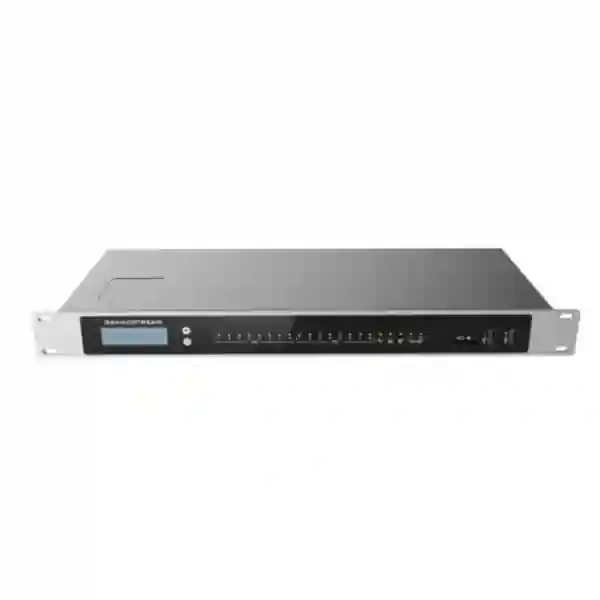
Grandstream UCM6308 Tanzania
The Grandstream UCM6308 is a high-capacity on-premise IP PBX and unified communications platform for organisations that want to centralise voice, video, meetings, mobility and business calling on one managed communications system. Grandstream positions the UCM6300 series as a scalable unified communication and collaboration solution, and the UCM6308 is the largest model in the standard UCM6300 line. It supports up to 3,000 users and up to 450 concurrent G.711 calls, making it suitable for enterprise offices, large branches, multi-department organisations, hospitality properties, education campuses, healthcare environments, contact centres and distributed operations that need a substantial extension base without relying only on a hosted PBX.
For buyers in Tanzania, the key question is not simply whether the UCM6308 has enough extension capacity. A successful deployment also depends on SIP trunk requirements, call routing, number of simultaneous external calls, analogue line migration, IP-phone strategy, VLAN and QoS design, firewall policy, remote-user access, power protection and growth planning. FourTeck can help buyers turn those operational requirements into a practical bill of materials and deployment plan. For broader business technology requirements, see the FourTeck Tanzania technology shop for related voice, networking and infrastructure categories.
What the Grandstream UCM6308 is designed to do
The UCM6308 acts as the central call-control and collaboration platform for a business telephony environment. It can register SIP extensions, handle internal calls, route incoming and outgoing calls, support IVR, call queues, ring groups, voicemail, call recording, conferencing, paging, intercom functions and extensive call-routing logic. Because it is part of the UCM6300 ecosystem, it can also support Grandstream Wave for desktop, browser and mobile communication and can be paired with UCM RemoteConnect for secure remote connectivity scenarios. Grandstream also provides GDMS compatibility for cloud-based setup, monitoring and management functions.
The model is especially useful where an organisation wants on-premise control while still supporting hybrid work and distributed endpoints. That architecture can appeal to IT teams that prefer to keep core PBX configuration at the business site while enabling selected remote users to connect through supported Grandstream services. It can also be useful for organisations moving from traditional PSTN or analogue extensions because the UCM6308 includes eight FXS ports for analogue telephone/fax endpoints and eight FXO ports for PSTN lines. These ports do not remove the need for careful migration planning, but they can make staged transitions easier.
Suitable for large extension populations and multi-department deployments when user capacity is a key requirement.
Grandstream specifies up to 450 concurrent G.711 calls, with up to 300 concurrent SRTP G.711 calls.
The analogue interfaces support migration and coexistence with selected legacy handsets, fax devices and PSTN lines.
The UCM6308 supports up to 25 simultaneous public meeting rooms and up to 300 simultaneous meeting participants across rooms combined.
Verified Grandstream UCM6308 technical highlights
| User capacity | Up to 3,000 users |
| Concurrent call capacity | Up to 450 concurrent G.711 calls; up to 300 concurrent SRTP G.711 calls |
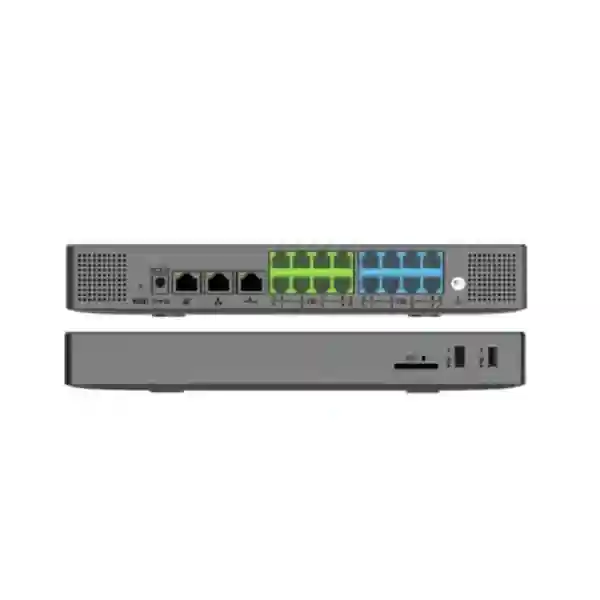
| Analogue interfaces | 8 FXS RJ11 ports and 8 FXO RJ11 ports |
| Network interfaces | Three self-adaptive Gigabit ports with switched, routed or dual mode and PoE+ |
| Storage / peripheral interfaces | 2 USB 3.0 ports and 1 SD card interface |
| Display | 128×32 dot-matrix graphic LCD with DOWN and OK buttons |
| Mounting | Rack mount and desktop |
| Dimensions | 485mm x 187.2mm x 46.2mm |
| Unit weight | 2,550g |
| Voice codecs | Opus, G.711, G.722 family, G.723.1, G.726-32, G.729A/B, iLBC, GSM; T.38 fax |
| Video codecs | H.265, H.264, H.263, H.263+ and VP8 |
| Management ecosystem | GDMS compatibility, Wave app, API integration and UCM RemoteConnect support |
Deployment planning and compatibility
A UCM6308 project should begin with a call-flow and capacity document rather than with the appliance alone. Count named extensions, shared-area extensions, remote users, reception positions, call-centre agents, conference requirements, analogue endpoints and expected growth. Then estimate peak simultaneous calls, not simply the total number of staff. A company with 500 extensions may have very different concurrency requirements from another company with the same headcount, especially if one has a busy contact centre or an outbound sales team.
The network layer is equally important. Voice traffic should be planned with VLAN segmentation, Quality of Service, reliable switching, suitable PoE capacity for phones and access points, and a firewall configuration that supports SIP and remote connectivity without exposing the PBX unnecessarily. The UCM6308 itself has three Gigabit network interfaces, but the overall experience still depends on the wider LAN and WAN design. If the business is building or upgrading the network at the same time, FourTeck’s Tanzania IT and telecom services page provides related context for integrated deployment planning.
Grandstream states that the platform supports zero-configuration provisioning of Grandstream SIP endpoints. This can simplify large handset deployments when the endpoint models and network are designed accordingly. For mixed-vendor endpoints, SIP standards can help interoperability, but feature behaviour should still be tested before large-scale rollout. CRM, PMS and other third-party integrations may be possible through the available API, but the exact integration scope depends on the external platform, connector and workflow.
Grandstream UCM6308 Tanzania
In Tanzania, the Grandstream UCM6308 is most relevant to organisations that have outgrown small-office PBX capacity and need a structured platform for hundreds or thousands of users. A national business may use the appliance at a main site while connecting departments and remote users through IP-based communications. Hotels, education groups, healthcare networks, logistics operators, financial-service organisations, government institutions, NGOs, industrial businesses and large corporate offices can all have complex call-routing needs that go beyond a basic SIP gateway. The first procurement step should be a capacity review: total extensions, peak simultaneous calls, branch topology, analogue line requirements, call recording, IVR depth, queue requirements and growth over the next several years.
Tanzania deployments also benefit from careful attention to connectivity and power. A PBX may be located at a well-connected head office while branch sites depend on different internet services. Voice quality can deteriorate when packet loss, jitter or congestion is not controlled, so QoS policy and sensible bandwidth planning matter. UPS protection for the PBX, switches, routers and any fibre or internet termination devices is equally important because a telephony platform remains useful only while the network path and connected endpoints are powered. Where legacy PSTN circuits remain part of the design, the UCM6308’s eight FXO ports can support staged migration, while eight FXS ports can accommodate selected analogue devices.
For procurement teams, the quotation should separate the PBX appliance from supporting elements such as IP phones, PoE switches, rack accessories, SIP service, UPS, structured cabling, remote-access requirements and installation effort. This avoids comparing one bare hardware quote with another complete solution. Organisations operating beyond Tanzania can also align telephony strategy with FourTeck’s regional platforms, including FourTeck Kenya and FourTeck Uganda, when branch technology standards need to remain consistent across East Africa.
Grandstream UCM6308 Dar es Salaam
For Dar es Salaam businesses, the UCM6308 can be a strong fit for larger corporate offices, logistics and shipping companies, hotels, healthcare organisations, universities, contact centres and multi-floor commercial sites where many extensions and structured call flows are needed. Urban deployments may have access to multiple internet and SIP options, but that does not remove the need for voice engineering. The PBX should be connected to a managed LAN with proper VLANs and QoS so large file transfers, cloud backups, video meetings and guest Wi-Fi traffic do not compete unpredictably with voice traffic. The organisation should also document failover expectations: whether a secondary internet circuit is required, whether PSTN lines are retained, and how calls should be routed during an outage.
A Dar es Salaam head office may use the UCM6308 as the central communications hub for reception, departments, executives, branches and remote users. Reception design deserves special attention because incoming calls may need to reach several departments, queue groups or after-hours destinations. IVR menus should be concise and reflect real customer journeys rather than simply mirroring the company organisation chart. Call recording, reporting and queue functions should be defined by role, with privacy and internal policy considerations documented. Remote users can be enabled through the wider UCM6300 ecosystem, but secure access should be planned deliberately rather than created through ad-hoc port forwarding.
When requesting a UCM6308 quotation for Dar es Salaam, provide the current PBX model if replacing one, number of users, phone types, analogue lines, SIP trunks, branches, call-centre requirements and rack availability. Include the expected expansion over the next two or three years. This gives the supplier enough information to determine whether UCM6308 capacity is justified or whether a smaller UCM6300 model would be more economical. A well-scoped quote should also state which installation, configuration, testing and user-training activities are included, so procurement can compare solution scope instead of only hardware price.
Grandstream UCM6308 Mwanza
In Mwanza, organisations considering the Grandstream UCM6308 may include regional headquarters, mining-related businesses, distributors, healthcare providers, education institutions, hotels and enterprises with operational sites around the Lake Zone. A large IP PBX can help standardise extension numbering, department routing and branch communication, but the design should reflect available connectivity at every site. If the central PBX is in Mwanza while users connect from branches or remote offices, each network path should be assessed for latency, jitter, packet loss and outage risk. Branch survivability and fallback procedures should be defined before dependence on the central system increases.
The UCM6308 can serve environments where analogue and IP telephony coexist during a transition. Existing analogue phones, fax devices or PSTN lines can influence the migration sequence, and the eight FXS plus eight FXO ports provide useful local connectivity for selected legacy elements. However, a full audit should identify every line and endpoint before migration. Old PBX systems often contain undocumented hunt groups, diverted numbers, door phones or fax lines that only become visible when the replacement starts. Capturing these details reduces disruption and helps the new call-routing plan remain familiar to users while improving manageability.
Power continuity also deserves practical attention in Mwanza deployments. A UPS should protect the PBX, core switching, firewall/router and essential access switches, not only the appliance. Where desk phones use PoE, keeping the PoE switch powered can preserve internal calling during short interruptions. For sites with generators, the changeover behaviour and UPS runtime should be tested. Procurement teams should request rack dimensions, power requirements, port counts and accessories in the quotation. If several branches will use the platform, include a logical diagram showing the main site, branch connections, SIP trunks and remote users so the final configuration can be documented consistently.
Grandstream UCM6308 Arusha
Arusha organisations evaluating the Grandstream UCM6308 often have communication needs that cross departments, guest-facing operations and multiple sites. Hospitality groups, tour operators, NGOs, conference facilities, education organisations, healthcare providers and regional corporate offices may need a PBX that supports reception workflows, internal extensions, mobile staff and branch connectivity. The UCM6308 has enough headline capacity for very large environments, but capacity should still be matched to actual usage. Count extensions, simultaneous calls, conferences, call queues and external trunks separately, because each dimension affects the deployment in a different way.
Hospitality and service businesses may require sophisticated call handling. Reception could need ring groups, time conditions, extension directories, voicemail, call transfer and selected analogue connections. A hotel or lodge environment may also involve property-management integration, but any PMS integration must be verified against the exact software and connector before procurement. Grandstream provides an API for third-party platform integration; that creates options, not a guarantee that every external application will work without development. The safest approach is to document the required events and commands, then validate them with the relevant software provider and integrator.
For Arusha deployments, the network should be built to maintain call quality even during periods of heavy internet use. Voice VLANs, managed switching, QoS and secure firewall policy are practical foundations. Remote extensions should use supported secure methods rather than exposing SIP ports broadly to the internet. If staff travel frequently or work from different locations, Wave and UCM RemoteConnect can form part of the design. A quotation request should identify whether users need desk phones, mobile/desktop softphone access, conferencing, recording and after-hours routing. This ensures the proposed bill of materials reflects how staff actually communicate.
Grandstream UCM6308 Dodoma
In Dodoma, the Grandstream UCM6308 can suit large administrative environments, institutions, universities, healthcare facilities, service organisations and corporate operations that need a scalable IP telephony core. A government or institutional deployment may have many departments, reception points, security desks and distributed buildings. Before selecting the PBX, map those departments into an extension and dial-plan structure that remains manageable. Number ranges can be reserved by building or department, while IVR menus, ring groups and queues can be aligned with public-facing services. A clear numbering standard prevents the system from becoming difficult to administer as new users are added.
Security and change control are also important. PBX administrator access should be limited, strong credentials should be used, configuration backups should be stored safely and firmware management should follow an agreed process. The UCM6300 series includes security features such as secure boot and a unique certificate, but secure deployment still depends on network policy and administrator practice. Firewall rules, remote access, SIP trunks and user permissions should be documented. For institutions with compliance or audit requirements, recording and retention settings should be governed by policy rather than enabled universally without review.
Power and rack planning should be part of the project scope. The UCM6308 is a rack-mountable appliance, so confirm rack depth, ventilation, UPS capacity and cable organisation. Its three Gigabit interfaces allow flexible network modes, but the final topology should be designed around the customer’s LAN architecture. A Dodoma procurement request should include the number of sites, buildings and users; existing telecom lines; required SIP services; phone models; PoE switching; UPS requirements; and expected expansion. That information supports a technically comparable quotation and reduces the chance of overlooked accessories or installation dependencies.
Grandstream UCM6308 UAE
For UAE organisations, the Grandstream UCM6308 is relevant where a sizeable on-premise IP PBX is required for corporate offices, hospitality, logistics, retail headquarters, education, healthcare or multi-site business operations. The UAE market includes a wide mix of SIP, structured cabling, managed network and collaboration environments, so deployment planning should begin with compatibility and telecom-service requirements. A company migrating from an older PBX may use the UCM6308’s analogue interfaces during transition, while new extensions move to SIP phones and Wave clients. For regional project context, FourTeck UAE covers IP PBX, telecom and broader IT infrastructure requirements.
Multi-branch organisations often benefit from standardising extension plans, handset profiles and support procedures between the UAE and East Africa. Standardisation does not require identical hardware at every site; a smaller branch may use a lower-capacity PBX while the headquarters uses UCM6308. What matters is that dial plans, SIP security, voice VLANs, QoS, backup procedures and endpoint configuration follow consistent principles. If the company uses CRM, PMS or other business software, integration requirements should be captured before deployment and validated against the Grandstream API and external software capabilities.
A UAE quotation should clarify the number of users, concurrent-call target, trunk service, analogue lines, reception consoles, conference needs, call recording, remote workers and branch interconnection. It should also identify whether the project includes phones, PoE switches, racks, UPS, cabling and firewall configuration. Buyers should avoid comparing only appliance prices when one quotation includes deployment and another does not. The UCM6308 can provide a capable communications core, but the commercial value comes from matching that capacity to the organisation’s operating model and maintaining a documented, supportable configuration.
Grandstream UCM6308 Uganda
Ugandan organisations may consider the Grandstream UCM6308 when they need a large extension base, centralised call control and structured connectivity between headquarters, branches and remote users. Banks, schools, hospitals, NGOs, logistics firms, hospitality groups and large commercial businesses can have complex requirements that justify an enterprise-class IP PBX. The project should begin with a network and telephony assessment rather than a model-only purchase. Identify every user group, calling pattern, branch, SIP or PSTN connection, reception role, queue, recording need and remote extension. This creates a foundation for deciding whether UCM6308 capacity is appropriate.
Connectivity between Kampala and regional branches can vary, so the design should consider what happens when a WAN link is unstable. Voice traffic is sensitive to packet loss and jitter, while remote registration also introduces security requirements. A properly designed firewall, voice VLAN and QoS policy are essential. Organisations should define whether branches require local fallback options, whether critical departments need analogue lines, and how inbound numbers will behave if the primary SIP service is unavailable. For Uganda-focused IT and PBX services, FourTeck Uganda provides regional solution context.
Procurement should include endpoint strategy. Grandstream zero-configuration provisioning can simplify supported Grandstream SIP phone rollouts, while mixed-vendor phones should be tested for required features. PoE budget and switching capacity must be sized for the final number of phones, not just current desks. UPS runtime should cover the PBX, firewall, core switch and essential access switches. For a clear quotation, provide user count, peak-call estimate, branch list, current PBX, existing phone models, SIP/PSTN details, recording policy and future growth. The result should be a complete deployment scope rather than an isolated appliance purchase.
Grandstream UCM6308 Kampala
In Kampala, the UCM6308 can serve larger office environments where reception, sales, support, finance, management and branch teams need to share one coordinated calling platform. Businesses with multiple floors or buildings should map network topology before deploying hundreds of phones. Voice VLANs can separate telephony from general workstation traffic, while QoS can help preserve call quality when users are transferring files or joining video meetings. Managed PoE switches should be sized for phone count and total power budget, and uplinks should provide enough capacity for the combined voice and data environment.
Call flow design should reflect how customers contact the business. A simple IVR may route callers to sales, accounts and support; a service desk may use queues with announcements and agent logic; management may need direct inward dial numbers; after-hours calls may be forwarded to voicemail or an on-call team. These requirements should be documented before configuration. The UCM6308 supports a broad set of call features and up to 64 IVR layers, but deeper menus are not necessarily better. The objective is a system that callers can navigate easily and administrators can maintain without excessive complexity.
Kampala buyers should also decide how remote users will connect. The UCM6300 ecosystem offers Wave and UCM RemoteConnect options, allowing organisations to extend communication beyond the office when the design supports it. Security remains important: use supported remote-access methods, keep firmware current and avoid exposing unnecessary services. When requesting pricing, distinguish between the UCM6308 hardware, licences or subscriptions for optional services, IP phones, switches, SIP services, installation and support. This makes commercial evaluation more accurate and helps the implementation team know exactly what must be delivered.
Grandstream UCM6308 Arua
For organisations in Arua, the Grandstream UCM6308 may be relevant where a regional operation needs to coordinate a substantial number of users, departments or remote locations. Logistics, healthcare, NGOs, education and public-service environments can benefit from a central extension plan and well-defined call routing. However, a large-capacity PBX should be chosen only after confirming that the expected user population and concurrency justify it. A smaller model may be more economical for modest sites, while UCM6308 becomes valuable when the deployment is designed to aggregate several facilities or accommodate significant growth.
Connectivity is a major design consideration for any branch-heavy system. If Arua is a branch connected to a PBX elsewhere, or if the UCM6308 in Arua serves surrounding sites, the WAN architecture should be tested for stability and latency. Voice can continue to sound poor even when ordinary web browsing appears acceptable, because real-time media reacts differently to packet loss and jitter. QoS, sensible codec choices, link monitoring and fallback procedures should be part of commissioning. The PBX’s local analogue interfaces can also provide useful migration or contingency options when traditional lines are retained.
A practical quotation checklist for Arua includes users, simultaneous calls, branch count, SIP trunks, analogue lines, number of IP phones, Wi-Fi phones or soft clients, recording requirements, conferencing, rack and UPS needs. If the site does not already have managed switching, include that in the design rather than connecting a large voice deployment to an unmanaged network. Staff training should cover transferring calls, voicemail, conference functions and escalation paths for faults. Documentation should include extension lists, network settings, trunk details and configuration backup procedures so the system remains supportable after installation.
Grandstream UCM6308 Mbarara
Mbarara businesses and institutions considering the UCM6308 should assess whether their requirement is a single large site or a central communications platform for several branches. Universities, hospitals, hospitality groups, regional enterprises and distribution operations may have more complex call routing than the number of staff alone suggests. Reception, customer service, departments, security points and remote staff all create different extension profiles. A capacity plan should therefore list user groups and peak calling behaviour, then reserve headroom for growth instead of sizing the PBX exactly to today’s extension count.
The UCM6308’s mix of SIP capabilities and analogue interfaces is useful for phased upgrades. Some sites may retain selected PSTN lines while shifting the majority of users to SIP endpoints. Others may need analogue connections for legacy devices. The migration plan should identify which legacy features are still required and whether they have direct replacements in the new environment. Fax, emergency lines, gate phones and unusual analogue devices should be tested rather than assumed. At the same time, network switching should be upgraded to provide PoE, VLAN separation and enough uplink capacity for voice plus existing business applications.
For reliability, the PBX and core network should be protected by appropriate UPS capacity and installed in a controlled rack environment. Configuration backups, admin credentials and firmware procedures should be documented. A Mbarara quotation should also state whether installation includes SIP trunk setup, endpoint provisioning, IVR recording, call queues, remote users and training. If several branches will connect, request a topology diagram and agreed numbering standard. These details help the system remain consistent as it grows and make troubleshooting faster because technicians can understand how the PBX, network and endpoints are intended to operate together.
Grandstream UCM6308 Gulu
In Gulu, a Grandstream UCM6308 deployment can support organisations that are consolidating communications across offices, institutions or field operations. NGOs, healthcare groups, universities, public-service organisations, hospitality businesses and regional companies may need an extension system that connects fixed desks with mobile and remote staff. The appliance offers large user and call capacity, but the actual design should be built around business workflows. Reception, hotlines, departmental queues, after-hours contacts and management lines each require different routing. Mapping those workflows before installation reduces later configuration changes.
For branch or remote communication, network quality is the main operational dependency. A voice VLAN and QoS policy can help prioritise telephony, but no configuration can fully compensate for an unstable access link. Critical sites should define fallback plans and monitor connectivity. Where analogue lines remain available, the UCM6308’s eight FXO ports can support integration of selected PSTN services, while FXS ports can connect approved analogue devices. This flexibility can help an organisation modernise gradually while preserving essential legacy connections during the transition.
Gulu procurement teams should avoid ordering only the PBX and assuming existing network hardware will be sufficient. Verify PoE capacity, managed switching, rack space, UPS runtime, firewall configuration and internet service. Decide whether Wave will be used for remote users, whether meetings will be hosted on the platform and whether call recording is required. A complete quote should define hardware, configuration, testing, handover and support. Good documentation is especially valuable for organisations with rotating staff or distributed IT responsibility because extension maps, trunk settings and backup procedures provide continuity even when administrators change.
Grandstream UCM6308 Kenya
Kenyan businesses can use the Grandstream UCM6308 as a high-capacity communications core for headquarters, contact centres, hospitality, universities, healthcare and multi-branch operations. The platform’s 3,000-user and 450-call limits provide substantial scale, but procurement should focus on actual call concurrency, extension count and service design. A Nairobi headquarters with a busy customer-service operation may need more simultaneous-call capacity than a larger organisation whose staff mostly use internal messaging and occasional calls. The right sizing process therefore separates registered users from peak call demand.
Kenya deployments may involve SIP trunks, mobile workforce requirements and multiple branch links. Security should be built into the architecture from the start. Use firewall policies that permit only required services, apply strong administrative controls and use supported remote-access capabilities rather than broad internet exposure. Voice VLANs and QoS improve network control, while managed PoE switching simplifies desk-phone power. For customers operating in Kenya and Tanzania, FourTeck Kenya can support regional standardisation discussions for PBX and network design.
A Kenyan quotation should identify SIP provider requirements, DID numbers, analogue lines, IP phone quantities, reception consoles, branch locations, call queues, recording and conferencing. If the system will integrate with CRM or PMS software, provide the exact product and version so compatibility can be assessed through the Grandstream API and relevant third-party interface. Include installation and user training in the scope if needed. For larger projects, staged rollout can reduce risk: configure the core PBX, test trunking and a pilot user group, validate call routing, then deploy remaining endpoints with documented profiles.
Grandstream UCM6308 Kuwait
In Kuwait, the UCM6308 is suited to organisations seeking a substantial on-premise communications platform with strong SIP capability, remote-user options and integrated conferencing. Corporate offices, hospitality, education, healthcare, retail groups and service organisations can use a central PBX to standardise dial plans, reception workflows and extension management. A large system should be treated as infrastructure rather than a single device purchase. Rack location, cooling, UPS, switching, firewall policy, SIP trunking and endpoint provisioning all contribute to the final performance.
Businesses upgrading from an older analogue or hybrid PBX can use the UCM6308’s eight FXO and eight FXS ports for selected legacy connections. This can reduce migration pressure, but every retained analogue circuit should have a clear reason and retirement plan. New SIP phones can be provisioned through supported Grandstream tools, while Wave can provide desktop, browser and mobile communication for selected users. If remote access or hybrid working is required, UCM RemoteConnect should be assessed alongside firewall and internet resilience so remote communication remains both usable and controlled.
For Kuwait procurement, request a solution price that separates core PBX hardware, endpoints, licences or optional service subscriptions, SIP service, network upgrades, installation and support. Confirm whether the quote includes Arabic or other voice prompts, IVR recording, call queues, business-hour rules and user training. If an organisation has offices in several Gulf and African markets, standardising configuration conventions can make support easier. The physical PBX model may vary by site size, but consistent extension ranges, security settings, VLAN policy and documentation can significantly reduce administrative complexity across the group.
Grandstream UCM6308 Ghana
Ghanaian organisations evaluating the UCM6308 may include large offices, universities, healthcare groups, hospitality properties, financial services, logistics companies and multi-branch enterprises. The platform provides capacity well beyond a small PBX, so it is most useful when the organisation expects a large number of registered users, busy call traffic or complex departmental routing. The design process should define extension groups, public numbers, branch links, queue agents, recording requirements, after-hours rules and conference use. This helps validate whether UCM6308 is the right model rather than simply the most powerful choice.
Accra and regional sites may use different internet providers and service quality, making WAN planning important for a centralised voice environment. Remote branches should be assessed for latency, jitter and outage behaviour. Managed switching with VLANs and QoS gives administrators greater control over voice traffic, while the firewall should enforce the minimum services required for SIP and remote connectivity. If analogue PSTN lines remain in use, the UCM6308 provides eight FXO ports for integration, and its FXS ports can support selected analogue endpoints where appropriate.
A Ghana quotation should include more than the PBX. Add required IP phones, reception accessories, PoE switches, UPS, rack components, SIP service and implementation. Define whether configuration will include IVR, queues, voicemail-to-email, call recording, remote users and reporting. Organisations with multiple countries should maintain one documentation template for extension plans, site addresses, trunk settings and escalation contacts. This is especially valuable when the same IT team supports several regions. The result is a deployment that can be maintained systematically instead of depending on the memory of the original installer.
Grandstream UCM6308 Nigeria
Nigeria’s large enterprise and multi-branch environments can make the Grandstream UCM6308 attractive for organisations that want on-premise control with substantial extension and call capacity. Banks, education groups, healthcare organisations, logistics companies, hospitality groups, energy businesses and service providers may need complex call routing across reception, call-centre teams, departments and remote users. A UCM6308 design should quantify peak call demand and user population separately. This avoids overestimating or underestimating capacity and supports a better comparison with other UCM6300 models.
Network resilience deserves careful attention. If branch offices connect across different providers, voice performance should be tested during normal and busy periods. QoS can prioritise voice, but the WAN still needs enough stable capacity. Power resilience should include the PBX, firewall, core switch, SIP edge and essential PoE access switches. Generator or inverter environments should be paired with a UPS that bridges transfer events and provides clean continuity. The PBX configuration should also be backed up and stored securely so recovery does not depend on manual reconstruction after a hardware or configuration problem.
For Nigeria procurement, capture the number of extensions, SIP trunks, analogue circuits, DIDs, queues, conference users, remote staff and branches. Confirm whether call recording has policy implications and identify required retention. If the system will integrate with CRM or other applications, validate the exact integration rather than assuming every API use case is ready-made. A phased rollout is practical for large sites: configure trunks, pilot users and call flows first; then deploy phones in batches. This approach allows the team to confirm voice quality, firewall behaviour and endpoint provisioning before hundreds of users depend on the system.
Grandstream UCM6308 Seychelles
In Seychelles, the UCM6308 can be appropriate for hospitality groups, resorts, government institutions, healthcare, education and larger businesses where one platform needs to coordinate many rooms, departments or sites. Hospitality deployments are especially sensitive to call-flow design because reception, guest services, back office, security and external lines can have different requirements. The eight FXS and eight FXO ports may also assist with selected analogue integrations during migration, but guest-room telephony, emergency calling and property-management workflows should be assessed in detail before final design.
Island and inter-site connectivity can make resilience an important topic. A business should define which communications must continue if an internet circuit fails and whether local PSTN services, secondary links or other fallback methods are required. Voice VLANs, QoS and monitored WAN links help maintain predictable service when networks also carry guest Wi-Fi, surveillance and business applications. Remote administration should be secured, and configuration backups should be maintained so the PBX can be restored after a fault without rebuilding the environment from memory.
A Seychelles quotation request should include the number of staff and guest-facing extensions, room counts where relevant, peak external calls, analogue lines, SIP service, conference requirements, recording, remote users and branch links. If the project is for a hotel or resort, identify the existing PMS and phone environment so integration can be investigated specifically. Buyers should also include shipping, rack, UPS, switching and installation requirements in the commercial scope. The goal is not merely to acquire a high-capacity PBX but to deploy a communications platform that remains understandable, supportable and scalable throughout its operating life.
Buying guidance: is the UCM6308 the right model?
Choose the UCM6308 when the organisation genuinely needs the top capacity tier of the standard UCM6300 family, the eight FXS and eight FXO interfaces, large conference capacity or substantial headroom for growth. For smaller deployments, another UCM6300 model may provide a better cost-to-capacity fit. Grandstream’s series scales from UCM6301 through UCM6308, and the key differences include analogue port count, call capacity and user capacity. A proper sizing exercise can therefore save money while preserving upgrade headroom.
Quotation checklist
Share the total users, peak concurrent calls, number of branches, SIP trunks, PSTN lines, FXS devices, phone quantities, reception positions, call queues, recording requirements, conferencing, Wave users, remote workers, CRM/PMS integration, rack availability, PoE switching, firewall model, UPS requirement and expected growth. Also state whether you need supply only or full configuration, testing, user training and support.
Frequently asked questions
How many users does the Grandstream UCM6308 support?
Grandstream specifies up to 3,000 users for the UCM6308.
How many concurrent calls can the UCM6308 handle?
Grandstream lists up to 450 concurrent G.711 calls and up to 300 concurrent SRTP G.711 calls for the UCM6308.
Does the UCM6308 have analogue telephone and PSTN ports?
Yes. The model includes 8 FXS RJ11 ports and 8 FXO RJ11 ports, supporting selected analogue endpoints and PSTN line integration.
Does the UCM6308 support remote users?
The UCM6300 ecosystem supports Wave for desktop, web and mobile users and can pair with UCM RemoteConnect for supported secure remote connectivity scenarios. The final remote-access design should still consider firewall, internet and security requirements.
Can the UCM6308 integrate with CRM or PMS platforms?
Grandstream provides a full API for third-party platform and application integration. Compatibility with a specific CRM or PMS should be verified for the exact software, version and required workflow.
Does the UCM6308 require per-user PBX licences?
Grandstream positions UCM Series IP PBXs as on-premise systems without licensing fees, upgrade fees or per-feature costs for the core PBX. Optional cloud services or third-party integrations may have separate commercial terms and should be confirmed during quotation.
Decision recap
The Grandstream UCM6308 is designed for organisations that need a large, feature-rich, on-premise unified communications platform. Its combination of up to 3,000 users, up to 450 concurrent calls, 8 FXS and 8 FXO ports, built-in meetings, Wave, GDMS support, network security features and integration API makes it a strong candidate for enterprise-scale telephony. The best result comes from sizing it against real usage and treating the PBX as one part of a complete voice architecture that also includes trunks, endpoints, switching, firewall policy, power protection and operational documentation.
Plan a UCM6308 deployment
Share your user count, branch topology, existing telephone environment and required call features. FourTeck can use that information to prepare a clearer UCM6308 solution scope and quotation for Tanzania or coordinated regional requirements.




Reviews
There are no reviews yet.