
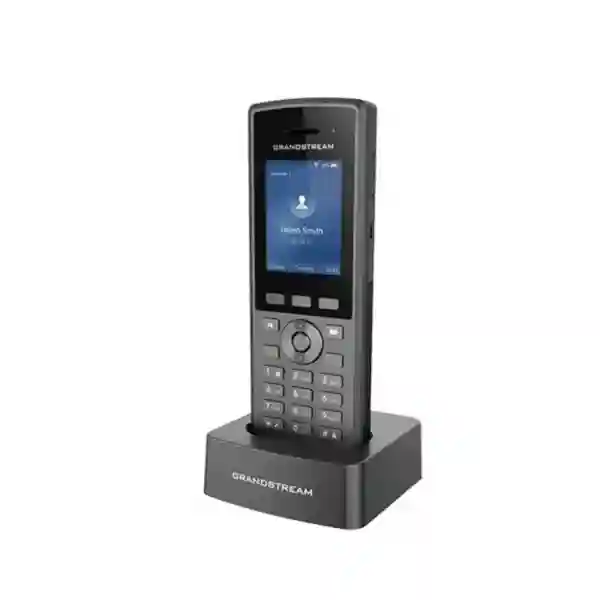
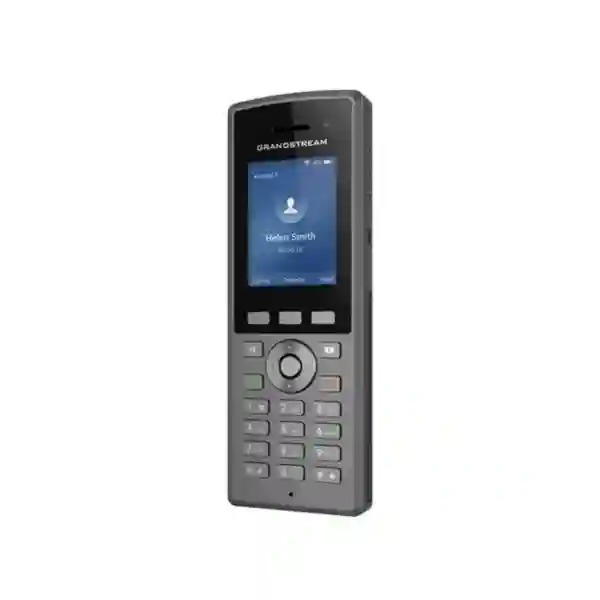
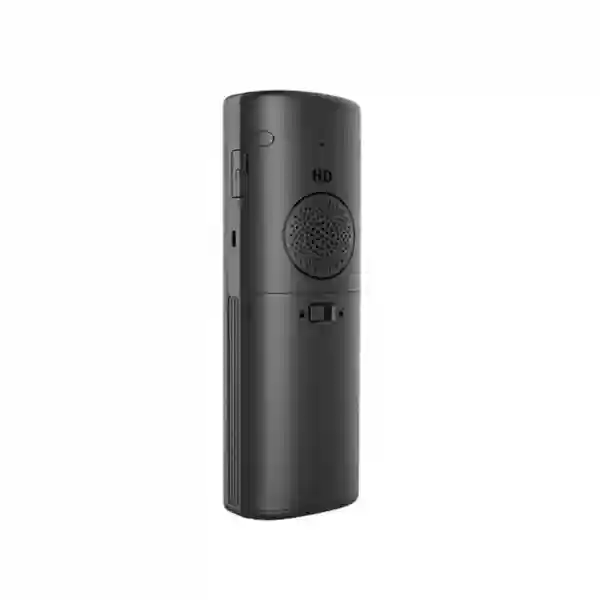
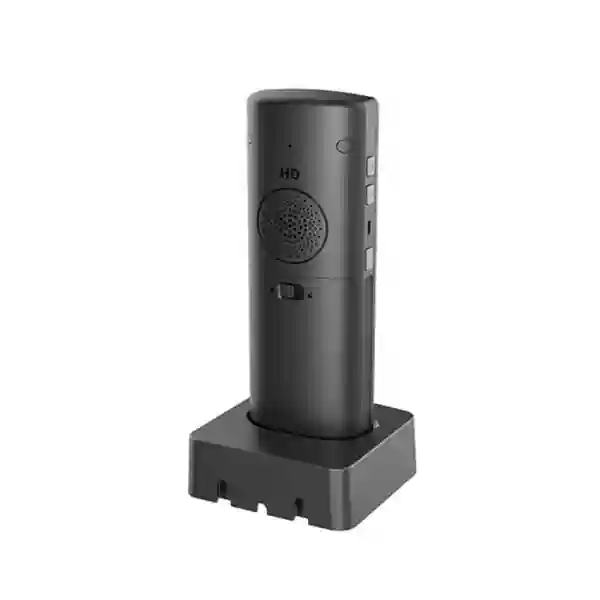
Grandstream WP825 Ruggedized Cordless Wi-Fi IP Phone
The Grandstream WP825 is a ruggedized portable Wi-Fi IP phone built for people who need to stay reachable while moving through a business site rather than remaining at a desk. It is particularly relevant to warehouses, retail floors, clinics, hospitality properties, security teams, logistics operations, factories and other environments where a conventional desk phone cannot follow the user. Grandstream equips the WP825 with integrated dual-band 802.11a/b/g/n/ac Wi-Fi, roaming support, two SIP accounts and two lines, HD voice, dual microphones, Bluetooth, a configurable push-to-talk button and a rechargeable 2000mAh battery rated for up to eight hours of talk time and 200 hours of standby.
Durability is the defining difference between the WP825 and many ordinary cordless business handsets. Grandstream rates it IP67 for water and dust resistance and describes the enclosure as cleaning-chemical resistant, antimicrobial and drop-safe from up to 2.5 metres. That makes the model a practical candidate for teams whose phones may be exposed to dust, frequent handling, routine cleaning or accidental drops. FourTeck Tanzania can help buyers evaluate whether the WP825 fits the existing SIP platform, Wi-Fi design, roaming requirement, headset preference and day-to-day workflow before quantity is finalized.
Rugged mobility
IP67-rated protection, cleaning-chemical resistance and a 2.5 m drop-safe design support demanding workplace use.
Wi-Fi voice
Dual-band 802.11a/b/g/n/ac Wi-Fi and roaming support help users keep a SIP extension available while moving through covered areas.
Shift-ready battery
The 2000mAh removable rechargeable battery is rated for up to 8 hours talk time and 200 hours standby.
Business calling
Two SIP accounts, two lines, three-way audio conferencing, Bluetooth headset support, HD voice and push-to-talk address common mobile voice workflows.
What the Grandstream WP825 solves
A desk phone works well when the user stays near the desk. It is less useful for employees who spend the day walking between storage aisles, patient areas, retail counters, production zones, hotel service areas or security posts. The WP825 moves the SIP extension onto the Wi-Fi network, allowing the handset to remain part of the organization’s IP telephony system while the user moves within designed wireless coverage. This can simplify internal calling, department reachability and task coordination without relying on a separate mobile-phone workflow for every employee.
The handset supports standard SIP-based telephony functions including hold, transfer, forward, call waiting, call logs, three-way audio conferencing, downloadable XML phonebooks and LDAP. Grandstream also supports secure signaling and media options including TLS and SRTP, along with 802.1x network access control. In a well-designed environment, these capabilities allow the WP825 to operate as a managed business voice endpoint rather than an isolated cordless handset.
The product should still be selected as part of a complete voice and wireless design. A rugged handset cannot correct weak Wi-Fi coverage, congested access points, poor roaming design or an incompatible PBX. Before ordering a larger quantity, it is sensible to confirm the SIP platform, authentication method, access-point coverage, VLAN and QoS approach, expected walking routes and the battery charging workflow. Buyers can review broader telephony options in the FourTeck Tanzania services portfolio, where IP PBX, IP phones, switching, Wi-Fi and lifecycle support are planned as connected parts of the business environment.
Verified Grandstream WP825 technical highlights
| Area | WP825 specification | Buying relevance |
|---|---|---|
| Wi-Fi | Integrated dual-band 802.11a/b/g/n/ac, 2.4 GHz and 5 GHz, roaming support | Designed for voice mobility across suitable business WLAN coverage. |
| SIP | 2 SIP accounts, 2 lines | Can support two identities or services depending on PBX design. |
| Display | 2.4-inch 240 × 320 TFT color LCD | Provides a compact mobile interface for call and directory functions. |
| Audio | HD audio on handset and speakerphone, dual microphones, AEC, Noise Shield, HAC support | Useful for noisy or active environments where call clarity matters. |
| Battery | 2000mAh Li-ion, up to 8 hours talk time and 200 hours standby | Supports mobile shift use; actual runtime depends on configuration and use. |
| Durability | IP67, water-proof, dust-proof, cleaning-chemical resistant, antimicrobial casing, drop-safe from 2.5 m | Helps address harsh or frequently cleaned environments. |
| Connections | Integrated Bluetooth, 3.5 mm headset jack, Micro-USB charging | Offers headset and charging flexibility. |
| Management | Grandstream Device Management System support and mass provisioning options | Important for multi-handset administration and firmware/configuration consistency. |
Deployment, Wi-Fi and PBX planning
The WP825 is only as reliable as the wireless network carrying the voice traffic. Voice roaming has different expectations from ordinary web browsing because a handset can expose brief coverage gaps, excessive retransmissions or poor handoff behavior as audible interruptions. For sites where employees walk while talking, access-point placement should be reviewed along actual movement paths, not only inside offices. Warehouses deserve special attention because metal shelving, stored goods, machinery and long aisles can change radio propagation. Hotels, hospitals and multi-floor buildings can also require careful channel and power design to keep roaming predictable.
Grandstream documents support for both 2.4 GHz and 5 GHz operation and supports 802.11r. The handset can prefer 5 GHz when both bands are available, while falling back according to signal conditions. Network designers should still decide how band steering, SSIDs, enterprise authentication and VLAN segmentation will be used. Voice traffic can benefit from Quality of Service policies across the WLAN, switching and routed network, while the PBX or SIP service should be reachable through the firewall policies required by the selected architecture.
If a new wireless deployment is required, FourTeck’s Tanzania portfolio covers business Wi-Fi, managed switching and structured infrastructure alongside voice. The FourTeck Tanzania technology overview explains how IP phones, wireless access points, VLANs, switching and cybersecurity can be coordinated instead of purchased as unrelated components.
Industries and use cases
Warehousing & logistics
Supervisors, dispatch coordinators and floor teams can keep a PBX extension available while moving through receiving, storage, packing and loading areas. Ruggedization is especially relevant where devices face dust and accidental drops.
Healthcare
Mobile staff can use SIP calling and push-to-talk style workflows while the antimicrobial, chemical-resistant enclosure supports environments with frequent cleaning procedures. Organizational infection-control policies should still determine cleaning methods.
Retail & hospitality
Store, hotel and service teams can remain reachable away from fixed counters or desks, helping departments coordinate without assigning every operational call to a personal mobile phone.
Security & facilities
Guards, facility supervisors and response teams can combine PBX calling with a configurable push-to-talk button, provided the Wi-Fi design covers the patrol and operational areas where the handset is expected to work.
Grandstream WP825 Tanzania
For organizations evaluating the Grandstream WP825 in Tanzania, the primary buying question should be whether staff need a rugged SIP handset that can move with them across a covered business site. The model is well suited to roles where employees are rarely seated: warehouse supervisors, retail floor managers, hotel operations teams, healthcare staff, maintenance personnel, security teams and logistics coordinators. Its two SIP accounts and two lines allow it to participate in a business IP telephony environment, while dual-band Wi-Fi removes the requirement for a dedicated Ethernet cable at the point of use. That combination is useful when a fixed desk phone would leave employees unreachable during much of the working day.
Tanzania deployments should be planned around the site rather than simply around the handset quantity. A warehouse in an industrial area may have long aisles, metal racking and loading bays that create different wireless conditions from an office. A hospital or hotel can include many rooms, thick walls, corridors and multiple floors. In each case, the WP825 depends on adequate Wi-Fi coverage, channel planning and roaming behavior. Before procurement, map where calls must remain active, which PBX or SIP service will register the handsets, which SSID and security method will be used and how many charging locations are required. If staff use Bluetooth headsets, confirm the preferred models and wearing style as part of the pilot.
Durability can reduce risk in environments where ordinary handsets are easily damaged, but IP67 does not eliminate the need for sensible handling. The model’s chemical-resistant and antimicrobial enclosure can be relevant to frequently cleaned workplaces, while the stated 2.5 m drop-safe design addresses common accidental falls. Procurement teams should still document battery, charger, belt clip, power adapter and spare-device requirements so the operating workflow is complete. Organizations with many handsets should also plan configuration templates, naming, firmware policy and user onboarding rather than programming every unit independently.
FourTeck Tanzania can help buyers combine the handset decision with the larger voice and network requirement. The FourTeck Tanzania business technology shop provides a buying framework around compatibility, capacity, infrastructure and lifecycle, which is particularly useful when WP825 deployment is tied to Wi-Fi upgrades, switching or an IP PBX project.
Grandstream WP825 Dar es Salaam
Businesses in Dar es Salaam often operate from busy commercial offices, warehouses, retail outlets, hospitality properties and mixed-use facilities where employees need to move continuously between service points. In these environments, the Grandstream WP825 can replace the “call the desk and hope someone is there” problem with a mobile SIP endpoint that stays attached to the organization’s voice system while the user walks through suitable Wi-Fi coverage. A logistics coordinator can move between dispatch and loading, a retail supervisor can answer calls while checking the floor, and a hotel operations employee can remain reachable without carrying a fixed extension.
A Dar es Salaam procurement should begin with a coverage review. Concrete walls, elevators, storage areas, partitioning, neighboring wireless networks and busy client density can all affect the radio environment. A handset pilot is valuable because voice roaming is more sensitive than basic data use: an area where a laptop appears to “have Wi-Fi” may still produce a poor experience during a live call. The pilot should test entrances, corridors, staircases, service areas, stock rooms, loading zones and any outdoor-adjacent spaces where staff commonly walk. It should also test the PBX registration and call-routing behavior expected in production.
For multi-floor offices or compounds, network design should include the access-point uplinks, PoE budget, VLANs and internet or SIP trunk path. Battery charging is an operational detail that should not be overlooked. The WP825 is rated for eight hours of talk time rather than eight hours of mixed shift presence, so actual charging practice depends on call volume, Wi-Fi conditions, screen use and other settings. Teams working longer shifts may decide to rotate handsets, keep charging cradles at supervised points or maintain spare batteries according to operational policy.
When requesting a quotation for Dar es Salaam, include the number of users, existing PBX, current Wi-Fi platform, site layout, expected walking areas, security method and whether installation or network remediation is required. This information allows the handset quantity to be assessed alongside the supporting infrastructure rather than quoted in isolation.
Grandstream WP825 Mwanza
For organizations in Mwanza, the Grandstream WP825 is most relevant where operational employees spend the day between offices, storage areas, service counters, workshops or security points. The value of the handset is mobility within a managed SIP environment. Instead of treating every mobile worker as a separate cellular-phone user, the organization can extend PBX calling over the site’s Wi-Fi infrastructure, preserving extension dialing, transfer, call forwarding and other business telephony workflows. This can be useful for warehouses, distributors, healthcare facilities, hospitality operations, educational campuses and larger commercial premises.
Mwanza buyers should evaluate the radio environment before deploying many handsets. Buildings with thick walls, large open spaces, storage racks or multiple structures may require more than a basic office access-point layout. Coverage should be tested at the height and routes where staff actually carry the phone. If users move between access points during live calls, the WLAN must support predictable roaming. Network teams should review SSID design, authentication, 2.4 GHz and 5 GHz coverage, interference and channel reuse. The WP825 supports both bands and roaming features, but infrastructure design determines whether those capabilities produce a stable user experience.
The rugged enclosure can be attractive for operations where handsets may be exposed to dust, repeated cleaning or accidental drops. Nevertheless, procurement should assess accessories and daily handling. Belt clips, charging cradles, headset preferences and spare-device ratios can have more impact on user satisfaction than adding unnecessary features. Organizations with centralized IT can also benefit from configuration templates and Grandstream device management capabilities to standardize accounts, settings and firmware across the fleet.
A useful Mwanza quotation request should state the PBX or hosted SIP service, extension count, number of WP825 users, site type, access-point vendor, expected coverage areas and any need for installation support. That creates a basis for a complete recommendation rather than a simple per-handset price comparison.
Grandstream WP825 Arusha
The Grandstream WP825 can be a strong fit for Arusha organizations in hospitality, tourism support, healthcare, retail, distribution, education and facilities management. Many of these environments require employees to move across rooms, corridors, service areas or larger compounds while remaining reachable by internal teams. A rugged Wi-Fi IP phone supports that workflow without turning the user into a desk-based extension. Because the handset registers through SIP, it can participate in the organization’s existing call plan, transfers and internal dialing when the PBX and network are configured appropriately.
Hospitality properties in and around Arusha should pay particular attention to coverage boundaries. Guest-room Wi-Fi and staff voice Wi-Fi may have different priorities even when they share infrastructure. Staff handsets need predictable coverage in back-of-house areas, service corridors, reception, housekeeping zones, stores and maintenance locations—not only in guest-facing areas where coverage is usually optimized. Separating staff voice traffic through appropriate network policy can make administration and troubleshooting clearer. QoS should also be considered across wireless and wired network segments when voice competes with guest internet, streaming and business applications.
The WP825’s IP67-rated casing, cleaning-chemical resistance, antimicrobial material and 2.5 m drop-safe specification are relevant where phones are shared between shifts or used in active operational settings. Organizations should establish a cleaning and charging routine that follows their own workplace policies and Grandstream guidance. Bluetooth support may be helpful to employees who need hands-free calling, while the configurable push-to-talk button can support rapid team communication scenarios when correctly configured.
Before purchasing for an Arusha site, it is useful to test one or more handsets in the real environment. Confirm call quality at the edges of coverage, handoff while walking, battery behavior over a typical shift and PBX features such as transfer, voicemail and directory access. A short pilot can prevent larger deployment issues and provides practical information for final quantity and access-point planning.
Grandstream WP825 Dodoma
In Dodoma, the Grandstream WP825 can serve organizations that need mobile voice coverage across administrative buildings, institutions, healthcare sites, warehouses, accommodation facilities and operational compounds. The key advantage is that employees do not have to return to a fixed desk phone to answer or make PBX calls. The handset carries the SIP extension over business Wi-Fi, which can improve reachability for supervisors, facilities staff, security teams and service employees who move frequently during the day.
A successful Dodoma deployment starts with network readiness. If the site already has enterprise Wi-Fi, the first step is to verify whether access points are positioned and configured for voice mobility rather than only general internet access. Hallways, stairwells, storage rooms, entrances and outdoor transition zones are common places where coverage can weaken. The WP825’s dual-band radio provides flexibility, but stable calling still depends on the access-point system, interference levels, roaming behavior and the wired network behind it. Voice VLANs, QoS and firewall policies should be reviewed when they are part of the organization’s network standard.
Government, education and institutional buyers may also care about repeatable administration. For a larger fleet, define handset naming, extension assignment, firmware versions, administrator credentials and replacement procedures before the units are distributed. Grandstream supports mass provisioning and GDMS device management, which can reduce manual work when the deployment is standardized. Users should receive a short operating guide covering transfer, hold, speakerphone, headset use, charging and what to do if Wi-Fi connectivity is lost.
For procurement, include both the number of handsets and the environment in the request. A quote that covers only unit price cannot determine whether access points, network changes or PBX configuration are also needed. By documenting the site conditions and call workflow first, buyers can compare proposals on the completeness of the solution rather than on hardware price alone.
Grandstream WP825 UAE
For multi-country organizations with operations in the UAE, the Grandstream WP825 can support a standardized mobile SIP endpoint strategy across warehouses, hotels, healthcare facilities, retail sites and industrial environments. Using the same handset family across regions can simplify user training, spare-device planning, firmware management and PBX templates, provided local network and telecom requirements are separately validated. The WP825’s core value remains the same: a rugged business handset that uses dual-band Wi-Fi to keep employees connected to the SIP voice platform while they move around the site.
UAE deployments often combine high-density wireless networks with multiple operational applications, so voice performance should be treated as a design requirement rather than an assumption. A warehouse can include scanners and IoT devices, while a hotel can carry guest traffic, staff tablets and room systems on the same infrastructure. Separate SSIDs or VLAN policies may be appropriate depending on the architecture. The WP825 supports enterprise Wi-Fi authentication and voice QoS capabilities, but the complete path through access points, switches, firewall and PBX should be tested under realistic load.
The rugged IP67 design is particularly relevant to facilities and operations teams who work across loading areas, maintenance zones or environments where devices face repeated handling. Bluetooth can support headsets for hands-free communication, while the push-to-talk control can be configured for operational workflows. Procurement teams should confirm whether a cradle and power adapter are needed for every user or whether shift-based charging stations make more sense. Spare batteries and replacement-handset policy can also be planned centrally.
Organizations coordinating Tanzania and UAE projects can use FourTeck UAE for related regional technology requirements while keeping endpoint specifications aligned across branches. Standardization should reduce unnecessary variation without forcing every site into an identical wireless design.
Grandstream WP825 Uganda
For Uganda-based businesses, the Grandstream WP825 is relevant to teams that need mobile internal calling across warehouses, healthcare sites, hospitality properties, retail operations, institutions and larger offices. The handset is not a cellular phone; it is a SIP endpoint that depends on business Wi-Fi. That distinction matters because the quality of the user experience is controlled largely by the network design and PBX environment. Where Wi-Fi coverage is stable, the WP825 can give employees a portable extension that supports transfers, conferencing, directories and other enterprise calling features.
Organizations with sites in both Tanzania and Uganda can benefit from using common deployment templates. The same extension naming logic, firmware policy, SSID strategy and user training approach can reduce support effort, while each branch still receives its own radio survey and capacity review. Warehouses may need aisle-level testing, hospitals may need corridor and room coverage, and hotels may need special attention to back-of-house locations. The handset’s roaming support is useful only when the wireless system provides overlapping coverage and sensible radio settings.
Ruggedization can help reduce device damage in active workplaces. Grandstream specifies IP67 protection, chemical resistance and drop safety from 2.5 m. Buyers should interpret those ratings as design characteristics, not as permission for careless handling. Charging, cleaning, spare battery practice and incident replacement should be part of the operating procedure. If the devices are shared between shifts, administrators should also think about account assignment and directory access.
For a cross-border project, prepare a bill of requirements that separates handset quantity from infrastructure work. This makes it easier to compare the actual solution scope: WP825 units, access points if needed, switch capacity, PBX licenses or extensions, configuration, testing, user training and support. Clear scope reduces the chance that a low hardware price hides missing deployment work.
Grandstream WP825 Kampala
Kampala organizations can use the Grandstream WP825 where employees move around offices, retail locations, distribution facilities, medical environments, hotels or mixed-use properties and still need a business extension. The handset connects through Wi-Fi instead of a desk Ethernet cable, allowing users to answer and transfer calls away from a fixed workstation. This is useful for operational roles whose productivity depends on being present where work is happening rather than sitting beside a telephone.
Dense urban wireless environments can contain many neighboring networks, so a Kampala installation should evaluate interference and channel planning as part of voice readiness. Merely seeing strong signal bars does not guarantee consistent call quality. Packet loss, retransmissions and poor roaming can become audible during a conversation. Site testing should therefore include the busiest working periods and the routes users actually follow. If the existing WLAN was installed primarily for basic internet access, the deployment team may need to adjust access-point placement, channels, transmit power or network segmentation before a larger WP825 rollout.
The phone’s two SIP accounts may be useful where users need separate service identities or where the organization has specific call-routing designs. Bluetooth and a 3.5 mm headset jack provide headset options, while speakerphone and HD audio support different calling styles. The configurable button can be used for push-to-talk scenarios. A pilot should confirm which of these features employees actually need so that training remains simple and standardized.
When requesting a Kampala quotation, include the quantity, PBX platform, Wi-Fi vendor, building type, number of floors, key coverage zones and whether existing wireless performance is already considered reliable. If network assessment is required, include it in the scope rather than expecting the handset itself to solve WLAN weaknesses. This makes the procurement decision more predictable and improves the chance of a successful first deployment.
Grandstream WP825 Arua
In Arua, the Grandstream WP825 can support organizations that need a portable voice extension for healthcare, warehousing, hospitality, security, institutional or commercial operations. The handset is especially useful when a staff member needs to move across several working areas but the organization still wants calls to follow established PBX extensions and call-routing rules. Internal dialing, transfers and directory-based calling can be more structured than relying on personal mobile numbers for everyday operational communication.
Connectivity planning is central to the purchase. A site may have acceptable Wi-Fi in offices but weak coverage in stores, service corridors, workshops or perimeter areas where mobile staff actually work. Before purchasing many units, test a representative handset across the real routes that matter. The WP825 supports both 2.4 GHz and 5 GHz Wi-Fi, but the best band depends on coverage, interference and access-point design. Voice traffic should also have a stable path to the PBX or SIP provider, including DNS, firewall and internet dependencies where relevant.
Operational resilience should include charging and spares. The battery is rated for eight hours of talk time and two hundred hours of standby, but usage patterns vary. Teams with long working days should decide where units charge, who is responsible for overnight charging and whether spare batteries or handsets are kept for continuity. A clearly labeled cradle location can be more effective than distributing chargers without a routine.
The rugged body is a significant reason to choose the WP825 over a less protected model. Water and dust resistance, cleaning-chemical resistance and 2.5 m drop safety can be valuable for active environments. Buyers should combine those durability benefits with a documented support process so damaged accessories, batteries or handsets can be identified and replaced without disrupting extension assignments.
Grandstream WP825 Mbarara
For Mbarara businesses and institutions, the Grandstream WP825 provides a way to extend SIP calling into mobile operational roles. Employees in distribution, healthcare, hospitality, retail and facility management can carry the handset while moving through the site, helping supervisors and colleagues reach them through the business phone system. The two-line, two-account design supports common SIP deployments, while speakerphone, Bluetooth and headset connectivity give users flexibility in how they handle calls.
A deployment should be sized by workflow rather than by employee headcount alone. Not every employee needs a mobile rugged handset, and some teams may share devices by shift. Identify which roles need continuous reachability away from desks, how many people are active simultaneously and whether users need individual extensions. In a healthcare or hospitality environment, shared handsets may require different directory and account policies from individually assigned units. In warehouses, users may need belt clips and push-to-talk features more than broad phonebook access.
Wireless readiness should be measured across the operational area. Voice clients may move frequently between access points, so overlapping coverage and predictable handoff are important. Obstacles such as stock, walls and machinery can change signal conditions from one area to another. Testing should include live calls while walking rather than only static Wi-Fi scans. The PBX should also be checked for codec, SIP security and extension provisioning requirements before final configuration templates are built.
For Mbarara procurement, ask suppliers to separate hardware, configuration, installation and network remediation in the proposal. This gives decision makers a clearer picture of what is included. A complete scope may include WP825 handsets, charging accessories, PBX provisioning, WLAN adjustments, testing and user training. Comparing those elements is more useful than comparing a single handset price without knowing the readiness of the surrounding voice infrastructure.
Grandstream WP825 Gulu
The Grandstream WP825 can fit Gulu organizations that need robust portable communication within a business or institutional Wi-Fi environment. Typical candidates include warehouses, healthcare facilities, hotels, educational campuses, retail operations and security teams. Instead of issuing a standard desk extension to an employee who is rarely at a desk, the organization can register the WP825 to its SIP system and let calls follow the user through suitable wireless coverage.
The device’s ruggedization is particularly relevant to operational use. Grandstream rates the enclosure IP67 and specifies resistance to dust, water and cleaning chemicals together with a 2.5 m drop-safe design. Those characteristics can help in environments where equipment is handled frequently or exposed to less controlled conditions. Still, durability should be supported by a process for charging, cleaning, battery replacement and fault reporting. A rugged phone that is not charged or correctly provisioned will not improve communication.
Wireless voice planning should focus on continuity. Staff may start a call in an office and walk into a storeroom, corridor or loading area. The design should maintain usable coverage along that route. Where multiple access points are required, roaming behavior should be tested with active calls. The WP825 supports advanced roaming features, but radio design and infrastructure remain responsible for the result. The wired network should also provide dependable switch uplinks and access to the PBX or SIP service.
A practical Gulu purchasing checklist includes quantity, assignment model, PBX compatibility, Wi-Fi platform, shift length, headset requirements and key coverage zones. Organizations planning future expansion should also consider how additional handsets will be provisioned and managed. Establishing one configuration standard at the beginning makes later additions much simpler than treating each new handset as a standalone device.
Grandstream WP825 Kenya
Kenyan businesses evaluating the Grandstream WP825 can use it as a rugged mobile extension for warehouses, hotels, hospitals, retail chains, security operations and other facilities with managed Wi-Fi. For organizations operating across East Africa, the model can also support a standardized endpoint strategy between Kenya, Tanzania and Uganda. A common handset family simplifies user training, accessories, configuration templates and support documentation while still allowing each site to receive a network design appropriate to its own building.
The choice should be driven by mobility and durability needs. If users remain at desks, a conventional wired IP phone may be more economical and easier to support. If users spend the day walking through operational areas, the WP825’s Wi-Fi connectivity and rugged housing become much more valuable. The IP67 rating, chemical-resistant antimicrobial casing and drop-safe design make it a stronger candidate than an ordinary consumer handset for demanding work areas. Bluetooth and the headset jack also let teams select hands-free options where appropriate.
Kenya deployments should validate the PBX and WLAN before large-scale ordering. Confirm SIP accounts, codecs, security, extension features, network authentication, SSIDs and the access-point platform. Then test real movement routes with live calls. Warehouses can create radio shadows around racks; hotels and hospitals can have dense wall layouts; retail spaces can experience high client counts. The network should be tuned for the environment rather than relying only on handset specifications.
Cross-border procurement teams should also document what is included in each regional quotation. Hardware, delivery scope, configuration, installation, training and support can differ by project and should not be assumed. Standardizing the technical specification while separately defining local commercial scope helps organizations compare proposals fairly and avoid unplanned work during deployment.
Grandstream WP825 Kuwait
Organizations with Kuwait operations can consider the Grandstream WP825 for mobile SIP communication in warehouses, hospitality, facilities management, healthcare, retail and service environments. The handset’s role is straightforward: keep the user connected to the IP PBX through Wi-Fi while allowing movement away from a fixed desk. For regional IT teams, using a common handset across several countries can simplify configuration standards and support processes, provided that every site’s wireless network and local operational requirements are validated separately.
Kuwait deployments may include large indoor facilities with dense wireless usage or industrial layouts where metal and equipment affect radio propagation. The WP825’s dual-band support provides flexibility, but access points must be placed and tuned for the actual coverage target. Voice roaming should be tested under realistic conditions, including calls made while walking between operational zones. If the handset is intended for security or maintenance staff, test service rooms, corridors, loading areas and other locations that may not be prioritized in normal office Wi-Fi designs.
The IP67 body can help with dust exposure, frequent cleaning and accidental drops, but environmental protection does not replace sensible operating procedures. Charging cradles should have defined locations, shared devices should be labeled, and administrators should maintain extension and configuration records. For a larger fleet, mass provisioning and centralized device-management practices can reduce manual configuration errors and accelerate replacement.
Procurement teams should request a solution scope that identifies the handset, required accessories, PBX work, WLAN changes and testing. If a Kuwait branch is part of a wider regional project, keep the core user profile and configuration template consistent while allowing local network and commercial details to vary. That balance produces standardization where it helps without masking real site differences.
Grandstream WP825 Ghana
For Ghana, the Grandstream WP825 is suitable where mobile staff need access to a business extension across warehouses, hospitals, hotels, retail properties, service centers or campus-style facilities. The product is most useful when an organization already uses—or is planning—a SIP-based phone system and dependable Wi-Fi. Employees can carry the handset between work areas while maintaining PBX features such as extension dialing, transfer and call handling, reducing reliance on ad-hoc personal mobile-number communication for internal operations.
A Ghana deployment should start with user-role mapping. Determine which employees truly need rugged mobility, whether devices are individually assigned or shared, and how many simultaneous users are active. The WP825 supports two SIP accounts and two lines, but most users may only need one business identity. Standardizing a simple configuration can make training easier. Teams that need quick operational coordination may benefit from the configurable push-to-talk button, while supervisors who speak frequently on calls may prefer Bluetooth headsets.
The wireless environment is the main technical dependency. Access-point density, channel use, authentication, VLAN design and backhaul all influence call quality. Larger properties should test roaming by placing active calls and moving across the normal routes used during work. Static signal readings cannot show every issue that appears during handoff. If weak zones are found, fix the WLAN design before increasing handset quantity.
Commercial evaluation should consider the total deployment rather than the handset alone. Buyers should confirm quantity, included accessories, power requirements, PBX provisioning, installation scope, wireless changes and support expectations. The WP825’s rugged features can reduce exposure to everyday workplace damage, but overall value depends on whether the organization also creates a reliable Wi-Fi and support environment around the device.
Grandstream WP825 Nigeria
The Grandstream WP825 can serve Nigerian enterprises that require mobile voice communication across warehouses, retail chains, hospitality sites, healthcare facilities, security operations and other busy environments. It is designed as a Wi-Fi SIP endpoint, which means users can remain part of the organization’s IP PBX even while moving between work zones. This can be preferable to maintaining separate communication methods for desk users and mobile operational staff, especially where extension-based workflows and call transfers are important.
Large Nigerian sites should treat wireless design as part of the telephony project. Warehouses and industrial buildings can contain radio obstacles, while hotels and multi-floor offices can create challenging handoff conditions. The WP825 supports dual-band Wi-Fi and roaming, but coverage must be engineered for voice. The pilot process should include calls made during movement, not only stationary tests. Network teams should also validate DHCP, DNS, firewall policy and reachability to the PBX because failures in any of those services can affect registration or calling.
Rugged characteristics are valuable when a handset is shared, carried through active areas or exposed to frequent cleaning. Grandstream’s IP67 rating and 2.5 m drop-safe specification provide stronger physical protection than a normal office handset. Organizations should still train users on charging, headset use, cleaning procedure and fault reporting. For distributed branches, administrators can create a standard configuration profile and maintain records of MAC addresses, extension assignments and firmware versions.
A Nigeria quotation should clarify whether the request is hardware supply only or a complete deployment. A complete project may require WLAN assessment, PBX configuration, accessories, handset provisioning, testing and user training. Procurement teams can then compare solutions based on readiness and scope instead of choosing solely by unit price.
Grandstream WP825 Seychelles
In Seychelles, the Grandstream WP825 can be especially relevant to hospitality, resorts, healthcare, facilities management, security and operational teams that work across distributed indoor and semi-outdoor service areas. A portable SIP handset lets employees remain reachable on the business phone system while moving between reception, housekeeping, maintenance, stores, kitchens, service corridors and other locations where a desk phone is impractical. The rugged IP67 design also makes the model more suitable than a conventional office handset for active operational use.
Island and resort properties often have complex building layouts, separate structures and outdoor transition areas. Wi-Fi coverage should therefore be checked specifically for staff voice routes. Guest Wi-Fi quality does not automatically prove that staff roaming calls will be stable in back-of-house zones. Access points may need to be positioned to cover service areas, and the wired backhaul between buildings or network cabinets should be reliable. The WP825 can roam between access points, but the network must provide overlapping coverage and appropriate configuration for the handoff to be smooth.
The chemical-resistant, antimicrobial casing can be useful in hospitality and healthcare environments where devices are cleaned frequently. Organizations should establish a cleaning method consistent with manufacturer guidance and local policy. Charging logistics are also important when staff work shifts. A centralized handover point can simplify charging, inventory and fault reporting for shared handsets, while individually assigned units may be better for departments that require direct extension ownership.
When preparing a Seychelles quotation request, specify the number of buildings, key operating areas, current wireless platform, PBX, user count and whether calls must remain active while walking between structures. The resulting design can then separate what the WP825 provides from what the site infrastructure must provide. This avoids overestimating the capability of the handset and creates a more dependable mobility plan.
How to choose the WP825 instead of a standard Wi-Fi phone
Choose the WP825 when the environment justifies ruggedization. If the user works mainly in a clean office and only needs occasional mobility, a less rugged Wi-Fi handset may provide the required communication at lower complexity. The WP825 earns its place where water or dust resistance, cleaning-chemical resistance and higher drop tolerance are valuable to the operating role. This is why it is frequently considered for healthcare, logistics, retail, hospitality, security and other vertical markets rather than only conventional offices.
Also consider the Wi-Fi and PBX environment. A rugged phone does not compensate for an undersized WLAN. If users report dead zones or unstable roaming with existing devices, the network should be assessed before rolling out WP825 handsets. For a new project, plan the voice system and wireless coverage together so that handset quantity, extension design and access-point coverage support the same workflow.
Quotation checklist for Grandstream WP825
Frequently asked questions
Is the Grandstream WP825 a DECT phone?
No. The WP825 is a Wi-Fi IP phone. It registers to a SIP service over compatible 2.4 GHz or 5 GHz wireless LAN infrastructure. This makes Wi-Fi coverage and roaming design central to deployment quality.
How many SIP accounts does the WP825 support?
Grandstream specifies two SIP accounts and two lines. The way those accounts are used depends on the PBX or SIP service and the organization’s call design.
Does the WP825 support Bluetooth headsets?
Yes. Integrated Bluetooth is provided for headset connectivity. There is also a 3.5 mm headset jack. Specific headset compatibility should be confirmed for the model selected.
Is the WP825 waterproof?
Grandstream rates the WP825 IP67 and describes it as water-proof and dust-proof, with a chemical-resistant antimicrobial casing. Deployment should still follow manufacturer handling and environmental guidance.
How long does the WP825 battery last?
The included 2000mAh rechargeable Li-ion battery is rated by Grandstream for up to 8 hours of talk time and 200 hours of standby. Real-world runtime varies with use, signal conditions, settings and battery condition.
Can the WP825 roam between Wi-Fi access points?
Yes, the product supports Wi-Fi roaming and Grandstream documents 802.11r support. Successful roaming still depends on access-point coverage, network configuration and the surrounding WLAN design.
Can the WP825 be centrally managed?
Grandstream lists GDMS support and also provides mass-provisioning options. These features are valuable when organizations want consistent configuration and firmware practices across multiple handsets.
What should be tested before buying many WP825 phones?
Test PBX registration, call features, live roaming, audio quality, battery behavior, charging workflow, headset use and coverage in every operational zone. A small pilot can reveal network issues before a fleet deployment.
Decision recap
The Grandstream WP825 is a strong candidate when a business needs a rugged SIP handset for employees who move around a Wi-Fi-covered site. Its combination of IP67 protection, 2.5 m drop safety, dual-band Wi-Fi, two SIP accounts, Bluetooth, push-to-talk, HD voice and a 2000mAh battery addresses operational roles where both mobility and durability matter. It is not automatically the best choice for every employee; desk-bound users may be better served by conventional IP phones, while environments with weak Wi-Fi should fix coverage before depending on wireless voice.
A good purchase decision therefore combines handset choice with network readiness. Confirm the PBX, Wi-Fi coverage, roaming performance, user count, shift length, charging process and support plan. Then request a quotation that clearly separates equipment from configuration, installation and network work. This approach makes the commercial comparison clearer and improves the likelihood that the handset works as expected from the first day of deployment.
Consult FourTeck Tanzania about the WP825
Share the number of handsets, existing phone system, Wi-Fi platform, building type and the areas where users need mobile calling. FourTeck can use that information to discuss the WP825 as part of a practical voice deployment rather than treating the handset as an isolated purchase. For organizations with larger technology requirements, the same project discussion can also consider access points, switching, cabling, firewall policy and IP PBX configuration.
For wider East African coordination, the FourTeck Uganda site can support Uganda-related requirements, while the Tanzania team remains the primary reference for this Tanzania product request.



Reviews
There are no reviews yet.