
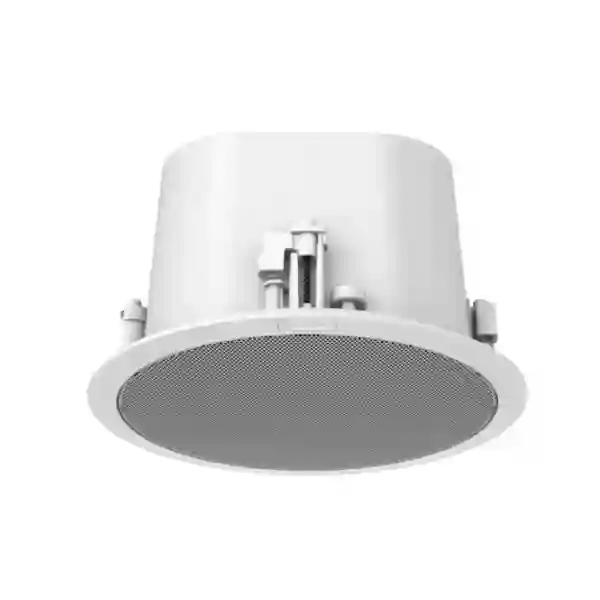
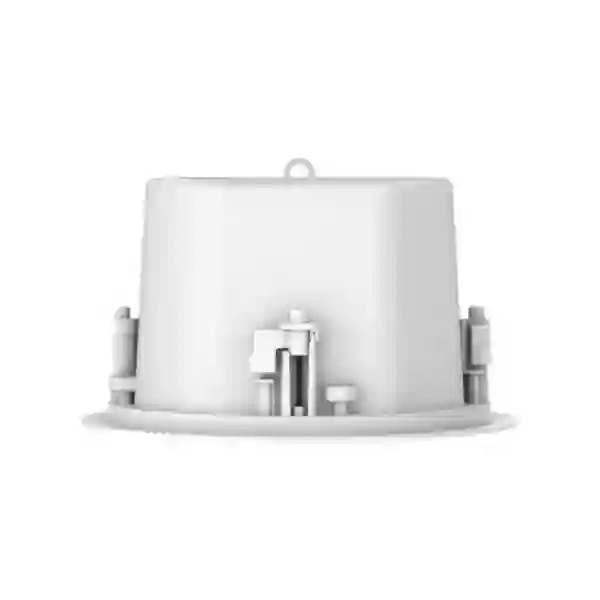
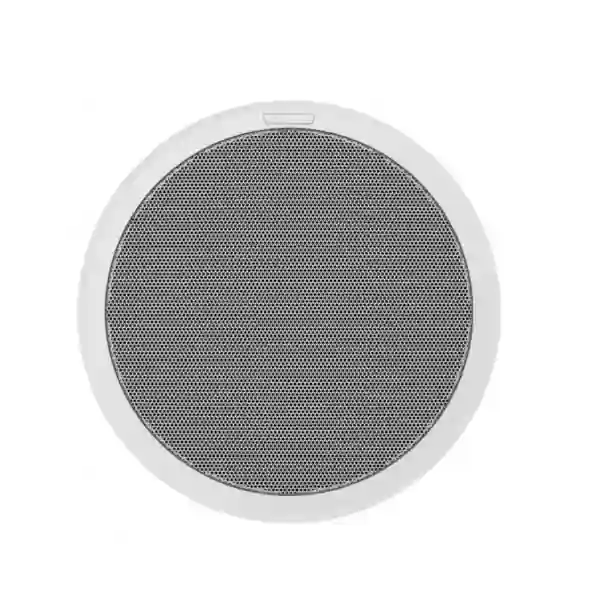
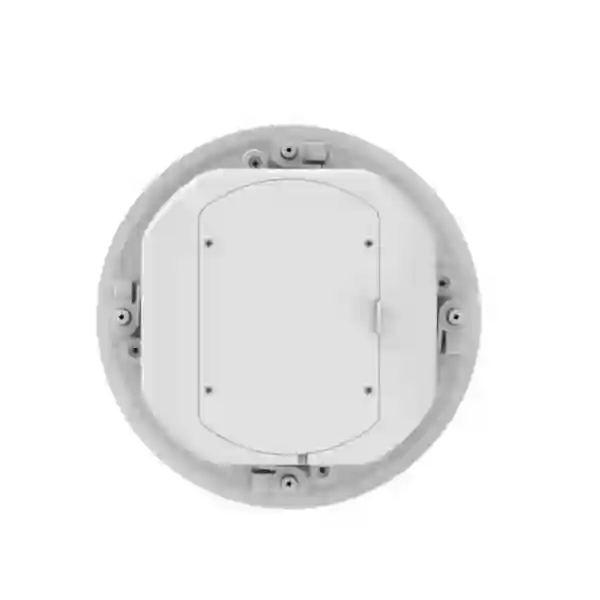
Hanwha SPA-C110W IP Ceiling Speaker
A white, PoE-powered, in-ceiling network speaker for suitable indoor announcements, paging and integrated IP audio projects. Compare verified specifications, limitations and design considerations before requesting a Tanzania quotation.
Quick specification comparison
| Speaker type | IP ceiling speaker, white |
|---|---|
| Amplifier | Built-in 10W Class D |
| Ethernet | 10/100 Base-T |
| Power | PoE / PoE+ |
| Maximum SPL | 96 dB (PoE); 100 dB (PoE+) |
| Speaker range (-10 dB) | 120 Hz–20 kHz |
| Sensitivity (1W) | 90 dB |
| Speaker coverage | 90° at 1 kHz; 60° at 4 kHz |
| Storage | 1 GB internal; optional SDHC microSD up to 32 GB per manufacturer |
| Integration | SIP, SUNAPI HTTP API, ONVIF Profile S |
| Operating conditions | -20°C to +50°C; 10–85% RH non-condensing |
| Dimensions and weight | Ø269 × 156.5 mm; approximately 2.7 kg |
Specifications are manufacturer-stated. Confirm final configuration, installation documentation and regional commercial terms for the intended project.
What is the Hanwha Vision SPA-C110W?
The Hanwha SPA-C110W IP Ceiling Speaker is a network-addressable in-ceiling audio endpoint intended for controlled announcements and other suitable IP audio applications. Instead of connecting every speaker to an analog amplifier over long speaker-cable runs, a designer can connect the SPA-C110W to an Ethernet network and supply power through a compatible PoE or PoE+ port. The speaker has its own built-in 10W Class D amplifier. For a facilities manager or systems integrator, the practical value is control: audio can be planned as part of a networked system, with attention to paging sources, different listening zones and routine supervision. Its white finish can suit indoor ceiling designs where a visible wall or horn loudspeaker would be undesirable.
This model is not a generic wireless Bluetooth loudspeaker, an outdoor siren, or a guaranteed replacement for an existing analog 70V/100V ceiling speaker. It needs a suitable Ethernet-based design, a proper power budget and configuration. Buyers should start by describing the messages to be delivered, how many distinct areas will hear them, what equipment originates those messages and who will manage the system. The SPA-C110W can then be evaluated against those requirements instead of being selected on its headline output rating alone.
At a glance: verified hardware and network specifications
The key model characteristics are specific enough to guide an initial shortlist. Hanwha Vision identifies the SPA-C110W as a white IP ceiling speaker with an integrated 10W Class D amplifier and 10/100 Base-T Ethernet. Its low-frequency and high-frequency speaker arrangement is described as an 8-inch LF drive and a 2-inch HF driver. The maximum sound-pressure ratings are stated separately for PoE and PoE+: 96 dB and 100 dB respectively. Speaker frequency range at minus 10 dB is 120 Hz to 20 kHz, and sensitivity is 90 dB at 1 W. The manufacturer lists a coverage pattern of 90 degrees at 1 kHz and 60 degrees at 4 kHz.
The speaker also has 1 GB internal memory, a supported external microSD option using SDHC up to 32 GB as specified by the manufacturer, one dry-contact input and one normally open dry-contact output. It supports SIP and selected network protocols, plus SUNAPI HTTP API and ONVIF Profile S integration. Physical data include a diameter of 269 mm, a height of 156.5 mm and a weight of approximately 2.7 kg. The specified environmental conditions are minus 20 to plus 50 degrees Celsius and 10–85% relative humidity without condensation. These are equipment specifications, not a promise that every ceiling or site environment is appropriate.
Why PoE and PoE+ matter for this ceiling speaker
Power over Ethernet is a significant planning advantage because power and data can share a single suitable Ethernet link from the network infrastructure. This can avoid a separate power adaptor at each ceiling location, provided the switch, cabling and installation conform to the applicable design. It also makes centrally managed network power and switch-level monitoring possible in installations equipped for those functions. The SPA-C110W supports PoE and PoE+ according to Hanwha Vision. That does not mean every port on an existing switch will support the desired speaker performance, and a switch marketed as PoE-capable should not be assumed to have enough total wattage for every connected endpoint.
There is a performance distinction buyers should not miss: Hanwha rates the speaker at up to 96 dB maximum sound pressure level with standard PoE and 100 dB with PoE+. If higher output is a design requirement, validate the exact supply class, available port power and total switch budget. Count every speaker, camera, access device and other powered endpoint sharing that switch. Also consider whether the network equipment will remain powered during a local electricity interruption. PoE removes a separate power feed at the speaker; it does not remove the requirement for reliable power at the network source.
Understanding the 100 dB sound-pressure figure
The advertised 100 dB is the maximum sound-pressure level specified for PoE+ operation, not a guarantee that every listener will hear a message at that level. Actual sound at a listener depends on distance, room acoustics, ceiling height, furniture, background noise, mounting position and the signal itself. In a quieter office lobby, the same speaker layout may achieve adequate speech intelligibility at much lower levels than in a busy arrival hall. More volume is not automatically better; excessively loud announcements can be uncomfortable and can make long reverberant rooms harder to understand.
Use the 96 dB PoE and 100 dB PoE+ ratings as design inputs rather than as a simple number-of-rooms claim. Before setting quantities, decide the intended coverage area and acceptable speech intelligibility at the farthest listening positions. Then consider realistic ambient noise and whether the building acoustics require more endpoints, a different speaker type or acoustic treatment. Commissioning should include speech tests in occupied conditions where practicable. A product that can deliver high sound pressure still needs careful placement and level-setting to make an announcement useful.
Frequency response versus speaker frequency range
Two different frequency specifications appear in the manufacturer's data and they should not be confused. The published line-output frequency response is 20 Hz to 20 kHz; this refers to the line-output specification. The speaker's acoustic frequency range, measured at minus 10 dB, is stated as 120 Hz to 20 kHz. Those figures describe different parts of the product. For the person selecting an in-ceiling public-address endpoint, the acoustic range is the more directly relevant figure when assessing speaker reproduction, although room design and the type of source audio remain important.
The SPA-C110W is principally compelling for networked announcements, paging and suitable program audio, not for applications that require the deep low-frequency performance of a dedicated subwoofer system. If a space is intended for high-fidelity music listening rather than practical information delivery, compare the full sound-system requirements instead of using a wide-looking frequency number as the sole selection criterion. Ask whether music and spoken information will need separate level profiles, and test recorded material from the actual source devices. Speech quality at normal listening volume usually matters more to business communication than an impressive top-end frequency figure.
Ceiling coverage and positioning
Hanwha Vision specifies a coverage pattern of 90 degrees at 1 kHz and 60 degrees at 4 kHz. This variation shows why ceiling speaker coverage should be designed across the relevant speech frequency range rather than visualized as a perfectly uniform circle. The high-frequency content that helps listeners understand consonants can distribute differently from the lower-frequency part of a voice. Mounting height, speaker spacing and listener positions therefore influence whether people hear clear words across the floor. A regular grid may be convenient for drawings but may not suit corridors, stairwell approaches, tall halls or spaces with partitions.
For each area, mark the intended listener zones, note the approximate ceiling height and identify sound-absorbing or reflective surfaces. Avoid placing a unit directly where major obstructions prevent useful coverage. Corridors can need a different layout from open offices; a wide room may require overlapping fields and level balancing. A site survey should determine the final number and placement of speakers. The published angles are useful for preliminary planning but do not replace detailed coverage calculations or an on-site listening test. Also leave sufficient space for safe access during installation and maintenance.
Zones, groups and multi-source control
The ability to target selected areas is often the reason to choose IP audio over a simple standalone speaker system. Hanwha's integration specification describes multi-source dynamic public-address control supporting up to 48 multicast sources, comprising 24 audio and 24 microphone channels, with up to 15 audio channels broadcast simultaneously. The same specification lists up to 256 multicast zones, up to 20 unicast zones and up to 255 groups. These are manufacturer-stated platform limits and should be interpreted within a verified system design, not as an unconditional promise about every third-party software package or network topology.
Consider a building that needs an everyday general announcement, department-level paging and a selected-area operational message. Zones allow those intended destinations to be considered separately. Groups may make it easier for an operator to address several zones as one logical set. Decide how a message source wins access when multiple calls occur, whether authorized users can override a general announcement and how routine content will be scheduled or controlled by the chosen software. Multicast capacity is meaningful only when the network supports and is configured for it correctly. System integration, control software and operator procedures must be assessed together.
SIP support and telephone-system considerations
The SPA-C110W supports SIP and Hanwha identifies tested SIP clients including models or software from Grandstream, Yealink, Cisco and MicroSIP, alongside the Asterisk PBX. Its listed SIP-related features include DTMF using RFC 2833 and support for PCMU, PCMA and Speex codecs at the specified rates. For a buyer, this provides a sensible basis for investigating telephone-based paging or integration with a suitable SIP environment. It does not establish plug-and-play compatibility with every current PBX model, hosted telephone platform, trunk provider or custom SIP deployment.
Before purchasing for a PBX-linked solution, verify the exact call flow. Decide whether calls are placed directly to the speaker, sent to a group, routed through a server or initiated by an authorized handset. Ask about codec negotiation, transport security requirements, registration limits, caller authorization, network segmentation and how DTMF is handled in the real calling path. Run a proof of concept with the actual PBX version and intended endpoint type. A product's general SIP support is useful evidence, but it cannot replace an interoperability test or project-specific acceptance criteria.
SUNAPI and ONVIF Profile S integration
Hanwha lists SUNAPI over HTTP and ONVIF Profile S under system integration for the SPA-C110W. These interfaces are relevant to organizations planning to connect IP audio with compatible applications or security infrastructure. They provide technical starting points for evaluating events, management and integrations, but supported functions must still be checked in the exact device firmware and application version. ONVIF Profile S is not a blanket guarantee that every audio workflow, paging function or video-management integration will operate the same way across vendors. Similarly, an API name alone is not evidence that a particular automation has already been implemented.
A useful integration brief should list desired actions in plain language. For example, specify what event should trigger a message, which speaker or zone should receive it, whether an operator needs confirmation and what logs are retained. The systems integrator can then map those requirements to documented API or product capabilities. Test access controls and error handling as well as the happy path. When a site already uses Hanwha network security equipment, there may be architectural benefits to evaluating the portfolio together, but integration should be demonstrated rather than assumed from brand familiarity.
Internal memory and optional microSD storage
The manufacturer specifies 1 GB internal memory and an external microSD option described as SDHC up to 32 GB with the named card guidance in its documentation. This is useful when considering system handling of supported local audio resources, configuration and related workflows. Storage capacity is not a stand-in for confirming how a particular message can be imported, retained, scheduled or played. Nor should the presence of a card slot be interpreted as proof that a removable card is included in the product packaging. Verify supported formats, limits and management functions in the current device documentation.
For a project using stored audio, the content-management process needs attention. Decide who can upload a new recording, how old versions will be retired, what the fallback is if a message fails and how changes are documented. Keep messages short and readily understood in the intended listening environment. If removable storage is being specified, confirm the supported card characteristics and environmental suitability before procurement. A site with frequent message changes may need a more formal publishing workflow than one using only an occasional pre-recorded operational notice.
Text-to-speech language support: an important Tanzania check
Hanwha's product specification lists text-to-speech languages as English (US and UK), German, French, Spanish and Russian. Swahili is not included in that listed set. This matters when a Tanzanian organization wants automated announcements in Kiswahili rather than merely English. Do not purchase on the assumption that the device's built-in TTS will synthesize Swahili correctly. If Kiswahili speech is necessary, explore an approved recorded-audio workflow or a separately tested text-to-speech source that delivers compatible audio through the chosen system.
Also distinguish synthesized speech from a person speaking through a microphone or from a prerecorded message. A project might need both Swahili and English announcements, and the correct workflow will depend on how messages are produced and routed. Have representative listeners review the exact pronunciations of locations, department names and safety instructions before deployment. Check whether multiple languages are played sequentially or directed to different zones, and make messages concise enough for the environment. Language choice is a core operational requirement rather than an optional marketing detail.
Dry-contact inputs and outputs
The SPA-C110W specification includes a single dry-contact input channel and one normally open dry-contact output channel. These may be relevant to integrations that involve simple contact states, alarms or event actions, depending on the supported configuration. For example, an integrator may investigate whether a permitted contact event can initiate a defined audio workflow in a particular application. That use case must be demonstrated with current documentation and wiring requirements; the existence of a contact connector does not by itself confirm the exact trigger logic or make the speaker a certified life-safety alarm controller.
During design, identify the contact signal source, electrical characteristics, isolation requirements and the intended response. Ask who owns the logic and which component reports an error. Verify what should happen after the input returns to its normal state and whether repeated triggers could overlap. Treat control cabling and network setup as parts of one coordinated system. If the intended purpose is evacuation, fire alarm or another regulated critical notification function, require specialist system design and applicable approvals for the complete solution rather than relying on a general-purpose network speaker specification.
Built-in audio checks and status monitoring
Hanwha includes an audio-monitoring feature described as a speaker test using a built-in graphic level meter. Connection verification and built-in system logging also appear in the manufacturer's specifications. For operators, these features can contribute to routine diagnosis, particularly where speakers are mounted in ceilings and are inconvenient to access physically. But a software indication of activity is not automatically proof that a listener heard the exact message at the expected volume. Operational readiness requires more than observing a connected-device icon on a dashboard.
A maintenance plan should combine device status checks with periodic listening tests. Include checks for unexpected silence, distorted playback, incorrect zone selection and excessive background noise. Keep a list of speaker locations so a technician can associate an endpoint with a room rather than relying only on an IP address. Record configuration changes and maintenance outcomes. If messages have to remain available during power or network incidents, test the designed fallback or backup arrangements. Monitoring features help identify problems, but site procedures determine whether those problems are noticed and resolved before the next announcement is needed.
Ethernet network design and addressing
The speaker uses a 10/100 Base-T Ethernet network interface and supports common protocols including IPv4, HTTP, SIP, mDNS, DNS, NTP, TCP, UDP, DHCP, ARP and ICMP. This fits many managed local-area-network environments, though the actual connection design should be agreed with the site's IT team. Determine whether endpoints receive their addresses through DHCP or another approved method, how devices will be named, and which services need to communicate across network segments. Document the location and switch port for each speaker to simplify future troubleshooting.
Avoid treating an IP audio system as an isolated audio purchase with no IT implications. Consider subnet capacity, multicast routing, firewalls, time synchronization, authentication, change control and bandwidth protection where applicable. Verify the traffic required by the chosen audio sources and control platform, especially if many simultaneous streams are planned. Also think through maintenance access: technical staff need a supported way to update and diagnose endpoints without exposing them unnecessarily to untrusted networks. A simple logical diagram showing sources, switches, speakers and management services is a useful procurement deliverable.
Installation space, weight and ceiling structure
The published diameter is approximately 269 mm and the body height is 156.5 mm, with a weight of about 2.7 kg. Those measurements help the installer assess whether the intended ceiling void offers enough depth and whether the ceiling structure can support the equipment using the manufacturer-approved mounting arrangement. They are not necessarily the exact ceiling cut-out size or a complete mounting instruction. Consult the current installation guide and relevant drawing before cutting any ceiling panel. Also check access around ducts, lighting, fire protection, cable trays and other services that may share the ceiling space.
Ceiling construction varies widely between an office with suspended tiles and a building with solid concrete. The same speaker may be unsuitable for a proposed mounting surface without additional approved components or design changes. Before ordering, confirm the mounting method, available service access, cable approach and any requirements from the building operator. Installation should not compromise ceiling fire-resistance, acoustic treatment or structural safety. Include a sample installed position in the site survey so the owner can approve appearance and reachability before technicians install every unit.
Plenum-rated does not mean outdoor-rated
Hanwha describes this model as plenum rated for in-ceiling use and lists safety standards including UL 2043 in its product specification. That information is relevant to certain ceiling environments and should be assessed against the project's applicable building requirements. However, the model does not have a published ingress-protection code in the referenced product table; its IP code is shown as not applicable. Consequently, buyers should not infer waterproofing, weather resistance or outdoor suitability from the fact that the product is robust enough for a particular ceiling-related rating.
For covered but damp locations, near cooking equipment, in high-humidity spaces or in a partially open building, ask for an explicit environmental suitability review. The stated operating humidity is 10–85% relative humidity without condensation. A location that experiences condensation, rain ingress or wash-down exposure may require another speaker enclosure type. Also remember that a plenum claim is not itself proof of acceptance under every local building code. Confirm the documents and approvals relevant to the exact project jurisdiction rather than importing a compliance conclusion from a datasheet intended for several international markets.
Shops, showrooms and retail interiors
Retail facilities may need discreet overhead messages, selected-zone operational announcements and appropriate program audio. A white ceiling speaker can be considered where the architecture favors concealed wiring and a low-profile installation. Yet retail acoustics can be difficult: hard floors, glass fronts and background music may compete with speech. A speaker specified at a high maximum SPL is not a substitute for an intelligibility design. A short message, delivered at an appropriate level from the correct locations, is usually more useful than simply increasing the volume of a poorly distributed system.
When considering the SPA-C110W for retail, clarify whether music is an everyday requirement or whether the primary need is speech. Confirm source compatibility, control software, legal licensing of any commercial music content and the intended interruption behavior. A checkout desk may need a different paging priority from a public sales area. Stockrooms or loading bays could require different audio hardware due to noise and environmental conditions. The system should be commissioned with the normal store equipment operating, not only in an empty, quiet space before opening.
Schools, training centres and campuses
Educational buildings often need clear speech to reach classrooms, offices, reception areas and corridors without creating unnecessary disturbance. A networked ceiling speaker can be evaluated for ordinary paging and administration messages where mounting and environmental conditions are suitable. Zone planning is particularly important: not every message is intended for every classroom. Consider the audible difference between a classroom in use, a quiet study area and a noisy entrance corridor. A well-designed paging system can reduce confusion when messages are targeted appropriately.
Requirements should include when announcements may be made, who is authorized to initiate them and how changes to the timetable are handled. A campus spread across multiple network segments deserves additional attention to connection quality, system supervision and recovery after an outage. Where a school requires emergency notification or evacuation functions, specify and verify the complete compliant system separately. This product description does not establish the SPA-C110W as a certified standalone emergency voice-alarm solution. Involving both facilities and safeguarding or safety personnel in the acceptance test is prudent.
Warehouses and industrial areas: when to reconsider the model
Although the SPA-C110W offers a published maximum SPL of 100 dB with PoE+, that alone does not qualify it for every noisy industrial area. Warehouses, workshops and loading zones can have high ambient sound, large reverberant volumes and dust or moisture exposure beyond the conditions suited to an indoor ceiling speaker. Some spaces may also lack a practical ceiling surface for this style of mounting. A wall-mounted or horn-style IP speaker, or a specially designed industrial public-address system, may be more appropriate after a survey.
If an industrial or logistics client is interested in this model, separate office, reception and administrative rooms from high-noise work zones. The ceiling product may be considered for the former while another endpoint type serves the latter. Test actual ambient conditions, expected listener distances and environmental exposure. Where warnings or evacuation messages are required, evaluate applicable standards, redundancy and speech-intelligibility targets at the system level. Do not assume that a high sound-pressure figure or an IP connection is sufficient evidence of safety-related performance or regulatory compliance.
Security, authentication and maintenance access
An IP loudspeaker is part of the network and deserves the same disciplined attention as other managed devices. Give it a documented owner, maintain an inventory of firmware and configuration, and control access to the management interface. The manufacturer lists network protocols and supported integration APIs, but these lists do not by themselves establish that every deployment is secure by default or that every desired transport-security feature is available. Check the current security guidance for the exact firmware and disable unnecessary exposure where the supported configuration allows it.
Use organization-approved credentials and access processes. If the device interacts with a telephone platform or an external control application, document which systems can initiate playback and which staff can alter zones. Discuss segmentation, monitoring, log review and backup of configuration with the IT administrator. Apply firmware updates through a controlled process after assessing changes and compatibility, rather than treating updates as risk-free during business hours. Cybersecurity should be part of procurement acceptance because an unauthorized announcement or inaccessible endpoint can cause operational disruption even in a noncritical application.
Commissioning: test the real user experience
A successful installation is not complete when the speaker powers on. The commissioning team should confirm device discovery, expected source connectivity, zone membership, routine operating levels and understandable playback in the actual rooms. Test the farthest listener points, noisy periods where practicable and the source devices staff will use every day. Listen for clipping, unwanted reverberation, abrupt audio start or incorrect message routing. If the system uses a telephone interface, test calls from the permitted handsets and verify their behavior under ordinary business network conditions.
Also test the operational edge cases: a disconnected speaker, a switch reboot, the absence of an upstream server and changes to source permissions. Check available logs and speaker-test tools, but use actual listening tests to validate audibility. The customer should receive an endpoint map, approved zone list, basic operating instructions and a record of test results. This helps new staff use the system correctly and gives technicians a baseline when investigating later faults. Acceptance criteria agreed before installation are more useful than an informal demonstration after the equipment has been mounted.
How to compare the SPA-C110W with other speaker types
Compare speaker options by mounting environment, acoustic objective, network design and operator workflow. Against a basic analog in-ceiling speaker, the SPA-C110W brings a built-in amplifier, network interface and manufacturer-listed IP integration functions. Against a wall-mounted IP speaker, it offers a different mounting location and visual profile. Against a horn speaker, it is not automatically the right choice for long-distance outdoor sound projection or difficult industrial noise. None of these comparisons yields a universal winner because the design constraint changes between locations.
Ask each supplier to describe the complete proposed system, including audio sources, control software, networking, mounting hardware and commissioning. Where possible, use the same room, intended message, listener location and background-noise conditions in comparisons. Examine how easy it is to change zones and how service staff will identify a faulty endpoint. If any bidder claims compatibility with the customer's existing security software or PBX, ask for a test plan. An inexpensive speaker with the wrong interface may lead to costly integration work, while an over-specified model can burden a straightforward project without adding customer value.
Procurement and integration checklist
When reviewing a proposed bill of materials, first verify that the exact item requested is the white Hanwha Vision SPA-C110W IP ceiling speaker, not the black version or a different ceiling model. Next, confirm the intended use is suitable for its indoor mounting arrangement and environmental specification. Ask for a manufacturer-supported installation drawing and current product documentation. Confirm the proposed PoE supply, switch ports, available power budget, network addressing and multicast support if relevant. A drawing showing each speaker's location and zone is especially valuable when the project has many endpoints.
The final checklist should also cover message source hardware, any necessary control application, SIP or API compatibility, installation method, storage needs, operator permissions, commissioning tests and maintenance responsibilities. Include a plan for future changes: who edits a message, who reassigns a zone and who updates firmware. Do not omit local commercial questions merely because the product itself has been technically shortlisted. A complete project quotation should state the assumptions and exclusions, with any requirement for additional network equipment or site work made visible before approval.
Frequently asked questions
Is the SPA-C110W an IP ceiling speaker?
Yes. Hanwha Vision classifies it as an IP ceiling speaker with 10/100 Base-T Ethernet and a built-in 10W Class D amplifier. It is designed to be connected to compatible network infrastructure rather than wired directly as a conventional passive analog ceiling loudspeaker.
Does it need a separate power adaptor at the speaker?
It supports power over a suitable Ethernet connection through PoE or PoE+. The network source still needs appropriate power and capacity, and the installed cable and switches must meet the design requirements.
Is the maximum output 96 dB or 100 dB?
Both figures are relevant under different supply conditions. Hanwha lists a maximum sound-pressure level of 96 dB on PoE and 100 dB on PoE+. Confirm the planned switch port before relying on the higher figure.
Can this speaker be used outdoors?
Do not assume so. The manufacturer describes it as an in-ceiling model and does not publish an ingress-protection rating in the cited general specification. Exposed, wet or condensing locations need another suitability assessment or speaker type.
Does it support SIP paging?
Hanwha specifies SIP and names tested SIP clients and the Asterisk PBX, but compatibility with a particular current phone system must be checked using the actual software versions, configuration and call path.
Does its text-to-speech engine support Kiswahili?
Swahili is not in the manufacturer's listed built-in TTS languages. A project requiring Kiswahili announcements should evaluate tested live speech or recorded-audio workflows, or a separately validated compatible speech-generation source.
What is the difference between line output response and speaker range?
The stated 20 Hz to 20 kHz figure is the line-output response, while 120 Hz to 20 kHz at minus 10 dB refers to the loudspeaker's acoustic range. They should not be treated as identical measurements.
How many zones are supported?
Hanwha lists up to 256 multicast zones and up to 20 unicast zones, along with up to 255 groups in its dynamic public-address control specification. System-level limits and interoperability must still be checked for the actual deployment.
Can it connect to other security software?
The manufacturer lists SUNAPI HTTP API and ONVIF Profile S. Those are integration starting points, not proof that every desired third-party function is available; verify the intended events and applications in a practical test.
Does the device include memory?
Hanwha specifies 1 GB internal memory and an SDHC microSD option up to 32 GB under its stated guidance. Confirm the supported content handling and whether a card is supplied separately before planning stored-message workflows.
What are the dimensions?
The published diameter is approximately 269 mm and height is 156.5 mm, with a stated weight of about 2.7 kg. Obtain the official installation drawing for the exact cut-out, clearances and approved mounting details.
Is it suitable for fire evacuation messaging?
Do not treat a general IP ceiling-speaker specification as proof of compliance for a life-safety voice alarm system. The complete emergency-notification solution needs specialist design, assessment and applicable approvals.
Request a project-specific Tanzania quotation
The Hanwha SPA-C110W IP Ceiling Speaker is worth considering when the requirement is a discreet indoor Ethernet-powered paging endpoint with manufacturer-listed SIP and IP integration functions. It is especially relevant where a project can support proper ceiling mounting, managed network power and deliberate audio zoning. The decision should still be based on the intended listening environment, control workflow, network architecture and compatibility tests rather than any single specification.
For a useful quotation, share your planned quantity, room or building type, ceiling height, preferred audio source, number of zones and existing PoE or PBX equipment. State whether announcements must be available in English, Kiswahili or both, and identify any environmental or business-continuity requirements. Request confirmation of model suitability, supply terms, installation components and integration responsibilities for your specific Tanzania project. A coordinated, tested solution is more valuable than a standalone speaker purchase with unspecified assumptions.




Reviews
There are no reviews yet.