
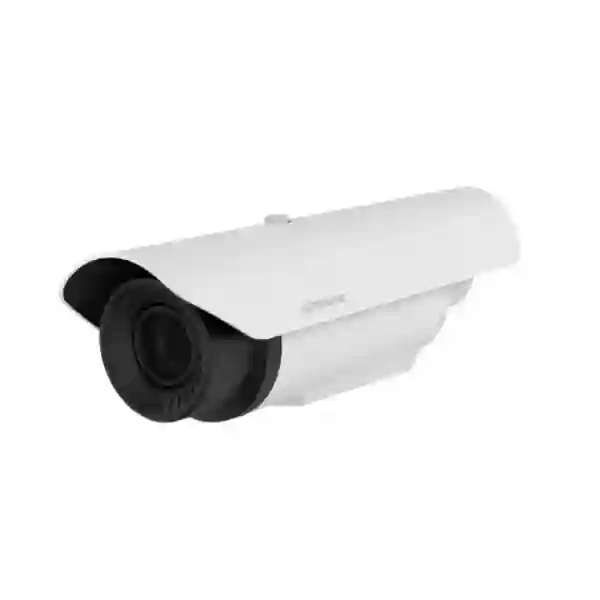
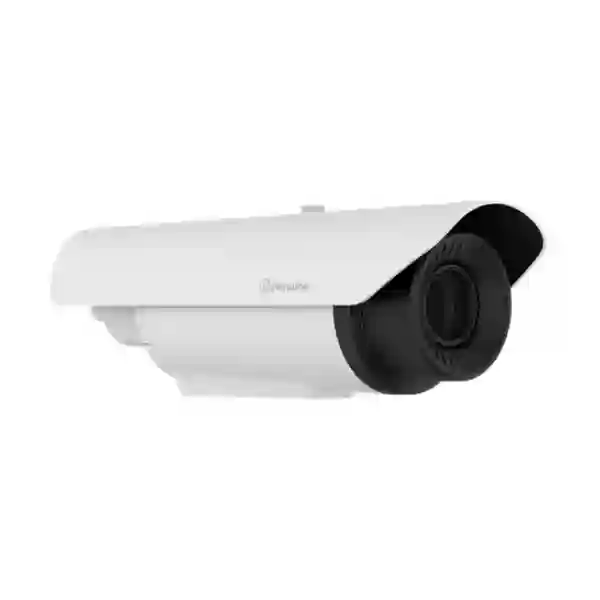
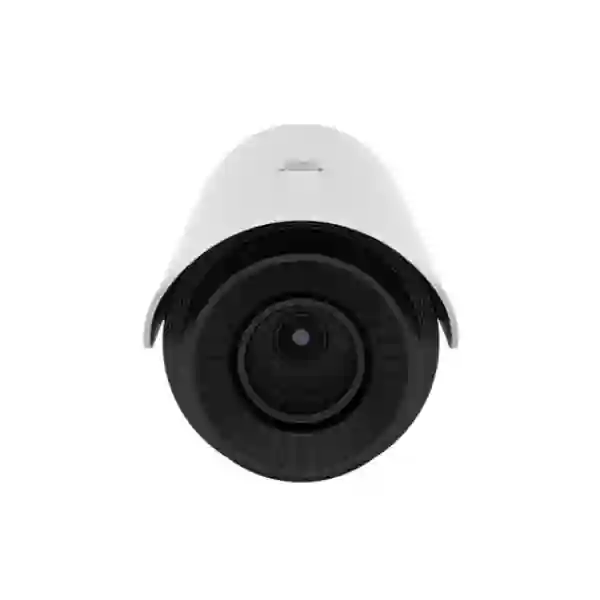
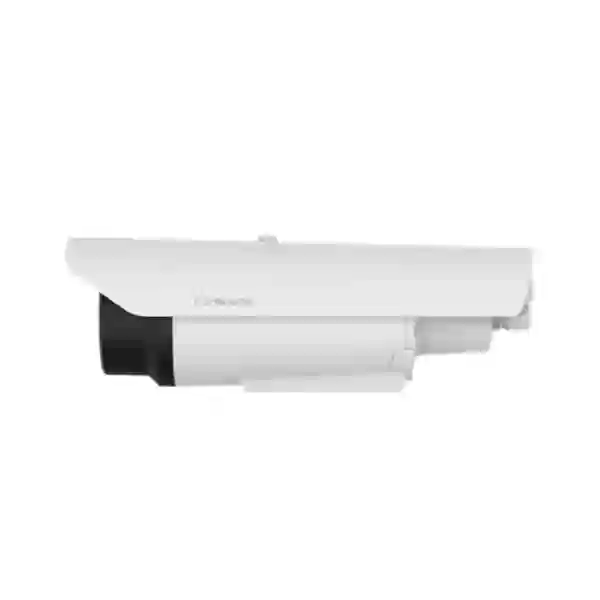
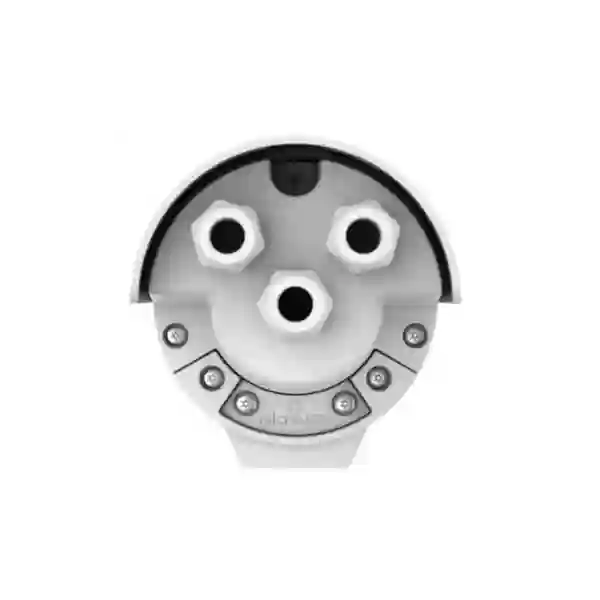
Hanwha TNO-4041T: 640 × 480 Thermal Camera with 19 mm Fixed Lens
See movement through thermal contrast when ordinary CCTV illumination is not the right tool. The TNO-4041T brings VGA thermal imaging, event analytics and IP video integration to carefully designed outdoor surveillance. It is intended for detection and situational awareness, not calibrated temperature measurement or optical identification.
Considering a perimeter, logistics yard or restricted approach? Start with the site dimensions, detection objective and recording platform, then request a configuration-based quotation.
At a glance
Important: detects temperature change; does not provide calibrated temperature readouts. No stock, price, local certification or installation coverage is implied.
Verified technical specifications
| Model / category | Hanwha Vision TNO-4041T / outdoor thermal IP camera |
|---|---|
| Sensor / spectral band | Uncooled microbolometer / 8–14 µm |
| Maximum resolution | 640 × 480 thermal pixels |
| Pixel size / NETD | 17 µm / ≤ 50 mK |
| Lens | 19 mm fixed / F1.0 |
| Field of view | H 32° / V 24.3° / D 39.2° |
| Minimum object distance | 11 m |
| Video encoding | H.265, H.264, MJPEG; up to 30/25 fps by video system |
| Network / interoperability | 10/100 Ethernet, RTSP, ONVIF Profiles S, G, T |
| Edge storage | 1 × microSD/SDHC/SDXC slot, up to 256 GB |
| Alarm interfaces | 1 input / 2 outputs |
| Power | 802.3af Class 3 PoE, 12 V DC or 24 V AC |
| Maximum published power | PoE 10 W / 12 V DC 9 W / 24 V AC 10.5 W |
| Outdoor ratings | IP66, NEMA 4X, IK10 |
| Operating conditions | -40°C to +60°C; 0–90% RH non-condensing |
| Size / weight | Approximately Ø102 × 309 mm / 2.45 kg |
| Temperature readings | No calibrated absolute object-temperature measurement |
Specifications are based on Hanwha Vision model documentation; confirm the intended firmware revision, exact supplied configuration and accessories before installation.
Who should consider this thermal camera?
The Hanwha Vision TNO-4041T is an outdoor thermal network camera intended for professional surveillance designs in which detecting a person, vehicle or other heat-contrasting object may matter more than collecting a conventional colour picture. Its 640 × 480 thermal sensor and 19 mm fixed lens make it a candidate for planned observation corridors, perimeter approaches and difficult low-light locations. Buyers should assess the scene, monitoring objective and integration environment rather than treating thermal equipment as a drop-in substitute for every visible-light CCTV camera.
The best starting point is a clear operational question. Do operators need early awareness of movement at a boundary, a visible alarm event in a video management system, or supplementary coverage where glare and darkness complicate conventional footage? This model is relevant to those questions. If the requirement is recognising faces, reading number plates, proving clothing colour or producing a calibrated temperature reading, a different imaging technology or a combination of cameras will be needed. Request a design review with the intended target dimensions, distances and mounting positions.
A quick specification-led buying decision
This camera uses an uncooled microbolometer with a maximum 640 × 480 image, a 17 micrometre pixel pitch and a 19 mm F1.0 lens. Hanwha lists an approximately 32° horizontal and 24.3° vertical field of view, alongside 39.2° diagonally. The 11 m minimum object distance is significant when an installation needs to inspect nearby objects. The sensor operates in the 8–14 micrometre spectral band, with a manufacturer-stated NETD of 50 mK or better. Those figures describe the instrument; they do not by themselves promise a particular human detection distance.
For networking, the product offers H.265, H.264 and MJPEG, a 10/100 Ethernet interface, multiple stream profiles and ONVIF Profiles S, G and T. For deployment, it supports IEEE 802.3af Class 3 PoE, 12 V DC and 24 V AC. Environmental designations include IP66, IK10 and NEMA 4X. Local recording can use one microSD-family card slot up to 256 GB. Together, these points help define a shortlist, but they still leave mounting, event behaviour, recording policy and software interoperability to the system designer.
Thermal imagery is different from ordinary CCTV
A conventional visible-light camera depends on light reflecting from a scene. A thermal camera instead captures differences in long-wave infrared energy associated with objects and their surroundings, displaying a contrast image that helps an operator locate activity. This can be useful after dark without relying on ordinary scene illumination. However, the result is not the same information as a colour photograph. A person may appear as a shape against a different-temperature background, while signs, badge details and surface colours remain unavailable.
Thermal contrast is also not constant. Heat from a sun-warmed wall, a newly cooled roof, damp ground or nearby equipment can alter the background. When a subject approaches the temperature of its environment, detection may become more demanding. The installer should validate the scene during relevant operating hours and seasonal conditions, especially where weather, water, reflective surfaces or dense vegetation may influence the picture. Operators benefit when thermal events are paired with an appropriate visible-light view for follow-up identification and incident review.
Understanding the 640 × 480 thermal sensor
The VGA-format detector gives this camera 640 horizontal by 480 vertical thermal samples. That resolution can improve scene interpretation compared with lower-resolution thermal options, but thermal pixels and colour-camera megapixels are not directly comparable. The viewed object must still occupy enough sensor pixels for the task. A person that is detectable as a small contrast shape might not supply the detail required for confident classification, and detection should never be described as positive personal identification.
Hanwha specifies 17 micrometre pixel size and NETD at or below 50 mK. NETD is a sensor sensitivity indicator measured in controlled conditions, not a guarantee of alert accuracy in a deployed site. Lens choice, image processing, environmental heat patterns, scene geometry and analytics configuration all affect the practical picture. Buyers comparing cameras should ask for realistic sample imagery or a site test covering their intended range and target size. Confirm whether the operational objective is simple detection, human-versus-vehicle recognition, or something that requires optical identification.
Why the 19 mm fixed lens matters
The integrated 19 mm focal length establishes a fixed field of view rather than an operator-controlled optical zoom. Hanwha specifies approximately 32° horizontally and 24.3° vertically. This is a useful middle-ground perspective for certain monitored approaches, but suitability depends on the width of the zone at the distance of interest. A long straight boundary, an access lane and a broad open yard may each call for a different lens and number of cameras. Do not assume one lens can cover all three equally well.
Ask the designer to draw the camera viewpoint and the expected width of the scene at near, middle and far distances. Mark entrances, blind spots, obstacles and the path a target is likely to take. Because focus is fixed and the manufacturer states a minimum object distance of 11 m, this is not the obvious first choice for close-up monitoring directly beneath a mounting point. Confirm any requirement for physical pan-and-tilt positioning separately: the camera can be considered for a compatible pan/tilt-head design, but it is not itself an integrated motorised PTZ camera.
Detection range needs an actual scene calculation
No responsible single-number range claim covers every site. The distance at which a thermal camera detects a human shape is different from the distance at which an operator can recognise an activity or distinguish a vehicle type. Target height and width, surrounding temperature, atmospheric conditions, pixel coverage and mounting angle all matter. Promotional distance figures sometimes assume ideal contrast and particular target definitions. A site with a hot roof or heavy vegetation may behave differently from a clear demonstration field.
For procurement, specify the smallest relevant target, the furthest required observation distance and the action expected from an alert. Decide what constitutes success: detection of movement, reliable categorisation, or a visual handover that enables a guard to verify the scene. Use manufacturer planning material as a starting estimate and verify assumptions through a field-of-view drawing, integration tests and, for critical coverage, a practical trial. A thermal camera cannot be expected to identify a person with the same detail as a suitably positioned visible-light camera.
A critical limitation: this is not a radiometric thermometer
The final letter of the TNO-4041T model is important. Hanwha differentiates its thermal-image T models from TR radiometric variants. The TNO-4041T provides thermal imagery and a temperature-change-detection analytic; it does not provide calibrated absolute temperature measurements of a person, machine or component. Its thermal colour palettes are visual presentation choices, not a readout of measured degrees Celsius. The distinction is essential for industrial buyers searching for temperature monitoring equipment.
For a project that needs a threshold such as a verified bearing temperature, an accurate transformer hot-spot reading or measured product temperature, investigate a specified radiometric device with the appropriate temperature range and accuracy. Even with radiometric hardware, measurement depends on emissivity, viewing angle, distance and environmental conditions. For this product, describe an alert as detection of a thermal change, not proof that an object reached a particular temperature. This avoids a potentially serious mismatch between the purchasing requirement and the installed system.
What temperature-change detection can do
Temperature-change detection may help signal that an observed region has altered thermally, depending on its configuration and environmental conditions. It can complement video surveillance when the purpose is noticing a change and prompting an operator to inspect the event. It is not a substitute for calibrated process instrumentation, electrical thermography or a certified fire-detection design. Any industrial safety function should be engineered using equipment and procedures appropriate to the hazard, with thermal surveillance treated as an auxiliary source of information where suitable.
A sensible commissioning exercise starts by identifying the region where change matters and the normal background variation over a working day. Test whether sun exposure, passing vehicles, exhaust, ventilation, reflections or routine equipment cycles create nuisance events. Establish a review procedure for alarms before connecting them to an operational response. If the desired outcome requires a numeric setpoint or documented measurement accuracy, stop at specification review: the TNO-4041T is not the correct substitute for a radiometric specification.
Video analytics beyond a basic motion alert
Hanwha lists motion detection, tampering, loitering, directional detection, virtual-line crossing, virtual-area intrusion, entering or leaving a zone, and appearance or disappearance event types. The camera also supports audio detection, sound classification and shock detection. These features give an integrator several ways to express operational rules beyond recording every movement. For example, a virtual line could define an approach across a boundary, while a loitering region could help operators prioritise persistent activity in a restricted area.
Analytics are only as useful as their setup. Camera movement, vegetation, machinery, animals, transient heat sources and overlapping traffic paths can create confusing events. Define each zone against an actual site plan; choose alarm priorities based on what staff can investigate; and measure nuisance alerts during commissioning. Avoid enabling every event type indiscriminately. Some audio functions require appropriate external microphones or connections, and software support must be checked for the relevant firmware and recording platform. The feature list describes available capabilities, not guaranteed performance for every deployment.
Design a meaningful alert and handover workflow
The manufacturer lists one alarm input and two alarm outputs, plus actions including notification, image upload, edge or NAS event recording and handover to a PTZ preset in a supported setup. That permits a system design in which a thermal event triggers more than a flashing icon. For a guarded site, an alarm could appear in the monitoring application with a camera identifier, time and zone name. An operator could then inspect related views, classify the incident and follow the organisation’s approved response procedure.
Plan the entire chain before buying: event generation, transmission, recording, notification, acknowledgement and reporting. Check each intended action against the actual VMS, NVR, network settings and firmware. A handover feature does not mean this fixed-lens camera has built-in pan-and-tilt motors or can drive any third-party head automatically. Alarm outputs also require correct interface design when connected to external devices. For safety, do not present a general CCTV alert as a certified emergency alarm or a guaranteed response service.
Where the TNO-4041T can fit a perimeter plan
Perimeter protection is a common reason to evaluate thermal surveillance. A camera can help an operator observe a monitored approach or detect movement where an optical scene would be poorly illuminated. The design should distinguish the legal or operational perimeter from the thermal scene. A fence corner, gateway, pedestrian route and vehicle track create different detection tasks, even if they appear close together on a site diagram. Choose the camera position so the relevant path remains visible instead of asking one fixed view to watch every direction.
Use overlapping coverage where a single camera would leave significant blind spots, and document how events are verified. Trees, vehicles, storage stacks, earthworks and newly built structures may obscure portions of the scene. The camera detects thermal contrast within its view; it does not see through walls or ordinary building materials. Place a complementary optical camera where faces, vehicle markings or contextual evidence are needed. Treat perimeter analytics as one layer in a broader plan involving lighting, barriers, procedures and an appropriately staffed response.
Industrial yards, warehouses and logistics areas
A warehouse compound or distribution yard may contain vehicles arriving after dark, large outdoor storage areas and gates with uneven lighting. Thermal surveillance can provide a separate view of motion in selected spaces, particularly where bright headlights and dark margins complicate ordinary image interpretation. A project may use a fixed thermal view to watch a route or boundary while a visible-light camera captures transaction details at the gate. The systems solve related but distinct problems, so the buyer should avoid asking thermal footage alone to identify number plates.
Operational planning should also account for routine forklifts, vehicles idling, personnel shift changes and areas with varying surface temperatures. Map the difference between normal movement and activity that should prompt intervention. At loading bays, determine whether the 11 m minimum object distance and 32° horizontal view make the chosen mounting point sensible. For taller warehouse structures, check bracket access, safe maintenance routes, cable protection and the possibility of future obstructions. Recording and privacy policies should reflect the site’s actual requirements.
Solar facilities, utilities and remote compounds
Open compounds with long lines of sight can be candidates for thermal observation, but openness should not be confused with guaranteed detection performance. Solar arrays, power distribution equipment, fencing and site roads may form a complicated geometry from any single camera mounting point. The TNO-4041T can be considered for awareness of selected routes or perimeter regions, subject to a scene assessment. Its temperature-change feature must not be described as calibrated inspection of panels, switchgear, cables or electrical connections.
For a remote location, design communication and power resilience before specifying the number of cameras. Calculate network capacity, consider how the recorder handles disconnection and decide whether microSD edge storage is useful as part of the recovery process. Check battery or UPS capacity against all connected equipment rather than the camera alone. Remote-site support also needs controlled access for firmware updates and a method for clearing environmental fouling. If operators need quantitative overheating diagnostics, specify separate radiometric and inspection equipment.
Commercial campuses and boundary crossings
On a campus or business property, thermal monitoring may be relevant to a narrow service corridor, boundary approach or restricted yard. Users often want an early indication of movement outside normal operating hours, not a constant stream of alarms from every pedestrian. The most useful scheme identifies particular crossings or areas that have an operational meaning. A thermal field of view can be aligned with those rules, while conventional cameras handle entry verification, identification and detailed evidence at doors or vehicle access points.
Governance matters as much as the camera. Establish who can see streams, which events are recorded, how long records are retained, and which staff have permission to export clips. Inform site personnel as required by applicable rules, and avoid adding microphones where there is no legitimate business purpose. The camera’s privacy masking and access controls can support a design, but policy and correct configuration determine actual privacy practice. Confirm the installation’s permitted scope with responsible local advisers rather than assuming that equipment features alone establish compliance.
Outdoor protection and environmental conditions
Hanwha specifies IP66, NEMA 4X and IK10 environmental or impact protection ratings for this model. IP66 concerns protection against dust ingress and powerful water jets under the rating’s conditions; IK10 addresses an impact-resistance test. Neither should be converted into a blanket assurance that the camera is immune to vandalism, flooding, lightning, chemical attack or poor installation. Mounts, glands, junctions and any peripheral enclosure have their own environmental suitability and may determine the resilience of the finished installation.
The manufacturer lists an operating temperature range of -40°C to +60°C and a non-condensing humidity condition. A project in Tanzania should still consider direct solar loading, exposed mounting steel, moisture, airborne dust and cleaning access at the actual site. Check any special hazardous-area or corrosive-atmosphere requirements separately. Where equipment is fixed high above ground, wind loading, safe working access and structural anchoring deserve professional review. The rating belongs to the camera as specified; it does not certify a complete installed system.
Power options and electrical planning
The camera accepts IEEE 802.3af Class 3 PoE, 12 V DC and 24 V AC. Hanwha lists maximum consumption of approximately 10 W on PoE, 9 W at 12 V DC and 10.5 W at 24 V AC, with lower typical figures under the manufacturer’s conditions. The presence of several inputs offers design flexibility, but the chosen supply, cable length, protection and installation method must be validated. Do not assume every nearby network switch has enough PoE capacity when many outdoor cameras share the same equipment.
Prepare a power budget for the complete installation, including any external microphones, heaters, switches, wireless links, recording hardware, pan/tilt accessories and backup systems. If power continuity is important, calculate autonomy against a realistic outage plan. Use appropriate surge protection and grounding designed for the location. Outdoor Ethernet and power runs should follow good workmanship and relevant electrical rules. Ask whether the selected PoE topology simplifies servicing or whether an existing low-voltage infrastructure changes the preferred design.
Networking, ONVIF and the existing VMS
A standard 10/100BASE-T Ethernet interface and published ONVIF Profiles S, G and T support make the TNO-4041T worth evaluating in an IP video system. Hanwha also lists RTSP and its SUNAPI interface among supported network methods. These are useful interoperability starting points, not a declaration that every analytics event or advanced function will be available in every VMS. Recording video may work while specialised event metadata or configuration controls require a supported integration or an additional license.
Before placing an order, confirm the exact recorder model, VMS version, firmware, codec settings, alarm mapping and retention architecture. Check whether the operator needs a live grid, alarm thumbnails, edge-storage retrieval, PTZ handover or centralised user management. Perform a camera-addition test in the intended software when possible. Assign addresses and permissions deliberately; keep camera management on controlled networks; and document the result for future service. A functioning preview is not the same as a fully validated alarm-and-recording workflow.
H.265, H.264, MJPEG and streaming profiles
The camera offers H.265, H.264 and MJPEG encoding, with a listed maximum of 30 frames per second at supported resolutions in a 60 Hz configuration, or 25 frames per second for the corresponding 50 Hz mode. Compression choice affects compatibility, bandwidth and stored-video requirements. H.265 may reduce data demands in a suitable workflow, but the actual result depends on motion, contrast, noise, encoder settings and the receiving platform. Do not calculate storage capacity from codec name alone.
An installation may use one stream profile for continuous recording and another for a monitoring wall or low-bandwidth remote viewing. Hanwha publishes multiple streaming support and WiseStream II capability; validate which profile combinations and controls are usable on the intended platform. Document resolution, frame rate, bitrate limits, image quality and retention requirements. Test footage during periods with movement and varying thermal contrast. Avoid unverified promises about days of storage, bandwidth savings or frame rate when the site has not supplied the necessary inputs.
Recording to microSD, NVR or NAS
The camera includes one slot supporting microSD, SDHC or SDXC media up to 256 GB, and Hanwha describes event-triggered recording to supported edge or network destinations. Edge storage can provide a useful element in a recording strategy, especially where a network connection may be disrupted. It does not guarantee that a clip will be preserved through every outage or card failure. Capacity, file system, endurance, recording mode and recovery process must all be specified rather than inferred from the slot’s advertised size.
For primary evidence retention, define the recorder and media architecture according to the organisation’s policy. Determine whether continuous video, event-only clips or a mixture is necessary. Review recording health, time synchronisation and clock accuracy; document who may export footage; and test retrieval after a simulated interruption. Use surveillance-grade storage where appropriate and monitor card errors as part of maintenance. Because thermal footage often needs an accompanying optical scene for identification, include the storage requirements of both camera types in the estimate.
Camera security and responsible administration
Hanwha documents security-related capabilities including HTTPS, network authentication and user access controls. These are starting points for a secure deployment, but they do not remove the need for a site-specific cyber plan. Place camera administration behind appropriate network segmentation, use strong unique credentials, restrict management access and retain configuration documentation securely. Avoid publishing camera interfaces directly to the internet simply to make remote viewing easier. Use an authorised VPN or approved remote-access design where access from outside is necessary.
Create an owner for updates, incident review and credential recovery. The support portal warns that bridge firmware may be required when upgrading early 1.00–1.2X firmware releases; follow the manufacturer’s exact upgrade sequence rather than skipping directly to a newer file. Schedule maintenance windows, preserve configuration backups as supported and verify functionality after changes. A proposal should identify who will manage the recorder, switch, camera and remote link. Security is an operating responsibility, not a one-time checkbox attached to the original installation.
Physical mounting and the field of view
Plan the mount around the observed scene rather than the easiest available wall. Draw a line from the lens through the intended detection region and check clearance for roofs, cable trays, branches, stored materials and parked equipment. The camera measures about 102 mm in diameter by 309 mm long and weighs approximately 2.45 kg according to the current manufacturer specification. A suitable support assembly should account for its weight, environmental loading and cable routing, with any additional pan/tilt hardware assessed separately.
Before final fixing, stand at the proposed location and confirm the actual ground-level scene. A mounting position that looks ideal on a drawing may place the crossing line behind a fence, under the near-field limit or outside a useful angle. Reserve maintenance clearance and ensure no cable connector is left exposed contrary to its enclosure rating. Document direction, mounting height, zone names and the nearest service point. Commissioning photographs and a recorded reference image help future technicians notice when landscaping or site changes compromise coverage.
Commissioning analytics without excessive nuisance events
A practical acceptance test should exercise every event that matters. For a perimeter project, that might mean a person crossing a virtual line in each intended direction, authorised traffic passing a nearby route and a stationary subject remaining in an area. Test ordinary backgrounds as well as the conditions most likely to confuse the system. Record what happened, which notification was received, whether the clip was stored and how long an operator required to understand the scene. This is more useful than confirming only that an event menu exists.
Tune regions and sensitivity in stages. Avoid defining analytics over moving foliage, busy roads or regularly heated machinery unless those objects are part of the operational purpose. Determine an escalation threshold that staff can sustain, and revisit settings after alterations to fencing or landscaping. If the camera is mounted to a moving platform, verify the supported analytics behaviour for that specific configuration rather than assuming stationary-camera rules translate directly. Keep a versioned record of settings so later maintenance can restore a known baseline.
Night surveillance: expectations and limitations
Thermal imaging can help a surveillance system observe temperature contrast without depending on scene lighting in the way a visible-light sensor does. This is one reason to evaluate the TNO-4041T for after-hours security. It should not be marketed as infallible in complete darkness or as a replacement for every night camera. Background conditions, target size, obstructions, lens framing and actual image contrast remain decisive. Some scenes become challenging when large objects and their surroundings settle to similar temperatures.
For sites that require legally useful incident evidence, consider the roles of different cameras. Thermal video can help locate activity; a correctly sited optical camera may be needed for facial, clothing, vehicle or contextual details. Operators should know which view answers which question. Lighting may still be necessary for safe physical response, even where thermal imagery supports remote observation. Test both night-time viewing and incident workflow on the real site, including the path between the camera alarm and the person responsible for action.
Weather, heat and scene changes in Tanzania
For buyers planning surveillance in Tanzania, specification review should include the local installation environment rather than assuming all open-air locations behave alike. Coastal exposure, an industrial yard, an inland commercial compound and a remote utility site can have very different combinations of airborne dust, rain, sun, humidity, vibration and service accessibility. The published operating conditions are important, but so are mounting choices, enclosures, surge arrangements and the effect of thermal backgrounds on analytics.
Do not infer that the product is in stock locally, has a particular regional approval or includes installation in every city. Those commercial and regulatory details must be confirmed for the actual procurement. Discuss the proposed location, network architecture, security policy and power resilience with the project team. Select an evidence-based camera layout and ask for a quote that identifies equipment, accessories, commissioning scope and service responsibilities. This approach gives buyers a clearer basis for comparing compliant offers without invented prices or timelines.
Privacy, recording policy and operational governance
Thermal imagery may contain less visible identifying detail than an optical close-up, but a surveillance system still requires appropriate governance. Establish the operational purpose, who can view streams, what alarms should be retained and when footage should be deleted. Review local legal obligations with qualified advisers for the specific site. Avoid assuming that a thermal sensor is automatically exempt from privacy requirements or that a manufacturer’s technical feature confers a particular legal permission to record people.
Use the camera’s access controls, audit capabilities and privacy-masking features as part of a documented system. Consider how external microphones, if used, change the privacy and consent assessment. Train operators on permissible use, evidence preservation, escalation and the limits of thermal interpretation. Keep administrator access separate from routine monitoring roles. During procurement, ask the integrator to demonstrate account management, time synchronisation, clip export and retention settings. Technology should support the policy the organisation has chosen, not silently determine it.
Compare thermal and visible-light cameras by task
A conventional colour IP camera may offer higher apparent scene detail under suitable illumination, while a thermal camera reveals a different set of contrasts. The right question is not which technology is universally superior, but what a security operator needs to know at each location. At an entrance, optical detail and lighting can be critical. Along a darker approach, a thermal view may make movement easier to notice. At a crowded loading bay, both forms of information may be necessary to understand an alert.
Prepare a task-by-task matrix before deciding equipment quantities. List movement detection, person-versus-vehicle assessment, identification, number-plate capture, evidence quality, day-and-night operation and recording costs separately. Thermal cannot reproduce visible colours or text details, and a standard optical camera cannot become a thermal imager simply through infrared illumination. Combining devices may be worthwhile, but it adds network, storage, mounting and maintenance considerations. A well-designed system assigns each sensor a purpose that its technology can credibly serve.
TNO-4041T versus a TR radiometric variant
Model suffixes help avoid a particularly expensive procurement error. The TNO-4041T is a thermal image camera with temperature-change detection. Hanwha’s TR-designated products are the family to investigate when numerical object-temperature measurement is needed, subject to the specific model’s temperature range and accuracy specification. Similar-looking housings or related focal lengths should not be treated as interchangeable evidence of radiometric performance. Require the exact model code on quotations and technical approval documents.
If the aim is detecting someone moving along a boundary, ordinary thermal imagery and appropriate analytics may be the deciding factors. If the aim is recording a verified component temperature or alarming at a stated absolute value, a radiometric requirement needs to be established before selection. A TR alternative is not automatically the right choice without studying the actual sensor, lens, accuracy and environmental conditions. Document the difference in the project brief and confirm the proposed model against official datasheets before procurement.
How to compare alternative lenses and viewpoints
The TNO-4041T is a 19 mm model; other thermal options may have wider or narrower fields of view. A wide view can cover more of a nearby area but distribute thermal pixels over a larger scene. A narrower view may put more pixels on a distant target while increasing the risk of blind spaces. That trade-off is why a lens cannot be selected from distance alone. Examine both the closest critical crossing and the furthest required observation point.
A simple design exercise helps: draw the boundaries of the zone, nominate the smallest object of interest, show obstacles and assign the operator’s intended action. Compare camera placement proposals on the same criteria. Where a seller provides a theoretical detection distance, ask for the assumptions behind that figure and for an acceptance method. The appropriate choice may be a different focal length, several fixed views or an integrated positioning system. Treat the TNO-4041T as one defined option within that engineering decision.
Budget for the complete surveillance system
The camera price is only one part of the project cost. Include suitable mounting hardware, brackets or pan/tilt accessories if required, outdoor network cabling, power and surge arrangements, switching, recording capacity, licenses and the labour needed to commission useful analytics. Remote sites can add communications equipment and backup power. A design that omits these elements may look attractive in an itemised camera comparison but become expensive when the missing integration work is discovered.
Ask suppliers to distinguish equipment supply from site survey, installation, configuration, acceptance testing, training and ongoing support. Confirm whether an optional storage card is included rather than assuming it is. If an integration depends on a particular VMS plug-in or license, make that dependency explicit. No price, delivery time, warranty term or installation coverage is stated here because such terms require a verified offer for the actual Tanzanian listing. A clear bill of materials and testing scope will support meaningful commercial comparison.
Checklist for a technical enquiry
A useful enquiry identifies the location, proposed camera quantity, mounting heights, site plan, expected target types, nearest and furthest relevant distances, lighting conditions and main purpose of monitoring. Explain whether the camera should work alone or with existing visible-light CCTV. Include the recording platform, software version, network topology, preferred power method and target retention period. State whether the security team requires alarms from a virtual line, intrusion zone, unusual temperature change or another specific event.
Also identify environmental issues such as exposed roofs, regular dust, nearby hot machinery, high wind loading or places where service access is difficult. Share photos or an annotated plan through an agreed secure channel if available. Ask the reviewer to confirm exact model fit, lens coverage, VMS compatibility, mounting accessories and any tests needed before purchase. The output should be a proposal that can be measured at commissioning, not a generic recommendation based only on a brand name.
Acceptance criteria to agree before installation
Define an observable outcome for each camera position before the equipment arrives. Instead of writing only ‘thermal monitoring required’, specify the monitored route, the type of motion that matters, the expected operating periods and the destination of an alert. Require evidence that the selected view includes the intended zone, that the recorder receives the agreed stream and that the operator can retrieve the corresponding clip. A project involving response staff should test the complete alert journey under controlled conditions.
Include a record of blind spots and limitations that the customer accepts, particularly for near-field objects, obstructed views and unverified recognition distances. Review the installation’s security settings, user accounts, time source and firmware maintenance procedure. Train operators in thermal imagery interpretation and in the need for optical confirmation when identity is important. A documented acceptance record makes it easier to distinguish product faults from scene changes, configuration errors and requirements that the camera was never designed to fulfil.
Maintenance and ongoing operating checks
After handover, schedule checks for image clarity, stable mounting, recording continuity, event accuracy and safe access to equipment. Clean the housing and viewing window only by methods authorised in the product documentation. Look for damaged cable glands, moisture ingress at associated junctions, new obstructions or changes in the thermal environment. Verify that the time displayed by the camera and recorder remains consistent, especially when recorded clips may be needed for investigation.
Periodically review whether analytics zones still correspond to the real site. Expansion work, landscaping, parked machinery or different shift patterns can reduce the value of a once-effective view. Monitor storage health and retain a controlled configuration backup where supported. Check firmware information using Hanwha’s documented process and avoid improvised upgrades to older revisions. Decide who owns preventive maintenance and who responds when the camera, recorder or remote link goes offline; the equipment itself cannot guarantee a complete service process.
When another solution is more suitable
Choose another design if the essential requirement is a calibrated temperature measurement, face identification, colour evidence or reliable number-plate recognition. The TNO-4041T does not become radiometric through software settings, and thermal pixels cannot recreate missing optical details. Also reconsider this fixed 19 mm view if a critical object is too close, beyond an acceptable pixel coverage, or hidden behind physical obstructions. Product specifications should inform an engineering fit decision, not override the realities of the site.
A buyer may need a dedicated radiometric thermal unit, a visible-light PTZ camera, a different thermal focal length, specialised industrial sensors or a combined deployment. Each option brings its own limitations and costs. Identify the requirement that drives the decision, then ask for an apples-to-apples comparison using the same scene and acceptance conditions. Where detection performance or regulatory suitability is safety-critical, use qualified specialist review and relevant approvals rather than promotional claims about camera capability.
Request a configuration-based quotation
When asking about the Hanwha TNO-4041T in Tanzania, provide the intended use case and a short description of the site. The decision should cover the 19 mm field of view, required event workflow, integration with existing network video equipment, mounting arrangements and power supply. Buyers should request confirmation of current availability, quoted inclusions, commercial terms and any applicable local requirements directly through an authorised purchasing process rather than relying on an assumed stock statement.
For an efficient review, include one annotated layout, the expected critical distance, the VMS or NVR model and the reason thermal monitoring is being considered. Clearly distinguish detection of thermal movement from numeric temperature measurement. Ask the supplier to specify any optional accessories and whether site testing is recommended. This produces a practical basis for deciding whether the camera belongs in the design, what supporting equipment is needed and what a successful commissioning result would look like.
Frequently asked questions about the Hanwha TNO-4041T
These answers separate published hardware capability from decisions that depend on a specific installation, software stack or purchasing agreement.
Can the TNO-4041T measure a person’s or machine’s temperature?
No. It is a thermal-image camera with temperature-change detection, not a radiometric model that reports calibrated absolute object temperatures. Buyers needing a temperature value or threshold should evaluate a model specifically documented for radiometric measurement and its accuracy requirements.
Does it work in darkness without ordinary lighting?
It images thermal contrast, so it does not depend on visible scene lighting the way a conventional colour camera does. Real-world usefulness still depends on target contrast, obstacles, scene geometry and weather. It cannot promise an equally clear or reliable detection result in every night-time environment.
What resolution and lens does it use?
The manufacturer specifies a maximum thermal resolution of 640 × 480 with a 19 mm fixed F1.0 lens. The view is approximately 32° horizontally and 24.3° vertically. Whether that view covers a particular distance or boundary requires a site-specific assessment.
Is the camera an integrated pan-tilt-zoom unit?
No. This is a fixed-lens thermal camera. Hanwha describes its suitability for integration with a pan/tilt head in an appropriate system, which is different from having a built-in motorised PTZ mechanism. Any movement accessory and control integration must be separately specified.
Can a thermal picture identify a face or read a number plate?
Thermal footage is not designed to reproduce the visible colour and fine surface detail needed for those tasks. If positive identification or plate reading is required, use a purpose-selected optical camera and appropriate lighting, positioning and recording settings in addition to thermal observation where justified.
Which power supplies are supported?
The official specifications list IEEE 802.3af Class 3 PoE, 12 V DC and 24 V AC. Power budgets must include the selected source, cabling, protection, external accessories and any backup system. A separate motorised mounting assembly would have its own requirements.
How much microSD storage can it take?
Hanwha specifies one microSD, SDHC or SDXC slot supporting a maximum of 256 GB. Actual recording duration depends on stream configuration, recording policy and scene conditions. Storage media, endurance and recovery behaviour should be checked for the intended installation.
Does it work with ONVIF video systems?
Hanwha publishes ONVIF Profiles S, G and T, plus standard IP video protocols. However, actual compatibility with a particular recorder or VMS, especially for analytics events and edge-recording retrieval, should be tested against the exact software and firmware combination.
What weather and impact ratings are specified?
The camera is specified with IP66, NEMA 4X and IK10 designations and an operating temperature range of -40°C to +60°C. These figures describe the model under specified conditions; brackets, connectors, surge protection and installed cablework must also suit the environment.
Can it detect intrusions or line crossings?
The published analytics include virtual lines, direction, intrusion or virtual-area events, loitering and other motion-related features. Successful operation depends on scene layout and configuration. A buyer should require an acceptance test with intended targets and normal nuisance activity.
Is an internal microphone included?
The published interface specification describes audio input and output connections, not an assurance that every installation includes an onboard microphone. Confirm external audio accessories, VMS support and the site’s privacy requirements before treating audio detection or two-way communication as an installed capability.
What should I provide for a Tanzania quote?
Share the use case, site plan, expected target sizes and distances, existing recording platform, mounting positions, power and network availability, and the required alarm response. Request confirmation of availability, accessories, service scope and commercial terms for the actual offer; none are assumed by this description.
Request a TNO-4041T surveillance design review
Describe the required scene, detection distances, installation environment, power method, video management system and expected alarm response. Request an exact-model quotation that identifies accessories and integration scope. Confirm Tanzania-specific availability and commercial terms directly before ordering.
Next step: Contact FourTeck Tanzania through your established enquiry channel and share a brief site plan or requirements summary. No unverified product or contact link has been inserted.




Reviews
There are no reviews yet.