
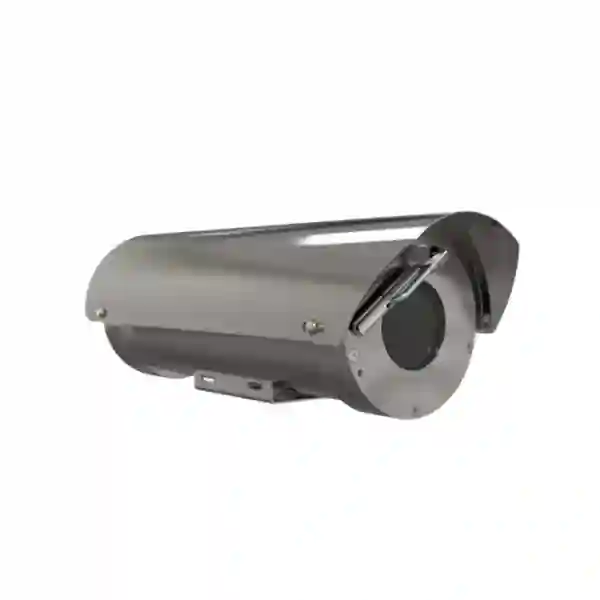
Hanwha TNO-6070E2FW-Z: explosion-proof fixed video for carefully engineered locations
Choose a specialist camera by the job it must perform and the hazardous-area documentation it must satisfy. This model pairs Full HD network video, a configurable 2.8–9 mm lens, a wiper and fibre connectivity in an explosion-proof fixed-camera design. The correct installation requires a verified classification match, compatible 110 V AC power, approved accessories and a workable video-recording plan.
Verified headline specifications
Figures are manufacturer-listed headline capabilities. Confirm exact settings, approvals, accessories and current technical documentation for the supplied model before procurement or installation.
At-a-glance technical reference
| Product type | Explosion-proof fixed network camera |
|---|---|
| Exact model | TNO-6070E2FW-Z |
| Video resolution | 2MP / 1920 × 1080 |
| Maximum listed frame rate | Up to 60 fps at Full HD |
| Lens | 2.8–9 mm varifocal |
| WDR | 120 dB at 30 fps, 2MP |
| Image assistance | True day/night, enhanced DIS, defog |
| Connectivity / cleaning | Fibre, wiper |
| Local media | SD/SDHC/SDXC memory slot |
| Power | 110 V AC; site-specific supply design required |
Who this industrial camera is for
Sites that handle flammable gases, vapours or combustible dust need to treat surveillance equipment as part of their hazardous-area engineering design. The Hanwha TNO-6070E2FW-Z is built around an explosion-proof fixed-camera concept rather than an ordinary commercial CCTV enclosure. It suits buyers exploring video coverage of a defined industrial scene where the area classification and device documentation support its use. Typical planning contexts include processing facilities, fuel-handling infrastructure, selected manufacturing operations and other locations assessed by a competent safety team. None of these examples means a particular installation is automatically approved; the site-specific classification comes first.
A buyer should begin with the observation task, not just a camera model number. Is the goal to see a gate, inspect a transfer point, watch a fixed conveyor section or support remote operational awareness? Identify what an operator must be able to recognise, how wide the scene is, where the camera can be safely mounted and what may obstruct the view. This model offers a varifocal lens for setup, but it remains a fixed viewpoint after installation. If operators need to turn the camera continuously or zoom across distant targets, a correctly classified PTZ solution may be a better fit.
What explosion-proof means in practice
The phrase explosion-proof should never be interpreted as a guarantee that a camera prevents every fire or explosion. In hazardous-location engineering, an explosion-protected design uses a specified protection method, enclosure and installation conditions to manage ignition risk. The correct safety decision depends on gas or dust grouping, temperature class, zone or division designation, ambient conditions, certification markings and the complete installation. A product description cannot replace a hazardous-area assessment or the actual certificate and installation instructions for the precise unit supplied.
Ask the project engineer to compare the site classification document with the model’s full marking and supporting certificate. Confirm whether the installation involves gas, vapour, dust or a mixture; whether an elevated ambient temperature affects the rating; and which wiring method, glands and seals are required. Also verify whether the enclosure, accessories and electrical connections preserve the required protection concept. A successful match on resolution or weather resistance does not establish hazardous-area suitability. Procurement should retain the exact certificate, drawing and serialised equipment information alongside the approved design.
Full HD video and when 60 fps matters
Hanwha lists 1920 × 1080 Full HD imaging and a maximum of 60 frames per second for this model. That combination can be useful for reviewing movement around a monitored industrial location because it offers more temporal samples than common low-frame-rate configurations. However, frame rate is only one element of usable evidence: scene illumination, exposure time, lens setting, mounting stability, compression, recording bit rate and operator viewing conditions all influence the result. A fast-moving object can still appear blurred when exposure is too long, even if the stream is nominally configured at 60 fps.
Specify the operational reason for each stream setting. A live control-room view may benefit from fluid motion, while a long-retention archive may prioritise manageable storage demand. Run a real scene trial at representative operating hours and check whether staff can see the relevant event without over-relying on digital enlargement. The camera’s wide-dynamic-range feature is specified as 120 dB at 30 fps in Full HD, so a design that requires both a particular WDR mode and maximum frame rate must validate the available combined configuration rather than assuming every advertised peak operates simultaneously.
Varifocal 2.8–9 mm lens: framing the task
The specified 2.8–9 mm lens lets an installer choose a wider or tighter framing during setup. The wider end helps capture more surroundings, while the longer end narrows attention to a smaller area. This flexibility is useful when mounting positions are dictated by hazardous-area engineering, structural steel, maintenance access or safe cable routes. The lens is not a substitute for an optical PTZ zoom system. Once the camera is aimed and framed, its job is generally to watch a fixed zone rather than sweep across several distant assets.
For a credible design, put actual target dimensions on a drawing and estimate the required scene width at the proposed camera distance. Consider whether you need only situational awareness or sufficient detail for a defined identification task. Check for bright reflections from tanks, complex pipework, equipment vibration and traffic passing close to the camera. Always review the final image from the planned mounting height. A lens selected solely from a catalogue angle may perform poorly when operators discover that the important valve, loading arm or doorway occupies too few pixels.
Changing light, shadows and glare
Industrial scenes often include doors that open into daylight, reflective metal, headlights, illuminated control indicators and shaded machinery. Hanwha identifies true day/night operation using an IR-cut filter, plus wide dynamic range for the TNO-6070E2FW-Z. These functions are valuable when part of a frame is bright while another part is dark, but they do not eliminate every lighting problem. WDR can involve compromises in motion rendition or exposure, and day/night switching still depends on the available scene illumination.
A commissioning test should include the hours when the site actually operates. Check the camera looking toward sunrise or sunset, around bright exterior luminaires and during night operations. Determine whether supplemental lighting is needed and, if so, whether the light itself must be specified for the hazardous location. Do not infer that this fixed camera includes an infrared illuminator merely because it has a day/night mode. Review both the colour and monochrome images and document the settings that deliver the most useful operational view.
Rain, moisture, dust and the integrated wiper
Outdoor industrial cameras face rain droplets, airborne dirt, salt contamination, process residue and routine washing. Hanwha identifies a wiper on the exact model, an important practical detail when the front window may become wet. The family technical literature also describes a substantial stainless-steel housing and weather-ingress protection. The wiper helps maintain a clearer viewing window, but it cannot remove every deposit or replace inspection and cleaning. Chemical films, hardened dust, scratched glass and damaged blades can still compromise the picture.
Define a realistic maintenance plan with the site’s safety and operations teams. Ask how operators will know that the wiper needs attention, whether any compatible washer system is part of the proposed package and which cleaning method the manufacturer permits. Keep access arrangements safe for elevated or classified areas. Confirm the actual unit’s environmental markings and any cleaning-chemical restrictions instead of using an IP number as a blanket statement about corrosion or continuous immersion. Water resistance and hazardous-area certification address different risks and both must be assessed.
Fibre connectivity and network architecture
The manufacturer lists fibre connectivity for this model, and the TNO-6070E2F family documentation describes a built-in single-mode fibre module. That can be valuable in a large industrial facility where the video backbone is designed around fibre rather than long copper links. The installation still requires a properly engineered cable route, compatible optical interfaces, end-to-end link budget and permitted glands or termination arrangements. Fibre in a camera brochure does not guarantee that existing switches, transceivers or connectors will interoperate without examination.
Map the entire path from camera to the recording location. Include pathway length, fibre type, connector condition, termination enclosure, patching, redundancy requirements and the presence of any hazardous-area boundary. Ask who owns the network, which VLAN or security controls apply and what monitoring is available for a lost link. A network plan should address failure behaviour as well as normal operation. When users expect continuous video, clarify how lost connectivity is reported, whether recordings are buffered locally and how any footage is retrieved after restoration.
110 V AC power deserves a design check
Hanwha states 110 V AC for the exact TNO-6070E2FW-Z listing. This is a critical procurement specification, not a minor accessory detail. The camera should not be connected directly to a different supply voltage merely because a site uses standard building mains. The electrical design must provide the required input using properly selected, protected and installed equipment. If conversion or an isolated supply is necessary, its suitability for the installation and location must be evaluated by qualified electrical personnel.
Before ordering, obtain the current wiring and power-consumption documentation for the exact variant. Confirm allowable input tolerance, protective devices, earthing and bonding, cable-entry requirements, isolation method and commissioning test procedure. Account for start-up behaviour and any wiper-related load. Where a control room expects surveillance during grid interruptions, design the upstream supply and recording equipment as one resilient system. The camera’s existence in the catalogue does not mean a power supply, transformer or backup arrangement is included in the delivered package.
Protecting the image without promising perfect visibility
The manufacturer names digital image stabilisation and defog functions. Image stabilisation may help manage some vibration-related movement, while defog processing can improve perceived contrast under certain low-contrast conditions. Neither function can recreate information that the lens never captured. Heavy occlusion, an entirely obscured window, severe shaking and inadequate light remain engineering problems. For safety-critical observation, it is particularly important not to treat digital enhancements as guarantees that an operator can recognise every event.
Check mounting rigidity first, then adjust the image-processing settings. Industrial structures may vibrate when pumps start, cranes move or nearby equipment operates. Capture test clips under the conditions most likely to challenge the scene. Evaluate the result on the actual control-room display at the intended viewing size, not only on a technician’s laptop. The right acceptance test is whether the camera provides the specific visual information the operating procedure needs, with a clear response plan for low-quality or missing video.
Local recording and evidence retention
The exact product page lists a built-in SD/SDHC/SDXC memory slot. Such a slot can support a recording architecture that uses local media alongside central network storage, subject to supported card type, capacity, firmware and configuration. It does not by itself prove that every card size is accepted, that the camera offers unlimited recording or that footage is protected from physical damage. Industrial environments also introduce practical considerations such as maintenance access, temperature, media endurance and controlled handling of recorded evidence.
Decide early whether video is used primarily for live oversight, incident reconstruction, audit support or several purposes. Estimate storage from frame rate, codec, resolution, scene complexity, operating schedule and retention period; validate the estimate with representative recordings. Define who can retrieve video, how timestamps are synchronised, when footage may be exported and who approves access. Where recording is part of a wider incident-response procedure, test retrieval before a real incident occurs. A local card is best treated as one component in an overall evidence-handling design.
Compatibility with a wider VMS or NVR
The TNO-6070E2F family material references network video protocols including ONVIF Profile S, while the exact model is sold as a network camera. For buyers, the practical question is whether the selected video management system or network video recorder supports the required functions on the intended firmware. Basic live view may be possible while events, recording controls, wiper operation or advanced settings require additional integration. Do not assume that a shared protocol label automatically covers every specialist feature.
Before purchasing, ask the integrator for a compatibility check tied to the VMS version, camera firmware and desired function list. Test live view, recording, user permissions, time synchronisation, event handling, reconnection and playback. A site with existing Hanwha equipment may still need to confirm support for an older or specialist hazardous-area camera. If the design calls for a third-party VMS, use its supported-device resources and a controlled proof of concept. Document the results so operators know which controls are available centrally and which require direct camera administration.
Cybersecurity and operational technology boundaries
A networked industrial camera belongs in a managed security architecture rather than on an unrestricted general-purpose network. The device may be close to process equipment but should not automatically receive access to control-system traffic. The site should assign ownership for its configuration, accounts, software updates, event logs and incident response. Network segmentation and strong authentication should be selected to fit the organisation’s security policy and operational requirements. Avoid publishing camera administration interfaces broadly or retaining default access credentials.
Before acceptance, confirm what firmware and lifecycle guidance is currently available for the exact device. Check password policy, encrypted management options, permitted services and the method for updating without disrupting operations. Plan the maintenance window with operational teams, especially where physical access to a hazardous location is difficult. If a particular security function is mandatory, verify it on the actual firmware rather than assuming that every Hanwha product generation supports identical controls. A resilient recording network also needs controlled backups, alerting and documented recovery steps.
Hazardous-area certifications and the model suffix
The precise suffix matters because similar TNO-6070 camera listings may differ in connection type, power input, wiper provision or regional certification scheme. The user-requested model is TNO-6070E2FW-Z, not a visually similar TNO-6070E1W or another E2F variant. Historical family documentation associates letter suffixes with different approval configurations, but a procurement decision should rely on the current certificate, model marking and order confirmation supplied for the exact unit. Do not substitute a reseller’s generic family statement for the formal safety documents.
For a Tanzania project, ask the responsible hazardous-area specialist which standards and approval evidence the facility requires. Compare that requirement with the certificate scope, ambient range, gas or dust classification, temperature class and installation conditions. Confirm the status of any certification for the offered serialised equipment and accessories. The listing does not assert that the camera is independently approved by a Tanzanian regulator or suitable for every local classified area. The correct next step is a documented engineering assessment, especially where the project specification cites an exact certification standard.
Mounting location and structural support
Hazardous-area cameras often have housings substantially larger and heavier than conventional office or retail cameras. Historical family specifications for the TNO-6070E2F series describe a unit weighing up to approximately 21 kg, so the mounting concept should be checked against the actual supplied configuration. Structural adequacy involves bracket selection, fastener capacity, corrosion exposure, wind and vibration, cable weight and safe maintenance reach. A camera can have the right electrical rating and still be installed poorly if the support structure is unsuitable.
Ask for the correct dimensional drawing and approved mounting accessories before the steelwork is finalised. Review line of sight against pipe racks, handrails, new equipment and moving vehicles. Account for routine cleaning and safe access to the window or wiper. Where the camera is on a pole or existing structure, obtain the appropriate load and deflection assessment. Any support or accessory entering a classified space must also satisfy the project design requirements. Do not infer that a bracket or pole adapter is supplied with the camera unless the quotation expressly includes it.
Cable glands, sealing and installation detail
In explosion-protected installations, cable routing and termination details can be as important as camera selection. The family literature depicts multiple cable entries, but the exact cable plan must be developed from the current drawing and approved instructions. The correct gland, stopping plug, seal, conduit method, cable construction and bonding arrangements depend on the protection concept and the site’s engineering standards. A general-purpose cable gland or an improvised entry modification may invalidate the intended safety arrangement.
Prepare a cable schedule showing each power and data run, entry location, protection method, termination point and maintenance isolation requirement. Confirm that a fibre connection can be made safely using the permitted route and enclosure arrangement. Installation should be performed by personnel competent in the relevant hazardous-area method and inspected under the site’s rules. Document the completed work with inspection records, as-built drawings and the actual equipment markings. This disciplined process reduces the risk of buying a suitable camera but installing it in a way that defeats its protection design.
Tanzania project planning without assumptions
Industrial sites in Tanzania can differ greatly in weather exposure, operating schedule, available electrical infrastructure, hazardous-area classification and internal technical resources. A coastal facility may need a corrosion-management plan, while an inland plant may place greater emphasis on dust control or remote maintenance. These are planning examples, not claims about a specific city, client or service area. The procurement brief should describe actual environmental conditions and the camera position rather than relying on broad geographic labels.
Also check local sourcing and project logistics before fixing the installation schedule. Verify exact-model availability, appropriate accessories, import documentation where relevant, installer competence and the method for obtaining after-sales support. No local price, stock status, delivery promise, warranty arrangement or installation coverage is asserted here. A purchase order should clearly distinguish the camera itself from optional mounts, compatible power equipment, network termination, commissioning labour and site-required inspection. The goal is a fully specified surveillance point, not merely a box containing a camera.
Where this fixed view can add practical value
A permanently framed industrial video point can help an operator watch a loading connection, a guarded access route, a process interface or an isolated asset from a central position. Choose locations where the image can help staff understand operational conditions while respecting established safety procedures. The camera is not a replacement for gas detection, fire detection, process instruments, interlocks, physical guarding or personnel in the field. Video should inform decisions within a defined workflow; it must not be presented as an independent safety function without specific supporting assessment.
For example, an operator monitoring a transfer bay might want to see whether vehicles are correctly positioned and whether the visible area is clear. A maintenance planner may want a general view of a remote enclosure to decide whether an inspection visit is needed. In each case the required level of detail, illumination, retention and uptime will differ. Write a one-sentence observation objective for each proposed camera before finalising the bill of materials. This prevents a technically impressive specification from being attached to a view that does not answer the site team’s actual question.
How to compare it with standard CCTV and PTZ
The first comparison is not a competition over megapixels; it is whether the camera type matches the risk classification. Conventional IP cameras can be appropriate in unclassified areas, where simpler housing and easier servicing may reduce cost and complexity. An explosion-protected camera should be considered where the assessed location requires a suitable protection method. Once the safety criteria are established, compare lens coverage, cleaning requirements, connectivity, power, recording and maintainability. A hazardous-area enclosure cannot compensate for the wrong field of view, and a higher-resolution standard camera cannot compensate for unsuitable certification.
Compare fixed and PTZ designs separately. This model provides a stable view of one selected scene, which can simplify continuous observation of a critical point. A PTZ can inspect several directions but may be looking elsewhere when an event happens. If simultaneous coverage of multiple positions is important, several fixed cameras may be preferable to one moving camera, subject to the site study. If detailed distant inspection is the main task, an appropriately rated PTZ or different focal length may be justified. Evaluate the whole solution and its operating procedure rather than choosing solely on purchase price.
Realistic performance acceptance tests
A practical commissioning test starts with a written list of images the site needs. Include a daytime view, a low-light view, a frame with bright background glare and a representative moving subject. Where applicable, test rain on the window and confirm that the wiper behaves as expected. Record the firmware version, lens setting, chosen stream configuration, operating conditions and who witnessed the result. This gives the project team an evidence-based basis for accepting the surveillance point.
Then test the complete path to the control room: live video, archive recording, playback, time accuracy, access privileges, loss-of-link alarm and restart behaviour. Verify the expected power feed, network isolation and installed cable seals through the appropriate electrical and hazardous-area inspection process. Test storage estimates against real video rather than relying entirely on a calculator. Make sure the acceptance criteria match the intended use. A pass should mean operators can perform the agreed observation task reliably under stated conditions, not merely that the camera powers on.
Maintenance after installation
Maintenance planning needs to account for both video quality and the integrity of the certified installation. The operating team should know how to recognise a blurred or obstructed view, a failed recording path, loss of time synchronisation and wiper problems. Define who can report these issues and how they are escalated. Scheduled inspections can examine mounting security, visible corrosion, glass condition, wiring protection and documentation without encouraging unauthorised dismantling of an explosion-proof assembly.
Do not open the housing or change certified parts using an ordinary CCTV maintenance procedure. Follow the manufacturer instructions and the site’s controls for work in hazardous areas, including isolation and required permits. Keep records of replacement components and any work that could affect certification. When a camera reaches the end of its supported service life, replacement should be a planned engineering change that checks camera compatibility, mounting, power and classification again. Good maintenance preserves the usefulness of the video and the original safety intent of the installation.
Questions to ask before requesting a quotation
An accurate quotation starts with the precise model, the required quantity and the intended use. Supply the hazardous-area classification or approved engineering specification if one exists, together with a description of the target scene, estimated mounting distance and operating conditions. Include the expected recording platform, network architecture, power availability and planned retention period. Tell the supplier whether the integrated wiper will be used regularly and whether additional washer or mounting accessories are being evaluated. These details make it possible to assess the complete system rather than only the camera body.
Ask the quoting party to identify all inclusions, exclusions and items requiring project confirmation. In particular, request the latest exact-model documentation, certificate or approval evidence, electrical drawing, compatible accessories, delivery terms and available support route. Check whether any commissioning, hazardous-area inspection or VMS integration work is included. Do not assume that a sample photograph, generic family sheet or alternative suffix is interchangeable. A clear written technical schedule protects both buyer and installer from unintended substitutions.
Procurement checklist for engineering review
Use a simple approval sequence before issuing a purchase order. First, confirm the operating objective and fixed-view coverage. Second, confirm the assessed hazardous-area classification and match it to the exact device documents. Third, verify the planned mounting support, environmental conditions, cable routing, required glands, 110 V AC power provision and fibre infrastructure. Fourth, check video-system compatibility and retention capacity. Finally, require a complete schedule of accessories, installation tasks, testing and documentation. This sequence keeps the expensive design decisions visible early in the process.
Have a qualified reviewer sign off the assumptions that depend on the site rather than the camera catalogue. These include classification, permissible protection technique, supply arrangement, optical link design, structural load and installation workmanship. Set a process for recording deviations when the actual site differs from the drawing. If the right certificate or power provision cannot be confirmed, hold the purchase until those gaps are resolved. A short pre-order review is usually more useful than resolving a major incompatibility after the equipment has arrived.
What this camera is not designed to replace
It is important to separate the camera’s imaging role from systems designed for other purposes. A 2MP visible-light camera is not a radiometric thermal imager, so it should not be purchased to measure object temperature. Its built-in image-processing options do not make it a certified detector for gas, fire or hazardous process conditions. The video stream cannot independently establish that equipment is safe to approach or that an area is free from combustible atmosphere. Those judgements require the appropriate instruments, procedures and qualified personnel.
Likewise, explosion-protected housing should not be confused with unlimited resistance to corrosion, impact or deliberate damage. A site’s chemical exposure, cleaning method and access conditions still matter. The lens can be adjusted during installation but does not provide unrestricted optical tracking of moving targets. And support for a local memory slot does not replace a defined evidence retention plan. Clear expectations help the purchasing team explain why this specialist camera is appropriate for one particular task while another instrument or camera family is needed elsewhere.
Video privacy and operator procedures
Industrial surveillance policies should define why video is collected, who may watch it and how recordings may be retained or shared. Camera positioning should focus on a legitimate operational objective and avoid unnecessarily capturing areas that are outside the approved scope. A fixed-view design can support that goal when the framing is planned carefully. The site should also decide whether live views are continuously monitored or reviewed only following an alert, because those approaches require different staffing and response arrangements.
Document account roles, approval for exports, retention periods and the process for responding to requests involving recorded images. Confirm any applicable legal or contractual requirements with appropriate local advisers rather than assuming a camera specification establishes compliance. Operator training should cover not only how to watch a video stream but also what to do when the image disappears or contradicts another instrument. Good governance makes the technical investment more useful and avoids treating stored video as an uncontrolled operational by-product.
Final decision: fit, documentation and next step
The Hanwha TNO-6070E2FW-Z offers a distinctive combination: an explosion-proof fixed-camera platform, Full HD video, a 2.8–9 mm varifocal lens, high-frame-rate capability, fibre connectivity and a wiper. Its main value is in correctly engineered surveillance of a defined industrial scene, especially where the camera’s hazardous-area documentation can be matched to the location requirements. The limitation is just as important: the camera does not automatically solve zoning, power, network, maintenance or recording design challenges.
For a Tanzania industrial project, request a technical review and a project-specific quotation identifying the exact model and accessories. Provide the planned use, hazardous-area documents, proposed distance, power arrangement and VMS details. Confirm current manufacturer documentation and procurement conditions before committing. No price, local stock level or delivery schedule is implied. The right purchase decision is the one that delivers a useful image, a maintainable installation and a documented match with the site’s approved safety requirements.
Buyer questions answered
Is the TNO-6070E2FW-Z a thermal camera?
No. Hanwha describes this exact model as a 2MP explosion-proof fixed camera with visible-light imaging. It should not be selected to measure temperature or replace radiometric thermal inspection equipment. If the purpose is to find heat anomalies, define that requirement separately and verify a suitable instrument against the site’s technical and hazardous-area criteria.
Does it support Full HD at 60 fps?
The manufacturer’s headline specification lists 1920 × 1080 video at up to 60 fps. The wide dynamic range feature is separately specified at 120 dB and 30 fps at 2MP. Verify the combined image settings and desired recording stream on the actual firmware before assuming that all maximum features can operate together.
What is the lens range?
The listed lens range is 2.8–9 mm. It supports configuring a wider or narrower fixed scene during installation. It is not a continuously roaming pan-tilt-zoom mechanism. Use the target distance and required detail level to decide whether the available view will meet the operational objective.
Does the camera come with a wiper?
Hanwha’s exact product listing includes a wiper, and the model’s W designation is associated with the wiper version in family documentation. The ordering team should still confirm the actual included components and whether any compatible washer system, maintenance supplies or accessories are separately required.
Is fibre connectivity included?
Fibre is identified by the manufacturer for this exact model. Family technical information discusses an integrated single-mode fibre module. Obtain the current interface and connection drawing to verify the optical specification, cable termination and compatibility with your network equipment. Do not assume that every transceiver, patch lead or network configuration is compatible.
Can the camera run from PoE?
The manufacturer’s exact product listing identifies a 110 V AC supply. Do not plan a Power-over-Ethernet-only installation for this model without documentary confirmation of a different approved variant. A site with a different available supply should have a qualified designer specify the appropriate conversion, protection and installation method.
Can it be installed in any hazardous zone?
No. Suitability is a site-specific engineering determination based on the complete device marking, certificates, gas or dust classification, temperature limits and installation requirements. The suffix and exact supplied unit must match the design. Obtain the current approval documents and seek sign-off from the responsible hazardous-area specialist.
Does the IP rating prove explosion safety?
No. Ingress protection concerns entry of water or dust under specified tests, while hazardous-area protection concerns possible ignition of an explosive atmosphere. A camera can have a strong environmental rating and still be unsuitable for a classified location. Both sets of requirements should be checked independently.
Will it work with our existing NVR?
The network-camera family literature references ONVIF Profile S, but specific compatibility depends on the VMS or NVR, its version, camera firmware and required features. Ask the integrator to test live video, recording, playback, alarms and any desired wiper controls. Do not assume that basic video compatibility means full feature integration.
Is an SD card sufficient for long-term recording?
The product page lists an SD/SDHC/SDXC memory slot. Storage suitability depends on supported media, scene complexity, frame rate, recording policy and retention needs. A site that depends on video for investigations should design a documented recording and backup plan and test that footage can be retrieved when needed.
Is local Tanzania stock or pricing confirmed?
This product description does not assert stock availability, a price in Tanzanian shillings, lead time, delivery coverage or warranty terms. Request a project-specific quotation and have the seller confirm current supply arrangements, accessories, transport requirements and after-sales provisions before placing an order.
What should I send for a technical quotation?
Provide the exact model, quantity, target scene, proposed mounting distance, hazardous-area classification, power conditions, fibre-network details and VMS requirements. Include any specified certification or inspection requirements and ask for a written accessory list. A complete brief allows the supplier and engineer to flag incompatible assumptions before purchase.
Request a Hanwha industrial-camera specification review
Share the exact camera model, the site’s hazardous-area assessment, expected field of view, 110 V AC supply plan, fibre topology and recording requirements. Ask for current model documents and a complete project-specific quotation. Do not proceed on the assumption that certifications, stock, delivery or installation scope are confirmed by a generic web listing.




Reviews
There are no reviews yet.