
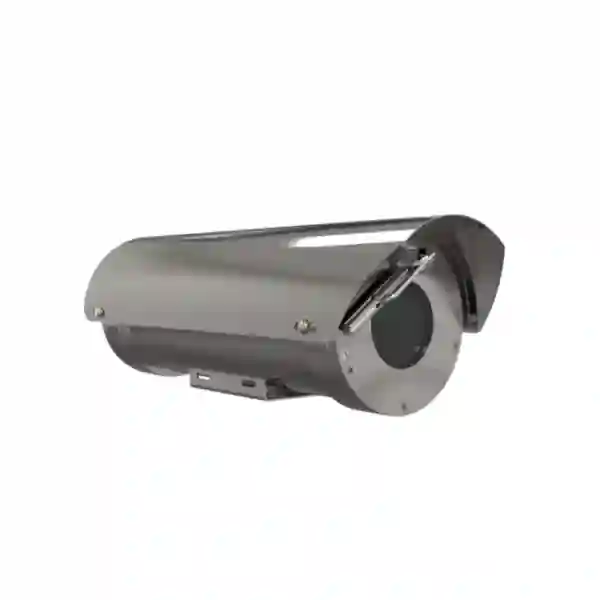
HANWHA VISION • INDUSTRIAL VIDEO SURVEILLANCE
TNO-6320E2FW-Z Explosion-Proof Zoom Camera
Need a detailed fixed view at an industrial location where the protective enclosure and installation method must suit an assessed hazardous atmosphere? The Hanwha TNO-6320E2FW-Z combines 2MP Full HD video, 32x optical zoom, a wiper and fibre-ready networking for specialist surveillance designs. Confirm the exact certification, viewing geometry and 110V AC power solution before purchase.
For Tanzania projects: request a model-specific technical and quotation review.
Specification snapshot
| Manufacturer | Hanwha Vision |
|---|---|
| Product type | Explosion-proof fixed network zoom camera |
| Exact model | TNO-6320E2FW-Z |
| Resolution and frame rate | 1920 × 1080; up to 60fps |
| Lens and focus | 32x optical zoom, autofocus; family lens 4.44–142.6mm |
| Image processing | 120dB wide dynamic range; day/night functions |
| Video | Multiple streaming; family documentation lists H.264 and MJPEG |
| Window and connection | Wiper, fibre connectivity, microSD/SDHC/SDXC slot |
| Input power | 110V AC; verify site-specific engineered supply |
| Approval and ordering | Check exact shipped certification, current lifecycle and Tanzania supply |
What this model is designed to do
The Hanwha TNO-6320E2FW-Z is a specialist explosion-proof network zoom camera intended for surveillance tasks where ordinary camera enclosures may not be suitable. Its job is to provide a detailed view of a selected location in an industrial installation while housing the imaging equipment within a purpose-built protective assembly. The product combines a 2MP camera, a 32x optical zoom lens, video analytics, a wiper and a fibre-capable connection. Before choosing it, a buyer must establish both what must be seen and what hazardous-area equipment may legally and safely be installed at the proposed position.
This product is best evaluated as a fixed camera station with a controllable optical zoom, not as a moving pan-tilt-zoom head. The lens can narrow its field of view to inspect distant details, but zooming does not turn the camera to another bearing. Its placement, bracket angle and initial view therefore have unusually high value. If an operator needs to scan around tanks, follow moving vehicles across multiple directions or patrol an expansive site, a correctly rated explosion-proof PTZ or positioning camera may be more appropriate than this fixed model.
For Tanzania-based industrial projects, a suitable use case might involve monitoring a defined section of a processing plant, transfer station, loading zone or other area with an assessed hazardous atmosphere. The mere presence of oil, fuel, chemicals or combustible dust is not enough to select an enclosure: the site classification, gas or dust group, temperature requirements, proposed power system and competent engineering approval must agree. Ask for a technical review of the exact TNO-6320E2FW-Z configuration before a purchasing decision is finalised.
Fast feature summary and decision points
Hanwha Vision identifies this model as a 1080p explosion-proof zoom camera capable of up to 60 frames per second, with 32x optical zoom and autofocus. It also lists 120dB wide dynamic range, multiple network video streams, intelligent video analytics, a wiper, fibre connectivity and a built-in microSD/SDHC/SDXC memory slot. These features are useful when a viewing position is hard to access and image quality, weather exposure and network transport must be considered together. They do not remove the need for a site survey or a hazardous-area equipment schedule.
The 32x lens brings a remote subject closer in the frame, while wide dynamic range helps when bright and shaded surfaces occupy the same scene. The wiper offers a method of clearing the viewing window, and fibre can be valuable where a suitable long-distance industrial network is planned. Local card recording may support a resilience design, but it should not automatically be treated as a substitute for the main recording system. Each benefit depends on a correct installation, appropriate configuration and adequate maintenance.
Three immediate checks can prevent a costly mismatch. First, confirm that a fixed viewing direction actually suits the surveillance task. Second, verify the certified configuration, cable entries, mounting hardware and environmental ratings against the site’s classification documents. Third, confirm the 110V AC power arrangement: Tanzania’s usual 230V/50Hz supply cannot simply be assumed suitable for a device specified at 110V AC. Establish these points before requesting accessories, a recorder specification or a formal quotation.
2MP Full HD video and what resolution means
The camera’s maximum listed image format is 1920 by 1080 pixels, commonly described as 2MP or Full HD. This offers a useful balance between image detail and handling a live industrial camera stream, particularly where a view has been carefully designed around equipment, personnel movement or a defined operating point. Hanwha lists up to 60fps, which may support smoother observation of motion when the network, recorder and selected stream profile can accommodate that frame rate. A 60fps headline does not mean every stream or recording arrangement will deliver that rate in all conditions.
Resolution should be judged against the distance to the subject and the required task, rather than treated as a guarantee of identification. A wide view may show the full area but allocate only a small number of pixels to an object far away. Optical zoom concentrates available pixels over a smaller field, though it simultaneously reduces situational coverage. The engineer should define whether the requirement is detection, observation, recognition or reading a specific visual detail and then check the scene using real focal lengths and lighting conditions.
During acceptance testing, capture examples at the wide, middle and long ends of the zoom range. Inspect moving subjects as well as stationary equipment, including any glare, vibration, haze or low-light conditions common to the site. Verify that the chosen recording profile preserves the detail visible in the live stream. For a security control room, practical test images, agreed observation distances and a written acceptance checklist are more reliable than deciding solely from the megapixel figure printed on a specification sheet.
32x optical zoom for focused industrial views
Manufacturer family documentation describes a lens range of approximately 4.44 to 142.6mm for the 32x optical zoom system. The wide end gives useful context around a fixed station, while the telephoto end concentrates attention on smaller or more distant subjects. Autofocus can support changes in lens position, but the best focus result still depends on the scene, contrast, environmental conditions and any obstruction at the protective window. Optical zoom is different from digital enlargement: the former changes the lens view, while the latter does not create missing scene information.
A long zoom can be valuable when approaching a location is difficult or undesirable. Operators might use it to inspect a specific indicator, observe the approach to a controlled gate or examine activity at a transfer point without relocating the camera. However, a very narrow view can be easy to misinterpret without a second overview camera. It can also magnify the visible effect of mounting movement and heat shimmer. A carefully planned pair of overview and detail views may serve the customer better than depending on one zoom camera to do everything.
Treat the exact aim direction as an engineering decision. Document the camera’s target sector, required vertical and horizontal coverage, nearest and farthest subjects, likely obstructions, day and night illumination and maintenance access. Confirm whether the operator truly needs remote zoom adjustment or would prefer a permanent fixed focal setting. If the viewing target moves outside the station’s direction, zoom cannot recover it. Choosing the proper category of camera before installation is typically more important than selecting the highest available zoom ratio.
120dB WDR, day and night operation
Hanwha specifies 120dB wide dynamic range for this model. WDR is intended to help handle strong differences between bright and dark parts of an image, such as a sunlit opening behind shaded pipework or a reflective metal surface near a darker platform. It can make detail easier to interpret across a challenging scene, but it does not make every lighting arrangement suitable for surveillance. Strong direct glare, obscured windows and backlit subjects can still reduce the usable evidence in captured video.
Manufacturer family material also lists day and night switching with an infrared-cut filter. This permits the imaging system to adapt to changing illumination and can support monochrome capture when light is low. It does not establish that the station includes an infrared floodlight, produces thermal imagery or can see through total darkness. Where the camera is expected to capture operational detail at night, the lighting design must be considered as part of the project rather than left to the day and night setting alone.
The practical review should include lighting direction, shadows from plant structures, glare from work lights, headlight movement, reflections from wet surfaces and visibility through steam or airborne dust. Images should be checked across actual operating shifts rather than only at midday. Define who is expected to interpret the picture and which visual cues matter. If an alarm or security decision depends on the camera, its image must be sufficiently clear at the precise moments the customer needs it.
Wiper-equipped protective window
The exact Hanwha model page identifies a wiper as part of the product’s feature set. A wiper can be helpful on exposed industrial sites where rain, condensation residue, washdown splash or deposited dirt may affect the window through which the camera looks. This is especially relevant to a camera installed high above a working area or close to a restricted process zone, where ordinary cleaning may require a permit and planned access. The benefit is improved maintainability of the view, not an assurance that the optical window will always remain clear.
Review the wiper as a working mechanism rather than a decorative specification. Its use should be checked against operating instructions, the site environment and the actual materials likely to collect on the window. Heavy deposits, abrasion, damaged blades or incompatible cleaning practices can still impair visibility. The project should establish a sensible inspection and cleaning interval, who may work on the unit and how those personnel will obtain safe access when an adjustment or service is required.
Do not assume that a washer tank, fluid supply, control accessory or every mounting component is included merely because a wiper is listed. Manufacturer literature describes optional washer and bracket accessories within the product family. Confirm the exact accessories, their compatibility, hazardous-area suitability and installation scope on the quotation. Where abrasive dust is present, maintenance methods should follow the manufacturer’s instructions. A good purchasing package specifies not just a camera model but the equipment and procedures required to keep its image usable.
Fibre connectivity and industrial network planning
Hanwha lists fibre connectivity for the TNO-6320E2FW-Z, and the corresponding manufacturer family literature describes a built-in single-mode fibre module. Fibre may be attractive in industrial settings where the surveillance network spans a large site or where a network design benefits from optical transport between equipment locations. That does not prove compatibility with an existing patch panel, fibre termination, switch or transceiver. The interface type, fibre characteristics and connected equipment should be confirmed using the exact supplied configuration and current installation guide.
Begin with the route, not the connector. A practical design considers the distance from the camera to the nearest approved network distribution point, conduit or tray availability, splice and termination locations, outdoor cable protection and the ability to test the optical path after installation. It should also address the location of active network electronics and whether the available switching equipment supports the required video streams. Where the design includes copper interfaces, confirm their availability on the exact model rather than assuming a generic IP camera wiring arrangement.
An industrial network must also be maintainable. Record the fibre identifiers, connection points, switch configuration, logical network assignment and responsible support team. Decide how loss of video will be detected and escalated; a well-connected camera is still of limited value if no one notices an offline stream. Separation of operational technology and surveillance networks, where required by the customer’s architecture, should be reviewed alongside bandwidth and cybersecurity. The camera is one part of that system, not a complete network solution by itself.
Streaming formats, recording and local media
The published family specification identifies H.264 and MJPEG video encoding with multiple stream profiles. A control room may use a higher-quality stream for recording and a different stream for remote viewing, subject to what the camera and video management system actually support. Configuring several simultaneous streams requires attention to cumulative bandwidth, recording duration and client compatibility. Do not assume H.265 support for this exact model merely because it appears on newer network cameras; plan against the confirmed format set unless updated product documentation states otherwise.
Hanwha’s exact-model page also identifies a built-in microSD/SDHC/SDXC memory slot. Edge storage may have a role in a recording resilience plan, but actual media support, approved card types, recording behavior, overwrite rules and recovery operation must be verified during design. The presence of a slot alone does not promise that video missed by an NVR will automatically be restored. If continuity during a network interruption is important, test the combination of camera firmware, media, recorder and management software under controlled conditions.
For every recording project, define the number of streams, resolution, frame rate, bitrate settings, motion or event recording policy, hours of operation and retention period. Then size central storage and network links with measured or defensible assumptions. Ensure video time stamps remain consistent through proper clock synchronization. Ask who can export evidence, how exports will be protected and what happens if a card or recording server fails. A technically impressive camera is useful only when its recorded footage can be located, interpreted and retained for the required period.
Intelligent analytics as an operator aid
Hanwha describes intelligent video analytics among the model’s main features. Within the broader TNO-6320E2F family, published material lists functions such as motion and tampering detection and virtual-line or entry-exit event concepts. Exact availability and configuration should be checked on the supplied firmware and connected platform. Analytics can make a view easier to supervise by highlighting certain activity; it should not be presented as an infallible safety detector or a substitute for the site’s mandatory process and protection systems.
Start by choosing one operational question. Is the operator trying to notice movement along a restricted passage, discover an obstructed view or understand whether a defined boundary has been crossed? A carefully chosen alert is more valuable than a large number of badly configured triggers. Camera shake, weather, steam, moving equipment, shadows and changes in illumination can create unwanted events. A long-zoom image can also change the apparent size and motion of objects, affecting any analytic region previously tuned at another focal length.
Agree how alerts will be displayed, acknowledged and investigated. Establish an acceptable false-alarm burden and confirm that personnel can still inspect the original video surrounding each event. Testing should represent normal production activity as well as the condition of concern. If the intended use has a safety implication, a competent site authority should define what independent systems remain required. The surveillance camera can support awareness and investigation, but should not be described as a certified emergency shutdown or gas detection device.
Explosion-proof housing and mechanical robustness
This product uses a specialised explosion-proof enclosure rather than an ordinary outdoor CCTV housing. Manufacturer family documentation describes electro-polished 316L stainless steel on welded assemblies and a toughened-glass viewing window. Those construction features are relevant to industrial durability and the protected camera assembly, particularly where corrosion exposure and restricted maintenance access form part of the installation problem. They should not be interpreted as permission to install the device anywhere that might contain flammable gas or dust without checking the exact certificate and installation conditions.
The family data also describes IP66/IP67 protection and further IP68 test information, together with an operating temperature range around minus 40 to plus 60 degrees Celsius for listed variants. Treat those figures as design information requiring confirmation against the exact supplied unit, its certification and the selected cable glands. Environmental performance depends on the complete assembled installation, not simply the housing body. Unsupported penetrations, damaged seals or inappropriate accessories can compromise the planned protection even when the camera housing itself is rugged.
Physical support matters because the family documentation places some configurations at up to roughly 21kg before all project-specific mounting considerations are resolved. A structural review should cover bracket compatibility, corrosion resistance, orientation, wind loading, vibration and safe maintenance access. The location should avoid placing the window directly behind persistent obstructions or high-temperature processes. Keep sufficient access for permitted servicing without requiring personnel to disturb process equipment unnecessarily. Approved installation drawings and the correct enclosure instructions take precedence over generic camera mounting practices.
Hazardous-area certification and site classification
The suffix and regional certification of an explosion-proof camera are not minor ordering details. Manufacturer TNO-6320E2F family material identifies different certification variants, including a ‘-Z’ configuration associated with cLCus Class I, Division 1 documentation. This information must be matched to the exact model and shipped label rather than used as a blanket approval statement. A site may classify hazardous conditions by zones, divisions, gas or dust groups and temperature class; the selected equipment must be suitable for the classification method and requirements applied to that installation.
For a Tanzanian project, request the actual certificates, permitted operating conditions and installation instructions for the particular camera being quoted. Have the responsible hazardous-area engineer determine whether the documentation is acceptable to the operator and applicable authorities. A certificate associated with one jurisdiction or scheme does not by itself establish any additional Tanzanian approval. Confirm also the glands, entries, sealing method, earthing, maintenance restrictions and associated field equipment. The overall installation must preserve the protection concept described in the approved documentation.
This page should help a buyer ask better questions; it is not a substitute for a hazardous-area assessment. Document what substances may be present, how the area has been classified and where the proposed camera mounting location sits relative to that classification. Ask for an installation package that distinguishes the enclosure rating from general ingress protection. IP67, for example, concerns environmental sealing, not alone the suitability of electrical equipment in an explosive atmosphere. Purchase approval should follow the site’s competent technical and safety review.
Power supply: essential Tanzania compatibility check
Hanwha’s exact product page lists 110V AC power for the TNO-6320E2FW-Z. Tanzania’s common distribution supply is approximately 230V at 50Hz according to Tanzanian electricity-sector information. That is a material difference. Do not connect a camera labelled for 110V AC directly to a 230V circuit on the assumption that network cameras always accept a wide mains range. Have an appropriately qualified professional confirm the required voltage, frequency, tolerance, protective devices and any manufacturer-approved power conversion method for the supplied camera.
Any power conversion or distribution hardware must be assessed as part of the full site design. If it is located in a classified area, its own suitability and installation method must be determined independently; the camera’s enclosure does not automatically protect nearby equipment. The designer should account for isolation, overcurrent protection, cable routes, earth bonding, maintenance lockout and the total loading of accessories. Family literature reports a maximum power figure around 37W for this camera family, but final circuit sizing should use the exact unit documents and complete accessory schedule.
Power continuity should be considered separately from voltage compatibility. If the camera has to remain available during plant supply changes, identify the approved UPS or backup architecture and calculate its required capacity based on the installed load. Record what happens during loss and restoration of supply and whether video recording resumes automatically. A formal site acceptance test should check the actual voltage at the correct terminals under load. Properly planning the 110V requirement is a fundamental procurement step, not a minor adjustment an installer should improvise on site.
Choosing the right location and viewing geometry
The first drawing for a fixed zoom camera should show the area of interest and the available safe mounting positions. Think about which objects operators need to observe, their relative height, the angle of approach and the range of distances the lens must cover. A long straight approach or a designated piece of equipment is more suited to a fixed station than a task requiring continuous rotational coverage. A schematic field-of-view study should be completed before brackets are ordered, especially when a hazardous location restricts where supports and cable routes may be installed.
Consider practical obstruction patterns. Large pipes, platforms, handrails, parked equipment and temporary containers can block a camera even when the original design drawing appears clear. Reflective surfaces can create glare, while vibration from machinery may make the long end of the zoom difficult to use. Inspect where rainwater or process splash might strike the window and whether a maintenance person could reach the enclosure safely. A camera placed close to a process line may see less than one installed farther back with a more useful angle.
Document the expected operational modes at the intended position. For example, operators may need a wide contextual image during routine shifts and a tighter view when reviewing an incident. If both views must be recorded continuously, the system design may require another camera rather than repeated manual zoom changes. During commissioning, test each required scene in actual plant conditions and note the settings used. The final specification should define success in terms of visible operational detail rather than a generic claim that a 32x lens can see far.
Recorder and VMS compatibility
A network camera must fit the customer’s recorder and video management software, not only the physical site. The broader manufacturer’s family literature lists ONVIF Profile S and proprietary integration options such as SUNAPI. These references are useful starting points, but they do not prove that every recorder will expose the same control, event and edge-recording functions. Check the exact model and firmware against the intended VMS version and confirm any required licence, device driver, recording channel or camera profile before ordering.
A staged integration test should verify live video, video format, time synchronisation, autofocus and zoom controls, event handling, user permissions, recording retrieval and disconnection behavior. An NVR may receive the main stream successfully yet fail to display a camera-specific analytic event. A system may also work during commissioning but lose a control function after a firmware or VMS upgrade. Separate essential functions from optional conveniences in the acceptance document so that compatibility can be evaluated against the customer’s real operational needs.
Where an existing site uses a mixed camera estate, check how this model will appear in alarm maps, operator workstations and mobile client views. Decide whether the camera requires a dedicated recording policy because of its location or retention requirements. Recording software should be licensed and administered according to its own terms, rather than assumed to be included with the camera. If the current recorder cannot support the required profile, factor a tested integration path or a suitable replacement into the quotation.
Cybersecurity and controlled remote access
Industrial video networks can become a significant operational dependency, so the camera should be treated as a managed network asset. Begin by recording its exact model, firmware version, configured IP address, network location and authorised administrators. Use a controlled commissioning process for credentials and remove insecure temporary access once testing is complete. Network segments, firewall policies and remote access methods should be determined by the customer’s security team rather than by opening unrestricted internet access to make a demonstration easier.
Check available encrypted management methods and supported authentication options using the exact firmware documentation. If the camera is managed through a VMS, determine whether individual camera accounts, centrally controlled accounts or limited service credentials best fit the organisation’s policies. Logs, backup configuration and the ability to recover a device after replacement are all relevant to lifecycle resilience. Security configuration should be coordinated with the video team so that network hardening does not unexpectedly interrupt event delivery, time synchronisation or routine administration.
Plan updates carefully, particularly for an explosion-proof camera that may be difficult to access once installed. An update process needs version checks, a tested rollback or recovery procedure where supported and an approved maintenance window. Any physical work in a classified area must follow site permits and safety procedures. If the camera is integrated into a wider operational network, involve the responsible technology and plant teams before commissioning. Good security is a practical combination of configuration, access control, monitoring and disciplined change management.
Bandwidth, storage and retention design
Selecting Full HD recording at a high frame rate can increase network and storage requirements, but the actual data rate depends on codec settings, picture complexity and the configured quality profile. Industrial scenes can vary significantly: a quiet storage area may be visually simple, while rain, moving vegetation, steam and frequent vehicle activity can produce more changing image detail. Do not size storage from resolution alone. Use a manufacturer-supported bitrate planning method and, where possible, sample the intended scene or use a conservative engineering assumption.
Calculate storage for each recording stream, the chosen recording schedule, required retention interval and redundancy policy. Include space for operational growth, export activity and any secondary recording destination. Network design should reflect peak rather than just average load, particularly if operators will open multiple live views during an incident. Where fibre is used, the camera-to-network path must be tested end to end; an optical link does not make switching, aggregation or recorder capacity irrelevant. All components share responsibility for an uninterrupted surveillance path.
Define a policy for lost frames, disconnected links and recorder faults. Should a control room alarm appear immediately, and who is responsible for restoration? Is edge recording expected to continue, and has recovery been demonstrated? Can a reviewer determine when a gap occurred? A clear answer to these questions produces more useful surveillance evidence than quoting an impressive nominal bit rate. Document the final settings so future maintenance staff can compare working configurations and detect changes that threaten retention or image quality.
Commissioning and acceptance test plan
Commissioning should demonstrate that the selected hardware is the correct certified variant and that it has been installed according to approved drawings. Before energising, the relevant team should verify mechanical fixing, cable entries, environmental seals, earthing and the power interface. The person responsible for hazardous-area compliance must confirm that inspection and documentation requirements have been met. The video team can then test the camera’s image and network functions without having to make assumptions about the safety of the installation.
Record images at representative focal lengths, illumination levels and operating conditions. Test autofocus, wide dynamic range, wiper function, video stream availability, time stamps, recorder connection and any configured alarms. Check whether the target object remains visible when nearby equipment is operating and vibrating. If the operator is expected to use the telephoto view, show the real image at that setting rather than relying on a zoom specification. A control room representative should witness the scenarios that matter to their work.
A complete handover should include the approved as-built location, exact model and serial details, certificate and manual references, network settings, recorder mapping, recording policy, asset owner and maintenance instructions. Configuration backups and access credentials must be handed over securely using the organisation’s procedures. Document outstanding limitations explicitly instead of treating them as invisible defects. Acceptance is complete when the customer can operate, investigate and maintain the required view using a known and supportable system configuration.
Maintenance planning for exposed installations
A rugged enclosure reduces certain environmental risks but does not remove the need for inspection. The wiper blade, viewing window, cable terminations and mounting hardware deserve particular attention at an exposed industrial station. Inspections should be scheduled around site access rules and the conditions that actually affect the camera. If the location is subject to corrosive agents, frequent spray or heavy dirt deposition, the maintenance plan may need to be more specific than a generic CCTV checklist used for an office building.
Routine visual reviews can identify a dirty window, reduced contrast, changed framing or repeated stream outages before they become a major loss of coverage. Maintenance staff should compare current images with an approved baseline and record when the wiper or focus no longer behaves as expected. Avoid improvising on sealed housings or using replacement parts simply because they fit physically. For equipment installed in a classified area, repairs and component substitutions require attention to the approved enclosure and manufacturer documentation.
Ask about practical support arrangements at the procurement stage. Who is permitted to inspect the unit, how will replacement components be identified, and what evidence is needed if a fault is reported? Manufacturer product pages may remain visible even when regional supply or lifecycle status changes; the buyer should confirm current ordering and support status for the exact code. A credible purchase plan includes spare-part questions, a maintenance route and an agreed approach to changes in firmware or connected recording infrastructure.
Typical industrial use cases
One possible application is a fixed observation point looking toward part of an oil, gas or chemical-handling facility that has been assessed for explosive-atmosphere risk. A narrow view may help authorised operators inspect an activity or equipment position without entering the area simply to look at it. This is a surveillance use case, not a claim that the camera measures gas concentration, detects leakage or verifies process safety. The protective housing and certification must be evaluated against the actual area classification, and the line of sight must be checked by the plant team.
Another application is watching a defined transfer or loading location where vehicles, workers and equipment pass through a predictable field of view. The lens can provide context at the wide end and visual detail at longer focal lengths, while the wiper may help after rain or site washdown. If the scene requires constant coverage of multiple directions or separate simultaneous close-ups, additional cameras or a suitable rated moving camera may be a better design. A fixed station works best when the customer can identify the important bearing in advance.
Other candidate environments may include process yards, industrial storage compounds and selected plant corridors, provided the exact equipment classification and local conditions support its installation. Do not interpret these examples as proof of regulatory suitability for a specific refinery, mine, terminal or factory. The correct solution is chosen by the risk assessment, surveillance objective, installed power, network design and maintainability. A quote should explain which objective the camera serves and which other elements are still required to deliver that objective.
Fixed zoom versus PTZ, thermal and ordinary outdoor cameras
This camera should not be confused with an explosion-proof PTZ camera. A PTZ head can change its direction mechanically, while a fixed zoom camera is aimed at a chosen area and changes magnification within that direction. If the application calls for patrolling many locations, following movement across a large yard or repeatedly turning between process units, a PTZ or positioning solution may merit evaluation. If the task is a consistent look at a particular line, gate or machine, the fixed station can simplify the viewing requirement.
It is also a visible-light network camera, not a thermal imaging instrument. Day and night camera functions should not be interpreted as a measured heat image or a gas-imaging capability. Some industrial hazards require specialist sensing that conventional video cannot provide. A thermal camera might serve a different inspection objective, but its resolution, lens, temperature measurement capability and area certification would need separate technical review. The question is not which camera sounds more advanced; it is what kind of evidence the operator actually needs.
An ordinary IP66 or IP67 outdoor camera may be appropriate in some harsh but unclassified environments, but its ingress rating alone does not qualify it for an explosive atmosphere. Conversely, selecting an explosion-proof enclosure does not remove the need to consider image clarity, network integration and operating cost. Ask the responsible engineer to distinguish environmental exposure from hazardous-area classification, then compare options on the complete specification. This avoids paying for the wrong protection type or installing an unsuitable camera because the zoom and resolution looked attractive.
Quotation and procurement checklist
Before requesting a quotation, provide the full manufacturer model code TNO-6320E2FW-Z, the required quantity and the intended installation environment. Describe the site classification using the classification documents adopted by the operator, not just the phrase ‘hazardous area’. Give the approximate mounting location, viewing distance, primary object of interest and whether a permanent fixed view or operator-controlled optical zoom is expected. State whether the project already has a VMS or NVR that the new camera must join, including the software version where known.
Ask the supplier to identify exactly what is being supplied: camera enclosure, wiper configuration, appropriate mounting hardware, cable entry components, required power interface, fibre-related hardware and any compatible optional washer assembly. Distinguish included items from optional accessories and site installation work. A complete scope should also address commissioning, document handover, testing and integration with the recording system. Require the exact approval documents and installation manual for the proposed unit, and ask the responsible engineering team to review them before ordering.
Finally, confirm current regional orderability, product lifecycle, any approved replacement model, service options, expected supply conditions and the commercial terms for the specific offer. The presence of a manufacturer product page does not prove local stock or a fixed lead time. No price, Tanzanian shilling amount, warranty term or delivery commitment is stated here because those details have not been verified for a FourTeck Tanzania listing. Request a written quotation that identifies the exact product and approved project scope rather than treating an online feature list as a supply contract.
What a good Tanzania project handover should include
A robust handover connects purchasing decisions with long-term site operation. The purchasing team should receive a clear bill of materials and a commercial quotation, while the engineering team should receive the appropriate equipment certificates, power design, mounting details and network drawings. The security team needs a working video feed, reliable recording and documented access controls. The maintenance team needs instructions, asset identifiers and safe access arrangements. Each group relies on information generated before and during installation, so it is useful to plan the handover deliverables in advance.
For the TNO-6320E2FW-Z, pay special attention to the 110V AC specification, the fixed viewing direction and the difference between environmental ingress protection and hazardous-area certification. These three details influence the equipment schedule, installation drawings and approval process. The fibre path, camera recording profile, video management integration and wiper maintenance should also be documented. When two teams use different terminology, write the requirement in terms of an observable test: a visible target, a measured power input, a recorded stream or an approved enclosure label.
Keep records of tests that establish the final operating state. Useful evidence can include an installation inspection checklist, representative day and night images, tested zoom positions, recorder playback results and the agreed fault-response method. If an optional feature was not supplied or could not be tested, record that explicitly. The goal is not the longest documentation package; it is a precise record that lets qualified staff distinguish the expected performance of the system from a future problem without guesswork.
Planning for a system that can be supported
Camera selection is only the beginning of the support lifecycle. Industrial installations often remain in use while network switches, recorders and operating procedures change. The site should record dependencies so that a future network migration or VMS update does not unexpectedly disconnect an important camera view. Preserve the current configuration, maintain a controlled list of firmware versions and schedule checks after changes to recording or network infrastructure. A validated baseline picture can also reveal slowly developing problems with lens focus, protective glass or the mounting orientation.
Support planning should include the availability of replacement components and a strategy if the exact model can no longer be ordered in the relevant market. A potential replacement should not be treated as a direct interchange until its enclosure certification, dimensions, mounting, optics, supply voltage, network interfaces and recorder integration have been compared. Where hazardous-area approvals are involved, substituting a newer camera is a design review, not merely a catalogue exercise. The operator should retain responsibility for acceptance of any altered installation.
A buyer benefits from identifying these issues early. Record what matters most: a specific inspection distance, safe operation at a declared location, a defined recording retention period, or continuity when a network link fails. Those requirements can then be used to evaluate the quoted camera and any proposed alternatives fairly. This approach reduces the risk of purchasing a technically correct product that still cannot be connected, installed or used in the intended application.
Frequently asked questions
Is the Hanwha TNO-6320E2FW-Z a PTZ camera?
No. It is presented as an explosion-proof zoom camera in a fixed camera station. Its 32x optical lens can change magnification, but the unit should not be specified as a mechanical pan-tilt-zoom device. Choose a properly rated PTZ or positioning model when the intended view must rotate or tilt during use.
What video quality does it provide?
Hanwha states 1080p resolution at up to 60 frames per second. Actual recorded quality depends on the selected stream, video codec, bitrate, lens setting, lighting, network and recorder. Establish the required observation distance and test the image on site before accepting a final design.
Does this camera use 110V or 230V power?
The exact product page lists 110V AC. Tanzania commonly uses 230V/50Hz distribution, so the power design needs professional review. Do not assume direct 230V connection is acceptable. Confirm the specified voltage, frequency, complete installation scheme and any approved power conversion equipment before energising.
Can it be installed anywhere hazardous gases are present?
No. Explosion-proof design is not blanket permission to install a device in every classified location. The site’s competent engineer must compare the exact supplied certificate, protection marking and installation conditions with the area’s approved classification and applicable requirements.
Does it include a wiper?
Yes, the exact-model manufacturer feature list identifies a wiper. However, do not assume a washer tank, fluid system or every accessory is part of the camera package. Confirm the bill of materials, accessory compatibility and maintenance instructions on the actual quotation.
Is the camera suitable for recording over fibre?
Hanwha lists fibre connectivity, and product-family material describes single-mode fibre integration. The actual fibre connection, optical characteristics, switching equipment and recording design still need to be specified and tested. Fibre is a network transport choice, not a complete recording system.
Can it record to a memory card?
The manufacturer lists a built-in microSD/SDHC/SDXC slot. Use the current documentation to verify supported media and edge-recording behavior. If recording during a network outage is essential, confirm that the chosen NVR or VMS can recover the footage as required.
Does it provide thermal or infrared night vision?
This is not specified as a thermal imaging camera. Hanwha documents day and night imaging functions, but that alone does not prove a built-in infrared illuminator or visibility in total darkness. Plan lighting according to the scene and the operator’s actual visual requirement.
Which video formats should the recorder support?
Manufacturer family specifications list H.264 and MJPEG with multiple streams. Check the precise firmware and selected VMS profile before purchase. Do not assume support for a newer codec or a particular analytic event solely from the camera’s network connectivity.
Is the camera waterproof and corrosion resistant?
Manufacturer family literature describes stainless-steel enclosure construction and ingress-protection ratings. These are useful engineering references, but performance depends on the exact variant and compliant installation, including glands and seals. Environmental sealing must not be confused with explosion-proof approval.
What should be checked before obtaining a Tanzania quotation?
Provide the exact code, quantity, classified-area information, power arrangement, mounting location, viewing distance and intended recorder. Ask for the certificate for the exact supplied configuration, a complete accessory list, current regional availability and written commercial terms.
Can FourTeck confirm delivery, pricing or installation from this page?
No price, stock position, installation coverage or delivery promise is asserted here. Request a project-specific quotation and a technical review of the proposed equipment. The appropriate next step is to share the site requirements and obtain written confirmation of scope and commercial terms.
Request a Hanwha explosion-proof camera quotation
To prepare a technically useful offer for the Hanwha TNO-6320E2FW-Z, share the quantity, site classification, intended viewing position, recorder or VMS details and the planned 110V AC power arrangement. Ask for exact certification, accessory compatibility, current product status and supply terms. For a classified location, have the site engineer review the final proposal before placing an order.
Contact FourTeck Tanzania to request a project-specific quotation and technical review.




Reviews
There are no reviews yet.