
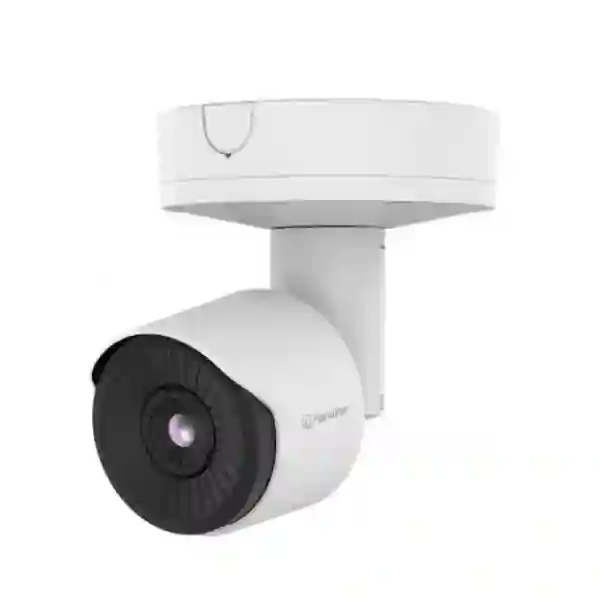
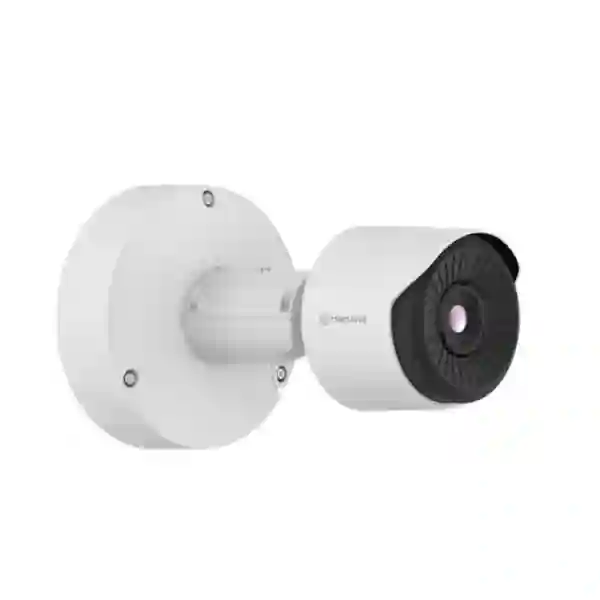
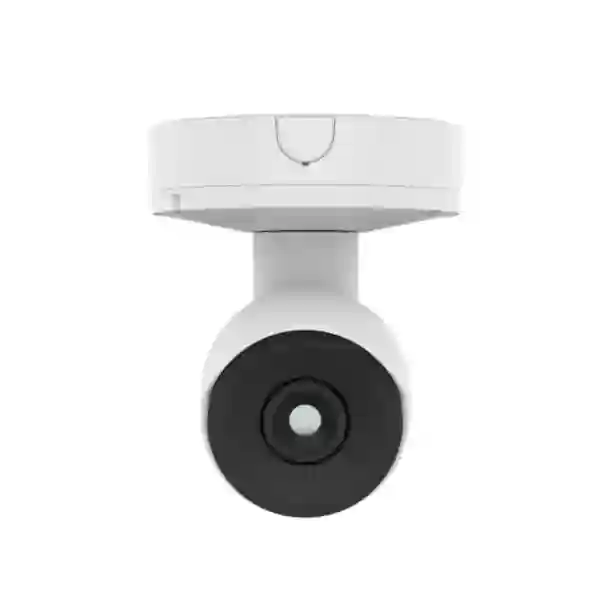
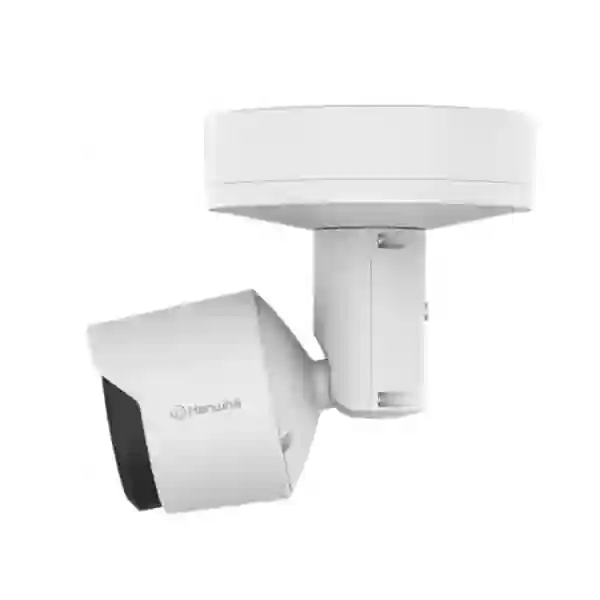
Hanwha TNO-C3012TRA | QVGA Radiometric AI Thermal Camera
For industrial temperature awareness and classified perimeter events, the Hanwha TNO-C3012TRA thermal camera combines a wide 90° view with radiometric monitoring across a specified −40°C to 550°C range. Its native 384 × 288 sensor, 4.4 mm lens, AI person/vehicle analytics and 8 fps video profile suit defined thermal oversight tasks when coverage and alerts are carefully planned.
Request a project-specific quote and coverage review from FourTeck Tanzania. Installation suitability, pricing, availability and warranty must be confirmed for the proposed site.
Key specifications at a glance
| Thermal detector | 384 × 288 uncooled microbolometer; 17 μm pixel pitch; ≤30 mK NETD |
|---|---|
| Lens and view | Fixed 4.4 mm F1.0; 90° horizontal field of view |
| Video | 384 × 288 or 768 × 576 output; 8 fps maximum; H.265/H.264/MJPEG |
| Temperature | −40°C to 550°C; ten polygonal radiometric regions; spot readings |
| AI events | Person/vehicle classification; line crossing; intrusion; loitering |
| Network | Ethernet; ONVIF S/G/T/M; RTSP, SUNAPI, MQTT support |
| Storage | One microSD/SDHC/SDXC slot, up to 1 TB |
| Power | IEEE 802.3af Class 3 PoE or 12 V DC |
| Housing | IP66/IP67; IK10; NEMA 250 Type 4X |
These are manufacturer-listed technical characteristics. They should be interpreted with the target distance, temperature-measurement limitations and integration requirements described below.
A thermal monitoring camera for decisions that cannot wait for visible smoke
The Hanwha TNO-C3012TRA thermal camera brings radiometric temperature measurement and AI-assisted scene awareness into a single fixed-view network camera. It is intended for operators who need more information than a conventional visible-light image provides. Rather than relying on ordinary reflected light, the sensor observes long-wave infrared energy and forms a thermal image. A supervised installation can therefore look for changes in apparent surface temperature while also checking for movement of people and vehicles. That combination is particularly useful where a plant team must distinguish an equipment alert from normal traffic across the same scene.
A strong application begins with a defined monitoring question: which object or surface matters, what change would require investigation, and who should respond? The camera is not a substitute for a fire-alarm system, process protection instrument or competent site assessment. It can provide a useful additional early-warning signal when targets are visible, conditions are understood and alerts are integrated into an agreed response procedure. The purchasing decision should focus on measurable coverage and alarm actions rather than on the presence of the word “AI” alone.
For Tanzanian buyers comparing thermal surveillance options, the model is best evaluated as part of a designed solution. A quote should capture mounting location, approximate distances, the intended target, reliable power, network connectivity and who will receive notifications. These are practical factors that determine whether the wide field of view becomes a benefit or whether a narrower lens would give a more informative image.
What the sensor actually delivers
The camera uses an uncooled 384 × 288 microbolometer with a 17 μm pixel pitch and an 8–14 μm spectral range. Hanwha specifies thermal sensitivity at NETD no greater than 30 mK. In practical terms, the detector is designed to distinguish relatively small thermal differences under appropriate conditions. Thermal sensitivity is not the same as absolute temperature accuracy. An apparently clear temperature contrast does not guarantee that the indicated value matches a contact thermometer or the temperature inside an enclosed component.
Network video can be configured at 384 × 288 or 768 × 576, but the native detector remains 384 × 288. A higher output image size does not add native thermal sensing pixels. This distinction matters when estimating how small a target can be and how much detail an operator can interpret. The camera supports H.265, H.264 and MJPEG at no more than eight frames per second. That lower frame rate can be suitable for many thermal monitoring and event-review tasks, but teams expecting smooth high-frame-rate recording of fast movement should select their equipment accordingly.
The stated 4.4 mm F1.0 fixed lens provides a horizontal viewing angle of approximately 90°, a vertical angle of 65° and a diagonal angle of 119°. The minimum object distance is approximately 0.6 m. A broad scene can be seen from one position, but each distant object occupies fewer detector pixels. Before committing to coverage, plot the important equipment or crossing point at actual mounting height and actual distance, not just on a convenient plan-view sketch.
Radiometric temperature monitoring: what it means
Radiometric operation means the camera can report temperature information rather than only display warmer and cooler shapes. Hanwha lists a temperature detection range of −40°C to 550°C. It also specifies temperature accuracy of ±2°C at temperatures no higher than 150°C and ±15% above 150°C, subject to the manufacturer’s measurement conditions. Buyers should treat this as a stated equipment capability, not as a blanket promise that every site surface can be measured within that tolerance regardless of distance, emissivity or environment.
The camera provides spot temperature readings and supports up to ten polygonal regions of interest for temperature monitoring. Each region can correspond to a selected surface area within the live thermal view. Its supported monitoring conditions include above, below, increasing and decreasing values. That flexibility helps an operator watch a particular equipment group while avoiding unrelated portions of the image. The exact thresholds and duration rules should be commissioned from real operating observations rather than chosen from a generic marketing example.
Temperature measurement is strongest when the objective is specific: investigate unusual heating on an exposed enclosure, observe a surface that normally remains within a known range, or track changes near an industrial process. It is weaker when a target is hidden behind glass, a cover or structural material. The thermal sensor measures radiation arriving from visible surfaces; it does not see temperatures through opaque barriers or establish the condition of components that are not in its line of sight.
Understanding temperature accuracy before specifying an alarm
An infrared temperature reading is influenced by the target’s emissivity, reflections, distance, viewing angle, size and environmental conditions. A shiny metal enclosure, for example, may reflect thermal energy from nearby objects. Wet or contaminated surfaces can look different from the same material when dry. The camera’s published measuring range and accuracy cannot remove these physical effects. A site assessment should therefore identify representative surfaces and compare camera readings against a suitable reference measurement where operational decisions depend on a temperature value.
Plan the alarm around meaningful changes, not only around one absolute number. Some equipment normally warms after startup; another item may undergo brief process-driven peaks. If the thresholds ignore those cycles, the site may receive nuisance notifications and stop trusting the monitoring system. Recording a baseline across operating states makes it easier to distinguish a normal warm period from an unusual increase. Use the camera’s above, below, increase and decrease monitoring capabilities in a way that reflects the operating process.
An acceptance test should deliberately include challenging cases. Observe the target during the hottest expected normal operation, from the intended mounting angle, with nearby heat sources active where safe. Inspect whether solar heating, reflections, vehicle movements or changed backgrounds produce unwanted alerts. Document measurement assumptions and recalibration checks. For safety-critical applications, use independent protective systems and appropriately qualified engineering review rather than treating a camera alarm as the sole protective control.
Using the ten temperature regions effectively
The availability of ten polygonal regions does not mean that all ten should be used automatically. Each region needs a reason to exist and an operator who understands its alert. Regions can be shaped around visible equipment sections or separate target surfaces, avoiding surrounding background as far as the scene permits. For example, an industrial yard may have several exposed areas of interest and one broader overview region. A carefully drawn polygon makes it easier to interpret an alarm than a large rectangle that includes sky, people, vehicles and unrelated machinery.
Decide whether each region is intended for early warning, escalating investigation or recording context. The camera supports configurable conditions, but the actual site workflow determines what those conditions should mean. For a fluctuating source, a rising-temperature notification may be more useful than a fixed upper threshold. For a stable surface, a threshold tied to baseline measurements may be appropriate. Every setting should be tested against real observations and revised if weather or process cycles cause excessive alerts.
The practical output is an alarm register: region name, monitored surface, reason for monitoring, agreed trigger condition, recipients, response action and procedure for checking false positives. This turns a feature list into a maintainable process. It also reduces confusion when shifts change or when a replacement operator needs to know why an event was raised. Save the commissioning record securely with the rest of the site documentation.
Industrial equipment and plant-area monitoring
Thermal monitoring can add context in production, energy, utility and general industrial environments where abnormal surface heating deserves investigation. The wide lens can cover a substantial nearby area, depending on distance and obstructions. Typical evaluation targets might include exposed equipment housings, selected electrical-equipment exteriors or process-adjacent surfaces that can be viewed safely. Suitability is conditional: the camera must have a direct, useful view of the relevant surface, and the thermal signature must be distinguishable at the installed distance.
A thermal image is not the same as electrical fault diagnosis. A hot patch may indicate normal load, a reflected heat source, contamination or a condition worth investigating. The camera can support a decision to inspect, but a qualified technician must determine the cause using the correct tools and safety procedure. It should not be described as seeing inside electrical cabinets or detecting hidden overheating when the cabinet is closed and opaque to the sensor’s thermal wavelength.
For a prospective buyer, a walk-through should record how often the monitored object changes, which surfaces are actually exposed, whether personnel can safely access the location and what response time is practical. This helps answer the business question: will the camera make a relevant anomaly visible early enough for an agreed response, without producing so many alerts that the team ignores them? The answer cannot be established by the datasheet alone.
Waste handling, recycling and battery-related areas
Hanwha identifies waste-management and battery-charging environments as use cases for radiometric thermal monitoring. These settings can contain changing heat signatures, equipment movement and materials whose condition is not fully apparent in visible-light footage. A thermal camera may provide additional situational awareness of exposed surfaces, piles or selected zones. It does not guarantee detection of an internal cell failure, a hidden ignition source or every stage of a developing incident, particularly when the source is covered or beyond useful measurement distance.
Consider the actual operating layout. A camera viewing a large yard may include forklifts, sun-exposed materials and frequent changes in the monitored scene. A small, stable charging area may allow more consistent regions and thresholds. Neither installation should inherit alarm settings without a site-specific trial. Plan how a notification reaches an attended workstation or an accountable duty holder, and decide whether the procedure requires visual verification, a controlled inspection or an emergency response under the site’s existing safety rules.
The most defensible deployment is layered. Retain suitable fire detection, electrical protection, operating procedures and emergency arrangements that the facility requires. Use the camera to improve visibility, documentation and escalation for conditions it can actually observe. The camera can form one useful input within a wider safety program, but buyers should be cautious of any proposal that promises to replace all conventional protection because a temperature-monitoring specification looks impressive.
Person and vehicle analytics alongside temperature awareness
The device also incorporates AI-based classification of people and vehicles. Hanwha lists object detection, virtual-line crossing or direction and virtual-area rules for intrusion, enter, exit and loitering. These events can help separate an interesting movement from ordinary thermal background changes. For example, a security team may want a notification when a person enters a restricted outdoor zone, while an operations team cares more about a temperature anomaly in nearby equipment. Both requirements should be discussed, but they should not be confused.
An analytics rule is not an identity-verification system. People and vehicles are broad object classes; this model does not establish who a person is, identify a registration plate or replace a high-resolution visible-light camera for forensic detail. Thermal contrast can be useful in low-light conditions, yet performance still depends on target size, temperature contrast, weather, scene obstruction and correct configuration. AI classification can reduce some irrelevant triggers, but no classification engine is flawless in every real-world setting.
Plan an event matrix with security and operations representatives. It should clarify whether an intrusion rule raises an operator notification, triggers recording, drives an output or is forwarded to another system. The scene can be sensitive to landscaping, access routes and seasonal changes. Validate person and vehicle events at the actual entry points and agreed viewing distances, while observing appropriate privacy, access and workplace monitoring policies.
Detection distance is not the same as useful identification
Hanwha provides Johnson-criteria distance figures for this model. It lists person detection at approximately 115 m, person recognition at 29 m and person identification at 14 m under the stated criteria; for vehicles the respective figures are 294 m, 74 m and 37 m. These are model-based reference figures, not guaranteed performance at every site. They describe different levels of thermal detail and should not be translated into promises about facial recognition, licence plates or specific individuals.
The most common specification mistake is to choose a camera solely because the largest stated distance exceeds the site boundary. Detecting that an object may be present is very different from reliably classifying it as a person or vehicle, and different again from producing detailed evidence. The 90° wide-angle lens sacrifices some distant target scale to cover more area. For long fence lines or small distant targets, a narrower field of view or several appropriately positioned cameras may be more useful than one broad thermal picture.
Commissioning should use representative targets at the intended distance, with the camera mounted at the final height and aimed at the actual zone. Test the event in daylight, darkness and any safe, relevant operating conditions. Check obstructions and background thermal clutter. If the objective is reliable visual identification, specify complementary visible-light cameras rather than assuming that a thermal stream can satisfy every evidentiary need.
Wide-angle coverage and mounting geometry
A 90° horizontal field of view is attractive when the camera must watch a nearby yard, a broad equipment face or several related surface regions from one position. Coverage geometry still changes rapidly with distance. A target placed far from the camera occupies a smaller fraction of its 384-pixel-wide native detector. Moving the device higher may widen the practical overview while making individual objects harder to resolve. Moving it closer can improve target scale but leave blind spots around the edge of the scene.
Before installation, mark the nearest useful monitoring point, the farthest important target and the areas where direct thermal line of sight is blocked. Large moving objects, storage racks, building corners and vegetation can all obscure an otherwise suitable view. Select a mounting location that maintains safe access for maintenance and protects cable entries. A wide-angle camera aimed at the wrong surface does not become a better system merely because its detector has good thermal sensitivity.
The lens is fixed-focus, and the mechanical pan, tilt and rotation ranges are positioning adjustments for installation, not a promise of motorized PTZ tracking. The specified manual positioning ranges allow a technician to orient the housing during setup. For a project involving several independent observation directions or moving-asset tracking, the buyer should confirm whether fixed thermal viewpoints, multiple cameras or a genuinely motorized alternative best matches the requirement.
Video recording, frame rate and event evidence
The TNO-C3012TRA supports H.265, H.264 and MJPEG network video with a maximum frame rate of eight frames per second. This can be an economical stream profile for a temperature overview and can provide useful snapshots around alarms. It is not a 25 fps or 30 fps visual-security camera. Fast-moving objects may change position substantially between frames, so investigations requiring fluid motion detail or precise timing should use complementary equipment chosen for those tasks.
Hanwha lists up to ten streaming profiles, unicast viewing for up to twenty users and multicast support. These are technical capabilities, not a recommendation to give every user unrestricted access. A deployment should calculate recording load using the configured image size, codec, scene complexity, bitrate and retention policy. A stored thermal video may show that a region changed, but it is also important to retain event metadata, timestamps and the site’s response records if the footage will support an incident review.
Storage planning needs to separate routine recording from event-triggered recording. The device lists a microSD/SDHC/SDXC slot supporting up to 1 TB, along with network and event-recording options described by Hanwha. Confirm the chosen card type, recorder and actual software behavior before assuming any particular retention period. Storage redundancy, backup ownership and evidence export should be designed as part of the installation, not left until after an important alarm occurs.
Network and VMS integration considerations
The camera has a shielded RJ-45 Ethernet interface and supports common IP video protocols. Hanwha lists ONVIF profiles S, G, T and M, SUNAPI and the manufacturer’s open platform, together with RTSP and other network services. These features make integration discussions easier, but a protocol label alone is not a guarantee that every recorder, analytics event or temperature value is supported by every third-party platform. Confirm functionality against the exact software version and licence configuration.
A useful integration test verifies more than live pictures. Check that the intended video stream displays reliably, timestamps remain synchronized, temperature alarms reach the correct destination and event recordings can be found later. If a video management system is expected to show radiometric values, confirm that function explicitly. Some applications may accept video while not exposing all proprietary metadata or advanced analytics. Write the expected event names and operator workflow into the technical acceptance checklist.
Hanwha lists event handling such as email or FTP image upload, network notifications, local or NAS event recording, configurable alarm output and MQTT publication. Whether these mechanisms are appropriate depends on the site’s security and operations architecture. Prefer authenticated, restricted transport and documented integration points; avoid automatically forwarding sensitive video or alarm details to unapproved mailboxes or public services.
Built-in cybersecurity features and the controls around them
The manufacturer lists signed and encrypted firmware, secure boot, access controls, IEEE 802.1X options, secure communication features and TPM-backed security functions. These are meaningful capabilities for a network camera, particularly when the installation touches operational monitoring. They do not mean that the device can safely be connected to the open internet without configuration. The real deployment should use unique credentials, suitable role permissions, network segmentation and an approved method for remote access.
Plan how firmware will be managed throughout the device’s service life. A nominated administrator should review manufacturer notices, test updates, maintain configuration backups and document who can alter temperature thresholds or disable event rules. A security-focused handover includes the camera address, firmware version, time synchronization setting, administrator ownership, permitted network destinations and a recovery procedure. These details protect the usefulness of the thermal monitoring system as much as the camera’s physical housing does.
Treat recorded thermal imagery and event logs as operational data requiring appropriate retention and controlled access. Even if the image does not show the same detail as a conventional CCTV camera, location and movement information may still be sensitive. Consult the organization’s applicable policies and legal advisers where monitoring affects workers or visitors. Strong technical features work best when supported by an agreed governance and incident-handling process.
Outdoor protection, weather and thermal environment
Hanwha lists IP66, IP67, IK10 and NEMA 250 Type 4X environmental specifications for the model. It also gives a camera operating-temperature range of −40°C to +60°C and a non-condensing humidity range from 0 to 95%. These are product-level specifications, not proof that every installation location is appropriate. Cable joints, conduit entries, brackets, surge protection and power equipment must be selected for the actual environment, and the finished installation should not weaken the camera’s stated protection.
Outdoor thermal scenes can change with sun, rain, hot roofs, wet ground and moving vegetation. Rain and atmospheric conditions may reduce contrast or effective range, and a surface that appears hot in one part of the day may behave differently in another. When planning in Tanzania, examine actual sun exposure, dust, rainfall, site access and the monitoring objective instead of relying on a generic climate assumption. A location-specific field test is especially valuable for large yards or equipment that experiences strong daily temperature variation.
Mechanical damage resistance is useful, but it should not be confused with unlimited protection from impact, corrosion, flooding or poor maintenance. Keep lenses clean according to manufacturer instructions, maintain drainage and check that the mount remains stable. A camera that shifts several degrees may no longer cover a carefully defined temperature region. Include the condition of the housing and view alignment in routine inspections.
Power, cabling and equipment selection
The TNO-C3012TRA accepts IEEE 802.3af Class 3 PoE or 12 V DC input. Hanwha specifies a maximum PoE power consumption of 10.8 W and a maximum 12 V DC consumption of 9.4 W. These figures help an installer estimate network-switch capacity and the associated electrical design. They do not determine the full project’s power budget on their own: switches, recorders, network links, surge-protection devices and any backup power need independent allowance.
For PoE designs, verify switch power availability at all ports under peak load, suitable cable distance and routing, and protection measures appropriate to the site. For 12 V DC, verify voltage delivery at the equipment and the suitability of power supplies. Avoid unsupported assumptions that both supply inputs can be combined for automatic failover. If a monitoring system is expected to remain available during a power disturbance, design and test the relevant UPS and network continuity rather than assuming the camera will continue operating.
A sound bill of materials includes mounting hardware, weather-resistant cable termination, network equipment, storage or recording software and any required alarm interfaces. Hanwha specifies an approximately 1.7 kg camera body and a compact cylindrical housing; a bracket must therefore be assessed for the actual mounting surface and local conditions. Confirm the correct accessories and versions for the intended installation, since accessory compatibility should not be inferred from appearance alone.
Installation planning: a practical site walk-through
Begin with a problem statement that can be tested. For instance, an operations team may want an event when an exposed machinery surface becomes unusually hot; a security team may want movement alerts in a defined no-access area. Determine which objective takes priority, whether one location can satisfy both, and what evidence would demonstrate success. Photograph the intended field of view for engineering discussion while respecting site rules, and record target dimensions and distances in a simple schedule.
Next, assess viewing geometry, line of sight, ambient heat, surface material, network routes and safe mounting access. A sensible test location avoids unplanned obstruction and lets the camera observe the relevant surfaces rather than walls or roofs that happen to be nearby. Agree how alerts will be tested and who will approve them. If temperature accuracy is important, plan comparison against an appropriate reference and document the emissivity and surface conditions used during the check.
Finally, create a commissioning acceptance sheet covering the live thermal picture, each relevant temperature region, person or vehicle rules where used, network time, recording, event delivery, access permissions and power recovery. Repeat selected tests after installation is complete rather than relying only on a desk-based proposal. A sign-off should describe any limitations, blind spots or conditions that require a supplementary sensor.
How to commission alerts without overwhelming operators
Alarm quality matters as much as sensor quality. An over-sensitive setup may generate large volumes of notifications from expected plant heating, vehicle movement, reflections or changing weather. An under-sensitive setup may miss a change that the facility wanted to investigate. Start with observed baselines, define a small number of meaningful events and test them against representative normal and abnormal scenarios where safe. If a particular threshold cannot be validated, describe it as provisional and review its usefulness after controlled observation.
Decide who receives each class of alert, during which hours and through which system. A temperature notification might prompt an operator to review the current image and contact maintenance; an access-rule event might go to security. Avoid assigning an event to an unattended mailbox or screen and calling the response plan complete. The operator should know how to acknowledge, escalate and close a case, and what to do when camera connectivity is lost or the view is obscured.
It helps to retain a short alarm history with event time, monitored region, action taken and outcome. This reveals which settings are useful and which create noise. When process conditions change, reassess thresholds and region boundaries. The objective is a dependable decision aid, not the largest possible count of enabled camera features.
Maintenance, verification and operational ownership
Thermal cameras are often installed in places where people assume monitoring will continue indefinitely. In practice, the view can be altered by a displaced mount, dirty lens window, new equipment, temporary storage or changes to the surrounding scene. Assign routine checks to a named operational role. Review the live picture, confirm target coverage, inspect recorded events and establish that temperature alerts still reach the intended recipient. The frequency should be based on the criticality of the monitored task and the local environment.
Document configuration changes and keep a controlled baseline of the approved setup. When a camera is replaced or software updated, verify its field of view, clock settings, event rules and storage connection before closing the work order. Review cybersecurity advisories and use a controlled firmware update procedure. Maintenance should include an agreed path for reporting technical faults to the responsible integrator or service provider, without promising a warranty or response time that has not been established.
Finally, reassess whether the monitored risks and target surfaces are unchanged. If machinery is moved, a new wall appears or the site needs a longer detection distance, the original camera placement may no longer be optimal. A successful installation remains useful because its assumptions are revisited, not because its hardware specification never changes.
Choosing this model versus a different thermal viewpoint
The TNO-C3012TRA is a strong candidate when wide coverage, temperature measurement and person or vehicle classification are required in one fixed camera. It is less obviously the correct choice for a narrow distant target, fast-motion review or scenes where surface-temperature readings are unreliable. The main tradeoff is the 4.4 mm wide-angle lens: it sees a broad area but spreads the native thermal detector pixels across that area. A different lens or a second viewpoint may improve the result for small or distant objects.
Hanwha’s related radiometric models provide other focal-length and frame-rate configurations. Do not assume that a model sharing part of the name has the same frame rate or field of view. Compare the exact ordering code and current manufacturer datasheet for each alternative. A project specification should state whether eight frames per second is acceptable, how much detail is needed at the farthest target and whether thermal temperature data must be exposed to a particular monitoring system.
A separate conventional network camera may be beneficial when operators require color context, readable labels or more detailed visual evidence. A dedicated process sensor may be necessary when accurate contact measurement, internal temperature information or a safety-rated shutdown function is required. Choosing an integrated solution based on complementary strengths is often more reliable than expecting one thermal camera to perform every monitoring function.
What a Tanzania project quotation should clarify
For customers planning an installation in Tanzania, request a proposal tied to the actual site rather than an unqualified camera price. Provide the intended location, monitoring goal, approximate target distances, environmental exposures, available network, power arrangement and existing recording platform. Explain whether the main concern is temperature change, perimeter movement or a combination of both. The resulting proposal can then assess whether the broad viewing angle and detector resolution are appropriate for the job.
Ask the supplier to confirm the exact model, compatible accessories, current product availability and any proposed software or recorder licence requirements. Include commissioning, training, documentation and acceptance tests in the scope discussion where appropriate. The unit price, shipping arrangements, installation service, warranty terms and taxes cannot be established from a manufacturer feature list; they should be provided explicitly in a current written quotation. Avoid treating an unverified online price as a local commitment.
Do not assume that a manufacturer certification printed on an international datasheet establishes all authorisations or obligations for a specific local project. The buyer and responsible installer should determine which site-specific approvals, data-governance requirements, electrical practices or contractual conditions apply. FourTeck Tanzania can be asked to review the proposed configuration and provide the appropriate next step, without presuming stock or an installation appointment is available.
A buyer’s acceptance checklist before committing
First verify the purpose. State the visible target, its size and distance, and what constitutes a successful alert. If the concern is thermal, identify the exposed surface and what makes a change significant. If the concern is a security event, identify the expected people or vehicle routes and the required evidence. Write down any tasks that the selected camera cannot perform, such as reading a licence plate from a distant thermal image or detecting an enclosed component’s internal temperature.
Second verify the infrastructure. Confirm acceptable power options, switch capacity, network isolation, software or recorder integration, evidence retention and alarm recipients. Review whether eight frames per second supports the operating objective. Specify the installation tests needed to prove that each critical function works at the final camera location, including overnight conditions where relevant. Agree who owns credentials, configuration and ongoing maintenance after handover.
Third verify the commercial scope. Confirm exact model designation TNO-C3012TRA, optional accessories, applicable delivery and support terms, and the documentation required by the buyer’s purchasing process. A technically persuasive brochure cannot substitute for a confirmed quote, a site survey or a commissioning plan. A clear procurement decision is one that links every selected feature to a use case and a practical verification method.
Why the product should be selected as part of a system
A reliable thermal monitoring deployment is a connected process involving optics, target visibility, network transport, notifications, skilled operators and a response plan. The camera provides a useful sensor and analytic capabilities, but no single specification can guarantee a complete outcome. Consider how the information will reach someone with authority to act, and whether another instrument is needed to verify the event. Those decisions determine whether the installation becomes a practical tool rather than another unattended screen.
When comparing offers, request a short design rationale: why this lens, why this mounting position, what target detail is expected, how temperature thresholds were chosen and what happens if a camera or network segment fails. These questions are more useful than a feature-by-feature comparison without site context. They also help procurement teams compare proposals consistently even when different integrators recommend different layouts.
For a well-matched project, the main value of the Hanwha TNO-C3012TRA thermal camera is its ability to bring radiometric information and classified movement events together in a networked overview. The next step is to validate that potential against your site, target size, operating conditions and response requirements before finalizing a purchase.
Frequently asked questions
Is the TNO-C3012TRA a normal CCTV camera?
It is a network thermal camera rather than a conventional color CCTV camera. Its image comes from infrared radiation, helping show relative surface heat patterns and allowing radiometric temperature reading within the specified range. It also supports AI classification for people and vehicles. It is not designed to provide ordinary color detail, read printed labels or replace a visible-light camera whenever high-resolution identification evidence is required. Choose a companion visible-light view when the investigation process needs both kinds of information.
Can this camera detect a fire before flames appear?
It may help operators identify an unusual thermal surface condition before a problem becomes visually obvious, provided the source is visible and the event thresholds are properly commissioned. That does not guarantee detection of every ignition scenario, a hidden heat source or a fire inside opaque equipment. It should not replace required fire detection, suppression, process controls or emergency procedures. Specify what surface is being monitored and how an alert will be verified and escalated.
Does the 768 × 576 setting mean the thermal sensor is that resolution?
No. Hanwha lists an uncooled 384 × 288 detector and also a 768 × 576 output video option. The larger output setting does not create extra native detector measurements. The underlying detail available for distant or small targets still depends on the original sensor, lens and viewing geometry. For coverage planning, assess target size against the native detector and confirm results at the intended installation distance.
Why is the camera limited to eight frames per second?
The manufacturer specifies a maximum of 8 fps for the TNO-C3012TRA across the listed video formats. A lower frame rate may fit temperature-trend monitoring and event-based overview tasks, but fast motion looks less continuous than on a higher-frame-rate camera. This matters for rapid object movement and some forensic uses. Confirm the exact model rather than assuming that another thermal camera in the same family has the same speed.
Can the temperature reading be used as a calibrated process instrument?
Do not assume so. Hanwha publishes a radiometric range and stated temperature-accuracy figures, but measurements depend on site conditions and surface properties. Emissivity, reflections, atmospheric conditions, viewing angle and target size can affect a reading. Where a process decision requires traceable or safety-rated measurements, use an appropriate approved instrument and validation procedure. A camera alert can be a valuable supplementary indicator without becoming the only basis for a critical action.
How many areas can be watched for temperature changes?
The specified camera supports up to ten polygonal temperature regions of interest. Use them to focus monitoring on relevant surfaces or sections of an area rather than every visible object. Hanwha also lists spot reading and region conditions for above, below, increasing and decreasing temperature. The right number and shape of regions depend on the live scene, acceptable false-alarm rate and the operator’s response plan. Each region should have an understandable name and documented trigger.
Will it work outdoors during rain or at night?
The device is specified for outdoor-style conditions with IP66, IP67 and IK10 ratings and an operating range of −40°C to +60°C. It does not require visible sunlight to form a thermal image. However, rainfall, moisture, changing background temperatures, obstructions and distance can still affect image interpretation or detection performance. Assess the finished installation, including cabling and accessories, and test critical rules under relevant local conditions rather than assuming identical performance every day.
Can it identify a particular person or read vehicle number plates?
No such capability should be assumed. Its AI analytics classify broad object categories such as person and vehicle and can apply configured movement rules. The thermal detector is only 384 × 288 natively and the wide-angle lens limits detail at distance. Hanwha’s detection, recognition and identification figures refer to defined thermal target criteria, not reliable recognition of named people or readable plates. A visible-light identification camera may be needed for those tasks.
Does it support an existing NVR or video management system?
The camera lists ONVIF profiles S, G, T and M, along with manufacturer integration interfaces and common network-video formats. Many systems can potentially receive compatible streams, but support for temperature values, event metadata, alarms and recording actions varies by software and version. Request a proof-of-function test with the exact recorder or management platform and the intended workflow. Do not treat a general ONVIF claim as confirmation of every advanced feature.
What power and connection are required?
The camera supports IEEE 802.3af Class 3 PoE or 12 V DC power and uses wired Ethernet for normal network operation. Allow for suitable cabling, switch budget, surge protection and any needed backup power or storage equipment. Hanwha lists maximum camera consumption of 10.8 W over PoE and 9.4 W at 12 V DC. A complete system power budget must still include other devices and the site’s continuity requirements.
Is a thermal camera alone enough for industrial safety?
No. A thermal camera is an observational and alerting tool with physical and operational limitations. It cannot see every hidden hazard or replace professional engineering controls, appropriate fire detection or safety-rated interlocks. A useful installation has a defined target, tested thresholds, trained responders, documented maintenance and independent protective layers where required. Evaluate its contribution in the context of the full site risk assessment rather than treating the temperature range as a safety guarantee.
How do I request the correct configuration for a Tanzania site?
Share the model name, monitoring purpose, site conditions, approximate distances, target dimensions, existing power and recorder details, and the preferred alarm workflow. Ask for confirmation of the correct lens choice, compatible accessories, current pricing and availability, and commissioning requirements. A quote or technical discussion should identify any need for extra cameras or independent sensors. Do not commit based solely on the product name when the application requires reliable temperature alarms or security-event coverage.
Request a site-specific thermal camera proposal
Tell FourTeck Tanzania which surfaces or zones matter, the approximate detection distances, your existing recorder platform and how an alert should be acted upon. Ask for a suitability review of the TNO-C3012TRA, accessory requirements and a written quotation before ordering.
Important: thermal monitoring is supplementary to appropriately specified fire protection, process safety controls and required site procedures. No local price, stock position, installation coverage or product warranty is represented here.




Reviews
There are no reviews yet.