
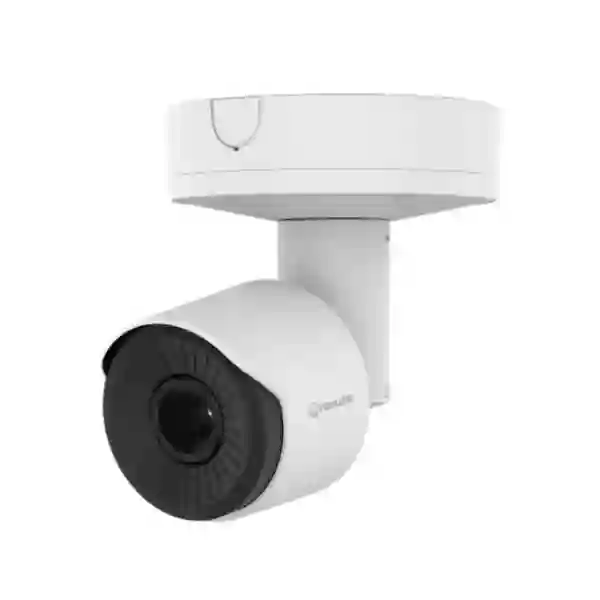
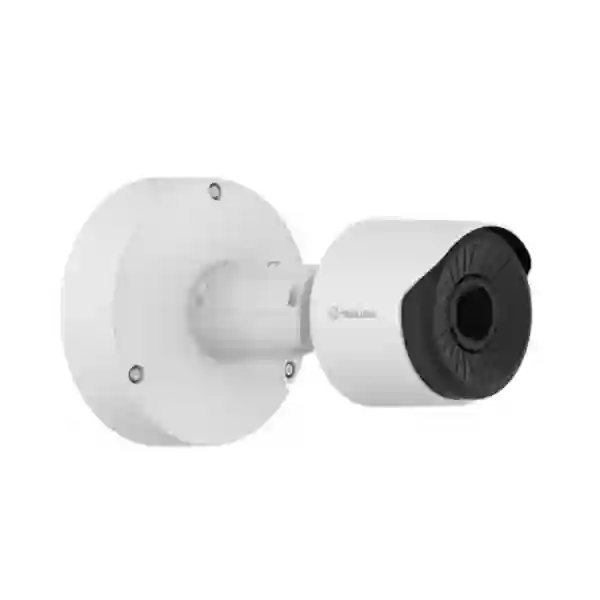
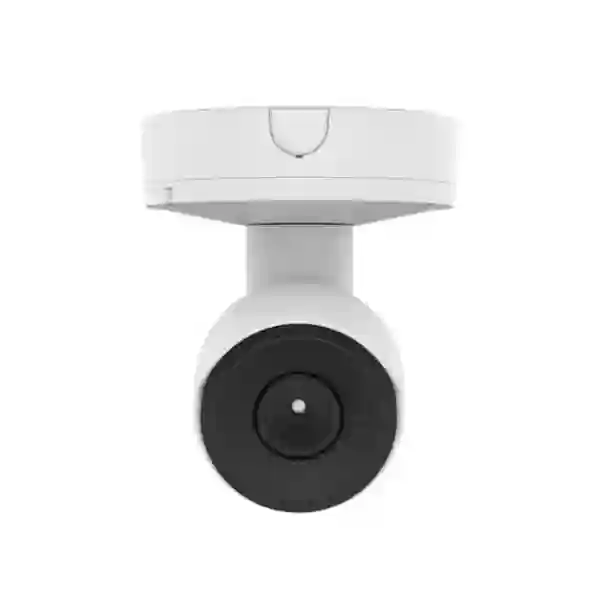
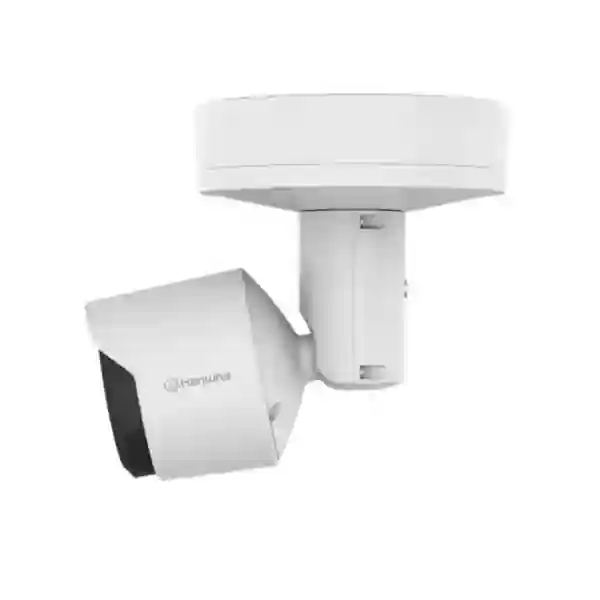
Hanwha Vision TNO-C3032TRA radiometric AI thermal camera
Monitor defined heat conditions and detect selected people or vehicle movements with a network thermal camera designed for professional installation. This 9.7 mm, 8 fps model combines temperature regions, thermal imaging and AI analytics, making it worth evaluating for industrial sites and security perimeters in Tanzania.
Request an application-specific quotation after confirming coverage distance, measurement requirements, integration, installation conditions and alarm response. Price, local stock, delivery and installation terms must be confirmed separately.
Verified specifications at a glance
| Sensor | 384 × 288 uncooled thermal microbolometer |
|---|---|
| Lens | 9.7 mm fixed; approx. 38° horizontal field of view |
| Video | Up to 8 fps; H.265, H.264, MJPEG |
| Temperature | −40°C to +550°C detection range |
| Thermal measurement | 10 polygonal regions, spot reading |
| AI analytics | Person and vehicle classification |
| Connectivity | Ethernet; ONVIF S/G/T/M; RTSP; SUNAPI |
| Power | PoE 802.3af Class 3 or 12 V DC |
| Housing | IP66/IP67, IK10, NEMA 250 Type 4X |
Specifications reflect manufacturer information for the exact model. Design and firmware details may change; confirm current documentation for procurement.
The three decisions that matter most
- Scene: Is the target large enough and visible at the planned distance?
- Event: Is the requirement temperature change, person/vehicle activity or both?
- Response: Will the intended platform and staff receive, verify and act on the event?
What this radiometric thermal camera is designed to do
The Hanwha TNO-C3032TRA is intended for sites that need a picture of heat conditions as well as useful security events. It combines thermal imaging, temperature measurement and AI classification in one fixed network camera. Instead of depending on reflected visible light, its sensor responds to long-wave infrared energy from the scene. This makes it a candidate for watching equipment and defined outdoor areas when normal lighting is poor or variable. The result is additional information for an operator, not a guarantee that every incident will be detected.
For an industrial buyer, the important question is whether the camera answers a particular operational problem. A temperature-monitoring project may focus on a defined piece of equipment or a storage zone. A security project may focus on people crossing a line or vehicles entering an area. A combined project may need both. Each objective affects the viewing angle, mounting distance, alarm configuration, recording plan and response procedure. Establishing those conditions before procurement is more valuable than choosing a camera on resolution alone.
This model has a 9.7 mm fixed lens, a native 384 × 288 thermal detector and a maximum 8 fps frame rate. Its stated temperature detection range extends from minus 40 to plus 550 degrees Celsius. AI analytics distinguish people and vehicles in supported scenes. These are useful capabilities for selected industrial and perimeter applications, but successful installation depends on the target size, weather, background, network and practical testing at the actual site.
A quick fit assessment before you request a quotation
Start by identifying the event you want to catch. If the problem is unusual surface temperature at a motor, a loading area or a process component, list the objects, their normal temperature patterns and the action required after an alarm. If the problem is an intrusion after working hours, describe the boundary, the type of movement, nearby roads and any animals or heat sources that could produce nuisance events. A precise event description helps determine whether the camera is appropriate.
Next, establish the distance and width of the monitored area. The 9.7 mm lens provides an approximately 38-degree horizontal field of view and 29-degree vertical field of view. That perspective may suit a defined approach or equipment area, but it cannot simultaneously provide fine detail and unlimited wide coverage. If a wide scene must be watched at a short distance, review a shorter focal-length alternative. If identification of faces or printed labels is required, a visible-light camera is also needed.
Finally, write down the integration requirements. Confirm the video management system, recorder, switch capacity, network segmentation, storage policy, event response and personnel who will use the alerts. The camera supports common video and event interfaces, yet specific features should be tested with the intended software and firmware. This review avoids the costly situation where a camera produces an image but the desired alarm or temperature value is unavailable in the operator’s normal workflow.
How thermal imaging differs from ordinary CCTV
A thermal camera creates an image from differences in emitted infrared energy rather than from colour and visible illumination. It can therefore reveal warm people or vehicles against a cooler background without a visible-light illuminator. It may continue to provide useful contrast in some dark, misty or smoky conditions where an ordinary camera struggles. Performance is not uniform across every type of fog, rain, dust or smoke, so site testing is important rather than assuming thermal imaging can see through every obstruction.
Thermal imagery is fundamentally different from a colour photograph. The user should not expect readable number plates, clothing colours, product labels or reliable facial identification from a QVGA thermal sensor. Those tasks call for a complementary optical camera chosen for the relevant detail. Thermal and visible cameras can provide different evidence for the same event: one highlights a temperature pattern or moving heat source; the other supplies contextual visual information if illumination and conditions permit.
Another common misconception is that thermal cameras see through walls, closed doors or ordinary window glass. In normal use this product measures radiation reaching the detector from visible surfaces in the thermal sense. Many building materials and conventional glass block the relevant infrared wavelengths. A camera outside a closed room cannot be relied upon to measure the temperature of objects hidden inside it. Plan clear lines of sight to surfaces that need observation.
Sensor resolution, thermal sensitivity and display output
The camera uses an uncooled microbolometer with 384 × 288 native detector elements, often described as QVGA thermal resolution. The specification also lists a 768 × 576 output option. Buyers should distinguish a higher displayed or encoded pixel dimension from the native sensing detail. Upscaling can improve presentation on a monitor, but it cannot create the same measurement information as a detector with more physical pixels. Evaluate the original thermal detail against the smallest target that matters.
The detector operates over the 8 to 14 micrometre spectral band and uses a 17 micrometre pixel size. Hanwha Vision specifies thermal sensitivity of 30 mK or better under its stated measurement conditions. That sensitivity supports differentiation of relatively small thermal contrasts, although the appearance of an actual target also depends on distance, atmosphere, emissivity and the surrounding scene. Sensitivity is not equivalent to guaranteed temperature measurement accuracy or identification performance.
Supported video compression formats include H.265, H.264 and MJPEG, with a maximum frame rate of 8 frames per second for this particular model. This is an important procurement distinction. Eight frames per second may be suitable for gradual temperature changes and many boundary-monitoring tasks, but a fast-moving process may need higher temporal resolution. Determine the speed of the event, how quickly an operator must react and whether the recording should show intermediate motion before deciding that the rate is sufficient.
Understanding the 9.7 mm lens and field of view
The 9.7 mm fixed-focus lens provides approximately 38 degrees horizontally, 29 degrees vertically and 47 degrees diagonally. The minimum specified object distance is 2.8 metres. These figures determine how much of a site appears in one frame and how many native thermal pixels represent an object. A camera installed too far away from a small critical component may show that component as only a few detector elements, making the temperature reading less representative of the actual hot spot.
Choose the mounting point by drawing the viewing cone over the target area. Consider the farthest object, nearest object, required temperature zone and likely obstructions. A short standoff can be challenging if the desired scene is much wider than the fixed view. A long standoff may be challenging if a critical item occupies only a tiny fraction of the image. No amount of digital magnification changes the physical angle of view or restores details absent at the detector.
The camera housing supports mechanical pan, tilt and rotation adjustments during installation, but these are positioning ranges rather than a claim that the product is a motorised patrol PTZ camera. Configure the fixed viewing direction deliberately, tighten mounts according to the installation guidance and document the approved aim point. If the process or perimeter changes later, re-evaluate the scene and alarm regions rather than assuming the initial setup remains suitable.
Detection distance is not the same as identification
Hanwha Vision publishes Johnson-criteria DRI figures for this model. The person figures are 336 metres for detection, 84 metres for recognition and 42 metres for identification. Vehicle figures are 857, 214 and 107 metres respectively. These are manufacturer model-based reference values using defined pixel-density thresholds; they are not guarantees for real intrusion detection or evidential identification at those distances. Weather, background temperature, target size and analytics conditions all affect practical results.
Detection generally means sufficient thermal pixels to distinguish that a target may be present, not necessarily that an operator can describe exactly who or what it is. Recognition and identification require more image information. For many industrial sites, an early warning that something has crossed a boundary is useful even when the camera cannot provide conventional visual identification. For investigations, however, a properly positioned optical camera or additional viewpoint may be essential.
Plan coverage using the weakest realistic situation, not the largest number in a range table. Check whether the far end of the area has adequate target pixels and whether vehicles, trees, fencing or warm equipment will mask movement. Test the expected subject at several representative distances and verify both the visual result and actual event notifications. If the application has a strict detection-probability requirement, obtain an engineering design and acceptance criteria rather than relying on a single DRI figure.
Radiometric monitoring and temperature regions
Radiometric capability means the camera can produce temperature-related readings rather than only a heat-pattern picture. The TNO-C3032TRA supports a stated temperature detection range from minus 40 to plus 550 degrees Celsius. The manufacturer lists ten polygonal temperature regions of interest and spot temperature readings. Those functions make it possible to focus monitoring on particular surfaces or areas instead of treating the whole frame as one undifferentiated alarm zone.
Region conditions include above, below, increase and decrease options. An operator might monitor whether a defined component crosses a review threshold or whether a storage zone shows an unusual temperature shift. Before creating thresholds, observe normal operation across several representative conditions. Ambient temperature, process loading, sunlight, rain and the operating cycle can all change what is normal. A threshold chosen without a baseline can create either excessive alarms or missed developments.
The camera’s thermal palette settings help a person interpret the image, but colour selection is a viewing aid rather than an independent temperature measurement. Record which region represents which asset, the approved threshold, the owner of the alarm and the intended escalation. For mission-critical processes, treat thermal events as one input to a wider operational safety system. A camera alert should be paired with an appropriate on-site response plan, not presented as automatic incident prevention.
Temperature accuracy and measurement limitations
The manufacturer’s current specification describes temperature accuracy as plus or minus 2 degrees Celsius at measurements up to 150 degrees Celsius and plus or minus 15 percent above 150 degrees Celsius. Those figures require careful interpretation and do not mean every distant, small or reflective surface will be measured to that tolerance in any environment. The result depends on measurement conditions and whether the target fills enough thermal pixels. Consult the manufacturer’s latest instructions for applicable settings and constraints.
Surface emissivity is particularly important. Different materials emit and reflect thermal radiation differently. Bare or polished metal may reflect surrounding heat sources and produce misleading apparent temperatures, while high-emissivity surfaces can be easier to evaluate. Viewing angle, intervening atmosphere, dust and solar heating may further affect the reading. Establish what physical surface will be monitored, whether it is representative of the underlying equipment condition and how its measurement will be verified.
Temperature values from a network camera should not automatically be treated as calibrated industrial instrumentation or medical readings. For safety shutdowns, regulated measurements or quality-control decisions, determine whether a dedicated sensor, independent confirmation or formal calibration process is required. The most useful deployment often combines the camera’s broad visual thermal awareness with specialised instruments at critical points. Define who will verify an alert before it triggers any consequential intervention.
AI person and vehicle classification
Built-in AI analytics can classify people and vehicles and support events such as object detection, virtual line crossing and activity in defined areas. The value is not just that a thermal object appears in the frame; the system can help focus operator attention on selected types of movement. For example, a perimeter rule might watch for a person entering a restricted walkway, while an access approach might watch for a vehicle travelling through a virtual line.
AI classification is not perfect and should not be described as eliminating false alarms. A person’s thermal shape can be partly hidden by equipment, vegetation or a fence. A vehicle may merge with a warm background, while unusual weather can reduce contrast. Accuracy also depends on the camera’s viewpoint and configured event area. Test the exact events you want, including legitimate staff movement, service vehicles, environmental changes and edge cases that resemble a prohibited event.
Use event rules that reflect the business process. A loading bay may have predictable delivery movements during working hours and tighter controls at night. A plant route may require different rules for pedestrians and vehicles. Document which detections should create a live notification, which should only be recorded and which should be reviewed periodically. Analytics are most helpful when the operator receives a small number of meaningful, actionable events rather than a constant stream of unexplained notifications.
Industrial overheating and early-warning use cases
An industrial site may use the radiometric features to watch a defined surface where an abnormal rise in temperature could merit investigation. Candidate examples include selected electrical equipment exteriors, mechanical assemblies, material handling areas or battery-related spaces, provided there is an unobstructed view and suitable engineering assessment. The specific cause of heat still requires diagnosis. The camera cannot infer every possible internal fault from an external surface measurement.
One practical workflow begins with baseline observations during normal production, followed by approved temperature regions and escalation thresholds. Operators then distinguish routine process changes from readings that require attention. If an alarm occurs, the procedure should specify who confirms the condition, how the location is made safe and which qualified staff respond. Automated notices can accelerate awareness but are not a substitute for maintenance inspections, specialist condition monitoring or trained emergency response.
The product should not be described as a certified fire detector, a replacement for a fire-alarm system or proof that a fire will be prevented. A radiometric camera may support an early-warning strategy at carefully selected locations, but effectiveness depends on what can actually be seen and measured. Buyers planning a safety-critical installation should review the broader hazard assessment, required standards and the independent protective systems already present at the facility.
Perimeter protection without visible-light dependence
Thermal imagery can be valuable around yards, stores, industrial fences and access approaches where lighting changes throughout the night. A person may stand out against cooler surroundings without a bright floodlight illuminating the entire area. This can make thermal monitoring a useful addition to the security layout, particularly when a conventional camera has difficulty maintaining exposure against strong lights, shadows or dark backgrounds.
Good perimeter design still requires more than mounting a camera and drawing a line on screen. Trees, tall grass, moving machinery, hot exhausts, animals and public footpaths must be considered. The aiming angle should reduce blocked sections of fencing and give analytics enough clear image area around the intended line or zone. A camera placed too high, too low or too far from the boundary can produce an image while providing poor event classification.
An effective security response connects each detection to a human or documented procedure. Decide whether the event should activate the video management system, prompt a guard to review another camera or trigger a permitted site alarm. Where identity or colour evidence matters, combine thermal observation with suitable optical coverage. Keep the security objectives realistic: the thermal camera supports detection and situational awareness but does not by itself verify identity, intent or authorisation.
Combining temperature monitoring with security workflows
The same camera can serve different stakeholders, but combined use must be deliberately designed. A maintenance engineer may care about a slow temperature increase in a machine region. A security operator may care about movement across a fence. These events have different time scales, priorities and response actions. Configure them separately so that a routine security event is not mistaken for a process fault and an important temperature change does not disappear in a busy alarm list.
Create an alarm matrix that records each event source, normal operating condition, alert threshold, review method, urgency and responsible team. Include out-of-hours coverage and the steps to take when the camera is offline. Where network integrations are required, validate how the specific recorder or management platform exposes AI events and radiometric readings. ONVIF support is useful, but it does not guarantee that every proprietary analytic field appears identically in all software.
Keep change control simple and traceable. If maintenance staff move an asset or security staff change an access route, the affected regions may need adjustment. Record the old and new alarm settings, the reason for the change and a test result. This practice helps teams understand why alerts changed over time and reduces the risk that a camera remains powered and streaming while no longer monitoring the asset or boundary it was purchased to protect.
Outdoor deployment in Tanzania
Industrial and commercial buyers in Tanzania may be working with outdoor yards, dusty approaches, exposed infrastructure or areas where the available lighting varies substantially. The camera has manufacturer-listed IP66/IP67 protection, IK10 impact resistance and NEMA 250 Type 4X enclosure classification. These ratings are relevant when assessing an outdoor installation, but they do not remove the need for correct cable entries, suitable mounting hardware and protection against site-specific mechanical and environmental risks.
The specified operating ambient temperature range is minus 40 to plus 60 degrees Celsius, with non-condensing humidity conditions. These are the camera’s environmental operating limits, not the temperatures it can measure in a target scene. Hot equipment surfaces can be within the radiometric measurement range while the camera electronics still need to remain inside their own allowable ambient conditions. Avoid mounting beside direct heat exhausts or in enclosed spaces where the device may overheat.
Before purchasing for a Tanzanian project, review local site conditions rather than assuming that a product rating alone confirms suitability. Check shade, airborne dust, salt exposure where relevant, driving rain, lightning protection, power quality, physical security and network access. Confirm any project-specific import, installation or procurement requirements through the appropriate channels. No local approval, stocked quantity, installation coverage or delivery commitment should be inferred merely from an international product specification.
Mounting position, obstruction and scene design
Site drawings should show the proposed camera position, target regions, visible obstructions and approximate viewing distances. Survey the location during active operations where possible. A clear line of sight in an empty plant can disappear once trucks, pallets or temporary structures occupy the space. A fixed thermal camera cannot automatically reposition itself around these obstructions. In areas where blockage is likely, consider an additional viewpoint or another type of sensor.
Mounting height affects both coverage and analytics. Looking sharply downward may reduce the visible profile of a person, while a very shallow angle can put many targets behind one another. For temperature monitoring, viewing the correct equipment surface is more important than capturing the largest possible scene. Avoid including irrelevant heat sources if they complicate alarms, and remember that polished or wet surfaces may reflect surrounding infrared energy differently over time.
Provide stable mechanical support appropriate for a housing weighing approximately 1.7 kilograms, plus bracket and cable loads. Review the manufacturer’s approved mounting accessories and secure the assembly against vibration or accidental movement. After installation, retain an approved reference image, region drawings and a description of the intended aim. Those records give future maintainers a clear basis for checking whether the monitored area has drifted after service work or environmental exposure.
Power, Ethernet and installation interfaces
The TNO-C3032TRA can be powered using PoE conforming to IEEE 802.3af Class 3 or a 12 V DC input. Hanwha Vision lists maximum consumption of 10.8 W over PoE and 9.4 W at 12 V DC. Design for the stated maximum plus the appropriate infrastructure margin rather than using a typical operating figure as the entire power budget. The product uses a shielded RJ-45 network interface with support for 10/100/1000BASE-T Ethernet.
Review the end-to-end power path, including the switch or injector, cable run, termination, protective devices and any backup supply required by the site’s operating policy. A working camera is of limited use during a critical outage if the switch, recorder or alarm receiver has lost power. Where power continuity is a requirement, specify it for the complete chain and confirm that the selected hardware supports the required capacity and runtime.
Other manufacturer-listed interfaces include configurable alarm input/output ports, RS-485, audio input and line output, with configuration-dependent capabilities. A Micro USB service preview is described for installation use and requires a compatible Wi-Fi dongle; it should not be planned as a normal permanent video-output connection. Confirm pinouts, electrical limits and compatible accessories against the current installation manual before wiring the device to external alarms or controllers.
Video platform and event integration
Video integration is easier when requirements are written as a feature checklist rather than a single statement that a platform supports IP cameras. The product lists ONVIF Profiles S, G, T and M, along with RTSP and Hanwha Vision’s SUNAPI interface. These standards and interfaces can help with streaming, recording and selected metadata workflows, but software implementations vary. Confirm the required profile, firmware version and platform licence for the exact installed system.
Test live view, playback, user permissions and event arrival independently. An NVR may record the thermal stream correctly while failing to display certain temperature-region metadata or AI classification details. If the operator requires a temperature overlay, numeric value, selected palette, alert bookmark or event acknowledgement, validate that behaviour with the proposed management software. Do not assume a generic ONVIF connection guarantees the same feature set as a native camera integration.
The product also lists support for MQTT and event actions such as notifications, alarm output and selected recording or file-upload actions. These features may support a wider monitoring workflow when properly configured and secured. Determine whether event messages must be received by a building system, security console or maintenance dashboard, then check the exact field mappings and failure behaviour. An event path should be tested after updates and network changes, not only during initial commissioning.
Recording, frame rate and retention planning
A maximum 8 fps thermal stream can support monitoring needs that do not require high-speed visual analysis, but retention capacity still depends on codec, image settings, scene complexity, event frequency and recording schedule. The camera provides H.265, H.264 and MJPEG options and supports multiple streaming profiles. Use an actual bitrate estimate from the proposed configuration instead of assuming that a particular resolution always produces a fixed amount of network traffic.
Manufacturer information lists one microSD, SDHC or SDXC storage slot with support up to 1 TB, subject to suitable card and configuration. Edge storage can provide useful local recording functionality, but the procurement plan should establish whether it is the primary store, a backup or a supplement to network recording. Evaluate card endurance, data access, failure detection and the relationship between onboard events and central storage before relying on a single medium.
Retention rules should be based on business needs, legal obligations and actual storage calculations. Decide how many days of normal footage and how much event history must be available, who can export recordings and whether the operator needs temperatures attached to those records. Test recovery after a network disconnect and verify the timestamps of events against the management platform. Camera and server clock consistency is especially important when combining thermal alerts with other security or operational logs.
Cybersecurity and controlled network access
The manufacturer’s feature list includes secure boot, signed and encrypted firmware, device credentials, encrypted communication options and a trusted platform module. The camera also lists HTTPS, 802.1X authentication and logging features. These support a defence-in-depth deployment, but their presence does not make any networked device secure without proper configuration, updates and operational ownership. Security settings should be reviewed as part of the installation acceptance process.
Use unique credentials, role-based access and only the services that the project needs. Place cameras on appropriately segmented networks, restrict management access, protect backups and make event destinations explicit. Review how administrators will manage firmware versions and security advisories. If a cloud connection or remote maintenance path is planned, verify the vendor functionality, applicable data handling arrangements and the organisation’s own cybersecurity policy before enabling it.
An operational plan should say who is authorised to change regions, export footage, alter user permissions or update firmware. Maintain a device inventory with location, serial details recorded by the owner, configuration version and support contact. Schedule reviews when network architecture or the video platform changes. Avoid exposing the camera directly to the open internet for convenience; use a properly designed remote-access method approved by the customer’s IT security team.
How to configure meaningful temperature alarms
Begin with the physical process rather than the software menu. Confirm the exact surface of interest and why its temperature matters, then observe it across normal shifts, workloads and ambient conditions. Determine whether the important event is crossing an absolute threshold, a rapid change or a persistent deviation from normal operation. The camera supports region conditions such as above, below, increase and decrease, but a correct menu selection alone does not establish a reliable alarm strategy.
Assign separate regions to clearly distinct assets wherever the viewing geometry allows. Avoid broad polygons that include multiple unrelated heat sources because the resulting measurement may be difficult to interpret. Check that the region remains aligned when the asset is operating and that moving equipment does not briefly cover it. Define the expected response and consider whether a short transient should be reviewed differently from a sustained abnormal reading.
During commissioning, test alarm generation, delivery, display and acknowledgement as a complete sequence. Record the threshold, ambient conditions, actual target arrangement and confirmation method used. If an event is intended to initiate maintenance inspection, make sure the maintenance team understands the limitations of a surface thermal reading. If a higher-consequence action is needed, design appropriate independent verification and safeguards instead of relying on an uncorroborated camera reading.
Commissioning tests for security analytics
Test line-crossing and area events using representative people and vehicles at the distances and directions expected in daily operation. Include both authorised and unauthorised routes to see whether the rule geometry matches the operational intent. Observe the events under different lighting conditions, and revisit testing when ambient temperatures or weather shift significantly. A camera that appears effective during a brief daytime demonstration may behave differently at the edge of its coverage.
Check the complete response chain from detection to the recipient. Confirm what the operator sees, whether the event is correctly labelled, how it is prioritised and whether supporting footage is available for playback. Simulate a network loss or device restart according to the site’s test procedure and confirm that faults are noticed. Record any scene that routinely produces nuisance events so that the installer can refine the area or recommend a different monitoring approach.
Agree on acceptance criteria before site handover. Useful criteria can include camera availability, scene coverage, specified test events, temperature region behaviour, video retrieval and cybersecurity configuration. Do not promise a universal percentage detection rate without a validated test method and site-specific evidence. A documented functional acceptance test makes future troubleshooting more practical and gives the buyer a realistic understanding of what the installed solution is designed to do.
Maintenance and operating checks
Thermal cameras need maintenance even when their enclosure is designed for exposed environments. A dirty optical window, shifted bracket or new obstruction can reduce useful performance while the network stream continues to function. Create a schedule for visual inspection, approved cleaning, alarm review and verification of the camera aim. Follow the manufacturer’s cleaning and handling instructions; improvised solvents or abrasive cleaning can damage sensitive exterior surfaces or protective elements.
Periodically review temperature-region settings against changing equipment conditions and security analytics against altered site traffic. New racking, temporary storage, growing vegetation or modified vehicle lanes can invalidate an earlier scene design. Check that alert recipients and escalation procedures are still current, particularly when staff responsibilities change. A monitoring system is only as useful as the process for interpreting and acting on the information it provides.
Include firmware status, account access, time synchronisation, storage health and event delivery in routine checks. Keep records of changes and test important alarms after maintenance. When a persistent reading seems implausible, investigate possible environmental or measurement causes before altering thresholds. Good maintenance turns the camera from a one-time installation into a managed operational tool, while preserving evidence about how and why its alarm behaviour changes.
Comparing lens and frame-rate variants
The exact model suffix matters. The TNO-C3032TRA has a 9.7 mm lens and an 8 fps maximum frame rate. Within Hanwha Vision’s related radiometric thermal family, other models use shorter fixed focal lengths and some versions are specified for up to 30 fps. Those alternatives are not interchangeable simply because their housings or QVGA sensor family appear similar. Check the precise model code on every quotation, bill of materials and procurement approval.
A shorter focal-length option can provide a wider view of a nearby scene but represent a distant object with fewer pixels. A longer focal-length view can concentrate more pixels on a narrower portion of the site. Higher frame rate can help when the movement or process changes quickly, but it may also affect selection, export requirements and project costs. Decide based on viewing distance, target dimension, event speed and interface needs rather than assuming the highest headline number is always best.
For a thermal perimeter project, begin with target geometry and practical event tests. For temperature monitoring, begin with visible surface size, measurement uncertainty and threshold relevance. For mixed use, consider whether one fixed view serves both functions adequately or whether two differently positioned devices would be a better design. Request written confirmation of the proposed model and firmware-dependent capabilities before final approval of the system.
Questions to settle with the project team
Ask the responsible engineer which process or boundary will be monitored, at what distances, and under which normal and abnormal conditions. Establish whether the required outcome is a live image, a numeric temperature, a classification event or a documented alert in the central system. Also ask which actions would create significant operational or safety consequences. These answers determine whether a camera-only design is reasonable or whether independent instrumentation and protective systems are required.
The IT and security teams should confirm network topology, PoE budget, firewall policy, management software, authentication method, retention and access permissions. The facilities team should confirm mounting approvals, cable routing, power backup, maintenance access and environmental constraints. Procurement should request the exact camera model, required brackets, storage media and compatible software details, with any service, delivery and warranty terms stated explicitly in the final quotation.
Before accepting a proposal, request a coverage drawing, event matrix, representative test plan and clear exclusions. These materials distinguish a complete monitoring solution from a camera supplied without integration or commissioning. Local stock, price in Tanzanian shillings, delivery, installation and warranty terms must be confirmed for the actual transaction; they are not implied by this technical overview. A disciplined review protects the project against assumptions that only emerge after equipment arrives.
Who should consider this model and who may need an alternative
The TNO-C3032TRA may suit a project that wants fixed-view thermal observation, selected temperature regions and AI-based person or vehicle events in the same networked device. It is especially worth evaluating when darkness or variable visible lighting makes ordinary CCTV alone insufficient, or when surface-temperature awareness could improve an established inspection workflow. Its environmental design and network interfaces make it a candidate for professionally engineered outdoor and industrial systems.
An alternative is advisable when the requirement is facial identification, vehicle number plates, colour evidence, imaging through walls or ordinary windows, high-speed motion capture, or a formally calibrated process measurement beyond this product’s specified limits. The same applies when a target is too small or distant for useful native detector pixels. In those cases, a visible camera, different thermal lens, dedicated sensor or other equipment may be necessary.
A well-chosen thermal camera is not necessarily the one with the longest range figure or broadest feature list. It is the one that reliably supplies the information needed at the real viewing distance and integrates with the owner’s operating procedure. Treat the quoted equipment as part of a system: camera, mounting, network, storage, software, alarm response and maintenance. Review those elements together before committing to a site design.
Frequently asked questions
Does this camera work in complete darkness?
Yes, its thermal sensor does not depend on visible lighting in the way a conventional colour camera does. It observes infrared energy from the scene, so it may show people and equipment at night without a visible-light illuminator. This does not guarantee equally good results in every weather condition or through physical obstructions.
Can it measure the temperature of a machine?
It offers radiometric measurement within a specified range and has temperature regions and spot readings. A useful result requires the correct surface to be visible, sufficiently large in the thermal image and suitable for the measurement conditions. Emissivity, reflections and ambient conditions matter. Critical decisions may require independent instrumentation.
How many temperature regions can be configured?
The manufacturer lists ten polygonal regions of interest for temperature detection. Each region should correspond to a clear asset or operational purpose, and its alert condition should be tested during representative operation. The right number of regions is determined by meaningful monitoring needs, not by filling every available slot.
Is the image resolution really 768 × 576?
The native thermal detector is 384 × 288. The specifications also list 768 × 576 as an available output resolution. That larger display dimension should not be confused with a detector that physically captures 768 × 576 independent thermal measurements. Evaluate the native pixel detail for small or distant targets.
Can it identify people or read number plates?
The built-in analytics can classify people and vehicles, but that is not the same as establishing a person’s identity. Its QVGA thermal view is not intended to replace a suitable visible-light identification camera or automatic number plate recognition solution. Use additional optical coverage where those details are essential.
What is the maximum video frame rate?
For the TNO-C3032TRA, the published maximum is 8 fps across the listed compression formats. Confirm that this is suitable for the movement speed and recording objectives of the project. Do not substitute a related 30 fps model’s specification when evaluating the exact model named in the quotation.
Can it connect to an existing NVR or VMS?
The model lists ONVIF Profiles S, G, T and M, RTSP and SUNAPI. These provide integration routes, but support for video does not automatically prove support for every radiometric value, alarm type or metadata field. Test the desired features with the exact NVR or VMS version and camera firmware.
Is it suitable for outdoor installations?
Hanwha Vision lists IP66/IP67, IK10 and NEMA 250 Type 4X environmental classifications for this model. An appropriate installation still requires correct brackets, sealed connections, suitable cabling and consideration of ambient temperature, condensation, vibration and the individual site’s environmental exposure.
Does a temperature alarm replace a fire alarm?
No. Thermal monitoring can assist with observation of certain abnormal surface-temperature conditions, but it is not a substitute for a properly designed fire detection, alarm or protection system. The wider safety assessment should define independent safeguards, verification and emergency procedures.
How should a Tanzania buyer request the right configuration?
Provide the monitored asset or boundary, approximate distances, a site drawing or clear photographs, existing network and recorder details, and the desired event response. Ask for confirmation of the exact model, accessories, software compatibility and written commercial terms. Availability, pricing, local support and delivery require confirmation for the specific order.
Request a TNO-C3032TRA project quotation
Share the monitored area, distances, required temperature thresholds or security events, existing CCTV platform and installation constraints. Ask for a configuration review covering the exact camera model, compatible mounting and network equipment, recording, event integration and commissioning. The proposed solution should document measurement limitations, acceptance criteria and any independent safety safeguards required by the application.
Contact FourTeck Tanzania through its verified enquiry channel to discuss suitability and obtain confirmed commercial terms. No local inventory, price or delivery timeframe is assumed on this page.




Reviews
There are no reviews yet.