
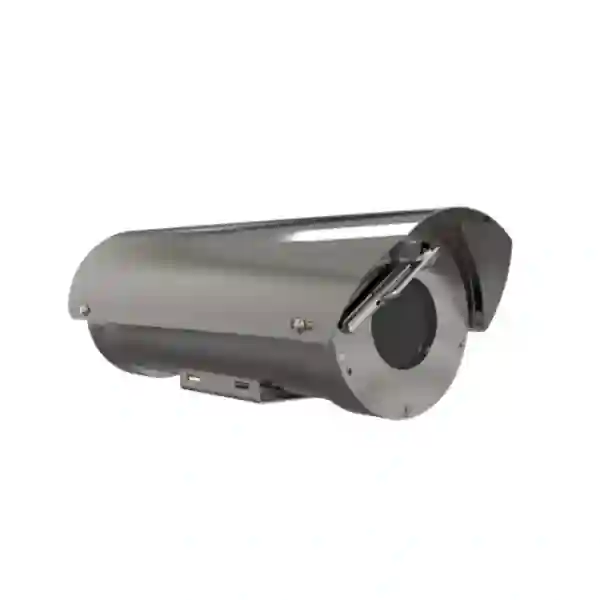
Hanwha Vision TNO-X6320E1WT1-Z Explosion-Proof 32x Zoom Network Camera
Purpose-built visible-light surveillance for carefully engineered hazardous-area projects, combining 2MP video, 32× optical zoom, an integrated wiper and 316L stainless-steel construction. The right decision starts with verified site classification, viewing needs and installation design.
At a glance: confirmed product features
The technical attributes above describe the manufacturer’s stated camera capabilities. They do not confirm that the equipment is approved for an individual hazardous location or available from local stock.
Why choose this industrial explosion-proof zoom camera?
The Hanwha TNO-X6320E1WT1-Z explosion-proof camera is intended for locations where ordinary surveillance hardware may not be appropriate. It brings full-HD network video, remotely adjustable optical zoom, and an industrial enclosure together in one product. The immediate buying question is not simply whether the image looks clear; it is whether the proposed camera, housing, certification and installation method match the hazards and operational needs of a specific site. That distinction matters especially when monitoring activity around processes, equipment, boundaries and work areas.
In a conventional security project, an installer may choose a camera mainly by field of view, recording budget and mounting height. At an industrial installation, the selection starts earlier. Engineering teams need to establish the hazardous-area classification, the gases or dusts involved, environmental exposure, inspection access and permitted electrical equipment. Only then should image coverage and video software be evaluated. This product offers a strong starting point for that conversation, but its description does not replace site-specific engineering approval.
The camera’s 32× optical zoom can help operators examine a defined region at different levels of detail without physically moving the mounting point. Integrated video analytics can flag selected events, while the wiper helps manage some visibility problems on the viewing window. Those features may support faster investigation or better monitoring workflow; they do not by themselves guarantee that a person, label, vehicle or small object will be identifiable at every distance, weather condition or lighting level.
For a procurement team in Tanzania, a useful enquiry should include the exact model suffix, intended installation zone, distance to target, required evidence quality, recording platform and power constraints. Ask suppliers to check the configuration rather than treating all explosion-proof products as interchangeable. A request for technical review before quotation helps prevent expensive changes to mounting, cabling or network infrastructure after the site has already been prepared.
Understand explosion-proof design and approval boundaries
Explosion-proof is a specific engineering concept, not a promise that a camera is suitable for every hazardous location. A certified enclosure is developed and assessed against defined conditions, and those conditions may involve installation methods, markings, cable entries, temperature limits and other restrictions. The product name alone does not establish that it may be installed in any refinery, tank farm, chemical plant, mining installation or fuel-storage area. Local project requirements must determine whether the exact supplied variant is suitable.
Hanwha Vision lists cLCus Class I, Division 1 information for the -Z model family, together with IP66 and IP67 environmental protection. The precise scope of the shipped unit’s certification and label should be confirmed against the official certificate, current technical documentation and site requirements. Do not assume that a classification used in one regulatory system automatically satisfies another, or that certificates shown for similarly named -C or -M variants apply to the -Z variant.
An ingress-protection rating describes resistance to specified dust and water exposure under defined tests; it is not the same thing as explosion-protection approval. Likewise, stainless steel may assist with environmental durability but cannot substitute for an approved cable-entry system or safe electrical installation. Buyers should verify the complete assembly, including cable glands, mounting accessories, terminal arrangements and any supplementary equipment that will enter the hazardous area. The weakest unapproved component may determine whether an otherwise capable design is acceptable.
Before issuing a purchase order, obtain the site’s hazardous-area drawing and the specification accepted by the responsible engineer or competent authority. Compare these with the actual equipment marking, wiring requirements, ambient limits and documentation provided for the exact camera variant. If the match cannot be established, hold the order while an appropriately qualified specialist reviews alternatives. This page provides product-selection guidance, not a site certification or a declaration of Tanzanian regulatory approval.
2MP full-HD video and 60 fps: what they mean on site
The manufacturer specifies a 1/2.8-inch CMOS imaging device and a maximum resolution of 1920 × 1080 pixels. At the appropriate encoding settings, H.265 and H.264 streams can run at up to 60 fps in a 60 Hz configuration, with regional frequency settings affecting the stated maximum. That combination can be useful when operators need a responsive view of movement, machinery or an access point. It should not be mistaken for high-resolution thermal imaging or a measurement system.
Two megapixels may be sufficient for monitoring an area and reviewing many operational events, but identifying very small objects depends heavily on the scene width and pixel density at the target. At a wide angle, a large process area occupies the frame; at greater zoom, the same pixels can cover a smaller section. Define the important activity and the minimum detail required before deciding that full-HD is enough. Ideally, demonstrate the proposed field of view using actual site distances.
Frame rate is one part of motion clarity. Exposure time, available light, compression settings and network conditions also influence whether a moving object appears sharp in recorded footage. Higher frame rates may demand more storage and bandwidth, while severe low light can make long exposures and noise reduction necessary. Review recorded examples rather than relying only on a headline frame-rate specification, especially where security incidents must be reconstructed after the event.
The camera offers multiple supported resolutions and video profiles. This allows system designers to assign different image settings to recording, live viewing and remote monitoring where compatible software permits. Rather than maximizing every setting, test whether the chosen profile delivers adequate evidential detail and acceptable retention. A balanced configuration can improve reliability over constrained backhaul links while preserving a higher-quality stream for local recording or security operations.
32× optical zoom, lens selection and viewing geometry
The camera’s optical lens spans 4.44–142.6 mm and includes autofocus, manual focus and one-shot autofocus options. Hanwha lists a horizontal angle of view from approximately 61.8 degrees at the wide end to 2.19 degrees at the telephoto end. This is a substantial change in scene coverage. It is useful for projects in which operators alternate between observing a broader process area and inspecting a smaller point of interest within that area.
Optical zoom changes the lens’s field of view while maintaining the camera’s native pixel grid. Digital enlargement, by contrast, cannot add detail that was not captured. For specification work, state the distance to the target and the required horizontal coverage at both zoom extremes. Consider whether an operator will regularly zoom away from a critical area: when the frame becomes narrow, events elsewhere in the original scene may no longer be visible to that camera.
The lens’s stated minimum object distance is 1.5 metres. For close-up inspections, verify that the proposed physical location and window position will permit useful focus. Long focal lengths can also magnify visible vibration, so mounting stiffness matters. The manufacturer lists digital image stabilization using a built-in gyro sensor; nevertheless, a structurally suitable support and careful isolation from machinery vibrations remain important for consistent results under real operating conditions.
This is a zoom camera in a fixed-position housing, not an automatically panning and tilting unit. Remote lens adjustment is not equivalent to moving the camera’s direction. When operators require coverage across several widely separated areas, compare a properly certified PTZ arrangement or multiple fixed cameras. This distinction is particularly important when drafting coverage drawings, alarm-response procedures and expectations for a control-room operator.
Day, night and difficult lighting
For mixed lighting, the TNO-X6320E1WT1-Z includes automatic infrared-cut filter operation for day and night, along with backlight compensation and wide dynamic range. Hanwha specifies WDR up to 150 dB. These functions can help when the image includes bright doorways, reflective equipment or shadowed structures. They improve how the camera handles a difficult scene but cannot make an unlit target visible without adequate illumination or suitable supporting infrastructure.
Published minimum-illumination figures are approximately 0.05 lux in colour and 0.005 lux in black and white under the manufacturer’s specified test conditions. Such laboratory values are useful for comparison, not guarantees of recognition at a distance. On site, the difference between seeing movement and reading a small identification mark can be substantial. Consider illumination design, available contrast, weather and the required evidence standard when making that decision.
In industrial environments, steam, haze, dust, reflective metal, vehicle headlights and rapidly changing daylight can affect images in different ways. The camera supports defog processing and digital noise reduction, but software enhancement has limits. Evaluate the actual scene during daytime and night-time, ideally while relevant processes are running. If the operational need is temperature detection, gas visualization or smoke analysis, specify a suitable purpose-built sensor rather than expecting these capabilities from this conventional visible-light camera.
Image tuning should be recorded as part of commissioning. Check white balance under artificial lighting, exposure near reflective tanks, and focus behaviour when zoom changes. Confirm how the camera performs after rain or during routine washdown if those events are expected. A successful acceptance test should demonstrate the target action under the hardest credible conditions, not only a bright, still demonstration image immediately after installation.
316L stainless steel housing, IP ratings and window wiper
Hanwha identifies the housing material as 316L stainless steel, with a silver finish. Material selection matters in environments exposed to moisture, cleaning chemicals, industrial pollutants or salt-laden air, although corrosion performance always depends on the actual chemical exposure and maintenance programme. Do not interpret a material designation as a blanket guarantee against corrosion. A site engineer should review environmental compatibility, particularly where unusually aggressive cleaning agents or process emissions are present.
The product page lists IP66 and IP67 protection to IEC 60529. These ratings concern specified environmental ingress tests and can support equipment selection for demanding outdoor service. They should be read alongside the manufacturer’s installation instructions, mounting orientation and entry-sealing requirements. Changes made during installation, such as inappropriate cable penetrations or unsupported modifications, may affect the protection of the installed assembly. Avoid basing the entire environmental decision on a rating shown in isolation.
An integrated wiper is a practical feature when water, dust accumulation or surface contamination temporarily obscures the camera window. It can help restore visibility in suitable conditions, but the wiper does not eliminate the need for inspection and cleaning. Abrasive contamination, hardened deposits or unsuitable cleaning procedures may require a planned maintenance response. Any optional washer system should be checked as a separate accessory and included only after confirming compatibility and hazardous-area requirements.
The camera is relatively substantial: Hanwha lists dimensions of approximately 176 × 154 × 480 mm and a weight of 15 kg. This affects bracket selection, lifting arrangements, access for maintenance and the structure supporting the unit. A mounting proposal should account for vibration, wind exposure, service access and local engineering conditions. The camera should never be treated like a lightweight general-purpose bullet camera merely because it performs a similar viewing function.
Analytics that support monitoring rather than replace judgement
The product supports motion detection and intelligent video analytics including tampering, fog, face and shock detection, as well as virtual-line and virtual-area rules. Listed area events include intrusion, loitering, entry, exit and appear or disappear conditions. These functions can provide useful event cues in industrial monitoring. Their operational value depends on scene geometry, software configuration, lighting, moving equipment and the quality of the alert-handling process.
For a plant boundary, a virtual line may help operators focus on unexpected crossings at a controlled access point. For a restricted work zone, an intrusion rule might identify movement within an area defined by the security team. However, each detection rule must be tuned to actual patterns such as routine maintenance crews, authorised vehicles, rain and rotating machinery. A poorly configured rule can create excessive alerts and reduce confidence in the surveillance system.
An analytics event is not the same as a verified safety incident. Video detection should be positioned as a supplement to established site procedures rather than a certified shutdown, fire detection or process-safety function. Where a use case has safety consequences, the controls and responsibilities of the applicable safety system remain separate. Never assume that a camera alert alone provides the reliability or certification needed for hazardous-process protection.
During commissioning, create a simple record for each rule: the purpose, area covered, expected trigger, exclusions, notification destination and operator response. Test a mixture of representative events and normal activities. Then assess how many false or missed alerts occur during an agreed observation period. Consistent documentation makes analytics easier to maintain when the site layout, shifts, lighting or permitted activities change.
H.265, H.264, MJPEG and video system integration
The camera provides H.265, H.264 and MJPEG encoding, together with WiseStream II smart-codec functionality and multiple video profiles. The stated maximum is ten streaming profiles, subject to platform and configuration constraints. This flexibility can serve installations with a local recorder, a control-room display and a lower-bandwidth remote viewer. Each application should be tested using the actual resolution, frame rate and codec combination it will receive.
Hanwha lists ONVIF Profiles S, G and T, along with SUNAPI and other network interfaces. These are valuable integration signals, but an ONVIF label alone does not promise that every third-party recorder will expose each analytic event, edge-recording function or management option. Obtain the current compatibility information for the chosen video management software, recorder firmware and camera firmware. Test live view, playback, time synchronization and event handling rather than checking connection alone.
The camera connects through a 10/100BASE-T RJ-45 network interface. Network design must account for more than the existence of an Ethernet port. Assess cable paths, hazardous-area transitions, switch availability, lightning or surge exposure, upstream capacity and segmentation from operational systems. If a remote facility depends on a radio or cellular backhaul, plan for variable bandwidth and intermittent connectivity. A high-quality local recording stream can coexist with a reduced remote view where supported.
For recording design, establish the number of streams, expected daily recording hours, bitrate assumptions, compression settings and the retention period required by site policy. Continuous footage of a busy scene consumes different capacity from event-driven recording, and analytics do not necessarily eliminate the need for full-time evidence. Ask the integrator to provide a written capacity calculation with realistic allowances for scene complexity and operational growth.
Local storage, events and resilience planning
Hanwha provides two built-in microSD, microSDHC or microSDXC slots with a published maximum of 256 GB per slot, for 512 GB total card capacity. This gives designers options for local edge storage and event recording, but the available recording duration depends on bitrate, card configuration and recording policy. The presence of two slots must not be interpreted as a specified redundancy mode unless that operating behaviour has been verified for the intended firmware and settings.
The official specification describes events that can lead to recording or notifications, including analytics and network-disconnect conditions. It also lists recording targets and event integrations such as memory cards or network-attached storage. The exact available actions should be confirmed in the deployed configuration. A design can combine local buffers with central recording to mitigate some outages, but recovery after a disconnection requires carefully tested software support.
Memory-card selection is an operational decision, not a minor accessory choice. Use media appropriate for the device and recording workload, follow the manufacturer’s formatting and endurance guidance, and set a replacement plan. Environmental operating conditions and frequent rewriting can affect card life. For important evidence, monitor storage health and test export procedures rather than assuming recordings will always be recoverable when an incident occurs.
A resilient surveillance system also needs dependable timekeeping and a documented loss-of-network response. Check NTP access, alert routing, recorder status and operator escalation. If a connection fails, determine which streams are lost, whether local recording continues in the tested setup and how footage is retrieved afterward. These checks are essential where the nearest technical team may not be immediately available to visit an industrial site.
24 VAC power and electrical integration
The TNO-X6320E1WT1-Z uses 24 VAC input power, with a manufacturer-specified maximum consumption of 37 W. It should not be specified as a PoE-powered camera. This distinction has practical consequences: a network cable alone does not satisfy its electrical requirements, and designers must provide a suitable approved power arrangement. Verify supply tolerance, cable distance, voltage drop and the electrical installation method in the manufacturer’s documentation before finalizing the bill of materials.
Power planning should consider the start-up behaviour, continuous load, protective devices, earthing or bonding requirements and the characteristics of the proposed transformer or power unit. In a hazardous area, the electrical design must also address the approved methods of installation. Any supporting power equipment needs its own location and suitability review. Do not improvise with a convenient general-purpose adapter near a process area simply because the nominal voltage appears correct.
For sites where outages occur, decide whether camera recording and network switching need backed-up power. A UPS plan should include the 24 VAC supply arrangement, network equipment and recorder, not only the camera’s wattage. Define which parts of the system must remain functional and for how long. Battery capacity, efficiency and the permitted electrical topology are project-specific and should be calculated rather than assumed from product marketing material.
During acceptance testing, verify operation at the intended supply, monitor any voltage issues during normal activities, and check the integrity of the connection from the camera to the recording system. Label circuits and document safe isolation procedures for maintenance. A well-designed power system is fundamental to surveillance availability, particularly when the camera is installed in a location that requires controlled work permits for every visit.
A practical engineering workflow before installation
Start by recording the monitoring objective in one sentence. Examples include observing movement at a chemical-loading point, reviewing access around enclosed processing equipment or obtaining a closer visual view of a fixed process component. Specify whether the footage is intended for live situational awareness, investigation, compliance records or another authorised purpose. The objective determines lens framing, recording quality, staffing expectations and whether a single fixed view can reasonably meet the need.
Next, commission a competent review of hazardous-area classification and equipment certification. Include the actual camera suffix, environmental conditions, equipment marking and permitted cable-entry details. A generic description such as industrial or explosion-proof CCTV is not enough. Confirmation should be retained in project documentation so future maintenance teams understand the approved installation and do not substitute a visually similar part with different markings.
Survey the physical location with both a camera specialist and the relevant site engineer. Record distance to target, available structures, expected obstruction, sun direction, accessible cable routes, corrosion exposure, window cleaning arrangements and maintenance access. Check whether any moving machinery changes the line of sight. Where possible, use a view simulation or temporary observation to expose blind spots before permanent mounting works begin.
Select the support structure and mounting accessories only after weight, dimensions, fixing conditions and certified installation requirements are known. The manufacturer lists explosion-proof mounting accessories, but a compatible catalogue item is not automatically the correct choice for every structure. The final bracket, fasteners and any other hardware should be supported by relevant calculations or approved engineering practice. Plan safe lifting and access around operating equipment.
After installation, configure the camera on an appropriately isolated network, apply approved firmware and secure credentials, then validate the desired image quality. Test each required profile in the actual recording platform. Verify time synchronization, analytics, alarms, recording retention, playback and event export. Repeat important checks across representative lighting conditions. Record the final configurations so that the system can be restored after maintenance without relying on informal knowledge.
Finish with a documented handover. Provide the site team with operating instructions, approved cleaning steps, inspection intervals, configuration backups, emergency isolation procedures and a contact path for technical escalation. Define who may change zoom, modify analytics or access recordings. For specialist equipment, good documentation can be as important as the initial image quality because it protects the value of the installation throughout its operating life.
Industrial applications that deserve a closer suitability review
At oil and gas facilities, a camera may be proposed to observe a fixed loading area, gate, inspection point or equipment cluster. The 32× zoom range can be helpful where observers need to alternate between context and detail from one mounting position. However, the presence of fuel, vapours or classified process areas makes engineering approval essential. Confirm exact hazard classification and separation distances before treating the camera as an appropriate candidate.
At chemical processing or storage locations, the key challenge may be a combination of harsh environmental exposure and complicated sightlines. Stainless-steel construction, a window wiper and remote zoom can be useful attributes to evaluate. Their suitability depends on the substances handled, cleaning procedures, mounting geometry and equipment markings. Video surveillance also should not be described as a substitute for process instrumentation, gas detection or the protective systems required by the installation.
For industrial yards or logistics sites, fixed-view coverage may help monitor an approach road, vehicle waiting point or restricted entrance. The zoom lens can provide a closer view of a selected detail, but a single camera cannot necessarily preserve simultaneous wide-area visibility when zoomed in. Where multiple targets must be monitored continuously, distribute coverage across separate cameras or assess another properly approved design. This is a coverage-engineering decision rather than a simple model upgrade.
At dusty outdoor facilities, heavy weather and recurring contamination can make window cleanliness a maintenance issue. The wiper and IP-rated enclosure merit attention, but installation crews should also consider access for inspection, the effect of airborne particles and whether abrasive deposits make automatic wiping unsuitable. If the monitoring requirement extends into extreme darkness or demands temperature data, investigate additional illumination or different sensor technology before purchasing.
At ports, process terminals and utility compounds, the camera may form part of a wider recording system with security staff and central management. Interoperability, reliable power, network availability and authorised remote access become central questions. The location may also have specialised permit procedures and environmental constraints. A project-specific review is more useful than a blanket statement that one camera meets all heavy-industry requirements.
Considerations for projects in Tanzania
Industrial projects in Tanzania can involve varied operating conditions, infrastructure arrangements and procurement practices. The correct approach is to define the actual project site and its requirements instead of making countrywide assumptions. Ask whether the installation is coastal, inland, exposed to heavy rainfall, subject to industrial contamination or connected through a constrained communication link. Conditions at one site do not establish suitability for another, even when the proposed camera model is the same.
For the electrical and hazardous-area design, the customer’s responsible engineer should confirm which standards, permits, inspection practices and certification evidence are acceptable for that installation. The manufacturer lists specific international markings, but this page does not assert that those markings constitute Tanzanian approval. If formal acceptance is required by an operator or local authority, request the documents and obtain written confirmation before procurement and installation.
A quotation should separate the camera from mounting, approved cable accessories, power equipment, networking, recording licences if applicable, installation labour and maintenance provisions. Import arrangements, duties, local stock, delivery dates and warranty terms should be confirmed in a current written offer. No price, lead time or inventory level is assumed here. This avoids giving decision-makers an artificially low project cost based only on the camera body.
Where technical support requires travel or controlled access to an industrial zone, maintenance planning becomes particularly important. Consider who will inspect the enclosure, perform firmware updates, maintain the wiper and test stored footage. Include tools, access permissions and safe-work procedures in the plan. Define whether the buyer needs supply only, integration design, commissioning assistance or ongoing support before requesting a tailored commercial proposal.
How to compare variants and alternative technologies
Hanwha uses closely related model names across its industrial surveillance range. Some cameras have a fixed optical direction, while separately named PTZ models can physically move their viewing angle. Related variants can also differ in power, wiper configuration, environmental ratings or certification markings. Verify the full suffix on the specification sheet, quotation, delivery paperwork and physical label. Do not replace a -Z unit with a -C or -M unit without checking the installation’s requirements.
The buying decision should also account for the purpose of the sensor. This TNO model captures visible-light video with optical zoom. It is not described by the manufacturer as a thermal measurement camera, an infrared gas-imaging device or an automatic process-control instrument. Where the intended need is night-time observation with no illumination, heat anomaly detection or gas monitoring, review appropriately designed technologies rather than stretching an ordinary video specification to an unrelated application.
A lower-cost general outdoor IP camera may be completely reasonable in an unclassified location but inappropriate for a classified hazardous area. Conversely, a costly explosion-proof assembly may be unnecessary where the installation is outside any special classification and an ordinary camera satisfies environmental needs. Compare the complete approved system and its operating costs, not just sensor resolution or a catalogue price. The highest-value choice is the one that matches the engineered risk and viewing requirement.
If the requirement calls for panoramic coverage while maintaining a permanently recorded wide shot, one fixed zoom unit may not be enough. Consider multiple fixed views, a dedicated overview camera or an approved PTZ alongside a fixed recording perspective. Ask how each proposed option changes network load, operator workflow, maintenance and access rights. This comparison avoids the common mistake of assuming more zoom alone automatically creates better site coverage.
Cybersecurity, data handling and authorised monitoring
The camera’s documented capabilities include HTTPS communication, user authentication, IEEE 802.1X network authentication options, IP-based access controls and audit-related logs. These features provide building blocks for a managed security design, but they must be configured and maintained. A camera exposed broadly to the internet without appropriate controls can introduce avoidable risk. Plan network segmentation, controlled administration and a documented firmware-management process with the responsible IT or security team.
Access rights should reflect operational roles. A control-room user may need live view and playback without permission to change firmware, network settings or analytic rules. A maintenance technician may need temporary administration under a change process. Define password management, credential replacement, logging and backup practices before handover. Review remote access pathways and limit them to the organisation’s authorised solution rather than relying on default settings.
Recorded images may include employees, contractors, visitors or vehicles. Organisations should apply their applicable privacy, workplace and data-handling rules, including clear purposes, proportionate retention and controlled export. Video management permissions should determine who can watch, share and delete recordings. Where event clips are sent to other systems, confirm that destinations and retention arrangements are authorised. This guidance does not purport to certify legal compliance for a particular site.
For long-lived installations, document the approved firmware version, camera configuration, network dependencies and incident-response contacts. Schedule periodic review of vendor advisories and compatibility before updates. Test changes in an appropriate maintenance window so that a security patch or recorder upgrade does not unexpectedly interrupt essential monitoring. Operational resilience depends on both the physical enclosure and the software processes around the network camera.
Commissioning tests that provide real evidence of performance
A useful factory or site acceptance plan should be written before delivery. Begin with the exact model and certification paperwork, then examine mechanical integrity and the approved accessory list. At the installed location, check mounting stability, seals and cable arrangements against the manufacturer’s instructions. These items may not appear in a video demonstration but determine whether the product can safely and consistently operate in the intended environment.
Video testing should include both the widest required view and the narrowest practical zoom view, with representative objects placed at known distances. Confirm focus acquisition, image stability and detail during daytime and low light. If a security task requires facial or vehicle identification, define the acceptance criterion and test it rather than assuming 2MP resolution satisfies the requirement. Save reference images with recorded settings for future comparison.
System testing should cover live streams, remote access permissions, event generation, analytics sensitivity, central recording, card recording when configured and recovery after authorised network interruption. Confirm accurate timestamps and usable export formats. Check whether alarms arrive at the intended operator console and whether the response instructions are unambiguous. A working camera image is only the first step in proving the surveillance solution works.
Maintenance acceptance should include a demonstration of approved window cleaning, any wiper operation, safe access arrangements and the procedure for reporting degraded images. Ensure the customer receives as-built drawings, firmware details and approved configuration backups. If anything is outstanding, document it with responsibility and closure criteria. This approach produces a defensible handover record rather than an unsupported claim that installation is complete simply because video appears.
Maintenance and whole-life ownership
Harsh environments can cause a camera to lose practical value even when the electronics continue functioning. Contamination of the viewing window, unstable mounts, changed lighting and network interruptions may gradually reduce usefulness. Set an inspection schedule based on local conditions and the manufacturer’s guidance, then adjust it in response to actual findings. A remote camera that is rarely reviewed may provide an unreliable view precisely when an incident later demands evidence.
Inspect the wiper and window for wear or deposits without using unapproved methods or chemicals. Any cleaning and maintenance procedure must respect the site’s hazardous-area rules and the manufacturer’s instructions. Never open or modify an explosion-protected assembly casually in a classified environment. Coordinate inspection with approved isolation, permitting and competent personnel. A simple routine can protect both safety and image quality over a long service period.
Review the recording system as well as the camera. Storage-media health, retention configuration, user permissions, clock accuracy and alarm destinations all need periodic checks. Run retrieval drills so operations staff know how to locate and export footage within the required timeframe. A camera that provides a strong live image but cannot deliver a reliable incident recording may fail its principal business objective.
When planning future changes, preserve model identifiers, certificates and configuration records. A replacement transformer, bracket, cable entry or camera variant can affect the system’s approved design. Request an engineering review for substitutions and significant modifications. Budget for safe access and specialist labour, not only replacement parts. That provides a more realistic assessment of total ownership cost than the initial equipment price alone.
Information to send with a quotation request
Start with the exact product identifier: Hanwha Vision TNO-X6320E1WT1-Z. State the number of cameras required and whether the request covers supply only or a complete installed solution. Include the project site in Tanzania, without assuming any particular office or distribution arrangement. A clearly identified project helps the supplier determine what technical documentation and commercial scope need to be discussed before pricing can be finalised.
Provide the hazardous-area classification, applicable site standards and available engineering drawings. If those details have not yet been determined, say so and request technical coordination before ordering. Identify exposure to water, dust, chemicals, vibration and other relevant environmental conditions. A list of realistic site challenges helps separate essential camera characteristics from attractive but unnecessary features, reducing the chance of incorrect product selection.
Describe the scene using target distance, required viewing width, mounting height, expected lighting, evidence goal and whether operators need simultaneous coverage of multiple directions. State whether analytics should send alerts and whether the existing platform must support ONVIF or a specific vendor interface. Also provide the recording retention policy, approximate network topology and available 24 VAC infrastructure. These details allow a practical system design rather than a camera-only recommendation.
Finally, ask the quotation to distinguish product price from installation and integration items, and to identify the actual stock position, delivery terms, warranty, project support and any documents needed for hazardous-area acceptance. The result should be a transparent, technically reviewable proposal. Where information is missing, request a qualified assumption or survey requirement instead of accepting an unverified statement of complete compatibility.
Site risk review: questions that prevent an unsuitable purchase
Which precise task would an operator be unable to perform without the proposed video view? This question helps distinguish a camera needed for a close observation of a fixed valve location from one intended to scan a large complex continuously. The answer changes mounting position, lens use, security staffing and the number of cameras required. If the task involves a safety-critical decision, define the appropriate independent safeguards rather than relying on video analytics for protection.
Who owns the decision on hazardous-area equipment acceptance? Procurement staff can collect documentation, but a competent engineer should determine whether the supplied marking and installation concept match the classification. Establish that responsibility early and make approval a project gate. Delayed checks are particularly costly when specialist equipment has already been ordered, cables have been installed and a structure has been built around an assumption.
What happens when the operator zooms in? A narrow field of view may reveal a detail while removing the surrounding context. Some applications need a second overview stream from a separate camera so that the wider activity remains recorded. Define whether the narrow view is occasional or continuous, who may control it and what an unattended camera should show. This avoids discovering coverage gaps after commissioning.
How will the camera be serviced without interrupting industrial operations unnecessarily? Consider access permits, work-at-height requirements, replacement components and restricted shutdown windows. Include routine cleaning, power isolation and image verification within the service plan. These questions connect the purchase specification to real operating costs and can reveal whether a proposed mounting point is impractical even though it provides an attractive initial view.
A more useful recording and bandwidth specification
Ask the integrator to show a bitrate assumption for each proposed stream and explain the conditions under which it might rise. Compression performance varies with scene motion, noise, detail and lighting. The central recorder, upstream network and any remote monitoring link should be designed against a realistic expected workload, with contingency for short periods of more demanding video. A single marketing figure cannot describe every operating environment.
Separate the live monitoring goal from the evidence retention goal. Operators may need an immediate, responsive view, while investigators need reliable, searchable footage covering an agreed number of days. These are related but different requirements. Recording policies should define the useful frame rate, resolution, continuous versus event-based operation and who can export video. Then confirm that storage and permissions support those policies over the equipment’s expected use.
When card recording is enabled, the commissioning team should document precisely what event triggers a clip, how it is indexed, whether the recorder can retrieve it and what happens after disconnection. Test this using the installed configuration rather than an assumed feature list. An event log that shows an alarm without usable associated footage may be inadequate for investigation, even if the camera otherwise appears to function correctly.
System time is a small technical detail with a large operational effect. If cameras, recorders and access-control records disagree, investigators may struggle to reconstruct the sequence of events. Define a trusted time source, monitor synchronization and test how timestamps appear in exported evidence. This is especially valuable when a camera forms one part of a broader industrial security and operational monitoring system.
Prepare for a dependable long-term handover
A final handover should identify the approved equipment and capture the installed configuration, not merely include generic manuals. Record the camera’s exact suffix, documented marking, firmware, network address plan, power arrangement, mount and accessory part numbers. Keep this information under appropriate access control. It helps technicians distinguish a legitimate replacement or firmware change from an alteration that requires further engineering review.
Include images from agreed test scenes in the commissioning record: daytime wide view, daytime close view, low-light operation and examples of any required event. Those reference results give future maintainers something measurable to compare after cleaning or a software update. If performance degrades, the team can determine whether the difference comes from fouling, camera position, lighting, network settings or another change.
Teach operators what the camera cannot do. It cannot see objects outside its fixed optical direction simply because it has zoom, cannot create detail beyond the scene’s captured resolution and does not replace purpose-built gas or thermal sensors. Communicating such limits is constructive: it helps teams use the system confidently while avoiding exaggerated expectations or a false sense of protection in demanding environments.
Review the project periodically against changing plant layouts, traffic, access controls and lighting. A camera that originally captured a critical point may later be obscured by equipment or made less useful by a revised process. A scheduled coverage review supports better decisions about relocating a camera, adjusting zoom defaults or adding a separate observation point. Surveillance value is sustained through operational ownership, not only a successful installation day.
Frequently asked questions
Is the TNO-X6320E1WT1-Z a PTZ camera?
No. It is an explosion-proof fixed-direction zoom camera. The lens has 32× optical zoom, but that does not mean the camera physically pans or tilts to survey a wider area. The similarly named Hanwha TNU-series products are a separate category. Confirm the required coverage pattern before ordering.
Does the camera support Power over Ethernet?
No. Hanwha specifies 24 VAC input for this exact variant and a maximum power consumption of 37 W. Ethernet provides network connectivity, not the specified operating supply. A compatible power system, cabling and hazardous-area installation method must be designed for the project.
What recording resolution and frame rate are available?
The product supports 1920 × 1080, or 2MP full-HD, and a published maximum of 60 fps with relevant H.264 or H.265 settings in a 60 Hz configuration. Actual settings depend on the selected region, stream, codec, network and recording solution. Confirm the required image quality at the target distance during acceptance tests.
Can it record to a memory card?
Yes. The manufacturer lists two microSD/SDHC/SDXC slots, each supporting a maximum of 256 GB. Recording duration depends on configuration, video activity and bitrate. A project should confirm supported cards, recording behaviour and retrieval procedures rather than assuming a specific number of storage days.
Is the camera approved for every hazardous location in Tanzania?
No such general approval is claimed. Hanwha publishes certification information for the model, but acceptance depends on the exact unit marking, classification of the site and applicable project requirements. A competent engineer or relevant authority must review whether the supplied equipment and installation method are acceptable.
What is the benefit of the built-in wiper?
The wiper can help clear certain kinds of moisture or contamination from the camera window so operators can maintain a usable view. It does not remove the need for inspection or appropriate cleaning. Verify any washer accessory separately and plan maintenance around the environmental conditions and safe-work procedures of the installation.
Will ONVIF guarantee compatibility with my recorder?
Not necessarily. The camera lists ONVIF Profiles S, G and T, which can assist interoperability with compatible video systems. However, analytics, edge storage, playback and other functions may behave differently among software versions. Ask for an integration check using the actual recorder, firmware and required workflows.
Can I use it for thermal monitoring or gas detection?
This model is a visible-light 2MP network zoom camera, not a stated thermal measurement or optical gas-imaging product. If the project requires temperature analysis or gas detection, specify a camera or sensor designed and approved for that task. A normal video analytic should not be substituted for a certified protective system.
How can I get a price or delivery estimate in Tanzania?
Request a project-specific quotation with the exact model, quantity, destination, required documents and whether supply, integration or installation is needed. Price, stock, shipping arrangements, import costs, warranty and lead times are not verified in this description and should be confirmed in the written offer.
What should I check before approving the installation?
Review the exact certification and model variant, approved power and cable design, mounting calculations, scene coverage, network security, recorder compatibility and safe access for maintenance. Ask for commissioning tests that demonstrate usable footage and working alarms under representative operating conditions. Retain the documentation for inspections and future repairs.
Request a technical review and quotation
Tell FourTeck Tanzania the quantity required, project location, exact camera model, hazardous-area documentation, target viewing distance and recording-system requirements. A project-specific review can identify the questions to resolve before quotation, including certification suitability, electrical design, mounting hardware and integration details.
Ask for confirmation of current terms, stock and any applicable project services. No unverified availability, warranty, delivery timeline or regulatory approval is promised by this page.




Reviews
There are no reviews yet.