
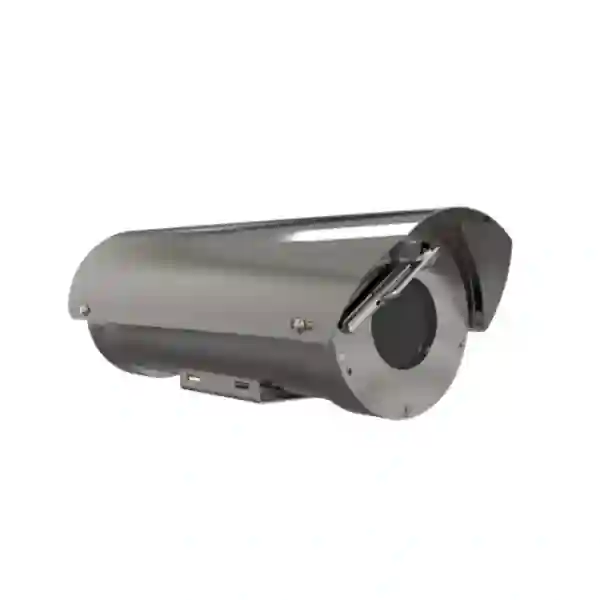
TNO-X6320E2F2WT1-M explosion-proof zoom camera
For demanding industrial monitoring, the Hanwha TNO-X6320E2F2WT1-M combines Full HD network video, 32x optical zoom, fibre capability and a wiper-equipped stainless-steel enclosure. Its purpose is to deliver a controlled fixed view in an appropriately engineered hazardous-area installation, not to replace certification review or a motorised PTZ camera. Request a project-specific technical assessment before ordering for Tanzania.
Verified specification snapshot
Use these published details as a starting point. Confirm the current datasheet, accessory package, certification schedule and order configuration before purchase.
| Camera type | Fixed explosion-proof zoom network camera |
|---|---|
| Maximum video output | 1920 × 1080 at up to 60 fps (H.265/H.264) |
| Optics | 32x optical zoom; 4.44–142.6 mm; autofocus |
| Sensor | 1/2.8-inch CMOS |
| Video encoding | H.265, H.264, MJPEG; multiple profiles |
| Connectivity | 10/100BASE-T Ethernet / single-mode fibre option on F2 model |
| Recording media | Two microSD-family slots, up to 256 GB per slot |
| Housing | 316L stainless steel; integrated window wiper |
| Environment | IP66/IP67; -40°C to +60°C operation |
| Electrical | 110V AC; maximum 37W |
| Size and mass | 176 × 154 × 720 mm; approximately 21 kg |
| Certification designation | INMETRO on -M variant; project-specific review required |
Built for demanding industrial observation, not ordinary premises CCTV
The TNO-X6320E2F2WT1-M addresses a specific surveillance problem: an operator needs a clear view of an asset or working area where a conventional camera enclosure may not be suitable. In a refinery, processing plant, tank farm or other potentially hazardous location, the environment and the electrical installation matter as much as the image. Selecting a camera solely because it offers zoom or a weatherproof finish can miss the essential question of whether the complete proposed equipment configuration is appropriate for the area’s documented hazard classification.
Hanwha Vision combines an industrial enclosure with a Full HD network camera and a long-range optical lens. The result is a fixed-view camera that can capture broad context or narrow in optically on a particular feature. The model’s integrated wiper and stainless-steel construction are useful where a camera window may face dust, spray or changing weather. Those advantages are only valuable when the mounting position, power supply, cable routes and maintenance access are designed around the same environment.
Buyers should treat the exact model suffix as part of the technical specification. Similar-looking members of the Hanwha explosion-proof family may use different power inputs, temperature variants, wiper configurations, fibre arrangements or certification designations. A quotation should therefore repeat the full model TNO-X6320E2F2WT1-M, not merely a family name. Ask the project engineer to check the manufacturer’s current product documentation and relevant certificate schedule against the intended location before equipment is ordered.
Who should consider this fixed explosion-proof camera?
This product is most relevant to industrial security planners, operations teams, engineering contractors and system integrators preparing a surveillance design for a hazardous or demanding process location. Potential observation tasks include viewing machinery interfaces from a safe control area, watching selected approaches to industrial assets and maintaining awareness of operations near equipment that staff should not approach casually. These are example use cases, not an assurance that any particular industrial zone is approved for this model.
It is less suitable when a general office, car park or retail building only requires standard CCTV protection. It is also not the right selection where operators must continuously rotate the camera through multiple directions, because optical zoom and programmable camera settings should not be confused with a motorised pan-and-tilt mechanism. A fixed camera needs a deliberate line of sight, and no amount of optical magnification can reveal an object hidden behind a pipe, vessel or structural column.
For Tanzania-focused procurement, the sensible starting point is the project specification rather than an assumed local stock list. Record the hazard classification, environmental exposure, desired viewing distances, expected image detail, network termination, supply voltage and integration platform. A supplier can then review the exact variant against those requirements and flag exclusions. Neither commercial availability, delivery period nor local certification acceptance should be taken for granted without a verified offer and project documentation.
32x optical zoom: plan both the wide scene and the close inspection
The lens provides 32x optical zoom with a stated focal length of 4.44 to 142.6 mm. Optical zoom changes the portion of the scene projected onto the sensor, allowing the operator to bring a distant area into clearer view without depending solely on software enlargement. At the wide end, the camera is useful for understanding activity across a defined observation corridor. At the narrow end, it can support closer inspection of a particular object or section of infrastructure, provided the image geometry and lighting are adequate.
The published horizontal field of view spans approximately 64.66 degrees to 2.29 degrees. These are lens properties, not promises of identification at an arbitrary distance. The actual number of useful pixels covering a person, object or marker depends on distance, viewing angle, target size and obstruction. Atmospheric haze, heat shimmer, dirty glazing and vibration can undermine a theoretical zoom advantage. A commissioning test at realistic operating conditions is more reliable than selecting a camera from the magnification figure alone.
The model offers autofocus as well as manual and one-shot focus options. This matters when a viewing task alternates between wider context and a narrow target, but focusing does not resolve blind spots. Before specifying the mounting bracket, prepare sample views showing the required wide overview and the smallest detail an operator must assess. That practical exercise helps determine whether one fixed zoom camera is sufficient or several complementary views are needed.
Full HD imaging and smooth live monitoring
Hanwha specifies a 1920 by 1080 maximum video resolution and up to 60 frames per second for H.265 or H.264, subject to the relevant system configuration. The 2MP image can be appropriate for live operational observation where scene composition, controlled zoom and consistent recording matter more than simply purchasing the highest pixel count. A higher-resolution camera is not automatically better for a hazardous location if its enclosure, optics or installation requirements fail the site specification.
The imaging system uses a 1/2.8-inch CMOS sensor and day/night operation with an infrared-cut filter mechanism. Published minimum illumination values are 0.05 lux in colour and 0.005 lux in black and white under specified test conditions. Those are laboratory-style sensitivity figures; they do not guarantee a clear image of every moving object at night. Real results depend on exposure settings, available lighting, moving targets, window condition and the chosen image profile.
Wide dynamic range, backlight compensation, noise reduction, defog processing and gyro-assisted digital image stabilisation are among the documented imaging functions. Each is a tool to tune difficult scenes rather than a replacement for site lighting or sound mounting. For example, a bright process area behind a shaded foreground may benefit from dynamic-range settings, while image stabilisation may help with modest vibrations. Verify each profile through actual captured footage rather than judging performance from a feature checklist.
Fixed-view camera versus an explosion-proof PTZ
A purchasing distinction worth making early is that the TNO-X6320E2F2WT1-M is an explosion-proof zoom camera in a fixed bullet-style enclosure. Its 32x optical lens changes magnification, but the product should not be described as a powered pan-tilt-zoom unit. This distinction affects the project bill of materials, observation coverage, operator expectations and the ability to follow activity across a broad industrial yard. A separate motorised positioning camera may be preferable if the surveillance plan explicitly needs mechanical movement.
The fixed configuration can be an advantage for a clearly defined target such as a gate approach, a pump skid, a process corridor or a single piece of equipment. Once the field of view is engineered, operators can review the same area consistently rather than depending on a movable camera being pointed in the right direction. For broader coverage, the design may require additional fixed cameras or a different explosion-proof model. A camera cannot monitor two opposite directions simultaneously just because it has digital presets.
Do not accept a specification sheet that substitutes the terms zoom, PTZ, positioning and fixed camera without explanation. Ask the integrator to show the exact movement capability of the proposed unit, the approved mount and the resulting field-of-view diagram. The same clarity is important for any software description: VMS commands, preset functions or interface compatibility do not by themselves prove that this particular hardware has a mechanical pan or tilt drive.
H.265, H.264 and multiple video streams
The camera supports H.265, H.264 and MJPEG video encoding. H.265 can offer useful compression efficiency compared with older formats, depending on scene complexity and playback infrastructure. H.264 remains relevant where compatibility with an existing recording or viewing platform is a priority. MJPEG may serve specialised integration needs but can impose a different bandwidth burden. The correct codec is the one the entire system can record, retrieve, secure and display reliably.
Up to ten streaming profiles are documented, providing flexibility to design a high-quality primary recording stream and lighter streams for constrained clients or monitoring workstations. These figures are platform capabilities, not an invitation to turn on every profile without capacity planning. Simultaneous streams, frame rates, bit rates and camera analytics can have practical limits. A commissioning plan should state the intended profile for each recording service, operator workstation and remote-viewing endpoint.
The camera also supports WiseStream II and selectable constant or variable bit-rate methods for relevant codecs. For a process plant, the network design should allow for busy scenes, moving equipment and changing image detail rather than calculating storage from a quiet test picture. Record the chosen settings and validate playback from the actual recorder. If a facility has strict image-retention requirements, calculate them from observed bit rates, recording schedules and policy, not from marketing estimates.
Intelligent analytics: alerts with human verification
Hanwha lists motion detection, tampering detection, fog detection, face detection, shock detection, virtual-line functions and virtual-area events such as intrusion or entering and leaving a selected zone. These functions may help a security operator focus on relevant changes in a fixed camera view. However, an analytics event is only an automated indication, and it should not be treated as proof that an incident occurred or that someone has been positively identified.
In an industrial location, moving machinery, vapour, insects, lighting changes and weather can generate nuisance triggers. The practical solution is careful scene selection, appropriately placed virtual lines, exclusion of known activity and a period of tuning after installation. A low-rate, well-understood alert may be more useful than a constant stream of alarms. Define which events should be recorded, which should notify an operator and which require a human visual check before any response.
Analytics also need privacy and security governance. Decide what the camera observes, who has permission to review footage and how long events should be kept. Use available masking features when a neighbouring activity should not be recorded. Where analytics are integrated into a video management system, verify exactly how the receiving software handles events, video clips and timestamps. Compatibility of the stream does not automatically mean every analytic category will appear with the same functionality in the third-party interface.
Single-mode fibre and copper network planning
The F2 configuration brings a single-mode optical networking option. Hanwha’s specifications describe a duplex single-mode 9/125-micrometre module for F2 models alongside an RJ-45 10/100BASE-T Ethernet reference. Fibre is attractive where the surveillance layout involves separated industrial buildings or where the project requires optical transmission as part of an engineered communications design. It is not enough to say simply that the camera is a fibre camera.
The integrator should confirm the supported optical link, connector arrangement, fibre termination and whether any additional interface or media equipment is required. The cable path, patch panel, network topology and equipment at the receiving end all need to match. Do not assume a fibre distance, connector type or simultaneous copper-and-fibre operating mode that is not explicitly confirmed in the current technical package. The installation should also respect hazardous-area cable-entry and sealing requirements.
Fibre does not replace power or solve every network risk. The camera still has its own specified electrical input, while the switch, recorder and management platform need reliable connectivity and suitable protection. Segment surveillance traffic according to the facility’s cybersecurity policy and define how a communications fault will be identified. A fibre feature becomes a real benefit only when the end-to-end link, splicing plan, redundancy expectations and commissioning tests have been documented.
On-camera storage and recording continuity
Two microSD, microSDHC or microSDXC card slots are specified, with a published capacity limit of up to 256 GB per slot and 512 GB total. Edge storage can be useful as part of a resilient surveillance design, but cards should be treated as a managed recording medium with finite endurance and maintenance requirements. Capacity is not the same as retention time: stored days vary with bit rate, frame rate, activity, recording schedule and card condition.
The central recorder or VMS remains important for searches, multi-camera review, authorised exports and routine operational workflows. Decide whether the camera will record continuously, only on selected events or through a combination of policies. Test the resulting files and timestamps, including what happens when a network interruption occurs. Do not assume that recording from an SD card will automatically backfill every central VMS product; that behaviour must be supported and configured in the complete solution.
Before handover, demonstrate that the chosen media are recognised, recording rules are active and authorised personnel can retrieve sample footage. Document card health checks, replacement policy and protections against casual removal. For critical incidents, rely on the organisation’s own evidence-preservation and access-control procedure. A dual-slot specification provides options, not a substitute for tested recording architecture and operational responsibility.
110V AC power is a procurement checkpoint
The exact model requires 110V AC and has a stated maximum power consumption of 37 watts. That input must be written prominently into the purchase specification. It is unsafe to assume that an industrial network camera accepts the same voltage as a nearby electrical outlet or a different variant in the product family. A site electrical engineer should define the supply architecture, conversion equipment where necessary, protection and isolation methods appropriate to the installation.
Power quality matters as much as nameplate voltage. The plan should account for startup, cable losses, protective devices, maintenance isolation, surge exposure and any project requirement for backed-up power. If an external transformer or supply is proposed, its location and suitability must be checked against the hazardous-area design. Neither a standard plug adaptor nor an improvised converter should be assumed acceptable in a classified environment.
For an installation in Tanzania, verify the actual available voltage and the facility’s electrical design rather than treating the camera as universally compatible with local mains. Request a single-line diagram, equipment data, correctly rated power components and an installation sign-off from qualified personnel. This check is central to technical suitability and cannot be deferred until the camera arrives at the site.
Hazardous-area certification: examine the exact configuration
The -M variant is associated with INMETRO certification in Hanwha’s documentation. INMETRO is a Brazilian conformity framework; that designation must not be presented as automatic permission for installation in every hazardous area or as proof of Tanzanian regulatory approval. The project’s responsible engineer should obtain the actual applicable certificate, manufacturer instructions and conditions of use for the exact camera variant and enclosure before making an installation decision.
The documented site classification needs to be considered alongside equipment markings and certificate limitations. Relevant questions can include the presence of flammable gas or dust, equipment group, temperature class, permissible ambient conditions, cable glands, sealing and earthing arrangements. The camera’s housing is only one part of the finished installation. An unapproved cable entry, incorrect supply accessory or unsuitable mount can undermine an otherwise well-specified system.
The word explosion-proof is a description of a particular protective equipment approach, not a promise that the camera will prevent explosions in a facility. Avoid inferring IECEx, ATEX or local approvals unless the exact variant’s documents confirm them and they are accepted for the project. Procurement paperwork should identify the complete model, certificate identifiers and any special installation conditions. Where project standards require third-party inspection or approval, complete those steps before energising the equipment.
316L stainless-steel construction and environmental protection
The camera uses a 316L stainless-steel enclosure and is specified with IP66 and IP67 ingress-protection classifications. This construction is relevant where the camera may encounter rain, moisture, dust and some demanding industrial atmospheres. However, a corrosion-resistant material is not immune to every chemical exposure, and an ingress rating does not override installation instructions. Suitability depends on the actual medium, cleaning regime, seals and surrounding hardware.
Hanwha states an operating temperature range of -40°C to +60°C and a non-condensing humidity range. These are published boundaries for the equipment, not a guarantee of unrestricted operation in any tropical or coastal location. A hot surface, direct radiant heat, enclosed mounting position or aggressive cleaning chemical can present a challenge even when ambient conditions appear acceptable. Use the manufacturer’s environmental and cleaning instructions for the exact model.
The 316L housing should be viewed as part of a system that includes fasteners, brackets, cable entries and maintainable seals. If the supporting hardware is a different material or the assembly traps water, long-term reliability may not match expectations. Include regular inspection of fittings, corrosion points and the viewing window in the maintenance plan. Verify cleaning products and methods before introducing them to sensitive coatings or sealing materials.
Integrated wiper: improved access to a useful image
The W in this configuration corresponds to the wiper-equipped model. A built-in wiper can help clear material from the viewing window where rain or light contamination interferes with visibility. That is useful for a camera mounted above an industrial process area where manual cleaning may require a planned access operation. Nevertheless, a wiper is not a universal cleaning system and should not be expected to remove all deposits or chemical residues without maintenance.
The operator interface, wiper operation and any accessory washer arrangement should be checked against the exact product manual and the proposed recording system. A remote command can be helpful, but the project needs to know who may issue it and what happens if the mechanism fails. Periodic inspection of the blade and window should be part of planned maintenance, especially where grit or salt deposits could affect the optical surface.
During site design, leave an appropriate maintenance approach and avoid positioning the camera where the view is repeatedly obscured by a permanent obstruction. The best camera location reduces unnecessary contamination at the source. A working wiper helps preserve operational visibility, but the safety assessment for accessing or servicing the assembly remains a separate responsibility.
Mechanical installation, load and line of sight
Hanwha publishes dimensions of approximately 176 by 154 by 720 millimetres and a mass of 21 kilograms. This is substantially different from a compact office IP camera and should be accounted for in structural design, handling and maintenance access. The supporting surface and approved mount must accommodate the camera assembly and any environmental loads that apply to the location. Avoid selecting a bracket solely because its fixing pattern appears compatible.
The installer should check wind exposure, vibration, corrosion, the mounting angle and the permitted orientation in manufacturer instructions. The camera’s long lens makes stable alignment particularly important at narrow fields of view. Even a small amount of movement can shift a distant target out of frame. Document the expected viewing distance and obtain the necessary support calculations, mounting hardware details and cable-routing drawings from the project team.
Consider the practical service envelope. Staff may need safe access to the wiper, window, cable connections and housing without interfering with the process. The completed installation must preserve enclosure integrity and allow necessary inspections. Include the camera location in as-built drawings and record reference images from the desired wide and zoomed positions so that any later shift in alignment can be noticed.
Network security and access governance
Hanwha lists mechanisms including digest authentication, IEEE 802.1X network authentication, IP-based access control and audit logs. Such capabilities can support a managed CCTV network, but they must be configured and kept consistent with the facility’s wider security design. A camera installed with default or shared credentials, unmanaged remote exposure or an outdated software baseline can create operational risk even if its mechanical enclosure is excellent.
Before commissioning, assign unique managed credentials, define administrator and viewer roles, record the approved firmware baseline and restrict network access to necessary systems. Follow the manufacturer’s supported maintenance process for updates and configuration backups. If remote support is required, establish it through the facility’s authorised access mechanism instead of leaving services publicly reachable by default. Record which team owns configuration changes and alert response.
The security design should also consider time synchronisation, log review, retention settings and the handling of recorded images. Test loss of connectivity, unauthorised login attempts and recovery after power interruption. Some controls may depend on the receiving infrastructure or current firmware, so confirm actual behaviour rather than assuming every protocol is enabled by default. Digital resilience is an integral part of industrial surveillance, not an optional feature added after installation.
VMS integration and third-party compatibility checks
The manufacturer lists ONVIF Profiles S, G and T along with SUNAPI. These interfaces create integration possibilities with supported recording and management platforms, but compatibility should be demonstrated for the precise software version and intended functions. Successful live video display does not automatically establish support for edge-recording retrieval, analytics events, advanced camera settings or remote maintenance features.
A pre-purchase integration checklist should name the intended VMS, recorder or network video appliance. Confirm the required video codec, stream resolution, maximum configured frame rate, authentication method, event subscription and video playback process. If a control-room operator expects a wiper control or specific alarm notification, test that exact workflow. When different manufacturers are involved, use their documented integration guidance and a representative system trial where practical.
Also define how images will be used after capture. Will security staff monitor live feeds, will operations teams review specific process areas, or will authorised investigators export clips? Each requires different permissions, display layouts and retention decisions. Clear operational expectations make it easier to decide whether the fixed zoom camera is the right source of footage and whether a separate positioning camera or additional sensor is needed.
Practical commissioning and acceptance tests
A useful acceptance test begins with installation documentation. Confirm the exact model and suffix, enclosure identification, mounting arrangement, power input, qualified cable entries and the project’s hazardous-area approval pathway. Examine physical installation quality before relying on a successful network connection as proof of completion. Verify the camera has been installed according to the current manufacturer instructions and the relevant site procedures.
Next, demonstrate imaging under conditions that resemble real operations. Test a wide overview, a representative zoomed target, expected daylight and low-light conditions, and the effect of vibration or weather where relevant. Validate focus behaviour and the ability of authorised operators to recover the intended view. Check the video and event timestamps, active recording schedule, playback, edge media and any agreed analytics or wiper commands.
Finally, review failure and recovery. Disconnect the network through an approved test procedure, verify how a fault is reported and check what footage is retained. Repeat relevant tests after power restoration and make sure configuration files, certificates, firmware information, instructions and as-built drawings are handed over. The project should close only when the recorded acceptance criteria are met, not when a live picture first appears on a monitor.
Service planning and lifecycle responsibilities
An industrial camera should be maintained within the plant’s approved inspection and permit system. Create an inspection schedule that covers housing condition, bracket security, window cleanliness, wiper function, cable-entry seals, connections and alignment. Maintenance personnel should understand both the electronic equipment and the special precautions that apply to the installation location. Access to the enclosure may need to be coordinated with operations and safety teams.
Keep a record of installed model, serial identification, certificate information, software version, configuration backup and any approved accessory changes. If a housing component or cable fitting requires replacement, ensure the replacement preserves the certified installation design. An ordinary-looking spare part should not be selected solely on price or physical size. Escalate uncertainty to the manufacturer or the project’s responsible competent person.
For ongoing video service, monitor recording health and network faults as well as the physical condition of the camera. Periodically retrieve sample footage and confirm that retention and permissions still meet operational needs. If production changes introduce new obstructions, additional lighting or different risk boundaries, reassess the field of view and the hazardous-area documentation. Maintenance is part of preserving the original design intent.
Procurement questions that prevent unsuitable substitutions
Ask whether the quotation identifies the full Hanwha TNO-X6320E2F2WT1-M model, including the -M suffix, and whether the supplier can provide current manufacturer documentation for that exact configuration. Establish what is included in the quoted hardware and what must be specified separately, such as mounting accessories, fibre terminations, power equipment, approved glands, storage media and integration work. A lower initial line-item price can be misleading if essential engineering items are missing.
Ask who will review the hazard-classification documents and whether the supplied certification and environmental markings meet project requirements. Record the actual supply voltage, available network topology, expected video-retention period and required image detail. If the project needs moving PTZ coverage, recognise that this is a separate requirement rather than assuming it will be met by the zoom lens. Make every special requirement visible in the purchase order and design approval.
For a Tanzania project, request a project-specific offer that confirms commercial terms, support arrangement and any applicable import or local acceptance requirements instead of assuming they apply automatically. Verify availability, lead time, price and warranty directly in the eventual quotation; none are confirmed by this product overview. This approach gives security and engineering teams a defensible basis for deciding whether the camera meets the job.
Industrial scenarios to evaluate
Process-equipment observation
A fixed overview of a designated processing bay can give operators a consistent visual reference. The engineering review should first establish the zone classification, any heat or chemical exposure and whether the chosen target can be seen without blind spots. Use optical zoom to inspect a specific area within that fixed sightline; do not assume the camera can rotate around machinery.
Tank-area perimeter viewpoint
A selected vantage point may offer useful views of a corridor or approach in a tank-related facility. Validate the line of sight, appropriate zoom level and conditions after dark. Confirm mounting and cable routing against site restrictions. Consider complementary cameras when the required coverage extends around structures that obstruct the image.
Remote industrial asset
Where equipment is separated from the control room, the single-mode fibre option may fit the communications strategy. The design still needs verified fibre terminations, compatible network equipment, 110V AC power architecture and fault monitoring. Remote monitoring usefulness depends on the entire link and recording arrangement, not only the camera’s optical module.
Operations review and event evidence
A management system can use live video and recordings to review defined operational events. Decide whether motion or virtual-line analytics offer a dependable trigger in that scene. Set appropriate retention and user permissions, test exports and train operators to verify alerts visually rather than treating automated events as confirmed incidents.
Pre-order engineering checklist
- Confirm the exact TNO-X6320E2F2WT1-M configuration and current technical literature.
- Check hazardous-area classification against the actual certification schedule and installation conditions.
- Verify 110V AC power design and protective equipment for the project.
- Approve line of sight, optical zoom requirements, support structure and maintenance access.
- Validate fibre termination, network security, VMS compatibility and recording retention.
- Request a written quotation identifying included hardware, exclusions and commercial terms.
Frequently asked questions
Is this a PTZ camera?
No. This is a fixed explosion-proof zoom camera, not a motorised pan-and-tilt unit. The lens provides 32x optical magnification, but a fixed mount will still point in the direction chosen at installation. If your specification requires operators to rotate or tilt the view remotely, request a different model expressly designed for positioning or PTZ operation and check its certification separately.
What video resolution and frame rate does it support?
The manufacturer’s product specification lists Full HD 1920 x 1080 video and up to 60 frames per second with H.265 or H.264 under the appropriate configuration. Actual recording settings depend on the VMS, available bandwidth, storage capacity and project policy. A commissioning test should verify delivered video and playback rather than relying exclusively on the camera’s headline maximum.
How much optical zoom is available?
The model has a 32x optical zoom lens with a 4.44 to 142.6 mm focal-length range. This allows the operator to change from a wider scene to a narrower, more detailed view along the same fixed camera direction. Image usefulness still depends on target distance, scene lighting, vibration, weather and what the site expects the operator to observe.
Does the camera support fibre networking?
Yes. The F2 variant is documented with a duplex single-mode fibre module for 9/125-micrometre fibre, in addition to the manufacturer’s Ethernet interface specifications. A systems integrator should verify actual connector and termination requirements, receiving equipment and the supported operating configuration. The mere presence of a fibre option does not confirm an arbitrary link distance or eliminate the camera’s power requirements.
Does it require PoE or 110V AC?
Hanwha states a 110V AC input and maximum 37W power consumption for this exact model. Do not design around a presumed Power over Ethernet supply or connect it directly to an incompatible voltage. The electrical designer should verify the approved power arrangement, appropriate conversion and protective equipment where required, as well as all hazardous-area installation conditions.
What does the -M suffix mean?
The suffix identifies a model variant associated in Hanwha documentation with INMETRO certification. It should not be treated as an interchangeable label or as a general approval for any installation. Request the certificate and current marking details for this exact camera and have the project’s responsible engineer check compatibility with the hazardous-area classification and applicable requirements.
Is it automatically approved for use in Tanzania?
No such conclusion can be made from the product name or INMETRO designation alone. Acceptance depends on the project’s applicable standards, regulatory requirements, certified equipment details and installation design. The buyer should have these reviewed by qualified personnel and obtain any necessary confirmations before commissioning. This page does not claim local regulatory certification, stock or installation authorisation.
Can the wiper clean the camera without maintenance?
The integrated wiper can help restore visibility when the viewing window is affected by suitable surface contamination, but it does not remove every deposit or replace inspection and cleaning. Confirm operating controls and maintenance guidance for the exact variant. In industrial settings, a service plan should consider blade condition, window damage, accessibility and approved safe-work procedures.
Can footage be saved without a recorder?
The camera has two microSD-family storage slots, each specified for up to 256 GB. This provides options for on-camera recording depending on configured rules and supported media. It does not guarantee a particular number of days of footage, automatic VMS synchronisation or evidence retention. Test the recording schedule, storage health and retrieval process as part of system acceptance.
Will it work with an existing VMS?
The manufacturer publishes ONVIF S, G and T and SUNAPI support, which can help interoperability. Nevertheless, a specific VMS must be checked for its supported firmware, live and recorded video, events, authentication and any requested wiper controls. A successful stream connection is only the first stage of verifying operational compatibility. Request a documented integration or representative test when advanced functions matter.
What environmental limits should be checked?
The product’s stated operating range is -40°C to +60°C, and the manufacturer’s page lists IP66 and IP67 ingress protection with 316L stainless-steel construction. Site designers must still evaluate direct heat, chemical exposure, mounting hardware, seals, cleaning products and non-condensing humidity conditions. The installed system should respect both the environmental specification and the instructions attached to its certification.
What information is needed for an accurate quotation?
Provide the complete model, project location and intended application, hazardous-area documentation, viewing distances, mounting conditions, voltage, fibre or copper network details, recording platform, retention expectations and any required accessories. Ask the supplier to confirm availability, pricing, warranty, delivery terms and included services in writing. A technical review before ordering helps avoid an expensive model or installation mismatch.
Request a project-specific Hanwha camera quotation
Discuss the Hanwha TNO-X6320E2F2WT1-M with the FourTeck Tanzania team as part of your industrial CCTV specification. Share your required viewing area, site hazard assessment, electrical supply and network architecture so the exact model and required accessories can be evaluated. Prices, stock, delivery and installation scope must be confirmed in the written offer.
Next step: request a technical review and quotation.




Reviews
There are no reviews yet.