
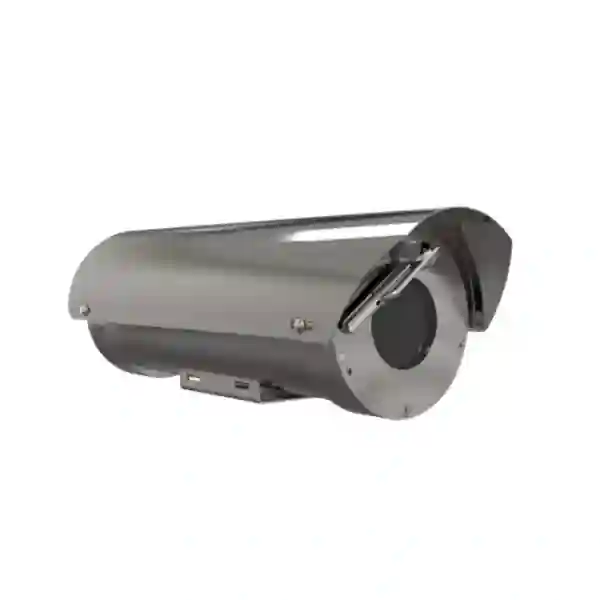
Hanwha TNO-X6320E2F2WT1-Z Explosion-Proof Zoom Camera
A fixed-direction 2MP network camera with 32x optical zoom, integrated wiper and single-mode fibre interface for engineered surveillance in suitable classified industrial locations. Check the exact certificate, site approval and 110V AC supply before specifying it for a Tanzania project.
Quick technical orientation
Figures reflect publicly listed manufacturer specifications. Exact certification, optional equipment, integration and installation details must be confirmed for the ordered variant.
Who should consider this camera?
The Hanwha TNO-X6320E2F2WT1-Z is designed for security teams planning visible-light video monitoring at hazardous industrial locations. It combines a fixed-position, explosion-proof stainless-steel housing with a 2MP network camera, 32x optical zoom, integrated wiper and single-mode fibre connectivity. Buyers who need to inspect a distant process area without placing an ordinary camera in a classified location can use this model as a candidate for engineering evaluation.
The important qualification is that an explosion-proof product is not automatically suitable for every hazardous area. Before selection, an appropriately qualified engineer must compare the precise enclosure certification and installation instructions with the site’s gas or dust classification, ambient temperature, wiring system and jurisdictional requirements. This product also requires 110V AC, an essential consideration in Tanzania’s standard 230V, 50Hz electrical environment.
The immediate buying step is to share the hazardous-area classification, intended viewing distance, power arrangement, fibre topology and mounting conditions for a configuration review and quotation. Availability, commercial terms and installation scope must be confirmed rather than assumed.
What the exact model includes
This particular ordering code matters. It identifies the TNO explosion-proof zoom-camera family rather than a conventional outdoor bullet camera, and it is specifically the F2 fibre, W wiper, T1 temperature-class and Z certification variant shown in Hanwha Vision’s manufacturer material. The camera provides Full HD 1920 × 1080 imaging, up to 60 frames per second with H.264 or H.265 under supported settings, and 32x optical magnification with autofocus.
The enclosure uses 316L stainless steel, while the published configuration has a built-in single-mode fibre module and wiper for the front window. The manufacturer specifies 110V AC input and a maximum consumption of 37W. The official detailed specification also identifies two microSD memory slots, a range of network protocols, video analytics, and support for ONVIF Profiles S, G and T.
Product-family suffixes are not interchangeable. A similar model without W may lack the wiper; another temperature code or certification suffix can represent a different approved configuration. Procurement documents should repeat the complete model string, not just the TNO-X6320 family name.
Why an explosion-proof enclosure is different
In an ordinary surveillance installation, an outdoor IP camera enclosure is primarily selected for rain, dust, vandal resistance and image quality. In a classified hazardous location, enclosure design, ignition control, cable entry and installation practice can become safety-critical. The TNO-X6320E2F2WT1-Z belongs to a purpose-built explosion-proof camera range; that description should prompt a certification review, not replace one.
For the Z variant, Hanwha’s configuration information identifies cLCus Class I, Division 1 certification for specified group and environmental conditions. That North American hazardous-location classification must not be treated as a blanket statement of Tanzanian regulatory acceptance or as proof of every IECEx or ATEX zone category. Confirm the nameplate, applicable certificate schedule, approved accessories and site documentation before equipment is released for installation.
Even a correctly selected enclosure can become unsuitable if gland choice, opening procedures, sealing, earth bonding or cable termination ignore the manufacturer’s requirements. The camera should therefore be specified as part of a complete engineered system rather than as a stand-alone box mounted at the last minute.
Assess the site’s hazardous-area classification first
The starting point is the site’s formal area classification documentation. Identify whether the camera position is a hazardous area, what atmosphere may be present, whether the hazard involves gas or combustible dust, and what temperature class and equipment protection concept are required. Those details determine whether this exact Z configuration is even eligible for consideration.
A site’s general label such as refinery, chemical plant or fuel depot is not enough. A process building can contain several classifications, and one mounting position may have a different requirement from another just metres away. The equipment must be matched to the declared conditions, including maximum ambient temperature, approved entry methods and any installation restrictions written into certification conditions.
Ask the responsible site engineer for the area classification drawing, specification for field equipment, preferred cable type, earthing practice, inspection standard and required certificate documentation. If the project’s required approval cannot be demonstrated for the exact variant, select a differently certified camera rather than assuming the word explosion-proof covers the difference.
A critical power requirement for Tanzania
The published electrical input for this exact model is 110V AC, with maximum power consumption listed as 37W. Tanzania’s normal public low-voltage supply is 230V at 50Hz according to TANESCO. That difference is not a minor adapter issue: the camera must not be connected directly to a 230V supply. An approved electrical design must provide the correct voltage and address any applicable frequency and power-conditioning requirements.
Determine whether the project already has a suitable protected 110V distribution circuit or will require a correctly rated conversion arrangement. The rating of any transformer, converter, protective device or associated enclosure must be engineered for the installation. Electrical equipment located within a classified zone needs its own suitability assessment; moving a converter outside the hazardous location may simplify compliance, but its final position is an engineering decision.
Include isolation, protective earthing, surge protection, cable routing, startup behaviour and backup power requirements in the system design. The published 37W camera figure is not a complete transformer-sizing calculation because inrush, accessories, conversion losses and margins may matter. Request the current installation manual and electrical drawings before ordering.
Power reliability and uninterrupted operation
A camera at an industrial perimeter may be needed most during a process alarm, security incident or electrical disturbance. Power architecture therefore deserves as much attention as lens selection. Decide whether the site requires a UPS, emergency generation, monitored circuit or other continuity arrangement. The camera’s 110V AC supply must be supported by that architecture without violating hazardous-location electrical requirements.
Map the power path from source through protective devices to the camera. Check where voltage conversion occurs, how the circuit will be isolated for maintenance, and how a technician can identify a supply fault safely. If a converter or UPS is used, evaluate its load, operating environment and planned maintenance rather than assuming a standard office power accessory is suitable for an industrial system.
Also plan for the network and recording equipment to remain available during disturbances. Battery-backed camera power alone cannot preserve footage if the recorder, network switch or fibre transport fails. A useful acceptance test verifies the system’s behaviour during a controlled power interruption and restoration, with the relevant site procedures and permits in place.
Image quality: 2MP detail with 32x optical zoom
The camera records up to 1920 × 1080 resolution and offers a 4.44–142.6mm lens with 32x optical zoom. Optical zoom changes the lens’s effective viewing angle so an operator can examine a smaller, more distant part of the scene using the available sensor resolution. This can be valuable when the installation position is constrained by classified-area boundaries or the need to keep personnel away from equipment.
Zoom should not be confused with guaranteed identification at a particular distance. The usable detail depends on target size, lighting, atmospheric conditions, vibration, lens setting, compression and how many pixels the subject occupies. A distant fence line, valve assembly and vehicle entrance have very different viewing requirements. Define the actual observation task before interpreting the 32x specification as a performance promise.
During design, prepare representative scenes with wide and narrow views. Establish what an operator must detect, recognise or inspect, and whether the same camera can cover every required scene. If simultaneous wide-area coverage is essential, a separate overview camera may be preferable to relying on a zoomed-in view.
Fixed viewing direction is not PTZ movement
This TNO product is described by the manufacturer as an explosion-proof zoom camera. The built-in lens can magnify a subject, but the body should not be represented as a motorised pan-tilt-zoom unit. Optical zoom and remote repositioning are different functions. A fixed bullet installation cannot automatically scan multiple directions merely because the zoom ratio is high.
Before specifying the number and position of cameras, draw the intended fields of view onto the site plan. Consider the camera’s viewing axis, mounting height, obstructions, shadowed areas, possible vehicle movements and inspection points. A zoomed-in view will cover a smaller angle, so an operator may temporarily lose awareness of activity elsewhere in the scene.
If the application requires remote pan and tilt, investigate a model explicitly specified as a hazardous-location PTZ or positioning camera with the appropriate approvals and site interfaces. If the scene stays largely in one direction but operators need to inspect details, this fixed-view optical zoom format may be a more appropriate starting point.
Day-and-night monitoring and difficult light
The listed camera supports automatic day and night operation with an infrared-cut filter, low-light monochrome imaging and digital processing functions for challenging scenes. Manufacturer specifications give minimum illumination values of 0.05 lux in colour and 0.005 lux in black and white under stated test conditions. These laboratory values help describe sensitivity but do not guarantee a usable image for every real industrial scene.
Backlighting from doors, vehicle headlights, bright process lighting or reflective metal can make the subject harder to see. The camera includes wide dynamic range and backlight-control capabilities intended to help balance contrasting areas. Hanwha’s product-page summary and detailed specification display different numeric WDR values, so a current approved datasheet should resolve the exact figure if it forms part of contractual performance requirements.
Plan lighting with the required task in mind. Verify the image at daytime, dusk and the worst expected night condition. Where an external illuminator is proposed, separately evaluate its electrical and hazardous-location suitability rather than treating camera low-light performance as a substitute for lighting design.
The integrated wiper: what it does and does not do
The W suffix is valuable in outdoor industrial service because it identifies an integrated wiper arrangement for the camera window. A wiper can support visibility when moisture or surface contamination would otherwise obstruct the view. It does not eliminate periodic inspection, nor should it be described as a self-cleaning system that removes every possible industrial deposit.
Before commissioning, check how the wiper is controlled, its operating clearances, the surrounding mounting orientation and any manufacturer limits. In abrasive, salty or chemically aggressive environments, inspection intervals should follow the site’s environmental exposure and the manufacturer’s maintenance guidance. Do not apply unapproved cleaning agents or alter the front-window hardware.
A washer reservoir or fluid supply must not be assumed to be included simply because the product has a wiper. If the process environment needs active washing, confirm whether a compatible, suitably approved washer system and accessories are specified separately. Cleaning and maintenance in a classified location must follow the site’s permit and isolation procedures.
Built-in fibre connectivity for industrial networks
The F2 variant includes a single-mode fibre interface identified by Hanwha as a 9/125μm module. Fibre may suit industrial camera routes where electrical isolation between communication segments, distances or site network architecture make copper-only links less convenient. It should still be designed as part of an end-to-end communications system, not treated as proof that every fibre switch or topology is plug-and-play compatible.
Confirm the connector and termination details against the installation manual, and check that the network equipment supports the intended optical interface, link budget, fibre type and physical route. A model-family specification also lists an RJ-45 network interface, but the exact installed connectivity and approved cable entry arrangement should be confirmed for this ordering code.
Fibre routes need planning for mechanical protection, bend radius, labels, patching, testing and safe termination locations. Do not improvise penetrations in an explosion-proof housing. The original approved cable-entry architecture, glands and sealing practices have priority over a convenient networking shortcut.
Streaming, codecs and recording-system planning
The published specification supports H.265, H.264 and MJPEG streams, along with multiple profiles and codec controls. H.265 can reduce storage or transport requirements in many scenes compared with H.264, but actual results depend on motion, scene complexity, frame rate, quality settings and recording software compatibility. MJPEG can be appropriate for particular integrations but generally has different bandwidth characteristics.
Decide which stream is intended for live operator viewing and which is intended for recorded evidence. A monitoring workstation may not need the same bitrate as a high-detail archive stream. Configure resolution, frame rate, keyframe interval and quality according to retention needs and system capacity, then test footage rather than choosing the lowest bitrate by default.
Never size a network solely from the stated 2MP resolution or the maximum frame rate. Record sample footage from an equivalent site scene, measure typical and peak traffic, and allow headroom for network management, time synchronisation, firmware maintenance and concurrent viewing. Verify VMS support for the selected codec and event features before specifying the final recording configuration.
Video analytics and realistic alert design
The manufacturer’s listed analytics include motion, tampering, fog, face and shock events, together with virtual-line and virtual-area functions such as crossing, intrusion, enter and exit. These tools can help direct an operator’s attention or trigger a rule in a compatible recording platform. Their performance still depends on scene placement, lighting, movement patterns and configuration.
At an industrial facility, moving machinery, steam, reflections, vibration and weather can create nuisance alarms. Begin with a few operationally important use cases, such as unexpected entry into a controlled view, then tune zones and schedules during supervised operation. Avoid treating every analytic event as verified evidence of an intrusion or safety condition.
These video analytics must not be marketed as a certified gas detector, fire detector, flame detector or automatic process-safety shutdown device. If the project has safety instrumented functions or regulated alarm obligations, dedicated certified systems and an appropriate engineering assessment remain essential. Define the human response to each alert, not just its technical trigger.
Local microSD recording and edge-storage limits
The listed camera includes two microSD/SDHC/SDXC slots with a published maximum of 256GB per slot, or 512GB total. Edge storage can support site-specific recording designs or provide an additional layer of resilience in some network scenarios. It does not automatically make a memory card equivalent to a managed recorder with documented backup, monitoring and evidence-retention processes.
Before choosing recording media, check the manufacturer’s current approved card requirements, expected write endurance and environmental limits. Estimate usable retention based on actual bitrate, recording mode and scene characteristics. A card intended for occasional photographs may be poorly matched to continuous video writing. Failure monitoring and replacement procedure should be part of the maintenance plan.
Where the evidence policy requires central archiving, verify that the recorder or VMS can ingest the streams and events needed. A network outage, card fault or incorrect time setting can compromise an incident record, so acceptance tests should include retrieval, playback and export of a sample clip.
Compatibility with VMS and ONVIF systems
Hanwha lists ONVIF Profiles S, G and T for this model, alongside its SUNAPI interface and supported network protocols. That gives integrators potential routes to standardised streaming and functions, but an ONVIF label by itself does not guarantee every camera feature will appear in every video-management platform.
Build a compatibility schedule identifying the exact VMS product and version, recorder firmware, desired codec, live views, recording schedule, event triggers and user permissions. Test core functions first: discover the camera, authenticate it, view the main stream, record, search, export and restore after network loss. Then test optional functions such as analytic events and auxiliary controls.
Do not assume the zoom, wiper, alarms, edge-storage workflows and all metadata will be equally available through a generic driver. These functions may require a native integration or particular firmware combination. The procurement specification should state which interactions are mandatory, which are preferred and what demonstration is required before acceptance.
Cybersecurity for industrial camera networks
The manufacturer lists HTTPS, IEEE 802.1X authentication options, IP-based access control and audit logs among the platform’s security functions. These features support a defence-in-depth approach, but their presence alone does not secure a deployment. The system must still be configured, patched and monitored according to the organisation’s security policy.
Use named administrative accounts and strong credentials; restrict device access to authorised management stations; consider network segmentation between cameras, operational technology and business systems; and use secure management channels where practical. Limit internet exposure, disable unnecessary access routes after testing, and document who is authorised to change analytics or recording settings.
Before production handover, record firmware versions, approved configuration backups, account ownership and a controlled update procedure. Industrial facilities often have change-control windows, so future patching should be coordinated with the operator, integrator and site safety lead. Cybersecurity controls should be tested without disrupting required surveillance coverage.
316L stainless steel and demanding environments
The enclosure’s electro-polished 316L stainless-steel construction is relevant when choosing an exposed industrial camera. It provides a different material and maintenance profile from a light-duty painted housing, particularly where weather and corrosive surroundings are important design considerations. However, stainless steel is not immune to all chemicals, deposits or corrosion mechanisms.
Review the environment for sea spray, chemical washdown, dust accumulation, process vapours, direct sun, heat sources and mechanical impact. The published operating range is -40°C to +60°C, with non-condensing humidity limits. These limits concern the product’s specified conditions and should not be extended by assumption to direct radiant heat or unsupported process exposure.
Select mounting hardware and nearby materials for compatible environmental performance. Avoid creating water traps, unapproved dissimilar-metal contacts or a maintenance arrangement that requires frequent unsafe access. Service-life assumptions depend on cleaning practice, chemical exposure and installation detail; no particular lifetime should be promised without a supported project-specific basis.
Ingress protection and weather exposure
The exact product’s official online specification lists IEC 60529 IP66 and IP67 under environmental standards. Related manufacturer family literature describes an IP68 condition, but the applicable rating and test conditions should be confirmed on the current datasheet and certification documentation for the precise configuration being supplied.
An IP rating describes a defined enclosure test. It does not by itself confirm explosion protection, chemical resistance, impact protection, unlimited immersion or correct cable-entry workmanship. The weakest point of a field installation may be a damaged seal, unsuitable gland, poorly supported cable or unauthorised modification rather than the housing material.
During design, check rain direction, drainage, condensation risk, dust exposure and safe access to the front window. In a location where washing or high-pressure cleaning is routine, confirm whether the proposed cleaning process is within the manufacturer’s approval. Keep periodic seal and gland inspection in the preventive-maintenance plan.
Size, weight and structural support
Hanwha lists approximate dimensions of 176 × 154 × 720mm and a mass of 21kg for the published configuration. This is a substantial assembly, so the choice of bracket, wall, pole or structural steelwork requires engineering review. Do not treat it like a compact office CCTV camera held on a lightweight generic mount.
Check the mounting surface, fastener design, vibration, accidental contact, maintenance access, wind loading where relevant and cable strain relief. The approved support must withstand the installed assembly and the site’s required design loads. Confirm whether a manufacturer-recommended bracket, adapter or sunshield is needed and whether that component is included in the requested supply.
Structural drawings should also preserve the optical sight line across the required range of zoom. A technically safe bracket that places the camera behind piping or an obstruction is still a poor surveillance design. Agree on aiming and access before field installation begins.
Planning camera positions for better coverage
Begin with a drawing showing the process areas, access points, boundaries and important operating equipment. Mark positions where a fixed camera can observe the target without obstructing maintenance or exposing a technician to avoidable hazards. For each candidate, list the scene width, target distance, illumination and mounting constraints.
Industrial monitoring often needs both context and detail. A wide view can establish what happened around an event, while the 32x zoom can examine a particular item. Because this model’s optical axis is fixed, one camera cannot be relied on to watch two opposing directions. Use separate cameras if continuous simultaneous views are necessary.
Evaluate accessibility for cleaning, fibre or power fault investigation, safe isolation and future replacement. Also consider reflections from stainless process equipment, moving crane structures, exhaust plumes and weather-induced movement. A site survey with representative images is more reliable than a camera-count estimate based only on floor area.
From engineering specification to installation
The installation sequence should be controlled by site procedures. First verify the exact ordered model and nameplate against the approved design. Next check the proposed mounting assembly, hazardous-location documentation, approved entry hardware and power design. Only qualified personnel working under the relevant permits should open, terminate or energise equipment within a classified area.
Follow the current Hanwha installation manual for cable entries, grounding, fastener torque, enclosure opening and closing, and any special certification conditions. Do not drill the housing, substitute seals, add unsanctioned cable entries or reuse a damaged component. An otherwise functional camera may fail the site’s safety acceptance if the enclosure installation is unauthorised.
Before energising, document mechanical completion, electrical inspections, communications checks and the identity of the responsible reviewer. Commission optical performance after confirming the electrical and hazardous-area work is satisfactory. Close out deviations and retain inspection records with the site asset documentation.
Commissioning checks that prove usability
An acceptance demonstration should establish more than whether a live image appears on a screen. Confirm that the camera is correctly identified by model and firmware, receives the intended voltage, and maintains network connectivity. Check the fibre link, selected video profiles, time synchronisation, authentication and recording destination.
Then assess image quality in daylight and low light, at wide and narrow zoom settings. Verify the requested subject detail, framing, image stability and focus behaviour. Where the wiper or supported analytic functions are included in scope, test them using the approved control interface and realistic conditions. Avoid creating unsafe test scenarios merely to demonstrate a feature.
Finally, confirm how operators retrieve footage, acknowledge alerts, report faults and restore service. Keep a commissioning record with configured settings, sample images, test dates and unresolved limitations. Repeat any failed test after corrective work rather than accepting the installation on a verbal assurance.
Network capacity, latency and resilience
An industrial network may need to carry video across a long fibre route, through switches and firewalls, and on to a control room or central recorder. Review the topology before selecting equipment. The camera’s supported streaming profiles do not determine the available fibre bandwidth, switching capacity or storage throughput on their own.
Plan for normal streams, concurrent operator viewing, alarm-related changes and maintenance activity. Define acceptable delay for live viewing if remote operators need near-real-time situational awareness. Check switch ports, optical modules, routing, VLAN design and power continuity. A redundant route can improve resilience only if the associated endpoints and configuration also support a valid recovery design.
Document network ownership and change procedures. A future switch replacement, IP-address change or security-policy update should not silently disable a critical view. Use monitoring to detect loss of camera communication and agree on escalation procedures with the site’s operations team.
Practical maintenance and lifecycle planning
The camera is intended for demanding service, but it still needs inspection. Schedule checks of image clarity, window condition, wiper operation, cable glands, mounting hardware, corrosion or deposits, recordings and system alerts. Frequency should reflect the environment, safety documentation, operating hours and manufacturer instructions.
A maintenance plan should define how personnel isolate the equipment, obtain access, protect certified interfaces and restore the installation after work. It should also record what parts and tools are approved. Replacing a seal, window or fastening component with an unverified substitute may compromise the enclosure’s hazardous-location approval.
Track firmware, configuration revisions, recording-health alerts and support documentation throughout the asset’s life. If a manufacturer changes a product’s support or replacement status, review the consequences for the site. Do not infer a warranty period, spare-part guarantee or committed support life from the camera’s model name.
Typical applications and the limits of each
Potential applications include observing selected zones at a petrochemical facility, monitoring equipment in a classified processing area, viewing access points near industrial handling systems and providing a detailed view of distant infrastructure. These are examples of design scenarios, not statements that the camera is automatically approved for every named facility.
In a process yard, optical zoom can assist operators who need a close visual check without entering a restricted area. At a gate, a fixed camera can observe an important approach when the field of view is planned carefully. In an exposed outdoor installation, the stainless housing and wiper may be useful, but safe access and contamination remain maintenance issues.
For every application, ask what the video is expected to achieve: awareness, operational observation, incident review or security response. If the objective is temperature measurement, combustible-gas detection, certified fire alarm or multi-direction remote tracking, this visible-light fixed zoom camera alone is not the correct functional specification.
How this differs from simpler CCTV choices
A standard outdoor bullet camera may provide adequate video in an unclassified environment at a much simpler installation level. The TNO-X6320E2F2WT1-Z is different because hazardous-location equipment selection, its heavy stainless enclosure, wiper and fibre network path become part of the buying decision. Those differences matter only where the site genuinely requires them.
Against a fixed-lens explosion-proof option, the 32x optical zoom adds flexibility for examining detail along a preselected viewing axis. Against an explosion-proof PTZ model, it should be evaluated as a fixed-direction alternative rather than a replacement for motorised scanning. The optical capability does not change the camera’s required voltage or its certification variant.
Value should be judged on the complete engineered installation: approved enclosure and cables, necessary power conversion, mounting structure, network interfaces, recorder compatibility, commissioning and maintenance. Comparing bare camera prices without accounting for those elements can give an inaccurate picture of project cost.
Information to include in a quotation request
To prepare a meaningful quotation, provide the complete manufacturer model TNO-X6320E2F2WT1-Z and the intended number of units. Attach the hazardous-area classification, installation location, maximum expected ambient temperature, ingress and corrosion considerations, approximate camera-to-target distances and a drawing of the mounting position.
Include the proposed power source and clarify whether a correctly engineered 110V AC feed is already available. State whether single-mode fibre is installed, its route length, connector arrangements and the proposed switches or media conversion. Identify the video-management software, recording retention target, preferred analytics, cybersecurity requirements and acceptance tests.
Ask separately about suitable brackets, glands, electrical conversion equipment, fibre termination, network commissioning and any requested washer or maintenance accessories. These may not be included with a base camera. Confirm the exact scope and written commercial terms before ordering; do not assume local stock, a particular price, delivery date, warranty or installation service.
Procurement documents and technical approvals
Industrial security procurement often involves more than a product description. Request the current manufacturer datasheet, exact-model installation manual, applicable hazardous-location certificate or declaration, nameplate details, technical drawings and list of approved installation accessories. Where the project has a formal submittal process, identify the approving engineer or authority.
Match every approval document to the actual ordering code. Product-family claims and certificates for a different suffix may not establish compliance for this Z version. Check ambient limits, gas or dust groups, temperature class, gland requirements and any conditions of use. Where standards or national rules differ, use the project’s competent authority to confirm acceptance instead of extrapolating from overseas certification.
Keep a record of substitutions and revisions. If a vendor proposes a visually similar camera because of supply conditions, the change requires review of imaging, power, fibre, wiper, dimensions and certification before approval. Model substitutions should not be accepted solely because the new item has a similar megapixel or zoom rating.
Build the full system, not just the camera
The finished solution includes a stable mounting point, an appropriately certified electrical and cable-entry design, the correct 110V AC supply, a functioning single-mode fibre path, suitable network equipment and dependable recording. The control-room operator also needs a usable interface, access permissions and a known response process.
Allocate responsibility across the site owner, hazardous-area engineer, electrical contractor, network specialist, security integrator and operations team. Each party sees a different failure mode. Without a coordinated scope, the project can end with a mechanically installed camera that cannot communicate, record or be safely energised.
During project closeout, supply the configuration record, relevant certificates and inspection evidence, system diagram, credentials handover procedure, recording tests and planned maintenance information. A clear handover protects the customer’s ability to operate and maintain the camera long after initial commissioning.
Choosing the right next step
The most important decision is suitability, not simply whether a catalogue specification looks attractive. If your project needs a fixed-direction, high-magnification network camera at a classified industrial position, the Hanwha TNO-X6320E2F2WT1-Z may be worth detailed review. Its 2MP/60fps imaging, 32x lens, single-mode fibre and wiper offer a defined feature combination, while the hazardous-location approval and electrical requirements set important boundaries.
Share the full model code together with the site classification, required field of view, network design and power conditions. Ask for written confirmation of exact-variant certification, accessory requirements and a site-appropriate electrical solution before placing an order. If the task instead requires pan and tilt, thermal imaging, additional zone approval or direct 230V powering, make those requirements explicit so the correct alternative can be evaluated.
This page is a technical selection guide, not a claim of price, stock, regional certification, installation availability or guaranteed performance. Formal engineering review and the current manufacturer documentation govern the final choice.
Frequently asked buying questions
Is TNO-X6320E2F2WT1-Z a thermal camera?
No. The manufacturer describes this model as a 2MP visible-light explosion-proof zoom camera. Do not confuse it with Hanwha models specifically identified as thermal cameras; use a dedicated thermal product when temperature-sensitive imaging is an actual requirement.
Can it pan and tilt from the control room?
It is a fixed-view zoom camera, not a motorised PTZ model. The 32x optical zoom changes magnification along the installed viewing direction. If remote pan and tilt are needed, select an appropriately certified positioning or PTZ model.
Can I connect the camera directly to Tanzania’s normal 230V supply?
No. Hanwha specifies 110V AC for this variant. A qualified designer must provide an appropriate supply arrangement and verify the installed system against the manufacturer’s electrical requirements and applicable hazardous-area rules.
Does the model include fibre networking?
Yes. The F2 configuration is identified with a built-in single-mode 9/125μm fibre module. Verify the precise termination, compatible network hardware and fibre route using the current installation guide before ordering equipment.
Is the wiper included with this exact variant?
The W designation and manufacturer description indicate an integrated wiper. That does not establish that a washer tank or fluid delivery system is included. Confirm any optional cleaning accessories separately.
Is this certified for every hazardous site in Tanzania?
No blanket approval should be assumed. The Z configuration is associated with specified cLCus Class I, Division 1 certification. A competent engineer must check the certificate, the exact area classification and applicable local project requirements before installation.
What image resolution and frame rate are available?
The published camera specification lists 1920 × 1080 resolution, with up to 60fps under supported H.264/H.265 settings. Actual recording settings must be chosen around the recorder, network, lighting and evidence requirements.
How much local storage does it have?
The manufacturer lists two microSD card slots with a maximum of 256GB per slot, totaling up to 512GB. Cards and recording configuration need separate verification; this figure does not establish a fixed number of recording days.
Does it work with an ONVIF-based video system?
Hanwha lists ONVIF Profiles S, G and T. Verify integration with the exact VMS version and required functions. Live video may work even when optional events, wiper controls or other advanced features need different integration methods.
How heavy is this camera?
The manufacturer’s online specification lists approximately 21kg. The substantial enclosure requires suitable structural mounting and safe maintenance access; mounting hardware and its load rating should be confirmed during design.
Can video analytics replace gas detection or a safety system?
No. The listed video analytics are surveillance features and should not be treated as certified gas, flame or process-safety detection. Safety-critical functions need appropriate dedicated devices and a separately approved system design.
Can I get a confirmed Tanzania price or delivery date here?
This description does not establish local price, inventory, lead time or delivery conditions. Request a project-specific quotation with the complete model number and technical requirements; obtain written confirmation of supply and commercial terms.
Request a technical configuration and quotation
For a Tanzania industrial surveillance project, share the complete Hanwha model, hazardous-area classification, viewing requirements, existing power, fibre network details and intended VMS. Request confirmation of suitability, supplied accessories and commercial terms before procurement.




Reviews
There are no reviews yet.