
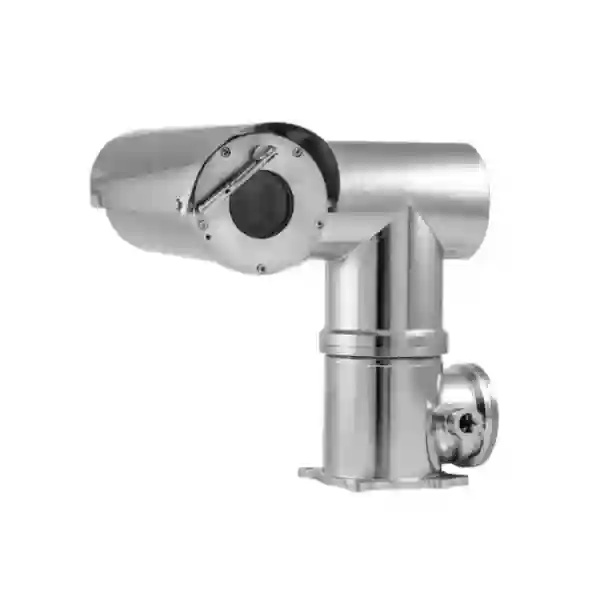
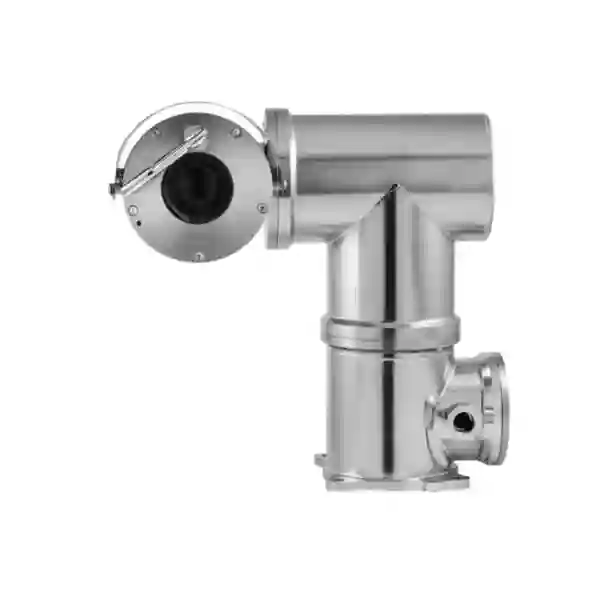
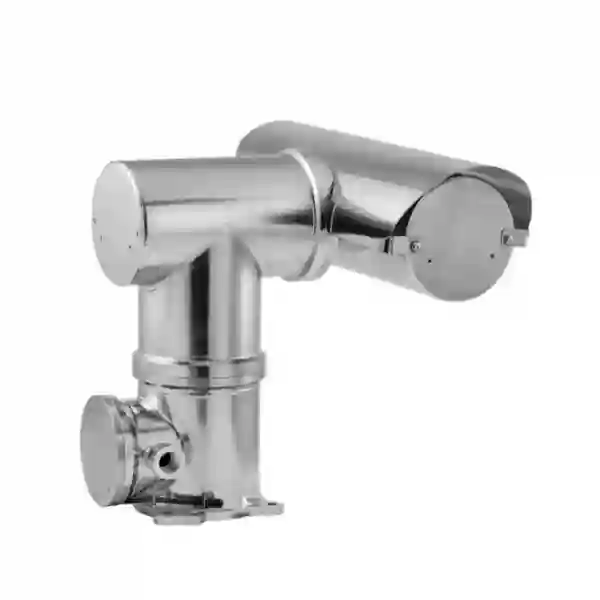
Hanwha TNU-X6320A2WT2-C Explosion-Proof PTZ Camera
Choose a hazardous-area surveillance camera by its certified installation fit, not simply its zoom specification. The Hanwha TNU-X6320A2WT2-C explosion-proof PTZ camera combines Full HD imaging, 32x optical zoom and a stainless industrial positioning assembly for qualified projects that require remote visual assessment.
Verified specification snapshot
| Model | TNU-X6320A2WT2-C |
|---|---|
| Camera type | Explosion-proof network PTZ positioning camera |
| Maximum image output | 2MP, 1920 × 1080 |
| Optical lens | 4.44–142.6 mm; 32x optical and 16x digital zoom |
| PTZ ranges | Pan 0–360°; tilt -90° to +90° |
| Video | H.265 / H.264 / MJPEG; WiseStream II |
| Day/night and WDR | Auto ICR; 120dB WDR |
| Enclosure | 316L stainless steel; toughened-glass window; wiper |
| Ingress protection | IP66 / IP67 |
| Listed certification | cLCus C1/D1; cLC CSA |
| Electrical input | 110VAC; maximum 80W |
| Manufacturer highlighted ambient range | -60°C to +40°C; confirm conflicting detailed table |
| Network | RJ-45 10/100BASE-T; ONVIF S and G |
| Edge storage | 2 microSD slots, up to 256GB each |
| Dimensions and weight | 418 × 457 × 401 mm; approximately 33 kg |
What this explosion-proof PTZ camera is designed to do
The Hanwha TNU-X6320A2WT2-C explosion-proof PTZ camera addresses a different requirement from a conventional outdoor CCTV unit. In a hazardous industrial area, engineers must consider whether a device is suitable for the atmosphere that can occur around flammable gas, vapour, or associated processes. A weather-resistant housing alone does not resolve that question. This camera combines a network imaging system with a dedicated protected positioning assembly, making it a candidate for projects in which the camera itself must be evaluated against a formal hazardous-area specification. Selection is an engineering decision, not a claim that every industrial location needs explosion-protected equipment.
The camera is intended for operators who need both a broad view of a production area and a closer view of selected equipment, personnel movements, barriers, or operating conditions. Its pan, tilt, and motorized zoom functions let a control-room operator reframe a scene without placing a person at the camera location for every adjustment. That convenience matters when access is controlled, inspections must be planned around permits, or a camera is mounted near equipment that is inconvenient to reach. Remote viewing complements physical safety procedures; it does not substitute for gas monitoring, fire detection, or an approved inspection programme.
For Tanzania-based procurement, the central buying question is whether the exact model and its certificates fit the site’s documented zone or division classification, available electrical supply, physical support, and video management architecture. FourTeck Tanzania can be approached for a technical quotation, but local inventory, delivery, commissioning services and approvals must be confirmed rather than assumed. A useful enquiry includes the intended area classification, site drawings, ambient temperatures, network method, mounting position and operational objective. That information supports a meaningful assessment before costs are committed.
At-a-glance product capabilities
Hanwha identifies the TNU-X6320A2WT2-C as a 2MP network camera with 1920 × 1080 output. Its lens covers 4.44–142.6 mm and provides 32x optical zoom, accompanied by a 16x digital zoom function. The optical range gives an operator genuine changes in framing, while digital enlargement crops existing detail rather than creating additional source resolution. These distinctions should guide expectations for distant equipment checks, especially if the scene includes small lettering or features that need more pixels than a Full HD camera can supply.
The positioner provides a nominal 0–360 degree pan range and -90 to +90 degree tilt range, with manufacturer-listed preset motion up to 45 degrees per second in pan and 24 degrees per second in tilt. These figures help plan a patrol pattern, but they do not promise continuous visibility of every point at once. A moving PTZ camera sees only its present direction. A safety-critical doorway or continuous process monitoring point may still require a fixed camera, even when a PTZ is installed nearby.
Other verified functions include a motorized wiper, automatic day/night switching through an IR-cut filter, wide dynamic range, a gyro-assisted digital stabilization function, defog processing, privacy masking, and camera-based analytics. The manufacturer specifies H.265, H.264 and MJPEG codecs and WiseStream II. These are valuable integration and operator features, but their effectiveness depends on image conditions, configuration, software compatibility and the surrounding installation. Commissioning should establish a repeatable image-quality baseline rather than relying on brochure features alone.
Why hazardous-area suitability must come before image resolution
An explosion-proof camera is not defined by strong metalwork or a high IP rating alone. The hazardous-area study identifies the substance, exposure circumstances, operating conditions and applicable classification scheme. Project engineers then confirm the certified equipment marking, installation restrictions, temperature limits, cable entry arrangements and any conditions imposed by the certificate. Hanwha lists cLCus Class I Division 1 and cLC CSA certifications for this variant, but those markings should be reviewed against the actual project requirements instead of being treated as a blanket worldwide installation permission.
Class and division terminology and zone-based terminology are not interchangeable labels. A site using IEC-oriented documentation may require different evidence or a formal equivalence assessment carried out by the responsible engineer and authority. There is also a distinction between a certificate for an enclosure family and the exact assembled product, including power supply, connectors and accessories. Request the certificate schedule and exact model identification before a tender declares technical compliance. Do not extrapolate certification to third-party accessories, modified entry fittings or field-built power arrangements.
The physical protection design and the video electronics answer two separate questions: can the equipment be legally and safely installed at this exact point, and can it deliver the operational picture the user needs? Both answers matter. A certified camera at a poor angle may miss the relevant task; an excellent optical view from an uncertified assembly may be unacceptable in the hazardous area. Good design starts with the site classification, then sets the scene requirements, then checks the selected model and its certified installation detail.
Optics, zoom and the realities of distant identification
The 32x motorized optical lens is useful when the observation requirement ranges from a wide overview to a tighter image of a tank manifold, pipework, access route, gate or process platform. The manufacturer quotes a horizontal field of view from approximately 64.44 degrees at wide angle to approximately 2.29 degrees at telephoto. At long focal lengths the framed scene is narrow, so orientation accuracy, camera movement, atmospheric haze and lighting become important. A good viewing plan names target distances, target sizes and the actual detail to be recognized.
A camera that can zoom tightly does not automatically prove that it can read every instrument or number plate at a chosen distance. The target might be behind dirty glass, exposed to glare, blurred by heat shimmer or partly blocked by a handrail. Digital zoom cannot recover detail missing from the 1920 × 1080 image. Evaluate prospective views using pixels on target and representative site images where possible. If a task requires reliable reading of small text, define that as a measurable acceptance test rather than an informal expectation.
PTZ presets can support recurring observation locations such as a valve bank, loading arm, approach road and perimeter crossing. Operators should give every preset a practical name, check what remains outside the frame, and verify how the camera reacts after power loss or a network interruption. Do not assume a preset tour is continuous monitoring. If two critical activities can occur simultaneously, multiple fixed or independently controlled views may be necessary. Build the camera schedule around observable risks and operational decisions, not simply the maximum zoom figure.
Low-light, contrast and difficult industrial scenes
The camera has automatic day/night functionality and a removable infrared-cut filter, enabling colour and black-and-white operation as conditions change. Hanwha lists minimum illumination of 0.05 lux in colour and 0.005 lux in black-and-white under its stated test conditions. Those laboratory figures do not describe the image quality of every real installation. Exposure time, lens aperture, subject motion, available lighting, glare, rain and video compression can materially change usability. The presence of day/night functionality should not be confused with a promise of built-in long-range infrared illumination.
Industrial scenes often combine bright sky, reflective stainless pipework and dark spaces beneath equipment. The listed 120dB wide dynamic range function can help balance contrasting areas. Camera aiming still matters: a floodlight directly facing the lens or a reflective vessel filling half the frame may require a different mounting position. Engineers should identify critical viewing windows at shift change, nighttime and during lighting outages. Any supplementary light in a classified area must itself be assessed for that environment.
Hanwha also lists digital noise reduction and defog functions. These may improve perceived clarity in some conditions, but aggressive noise reduction can smooth away small moving details. Image tuning should balance detail preservation, frame rate, bitrate, noise and storage capacity. A recorded clip of a representative process event is often a better acceptance reference than a still frame viewed briefly during installation. The system should be tested under real lighting and with the actual monitoring display, recording software and network profile.
Gyro-assisted image stabilization and the built-in wiper
Mounted equipment can experience structural vibration from nearby rotating machinery, sea conditions, wind or process movement. The integrated gyro sensor supports digital image stabilization, which may help reduce visible image movement. It is not a replacement for correctly engineered mounting, and digital compensation can have trade-offs in crop or apparent image presentation. The support structure still needs adequate stiffness, secure fasteners and an appropriate interface for the camera’s mass and moving assembly.
The integrated window wiper is especially relevant where rain, spray, humidity and surface deposits can interfere with the front window. A wiper can remove some moisture from the viewing surface; it cannot clean every chemical deposit, remove all salt residue or prevent condensation elsewhere in the optical path. Operational procedures should specify when the wiper is used, how the viewing window is inspected and what cleaning methods are allowed for the housing and glazing. Site-specific corrosion and washdown exposure should form part of the maintenance plan.
A wiper should not be confused with a complete washer system. Additional cleaning equipment may require separate compatible components and its own hazardous-area evaluation. Routine checks can include visual obstruction, wiper movement, window integrity, fastening condition and correct preset alignment. Industrial cameras often remain in service for long intervals; designing access for safe cleaning and inspection is as important as choosing a feature-rich image sensor.
Stainless-steel construction, weather exposure and physical handling
Hanwha describes electro-polished 316L stainless steel on welded assemblies, with a toughened-glass camera station window. The manufacturer lists IP66 and IP67 ingress protection. These characteristics are relevant to exposed industrial sites and potentially corrosive environments, but they do not make the equipment immune to all chemicals, every form of washdown or indefinitely harsh marine exposure. Chemical compatibility should be checked against the substances actually present, including cleaning agents and any salt-laden atmosphere.
The published overall dimensions are approximately 418 × 457 × 401 mm and the product weight is approximately 33 kg. This is substantial equipment, not a lightweight ceiling dome. The design must account for structural loading, the mounting bracket, movement envelope, lifting arrangements, anchor selection, cable strain relief, vibration and maintenance access. Final installation should follow the current instructions for the exact assembly and accessories. Weight also matters when considering platforms, poles and retrofit locations with unknown structural capacity.
IP ratings address ingress performance under defined tests; they do not validate hazardous-area classification, corrosion lifetime or the strength of an installation. A project using multiple suppliers for brackets, adaptors and cables should verify their suitability as a complete assembly. Avoid machining or changing certified parts casually in the field. Any alteration that affects flame paths, cable entries, enclosure integrity or equipment markings requires expert review under the applicable installation and certification procedures.
Power planning for Tanzanian installations: a decisive check
The TNU-X6320A2WT2-C is specified by Hanwha for 110VAC input, with maximum listed consumption of 80W. Tanzania’s ordinary low-voltage distribution commonly supplies approximately 230V phase-to-neutral, so an installer must not treat this camera as a direct 230VAC appliance. A suitable, engineered power arrangement must be verified for the exact camera, local site supply and hazardous-area requirements before energizing it. The power system is part of the solution cost, not a minor detail to discover at commissioning.
An electrical designer should confirm source voltage and frequency, circuit protection, earthing and bonding, transient protection, isolation, permissible cable type, protective devices and any certified accessories. If voltage conversion is required, its location and enclosure must be evaluated for the classified area and installation rules. Simply adding an unspecified transformer inside a hazardous zone is not a defensible assumption. The installer also needs to check the manufacturer’s current supply-frequency requirements rather than relying only on the headline voltage label.
Power continuity matters for security response. A camera cannot provide a useful image when its power, network path, recording endpoint or monitoring station is unavailable. Size backup arrangements against the entire pathway, including switches and transmission equipment, not just the camera’s maximum consumption. If the site has generators or uneven power quality, review starting conditions, transfer events and fault protection. Commissioning should document what happens when supply fails and returns, including connectivity, recorded evidence, PTZ position and operator notification.
Network interfaces, video streaming and integration
The exact non-F2 model lists an RJ-45 10/100BASE-T Ethernet interface. Hanwha separately identifies duplex single-mode fibre hardware for F2 variants, which should not be assumed present on the TNU-X6320A2WT2-C. This distinction influences cable design, long-distance transmission and the location of industrial network equipment. If the camera is far from the control room, plan the transmission link and any intermediate equipment based on actual network distance, environmental exposure and certified installation constraints.
The camera supports H.265, H.264 and MJPEG, multiple streaming profiles, unicast and multicast options, and ONVIF profiles S and G as listed by Hanwha. It also exposes SUNAPI and Hanwha Open Platform interfaces. These standards and interfaces can assist interoperability, but they do not guarantee that every third-party VMS will expose wiper control, all analytics, event metadata or each PTZ feature. An integration test with the intended VMS version and recorder is preferable to generic compatibility language in a purchase order.
Streaming configuration should consider the number of simultaneous viewers, target resolution, frame rate, bitrate policy, recording schedule and available upstream capacity. Hanwha lists up to 10 streaming profiles and up to 20 unicast users. Those figures should not be treated as a recommendation to run every profile at maximum rate. Bandwidth and retention calculations depend on scene activity, codec settings, event frequency and the connected recording platform. Establish a primary evidential profile and a practical remote-viewing profile based on operational use.
Storage, retention and the evidence pathway
Hanwha lists two microSD/SDHC/SDXC slots supporting up to 256GB per slot, giving a maximum published total of 512GB for this camera. The existence of slots does not mean that memory cards are supplied or that local storage replaces a site recording strategy. Confirm supported media types, recording mode, card endurance, environmental restrictions and maintenance procedure with the latest manufacturer guidance. For critical evidence, consider how quickly a full card overwrites the earliest clips and how footage is exported after an incident.
Central VMS or NVR recording may be appropriate where the site has multiple cameras and dedicated monitoring personnel. The design should consider whether recordings remain available through network interruptions, how failed recording is signalled, and who has access to export or delete footage. Storage capacity depends strongly on bitrate and retention days; a large nominal memory card is not a substitute for an actual retention calculation. If a site requires 24-hour continuous coverage of a process, a single PTZ’s changing view may create evidential gaps even when recording is continuous.
Establish the evidential workflow before handover: event time synchronization, camera naming, operator logs, retention duration, backup or export controls, and permitted access. Perform a retrieval test using a recorded clip with moving subjects and the intended playback software. For sensitive operating facilities, ensure surveillance policy, privacy controls and information security measures are aligned with the organization’s governance. Avoid making assumptions about cloud hosting, data residency or regulatory compliance that have not been verified for the complete system.
Analytics, alarms and privacy controls
Manufacturer-listed analytics include motion, tampering, fog, face and shock detection, virtual-area events and virtual-line events. For example, a virtual crossing line could support notification when movement occurs across a defined boundary in the current view, while intrusion or entry/exit logic can help operators review activity in a selected scene. These are configured video-analysis functions, not certified process-safety detectors. Their accuracy varies with weather, image quality, shadows, camera movement, scene geometry and the behaviour of the observed objects.
Analytics should be treated as an aid to situational awareness. An alert may require human verification before action. In busy industrial scenes, moving cranes, steam plumes, flashing lamps and legitimate personnel routes can produce unwanted detections. Test sensitivity and geometry against both normal activity and representative incidents; tune schedules if a patrol changes the image composition. Operators also need a clear response procedure: what alert matters, who receives it, what evidence is retained and how false alarms are reviewed.
The camera supports privacy masking, with 24 rectangular zones listed by the manufacturer. Masks may help protect nearby areas that do not need surveillance, although the way masks behave during PTZ movements should be tested in the intended configuration. Apply role-based viewing privileges, appropriate retention limits and secure export procedures. Recording staff, contractors or public approach routes raises governance questions separate from technical camera capability. A well-designed system demonstrates why each viewing area is needed and how access is controlled.
Cybersecurity and network segmentation
Hanwha lists HTTPS, SRTP, IEEE 802.1X network authentication, IP-based access control and access or event logs among supported security capabilities. These features provide tools for secure deployment; they do not secure the camera automatically. Integrators should change default credentials if applicable, configure strong accounts, restrict management access, use current supported firmware and isolate surveillance traffic in an appropriate network segment. The security team should confirm which protocols are necessary and disable unused exposure where the configuration permits.
Network cameras are connected computing devices. A design that prioritizes enclosure protection but ignores credential management, insecure remote access or unmanaged switches leaves a different type of risk unresolved. Document device ownership, administrative roles, configuration backup, firmware approval, time synchronization and incident response. Avoid unreviewed internet exposure or port forwarding. For remote sites, access should follow the organization’s approved method rather than a convenience workaround added late in commissioning.
Plan for lifecycle maintenance. Firmware updates can affect interoperability, analytics or security settings, and some sites require formal outage windows for any configuration change. Retain a known-good backup and test the video workflow after approved updates. The procurement package should identify how support documentation is obtained and who is responsible for vulnerability review. Security is a continuing operational process, not an optional feature that ends once the physical camera has been bolted into position.
A practical selection comparison: PTZ versus fixed and fibre models
A fixed camera provides a continuous view of one area while a PTZ provides flexible framing over several positions. The TNU-X6320A2WT2-C is attractive when an operator needs to inspect multiple locations from one approved mounting point, but it cannot watch each position simultaneously. If uninterrupted coverage of a pump interface or gate is necessary, a complementary fixed view may be the better investment. Avoid treating the PTZ as a universal substitute for a multi-camera design.
For a network installation, the exact model number matters. Hanwha documents fibre interfaces on F2 versions within the wider product family. This item is not the F2 variant, so a specification that requires direct single-mode fibre must be rechecked against the correct model. Power variants likewise differ within related product names. The buyer should compare the full designation on the quote, manufacturer’s datasheet, certificate and packing documentation rather than matching only the first characters of the model.
Selection also depends on ambient temperature, corrosion exposure, certificate scheme, optical objectives, mounting geometry, wiring rules and service access. A lower-priced or higher-resolution conventional PTZ may be inappropriate for a classified area. Conversely, an explosion-protected PTZ may be unnecessary where a documented risk assessment locates the camera outside the hazardous boundary and conventional equipment satisfies the need. Engineering justification matters more than selecting the most complex camera available.
Commissioning and acceptance tests worth specifying
Set acceptance criteria before installation. Identify three or more meaningful scenes, such as the widest operational overview, a representative long-distance close-up and a low-light or high-contrast condition. Capture reference images at agreed times and note the PTZ preset names. Verify pan and tilt end positions, focus recovery, zoom responsiveness, exposure behaviour and wiper operation. If the camera is used for incident review, test the actual recorded footage rather than judging only a live monitor feed.
An installation test should include the certified enclosure and cable entry inspections required by the responsible engineer. The electrical commissioning record should note supply voltage, protective device selection, bonding and any conversion method approved for the design. The network record should identify switch port, addressing, time server, VLAN or equivalent segmentation, VMS device profile and access rights. Test controlled loss and restoration of power and connection to understand how alarms, presets and recording recover.
Finally, hand over clear operating documentation. Operators need instructions on changing presets without losing a priority view, acknowledging analytics, using the wiper appropriately and escalating a degraded picture. Maintenance teams need approved cleaning and inspection instructions and safe-access provisions. If a design assumption is unverified, record it as an open item before acceptance. A camera becomes a useful security asset when the entire viewing, recording, response and maintenance workflow is demonstrably functional.
Temperature range: read the model-specific details carefully
The prominent specification for this particular WT2-C variant states -60°C to +40°C. On the manufacturer page, the detailed environmental table also displays a different operating range ending at +60°C. Because those published statements conflict, the safe purchasing approach is to request the latest manufacturer confirmation and exact certificate schedule for the assembled product rather than adopting the more generous number without verification. The product description here uses the conservative highlighted -60°C to +40°C range.
That difference is not merely academic. Hot industrial roofs, direct sun on equipment, nearby process heat and enclosed installation pockets may experience temperatures different from a regional weather forecast. Assess the maximum ambient temperature at the intended camera position, including abnormal but credible operating periods. A model rated for very low temperatures may still require particular attention to its upper ambient limit. The certified temperature range and any special conditions must remain consistent with the hazardous-area design.
Temperature also interacts with cable materials, seals, electronics, power equipment, storage media and maintenance access. Confirm that the complete installed system has a defensible operating envelope. Do not assume that a single temperature figure for the camera establishes ratings for accessories or third-party infrastructure. Where site temperature approaches a limit, the procurement specification should require written confirmation of the exact configuration before purchase.
What to include in a useful project quotation request
A serious quotation for an explosion-protected camera must cover more than the camera unit. Ask for the full manufacturer part number, current product data, relevant certification documents and the proposed installation arrangement. Provide the hazardous-area classification and local project standard so the proposed assembly can be checked. The quote should identify power compatibility, mounting interface, network connection method, cable entry detail, required accessories and the intended recording platform. This prevents a low headline price from concealing important design gaps.
Share the actual viewing requirement: subject distance, task being observed, desired detail, day and night conditions, lighting, continuous versus occasional monitoring, and any simultaneous views. Include structural access restrictions, the available network path and whether fibre is mandatory. Where a wiper or washer arrangement is required, state how cleaning will be managed and which equipment is in scope. Provide the site’s ambient-temperature envelope and relevant corrosion exposure.
Keep commercial questions separate from technical evidence. Request a project-specific confirmation of availability, procurement terms, lead time, import arrangement, warranty, support responsibilities and any local installation service before making commitments. None of those terms can be inferred from the manufacturer product sheet or from a different country’s reseller listing. In the Tanzania market, that discipline is particularly important for specialist hazardous-area equipment that may require detailed engineering review before an order is accepted.
Common business and industrial scenarios
These are practical examples to help define a project brief, not promises that any site is automatically certified or approved for installation. Each scenario requires its own hazardous-area assessment, optical plan, electrical design and operations procedure.
1. Oil and gas processing areas
For an oil or gas facility, the camera may be considered for supervised views of manifolds, access gates, loading positions or operating platforms where the area study calls for appropriate certified electrical equipment. Begin with the classification drawing and identify the exact mounting point; an adjacent area can have a different classification. Determine whether personnel movement, equipment status or incident reconstruction is the principal visual objective. A 32x lens may provide flexible close-ups, but it will not verify pressure or gas concentration. Coordinate alarm handling with the actual safety systems and operating procedures. Check camera temperature exposure near process equipment and validate the 110VAC supply arrangement within the approved electrical design. During acceptance, record representative views and ask operations staff to judge whether the image answers a real decision question.
2. Tank farms and loading operations
A tank farm presents changing scenes: vehicle movement, hoses, valves, loading arms and open pathways. The PTZ can help a control-room operator select among these targets without installing a separate manually aimed device at each one. However, a single camera looking at a tanker cannot simultaneously provide a permanent image of a remote gate. A coverage drawing should identify the blind periods created when the PTZ moves. If critical loading events require uninterrupted evidence, pair the positioning camera with fixed coverage as appropriate. Check reflective metalwork, backlighting and night illumination before deciding where to mount the camera. The hazardous-area certificate and approved cable installation remain more important than the convenience of zoom when the location is classified.
3. Chemical handling and bulk storage
Chemical facilities should first identify which substances and processes create the hazardous classification. The fact that a building stores chemicals does not, by itself, define the required camera marking. At a verified suitable location, remote PTZ observation can support routine review of access routes, transfer tasks and equipment surroundings. The 316L enclosure may be useful in demanding environments, but chemical compatibility with particular vapours, splashes or cleaning products must be checked. Plan the position so that hoses, bund walls and structural supports do not obstruct the intended view. Establish an image inspection and cleaning schedule for the wiper and toughened-glass window. Treat analytics as a prompt for operator attention, not as proof that a process is safe or unsafe.
4. Marine terminals and exposed jetties
Marine and terminal installations may expose equipment to wind, rain, salt spray, vibration and difficult service access. A stainless camera assembly, integrated wiper and ingress-rated enclosure can be useful attributes, but corrosion performance still depends on the complete system and maintenance regime. The camera support must withstand local design loads and allow safe access for inspection. Long telephoto views across water can suffer atmospheric shimmer, so image quality should be evaluated at realistic distances. If the camera is offshore or on a remote pier, specify network resilience and backup power for connected equipment. Confirm whether the exact site is classified and which certification scheme applies; maritime or port location alone does not automatically establish a matching approval.
5. Mining and mineral processing sites
Mining sites vary considerably: some observation locations are ordinary industrial environments while others present combustible dust, gas or chemical hazards. Do not purchase an explosion-protected camera without first establishing the actual area classification and relevant certificate needs. A PTZ may help inspect approach roads, selected process equipment or controlled-entry points from a robust fixed location. Dust on the window, high contrast at open pits and vibration near machinery can reduce the benefit of 32x zoom. If a site relies on wireless or long-distance transmission, account for bandwidth and outages. Document how recorded views are used during shift handover and incident review. Qualified personnel should approve structure, power, cable entries and access before the unit is installed.
6. Heavy industry and utilities
Large industrial sites may seek camera coverage of loading bays, production platforms or remote assets to help operators verify alarms and coordinate responses. The choice of explosion-protected equipment is justified only when the classified area and certificate requirements support it. Where it is justified, PTZ control can reduce unnecessary physical visits for an initial visual check, though it cannot replace an approved maintenance inspection. Plan views around the questions operators actually ask, such as whether an area is occupied, whether a barrier is open or whether access is blocked. Provide role-specific controls and clear priority presets. Where power disturbances are possible, test recovery behaviour and ensure the surveillance network is included in continuity planning.
7. Remote infrastructure with constrained access
At a site where authorized visits require permits, escorts or substantial travel, remote viewing can provide a useful first look at a reported anomaly. The engineering team should still be realistic about the limits of video: the camera observes visible conditions in the present direction and cannot confirm hidden faults. Verify network performance, remote access controls and how video will be recorded during outages. Give maintenance staff a documented way to inspect the enclosure and clean the window without unsafe improvisation. A remote camera with no approved support plan may become an inaccessible point of failure. Consider whether periodic fixed views, manual PTZ control or a combination will best support the remote operations team.
8. Brownfield upgrades and camera replacements
Replacing an existing hazardous-area camera is not simply a matter of matching dimensions or mounting a newer model in the same location. Check the old cable route, approved entries, power system, network type, structural strength and area-classification documentation. The TNU-X6320A2WT2-C uses 110VAC and RJ-45 Ethernet; a legacy system may have used different power or a direct fibre connection. Review the complete part number if an F2 fibre variant is required. Check the field-of-view geometry and whether existing mounts can support the approximately 33 kg assembly. Plan changeover to preserve essential monitoring and historical recording records. Commission the replacement through the same certification, power, image and recording acceptance process as a new installation.
Engineering and procurement checklist
Use this checklist during design meetings and quotation review. A complete answer to each item is more meaningful than a generic declaration that a camera is rugged or industrial grade. The goal is to identify open decisions early enough to resolve them without costly field rework.
01 — Area classification and certificate
Obtain the current hazardous-area drawing and identify the exact camera location, substances and governing installation standard. Match the full product designation to the manufacturer’s certificate schedule and conditions, including temperature limits and accessories. Record who is authorized to approve the resulting equipment selection.
02 — Electrical input and conversion
Confirm the available source voltage and frequency at the actual installation point. The camera is listed as 110VAC with up to 80W maximum consumption; do not connect it directly to ordinary 230VAC supply. Any conversion, isolation or protective arrangement must be engineered and assessed for its physical location.
03 — Environment and thermal exposure
Document minimum and maximum ambient temperatures at the installed camera, not simply typical town weather. Review corrosion sources, chemical exposure, washing practices, wind and salt spray. Ask the manufacturer to resolve the contradictory published upper-temperature statements for this specific variant.
04 — Structure, support and handling
Account for the approximately 33 kg camera, bracket, movement loads, fasteners, anchors, wind load and safe lifting. Confirm available clearance for pan and tilt movement, and allow staff safe access for window cleaning and inspection.
05 — Lens and view objectives
For each priority view, document the distance, target size, lighting and minimum detail needed. Check that Full HD resolution and the motorized lens meet the actual task. Mark blind spots and decide whether uninterrupted fixed coverage is also required.
06 — Network transmission
Confirm this variant’s RJ-45 Ethernet interface against the intended cable network. If a direct single-mode fibre camera connection is essential, assess the appropriate F2 variant instead. Include network resilience and bandwidth for recording, live viewing and management.
07 — VMS feature verification
Test PTZ control, presets, wiper control, analytics, ONVIF interoperability and stream settings using the proposed VMS version. Do not assume every camera capability appears in every third-party interface. Document any necessary licensed software feature.
08 — Storage and retention
Choose central recording and any edge storage based on an explicit retention policy, realistic bitrates, scene activity and failure modes. Confirm whether memory cards are included and qualified for the chosen duty. Test event export and playback.
09 — Cybersecurity
Agree on administrative responsibility, network segmentation, authorized remote access, firmware lifecycle, credentials, time synchronization and log retention. Restrict unnecessary services and follow organizational security rules for video surveillance devices.
10 — Service and operator handover
Define safe inspection intervals, wiper and window maintenance, operator presets, escalation procedures, approved replacements and responsibility for obtaining support. Make the final acceptance record include representative daytime, nighttime and recorded clips.
Frequently asked questions
Is this a standard outdoor PTZ camera?
No. This model belongs to Hanwha’s explosion-protected positioning camera family. It is intended for evaluation in demanding industrial settings where hazardous-area requirements may apply. An ordinary outdoor camera’s rain rating cannot be assumed to satisfy those requirements. Verify the precise certification and site classification before selection.
What is the exact image resolution?
Hanwha specifies 1920 × 1080 output, commonly described as 2MP Full HD. The image sensor and output format should not be confused with a 4K camera. Whether Full HD is sufficient depends on target distance, scene width and the detail required for each use case.
How much optical zoom does it provide?
The stated optical zoom is 32x through a 4.44–142.6 mm lens, with an additional 16x digital zoom capability. Optical zoom changes the image framing through the lens. Digital zoom enlarges existing pixels and should not be treated as equivalent extra optical detail.
Can it pan all the way around?
The manufacturer lists a 0–360 degree pan range and a -90 to +90 degree tilt range. Actual coverage is influenced by mounting position, obstructions and safety clearances. A PTZ view remains directional, so continuous simultaneous observation of many locations may require additional fixed cameras.
Does the camera have a window wiper?
Yes. An integrated wiper is among the listed model features. It can help clear some moisture from the window, but operators should not assume that it removes every type of deposit or replaces manual inspection. If a washer unit is desired, verify compatible accessories and certification separately.
Does it support night-time surveillance?
It has automatic day/night operation using an infrared-cut filter, together with low-light specifications. This does not mean the model is advertised as having a built-in long-range infrared illuminator. Project lighting conditions should be tested to establish usable night-time images.
Is the TNU-X6320A2WT2-C a thermal imaging camera?
No thermal sensor is specified in Hanwha’s description for this exact model. It is a visible-light Full HD day/night network camera in an explosion-protected PTZ assembly. Do not interpret the temperature range as a thermal measurement capability or use it as a substitute for a thermal camera.
What input power is required?
Hanwha specifies 110VAC input and a maximum power consumption of 80W. This needs special attention in Tanzania because standard low-voltage supply is commonly 230VAC. A project-qualified electrical design must resolve the difference without breaching hazardous-area installation requirements.
Can it connect directly to a fibre network?
The manufacturer identifies single-mode fibre connectivity for variants bearing the F2 designation. The TNU-X6320A2WT2-C is listed with an RJ-45 10/100BASE-T Ethernet interface. Check the entire model number rather than assuming that every version in the family has the same connection.
Which recording codecs are supported?
H.265, H.264 and MJPEG are listed. The camera also supports WiseStream II and multiple stream configurations. Select encoding settings based on the required image quality, VMS compatibility, available bandwidth and evidence-retention policy.
Does it support ONVIF?
Hanwha lists ONVIF profiles S and G for this camera. Integration still depends on the intended recording platform and software version. Confirm whether the VMS can operate required PTZ functions, wiper control, event triggers and recorded playback before purchase.
How much local storage is possible?
The published specification provides two microSD/SDHC/SDXC slots, each supporting up to 256GB, for a stated total of up to 512GB. Verify card compatibility, installation and recording policy. Do not assume cards are supplied, or that edge storage alone meets the site’s evidence-retention needs.
What ingress protection is stated?
Hanwha specifies IP66 and IP67. These ratings address defined protection against dust and water ingress. They do not by themselves establish explosion protection, resistance to every chemical, or a maintenance-free service life.
Which hazardous-area certification is listed?
The manufacturer’s description lists cLCus Class I Division 1 and cLC CSA certification. Suitability must be checked against the actual location, applicable installation standard and complete certificate for the exact variant. Do not interpret those labels as proof of automatic Tanzanian regulatory approval or equivalence to another scheme.
What operating temperature should be used?
The model’s prominent manufacturer feature list states -60°C to +40°C. A different upper limit appears in the detailed environmental table. Use the conservative highlighted figure for initial screening and request written clarification and applicable certificate details before finalizing the engineering specification.
Is it suitable for a coastal or marine location?
The stainless-steel assembly and IP66/IP67 ratings are useful attributes for exposed environments, and the series is presented for industrial and marine applications. Still check specific corrosion agents, wind loads, mounting design, cleaning access and any hazardous-area classification. Marine suitability is a system-level assessment.
Can analytics replace a gas or fire alarm?
No. The listed video analytics include visual events such as motion, intrusion, tampering and virtual lines. They are not a replacement for certified gas detectors, fire detection, shutdown logic, or emergency procedures. Alerts should be verified and assigned an appropriate human response.
What must be supplied to obtain a meaningful quote?
Provide the exact model number, hazardous-area study or classification, installation location, expected ambient range, target views and distances, power source, network medium, VMS details, mounting constraints and required accessories. Ask separately for confirmed commercial terms, availability and support scope in Tanzania.
Is the camera approved for every hazardous site in Tanzania?
No such universal approval is established here. Listed manufacturer certifications should be reviewed against the site’s governing rules, current certificate, project requirements and any applicable local authority expectations. Procurement should not proceed merely on the assumption that an overseas certification automatically satisfies all local obligations.
Can one PTZ replace every fixed camera at a large site?
Usually not where several scenes require simultaneous continuous observation. A PTZ can move between views but records only the current direction at a given moment. A combination of permanent fixed views and one controllable PTZ may address operational needs better than a PTZ alone.
Final buying guidance for Tanzania
Before committing to this product, confirm three facts in writing: the camera’s exact hazardous-area acceptance for the intended installation, a safe electrical design for its 110VAC input, and a usable view of each operational target. The manufacturer’s published temperature information should be clarified for the precise assembled variant. Network integration, structural support and safe maintenance access deserve equal attention. These checks are what separate a workable hazardous-area surveillance design from an attractive specification sheet.
Ask for an itemized, project-specific technical and commercial quotation covering camera configuration, certificates, any required approved accessories, power and transmission arrangements, mounting, recording and the intended commissioning scope. Regional availability, price, delivery and warranty cannot be assumed from general product literature. A clear brief allows the proposed solution to be reviewed against your actual facility instead of relying on promises about unspecified environments.
The recommended next step is to request a review of your site classification, camera location, target distances, electrical supply and VMS requirements. This supports a defensible decision about whether the TNU-X6320A2WT2-C is suitable or whether a related power, fibre or fixed-camera alternative better serves the project.
Request a technical quotation
Share the proposed hazardous-area classification, site power, network route and observation goals with FourTeck Tanzania for a project-specific review. Confirm equipment suitability, documentation and commercial terms before purchase.
Next step: Request an engineering-led product assessment and quotation.




Reviews
There are no reviews yet.