
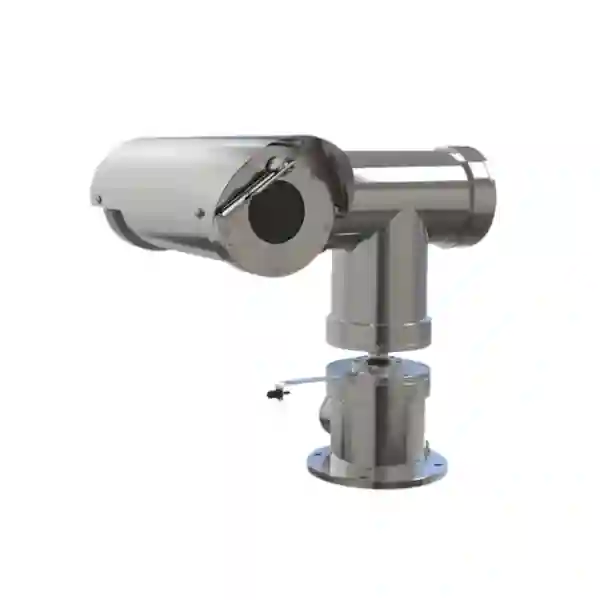
Hanwha TNU-X6320E1F2WT1-Z Explosion-Proof PTZ Camera
The Hanwha TNU-X6320E1F2WT1-Z is a specialist, legacy explosion-proof PTZ network camera used in industrial surveillance planning. It combines Full HD 1080p video at up to 60 fps, 32x optical zoom, 150 dB wide dynamic range, a built-in wiper, single-mode fibre connectivity and 24 VAC power. Hanwha Vision now identifies the original product as discontinued and names TNU-X6320A1F2WT1-Z as its replacement. Buyers in Tanzania can use this guide to review the original configuration, assess engineering constraints and prepare a precise technical enquiry. Stock, local price, manufacturer support and site-specific suitability remain subject to confirmation.
Key features and technical summary
| Original model | TNU-X6320E1F2WT1-Z |
|---|---|
| Product type | Explosion-proof PTZ network camera |
| Manufacturer status | Discontinued |
| Named replacement | TNU-X6320A1F2WT1-Z |
| Imaging | Full HD 1080p, up to 60 fps |
| Lens | 32x optical zoom with autofocus |
| Wide dynamic range | 150 dB, legacy published value |
| Communications | Single-mode fibre, F2 version |
| Cleaning | Integrated wiper |
| Edge storage | Two microSD/SDHC/SDXC slots |
| Power | 24 VAC |
| Historic environmental specifications | IP66 / IP67; approximately −40°C to +60°C |
| Historic -Z designation | cLCus Class I, Division 1-related, certificate review required |
Published original-model specifications are for orientation; verify the complete data sheet, installation manual, certificates and supplied revision before design approval.
Purpose and buyer fit
The Hanwha TNU-X6320E1F2WT1-Z addresses a specialist surveillance requirement: an industrial operator may need remotely directed video coverage at a location where the use of ordinary outdoor cameras would not satisfy the site’s hazardous-area engineering requirements. The legacy unit combines a remotely aimed PTZ view, 32x optical zoom and a protective assembly associated with specific explosion-proof applications. From a suitable location it can help operators inspect equipment, entrances, boundaries and activity without sending a person into each observation area. Its purpose is best understood as targeted situational awareness rather than a promise that one moving camera will cover an entire installation at once.
This product page is useful for engineers maintaining a system that already includes the model, project teams checking an older equipment schedule, and buyers comparing the exact legacy item with its named successor. Hanwha Vision states that production of this model has been discontinued and identifies the replacement as TNU-X6320A1F2WT1-Z. A new project should therefore begin by evaluating the supported replacement, while a legacy maintenance request should establish what equipment and support remain obtainable. Price, availability, delivery, warranty and eligibility for a particular industrial installation must be confirmed separately in writing.
Explosion-proof classification is a project decision
The phrase explosion-proof describes equipment designed for particular hazardous-location requirements; it is not the same as describing a camera as waterproof or vandal resistant. Industrial atmospheres may contain flammable vapours, gases or other hazards that trigger formal selection and installation requirements. Historic Hanwha documentation associates this exact -Z variant with cLCus Class I, Division 1-related certification. That identification helps distinguish the suffix, but it does not mean that every explosive atmosphere or every industrial site is automatically appropriate. The exact certificate, gas groups, temperature class, conditions of use and local engineering rules must be reviewed against the site’s classification dossier.
Ask the responsible safety and electrical specialists to obtain the original manufacturer documents and compare them with the classified-area drawings. Pay particular attention to cable entries, seals, glands, earthing and the surrounding equipment; a correct camera assembly can be undermined by unsuitable installation components. Accessories and maintenance practices also belong in the assessment. Neither a product label nor a catalogue summary establishes Tanzanian regulatory approval for a particular project. For procurement, require a signed technical specification that identifies the location classification and the precise camera version, with any deviations resolved before purchase.
Full HD video at up to 60 frames per second
Hanwha Vision publishes a 1080p video capability of up to 60 frames per second for the original TNU-X6320E1F2WT1-Z. Full HD video can support a useful balance of detail, recording load and live operation in an industrial security system. Higher frame-rate recording can be valuable when the intended scene includes movement, but frame rate alone is not a measure of identification ability. What a user can actually see depends on distance, zoom position, lighting, exposure, compression, atmospheric clarity, vibration and the screen used for playback.
Define the operational target before selecting recording settings. A broad view of a process area may have different priorities from an operator’s close inspection of a valve or access gate. Establish whether the footage is needed for general awareness, incident review or a more demanding evidential purpose. During commissioning, record representative day and night scenes and play them back in the real video-management system. Verify the resolution and frame-rate configuration rather than relying only on the camera’s maximum published capability. A design that performs well in an empty daytime demonstration may need different settings when the site becomes busy.
The practical value of 32x optical zoom
The model is published with 32x optical zoom and autofocus. Optical zoom provides a physically narrower lens view and can show details that occupy only a small portion of a broad image. In an industrial setting that may allow an operator to locate an event, magnify a specific piece of equipment and return to an overview from the same camera position. It is especially useful when observation points are widely separated but occasional manual close inspection is necessary.
Optical magnification also reveals weaknesses in an installation. Heat shimmer, rain, dust, haze, poor lighting, long viewing distances and small structural vibrations can prevent reliable detail even with a strong zoom lens. At a narrow field of view, minor movement of a mast or support can become obvious. Determine expected recognition or identification needs with site-specific tests rather than assuming a fixed distance from the zoom ratio. Mounting stiffness, window cleanliness and control-room viewing arrangements are all part of image quality. Autofocus helps adjust the image, but it cannot correct every environmental or mechanical limitation.
Pan and tilt operation for situational awareness
A remotely positioned PTZ camera can examine several directions from one installed location. The useful design work is to specify which scenes operators actually need: for example, a selected industrial entrance, a loading point, process equipment and a boundary section. Clearly named presets can help control-room staff return to repeatable views and reduce the time spent manually searching. A documented home view is also important so that the camera has a useful resting position when it is not being actively controlled.
PTZ creates a trade-off that should be explicit in the security design. While the lens is aimed closely at one event, activity elsewhere may not be recorded at useful detail. A moving camera is not a substitute for fixed continuous coverage where that is necessary. Define how patrol sequences, manual operation, event responses and return-to-home settings interact with the site’s recording objectives. Train users on permissions and preset behaviour. For most complex installations, a flexible PTZ view works best alongside strategically placed fixed overview cameras.
Wide dynamic range and demanding light
The legacy model’s Hanwha product information identifies 150 dB wide dynamic range. Industrial scenes frequently include bright sky, reflective metal, shadowed structures and artificial lighting within the same frame. WDR processing is intended to preserve usable detail across challenging contrast, which can help operators inspect an area where a standard exposure would leave either highlights or darker details difficult to read. That is relevant for outdoor entrances, illuminated working areas and camera positions facing an opening.
Wide dynamic range is not a guarantee of perfect visibility. Camera positioning, glass cleanliness, scene lighting and motion still matter. Test important views during the hours in which lighting is most difficult, not just under comfortable conditions. Note that Hanwha publishes a different 120 dB WDR value on the named successor model; do not silently assume identical exposure processing between generations. A replacement project should compare actual recorded scenes with the client’s operational requirements, especially where glare or deep shadow is already a known problem.
Integrated wiper for exposed observation points
An integrated wiper is one of the manufacturer’s specified features for the TNU-X6320E1F2WT1-Z. The practical objective is to help recover a usable view when rain or other removable surface contamination affects the viewing window. For an industrial monitoring station, reducing avoidable interruptions to the image can be important when the operator needs to inspect equipment in wet weather. Nevertheless, the wiper is not an automatic cleaning solution for every residue, and it does not make regular maintenance unnecessary.
Dust, oily film, deposits and chemical contamination may require specific cleaning procedures approved for the enclosure. If a washer system is being considered, confirm the exact accessory compatibility, fluid requirements, connection arrangements and hazardous-area suitability. Hanwha identifies washer-related accessories in the product family, but their presence in a catalogue does not establish that they are included with this camera or available for the original revision. Maintenance workers should follow the product instructions, avoid damaging the window and preserve the equipment’s certification conditions.
Single-mode fibre connection on the F2 variant
The F2 suffix is a meaningful network detail. Historical manufacturer documentation identifies the exact TNU-X6320E1F2WT1-Z as a single-mode fibre version. This distinguishes the camera from variants designed around different communication arrangements and may be particularly important in an existing industrial fibre backbone. Fibre is often considered for extended network links and locations with difficult electrical conditions, but actual benefits depend on the whole installation rather than the presence of a port alone.
Record the fibre type, termination, optical interface, patching, link budget, network switch or converter and any existing spare fibres before planning replacement. Do not assume a generic optical module or arbitrary transceiver will be compatible. Obtain the manufacturer’s relevant connection details for the exact supplied assembly, and verify the end-to-end link at commissioning. Protect cable routes and allow for safe isolation and maintenance. For legacy migrations, retaining the physical infrastructure can be attractive, but IT security, available firmware and supported equipment should still be reviewed.
Video-management and network integration
This is a network-camera product intended to participate in a wider viewing and recording system. The camera specification does not by itself establish complete compatibility with every network video recorder or video-management platform. A project team should identify the intended system version and validate live view, recording, playback, PTZ commands, named presets, event handling, authentication and time synchronisation. Legacy devices may use particular firmware or software combinations that affect available features.
Include the IT and operational-technology teams in network planning. Decide who can administer the camera, which workstation or recorder receives streams, how users authenticate and what network paths are permitted. Minimise unnecessary network exposure and use available secure settings where supported. A working preview image is only the first stage of integration: the camera must continue to behave predictably after power interruption, network reconnection and shifts between operators. Document the tested configuration so that maintenance changes do not unexpectedly disrupt recordings or PTZ control.
Multiple streams and capacity planning
Hanwha highlights multiple streaming as a feature of the original camera. In a correctly designed system, separate video profiles can support different needs: a detailed recording stream, a lower-demand monitoring view and possibly other application requirements. The number and configuration of streams should be verified against the product and recorder documentation. Compression settings affect not only the amount of network traffic but also the detail preserved in recorded footage.
Calculate the expected number of simultaneous users, frame-rate demands, recording duration and video retention before finalising the network. Include scene complexity and busy operating periods instead of sizing bandwidth around a quiet example. Rain, moving machinery, vehicles and high-detail backgrounds can increase encoded traffic. Review switching, uplink capacity and any remote-access bottleneck. Where bandwidth is limited, decide which recording quality must be preserved and which live views may use lighter profiles. Confirm those choices with recorded tests and provide headroom for realistic operating conditions.
Dual memory-card slots and recording resilience
The original model’s product summary includes two microSD, SDHC or SDXC memory-card slots. These may contribute to local recording options, subject to the camera’s exact firmware, accepted media and configuration. Local storage can be useful in a system that needs additional resilience, but the existence of card slots does not guarantee footage survival through every fault or replace a central recorder. The actual usable recording duration depends on capacity, video settings, scene activity and card health.
Define what the site requires from edge and central recording separately. Confirm retention policy, recorded evidence access, timestamp accuracy and how a failed card or lost network link will be reported. Specify suitable approved recording media and a maintenance method that respects hazardous-area restrictions. Commissioning should include retrieval of sample footage, not merely insertion of a card. Where evidence continuity is especially important, include monitoring and documented recovery procedures. The storage design should be tested as a system rather than inferred from the number of slots.
Using intelligent video analytics appropriately
Hanwha Vision lists intelligent video analytics as one of the TNU-X6320E1F2WT1-Z features. In a surveillance workflow, a configured event may prompt an operator to inspect a scene, but it is not the same as a certified plant safety function or a guarantee that every intrusion will be detected. Rain, reflections, shadows, moving equipment and a camera’s changing field of view can influence rules and alerts. A PTZ camera may also be aimed elsewhere when a different area requires attention.
Start with a small number of operationally meaningful alert conditions and validate them in the intended setting. Identify the person or team who receives each event, how false alerts are handled and what action follows a genuine notification. Test during different lighting and activity periods, not only in controlled conditions. Record the agreed rules and any required exceptions. Safety-critical equipment must remain supported by suitable dedicated engineering controls; general camera analytics can assist an operator but should not be substituted for those controls.
Electrical design around 24 VAC
Hanwha specifies 24 VAC power for the original TNU-X6320E1F2WT1-Z. That matters because similarly named camera variants may differ in their supply arrangements. Do not assume that ordinary Power over Ethernet can power this explosion-proof positioning assembly. Use the exact manufacturer instructions to determine supply sizing, electrical protection, wiring and any relevant starting or operating conditions. Confirm the model suffix before procurement so that the power system is not designed for a different variant.
The site engineer should consider cable length, voltage drop, transformer capacity, protective equipment, earthing and safe isolation. Where video is operationally important during a mains outage, evaluate appropriate power continuity as part of the wider installation. Cable entries and supporting electrical components may also be subject to hazardous-area rules. A device that works on a temporary bench supply may behave unreliably if the installed power source is insufficient. Power tests should therefore form part of the final acceptance process.
Weather exposure and enclosure protection
Historical manufacturer documentation associates the exact model with IP66 and IP67 ingress-protection ratings and an operating temperature range from approximately minus 40 to plus 60 degrees Celsius. These ratings are useful engineering inputs but not a promise that the installed camera will resist any cleaning chemical, impact, pressure or environmental condition. Enclosure protection depends on correct assembly, approved entries, seals and installation methods, as well as preserving the condition of the viewing window.
For a Tanzania deployment, evaluate rain exposure, airborne dust, solar loading, corrosion, cleaning methods, vibration and maintenance access. The specific location matters more than a general statement about national climate. If an aggressive atmosphere is present, confirm the precise material and accessory specification rather than generalising from related Hanwha models. Ensure that brackets, fixings and cable paths are suitable for the site. The designer should also account for safe maintenance and for the consequences if the camera temporarily loses its view in poor weather.
Choosing the mounting position
A high-zoom PTZ performs best when the mounting position has been selected from the required views backward. Map the important objects, entry routes and inspection points before choosing a wall, column or mast. Tanks, structural steel, pipework, buildings and moving equipment can obstruct the line of sight. Consider changes in the operating environment that could make a previously useful position ineffective. An apparently convenient high mounting point may introduce vibration or difficult service access.
Obtain the manufacturer’s mechanical drawings and installation guidance for the exact model and any proposed mount. Confirm structural loads, fixing suitability, wind effects and the planned range of camera movement. A qualified engineer should review any custom fabrication or mast. Route 24 VAC power and fibre without creating unsafe maintenance conditions, and leave sufficient space for the approved service procedure. Verify that the camera can reach each agreed preset without collision or obstruction. The mounting decision is both an imaging decision and a safety decision.
Potential industrial applications in Tanzania
Potential buyers include industrial operators considering specialist surveillance at fuel-handling facilities, processing areas, selected storage installations and other sites with formally classified risks. Those examples describe types of requirements, not confirmed installations or proof that this particular model can be used in every one of them. A facility’s hazard assessment and project certification requirements determine which equipment can be installed. The full part number must be checked carefully when different regional variants or historical models appear on an equipment schedule.
Different locations call for different observation priorities. One site may need an operator to inspect vehicle activity at a loading point; another may want close views of specific process equipment without routine physical approach. In each case, work out whether a PTZ is the right operational tool, where continuous fixed coverage remains necessary and how the video reaches an authorised monitoring team. A sensible project scope includes documented views, recording responsibilities, safe access and an acceptance test rather than starting with the product label alone.
How PTZ works alongside fixed cameras
The value of one positioning camera depends on the wider system. A PTZ provides flexible attention, but while it turns or zooms to one target it may no longer record another. A perimeter, critical access route or hazardous process area that requires continuous observation should not rely on an assumption that one moving lens observes everywhere. Fixed cameras can maintain an overview while PTZ supports closer investigation. The correct arrangement is determined by operational tasks and risk, not a universal ratio of fixed cameras to PTZ units.
Build an observation matrix identifying what needs to be visible, at what time and for what purpose. Separate continuous monitoring from occasional inspection and define how staff respond to a reported event. Include recorder capacity, video retention, evidence handling, operator training, maintenance and the possibility of communications failure. An explosion-proof assembly may be necessary at one classified location but inappropriate and uneconomical elsewhere. Keep the camera selection tied to site engineering rather than using one specialist model throughout a facility simply for consistency.
Network security and lifecycle support
Network video equipment should be treated as an asset within the organisation’s IT and operational-technology security programme. Use authorised accounts, strong unique credentials, restricted administrative access, appropriate segmentation and secure communication capabilities where the installed firmware supports them. Keep an inventory of devices, firmware versions, addressing and maintenance ownership. Avoid unmanaged exposure of the camera to external networks, and document how service personnel gain access when support is required.
Lifecycle planning is particularly important here because the manufacturer marks the TNU-X6320E1F2WT1-Z discontinued. Check the availability of security updates, firmware, replacement parts and compatible management software before retaining it in a new or expanded system. A working legacy camera may still create a support dependency that should be recognised in the project risk assessment. Test any maintenance change against recording, PTZ control and fibre connectivity, retain configuration backups and establish a replacement plan if support becomes insufficient.
Commissioning and acceptance testing
A successful commissioning programme verifies the complete installation against the customer’s approved specification. Begin with the actual model and suffix, hazardous-area documentation, approved mount, cable entries, electrical supply and optical link. Verify the required views, usable zoom, PTZ presets and home position. Test image quality in representative lighting and weather conditions where practical. Demonstrate the integrated wiper through the applicable approved procedure and check that it does not interfere with the surveillance objective.
Next verify the recording path, playback, storage alerts, time synchronisation, permissions and any agreed analytics. Simulate appropriate network or power interruption scenarios under a safe test plan and observe the system’s recovery. Confirm that control-room operators can retrieve important footage and that the footage reflects the specified camera settings. Record deviations and corrective actions before handover. A signed set of acceptance results gives both the customer and integrator a clear standard for maintenance and future replacement decisions.
Maintenance without compromising protection
Preventive maintenance should assess picture clarity, window contamination, wiper condition, mechanical stability, cable routes, fibre performance, recording health and authorised PTZ response. Regular checks can reveal a degrading view or network problem before it becomes complete monitoring loss. Procedures should reflect the exposure and operational criticality of the specific location, rather than an arbitrary maintenance interval copied from an ordinary office camera.
Any work involving the explosion-proof enclosure, glands, seals or electrical connections must follow the manufacturer’s instructions and the site’s safe-work requirements. Do not improvise replacement parts or open equipment in conditions that are not approved. Maintain records of inspection, repair and firmware changes so the next engineer understands the installed configuration. The discontinued status also makes planning for spares, service escalation and eventual migration more important. Where replacement requires downtime, develop a temporary monitoring arrangement that meets the site’s operational requirements.
Comparing the original with the successor
Hanwha Vision identifies TNU-X6320A1F2WT1-Z as the replacement for this discontinued model. That designation is a useful starting point, not proof of a direct drop-in exchange. A replacement review should examine certification documents, mechanical dimensions, mounting loads, 24 VAC power, fibre interface, PTZ geometry, wiper arrangement, recorder compatibility and maintenance access. Small changes in an enclosure or connection arrangement can have significant implications for a hazardous-area installation.
Image characteristics also deserve comparison. Hanwha advertises the original model with 150 dB WDR, whereas its successor is published with 120 dB WDR. This is an example of why new product specifications should be assessed independently instead of assuming every figure improves or stays unchanged. Compare meaningful site scenes and current documentation, especially if the existing system depends on a particular image result. Ask for the exact quoted model, accessories and any changes required to the installation before making a purchase decision.
What to provide when asking for a quote
For an efficient technical quotation, provide the full requested model number, whether the request concerns an existing installation or a new project, and the hazardous-area classification documents. Describe the intended camera position, critical views, network backbone, fibre terminations, available electrical power and video-management system. When replacing an installed unit, relevant drawings and carefully handled photographs can help establish the current connection and mounting arrangement. Share sensitive site information only through an appropriate approved project channel.
Request a response that states the proposed item and revision, certificate documentation, mounting and washer accessories, lifecycle status, any configuration work and the scope of testing. Price, stock, delivery, warranty and installation services must be confirmed by the actual offer; they are not asserted by this product description. A properly scoped enquiry prevents mistakes involving a similar-looking but electrically different variant. It also helps the buyer compare keeping a legacy camera, sourcing approved spares or migrating to a currently supported replacement.
Questions before retaining a legacy installation
Before deciding to retain the original camera, identify its current state and the reason for review. Is the unit functioning correctly, or are there faults in image quality, positioning, cleaning or communications? Are the original certification documents and installation drawings available? Has the site’s hazardous-area classification or surveillance requirement changed? Answering these questions distinguishes a simple maintenance task from a redesign and makes it easier to identify the risks of extending equipment service life.
Check the condition of the mount and cable installation, the current recorder compatibility and the ability to maintain secure access to the camera. Establish whether service parts, manufacturer support and qualified maintenance are obtainable. If a successor is proposed, plan for re-commissioning instead of assuming that familiar model numbering guarantees interchangeability. A lifecycle decision should balance reliability, safety, documentation, total project work and operational disruption rather than judging solely by the initial hardware cost.
Frequently asked questions
Is the original Hanwha model discontinued?
Yes. Hanwha Vision lists the TNU-X6320E1F2WT1-Z as discontinued and identifies TNU-X6320A1F2WT1-Z as the replacement. This does not establish whether any individual seller has old stock. A buyer should seek explicit confirmation of the quoted item, manufacturer support position and applicable commercial terms. A new project should evaluate the successor before committing to discontinued equipment.
What is the stated video resolution and speed?
The original model is advertised for Full HD 1080p video at up to 60 frames per second. Real recording settings and detail depend on the selected stream, recorder, network and conditions at the site. Record and play back representative scenes during acceptance testing. Maximum published capability does not guarantee that a distant object will be identifiable in poor lighting, dust or vibration.
Does the model include 32x optical zoom?
Yes. Hanwha describes 32x optical zoom with autofocus. It allows operators to move from a wider scene to a closer view, provided the viewing conditions and mounting position are suitable. Test important recognition distances in the real environment. Zoom does not remove obstructions, compensate for all movement or guarantee a clear image through haze or contamination.
What is special about the F2 variant?
Historical manufacturer materials identify the exact F2 model as a single-mode fibre version. For retrofit projects, verify the optical interface, termination, link budget and switching equipment instead of assuming compatibility with any transceiver. A correctly designed network link is important for both control and recording. Confirm the details against documentation for the exact camera being supplied.
Can this camera be powered through PoE?
The stated power input for the original TNU-X6320E1F2WT1-Z is 24 VAC, so ordinary PoE should not be assumed to power the complete assembly. Confirm transformer, wiring, protection and isolation requirements with the manufacturer documents and responsible electrical engineer. A similar part number can refer to another configuration, which is why full model identification matters.
Does the explosion-proof designation cover every hazardous location?
No. Suitability depends on the exact certification and a formal comparison with the site’s classification and installation rules. Historical documentation associates this -Z variant with cLCus Class I, Division 1-related approval. That is not a blanket claim of compatibility with every hazardous atmosphere or of regulatory approval for any specific Tanzanian facility. Obtain the relevant certificate and qualified engineering review.
Does the integrated wiper eliminate cleaning?
No. The wiper may help clear rain or removable deposits, but exposed industrial windows still need inspection and appropriate cleaning. Do not use unapproved chemicals or parts that could damage the enclosure. If a washer accessory is proposed, verify compatibility and its installation requirements. The wiper’s existence is not a promise that the lens will remain clear in every operating environment.
Can it take the place of fixed CCTV cameras?
Not always. While the PTZ follows one scene, it cannot simultaneously maintain detailed views of every other direction. Use fixed cameras where continuous coverage is necessary and PTZ where operators benefit from flexible closer inspection. The right camera mix depends on risk, recording objectives, site layout and available monitoring personnel rather than the zoom specification alone.
What should be checked about memory-card recording?
Hanwha identifies two microSD-family memory-card slots. The supported media, effective capacity, event behaviour and recording retention should be checked against the actual firmware and selected settings. Edge recording does not automatically replace a central recorder. Commissioning should verify that clips can be retrieved, timestamps are accurate and any storage failure can be detected by responsible staff.
Will it integrate with my existing video-management system?
Compatibility has to be demonstrated with the actual recorder or video-management version. Test live image, recording, playback, PTZ control, authentication, preset behaviour, event handling and time synchronisation. Network-camera compatibility by itself is not proof that every advanced feature will work. Review firmware and cybersecurity implications as part of a legacy-system integration.
Is the listed successor a drop-in replacement?
Not necessarily. Compare hazardous-area certificates, power, fibre, mount, camera movement, optics, video processing, management software and accessories. Hanwha publishes different WDR headline figures for the two generations, so even image-processing assumptions should be checked. A qualified design review and new acceptance tests are appropriate before installing a successor in a classified location.
How do I request a Tanzania project quotation?
Provide the exact model, hazard classification, required views, location drawings, fibre arrangement, 24 VAC supply and recording platform. Explain whether the request is for a spare, an installed-system upgrade or a new design. Ask for the specified model and accessories, relevant documents, confirmed stock status, warranty, lead time, pricing and commissioning scope. None of those commercial details is established by this informational listing.
Request a technical quotation or replacement review
Ask FourTeck Tanzania to evaluate the original Hanwha TNU-X6320E1F2WT1-Z requirement alongside the manufacturer’s named successor. Send your classified-area schedule, intended views, fibre connection details, 24 VAC supply and mounting requirements through an appropriate project communication channel. Request confirmation of the offered model, accessories, supporting certificates, stock status, commercial terms, warranty and installation requirements before approving a purchase. This information supports a specific engineering and procurement decision; it does not claim inventory, approval or compatibility for any individual site.
Contact FourTeck Tanzania to discuss the specification and request a quotation.




Reviews
There are no reviews yet.