
HANWHA VISION • RADIOMETRIC THERMAL MONITORING
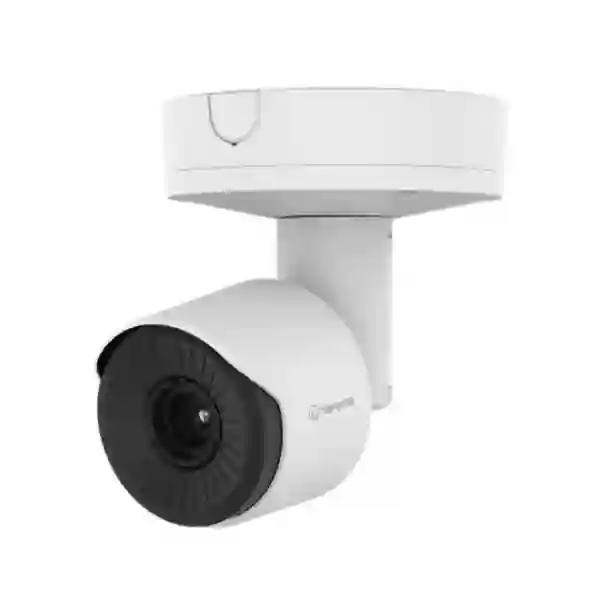
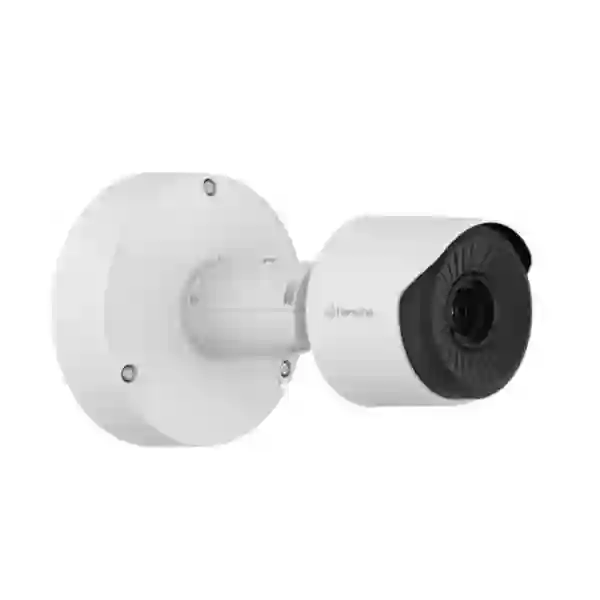
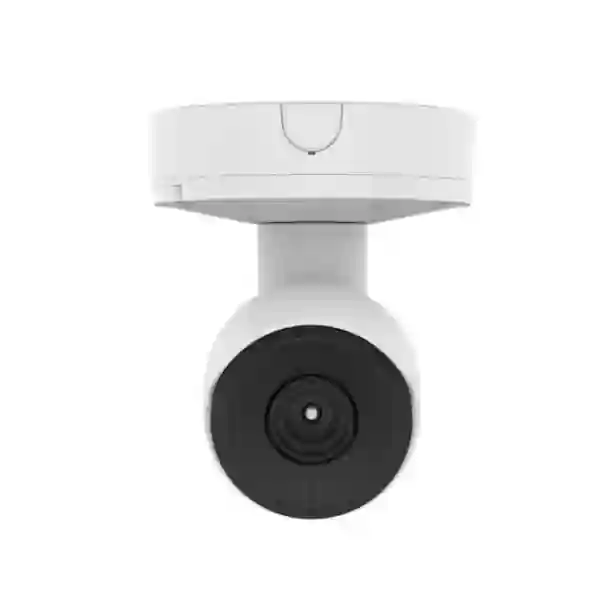
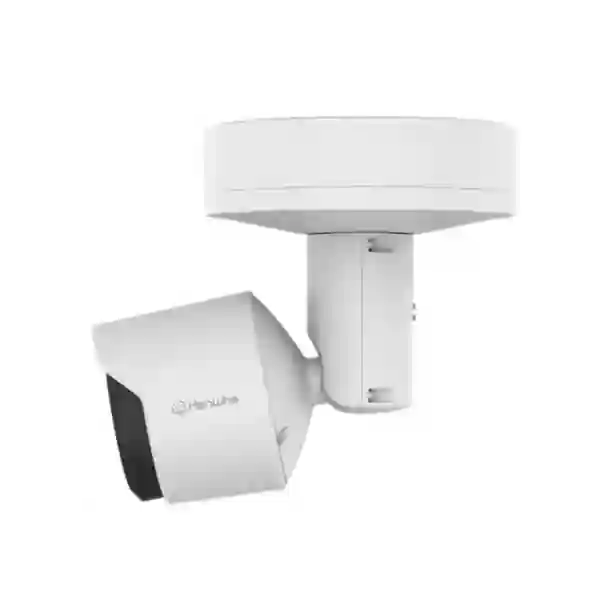
Hanwha Vision TNO-C3020TRA Radiometric AI Thermal Camera
For Tanzanian organisations planning thermal surveillance or temperature-based alerts, the Hanwha TNO-C3020TRA offers a 384 × 288 detector, a wide 6.6 mm view, person-and-vehicle analytics, and selectable temperature monitoring areas. Its strongest role is to support a tested response workflow around a clearly visible target—not to replace certified safety equipment or a detailed site survey.
Verified specification snapshot
The figures below are the manufacturer’s published product specifications. They describe camera capabilities, not a guarantee of local stock, site-specific alarm range, process accuracy or compatible software behaviour.
| Camera type | QVGA radiometric AI thermal network bullet |
|---|---|
| Original sensor / output | 384 × 288 native; 768 × 576 output option |
| Lens / view | 6.6 mm fixed; 60° horizontal, approximately 44° vertical |
| Video / coding | Up to 30 fps; H.265, H.264, MJPEG |
| Thermal detector | Uncooled microbolometer; 8–14 μm; NETD ≤30 mK |
| Radiometry | −40°C to +550°C; whole field or up to 10 polygonal ROIs |
| Measurement accuracy | Manufacturer states ±2°C at ≤150°C and ±15% above 150°C, subject to specified conditions |
| Analytics | AI-based person / vehicle classification; supported virtual lines and areas |
| Power / typical draw | IEEE 802.3af PoE or 12 V DC; PoE typical 9 W |
| Weather and protection | IP66/IP67, IK10, NEMA 250 Type 4X per manufacturer |
| Network and storage | ONVIF S/G/T/M; RTSP, MQTT, SUNAPI; microSD slot up to 1 TB |
| Listed operating conditions | −40°C to +60°C; non-condensing humidity limits |
A thermal camera for two demanding jobs
The Hanwha Vision TNO-C3020TRA combines radiometric temperature observation with security-oriented thermal video analytics in a compact network bullet camera. It is designed for situations where operators need to notice changes in heat patterns or detect relevant movement, including sites that cannot rely solely on ordinary visible-light images. A suitable deployment starts by defining the monitored object, the alarm response, and the distance from camera to target rather than selecting a device by resolution alone.
For a facilities manager, the first decision is whether continuous thermal awareness can complement existing inspections and safety procedures. For a security designer, the central question is whether a 60-degree horizontal view and person-or-vehicle analytics suit the perimeter geometry. The TNO-C3020TRA can serve both discussions, but its temperature measurements, detection ranges and alerts must be evaluated under real site conditions. Ask for an application review before deciding how many cameras to use.
What the model actually measures
This product uses an uncooled microbolometer to sense long-wave infrared energy, with the manufacturer specifying an 8–14 micrometre spectral range. It presents a thermal image instead of a conventional colour photograph. Thermal contrast can help reveal a person, vehicle or warm area in darkness without depending on visible scene illumination, but interpretation still depends on target size, background, line of sight, weather, emissivity and mounting position.
Radiometric capability adds estimated temperature information to the scene. That is different from a thermal camera intended only to display relative hot and cold areas. The difference matters when selecting alarms for equipment and materials: the operator can assess temperature-related conditions rather than interpreting palette colour alone. The image does not by itself establish the cause of heat, make a chemical diagnosis or replace an appropriately specified process sensor or certified safety instrument.
Thermal resolution: understand the original pixels
The original detector resolution is 384 by 288 pixels, commonly described as QVGA in Hanwha Vision’s product literature. The camera also lists a 768 by 576 output option, which should not be confused with a higher-resolution native thermal detector. Enlarging an output image may improve presentation in a monitoring interface, but does not create additional scene detail that the sensor did not record. This distinction is important for selecting distance and target size.
A buyer assessing a small connection, an isolated hot component or a distant intrusion should request a realistic scene demonstration. Wide views distribute the available pixels across a greater area, while narrower fields can make a distant object occupy more pixels. The required number of pixels on the target depends on whether the task is basic detection, meaningful recognition, or quantitative review of a small thermal feature.
Why the 6.6 mm lens matters
The fixed 6.6 mm lens provides a manufacturer-stated horizontal field of view of approximately 60 degrees, with about 44 degrees vertically and 78 degrees diagonally. This makes the model a wide-view choice within the relevant thermal range rather than a long-distance narrow-angle specialist. A wide view can be useful for equipment clusters, yard approaches and a defined section of a compound, provided critical areas remain large enough in the image.
The lens is fixed-focus, and the published minimum object distance is 1.4 metres. Camera position must therefore be planned rather than relying on optical zoom or remote refocusing after installation. Consider height, downward angle, obstructions, target movement and changes in site activity. Where precise measurement of a small object is essential, a closer position or an alternative focal length can be a better decision than trying to enlarge the image digitally.
Thermal sensitivity in practical terms
The manufacturer specifies NETD at or below 30 millikelvin. NETD describes the sensor’s ability to distinguish small apparent temperature differences under defined test conditions. A low figure is useful for producing detail in scenes with subtle thermal contrast, but it is not the same specification as absolute temperature accuracy. Buyers should not translate the NETD number into a promise that every object temperature will be correct to a fraction of a degree.
Real-world results are influenced by reflections, emissivity, atmosphere, viewing angle and distance. Two objects at the same actual temperature can appear different if their surfaces emit infrared radiation differently. In an industrial survey, camera placement and an appropriate reference procedure can matter as much as nominal sensitivity. Define what degree of change actually warrants an alert and establish a threshold based on site observation rather than an arbitrary number.
A broad temperature observation range
Hanwha Vision lists a temperature detection range from minus 40 degrees Celsius to plus 550 degrees Celsius for this radiometric model. That broad span can accommodate a variety of outdoor and industrial monitoring questions, from unusual cold conditions to elevated surface temperatures. It should not be interpreted to mean that every point across the range can be measured with the same uncertainty or under every environmental condition.
For purchasing decisions, document the temperatures expected in normal operation, the abnormal values that require review and the size of the region to be observed. A threshold intended for an electrical cabinet may be unsuitable for a waste-storage area or a charging zone. Operators should establish how an event is confirmed, who receives notification and what action is taken before treating continuous thermal monitoring as an operational control.
Temperature accuracy and its limitations
The official specification states temperature accuracy of approximately plus or minus 2 degrees Celsius at or below 150 degrees Celsius and plus or minus 15 percent above 150 degrees Celsius under the manufacturer’s stated measurement conditions. The manufacturer also notes room-temperature conditions and automatic temperature mode in its documentation. These figures are not universal guarantees for every surface, distance, installation or changing environment.
Highly reflective metal, a hot object seen through glass, rain-wetted surfaces or a partially blocked view can produce readings that do not represent the desired surface temperature. An installation plan should record the object’s emissivity, the location of the region of interest, and the relevant ambient and operational conditions. Where a process demands traceable precision, independent calibration or an appropriate contact sensor may still be required.
Monitor whole scenes or selected areas
The TNO-C3020TRA supports whole-field temperature observation as well as up to ten user-defined polygonal regions of interest. That permits one camera view to include several meaningful areas while treating them separately for monitoring purposes. A facility might define a region for a particular stack, machine enclosure or doorway approach rather than allowing every warm object in the image to carry equal operational importance.
The correct shape of a region should track the object or danger area without including too much changing background. This is particularly important where vehicles, sunlight, moving workers or routine process heat are present. Each region requires its own threshold rationale, ownership and response procedure. Ten regions should be understood as a configuration capability, not proof that ten independent safety-critical processes can be certified or measured equally well by one view.
Temperature conditions that can initiate review
Manufacturer-listed region conditions include temperature above or below a selected level and increasing or decreasing temperature conditions. These choices enable a monitoring plan that looks for more than a fixed hot spot. For instance, a rapid upward change in a designated area may be more useful than a simple absolute reading when the normal operating temperature varies by time of day or by production cycle.
Threshold selection should be established through observation and testing. A temporary warm vehicle passing a storage area is not equivalent to gradual heating within the stored material. Configure observation zones to separate those behaviours where practical. The camera provides signals for investigation; operators and any connected system must still determine the seriousness of an event and apply appropriate safety actions.
Person and vehicle classification
The camera provides AI-based classification for people and vehicles, alongside supported virtual lines and virtual-area events. These capabilities help a monitoring team focus on relevant perimeter activity rather than treating all thermal movement as equally meaningful. Typical configuration questions include the direction of travel, areas in which people should not linger and whether a vehicle entering a defined zone is expected during a shift.
AI classification is not a promise of perfect object identification. Partial occlusion, small targets, crowding, weather and unusual viewing geometry can affect results. For higher-consequence sites, validate both missed events and nuisance alarms using representative footage. Do not present the analytics as facial recognition, licence-plate reading or individual identity verification: a thermal person-or-vehicle classification is a different function.
Using virtual lines and intrusion areas
A virtual line can be used to detect a crossing or a specified direction of movement through the thermal view. Virtual areas can support intrusion, entrance, exit and loitering scenarios as documented by the manufacturer. These functions may be valuable where the security requirement is behavioural: knowing that someone approached a restricted gate after hours rather than merely noticing some movement anywhere in a large image.
Configuration quality is essential. Draw lines where a target has a usable thermal size and is unlikely to disappear behind a structure. Avoid placing critical zones exactly on image edges or across busy lawful routes when the intended alarm is unauthorised movement. During commissioning, walk and drive through test paths, including the difficult ones, so that a site team understands which events are actually observable.
Thermal imaging and ordinary CCTV work together
A standard optical camera generally provides colour, appearance and scene context when adequate light is available. A thermal camera responds to infrared energy, which can make the movement and temperature distribution of objects easier to notice at night or against a dark scene. These strengths are complementary, not interchangeable. Thermal video may show that an object is moving without showing the visual details needed for an incident report.
For sites requiring evidential colour images, consider pairing thermal observation with a suitable visible-light camera. An operator can use the thermal alert to decide where to look, while a separate optical view provides additional detail. The TNO-C3020TRA should not be described as a full replacement for every existing security camera, nor as a general-purpose thermal thermometer for any target at any distance.
Perimeter monitoring: choose coverage deliberately
For a perimeter application, start with a site plan that shows fences, walls, roads, vegetation, gates and potential concealment points. The wide-angle lens can cover a substantial scene, but useful classification range depends on the size and contrast of the target in that scene. A mounting position that maximises apparent coverage may leave the most important distant approach with too few pixels for dependable analytics.
Select camera positions according to expected entry routes and the actions that should trigger review. Note vehicle routes and legitimate staff movements separately. Plan sufficient overlap for blind corners or use an additional device rather than expecting one wide-angle view to see through buildings or dense obstacles. Operators should be able to explain what the camera can and cannot monitor from each installed position.
Interpreting published DRI distances
The manufacturer publishes Johnson-criteria detection, recognition and identification estimates. For this model, the listed examples include person detection around 200 metres and vehicle detection around 510 metres, with substantially shorter distances for recognition and identification. These are model-based imaging criteria, not guaranteed AI-trigger distances, not verified Tanzanian deployment ranges, and not proof that a distant person’s identity is available.
Weather, size, thermal contrast, target motion, installation angle and application settings can produce different results. Treat DRI figures as an early lens-selection reference only. A procurement specification should separately state the distance at which an actionable alarm is required and the evidence necessary to accept performance. If that distance exceeds realistic capability in the intended scene, reconsider placement, focal length or camera count.
Industrial overheating and asset observation
Radiometric monitoring can be considered where abnormal surface heating is a useful sign that an asset deserves inspection. Examples might include designated equipment housings, process areas or externally visible components. The goal is to provide earlier awareness of an unusual thermal pattern while retaining established maintenance and safety controls. A view through a closed metal enclosure does not reveal the temperature of parts hidden inside it.
Choose measurable surfaces and document normal operating cycles before setting alarms. Motors, ventilation equipment and electrical systems may warm up legitimately when load changes. A single global threshold could produce unnecessary alerts or fail to account for a different normal baseline on another machine. The decision should be driven by the maintenance question, the accessible surface, and a practical escalation workflow.
Battery-charging area monitoring
Battery-charging facilities may benefit from observing defined areas for unusual thermal changes, subject to an application assessment. Hanwha Vision identifies charging environments as a possible use case for radiometric thermal monitoring. The camera can provide a view of exposed surfaces or a surrounding region, but it does not automatically measure cell-core temperature inside opaque equipment or determine battery chemistry or fault mechanism.
Position the device so relevant surfaces are visible, and keep ordinary traffic and temporary heat sources out of sensitive regions where possible. Confirm with the responsible safety professional what temperature-related warning should prompt investigation. A thermal camera is not a certified gas detector, smoke detector, fire-alarm control panel or substitute for required electrical protection. Its outputs should complement a properly engineered safety programme.
Waste, recycling and storage scenarios
Waste handling and storage present variable temperature, surface and visibility conditions. A radiometric camera may help operators inspect an exposed pile or a defined handling location for changing thermal patterns, particularly where continuous human observation would be difficult. However, piles can contain hidden hot regions that are not visible from the camera’s perspective. Moisture, material type and moving equipment can alter apparent temperatures.
A useful design begins with the likely incident scenario: where heat may originate, whether a detectable surface change is expected, and who would respond to an alert. Multiple views or different sensors may be appropriate for complex volumes. Avoid assuming that a temperature threshold on the visible surface will always reveal an internal hot spot early enough to prevent an incident. Conduct on-site validation.
Warehouses and outdoor yards
Warehouse and yard operators often need to observe broad spaces with mixed temperatures and changing activity. Thermal video can add value at night or where a conventional camera has limited visual contrast. The wide 60-degree field is suitable for evaluating selected approaches or equipment zones, but shelves, containers, parked vehicles and structural columns can block its line of sight just as they block a visible-light camera.
Where the aim is asset monitoring, mount the device with an unobstructed view of the relevant exterior surface. Where the aim is security, use lines and zones to reflect how the site actually operates. Separate loading schedules, cleaning routines and ordinary vehicle access from suspicious events. Clear operating rules are more useful than sending every thermal anomaly to the same alert channel.
What happens in fog, smoke and rain
Thermal sensing can maintain useful scene contrast in some conditions that challenge ordinary visible cameras, such as darkness or certain reduced-visibility scenes. That does not mean it can reliably see through any density of fog, smoke, steam, dust or heavy rain. Atmospheric attenuation and foreground material can limit both image quality and temperature measurements, sometimes severely.
A responsible design records local exposure and sets performance expectations accordingly. For an exposed site in Tanzania, consider rainfall, humidity, windborne dust, temperature changes, nearby heat sources and the chosen installation height. Test under representative conditions when feasible. If the use case is safety-critical, do not rely on marketing phrases such as ‘sees through smoke’ without assessing the actual smoke type and density.
Understand reflections and emissivity
Radiometric cameras infer temperature from infrared radiation received by the detector. The emitted component depends on emissivity, while a shiny or reflective surface can also return radiation from surrounding objects. This is why a polished metal panel can display a misleading warm reflection and why two adjacent surfaces at the same temperature may appear different in a thermal palette. The thermal image is not an automatic map of true internal component temperatures.
Before specifying an alarm, inspect the target’s surface finish, angle and expected environmental reflections. If the relevant surface is hidden behind ordinary glass, do not assume its emitted long-wave infrared signal will pass through the glazing. Where accuracy is important, identify a suitable exposed reference location and establish an approved measurement procedure. Site measurements should be interpreted by someone who understands these limitations.
Housing, weather and impact protection
Hanwha Vision lists IP66 and IP67 environmental ratings, IK10 impact resistance and NEMA 250 Type 4X protection for this model. These ratings support consideration of exposed installations, but they do not remove the need for correct cable entries, sealing, corrosion assessment and a suitable mechanical fixing. The stated operating temperature is minus 40 to plus 60 degrees Celsius with non-condensing humidity limits.
Outdoor design should review direct solar exposure, wind, rain, drainage and mounting stability. Verify that junctions and any additional accessories preserve the required environmental protection. The camera’s own rating does not automatically apply to a third-party enclosure or a poorly sealed cable joint. Inspection access, safe working height and maintenance clearance should be included at design stage rather than solved after the camera is installed.
Power planning: PoE or 12 V DC
The manufacturer supports IEEE 802.3af Class 3 Power over Ethernet and 12-volt DC input. Listed power consumption is approximately 9 watts typical and 10.8 watts maximum via PoE, and approximately 7.7 watts typical and 9.4 watts maximum on 12-volt DC. A network design must include switch power budget, the rest of the connected equipment and the actual supply arrangement.
Where continuous monitoring is required, consider what happens when mains power or the network fails. An appropriately designed uninterruptible supply may be necessary for the application, but its capacity and runtime must be sized separately. Check cable distance, grounding, surge exposure and safe isolation against the installation design. Do not assume that providing PoE by itself guarantees uninterrupted alarms or recording.
Network integration and interoperability
The camera supports standard IP video concepts as well as published ONVIF Profiles S, G, T and M, RTSP, MQTT and Hanwha Vision’s SUNAPI interface. These capabilities create options for integrating video and events into monitoring systems, but a standards list is not a complete compatibility certificate for every recorder, VMS, alarm platform or software version.
Before procurement, confirm the exact features that a chosen system can receive: live stream, recording, temperature value, metadata, event notification, region identifier and any required alarm acknowledgement. Some interfaces may expose basic video while advanced analytics or radiometry require an approved integration path. Request a working demonstration with the intended software, firmware and network policies if the application depends on those details.
Video compression and recording strategy
H.265, H.264 and MJPEG are listed video codecs, with WiseStream II and AI-related WiseStream III options also specified. The camera supports multiple stream profiles, which can help a system designer distinguish a monitoring view from a recording stream. Compression settings influence bandwidth, recording volume and image appearance; aggressive compression can make a scene harder to interpret during an incident review.
Estimate storage using the intended frame rate, bitrate, hours of recording, retention policy, motion/event behaviour and number of connected cameras. A nominal maximum of 30 frames per second is a capability, not an instruction to use that rate in every installation. Confirm the network’s real capacity and the recorder’s ability to retain the required thermal information before setting a policy.
Local recording and event continuity
Hanwha Vision specifies one microSD/SDHC/SDXC edge-storage slot with a stated capacity up to 1 TB, subject to compatible media and configuration. Edge storage can form part of a resilience plan, for example when a central recording connection is briefly unavailable. It does not guarantee that every alarm will be captured in every failure scenario or that stored files will be immune to physical damage.
Decide whether the operating requirement is continuous recording, event recording or a combination. Document retention, access permissions, export processes and verification checks. For remote sites, establish a procedure to notice a failed card, a lost recording path or an unexpected camera restart. These details are as important to incident review as choosing the correct image resolution.
Alarm routing and operational response
Supported alarm and event options include configurable input/output connections, recording at triggers, event notifications, MQTT publication and PTZ preset handover, subject to the configured system. A camera event becomes useful only when it reaches an accountable recipient with sufficient context. In many projects the difficult part is not generating an alert; it is preventing the alert from being ignored or misinterpreted.
Define event severity and recipient groups, then test each route. A thermal temperature change could require maintenance review, whereas a boundary crossing could require security verification. The same dashboard may display both, but the response rules should not be interchangeable. Decide how alarms are acknowledged, how repeat events are handled and what records must remain available for later investigation.
Cybersecurity for network-connected thermal cameras
The manufacturer’s security specification lists signed and encrypted firmware, secure boot, HTTPS, IEEE 802.1X options, device certificates and secure storage capabilities. These are useful technical foundations, not evidence that the finished installation is secure by default. An exposed or poorly maintained camera can still become a network risk when accounts, passwords, firmware and access rules are mishandled.
Include the camera in a managed asset inventory. Change default credentials where applicable, apply supported firmware updates through a documented process and restrict administrative access to authorised personnel. Consider a separate surveillance network, controlled remote access, secure time synchronisation and event-log review. Ensure installers provide a handover record that contains configuration ownership without exposing passwords in ordinary site documents.
Practical camera placement on a Tanzanian site
The local deployment review should account for the actual site rather than assume all facilities share the same environment. A busy loading yard, a coastal industrial site and an enclosed workshop can present different sunlight, dust, rainfall, corrosion, visibility and network conditions. The camera’s published environmental ratings are a starting point for engineering review, not a guarantee of suitability for every untested location.
Plan camera height to balance tamper resistance and useful target detail. Confirm that the field of view includes the intended hazard area in ordinary and peak operating conditions. Inspect cable routing, lightning or surge exposure where relevant, maintenance access and the capability of the local power supply. Any installation or service coverage offered by a vendor should be confirmed in a quotation rather than assumed from a website description.
Lighting is not the central constraint—but geometry is
A thermal camera does not require visible light to display a heat-based scene, which is a valuable difference from conventional daylight imaging. Yet thermal coverage still requires a clear optical path. A row of containers, a closed door, a thick wall or an opaque barrier can conceal the very surface or person being monitored. Camera placement should be checked from realistic standing and operating positions.
Do not equate a wide nominal field of view with complete protection. Draw the actual view on an installation plan and mark near-field obstructions and excluded corners. If a hazard develops behind a barrier, another camera position or sensor class may be needed. The purpose of a coverage study is to make these limits explicit before the system becomes part of a safety or security procedure.
A sensible commissioning sequence
Begin with a written application statement: target objects, operating hours, required event, permitted detection latency and the person or system responsible for acting. Next establish the camera location, fixation, protected cable route, power supply, network segment and the receiving recorder or monitoring system. Check current official documentation for firmware and compatible accessories before mounting.
After physical installation, inspect the thermal view at the expected operating state and configure image orientation, temperature regions and security analytics. Build an initial baseline using routine conditions rather than selecting thresholds blindly. Then test representative normal activities and abnormal scenarios where safe and authorised. Handover should include final configuration, network details, alert recipients, maintenance responsibilities, training and agreed acceptance criteria.
Test false positives and missed events
A successful demonstration should not consist only of one person walking across a line or one warm object placed in front of the camera. Test the difficult situations the site may encounter: distant approaches, crossing near the frame edge, changing sun exposure, rain, background heat and moving equipment. Record whether the camera detects the intended event and whether it flags routine activity unnecessarily.
For temperature observation, compare the intended area to an appropriate independent measurement method where needed and document the conditions. Distinguish observed repeatability from the manufacturer’s stated accuracy. Agree in advance how many nuisance events operations can tolerate and who is allowed to adjust thresholds later. A documented acceptance test gives both the buyer and operator a practical basis for judging performance.
Routine care and configuration ownership
Once commissioned, the site should maintain a regular inspection routine. Confirm that the front optics are unobstructed, mountings remain secure, cable seals are intact and relevant surfaces still lie inside the intended regions. Construction changes, stored materials and new vehicle routes can alter the thermal scene enough to reduce alarm usefulness without causing an obvious hardware fault.
Monitor camera health, recording status, device time, firmware policy and event delivery. Keep approved backups of configuration and a log of adjustments to zones or thresholds. Assign named responsibility for changes so an emergency alert is not silently disabled during troubleshooting. Maintenance intervals should be set by the site’s risk assessment and local conditions; no universal service interval can be inferred from the product description.
Choosing between a wider and narrower thermal view
The TNO-C3020TRA is the 6.6 mm option in a family that also includes different focal lengths. A wider lens generally covers more area at the expense of target pixels at a given distance, while a narrower lens provides a more concentrated view. The correct choice depends on the required target size and distance, not which product sounds more powerful on a specification sheet.
For a narrow corridor, far perimeter or small hot component, ask whether a different lens or placement is better. For a broad near-field scene, the 60-degree field can be attractive. If both tasks are important, separating them into distinct views may be more dependable than expecting one compromise position to serve every purpose. Confirm any alternative model’s exact specifications independently; family features should not be copied without verification.
Who should consider this camera
Suitable buyers to evaluate the model include industrial safety teams observing accessible hot surfaces, facilities engineers monitoring defined equipment areas, and security managers who need thermal person-or-vehicle analytics on selected approaches. System integrators may also value the available network and event interfaces. In each case the value lies in a clearly designed use case and tested workflow, not in treating a thermal feed as a standalone solution.
The model may be a poor fit where the requirement is facial detail, reading small printed labels, measuring hidden internal temperatures, detecting hazardous gas, certified fire detection or observing very small targets at excessive distances. Stating these limits helps procurement teams avoid mismatched expectations. Describe the business problem and measurement or detection distance when requesting technical advice.
What to ask for in a quotation
Provide the exact product name Hanwha Vision TNO-C3020TRA, required quantity, application, mounting position, target distances, network details and expected recording platform. For radiometric work, include the intended material or surface, normal temperature range, desired warning condition and any measurement accuracy requirement. For security work, specify the event type and the shortest and longest useful detection distances.
Request confirmation of regional product availability, commercial price, approved accessories, licensing or integration requirements, warranty terms and delivery conditions for the proposed supply. These items are not established by the general technical specification. Also ask whether any export or import documentation is required for the offered configuration, and have the supplier verify current rules rather than assuming every thermal camera has identical import conditions.
A deployment checklist before purchase
A practical approval checklist should cover purpose, site survey, field of view, target pixel size, surface visibility, power, network path, event destination, recording, environmental protection and acceptance criteria. For temperature applications it should additionally identify emissivity considerations, reference measurements, safe threshold selection and the process followed after an alert. For security applications it should list authorised traffic, intrusion boundaries and operator verification steps.
Document ownership for each item. An installer can validate mounting and network configuration, a maintenance engineer can judge equipment alarm meaning, and a security supervisor can define response to an intrusion event. Procurement can then compare proposals against the same operational requirements. This prevents a purchase decision based solely on one attractive headline feature while important work remains unspecified.
Thermal monitoring is not a standalone safety certificate
It is important to distinguish surveillance capability from safety certification. Radiometric video may identify a condition worthy of investigation, but a camera does not automatically replace a code-required detector, process interlock, fire-alarm system or emergency shutdown function. Engineering decisions about consequence, redundancy and safe response should be made by qualified personnel using the applicable project requirements.
Likewise, markings or standards shown on a manufacturer page should not be presented as proof that a product has a specific approval in Tanzania. Ask the proposed supplier and responsible project team to establish import conditions, required documentation and suitability for the intended installation. This page describes technical capabilities and selection considerations; it is not a claim of local regulatory clearance.
Network event metadata needs a test
ONVIF support is helpful when integrating a camera with existing video software, but interoperable live streaming is only the first stage. Temperature monitoring becomes operationally useful when the receiving system can interpret the specific event or reading that matters. Depending on software design, a supported stream may not expose every advanced sensor field or offer an operator-friendly temperature history.
Ask the integrator to demonstrate the complete journey of a test event: camera observation, event transport, display in software, recorded evidence, notification and acknowledgement. Check whether multiple configured regions remain distinguishable, and whether the timing and retained data support incident review. This test is particularly important for projects where the camera must work with an existing third-party VMS.
Reducing alert fatigue
A good monitoring design avoids asking personnel to respond to dozens of low-value notifications. Start with the smallest set of meaningful regions and lines. Use operational schedules and known lawful movement to establish which events deserve attention, then review false positives after deployment. An alert that arrives without context may become noise even when the sensor correctly reports a temperature change or motion.
Agree a hierarchy: informational trends for maintenance, warning conditions requiring investigation, and urgent incidents for a formally defined response. Do not imply that the camera itself certifies severity. Review thresholds whenever equipment loads, storage arrangements or perimeter use changes. This discipline protects the usefulness of both radiometric monitoring and security analytics over time.
Considering total project cost
The unit price is only one part of a working thermal surveillance installation. Other potential requirements include appropriate mounting accessories, network switches, protected cabling, a recording platform, storage, monitoring software, commissioning, training and ongoing administration. Some sites may also need additional visual cameras or other sensors to meet their operational objective.
Compare project proposals by the same monitoring outcome and verified acceptance test rather than by the camera count alone. A low-cost configuration that produces unreliable alarms can impose significant operational work, while an oversized design may add complexity without useful coverage. Ask for an itemised quotation and confirmation of which services, accessories and licences are included. No Tanzania price or stock claim is made here without a verified offer.
Planning for an incident review
Decide in advance what evidence must be retained after a temperature or intrusion alert. Security teams may need timestamps, thermal footage, visible-camera context and a record of operator decisions. Maintenance teams may need the region location, baseline conditions, temperature trend, loading state and inspection outcome. Not every recording system automatically stores every piece of analytic metadata.
A good incident process also considers privacy, role-based viewing and secure export. Avoid indiscriminate access to recordings and retain information according to the organisation’s lawful policy. Test whether the record is comprehensible to someone who was not watching the live feed. The value of continuous monitoring is strengthened when an event can be reconstructed and the next corrective action can be documented.
Making the final suitability decision
This model makes most sense when a buyer can identify a clearly visible thermal target, define a meaningful response and verify that the 6.6 mm field of view reaches it at useful image scale. The combination of radiometric regions, 30 fps thermal video, AI object classification and standard network integration makes the TNO-C3020TRA a candidate for carefully designed mixed monitoring applications.
A sensible next step is to request a technical and commercial review with a site sketch, typical distances and the intended software platform. Confirm the exact supply terms and perform site-specific validation before using alerts for consequential decisions. FourTeck Tanzania can be contacted through its usual verified customer enquiry channel to discuss a quotation; this description does not assert inventory, warranty, delivery coverage or installation services that have not been confirmed.
Frequently asked buying and deployment questions
These answers address common decisions about the specific Hanwha Vision model. They should be used alongside a current datasheet, a site assessment and an integrator compatibility check.
Is the TNO-C3020TRA a normal CCTV camera?
No. It is a radiometric thermal network camera that senses long-wave infrared radiation. Its image is useful for heat patterns and some person-or-vehicle monitoring scenarios, but it does not provide the colour scene detail of a conventional optical camera. A combined system may be appropriate where both forms of information are needed.
What is the camera’s native thermal resolution?
The detector is 384 × 288 pixels. A 768 × 576 output mode is listed, but that larger stream should not be interpreted as additional native thermal detail. Use the required target size and distance to decide whether the resolution is sufficient.
Can it measure temperatures up to 550°C?
The manufacturer states a detection range from −40°C to +550°C. Accuracy varies across that range and is conditional on the measurement situation. Confirm surface emissivity, line of sight, distance and acceptance criteria before relying on a specific number.
Does this product recognise faces or number plates?
The listed AI object classification covers persons and vehicles. It is not a facial-recognition or automatic number-plate recognition system. If positive identity evidence is required, plan a suitable additional visible-light imaging solution.
Can one camera replace a fire alarm?
No. Radiometric surveillance can support investigation of temperature anomalies in selected exposed areas, but it is not a substitute for required fire detection, gas detection, protective interlocks or safety procedures. Engineering controls should follow the applicable risk assessment.
Does it work in complete darkness?
Thermal imaging does not require visible light for a heat-based scene. However, object contrast, distance, obstructions and environmental conditions still determine whether a useful image or alarm is obtained.
Can it see through walls or glass?
No. Ordinary building barriers conceal many targets, and conventional glazing does not offer unrestricted transmission of the long-wave infrared wavelengths used by this camera. The actual target surface must be visible to the thermal detector.
How many temperature regions can be configured?
The published specification lists up to ten polygonal regions of interest and whole-field observation. The number of useful regions depends on scene geometry, measurable target size and the operational meaning of each alert.
Is PoE supported?
Yes. The manufacturer lists IEEE 802.3af Class 3 PoE alongside 12 V DC. Check the network switch power budget, protection and backup design for the proposed installation.
Can the camera integrate with a third-party VMS?
The manufacturer lists ONVIF Profiles S, G, T and M, RTSP, MQTT and SUNAPI capabilities. Actual video, analytic and temperature-data interoperability must be tested against the intended VMS version and integration path.
Is this an outdoor camera?
The manufacturer lists IP66/IP67 environmental protection, IK10 impact resistance and NEMA 250 Type 4X. Correct mounting, protected cable joints and review of site conditions remain important. These ratings do not establish an unrestricted installation guarantee.
Is the product available and priced in Tanzania?
No current Tanzania-specific price, stock position, delivery promise or target-listing SKU has been verified for this content. Request a current quotation and confirm the exact supplied model, accessories, availability and conditions before ordering.
Can it monitor a very distant person?
Published imaging-based DRI values are useful for preliminary discussion, but do not guarantee reliable AI event triggering at those distances. Validate the required scene, target size and alarm performance on a representative site.
What should I send with a quote request?
Share the model, quantity, intended application, plan or photographs of the site, typical distances, target surfaces or intrusion routes, available power, desired recording platform and required alert behaviour. Those details help assess suitability without guessing.
Does its 30 fps frame rate mean easier importing?
Not necessarily. The manufacturer notes that certain thermal equipment may be subject to export or import controls. The supplier should confirm the classification and required permits for the exact product and trade route. No Tanzania-specific clearance is claimed.
Are temperature readings equal to thermal sensitivity?
No. NETD is a thermal sensitivity specification; temperature accuracy describes how closely a radiometric reading represents a reference value under defined conditions. Surface properties and environmental factors affect the latter.
Request a site-specific Hanwha TNO-C3020TRA quotation
To assess suitability, describe whether your priority is radiometric temperature observation, perimeter analytics or a combination. Include a site plan, intended mounting position, approximate distances, available network infrastructure and the required alarm response. Request confirmation of the exact supply model, availability, accessories, software compatibility and current commercial terms.
Contact FourTeck Tanzania through its verified customer enquiry channel to discuss requirements. No price, stock, warranty or delivery promise is made in this description, and no unverified destination link has been added.




Reviews
There are no reviews yet.