
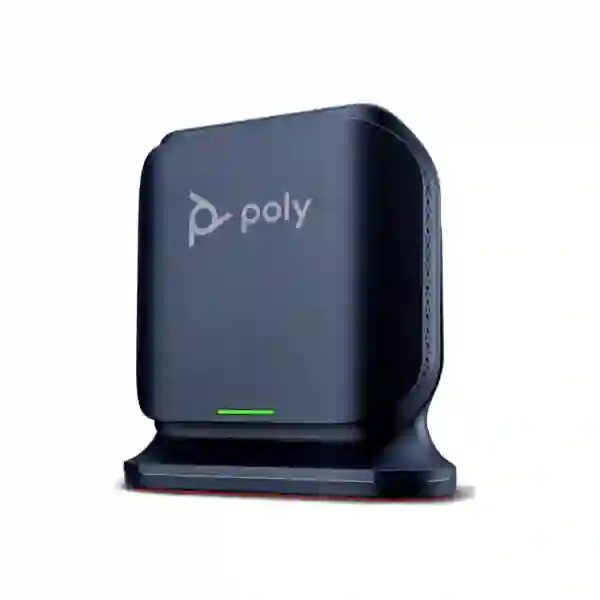
HP Poly Rove B4 DECT Base Station
Equip moving teams with a properly planned, scalable cordless calling system. The HP Poly Rove B4 DECT Base Station connects compatible handsets to SIP business telephony through an Ethernet-connected multi-cell radio network. It is suited to organisations that need dependable coverage across several work zones, not merely a standalone desk telephone replacement.
For a Tanzania deployment, request a configuration and quotation based on your floor plan, handset needs, peak call traffic and the exact regional radio variant. Pricing, stock and regulatory suitability must be confirmed for the intended order.
Key specifications at a glance
| Product role | Multi-cell DECT IP base station for compatible Poly Rove handsets |
|---|---|
| Handsets per B4 | Up to 30 |
| Active calls per B4 | Up to 8 narrowband or 4 wideband |
| Multi-cell system limits | Up to 254 bases; 1,000 handsets; 1,000 SIP registrations (published ceilings) |
| Indoor wireless reach | Up to 50 m under favourable conditions for the Africa-listed variant |
| Network interface | 1 RJ-45 Ethernet port, 10/100/1000 Mbps (Africa specification) |
| Power options | PoE; optional supported external 5 V / 2 A DC adapter |
| Coverage accessory | Poly Rove R8 repeater, up to 3 per B4 under HP guidance |
| Regional band example | HP Africa lists 1880–1900 MHz variant 8J8W4AA; verify Tanzania suitability |
Published maximum capacities are planning limits. Real performance, suitability and accessories depend on site conditions and the chosen configuration.
What the HP Poly Rove B4 actually does
The HP Poly Rove B4 DECT Base Station is the radio and IP-network connection point for compatible Poly Rove cordless handsets. It is not a complete desk telephone, and a base station alone does not provide a handset, telephone number or calling subscription. Its purpose is to connect roaming workers to a suitable SIP calling environment while allowing the wireless footprint to expand through coordinated base stations. For a business evaluating cordless telephony, that distinction matters: plan the handsets, base stations, network access, PBX or hosted calling service, power and any repeaters as a complete system.
The B4 belongs to the multi-cell part of the Poly Rove family. Instead of expecting one radio to reach every room, a deployment uses several well-positioned B4 units to provide overlapping coverage. A suitable multi-cell design enables a worker to move between coverage cells while continuing a conversation. The useful commercial question is therefore not simply how far one base reaches. It is whether the full layout supports the right number of people, the busiest calling periods and the routes workers actually take.
Businesses with a small, contained calling area may not need multi-cell infrastructure. A larger workplace with separate wings, reinforced walls, multiple floors or high call density may benefit from B4 planning. Confirm the necessary scale before purchasing hardware, because a technically capable base station cannot compensate for a poor survey, weak network or an incompatible calling platform.
Who should shortlist this multi-cell DECT system
Consider the Rove B4 when staff need to keep their telephone conversations active while moving around a site rather than remaining at fixed desks. Examples include reception and operations teams serving several building zones, supervisors walking between departments, and facilities staff who receive important internal calls away from their desks. DECT is a dedicated cordless-telephony approach, so the design task centres on handset coverage and voice performance rather than merely extending ordinary Wi-Fi access.
The best candidates have a practical reason for multi-cell roaming. A two-floor business might discover that one base already covers every occupied location, while a larger building with concrete stairwells may need several carefully placed cells. Another company may have good radio coverage but insufficient simultaneous voice capacity at the busiest station. In both cases the correct design emerges from observed usage, a floor plan and a site survey, not a generic square-metre promise.
Ask whether users need rugged handsets, hands-free features, additional line appearances, or access to a particular hosted telephony service. These requirements affect the total solution and may be more important than the choice of base alone. A sensible shortlist evaluates the B4 together with compatible Poly Rove handsets, the Poly Rove R8 repeater where relevant, network readiness and the intended SIP service.
Capacity: handsets are not the same as active calls
HP Poly documents up to 30 handsets associated with each Rove B4 base station and up to eight simultaneous narrowband calls on an individual B4 cell. These are different measurements. The handset figure describes how many devices can be associated with a base; the call figure describes how many conversations the radio can handle at the same time under the stated audio conditions. A team may own thirty handsets without all thirty being able to sustain simultaneous calls through one cell.
Wideband audio changes the planning calculation. HP Poly’s site-planning guidance shows four concurrent wideband calls on a B4 rather than the eight narrowband calls. Wideband consumes additional radio resources, making it useful to establish whether call quality expectations, codec selection or peak traffic is the dominant requirement. A brochure figure for total possible conversations should never replace a busy-hour assessment in a real office, hotel or industrial building.
At the larger-system level, HP Poly describes a multi-cell platform of up to 254 base stations, 1,000 handsets and 1,000 SIP registrations, with an overall system call-capacity figure of up to 2,000. These are published ceilings, not a guarantee for a specific deployment. Real-world throughput depends on placement, active cell distribution, audio codec, radio conditions, software configuration and call-server capacity. Size the local network and each busy zone before relying on a system maximum.
What multi-cell handover means for everyday work
A user might begin a call in a reception area, walk along a corridor and continue into a workshop. Where the radio cells have appropriate overlap and the network and handsets are configured correctly, the multi-cell system is designed to pass the active call between coverage points. This is the main difference between merely owning several isolated cordless bases and engineering one coordinated multi-cell environment. Roaming depends on the strength and quality of the neighbouring radio links.
Pay special attention to doors, stairwells, loading entrances and the places where people move between floors. Those transitional spaces can be more important than a large open room because radio performance may change sharply as a person crosses a wall or enters a lift lobby. A site assessment should test calls along the actual walking routes, including at the edge of each cell and when several users are active.
Do not assume that a line drawn on a floor plan proves seamless handover. Building materials, interference and placement heights matter. Record where each cell is expected to overlap another, test whether handsets can locate the next base in time and review the outcome before mounting devices permanently. A commissioning walk test offers more confidence than quoting a maximum range without context.
DECT coverage and published range
HP’s Africa-market product specification lists a wireless range of up to 50 metres indoors for the applicable Rove B4 variant. Family documentation also quotes up to 300 metres outdoors under favourable conditions. These figures are upper reference points, not an indoor design radius for every building. The deployment guide includes more conservative examples for some radio regions and warns that physical surroundings can restrict usable coverage.
An open room with limited obstructions may behave very differently from an office divided by thick partitions, a warehouse with metal racks or a hotel constructed with reinforced concrete. The number of walls between a handset and its serving base can influence intelligibility and the reliability of handover. People, metal fixtures and movement can also change a radio environment during the day.
To determine a practical quantity, mark required working areas, note obstacles, choose candidate base locations and verify performance with a survey. Plan deliberate overlap where continuous roaming is required. The correct number of devices is a deployment result, not a fixed promise derived from the size of the building. Avoid deciding coverage by multiplying a published outdoor range by the number of bases.
Understand walls, floors and workplace materials
HP Poly’s planning documentation identifies concrete and metal as particularly important radio obstacles. Brick, tinted glass and building contents may also affect signal, while open air behaves differently. Even two similar buildings can call for different layouts if one has tall shelving, metallic ceilings, reinforced pillars or several dense service cores. This is why on-site context belongs in the procurement conversation from the beginning.
Create a sketch showing walls, lift shafts, staircases, storage rooms and restricted areas. Add locations where workers spend time and where calls must remain active. Note whether machinery, electrical equipment or other cordless systems may influence the environment. Consider what will change after installation: new stock racks, movable partitions or equipment could alter the radio path.
For a multi-storey installation, consider each floor separately, then test movement through connecting spaces. Placing a base close to a large stairwell is not automatically better than placing it centrally on a floor. The optimum position must balance user density, local attenuation, adjacent cell overlap and the availability of an appropriate Ethernet cable. Survey findings should govern mounting positions.
Ethernet and Power over Ethernet requirements
The Rove B4 links to the IP network by Ethernet and supports Power over Ethernet, simplifying installations where a suitable PoE switch port can supply power over the network cable. HP’s Africa-market specifications show a single RJ-45 interface supporting 10/100/1000BASE-TX connections. The vendor also identifies a compatible optional external power option rated at 5 V and 2 A DC. Confirm the exact hardware variant and power accessories selected for the purchase.
PoE can reduce the need to place a separate electrical outlet near every radio location, but it does not eliminate the need to design the network. Check PoE availability, switch capacity, cable condition, cable routes, network segmentation and upstream resilience. A base station that loses its Ethernet uplink or power will not maintain normal calling service merely because the handset battery remains charged.
Ask the installer to document which switch port serves each base and which power source is expected. Consider power backup for switches and call-system components if maintaining communications during short power interruptions is an operational requirement. Where local DC power is proposed, verify the appropriate supported adapter, electrical specifications and whether it is included in the actual quoted package.
Package contents and what must be ordered separately
HP lists the Rove B4 base station, a desk stand, Ethernet cable, quick-start guide and safety information sheet in its standard box contents for the Africa-listed variant. That list does not include a cordless handset or a general-purpose IP PBX service. Buyers should avoid treating the B4 as a ready-to-use phone kit. A functioning solution needs appropriate handsets, registration to a compatible calling service and a network connection.
Power sourcing deserves a separate line on the quotation. When using PoE, check that existing switching equipment provides suitable power at the chosen location. If a dedicated adapter is preferred, ask for the compatible optional 5 V / 2 A DC unit to be listed explicitly rather than assuming it is included. Installation materials and any additional Rove R8 repeaters should be itemised separately when needed.
An accurate bill of materials should distinguish bases from handsets, chargers, power accessories, network infrastructure, mounting arrangements, support services and optional coverage expansion. It should also identify the regional radio variant. This avoids a common purchasing problem in which a low unit price is compared with a complete installed solution, even though the scopes contain different components.
Compatible Poly Rove handsets and worker profiles
The B4 is intended to operate within the Poly Rove cordless family. HP Poly documentation identifies compatible Rove handsets and the Rove R8 coverage repeater. Different handset models offer different ergonomic and functional choices; the right one depends on user duties, exposure to demanding conditions and required calling features. Handset suitability should be checked alongside the base-station design rather than decided after infrastructure has been purchased.
Reception and administration staff may prioritise straightforward call handling and a familiar user interface. Operations personnel might value a handset that is easier to carry throughout a shift, while certain environments may call for more durable designs. Determine whether users require a belt clip, charger locations, alert features, audio accessories or shared line arrangements. Confirm exact compatibility and feature availability for the selected handset model and software release.
Plan handsets as named or shared devices according to operational practice. A shared device pool may have different registration, charging and accountability needs from one handset assigned permanently to each employee. Document spare batteries and charging procedures where appropriate. Successful cordless calling depends on how people handle, charge and locate the handsets as much as it does on the base radio.
Using the Poly Rove R8 repeater carefully
The Poly Rove R8 repeater provides an option for extending radio coverage where another full base station is not the best fit. HP documentation describes compatibility between the B4 and up to three R8 repeaters per base station. That limit belongs to the specified B4 combination and should not be replaced with a repeater figure quoted for a different Rove base model.
A repeater extends coverage, but it is not equivalent to installing another IP-connected base with independent call capacity. If a particular location has many simultaneous callers, adding a repeat-only coverage device may not address the underlying capacity issue. The installer should decide between a repeater and an extra B4 based on both the radio footprint and expected conversations at the busiest time.
Repeater placement also needs attention to source signal quality and handover requirements. Installing a repeater at the point where a handset already struggles is unlikely to be an ideal strategy. Choose a position with a reliable relationship to its serving base, evaluate the path into the weak area and test the outcome. Include planned repeater quantity and configuration in the finished site documentation.
SIP and business calling-platform integration
Rove B4 forms part of a SIP-based business telephone system. It provides the wireless DECT access side, while the connected IP PBX or hosted voice platform provides the account, dial plan and other call-control functions. The deployment must therefore be checked against the exact platform being used. Calling protocols may be familiar, but support for specific functions, provisioned identities and provider features can still differ.
Before purchasing, confirm the intended SIP service, registration method, network addressing, access control and the features users expect. Relevant examples include transferring calls, shared line appearance, directory access, voicemail indications and call pickup. Ask which functions are delivered by the PBX and which are available through the selected Rove handsets and firmware. Do not promise compatibility with a particular third-party system solely because both products mention SIP.
Network configuration should also be treated as a voice-service concern. DNS, DHCP, time synchronisation, correct routing and quality-of-service policies can affect operation. If voice services must cross network boundaries, review firewall and security requirements with the responsible administrator. Plan a small interoperability test before ordering a large batch for deployment.
Voice codecs, intelligibility and busy periods
Published Rove family documentation lists voice codecs including G.711 variants, G.722 and Opus, with codec details and configuration dependent on the platform and firmware. The practical decision is about balancing audio quality, service interoperability and radio capacity. A preferred codec should be chosen through an end-to-end check that includes the calling platform, configuration and actual handsets.
The HP Poly deployment guide is particularly useful because it shows that B4 simultaneous call capacity changes between narrowband and wideband operation. A cell supporting up to eight narrowband conversations is shown at up to four wideband conversations. If staff spend much of their time speaking at the same location, wideband channel use can become a sizing factor. A reception area with busy call traffic can therefore need a different cell arrangement from a corridor used mainly for walking.
During testing, place calls in both directions and judge clarity in realistic conditions. Observe ringing, answering, transfers, hold and handover. Speak from inside problem rooms and during movement, rather than testing only next to the base. Check what the system does when several people place calls together and document the codec configuration used for acceptance tests.
Security and responsible system administration
HP describes the Rove B4 as using DECT security features, including encryption for communications between compatible handsets and the DECT infrastructure. This is useful protection for cordless voice traffic, but it does not mean that the entire business telephony deployment is automatically secure. SIP signalling, provisioning, administrator access, network equipment and hosted service policies each need their own controls.
Assign administrative ownership before installation. Change default credentials where relevant, restrict access to configuration interfaces, maintain an approved firmware process and keep accurate records of paired devices. Ensure lost or retired handsets can be removed through an appropriate management procedure. If the workforce shares devices, define who can register or reassign them.
Separate operational claims from certification. A manufacturer statement about DECT security should not be described as an independent guarantee of privacy for all connected systems. Equally, no Tanzania-specific telecommunications approval should be inferred from a general product page. Obtain the appropriate local equipment and radio-frequency confirmation for the exact hardware variant before rollout.
Provisioning, monitoring and long-term support
Planning only for the installation day can make a multi-cell system harder to support. HP Poly documentation describes web-based configuration and provisioning capabilities, and HP lists a Poly device-management service associated with the Rove platform. The exact management environment available to a buyer depends on the product software, provider arrangement and implementation choices; confirm the required management method before committing to it.
Document firmware versions, IP addressing, service registrations, multi-cell identifiers, base locations and administration access. Record the configuration baseline after successful acceptance testing so that faults and changes can be compared against a known working state. Identify who will update software and who is authorised to change calling profiles or registrations.
When a site grows, revisit both radio coverage and load distribution. Adding ten handsets to an existing site does not necessarily require ten new bases, but adding a densely staffed department can change a local cell’s busy-hour needs. An organised inventory and a plan for change control make expansion and fault diagnosis more predictable.
B4 versus a smaller Rove base station
The most useful comparison is not simply which base has the greater published capacity. The question is whether the business needs coordinated roaming across several cells. A smaller single-cell or limited dual-cell solution may be appropriate for an office where employees rarely leave one coverage area. The B4 is the multi-cell option for more extensive layouts that need scalable coverage and planned handover.
Compare the footprint, number of handset users, simultaneous calls, handset routes and expansion expectations. A limited office footprint could make B4 complexity unnecessary, while a large site should not force an isolated-base solution to perform a task for which it was not designed. Ask the supplier to compare total installed cost rather than individual base prices. The number of network drops, accessories and survey hours can influence the final budget.
Do not assume that a B4 automatically offers more conversations in one cell than every smaller Rove model. Its strength is the coordinated multi-cell design. Use the relevant model’s official capacity table, including codec effects, and verify any proposed mixture of base-station types against HP guidance. A measured network plan is the right basis for a fair comparison.
Practical considerations for buyers in Tanzania
For a Tanzania-facing procurement, begin with the exact radio version and intended deployment. HP’s Africa product catalogue identifies an 1880–1900 MHz Rove B4 variant, while other regional configurations operate in a different DECT range. The presence of a model in an Africa catalogue does not by itself establish that the exact unit is authorised for use in Tanzania. Check applicable TCRA requirements and the specific equipment documentation before placing an order.
Request a clear bill of materials covering the base station, compatible handset models, R8 repeaters if required, PoE infrastructure, power accessories and implementation services. Ask for an explanation of the support arrangement and who handles future configuration changes. Avoid basing a purchase decision on overseas advertised prices, because those listings do not establish a Tanzanian price, import treatment, local stock position or delivery commitment.
Where uninterrupted business calling is important, include switch backup power, IP connectivity resilience and call-platform continuity in the requirements discussion. A DECT signal may remain strong while its upstream network or SIP service is unavailable. These are separate dependencies that should be designed together. Ask for a quote based on the actual building layout, desired number of users and peak calling requirement.
Business scenario: hotel operations and guest support
A hotel or larger guest-facing property may have housekeeping, maintenance, front-office and operational teams moving through corridors and between floors. Cordless calling can allow workers to communicate without returning to a fixed telephone. The difficult part is often the mix of strong radio obstacles and a need for reliable coverage near service rooms, lifts and staircases.
A B4 site assessment should identify which teams require active calls while moving and which zones need only occasional calling access. Dense concrete construction and enclosed back-of-house routes may change the number of base stations required. Handset selection, chargers and shared-device procedures should be planned with shift patterns. Rather than assuming every guest room needs equal radio strength, prioritise the places where staff actually work and communicate.
Business scenario: warehouse and logistics teams
Warehouses create an unusual combination of open space and large radio obstacles. Tall shelves, steel racking and moving inventory can alter coverage across aisles. Supervisors, receiving staff and logistics coordinators may need to remain reachable as they pass loading bays or storage zones. A carefully designed multi-cell network can support this working pattern when the site requires more than one radio cell.
Survey the site with its normal stock arrangement and check handover at the ends of aisles and transitions between storage areas and offices. If calling traffic is concentrated around dispatch operations, evaluate local capacity in addition to range. Do not use outdoor distance figures as a substitute for testing inside a metal-rich facility. Document locations that become weaker when doors close or equipment is parked.
Business scenario: healthcare, education and campuses
Larger healthcare facilities, learning environments and campus-style businesses can have several departments with different radio conditions and calling needs. A worker may be required to stay contactable while crossing an internal corridor, stepping into a stairwell or moving between operational zones. A multi-cell design becomes useful when these routes cannot be reliably served from a single base.
Define priority call routes and test them using the handset model to be deployed. For sites with critical communications requirements, a cordless office telephone system should not be assumed to replace purpose-built emergency, clinical or safety communication systems. Review the organisation’s specific requirements, uptime targets and any special equipment policies. Use B4 only where the tested deployment is appropriate for the intended voice workflow.
Business scenario: multi-floor offices and service sites
Offices often look simple on a plan but contain radio-sensitive spaces such as meeting rooms, reinforced cores, equipment cupboards and lift lobbies. A B4 design can support staff who move between departments or floors, while centralised call service integration helps the team use familiar extensions. The goal should be dependable usable coverage rather than placing one base on each floor by habit.
Estimate call concurrency for reception, service desks and busy operating teams. Some zones may have relatively few roaming users but many calls during peak periods. Others may require extensive movement coverage and only occasional conversations. Testing those differences prevents an unnecessarily expensive build and helps ensure that additional bases or R8 repeaters are placed for the right reasons.
An effective site survey before purchasing
Begin the survey with a current floor plan or a simple, accurately annotated site drawing. Mark where users are based, where they must be contactable and where they move while speaking. Note staircases, doorways, heavily reinforced walls, tall equipment and any outdoor transition areas. Identify candidate network access points rather than choosing base locations that cannot later be wired or powered.
Estimate the total number of handsets and the maximum number of calls likely to be active within each work zone. Record whether the intended calling profile uses narrowband or wideband codecs, because it changes the B4 capacity calculation. Count the number of users who could gather at shift changes, reception desks or dispatch points. Those brief peaks may drive the design more than the normal average.
Finally, conduct a practical radio walk test or appropriate predictive assessment followed by verification. Test coverage and handover with representative devices, then adjust base positions where the actual results differ from the proposal. Keep a commissioning record of the locations accepted and the conditions tested. A documented survey gives the buyer a defensible basis for both the initial quantity and later expansion.
Installation and commissioning sequence
Start with a reviewed design that names the calling platform, handset family, radio variant, expected base count and coverage priorities. Confirm that the network provides suitable PoE power or approved alternative power where each base will be installed. Mark and label the switch ports and cable runs for maintainability. Check whether any planned repeaters have appropriate signal relationships to their serving B4 base.
Configure the network and calling service according to the approved security plan. Apply the correct firmware and provisioning settings, register handsets and confirm multi-cell relationships before broad distribution to users. Test voice calls in each cell, including both incoming and outgoing service, then walk the important handover routes. Include at least one busy-period test with the intended audio codec.
Close the project with a practical handover. Record the as-built locations, equipment identifiers, key configuration settings, responsible administrator and escalation process. Explain how staff charge devices and report faults. Provide a plan for adding handsets, handling lost devices and reviewing coverage when the interior layout changes. These administrative details are part of usable business communications, not optional extras.
Procurement checklist: questions to put on a quotation
Ask the supplier to identify the exact HP Poly Rove B4 hardware variant and its radio frequency band. Ask how that variant’s intended operation and required documentation will be checked for Tanzania. Request a separate quantity for every base, handset, charging accessory, repeater and power accessory, so that the equipment list can be reviewed without ambiguity.
Request an explicit coverage proposal rather than a blanket range promise. It should show the main areas, user routes, likely radio obstacles and the expected degree of overlap between cells. Ask for the basis of the number of B4 units and which locations have the highest concurrent calling demand. Clarify whether a proposed repeater is intended to improve distance coverage or whether a new base is needed for call capacity.
Ask about installation scope, SIP integration testing, software configuration, documentation and ongoing support. Clarify who supplies the PBX or hosted service and who resolves problems that cross between network and calling-provider boundaries. Finally, request a written breakdown of cost, commercial terms and the expected deliverables. Do not treat an unverified internet listing as evidence of stock or a Tanzania-specific warranty.
Common setup problems and how to investigate them
If a handset has poor coverage in a particular room, first compare that room with the surveyed plan and check whether doors, materials or furnishings have changed. Determine whether the fault follows one handset or affects several devices. The answer helps distinguish an individual handset problem from a wider radio-coverage concern. Repositioning a base without testing may shift the dead area rather than solve it.
If call clarity declines only during busy periods, examine how many calls are active in the affected cell and which codec is configured. Remember that HP’s B4 planning table distinguishes narrowband and wideband capacity. Also consider the IP network, switch power and the upstream SIP platform. Wireless and wired causes can produce similar user complaints, so observations and logs are more useful than assumptions.
If roaming conversations drop between cells, check planned overlap, base synchronisation and current software configuration. Re-test the actual walking route while observing signal changes. An R8 repeater can help with selected coverage gaps, but it should not be added indiscriminately without considering the serving radio and local capacity. Escalate persistent issues using the recorded equipment, firmware, topology and test results.
Common business situations
Reception and customer-facing teams
Maintain reachability as staff move between a counter, nearby offices and service areas. Verify shared-line behaviour and how incoming calls are distributed by the PBX; a base station alone does not create a call queue.
Facility and maintenance staff
Provide cordless access around corridors, workshops and service rooms where workers cannot carry a desk phone. Survey difficult materials and test handovers where people normally move.
Shift-based operations
Plan handset allocation, chargers and spare capacity for staff changes. Busy-hour concentration can matter more than the total number of registered users.
Expanding business premises
Reserve suitable network connections and review the next coverage zone before adding a further multi-cell base. Do not assume a repeater adds the same calling capacity as a new base.
Buildings with changing layouts
Record the original radio assessment and re-test after major rack, wall or equipment changes. Published maximum ranges are not a substitute for a fresh survey.
Teams using hosted calling
Check the actual hosted SIP provider’s interoperability, account provisioning and features before rollout. A SIP label alone is not sufficient proof of complete feature support.
Frequently asked questions
Is the Poly Rove B4 a cordless phone or a base station?
It is a DECT IP base station, not a complete handset. It provides wireless access for compatible Poly Rove handsets and connects the system to an IP calling environment. Handsets, charging equipment, the SIP service and suitable network or power arrangements must be considered separately. Request an itemised bill of materials if you need a fully working telephone system rather than only a replacement base station.
How many handsets can connect to a Rove B4?
HP Poly documents up to 30 handsets per B4 base station. This figure should not be confused with simultaneous call capacity. The same product documentation describes eight simultaneous narrowband calls per B4, and the deployment planning guide gives four simultaneous wideband calls. For a busy work area, calculate calling concurrency by cell before deciding how many bases to order.
Can the B4 support calls while a person walks between floors?
Multi-cell roaming and handover are important intended capabilities of a coordinated B4 deployment. They require adequate radio coverage, appropriate overlap between cells and correct system configuration. Passing through a concrete core or a metal-lined stairwell can still create a difficult radio environment. An on-site handover test should form part of the acceptance procedure for the exact routes employees use.
What indoor distance can the B4 cover?
HP’s Africa product specification gives up to 50 metres indoors. Real coverage depends on the building, interference and installation layout. Heavy walls, metal storage, concrete and some internal partitions can reduce useful signal. Instead of committing to a number of bases based on a fixed circle around each device, have the environment surveyed and check the required coverage with suitable test calls.
Does the base station include a handset?
The Africa-market HP box-contents list includes the B4 base, desk stand, Ethernet cable, quick-start guide and safety information sheet. It does not list a cordless handset. Check the exact quotation and selected package because the final system may also need one or more Rove handsets, chargers, PoE infrastructure or an optional power adapter. The base alone is not a functioning employee telephone.
Does the Rove B4 need PoE?
The B4 supports Power over Ethernet, which is convenient for wired multi-cell installation. HP also lists an optional external 5 V, 2 A DC power option. The appropriate power choice depends on the selected device and site design. Confirm that any required separate adapter is included in the quote and that the network switch has the necessary capacity for all bases.
Can I use a Poly Rove R8 repeater with the B4?
Yes. HP documentation describes B4 compatibility with Poly Rove R8 repeaters and a limit of up to three repeaters per B4 base station. A repeater helps address selected coverage gaps but should not be treated as another full-capacity B4. Survey the area before deciding whether the requirement is coverage expansion, more active calls or both.
Will the B4 work with my existing IP PBX?
The Rove family uses SIP-based telephony, but compatibility with a particular PBX or hosted platform must be checked for the exact service and software versions. Verify handset features, registration, transfer, shared lines, directories and other required workflows. A brief pilot with your actual platform can reveal issues that a generic standards description cannot predict. Do not assume every provider feature is supported.
Is the HP Poly Rove B4 approved for Tanzania?
The manufacturer offers regional variants with different DECT frequency bands, and the Africa catalogue identifies an 1880–1900 MHz version. This information by itself does not establish approval for a specific installation in Tanzania. Check applicable Tanzania Communications Regulatory Authority requirements and any necessary equipment or spectrum documentation for the exact unit before acquisition and deployment.
How many B4 base stations will my building need?
There is no reliable answer based only on building size. The number depends on rooms and materials, active users, expected concurrent calls, codec selection, required handover routes and the available Ethernet infrastructure. A proper plan maps those details and verifies the radio result. Some facilities need more bases to fill coverage gaps; others need extra capacity in busy areas even when the signal is already strong.
Can the same system be expanded later?
The B4 is intended for scalable multi-cell deployments, and HP documents a theoretical multi-cell configuration of up to 254 bases with larger system-level handset and registration limits. A later expansion still needs planning for coverage, call demand, provisioning and network access. Keep an accurate equipment map from the first installation and confirm interoperability when changing hardware or software.
What information is needed for a useful quote in Tanzania?
Provide the approximate number of handset users, floor plans if available, location and type of working areas, busiest expected number of calls, the existing PBX or hosted voice platform, and any difficult walls or outdoor transitions. Indicate whether you already have suitable PoE switches and whether the system must operate during power interruptions. Request confirmation of the regional hardware variant, suitability checks, accessory quantities and the scope of installation support.
Plan the right Poly Rove B4 solution for your business
Share your floor plan, number of handset users, existing SIP platform, required roaming areas and estimated busy-hour calls when requesting a quote. These details help distinguish additional coverage needs from additional call-capacity needs, so the proposed number of bases and repeaters has a clear technical basis.
Ask for an itemised Tanzania-specific proposal confirming the exact hardware variant, handset accessories, power requirements, integration scope and any applicable local authorisation checks. Confirm pricing, availability and commercial terms directly before ordering.




Reviews
There are no reviews yet.