
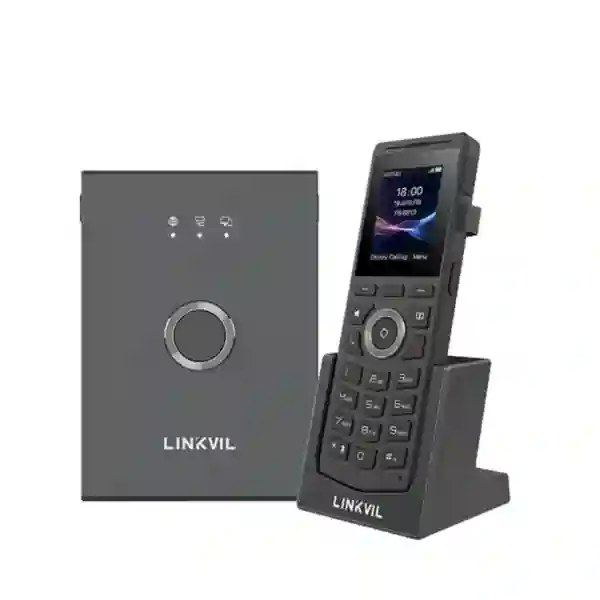
LINKVIL W710P DECT Phone System Tanzania
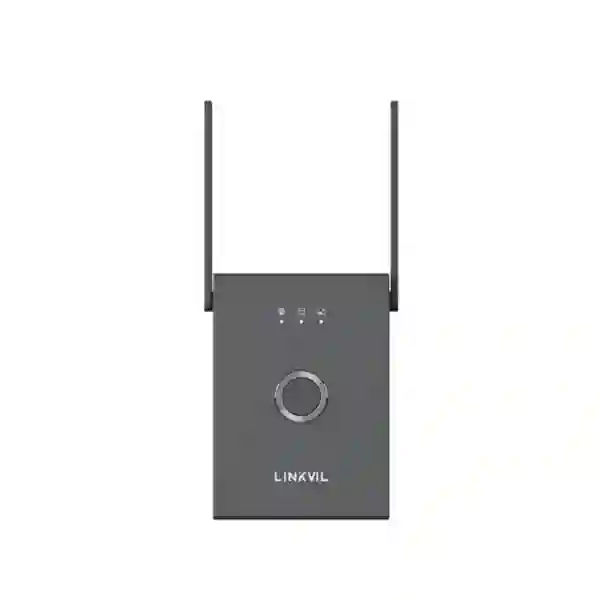
The LINKVIL W710P DECT Phone System combines the W710D IP base station and W610D cordless handset in one practical package for organizations that need mobile business calling over a SIP-based voice environment. The platform is designed for dense-user and short-range wireless communication scenarios, making it suitable for offices, hotels, retail floors, warehouses, clinics, schools and other facilities where staff need to move while remaining reachable on business extensions.
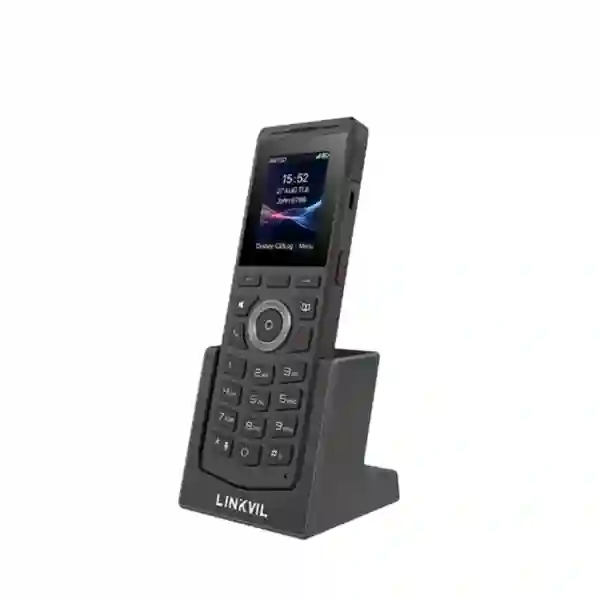
According to the manufacturer, one W710D base can support up to 10 W610D handsets, up to 10 simultaneous calls and up to 20 SIP accounts. Published wireless coverage reaches up to 50 metres indoors and up to 300 metres outdoors under appropriate conditions. The W610D handset includes a 2.0-inch 240 × 320 colour screen, one side key, 16 DSS keys, up to eight hours of talk time and up to 160 hours of standby time. These characteristics make the W710P especially useful where wired desk-phone placement would restrict staff movement or create unnecessary cabling.
Quick specification answer
W710P = W710D DECT IP base + W610D cordless handset.
Handsets
Simultaneous calls
SIP accounts
Indoor / outdoor range
What the LINKVIL W710P solves
A fixed desk phone works well for employees who spend most of the day at one workstation. It is less practical for supervisors, warehouse staff, hospitality teams, retail associates, clinic personnel, technicians and operations teams who need to move around a facility. The W710P addresses this problem by placing SIP connectivity at the base station and extending calling to portable DECT handsets. Staff can remain available on business extensions while moving within the supported radio area instead of returning repeatedly to a desk or relying on personal mobile numbers.
The system is also useful when a business wants to expand voice coverage without running a dedicated network cable to every handset location. The base station still needs suitable network and power planning, but additional W610D handsets can be registered to the supported system capacity. This creates a cleaner model for locations with shift workers, rotating staff, shared departments or operational areas in which mobility matters more than a permanently assigned desk telephone.
Verified LINKVIL W710P features
W710D + W610D package
The W710P package consists of the W710D DECT IP base station and a W610D portable DECT handset, giving buyers a defined starting point for a cordless business voice deployment.
Up to 10 handsets
A W710D base can register up to 10 compatible W610D handsets, allowing a small or medium team to share one base platform within the supported coverage and call-capacity limits.
10 simultaneous calls
The platform supports up to 10 simultaneous calls, which is important when estimating whether one base station can handle the expected peak calling pattern of a department or facility.
20 SIP accounts
Support for up to 20 SIP accounts provides flexibility for extension design, service-provider registration and PBX integration, subject to the configuration of the wider voice platform.
Business mobility range
Published coverage is up to 50 metres indoors and up to 300 metres outdoors. Actual results vary with walls, building materials, interference, layout and base positioning, so a site-aware deployment is recommended.
Colour handset display
The W610D uses a 2.0-inch 240 × 320 colour display and provides a compact interface intended for portable business calling rather than desk-bound use.
DSS and side-key access
The handset provides one physical side key and 16 DSS keys, helping users reach programmed functions or contacts more efficiently when configured for the organization’s workflow.
Battery for mobile shifts
Manufacturer figures state up to eight hours of talk time and up to 160 hours of standby time, supporting day-to-day cordless use when charging practices are included in operational planning.
Deployment, SIP integration and buying guidance
Before ordering a LINKVIL W710P, define the voice environment it will join. Confirm the SIP service or IP PBX, extension plan, expected concurrent calls, number of users, building layout and whether staff need one-to-one assigned handsets or shared devices. The W710P’s supported limits provide an upper boundary, but a successful deployment depends on real usage. Ten registered handsets do not automatically mean ten calls will occur at once, while a busy hospitality, warehouse or service team may approach the simultaneous-call limit more regularly.
Radio planning matters just as much as SIP configuration. The published indoor and outdoor distance figures should be treated as maximum reference values, not guaranteed room-by-room coverage. Reinforced concrete, metal shelving, lift shafts, machinery, dense walls and other materials can reduce usable range. The base should therefore be positioned around the work area rather than hidden in a remote communications room simply because that is where the network switch is located. Structured cabling can place the base at a more suitable central point while still connecting it to the voice network.
For organizations building or upgrading a wider voice system, review the FourTeck Tanzania technology shop for business IT and telecom procurement guidance. For design, installation and lifecycle planning, the FourTeck Tanzania services page explains the broader integration approach. Organizations with regional requirements can also explore FourTeck Kenya, FourTeck Uganda and FourTeck Africa for related market coverage and solution context.
LINKVIL W710P Tanzania
Businesses in Tanzania evaluating the LINKVIL W710P are typically looking for a cordless business phone system that can connect to a SIP-based telephony environment while allowing staff to move around the workplace. The strongest fit is not simply “any business that needs a phone.” It is an organization where employees frequently leave their desks and still need to answer internal or external calls. Examples can include hospitality operations, warehouses, retail sites, clinics, schools, workshops, logistics facilities and multi-room offices. In these environments, a DECT handset can be easier to manage than asking employees to depend on personal mobile phones for day-to-day internal communication.
For Tanzania deployments, procurement teams should confirm the complete requirement rather than buying only the starter package. Decide how many W610D handsets will be needed initially, whether the organization expects to grow toward the 10-handset base limit, how many simultaneous calls occur at peak periods and what SIP or IP PBX platform will provide the extensions. Network readiness should also be checked. The base requires reliable connectivity to the voice environment, and voice traffic should be considered alongside other network services such as computers, Wi-Fi, CCTV or cloud applications. If several technologies share the same switching infrastructure, VLAN and Quality of Service planning can help keep business calling predictable.
Coverage should be validated against the real building. Published figures of up to 50 metres indoors and 300 metres outdoors can be useful in early planning, but Tanzanian sites vary widely in construction, floor area and materials. A compact office may need only careful central placement, while warehouses with metal racking or multi-room facilities may create radio obstacles. Buyers should therefore provide a floor plan or at least a description of walls, floors and operating zones when requesting a quotation. A useful Tanzania quote request should include handset quantity, PBX or SIP provider, expected call volume, site layout, required accessories and whether configuration assistance is needed. This gives the supplier enough context to assess the W710P as part of a working communication system rather than as an isolated handset purchase.
LINKVIL W710P DECT Phone System Dar es Salaam
In Dar es Salaam, the LINKVIL W710P can suit organizations that need mobile voice communication across busy office, hospitality, retail, logistics and service environments. The commercial value comes from allowing employees to carry a business handset while remaining connected to a SIP-based extension. A hotel operations team may need staff to move between reception, back office and service areas. A warehouse supervisor may need to walk between receiving, storage and dispatch. A clinic administrator may need to move between reception and treatment areas. In each case, the cordless handset reduces dependence on a fixed desk location without requiring business calls to be shifted to personal cellular numbers.
Dar es Salaam buyers should look closely at building geometry and radio obstacles before assuming one base will cover every room. Concrete walls, metal structures, multiple floors and equipment areas can change practical DECT coverage. The published W710P maximum of up to 50 metres indoors is a useful reference, but the installation point of the W710D base has a major effect on results. A centrally located base with suitable wired network access will usually be a more rational starting point than installing it at the far edge of the site beside an existing router simply for convenience.
Procurement should also consider how the system will connect to the organization’s voice platform. Confirm SIP credentials or PBX extension requirements, call routing, voicemail, reception workflows and whether different staff need individual accounts. With support for up to 20 SIP accounts and 10 simultaneous calls, the platform offers flexibility, but design should still be based on real peak demand. For a Dar es Salaam quotation, specify the number of handsets, whether additional charging locations are required, expected users per shift, current PBX or hosted-voice platform, and any network configuration support. That information makes it easier to determine whether the W710P is the right single-base solution or whether the site should be planned around a different cordless architecture for broader coverage or scale.
LINKVIL W710P DECT Phone System Mwanza
For organizations in Mwanza, the LINKVIL W710P provides a way to introduce or expand cordless SIP telephony in environments where employees need to move between work areas. Instead of deploying a desk phone at every counter, room or operational point, a business can connect the W710D base to its voice network and register compatible W610D handsets for mobile users. This approach may be especially practical for hotels, retail businesses, schools, clinics, warehouses, workshops and administrative sites where staff spend much of the day away from a fixed desk.
Planning should begin with user roles. A manager may need a dedicated handset and extension; a warehouse shift may share handsets by function; a hotel may assign handsets to departments. These approaches create different requirements for SIP accounts, contact lists, DSS programming and charging routines. Since the base supports up to 10 handsets and 10 simultaneous calls, buyers can compare their expected operational profile against the platform limits before purchasing. An organization with only three or four mobile users may value the expansion headroom, while a larger site should assess whether one base is sufficient for both capacity and radio coverage.
Mwanza deployments should also account for network reliability and power continuity. The W710P depends on the IP voice environment, so switch connectivity, router stability, PBX availability and internet service can all affect calling depending on the architecture. If the PBX is hosted in the cloud, internet resilience becomes especially important. If it is on-premises, local network design remains critical even during external connectivity issues. Businesses should document how calls are expected to operate during outages and whether UPS protection is required for networking equipment and the base. When requesting a Mwanza quote, include the existing phone system, number of users, expected coverage area, construction materials, peak concurrent calls and any need for installation or configuration. A detailed request makes the quotation more useful and reduces the risk of discovering coverage or compatibility issues only after equipment arrives.
LINKVIL W710P DECT Phone System Arusha
The LINKVIL W710P is relevant to Arusha organizations that need professional cordless communication while keeping business calls attached to a SIP or IP PBX environment. Hospitality is an obvious use case because staff frequently move between front desk, offices, service areas and guest-facing spaces, but the same requirement can exist in tour operations, schools, clinics, retail, warehouses and business campuses. A cordless DECT handset allows a staff member to remain reachable without using a personal mobile phone or returning to a fixed extension.
For hospitality and visitor-facing environments in Arusha, the main design questions are coverage, staff roles and call flow. A front desk may receive outside calls and transfer them to mobile staff. Operational teams may need internal extensions for coordination. Managers may need dedicated SIP identities, while shared teams may use function-based extensions. Because the W710P supports up to 20 SIP accounts, the telephony design can accommodate several account assignments, but administrators should keep the extension plan simple enough for staff to use consistently. DSS keys can be programmed to support frequently used actions or contacts, helping users who need quick access while moving around the facility.
Coverage verification is important in properties with separate buildings, thick walls, courtyards or multiple levels. The published outdoor range of up to 300 metres should not be interpreted as guaranteed campus-wide service, particularly when structures interrupt line-of-sight. For larger compounds, buyers should describe the physical layout before settling on a single-base design. Network cabling may allow the base to be mounted in a central location that improves radio performance. An Arusha procurement request should also identify whether the current PBX is cloud based or local, how many simultaneous calls are expected and who will handle provisioning. If the system is being introduced alongside a broader telephony upgrade, the handset package should be evaluated together with switching, VLAN design, internet resilience, power backup and user training so the final deployment remains reliable after the initial installation.
LINKVIL W710P DECT Phone System Dodoma
Organizations in Dodoma can consider the LINKVIL W710P when they need cordless access to business calling across offices, service counters, stores, educational facilities, clinics or operational departments. The system is especially relevant when staff mobility is a recurring work pattern rather than an occasional convenience. By registering W610D handsets to the W710D base, an organization can provide portable extensions while retaining the structure of a SIP phone system, including centralized call routing and extension management according to the capabilities of the connected PBX or service.
A useful Dodoma buying exercise starts by mapping staff movement. Identify which employees are stationary, which need to roam and whether a handset is assigned to an individual or a role. This determines the number of devices more accurately than simply counting employees. Next, estimate peak calling. The W710P supports up to 10 simultaneous calls, so a small team may have significant headroom while a call-intensive department should compare expected concurrency carefully. The system also supports up to 20 SIP accounts, which can help when different extensions or registrations are required.
The physical environment should be reviewed before installation. Indoor coverage can be affected by reinforced walls, storage areas, electrical equipment and building shape. The W710D base should be placed to serve the actual work zone, not merely the easiest network outlet. If necessary, structured cabling can provide network access at a better radio position. Buyers should also consider charging discipline, spare handsets for shift changes and labeling so devices return to the correct department. For a Dodoma quotation, provide the number of handsets, the PBX or SIP service, floor or site layout, expected peak calls, required user features and whether configuration or testing support is desired. This allows the procurement discussion to address compatibility and deployment rather than focusing only on the purchase price of the starter package.
LINKVIL W710P DECT Phone System UAE
In the UAE, the LINKVIL W710P can be evaluated for offices, hospitality properties, retail operations, warehouses, clinics and service businesses that need cordless SIP extensions within a defined site. The business case is strongest where employees move continuously and where retaining calls inside the corporate telephony environment is preferable to using mobile phones. The W710D base and W610D handset package provides a compact starting point, while the base platform can scale to up to 10 registered W610D handsets and 10 simultaneous calls.
UAE deployments often involve well-developed IP infrastructure, but that does not remove the need for radio planning. Large villas converted to offices, multi-level retail premises, warehouses with high metal racking and hospitality environments can all introduce coverage challenges. The published indoor range of up to 50 metres and outdoor range of up to 300 metres should therefore be treated as planning references. Base placement, wall density and interference should be assessed before deciding that one base can serve the entire property.
Another buying consideration is integration with the existing PBX or hosted SIP service. Procurement teams should confirm extension provisioning, codec and network requirements, call routing, voicemail and any security policies applied to voice devices. Organizations operating across multiple countries may also want a consistent handset model for specific staff profiles while allowing local SIP services and PBX configuration to differ by site. When comparing quotations in the UAE, check exactly what is included in the package, which accessories are required, who will configure the base and handsets, and whether site testing is part of the scope. Do not compare only the hardware line item. A lower equipment price can become less attractive if network preparation, provisioning or compatibility work is excluded and must be resolved later. A clear bill of materials and configuration scope helps purchasing teams make a more accurate decision.
LINKVIL W710P DECT Phone System Uganda
For businesses in Uganda, the LINKVIL W710P offers a cordless SIP telephony option for teams that need to communicate while moving around a workplace. The W710D base can support up to 10 compatible W610D handsets, making the system relevant to small and medium operational groups rather than only single-user deployments. Typical scenarios can include hotels, schools, health facilities, retail sites, warehouses, logistics operations and distributed offices where staff need business extensions away from a desk.
The key procurement question is whether the organization needs mobility within one coverage area or seamless communication across a much larger campus. The W710P is a single-base DECT package, so buyers should not assume that adding handsets automatically extends radio range. Additional handsets increase user capacity within the base’s service area; they do not move the base radio footprint. For facilities with multiple buildings or significant separation between work zones, coverage should be assessed before selecting the architecture.
Ugandan businesses should also check how the device will register to their PBX or SIP platform. Up to 20 SIP accounts gives administrators flexibility, but the phone system still needs a clear numbering and call-routing plan. If the PBX is cloud hosted, stable internet and appropriate network policies are important. If it is local, switching, power and internal network resilience become the main dependencies. Charging and device management should also be planned for shift teams so cordless handsets remain available when needed. A good Uganda quotation request includes the number of users, building size, existing PBX, SIP provider if applicable, peak call volume and installation expectations. This helps distinguish a straightforward equipment supply from a deployment requiring voice VLAN work, PBX configuration, user provisioning and post-installation testing. Buyers handling a regional project can coordinate their broader requirements through the FourTeck network while still validating each site independently.
LINKVIL W710P DECT Phone System Kampala
Kampala businesses can use the LINKVIL W710P as a compact cordless extension platform in offices, hotels, retail premises, clinics, educational facilities and operational sites. Many of these environments combine customer-facing staff with back-office teams. A DECT handset can help bridge that gap by allowing selected employees to answer or place business calls while moving between counters, rooms or service areas. The W710P package includes one W610D handset and the W710D base, so additional handset requirements should be identified during procurement rather than assumed to be part of the starter kit.
In a busy Kampala workplace, concurrency deserves attention. Up to 10 handsets can register to the base and up to 10 simultaneous calls are supported, but actual usage varies. A retail outlet may have many mobile staff but relatively few concurrent calls, whereas a service center or hospitality team may experience busier periods. Procurement teams should estimate call peaks and consider whether mobile users also need voicemail, call transfer, groups or other PBX-level functions. These features depend on the broader telephony platform, so handset purchasing should be aligned with PBX configuration.
Building materials and floor layout can make a meaningful difference to coverage. A base placed centrally on the working floor can perform differently from one installed inside a communications room behind thick walls. The published 50-metre indoor range should therefore be validated against the real site. For multi-floor or complex facilities, plan radio coverage before committing to one base. Network power protection is another consideration. If calls are important during short mains interruptions, the network switch, router and PBX should be assessed for UPS support along with the DECT equipment. A Kampala quotation should include site type, floor count, intended handset quantity, current phone system, connectivity model and configuration needs. These details help ensure the quoted solution addresses communication workflow, not merely the number of devices.
LINKVIL W710P DECT Phone System Arua
For organizations in Arua, a cordless SIP phone system can be valuable where operational staff work across reception areas, stores, clinics, schools, warehouses or service facilities and cannot remain beside a desk extension. The LINKVIL W710P provides a W710D base and W610D handset as a starting package, with support for additional W610D handsets up to the base limit. This lets a business create a mobile voice group while maintaining calls within the organizational phone system.
Arua buyers should pay particular attention to the relationship between the voice service and the local network. A DECT handset can only be as useful as the telephony environment behind it. If the base registers to a hosted SIP service, internet quality and router configuration influence call reliability. If calls are handled by an on-premises IP PBX, the LAN, switching and PBX availability become more important. In either design, procurement should identify who will supply SIP credentials, who will configure extensions and how users will be trained to transfer calls or use programmed keys.
Coverage planning should remain practical. A published outdoor range of up to 300 metres can sound generous, but intervening structures, walls and site geometry reduce real-world performance. Businesses with detached buildings or a large compound should avoid assuming one base will provide full coverage without validation. The 50-metre indoor figure is similarly dependent on construction. A quotation request should therefore describe the work area and any known obstacles. Also consider battery routines: the W610D is rated for up to eight hours of talk time and 160 hours standby, but heavy-use teams still need reliable charging procedures. For shift environments, assigning numbered handsets and chargers to departments can simplify management. A well-scoped Arua deployment combines handset quantity, coverage, PBX compatibility, network stability and user workflow into one decision rather than treating the device as a standalone cordless phone.
LINKVIL W710P DECT Phone System Mbarara
The LINKVIL W710P can support businesses in Mbarara that want cordless extensions for employees who spend significant time away from fixed workstations. Hospitality, education, healthcare, retail and warehouse environments are common examples of work patterns where staff move between rooms or zones but still need to answer business calls. The W610D handset provides that mobility while the W710D base handles the DECT connection to the SIP voice environment.
A useful purchasing decision starts with identifying the communication zones rather than only the headcount. Ten employees may all work in one compact area and fit comfortably within one base deployment, while five users spread across multiple buildings may present a greater coverage challenge. The W710P supports up to 10 registered handsets, but that limit should not be confused with geographic reach. Radio coverage is shaped by distance, walls and physical obstacles. For this reason, a site sketch or floor plan is valuable when the phone will be used beyond a simple office floor.
Mbarara organizations should also define extension ownership. Individual employees may need personal SIP accounts, while operational teams may use shared functional extensions. The base supports up to 20 SIP accounts, providing room for different registration strategies, but the PBX must be configured to match the workflow. If the organization expects calls to ring multiple users, transfer to reception or route after hours, these rules should be designed at PBX level. For procurement, request a quotation that identifies the starter package, extra handsets, any power or mounting accessories, configuration services and testing. Also confirm how firmware and configuration will be maintained after deployment. A system that works on installation day but has no documented credentials or configuration record can become difficult to support later. Simple documentation of base location, extension assignments and network settings greatly improves lifecycle management.
LINKVIL W710P DECT Phone System Gulu
In Gulu, the LINKVIL W710P is a practical option for businesses and institutions that need portable voice endpoints connected to a SIP telephony platform. It can be especially useful for teams that cover multiple rooms, reception areas, storage zones or service points during the day. Instead of installing a desk phone wherever an employee might temporarily work, the organization can issue W610D handsets to mobile roles and connect them through the W710D base.
The first sizing step is to count mobile users and then estimate simultaneous call demand. The base supports up to 10 handsets and 10 simultaneous calls. These limits allow a reasonably active small team, but usage patterns matter. A school administration team may have modest call concurrency, while a customer-service or hospitality environment may need more active channels. The system’s support for up to 20 SIP accounts can help structure extensions, but voice administrators should avoid unnecessary complexity. Users benefit from a simple numbering plan and clearly programmed contacts or DSS functions.
Gulu deployments should also include basic infrastructure planning. The base must connect reliably to the IP network, so cable quality, switch availability and router or PBX stability all matter. When the system depends on a cloud SIP platform, internet quality becomes part of voice availability. When it connects to a local PBX, internal network and power continuity remain essential. The handset’s published battery figures support mobile use, but charging points should be placed where staff naturally return devices between shifts. A quotation request should state handset quantity, expected expansion, the current PBX or SIP provider, coverage area and any need for setup assistance. If the building is large or divided into several blocks, mention that before ordering. This allows the solution design to address whether the W710P single-base architecture matches the required radio footprint or whether a broader cordless system should be evaluated.
LINKVIL W710P DECT Phone System Kenya
Kenyan organizations considering the LINKVIL W710P are often balancing two goals: staff mobility and controlled business telephony. A SIP-connected DECT system can serve both by allowing portable handsets to remain part of the organization’s extension plan. This can suit hospitality, logistics, retail, healthcare, education and offices where employees routinely leave fixed desks. The system starts with the W710D base and a W610D handset and can expand within the base’s supported capacity.
For a Kenya deployment, verify whether the current voice platform is an on-premises IP PBX, hosted PBX or direct SIP service. This determines how accounts, routing and resilience should be handled. The W710P supports up to 20 SIP accounts, but administrators should map them to actual user or department requirements. Peak call volume should also be considered because the system supports up to 10 simultaneous calls. A small branch may never approach that figure, while a busy property or service department might.
Radio coverage is another key buying factor. The manufacturer specifies up to 50 metres indoors and 300 metres outdoors, but practical performance depends on the environment. Nairobi offices with reinforced partitions, warehouses with racking or hospitality properties with multiple buildings can all reduce coverage. The same principle applies elsewhere in Kenya: base placement should follow the work area, not simply the nearest network cabinet. Procurement teams should also ask what is included with the W710P package, how many additional handsets are needed, whether provisioning is included and who will test calls after installation. Businesses operating across East Africa may prefer a repeatable standard for handset models and user training, but every site should still be assessed separately for coverage, PBX compatibility and network conditions. Standardization works best when it is combined with local technical validation rather than copied blindly from one branch to another.
LINKVIL W710P DECT Phone System Kuwait
For businesses in Kuwait, the LINKVIL W710P can provide cordless SIP communication for mobile staff in offices, retail facilities, warehouses, hospitality environments, clinics and service operations. The package provides a W710D base and W610D handset, with the ability to register additional compatible handsets up to the supported limit. This structure can reduce the need to install a fixed desk phone at every operational point while keeping users inside a managed business phone system.
Kuwait buyers should match the product to the site rather than focusing only on the handset specification. Larger commercial facilities can include thick internal walls, storage areas and back-of-house spaces that affect radio coverage. The published maximum indoor and outdoor range figures are useful for initial comparison but cannot replace site-specific planning. In many cases, positioning the base centrally and providing network cabling to that position is more effective than placing it in a server room at the edge of the operational area.
Voice integration also deserves careful scoping. Confirm how SIP accounts will be assigned, whether the PBX supports the desired transfer and group behavior, and how emergency or after-hours routing is handled according to the organization’s policies. The W710P can register multiple SIP accounts, but the user experience still depends on sensible programming. For procurement, compare quotations on complete scope: base and handset quantities, extra chargers or accessories if required, installation, provisioning, network work and post-install testing. Businesses with multiple branches should decide whether configuration templates will be standardized and how credentials will be protected. Good lifecycle practice includes keeping a record of firmware, base settings, extension assignments and administrator access. These steps make future expansion or troubleshooting easier and help ensure the cordless phone system remains a managed business asset rather than an isolated device whose configuration is known only to the original installer.
LINKVIL W710P DECT Phone System Ghana
The LINKVIL W710P can be considered by organizations in Ghana that want SIP-based cordless calling for employees who move around a site. In offices, hotels, schools, clinics, shops, warehouses and service facilities, mobile communication can reduce missed calls and improve internal coordination. The W610D handset is carried by the user while the W710D base links the DECT environment to the IP voice system.
A Ghana deployment should be sized from both users and call traffic. The base supports up to 10 W610D handsets and up to 10 simultaneous calls. A business may therefore register several devices while still remaining comfortably below the call-capacity ceiling, but each organization has a different usage pattern. Teams that spend much of the day coordinating by phone should estimate busy-hour call demand rather than relying on average usage. The base’s support for up to 20 SIP accounts provides additional flexibility for extension design.
Coverage should be assessed physically. The maximum published distances do not guarantee performance through multiple concrete walls or across separate structures. If the organization has a large warehouse, multi-floor office or detached buildings, describe those conditions in the quotation request. The supplier can then evaluate whether central base placement is adequate or whether the site requires a different architecture. Network and power availability are equally important. A cloud PBX needs stable internet; an on-premises PBX needs a reliable local LAN; both designs benefit from appropriate power protection. Procurement teams should request clarity on which components are included, who performs configuration and how the system will be supported after handover. For regional organizations with branches in Ghana and other African markets, consistent handset choices can simplify staff training, but site-specific network and radio planning should still be performed. Compatibility, coverage and operational workflow are more important than simply matching model numbers across every location.
LINKVIL W710P DECT Phone System Nigeria
In Nigeria, the LINKVIL W710P is relevant to businesses that need portable SIP extensions across defined indoor or outdoor work areas. Hotels, offices, healthcare facilities, warehouses, retail operations, educational institutions and logistics teams may all have employees who need to remain reachable without staying at a desk. The W710P package provides the W710D base and W610D handset, with expansion support for additional compatible handsets up to the base limit.
Nigeria buyers should treat telephony resilience as part of the product decision. The cordless handset depends on the base, and the base depends on the network and voice platform. Where calls are hosted in the cloud, internet availability is important; where the PBX is local, switching and local power become the key dependencies. Organizations that require high availability should assess router, switch and PBX backup power rather than protecting only the cordless handset charger. A voice system remains available only when the full chain supporting it stays operational.
Coverage also needs realistic planning. The W710P’s published range is up to 50 metres indoors and up to 300 metres outdoors, but building construction and interference influence the result. Large warehouses and multi-building sites should be assessed carefully. The base should be mounted where it can serve users effectively while still having dependable network connectivity. A Nigerian quotation request should include the number of mobile users, expected concurrent calls, current PBX or SIP service, site layout, network readiness and any configuration or training requirements. Procurement teams should also compare lifecycle details rather than only initial cost. Ask how additional handsets will be provisioned later, how administrator credentials will be documented and who will maintain configuration backups. A clean deployment record helps internal IT staff or future support teams troubleshoot problems without rebuilding the system from memory. For growing organizations, this operational discipline is often as important as the handset specification itself.
LINKVIL W710P DECT Phone System Seychelles
Organizations in Seychelles can evaluate the LINKVIL W710P when staff mobility is important within hotels, resorts, offices, retail spaces, clinics, warehouses or service facilities. Hospitality use is particularly intuitive because employees may move between reception, administration and operational areas while still needing access to business extensions. The same principle applies to other sectors: a portable W610D handset can keep communication inside the organization’s SIP phone environment while the employee moves through the supported coverage area.
For island properties and hospitality sites, physical layout deserves careful attention. Separate buildings, landscaped areas, thick walls and changes in elevation can make radio coverage less predictable than a simple distance figure suggests. The W710P has a published outdoor range of up to 300 metres and indoor range of up to 50 metres, but these values should not be interpreted as guaranteed coverage between detached structures. Buyers should map the areas where staff actually need calling and position the W710D base accordingly. If communication is required across a larger or more segmented property, evaluate whether a single-base system is appropriate before ordering extra handsets.
Seychelles procurement teams should also define the PBX connection and operational responsibilities. Confirm the number of SIP accounts, extension assignments, transfer behavior and whether the phone system is local or cloud based. The W710P supports up to 20 SIP accounts and 10 simultaneous calls, giving small and medium teams useful capacity, but configuration must still match the organization’s workflow. A complete quotation request should include base quantity, handset quantity, expected coverage zones, current voice platform, network availability and installation scope. If the device is being used in a hospitality environment with shift changes, establish a charging and handover routine so handsets remain available and are returned to the correct department. Clear labeling, documented extensions and centralized configuration records make long-term support substantially easier.
How to decide whether W710P is the right fit
Choose the W710P when you need a compact single-base DECT system for up to 10 compatible handsets, your expected peak traffic fits within 10 simultaneous calls, your SIP or IP PBX environment can support the intended registration design, and the required work area is suitable for one base’s radio coverage. Reconsider the architecture if the site spans multiple separate buildings, requires seamless coverage across a large campus, or needs more handset and concurrent-call capacity than one W710D base provides.
How many people need portable handsets now and after expected growth?
How many calls happen at the busiest time?
Can one base realistically cover the required rooms and operating zones?
Which PBX or SIP service will provide the extensions?
LINKVIL W710P FAQs
What is included in the LINKVIL W710P package?
The manufacturer identifies the W710P as a package consisting of the W710D DECT IP base station and a W610D cordless handset. Confirm the exact commercial box contents and power accessories on the quotation for your market before ordering.
How many handsets can the W710P support?
The W710D base supports registration of up to 10 compatible W610D handsets. Additional handsets expand the number of users, but they do not increase the base station’s radio coverage area.
How many simultaneous calls are supported?
The published specification is up to 10 simultaneous calls. Buyers should compare this limit with real peak usage rather than average daily call volume.
What is the LINKVIL W710P wireless range?
The manufacturer publishes coverage of up to 50 metres indoors and up to 300 metres outdoors. Actual range varies with walls, construction materials, interference, base placement and the physical environment.
Does the W710P work with SIP?
Yes. The W710D platform supports up to 20 SIP accounts. Exact interoperability and configuration should be confirmed against the PBX or SIP service used by the organization.
Is W710P suitable for hotels and warehouses?
It can be suitable where staff need cordless business calling within a defined coverage area. Hotels and warehouses should pay particular attention to walls, multiple buildings, metal racking and operational zones because those conditions can affect radio coverage.
How long does the W610D battery last?
Manufacturer figures state up to eight hours of talk time and up to 160 hours of standby time. Real use depends on call duration, settings, battery condition and charging practice.
Quotation checklist
Decision recap
The LINKVIL W710P is a strong candidate when the requirement is a compact DECT-over-SIP deployment for mobile business users within a controlled site. Its verified strengths are straightforward: W710D base plus W610D handset, support for up to 10 handsets, up to 10 simultaneous calls, up to 20 SIP accounts, published range up to 50 metres indoors and 300 metres outdoors, and a portable handset with colour display and long standby capability. The purchasing decision should be finalized only after checking PBX compatibility, expected call load, building coverage and the complete bill of materials.
Plan your W710P deployment with FourTeck Tanzania
For an accurate quotation, share the number of users, site layout, existing phone system, SIP environment and whether you need supply only or configuration support. This allows the conversation to focus on the complete working requirement rather than simply the model number.



Reviews
There are no reviews yet.