
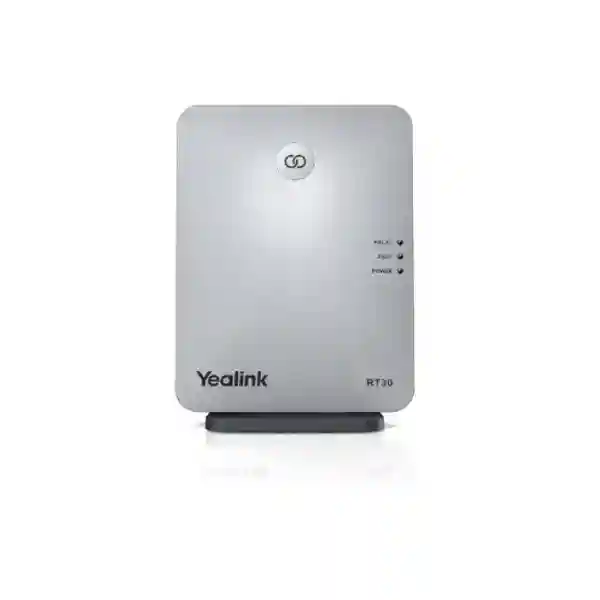
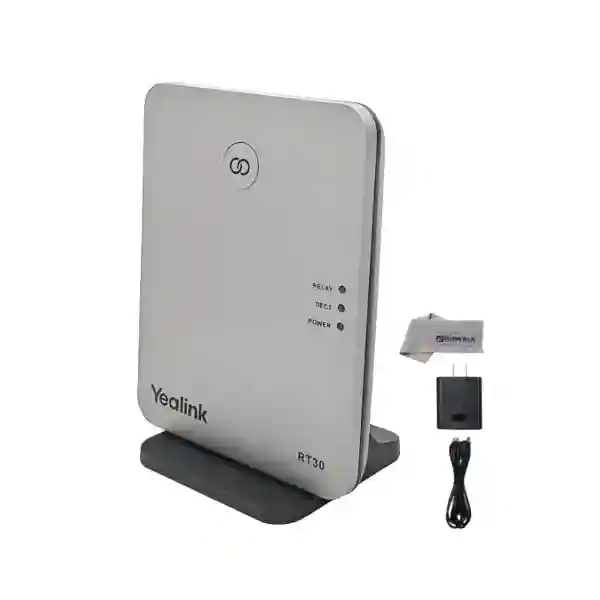
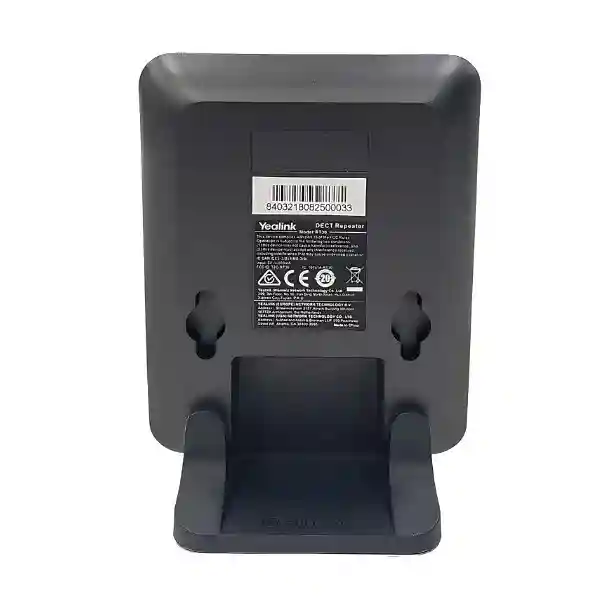
Yealink RT30 DECT Repeater
The Yealink RT30 DECT Repeater is designed to extend the radio coverage of compatible Yealink DECT phone systems where a single base station cannot provide dependable signal across the whole workplace. It is particularly useful for offices with long corridors, divided floors, warehouses, hospitality facilities, clinics, schools, retail back offices and operational areas where staff need to remain reachable while moving away from the base station. The RT30 does not replace the Yealink base station or PBX; it expands the DECT radio footprint so compatible cordless handsets can continue communicating through the existing system.
Yealink publishes compatibility with the W60B, W70B and W52 DECT IP Base Station families subject to the required firmware versions. The repeater supports up to four simultaneous calls per repeater when the supported firmware conditions are met, up to six repeaters registered to one base station in a star topology, and up to two RT30 repeaters arranged in cascade when used with W60B or W70B. Manufacturer figures state radio extension of up to 50 metres indoors and up to 300 metres outdoors in clear-view, ideal conditions; real buildings can reduce those distances because walls, reinforced concrete, metal shelving, machinery and interference affect radio propagation.
Choose RT30 when you already use a compatible Yealink DECT base and need to improve cordless radio reach rather than add an entirely separate phone system.
Before ordering, confirm the exact base model, firmware, handset estate, required call concurrency and proposed repeater locations.
What the Yealink RT30 solves
Cordless telephony is valuable only when users can move through the areas in which they actually work. A DECT base station can perform perfectly at a desk and still leave weak-signal zones behind thick walls, at the far end of a floor, inside storage areas or along a long passage. RT30 addresses that physical radio-coverage problem. It receives the DECT link from a compatible Yealink base or, in supported cascade designs, another RT30, and relays the coverage into the intended area. Because the repeater is part of the radio layer, businesses can improve mobility without automatically redesigning extension numbers, reception logic, call queues or the IP PBX configuration.
The practical value is strongest when placement is planned instead of guessed. A repeater must itself receive a sufficiently good link from the base or upstream repeater. Mounting it in the original dead zone gives it little useful signal to relay. A better approach is to identify where the base signal begins to weaken, position RT30 inside a still-usable overlap zone, verify the DECT LED status, and then test real calls while walking through the target area. Where coverage must extend in several directions, the star topology can be appropriate; where the requirement stretches down a corridor or toward a remote part of a facility, the supported two-repeater cascade with W60B/W70B can be considered.
Coverage extension
Extend compatible Yealink DECT radio coverage into weak or previously unreachable areas while retaining the existing cordless phone platform.
Mobility during calls
Yealink documents automatic handover between RT30 repeaters when coverage overlaps correctly, supporting more natural movement during active calls.
Flexible layout
Use multiple repeaters around a base in a star layout or, with W60B/W70B, a supported cascade when coverage must be extended in one direction.
Verified Yealink RT30 technical highlights
| Item | Manufacturer-published information |
|---|---|
| Purpose | Extends DECT coverage for compatible Yealink DECT IP base-station deployments. |
| Base compatibility | W60B, W70B and W52 base station, with manufacturer-stated minimum firmware versions. |
| Repeaters per base | Up to 6 in star connection. |
| Cascade | Up to 2 repeaters in cascade when connected with W60B/W70B. |
| Concurrent calls | Up to 4 simultaneous calls per repeater under supported firmware conditions. |
| Published ideal range | Up to 50 m indoors; up to 300 m outdoors in clear view and ideal conditions. |
| Radio | Two internal omnidirectional antennas; GFSK modulation. |
| Indicators | Power, DECT link and active relay LEDs. |
| Mounting | Desktop or wall mountable. |
| Power | AC 100–240 V input through supplied adapter; DC 5 V/600 mA output. |
| Dimensions | 130 mm × 100 mm × 25.1 mm. |
Range figures are laboratory-style ideal-condition maxima, not a guarantee for every building. Confirm the applicable regional radio version and compatibility before procurement.
Compatibility, placement and deployment guidance
The most important buying check is not simply whether the product name says “DECT repeater.” Confirm that the existing Yealink base station is one of the supported models and that its firmware meets the version required by Yealink. Manufacturer documentation lists W60B version 77.81.0.35 or later, W52 Base Station version 25.81.0.10 or later, and W70B version 146.85.0.15 or later. For the published four-simultaneous-call capability, Yealink also notes W70B version 146.85.0.35 or later and RT30 version 83.0.0.22 or later. Firmware planning is therefore part of the deployment, especially when an older DECT system has been operating unchanged for years.
Placement should be validated with real call testing. Start with the current base-station coverage, identify the point where speech begins to degrade, and place the repeater slightly inside the good-signal zone rather than at the furthest possible point. The RT30 DECT LED provides a useful visual indication: Yealink documents green for an excellent-to-good radio link and orange for a poor link. Buildings with reinforced concrete, metal racks, lift shafts, industrial equipment, dense shelving or multiple fire doors may require more conservative spacing. Where several repeaters are installed, avoid creating unnecessary overlap or interference and document which area each unit serves.
For broader voice-system planning, FourTeck Tanzania’s business technology services page explains how IP PBX, IP phones, switching, Wi‑Fi, cabling and support dependencies should be considered together. Buyers can also review the Tanzania technology shop when planning related business equipment. These links are useful because RT30 solves a DECT radio problem, while call routing, extension design, SIP connectivity and wired network readiness remain responsibilities of the wider telephony environment.
When RT30 is the right choice—and when a different architecture may be better
RT30 is a strong fit when the business already has a compatible single-cell Yealink DECT base, the handset count and concurrent-call requirement remain within that system’s limits, and the main problem is physical radio reach. Examples include a reception team that walks between front desk and back office, a warehouse supervisor who needs coverage beyond the office doorway, hotel staff moving through service areas, or a clinic where cordless users cross several rooms during a call. In these situations, extending the existing radio domain can be simpler than introducing a separate base and another independent coverage area.
A repeater is not always the correct answer for large campuses or high-capacity deployments. If the requirement involves many users, many simultaneous calls, multiple buildings, dense roaming, or broad floor-by-floor coverage, a Yealink multi-cell DECT architecture may be more suitable than adding repeaters to a single-cell base. Procurement teams should describe the total handset count, simultaneous-call requirement, floor plan, movement paths and expansion expectations before selecting the architecture. The goal is not to maximize repeater quantity; it is to create a voice system with predictable mobility, capacity and supportability.
Yealink RT30 DECT Repeater Tanzania
For organisations searching for the Yealink RT30 DECT Repeater in Tanzania, the central procurement question is usually whether the device will solve a real weak-coverage problem in an existing Yealink cordless phone environment. Tanzania offices can range from compact commercial suites to multi-room compounds, hotels, medical facilities, warehouses, schools and operational sites where staff do not remain beside a desk phone. RT30 is most relevant when users already rely on compatible Yealink DECT handsets and the base station provides adequate capacity but radio strength fades before users reach the places where they need to answer or continue calls. In that situation, the repeater can extend the DECT footprint without changing the basic user experience of the handset.
A Tanzania deployment should be planned around the physical building rather than a published range number alone. Yealink states up to 50 metres indoors under ideal conditions, but real construction can reduce that substantially. Reinforced concrete, metallic partitions, shelving, stairwells, plant rooms and electrical equipment can shape the signal in ways that are difficult to predict from a floor plan. A practical survey should therefore trace the current usable coverage, identify the routes along which people move during calls, and position RT30 where it still receives a strong enough base link. Once registered, test calls should be made while walking through the transition zone to confirm that the handover behaviour is acceptable.
For Tanzania procurement, provide the existing base model—W60B, W70B or W52 where applicable—its firmware version, the handset models, number of active users and areas with weak reception. Also state whether the aim is to improve coverage around one floor, extend in several directions, or reach a distant zone in a linear path. That information helps determine whether one RT30, a star arrangement, a supported two-repeater cascade, or a larger DECT architecture is more appropriate. A quotation should also clarify quantities, included power accessories, mounting expectations and any configuration or site-support scope rather than treating the repeater as an isolated box.
FourTeck Tanzania can be approached through its verified contact page for a product quotation or compatibility discussion. Customers planning a broader communication refresh can also review FourTeck IT Solutions Africa for regional IT and IP-PBX context. Availability, lead time, warranty terms and final supply scope should be confirmed on the quotation because these are commercial conditions rather than fixed product specifications.
Yealink RT30 DECT Repeater Dar es Salaam
Businesses seeking the Yealink RT30 DECT Repeater in Dar es Salaam often have a practical mobility problem rather than a need for a new telephony platform. Corporate offices, hospitality properties, logistics facilities, retail operations and service businesses may already use Yealink DECT handsets successfully near the base station but experience weak reception at the far end of a floor, behind dense partitions or in adjacent operational areas. RT30 can be considered when the existing base and handset platform is compatible and call capacity is otherwise sufficient. It extends the DECT radio layer so a cordless user can remain on the same telephone system while moving farther from the original base.
Dar es Salaam installations should pay close attention to actual site geometry. Modern offices may contain glass partitions, concrete structural cores, lift shafts and equipment rooms; warehouses may include high metal shelving and loading zones; hotels may have long corridors and many internal walls. These factors make a simple “metres from the base” rule unreliable. A better method is to walk-test the current system, mark the point at which audio or signal quality begins to decline, and then install the repeater within the good-coverage overlap. The RT30’s DECT status indication can assist during placement, but the final acceptance test should be a live call through the areas users actually traverse.
Procurement teams in Dar es Salaam should confirm the exact Yealink base model and firmware before ordering. This avoids the common mistake of assuming every DECT product works with every repeater. State whether the site uses W60B, W70B or an older W52 base, and include current firmware information. If the requirement is for up to four simultaneous calls through a repeater, verify the firmware combination specified by Yealink. It is also useful to provide a simple floor sketch showing the base, walls, weak-signal points and the target area. That allows the quotation to focus on a realistic repeater quantity and placement strategy.
If the Dar es Salaam project also involves IP PBX changes, SIP trunks, reception call flows, voice VLANs, PoE switching or UPS-backed network equipment, treat those as separate but connected workstreams. RT30 extends DECT coverage; it does not increase the PBX feature set or replace good network design. A complete purchasing discussion should therefore separate radio-coverage objectives from call-capacity and network objectives, producing a clearer bill of materials and easier acceptance testing.
Yealink RT30 DECT Repeater Mwanza
For a Yealink RT30 DECT Repeater requirement in Mwanza, the most useful starting point is to define where cordless calling fails today. A business may have a reception or administrative base station in one part of a property while supervisors, technicians or service staff move into storerooms, workshops, corridors, customer areas or outdoor-adjacent spaces. If the installed Yealink DECT platform is compatible and user capacity remains appropriate, RT30 can extend the radio footprint without creating new extensions or asking staff to carry a different communication device simply to reach those areas.
The manufacturer’s ideal range figures should be treated as planning references, not promises. Mwanza sites may combine masonry walls, metal roofing, shelving, equipment and open spaces, each of which affects propagation differently. The placement process should establish an overlap between the original base coverage and the repeater. If the repeater is installed too far into a weak zone, it will relay an already poor link. Positioning slightly closer to the base can produce a more stable result even if the physical distance from the target area is greater. The objective is a reliable radio path, not simply the furthest possible mounting point.
Where coverage must expand around the base in several directions, Yealink supports up to six RT30 units per compatible base in a star arrangement. Where the requirement is linear—such as reaching farther down a long corridor or toward a distant work area—the supported cascade option with W60B or W70B may be relevant, with up to two repeaters arranged sequentially. These are architecture choices, not automatic defaults. The number of users and simultaneous calls should be checked so that improved coverage does not hide an underlying capacity limitation in the base system.
For procurement in Mwanza, provide model numbers, firmware, quantities and a description of the physical area to be covered. Ask the supplier to distinguish hardware supply from optional configuration, placement assistance, testing and documentation. This makes commercial comparisons easier and reduces ambiguity. If future expansion could involve substantially more handsets or wider roaming across several buildings, discuss whether a Yealink multi-cell DECT platform would be a better long-term design than repeatedly extending a single-cell system.
Yealink RT30 DECT Repeater Arusha
Organisations looking for the Yealink RT30 DECT Repeater in Arusha can use the product to address a specific class of communication problem: cordless users who need to move beyond the reliable radio boundary of a compatible Yealink DECT base. This can be relevant in hospitality, tour operations, professional offices, schools, clinics and facilities with service areas that sit outside the strongest base-station footprint. The RT30 is attractive where the existing phone system already meets call-routing and user-capacity needs and the remaining issue is simply that people lose dependable DECT coverage as they move around the premises.
Arusha properties can include mixed building materials, separated rooms and indoor-outdoor transitions. Those conditions make site testing important. The headline indoor and outdoor range figures published by Yealink describe ideal conditions; an actual building may achieve less or occasionally different coverage depending on obstruction and interference. Before installation, make a test call at the base, walk toward the problem area and note where audio starts to degrade. The repeater should be installed before that point, not inside the dead zone. After registration, repeat the same walk test and confirm both audio quality and handover while the call remains active.
For businesses with guest-facing operations, continuity is especially important because missed calls can affect reservations, service response or internal coordination. However, a repeater does not solve every voice issue. Poor SIP connectivity, PBX misconfiguration, internet instability or handset battery problems need separate diagnosis. RT30 should be selected only when the weakness is demonstrably in DECT radio coverage. This distinction prevents unnecessary hardware purchases and gives IT teams a clearer troubleshooting path.
When requesting an Arusha quotation, include the base model, firmware, number of handsets, normal simultaneous-call level and the target coverage area. If the property has several floors or detached buildings, describe them explicitly because a single-cell repeater architecture may not be the best fit for every layout. Ask for the exact RT30 quantity, included power adapter and cable, mounting requirement and any installation scope to be stated clearly. That makes it easier to approve the purchase and verify the deployment against agreed coverage objectives.
Yealink RT30 DECT Repeater Dodoma
A Yealink RT30 DECT Repeater deployment in Dodoma is best justified by measured coverage need. Government-related offices, professional organisations, educational facilities, hotels, service centres and commercial sites may use cordless phones so staff can remain reachable away from a fixed desk. Where a compatible Yealink W60B, W70B or W52 base station is already installed, RT30 can increase the practical radio area without changing the extension identity carried by the handset. This makes it useful for sites where users are satisfied with the existing phone platform but experience dropouts or weak signal beyond a particular wall, corridor or operational zone.
The repeater should be thought of as a radio relay rather than a range amplifier that can be placed anywhere. It needs a sufficiently strong upstream DECT link to provide useful downstream coverage. In Dodoma offices with thick internal walls or concrete structural elements, the optimum location may not be geographically halfway between the base and the weak area. Radio can travel better through doorways and corridors than directly through dense walls, so a practical placement may follow the building’s open paths. The RT30 LED indications provide a simple way to judge link quality, but live voice testing remains the best confirmation of user experience.
Capacity should be reviewed at the same time. Yealink documents up to four simultaneous calls per repeater under the supported firmware conditions and up to six repeaters per base in star mode. These figures do not mean every deployment should use the maximum. If a Dodoma site is growing rapidly, has many cordless users, or expects heavy concurrent calling, the overall base-station architecture should be checked to ensure that adding coverage does not postpone an inevitable capacity upgrade. A multi-cell design can sometimes be more appropriate for large-scale roaming.
A useful quotation request includes the floor plan, current base and handset models, firmware, number of users, estimated simultaneous calls and weak-signal locations. Procurement teams should also ask whether configuration, testing and documentation are included or optional. This makes the project easier to compare against alternatives and gives the technical team a clear acceptance criterion: users should be able to make and maintain calls in the agreed target areas after deployment.
Yealink RT30 DECT Repeater UAE
Businesses searching for the Yealink RT30 DECT Repeater in the UAE commonly operate in offices, warehouses, hospitality properties, clinics, retail facilities and mixed commercial sites where a cordless user may move well beyond the immediate base-station area. RT30 is relevant when the Yealink DECT platform is already suitable in terms of extensions and call capacity but radio coverage needs improvement. It can extend the W60B/W70B/W52-family deployment subject to manufacturer compatibility and firmware requirements, preserving the familiar cordless handset workflow while adding reach to selected parts of the premises.
UAE buildings can present demanding radio conditions. Reinforced concrete, lift cores, metal partitions, server rooms, racking and large open warehouses all affect DECT differently. The ideal published indoor and outdoor ranges cannot substitute for a site survey. Place the RT30 where the upstream DECT link is still strong, then test a live call through the intended transition zone. For a large floor where weak areas surround the base, a star arrangement may be suitable. For a long linear path, the supported cascade option with W60B/W70B may be evaluated. Each repeater should have a defined purpose and documented location.
UAE procurement teams should also confirm the radio-frequency version appropriate to the deployment region rather than assuming that every globally listed unit is interchangeable. Product sourcing should specify the required regional variant, base model, firmware and number of repeaters. Where the business already has a large Yealink cordless estate, include handset count and simultaneous-call expectations in the design. This helps determine whether a repeater extension remains the right approach or whether a Yealink multi-cell DECT system would provide a more scalable foundation.
For related UAE business communication and IT requirements, customers can review FourTeck UAE IT and telecom solutions. A commercial proposal should clearly identify RT30 hardware quantity, supplied accessories, any configuration or survey work, warranty terms and delivery scope. Price, stock and lead time should be confirmed at quotation stage because these conditions change independently of the published Yealink technical specification.
Yealink RT30 DECT Repeater Uganda
The Yealink RT30 DECT Repeater can support Ugandan organisations that already use compatible Yealink cordless telephony but need better coverage across a larger operating area. In offices, clinics, hospitality sites, schools, warehouses and service facilities, staff often need to answer a call while moving between rooms rather than remaining beside the base station. When the underlying call system is satisfactory and the weakness is radio reach, an RT30 can be a focused way to expand the DECT coverage zone without changing extension numbering or introducing an unrelated cordless platform.
A Uganda deployment should begin with compatibility. Confirm whether the base is W60B, W70B or W52 and verify the firmware version against Yealink’s published requirements. Then map how users move. A receptionist may walk to a records room, a hotel team may move between service areas, and a warehouse supervisor may cross from an office into storage space. These paths determine where coverage overlap is needed. The repeater should be installed where it receives a strong upstream DECT signal, not at the furthest point where reception has already collapsed.
Where the business needs several directional extensions around one base, Yealink supports up to six RT30 units in a star topology. Where the requirement stretches in one direction, up to two RT30 units may be cascaded with W60B/W70B. Each topology should be selected from the building layout and call demand. If user numbers, concurrent calls or roaming scope are large, compare the repeater approach against a multi-cell DECT design before committing to the final bill of materials.
Ugandan customers planning wider voice or network projects can also review FourTeck Uganda communication solutions. For an RT30 quotation, include quantity, base-station model, firmware, handset count, weak-coverage locations and any installation or testing requirement. Confirm commercial conditions such as current availability, delivery and warranty on the final quotation rather than relying on generic online claims.
Yealink RT30 DECT Repeater Kampala
For Kampala businesses, the Yealink RT30 DECT Repeater is particularly relevant where a cordless phone user needs to move across an office, hotel, clinic, school, retail back office or warehouse and the existing Yealink base no longer provides strong DECT signal throughout that route. The purchase decision should be driven by a known coverage gap. If calls are clear close to the base but degrade predictably in the same distant area, RT30 may address the problem. If calls fail everywhere, the issue may instead involve the PBX, network, SIP service, handset or base station and should be diagnosed before a repeater is added.
Kampala premises can contain dense internal construction and varied layouts. A repeater should be installed within the strong portion of the original coverage so it has a clean signal to relay. The manufacturer’s LED status helps during placement, and the recommended validation is a live call made while walking through the original weak area. This user-focused test is more meaningful than confirming only that the repeater is registered. The goal is not simply a green indicator; it is continuous, understandable voice where staff need it.
For multi-zone sites, decide whether coverage must radiate in several directions or progress along one long path. Star topology can support several repeaters around the compatible base, while the supported cascade with W60B/W70B can extend two repeaters sequentially. Avoid automatically installing the maximum number. Each unit should be justified by a distinct coverage objective, because excessive or poorly planned radio overlap can complicate troubleshooting. Record the repeater ID and location so later maintenance does not become guesswork.
A Kampala quotation request should state the existing Yealink base, firmware, handset models, number of cordless users, typical call concurrency and the areas to be covered. If the organisation expects substantial growth, ask for an architecture comparison between extending the single-cell system and migrating to a multi-cell Yealink platform. That gives procurement a better view of both immediate cost and long-term scalability.
Yealink RT30 DECT Repeater Arua
Customers seeking a Yealink RT30 DECT Repeater in Arua may be supporting smaller offices, service facilities, hospitality locations, healthcare environments or operational sites where one compatible Yealink DECT base covers the core area but does not reach every room or work zone. In this kind of deployment, a repeater can be a more targeted investment than redesigning the whole telephony environment. The RT30’s purpose is to extend the radio path for cordless handsets, so users can continue receiving and maintaining calls as they move beyond the original base coverage.
The installation should follow the signal, not just the building plan. Walls and obstructions can create unexpected weak spots, while corridors or open doorways may allow the DECT signal to travel farther. Test the current system before choosing a mounting point. Start a call near the base and move toward the target area until the signal begins to decline. Position the repeater back inside the healthy zone and use its DECT status LED to check link quality. After registration, repeat the walking test and confirm the transition under normal conditions.
Arua buyers should verify the exact base station and firmware before placing an order. Yealink lists specific minimum versions for W60B, W70B and W52 compatibility, and later firmware is needed for some four-call capability scenarios. This is important when older systems have not been updated. Include those details in the quotation request along with the number of handsets and expected simultaneous calls. The repeater quantity should match the coverage objective, while the overall base must still have sufficient system capacity for the users.
For a small site, the final solution may be a single RT30 placed at a carefully tested location. For a longer facility, a star or supported cascade design may be appropriate. For many users across a broad estate, a multi-cell DECT system may be more maintainable. A good procurement process asks for the architecture rationale as well as the hardware price, ensuring that the device purchased actually solves the business communication problem.
Yealink RT30 DECT Repeater Mbarara
In Mbarara, the Yealink RT30 DECT Repeater can be considered by organisations that need reliable cordless voice coverage across a site larger or more obstructed than a single compatible Yealink base can comfortably serve. The product is suitable for extending radio reach, not for adding PBX features. This distinction matters because a user who loses calls only in a distant storeroom has a different problem from a user whose extension fails at every location. RT30 addresses the first scenario by relaying DECT coverage into the weak area when correctly placed.
For healthcare, hospitality, education, retail and office environments in Mbarara, mobility routes should be documented before equipment is purchased. Identify where staff start a call, where they walk, and where communication becomes unreliable. This simple operational map is often more useful than a generic square-metre calculation. The repeater must remain within a good upstream DECT zone, which means its optimum mounting point may sit closer to the base than expected. Manufacturer-published ideal ranges can guide expectations, but thick walls, metal objects and electrical interference can reduce real coverage.
If more than one repeater is needed, choose the topology intentionally. A star arrangement can spread coverage around the base; with W60B/W70B, a two-unit cascade can extend coverage in one direction. The design should also check simultaneous-call demand because radio coverage and call capacity are separate constraints. A business can have strong signal everywhere and still need a different architecture if many cordless users are active at the same time.
An Mbarara request for quotation should specify the base model, base firmware, current handsets, user count, busy-hour call level and target areas. Ask whether site survey, registration, mounting, test calls and documentation are included. Confirm the supplied power adapter and cable and request any warranty conditions in writing. This structured procurement approach gives the technical team and purchasing team the same definition of success and reduces the risk of buying a repeater that is compatible in name but poorly matched to the site.
Yealink RT30 DECT Repeater Gulu
A Yealink RT30 DECT Repeater requirement in Gulu commonly starts with a straightforward complaint: cordless phones work near the main office but become unreliable farther into the property. If the current Yealink system uses a supported base and provides enough extensions and calls, RT30 can be a focused response. It expands the DECT radio coverage available to compatible handsets, helping staff maintain mobility without changing their normal extension or requiring a second independent cordless phone system for the weak area.
Before purchasing, verify whether the weak area is caused by distance, building structure or another technical problem. Test several handsets in the same location. If all show similar degradation while working normally near the base, radio coverage is a strong suspect. If only one handset fails, investigate that handset first. Once a repeater is justified, choose its position by finding the edge of good base coverage and moving slightly back toward the base. The RT30 must receive a stable signal to relay a stable signal.
Gulu deployments may involve a single main building, a long corridor, separate functional rooms or a combination of indoor and nearby open areas. One RT30 can address a localized extension need, while multiple units can form a star around the base. With W60B or W70B, a maximum two-repeater cascade can be considered for a linear route. Always verify firmware requirements, especially if the base has been in service for a long time. The equipment should be updated and tested according to the organisation’s change-management practices rather than altered casually during working hours.
For procurement, describe the current problem in operational terms: which users are affected, where calls degrade, how many handsets are active and where coverage is needed. Ask the quotation to separate product supply from optional installation and testing. This makes it easier to compare proposals and to confirm whether the final solution should remain a repeater-based single-cell system or move toward a multi-cell platform as the organisation grows.
Yealink RT30 DECT Repeater Kenya
For buyers evaluating the Yealink RT30 DECT Repeater in Kenya, the product is most useful where an existing Yealink DECT base works well but does not provide radio coverage across every part of the facility. Nairobi offices, hospitality properties, clinics, schools, warehouses and branch locations can all include areas where walls, distance or internal layout weaken the signal. RT30 extends the compatible DECT coverage domain so mobile staff can keep using the same cordless handsets and extension environment while moving farther from the base.
Compatibility should be documented before purchase. Yealink lists W60B, W70B and W52 base compatibility with stated firmware minimums, and buyers should verify that the specific installed system meets those requirements. If the deployment depends on up to four simultaneous calls through each repeater, check the additional firmware conditions published by Yealink. This avoids buying hardware that is physically correct but paired with outdated software. It also creates a clear upgrade and rollback plan for IT teams managing a production phone environment.
Kenyan sites should then validate placement. The theoretical outdoor figure of up to 300 metres assumes clear view and ideal conditions; the up-to-50-metre indoor figure is also an ideal maximum. Offices with concrete walls or warehouses with metal racking can achieve less. Walk-test the signal and install RT30 within good upstream coverage. For several weak zones around the base, a star design can be used; for a long direction, the supported W60B/W70B cascade can be considered. If handset and call requirements are already approaching the limits of the single-cell platform, compare multi-cell options before adding repeaters.
Customers can also review FourTeck Kenya IT and VoIP solutions when planning related communication infrastructure. A Kenya quotation should state the exact RT30 quantity, regional variant, supplied accessories, installation scope, warranty and delivery terms. Commercial details can change, so procurement should rely on the issued quotation rather than assumptions from older marketplace listings.
Yealink RT30 DECT Repeater Kuwait
The Yealink RT30 DECT Repeater can support Kuwait businesses that need to expand cordless coverage within an existing compatible Yealink deployment. Offices, clinics, stores, warehouses, hospitality locations and service facilities may have staff who rely on DECT handsets while moving between work areas. When the base station and PBX already provide sufficient call capacity and features, a repeater can address the narrower problem of radio coverage. Users continue working with their normal cordless handsets while the RT30 relays the DECT signal into an area that the base alone does not serve reliably.
Kuwait installations should treat walls, equipment rooms, reinforced structures and metal shelving as radio-design factors. The published maximum ranges are useful orientation but cannot predict every site. Conduct a walk test, identify the edge of dependable base coverage and locate the repeater within that boundary. The RT30 DECT indicator helps confirm whether the link is strong enough. After installation, test calls under ordinary working conditions, including movement through doors and transition points where users previously experienced degradation.
The correct topology depends on the geometry of the requirement. Up to six repeaters may be registered to a supported base in star mode, while W60B/W70B deployments can support up to two RT30 units in cascade. More hardware is not automatically better. Each repeater should cover a defined area, and the design should preserve manageable overlap. If the organisation requires extensive multi-floor roaming or expects significant growth in handset count and simultaneous calls, a multi-cell DECT system can be a better strategic platform than stretching a single-cell environment.
Kuwait procurement teams should provide the installed base model and firmware, handset count, expected concurrent calls, floor layout and target coverage area. They should also confirm the radio-frequency variant appropriate to the region, supplied accessories, warranty and installation scope. A documented design makes acceptance testing simpler: users should be able to make and maintain calls throughout the agreed coverage zones without relying on assumptions about theoretical maximum distance.
Yealink RT30 DECT Repeater Ghana
Ghanaian organisations considering the Yealink RT30 DECT Repeater are typically trying to improve the mobility of staff who already use Yealink cordless handsets. An office may have good signal around reception and administration but weak coverage deeper inside the premises. A hospitality site may need calls to remain active between front desk and service areas. A warehouse may need a supervisor to remain reachable after leaving the office. If a compatible Yealink W60B, W70B or W52 base already meets the organisation’s call capacity, RT30 can extend the radio footprint without forcing users onto a separate communication platform.
The correct installation point is essential. A repeater cannot create a strong upstream signal where none exists. It should sit inside the original base coverage and relay that connection onward. This is why a floor plan alone is not enough. Conduct live-call testing and observe where the signal quality begins to decline. Building materials, racking, equipment and interior layout influence the result. The manufacturer’s up-to-50-metre indoor figure assumes ideal conditions, while actual indoor distance may be lower. The same caution applies to outdoor measurements.
If the Ghana site has more than one weak zone, Yealink’s star topology allows several RT30 repeaters around one compatible base, up to the documented limit. If the requirement is long and narrow, the two-repeater cascade supported with W60B/W70B may provide a cleaner approach. In either case, verify firmware and concurrent-call requirements. Coverage expansion should not be mistaken for user-capacity expansion. If the base is already near its handset or call limits, the system architecture may need to change instead.
A Ghana request for quotation should specify the exact base, firmware, handset models, number of users, problem areas and intended coverage. Ask for the hardware quantity, accessories, installation scope, warranty and commercial delivery terms to be stated explicitly. That information allows procurement to compare like with like and gives technical staff a clear basis for commissioning the repeater rather than simply confirming that it powers on.
Yealink RT30 DECT Repeater Nigeria
The Yealink RT30 DECT Repeater can be useful for Nigerian businesses that need to expand cordless voice coverage while retaining an existing compatible Yealink DECT platform. Corporate offices, hotels, healthcare facilities, retail sites, schools and warehouses may all have users who spend part of the day away from a fixed desk. When those users experience a predictable drop in DECT signal only in distant or obstructed areas, RT30 can extend the radio layer while leaving the broader IP-PBX call routing and extension design unchanged.
Nigeria deployments should first separate coverage problems from other voice problems. If poor calls occur only in one part of the building, investigate radio strength. If the problem occurs even beside the base, check the PBX, network, SIP service and handset before assuming a repeater is required. Once radio coverage is confirmed as the issue, test the boundary of good service and place RT30 within a strong overlap zone. Concrete walls, metal doors, shelves and equipment can reduce practical range, so published ideal-condition distances should not be used as a guarantee.
For sites needing multiple coverage extensions, RT30 supports star deployment around compatible bases and a two-repeater cascade when used with W60B/W70B. The decision should be tied to the floor plan and mobility path. It is also wise to review total handset and concurrent-call requirements. A business growing into many cordless users across several floors may gain more from a multi-cell DECT platform than from continuing to extend a single-cell system. Architecture should follow scale, not habit.
Nigerian buyers should include base model, firmware, handset quantity, expected busy-hour calls and coverage targets when seeking a quotation. Confirm whether the proposed scope includes only product supply or also registration, mounting, testing and documentation. Final stock, lead time, warranty and delivery terms should be confirmed commercially. The goal is a transparent purchase where both technical and purchasing teams understand exactly what the RT30 is expected to improve.
Yealink RT30 DECT Repeater Seychelles
For Seychelles businesses, the Yealink RT30 DECT Repeater may be relevant in hotels, resorts, professional offices, healthcare environments, retail spaces and operational properties where staff need cordless voice coverage beyond the core base-station area. The product is best suited to existing compatible Yealink DECT deployments in which the handsets, PBX functions and user capacity already meet the requirement. RT30 then becomes a focused radio-extension tool, helping users remain connected as they move into rooms or service areas where the base alone does not provide adequate signal.
Properties with spread-out layouts require careful expectations. Even though Yealink publishes outdoor range up to 300 metres under clear-view ideal conditions, actual environments can include concrete structures, vegetation, equipment, elevation changes and separated buildings that alter radio performance. An RT30 should not be assumed to bridge every detached structure. Site testing should confirm the upstream DECT link at the intended repeater location. If a building-to-building requirement is significant, compare the repeater approach with alternative base or multi-cell placement rather than relying on headline distance.
Within a building, the same principle applies. Place the repeater before the original signal becomes poor and validate the result with active calls. If several areas around the base need help, a star arrangement can be planned. If the coverage path is linear, the supported two-unit cascade with W60B/W70B may be useful. Document each repeater’s position and ID so maintenance teams can identify which device serves which area. This is especially valuable in guest-facing environments where service disruption must be diagnosed quickly.
For Seychelles procurement, request a quotation based on the exact Yealink base, firmware, handset estate, call concurrency and site layout. Ask the supplier to state the regional hardware variant, accessories, configuration scope, warranty and delivery details. If the site is expected to expand across multiple buildings or many handsets, include a multi-cell alternative in the planning discussion. This helps the organisation balance short-term coverage improvement with long-term maintainability and avoids repeatedly adding equipment to an architecture that has reached its practical scale.
Industries and use cases
Hotels & hospitality
Support cordless mobility between front desk, back office and selected service areas where compatible Yealink DECT coverage needs extension.
Warehouses
Extend voice coverage from an office area toward aisles, staging points or supervised work zones while accounting for metal-rack interference.
Healthcare & clinics
Improve reach for cordless staff movement across rooms and administrative zones where fast internal communication is important.
Offices & education
Help users remain reachable beyond reception or administration when they move through corridors, meeting areas and operational rooms.
Quotation checklist for Yealink RT30
1. Base station: identify W60B, W70B or W52 and record the firmware version.
2. Handsets and users: list handset models, quantity and expected simultaneous calls.
3. Coverage problem: describe exactly where the current signal becomes weak and where users need service.
4. Site layout: note floors, long corridors, concrete walls, shelving, plant rooms and detached areas.
5. Topology: determine whether a single repeater, star arrangement or supported cascade is appropriate.
6. Commercial scope: confirm RT30 quantity, included adapter/cable, mounting, configuration, testing, warranty and delivery.
7. Growth: state whether handset count or site size is expected to expand so the architecture can be checked against multi-cell alternatives.
Frequently asked questions
What does the Yealink RT30 do?
It extends the DECT radio coverage of compatible Yealink DECT base-station deployments. It does not replace the PBX or create SIP extensions by itself.
Which Yealink base stations support RT30?
Yealink documentation lists W60B, W70B and W52 base stations with stated firmware requirements. Confirm the exact model and firmware before purchase.
How many RT30 repeaters can connect to one base?
Yealink states up to six repeaters per compatible base in a star connection.
Can RT30 repeaters be cascaded?
Yes. Yealink states that up to two RT30 repeaters can be arranged in cascade when used with W60B/W70B.
What range should I expect?
Yealink publishes up to 50 metres indoors and up to 300 metres outdoors in clear-view ideal conditions. Actual coverage depends on walls, metal, interference and placement, so a site test is recommended.
How many calls can one RT30 carry?
Yealink documents up to four simultaneous calls per repeater under supported firmware conditions. Verify the required W70B and RT30 firmware if this capacity is important to the project.
Where should the repeater be installed?
Install it inside an area where the upstream DECT signal is still good, then allow the repeater to extend coverage farther. Mounting it inside the existing dead zone is usually ineffective.
Should a large site use repeaters or multi-cell DECT?
Repeaters suit targeted range extension within the scale of a single-cell system. Large handset populations, high call concurrency, multi-floor roaming or broad campuses may be better served by a Yealink multi-cell design.
Decision recap
Choose the Yealink RT30 when you have a compatible Yealink single-cell DECT base, adequate user and call capacity, and a clearly identified radio-coverage gap. Confirm firmware before purchase, place the repeater where the upstream signal is still strong, and validate the result using real calls through the target area. Use star topology for several directional extensions and the supported two-unit cascade with W60B/W70B when coverage must extend along a linear path.
If the project involves many handsets, high call concurrency, several floors or broad roaming across a large estate, compare the repeater approach against a multi-cell DECT system. FourTeck can help frame the requirement around coverage, capacity, compatibility and deployment rather than treating the purchase as an isolated accessory decision.
Consult FourTeck Tanzania about your Yealink DECT coverage
For a useful recommendation, share the Yealink base model, firmware, handset count, approximate simultaneous-call demand and a simple description of where coverage becomes weak. If available, include a floor sketch. This information helps determine whether the requirement is one RT30, a multi-repeater layout or a different DECT architecture.



Reviews
There are no reviews yet.