
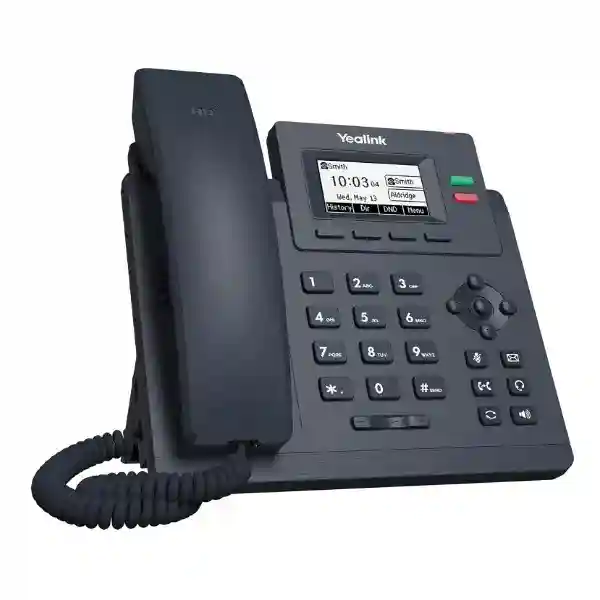
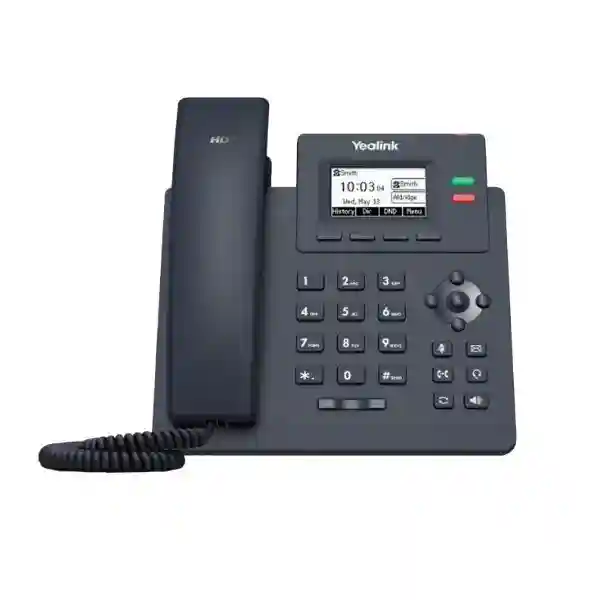
Yealink SIP-T31P Tanzania
The Yealink SIP-T31P is an entry-level business IP phone designed for organizations that want dependable SIP desk calling, straightforward administration and practical deployment features. It supports two VoIP accounts, Yealink HD Voice, a 2.3-inch 132×64-pixel graphical LCD with backlight, a two-port 10/100M Ethernet switch, Power over Ethernet, local 5-way conferencing, an EHS-compatible wireless headset path, centralized provisioning options and wall mounting. For businesses in Tanzania, the value of the SIP-T31P is not simply the handset itself: the phone works best when the PBX, SIP service, PoE switch, VLAN policy, cabling, QoS, firewall and provisioning method are planned together.
2 SIP accounts
Suitable for users who need two configured VoIP identities or line appearances in a compact desk-phone format.
PoE-ready deployment
IEEE 802.3af Power over Ethernet can simplify desk cabling when the network switch provides a compatible PoE supply.
HD business calling
HD handset and speaker audio, Smart Noise Filtering and supported codecs are intended to improve day-to-day voice communication.
Centralized provisioning
Browser, phone and auto-provisioning methods help IT teams deploy repeatable configurations across multiple desks.
What the Yealink SIP-T31P solves
Many organizations do not need a large color-screen executive phone at every desk. General users often need a reliable extension, call transfer, hold, mute, DND, speed dial, caller information, conference capability and a manageable way for administrators to provision phones at scale. The SIP-T31P addresses this entry-level business requirement while retaining features that matter in structured VoIP deployments, including SIP standards support, VLAN and QoS options, SRTP for voice, TLS support, IPv6, OpenVPN, 802.1X and remote phonebook capabilities. The practical buying question is therefore whether its two-account design, Fast Ethernet interfaces and feature set match the intended user role and network architecture.
For receptionists handling many simultaneous lines or executives who want large color displays, Bluetooth, built-in Wi-Fi or extensive programmable keys, a higher-tier model may be more appropriate. For standard desks, branch offices, counters, shared work areas and users with moderate call-handling needs, the SIP-T31P can be a sensible fit. Buyers should compare the exact user profile rather than choose by price alone.
Verified Yealink SIP-T31P specifications
| Area | Verified specification |
|---|---|
| Display | 2.3-inch 132×64-pixel graphical LCD with backlight |
| Accounts | Up to 2 VoIP/SIP accounts |
| Ethernet | 2 × RJ45 10/100M Ethernet ports |
| Power | PoE support; external Yealink AC adapter is an optional power method |
| Conferencing | Local 5-way conferencing |
| Directory | Local phonebook up to 1,000 entries plus XML/LDAP remote phonebook support |
| Management | Browser/phone configuration, FTP/TFTP/HTTP/HTTPS auto-provisioning, PnP and TR-069 |
| Security/network | SIP v1/v2, VLAN/QoS, SRTP, TLS 1.3, HTTPS certificate management, AES256 configuration-file encryption, 802.1X, OpenVPN, IPv6 and related controls |
Planning the SIP-T31P as part of a business phone system
A desk phone depends on the surrounding voice architecture. Before ordering a quantity of SIP-T31P phones, confirm which PBX or hosted SIP platform will register the devices, how extensions will be created, whether the provider requires special outbound proxy or NAT settings, and which codecs are preferred. On a managed LAN, a voice VLAN can keep phone traffic organized separately from ordinary workstation traffic. QoS settings can help prioritize voice where congestion exists, while a properly sized PoE switch can power phones without individual desk adapters.
For larger rollouts, administrators should also define naming conventions, extension ranges, provisioning templates, firmware policy, admin credentials, emergency-call handling, directory sources and change-control procedures. These tasks are easier to solve before deployment than after dozens of handsets are already on desks. Fourteck Tanzania’s broader business technology shop explains how IP phone, PBX, switching and infrastructure decisions fit together, while the services page provides context for integrated deployment and support requirements.
Yealink SIP-T31P Tanzania
Organizations searching for the Yealink SIP-T31P in Tanzania are often trying to solve a practical office-telephony requirement rather than simply purchase a handset. A procurement team may be equipping a new office, replacing older analog extensions, standardizing desk phones across several departments, adding users to an existing IP PBX, or building a branch-office voice system. In each case, the SIP-T31P should be evaluated as an endpoint within the full voice environment. Its two SIP accounts suit ordinary users who do not require a large number of line appearances. PoE can simplify desk installation when the access switch supports the required standard, while the second Ethernet port can help in common desk layouts where a phone and computer share one network drop.
For Tanzania deployments, buyers should identify the number of extensions, calling patterns, PBX or hosted platform, SIP trunk provider, internet dependence, network-switch capacity and power-resilience plan. Where voice depends on an on-premises PBX, local LAN design becomes central. Where voice is hosted in the cloud, internet stability, DNS, firewall rules and WAN resilience become more important. A UPS-backed PoE switch can help phones stay powered during short power interruptions, but only if the PBX, router, firewall and upstream connectivity are also protected. This is why phone procurement should be coordinated with the broader network.
Businesses comparing quotations for Yealink SIP-T31P Tanzania should request clarity on the exact model, quantity, included accessories, power method, provisioning scope and compatibility assumptions. The optional nature of an external power adapter matters when PoE is not available. The phone’s two-port Fast Ethernet design also means buyers should check whether the user’s desktop workflow has any requirement that would justify Gigabit connectivity instead. For many standard office users, Fast Ethernet is sufficient for the voice endpoint and typical PC passthrough use, but higher-bandwidth workstations may benefit from a different topology or phone model.
Yealink SIP-T31P Dar es Salaam
In Dar es Salaam, demand for a phone such as the Yealink SIP-T31P can come from corporate offices, professional services firms, logistics operations, hotels, schools, clinics, retail organizations, branch networks and customer-service teams. The city’s range of business environments means there is no single correct deployment pattern. A compact office may use a hosted PBX and one PoE switch, while a larger building may use multiple access switches, dedicated voice VLANs, redundant internet links and centralized provisioning. The SIP-T31P fits best where users need dependable desk calling, two SIP identities, transfer and conferencing features without the cost and complexity of a higher-tier executive endpoint.
A Dar es Salaam procurement plan should map the phone quantity to actual user roles. Standard desks can use the SIP-T31P, while reception or switchboard positions may require more programmable keys and a larger visual interface. Meeting rooms may need conference phones rather than ordinary desk sets. Warehouses or operational areas may need different mounting or durability considerations. This role-based approach avoids overspending on features that ordinary users do not need while ensuring high-call-volume positions are not constrained by an entry-level design.
Network preparation is equally important. Verify PoE budget, cable quality, patch-panel labeling, DHCP behavior, VLAN tagging and QoS policy before mass deployment. If phones share network drops with computers, confirm the desktop connection path and any performance requirements. If the PBX is hosted, test call quality during busy internet periods rather than assuming bandwidth alone guarantees good voice. For multi-site businesses headquartered in Dar es Salaam, standardized extension plans and provisioning templates can make branch expansion easier. Fourteck’s regional network, including Fourteck Uganda and Fourteck Kenya, can also provide context for organizations working across East African markets.
Yealink SIP-T31P Mwanza
For businesses in Mwanza, the Yealink SIP-T31P can be considered for offices, trading companies, education, hospitality, healthcare, distribution and branch operations that want a manageable SIP endpoint. The procurement discussion should begin with the communications workflow. Determine whether each user needs one extension or two accounts, how calls are transferred, whether departments use hunt groups or queues, how voicemail is handled, and whether staff require headsets. These answers reveal whether the SIP-T31P is the appropriate endpoint or whether some users need a more feature-rich model.
Infrastructure planning can be especially valuable when a new voice rollout coincides with a network refresh. The same managed switch may power phones, wireless access points and cameras, so PoE capacity must be calculated across all devices rather than reserved only for telephony. Voice traffic can share the physical LAN but benefit from logical separation and disciplined QoS. Cabling should be tested and labeled, and the network rack should have sufficient UPS capacity for the equipment that keeps calls operational. Protecting only the handset power source does not help if the switch or router drops offline.
Mwanza buyers should also plan for supportability after installation. A repeatable configuration template, documented administrator access, firmware policy and known reset/recovery procedure can reduce future troubleshooting time. For branches managed from another city, remote provisioning and device-management capabilities become more valuable because every minor change should not require an on-site visit. Before requesting a quote, prepare the quantity, PBX platform, current network design, PoE availability, extension list and target deployment date. This gives suppliers enough detail to identify dependencies rather than quoting only the handset. The result is a more accurate bill of materials and a lower chance of discovering missing power adapters, switch capacity or cabling at the last stage.
Yealink SIP-T31P Arusha
Arusha organizations often operate in sectors where dependable voice communication remains important even when messaging and collaboration applications are widely used. Hospitality businesses, tour operations, professional offices, education providers, NGOs, clinics and administrative teams may need desk phones for reception, reservations, internal extensions and customer calls. The Yealink SIP-T31P is positioned for general users who need a straightforward SIP handset with HD voice, two accounts, PoE and standard business calling features. It should be matched to the user role rather than treated as the universal model for every extension.
A hospitality or customer-facing deployment, for example, may have different endpoint tiers. Back-office desks might use the SIP-T31P, while front-desk positions require more line keys or expansion options. Guest-room telephony may demand a separate phone category entirely. An NGO or multi-branch organization may care more about centralized provisioning and consistent extension numbering. A school or clinic may prioritize easy transfers, directory access and simple operation. Identifying these requirements before procurement helps create a mixed endpoint strategy that balances usability and cost.
For Arusha sites, voice quality depends on the network path. Check LAN stability, switch PoE capacity, DHCP, VLAN configuration and any firewall rules that affect SIP signaling or RTP media. If calls traverse the internet, consider latency, jitter, packet loss and failover design. If internet redundancy is needed, confirm how the PBX or hosted service behaves during WAN changes. Training should also be part of rollout: even a simple handset provides more value when users know how to transfer calls, start a conference, use DND appropriately and access voicemail. Documenting these functions in a short internal guide can reduce help-desk questions and make adoption smoother.
Yealink SIP-T31P Dodoma
Organizations in Dodoma evaluating the Yealink SIP-T31P may include administrative offices, professional firms, education, healthcare, projects, retail operations and growing branch networks. The phone is suited to desk users who need two SIP accounts and core enterprise calling functions in a compact form. For procurement teams, the more important decision is whether the complete voice platform has been defined. A handset can register only when the PBX or SIP service, credentials, network routing and security policies are correctly prepared.
New-office projects should include telephony in the cabling and switching design from the beginning. If each desk has one cable run and the phone is expected to pass connectivity to a PC, confirm that the Fast Ethernet interface is appropriate for the workstation role. If users transfer large files or require high-speed LAN access, consider a second data outlet or a phone model with Gigabit Ethernet. If PoE is planned, calculate switch power budget for the full endpoint count and any other PoE devices. This is more reliable than discovering after installation that the switch has enough ports but insufficient power capacity.
For existing sites migrating from analog PBX to IP telephony, inventory numbers, departments, reception workflows, call queues, voicemail, emergency dialing and external numbers before changing devices. A staged migration can reduce disruption. The SIP-T31P can then be provisioned using repeatable templates and named according to a documented extension plan. Buyers should also define who owns ongoing administration: internal IT, a service provider or a shared model. This operational clarity matters because phones require occasional firmware updates, extension changes and troubleshooting even when the hardware itself is stable.
Yealink SIP-T31P UAE
Businesses with operations in the UAE may consider the Yealink SIP-T31P as a standard desk endpoint for branches, shared services, back-office teams and satellite locations where two SIP accounts and essential call features are sufficient. Multi-country organizations often gain more value from standardizing endpoint profiles than from buying the same device everywhere without a plan. A useful standard might define the SIP-T31P for ordinary users, a higher-tier phone for executives and reception, and dedicated conference devices for meeting rooms. The model assignment stays consistent while local PBX, carrier and regulatory arrangements are handled per site.
For UAE deployments, confirm platform compatibility, SIP service requirements, network security and any provider-specific configuration before ordering. PoE remains useful for reducing desk adapters, especially in structured office environments with managed switching. Centralized provisioning can simplify larger rollouts and make configuration consistent across offices. If devices are managed by a regional IT team, document firmware versions, configuration templates, extension ownership and support escalation paths so that a problem can be diagnosed without relying on local memory.
A company that operates in both Tanzania and the UAE should compare not only handset prices but also the operating model. Will extensions be hosted on one cloud platform, separate local PBXs or a hybrid design? How will inter-office dialing work? Are there regional SIP trunks or separate number ranges? Which network policies are common and which must vary? Fourteck’s broader UAE technology site can support the regional context while the Tanzania site remains the primary reference for Tanzania procurement. Standardization should simplify administration without ignoring local telecom conditions.
Yealink SIP-T31P Uganda
Ugandan businesses considering the Yealink SIP-T31P typically have similar core questions to Tanzania buyers: whether the phone works with the selected IP PBX, whether PoE is available, how many SIP accounts users need and how devices will be provisioned. The model’s two-account design and local 5-way conferencing make it suitable for standard office roles where users need core voice features but do not require a large color display or many programmable line keys. It can be used as part of a new SIP rollout or to expand an existing compatible environment.
The key procurement task is to separate endpoint requirements from platform requirements. A phone does not create call routing, IVR, queues or trunk capacity by itself; those capabilities come from the PBX or hosted service. The handset provides the user interface for those services. Therefore, a quote should identify both the endpoint quantity and the surrounding platform assumptions. If an organization is replacing analog phones, additional network-switch ports, PoE, cabling or gateways may be needed depending on the architecture.
For organizations with offices in Uganda and Tanzania, consistent configurations can reduce administrative effort. The same extension naming, VLAN design, provisioning method and user guides can be reused where the PBX architecture supports it. However, internet connectivity and carrier services should still be evaluated per site. Buyers can consult Fourteck Uganda for Uganda-focused requirements while coordinating broader regional standards through the Tanzania project team. A well-structured quote should state quantities, PBX or SIP platform, PoE availability, headset needs, installation scope and whether configuration is required.
Yealink SIP-T31P Kampala
In Kampala, the Yealink SIP-T31P can suit general office users in professional services, retail headquarters, logistics, education, healthcare, hospitality, NGOs and branch operations. The two SIP accounts allow a user to register more than one identity or service where the PBX design requires it, while HD voice and Smart Noise Filtering help support clearer day-to-day calls. Local 5-way conferencing is useful for occasional ad-hoc discussions without requiring a separate conference bridge for every small group call.
Kampala deployments should be planned around the network, especially in sites where data, Wi-Fi, CCTV and phones share the same switching infrastructure. Count PoE devices, verify the switch’s total power budget and reserve capacity for growth. Configure voice VLANs where appropriate, and confirm that DHCP and QoS policies are documented. If a phone is connected between the wall jack and the user’s PC, understand that the SIP-T31P has Fast Ethernet ports. This is usually adequate for voice and many general desktop tasks, but teams with heavier network use should review whether the passthrough connection meets their needs.
Businesses should also plan administration before rollout. Decide whether phones are configured individually, through auto-provisioning or through a device-management workflow. Centralized methods become increasingly valuable as quantities grow because they reduce inconsistent settings. Keep extension credentials protected, limit administrative access and document recovery procedures. Before a procurement decision, ask for the exact handset model, included accessories, power method, firmware expectations and scope of configuration. These questions help compare quotations on equal terms rather than focusing only on the unit price.
Yealink SIP-T31P Arua
For an Arua office or branch, the Yealink SIP-T31P can be a practical choice when the organization wants a simple SIP desk phone with business-grade provisioning and security features. Branch planning should start by deciding whether the local site connects to a central PBX, uses a hosted cloud service or operates a local system. That decision affects WAN dependence, extension registration, firewall policy and how calls behave during internet interruption. A handset choice should therefore follow the voice architecture rather than precede it.
If the Arua site is managed remotely from Kampala, Tanzania or another regional office, the SIP-T31P’s provisioning options can help administrators maintain consistent settings. Define a template with preferred codecs, time settings, directory sources, line keys, security parameters and firmware policy. Standard templates reduce configuration drift and make replacement units easier to deploy. The local network should have tested cabling, sufficient switch ports and the required PoE capacity. Where power resilience is important, the entire network path—including switch, router and PBX equipment—should be supported appropriately.
A branch deployment also benefits from a simple acceptance checklist. Test incoming and outgoing calls, extension dialing, transfer, hold, voicemail, conferencing, caller ID and any hunt-group behavior. Confirm that call quality remains acceptable during busy data periods. Label phones with extension information if that fits internal policy, and record serial or asset information for inventory. These operational details are often more important to long-term reliability than adding unnecessary endpoint features. When requesting a quote, include the branch size, number of extensions, current PBX platform and whether installation or remote provisioning is expected.
Yealink SIP-T31P Mbarara
Mbarara businesses evaluating IP telephony may use the Yealink SIP-T31P for general administrative desks, customer-service positions with moderate call volume, clinics, education, retail offices or branch teams. Its physical keys, backlit monochrome display and familiar handset design reduce the learning curve for users moving from traditional desk phones, while SIP connectivity makes the endpoint part of a modern IP-based phone system. The key is to confirm that two accounts and the available line keys are enough for each role.
When the phone is part of a greenfield office deployment, coordinate voice with the LAN and cabling plan. Decide whether desks need one or two network outlets, whether phones will be PoE powered, and whether PC traffic will pass through the handset. For sites with shared PoE infrastructure, create a device count that includes phones, access points, cameras and other powered endpoints. A switch may advertise many PoE ports but still have a total power limit, so both port count and budget matter. Voice VLAN and QoS settings should be part of the switch configuration rather than added only after users report call problems.
For ongoing management, document who can change extensions and how configuration backups are maintained. If users move between departments, a centralized provisioning approach can make reassignment easier. If the phone is used with a wireless headset, confirm the exact EHS accessory and headset compatibility before purchase rather than assuming any wireless headset will work. Procurement teams should request a quotation that separates hardware, optional power adapters, accessories, configuration, installation and support so that competing offers can be compared fairly.
Yealink SIP-T31P Gulu
For organizations in Gulu, the Yealink SIP-T31P can provide a standardized desk-phone option for offices that need SIP calling, two accounts and manageable deployment without premium endpoint features. The phone supports common call functions such as hold, mute, DND, forwarding, waiting, transfer and auto answer, which makes it useful for ordinary office communication. The local 5-way conference function can help small teams coordinate quickly, while the directory and remote phonebook options can make internal contacts easier to access when configured correctly.
The most important design question for a Gulu branch is often resilience. If the PBX is hosted elsewhere, voice depends on WAN connectivity. If the PBX is local, external calls may still depend on SIP trunks or other telecom services. Document what happens when the primary internet link fails and whether a secondary path is required. The network rack should also be considered as a system: PoE switching, firewall/router, PBX appliance and any access equipment need appropriate power protection if phones are expected to remain usable during short outages.
Deployment can be simplified with a standard branch template. Assign extension ranges, phone names, VLAN settings and support contacts consistently. Test every handset before handover and provide users with a compact guide for transfer, conference, voicemail and DND. This reduces basic support calls and helps staff use the phone effectively. Buyers should verify optional accessories and power arrangements in the quote. Where PoE is available, a separate adapter may not be required; where it is not, the power method must be included explicitly to avoid delays at installation.
Yealink SIP-T31P Kenya
Kenyan businesses frequently use SIP telephony in offices, branch networks, hospitality, education, healthcare and service environments. The Yealink SIP-T31P addresses the entry-level desk segment with two SIP accounts, HD voice, PoE and a backlit graphical display. It is particularly relevant where procurement teams want a consistent standard phone for general users while reserving higher-tier models for reception, executive or intensive call-handling roles. This tiered strategy can control cost without forcing the same feature set onto every employee.
Compatibility and deployment scope should be confirmed before purchase. A SIP phone can work with many standards-based platforms, but specific features such as BLF behavior, directory integration, provisioning and advanced call handling can vary by PBX implementation. Buyers should therefore test the exact environment or confirm support with the platform provider. Network readiness includes PoE, VLANs, QoS, DHCP and firewall behavior. If a hosted phone system is used, stable internet performance matters more than headline bandwidth alone; jitter and packet loss can affect real voice quality.
For companies with operations in Kenya and Tanzania, standardizing on a common phone profile can simplify training and spare-device planning. The Fourteck Kenya site provides a regional point of reference, while Tanzania procurement can be coordinated through Fourteck Tanzania. In a cross-border project, define which elements are global standards—phone model, extension template, security policy—and which remain local, such as carrier services and number plans. This creates consistency without making unsupported assumptions about local telecom arrangements.
Yealink SIP-T31P Kuwait
In Kuwait, the Yealink SIP-T31P can be used as an economical standard endpoint for ordinary business users who need two SIP accounts, HD voice and PoE in a familiar desk-phone form. Organizations operating across the Gulf and East Africa may choose one endpoint family to simplify user training and central management. The benefit of this approach comes from consistent configuration and role definitions rather than from assuming every site has the same telecom provider or network design.
Before procurement, confirm the PBX platform, extension licensing, SIP trunk arrangement, supported codecs, provisioning method and network-security requirements. For multi-floor offices, voice VLANs and centrally managed switches can make phone traffic easier to control. PoE simplifies power distribution, but UPS capacity should include switches and the rest of the voice path. If the phone shares an Ethernet link with a workstation, its 10/100M interface should be considered when deciding whether the topology is appropriate for that user.
A regional IT team can improve maintainability by using common templates, naming conventions, firmware standards and security settings. The same handset can then be replaced or re-provisioned with less manual work. Procurement documents should identify what is included and what is optional, especially power adapters, headsets and installation services. For Kuwait-specific inquiries, organizations can also reference Fourteck Kuwait. This supports regional coordination while keeping local requirements separate and explicit.
Yealink SIP-T31P Ghana
Ghanaian businesses evaluating the Yealink SIP-T31P can use it as a standard SIP endpoint for employees whose needs center on reliable calling, transfer, hold, conference and directory access. The two-account design makes it more flexible than a single-line entry handset while still remaining focused on everyday office use. It should be compared with higher-end Yealink models when users require Gigabit Ethernet, more programmable keys, color displays or additional integrated connectivity options.
A Ghana deployment should document the phone system architecture before hardware is ordered. If the PBX is cloud hosted, internet resilience and firewall policy are important. If the PBX is on premises, switch design, local server/appliance resilience and SIP trunk integration become central. In both cases, PoE planning, VLAN configuration and cabling quality affect deployment. A phone that is technically correct can still perform poorly on a congested or poorly configured network, so acceptance testing should include real calls during normal working conditions.
Organizations expanding across multiple sites should standardize the parts that make support easier: provisioning templates, extension naming, directory sources, admin controls and user instructions. Keep configuration credentials secure and avoid using inconsistent manual settings unless necessary. When preparing a request for quotation, include user quantity, PBX platform, current network infrastructure, PoE availability and any headset or wall-mount requirements. This allows a supplier to identify dependencies and avoids a narrow quote that includes only the handsets while leaving out essential deployment items.
Yealink SIP-T31P Nigeria
Nigeria’s wide range of business environments—from small professional offices to multi-site enterprises—means the Yealink SIP-T31P should be selected by role and architecture. The phone offers two SIP accounts, Power over Ethernet, HD audio, a backlit graphical display and local 5-way conferencing, making it suitable for many general office users. It is not intended to replace high-feature reception consoles or executive phones where users need many lines, large displays or extensive programmable keys.
Network resilience deserves close attention in any IP-telephony project. A desk phone is only one component in the call path. The PoE switch, router, firewall, PBX and service provider all influence availability. If the organization uses a cloud PBX, test WAN behavior and understand failover. If an on-premises PBX is used, protect the local equipment and maintain configuration backups. Voice VLANs and QoS can help keep traffic organized, but they should be implemented according to the actual network rather than copied blindly from a generic template.
For distributed businesses, centralized provisioning reduces repetitive work. Administrators can maintain consistent line settings, directory references and security parameters across many phones. Procurement teams should also compare total deployment cost, not only unit price. Optional adapters, PoE switch upgrades, cabling, headsets, PBX licenses, SIP services and configuration labor may all affect the final budget. A complete quotation therefore starts with the number of users, role breakdown, existing PBX, network readiness and desired support scope.
Yealink SIP-T31P Seychelles
Businesses in Seychelles that need a compact SIP desk phone for offices, hospitality administration, services, education or multi-site operations can evaluate the Yealink SIP-T31P for standard users. Its two SIP accounts, HD voice and PoE support are suited to straightforward business calling. In hospitality environments, however, endpoint selection should distinguish front-office and back-office users from guest-room requirements, because those roles can need different phone designs and management features.
For island deployments where remote administration may be valuable, centralized provisioning and documented configuration can reduce dependency on repeated on-site changes. Define the PBX platform, SIP provider, extension scheme and remote-management method before equipment arrives. The local network should have appropriate PoE switching, VLANs where needed, tested cabling and a power-resilience strategy. If a hosted platform is used, WAN stability and backup connectivity should be assessed according to business criticality.
A useful procurement checklist includes handset quantity, user roles, power method, PBX compatibility, network requirements, headset needs and configuration scope. For mixed environments, select the SIP-T31P only for users whose needs match its two-line entry-level positioning and choose other endpoints where requirements differ. This avoids both under-specifying demanding roles and over-spending on premium phones for ordinary desks. Regional organizations can keep provisioning and user training consistent while still respecting site-specific connectivity and telecom arrangements.
Compatibility, security and deployment guidance
The SIP-T31P supports standard SIP signaling and includes network and security functions such as SRTP, TLS 1.3, HTTPS certificate management, AES256 configuration-file encryption, digest authentication, OpenVPN, 802.1X, IPv6 and VLAN/QoS capabilities. These features provide tools for a secure deployment, but security depends on configuration. Administrators should change default credentials, limit management access, use supported encrypted protocols where appropriate, keep firmware current, restrict unnecessary exposure to the public internet and maintain backups of working configuration.
PBX compatibility should be confirmed at the feature level. Basic SIP registration and calling may work across many platforms, while BLF, voicemail indicators, remote directories and provisioning behavior can depend on the PBX. For larger projects, test one or more phones against the target system before committing to a full rollout. A short pilot can validate call quality, transfer, conference, voicemail, caller ID, failover and directory behavior.
Related Fourteck resources
Fourteck Tanzania Shop
Browse the broader business technology portfolio and procurement guidance for IP phones, PBX, switching, security and infrastructure.
Fourteck Tanzania Services
Review integrated technology services where deployment, configuration, network readiness and ongoing support are part of the requirement.
Regional Fourteck Network
Organizations operating across borders can coordinate related requirements through Fourteck’s regional sites.
Frequently asked questions
How many SIP accounts does the Yealink SIP-T31P support?
The Yealink SIP-T31P supports up to two VoIP/SIP accounts. This makes it suitable for standard users who need one or two configured identities without requiring a high-line-count executive phone.
Does the Yealink SIP-T31P support PoE?
Yes. The SIP-T31P supports Power over Ethernet, allowing a compatible PoE switch to provide network connectivity and power over the Ethernet cable. Confirm switch PoE capacity before deployment.
Is a power adapter included?
Yealink documentation lists the power adapter as optional. Buyers should confirm whether their quotation includes an adapter or whether the phone will be powered by PoE.
Can the SIP-T31P be centrally provisioned?
Yes. Yealink documents browser/phone configuration and auto-provisioning through FTP, TFTP, HTTP and HTTPS, along with PnP and TR-069 options. The exact method depends on the chosen management and PBX environment.
Does it support conferencing?
Yes. The SIP-T31P supports local 5-way conferencing, which can be useful for small ad-hoc voice meetings.
What should I check before buying the SIP-T31P?
Confirm PBX or SIP-service compatibility, the number of accounts required, PoE availability, Fast Ethernet suitability, headset needs, provisioning method, voice VLAN/QoS design, optional adapter requirements and the configuration or installation scope.
Quotation checklist for Yealink SIP-T31P
To receive a more accurate quotation, prepare the required quantity, user roles, PBX or hosted SIP platform, current extension count, SIP trunk/provider details where relevant, PoE switch availability, cabling status, headset requirements, wall-mount requirements, provisioning expectations and target deployment location. Also state whether you need hardware supply only or assistance with configuration, installation, testing and documentation.
Decision recap
Choose the Yealink SIP-T31P when users need a straightforward two-account SIP desk phone with HD voice, PoE, a backlit display, dual Fast Ethernet and manageable provisioning. Consider a different model when users need Gigabit passthrough, many programmable keys, a large color screen or additional integrated wireless features. The best deployment combines the correct handset with a compatible PBX, stable network, sufficient PoE, appropriate security and documented provisioning.
Consult Fourteck Tanzania
Share your required quantity, office or branch locations, current phone system, SIP provider or PBX platform, user roles and network details. Fourteck Tanzania can use that information to help determine whether the SIP-T31P is suitable for the intended desks and what supporting network or deployment items should be considered.




Reviews
There are no reviews yet.