
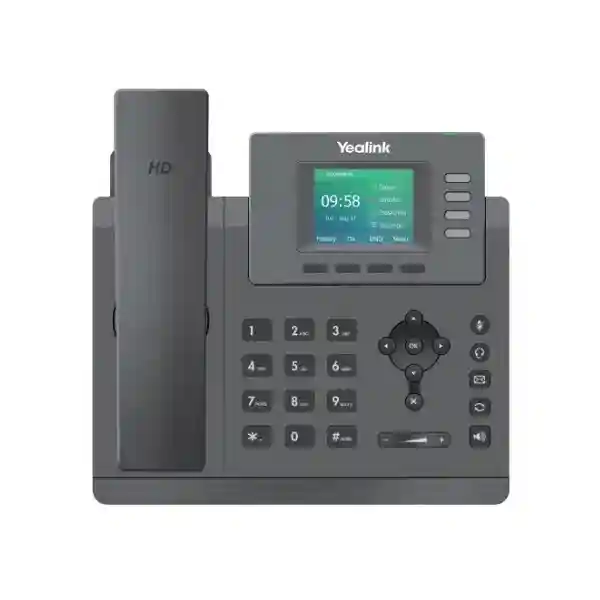
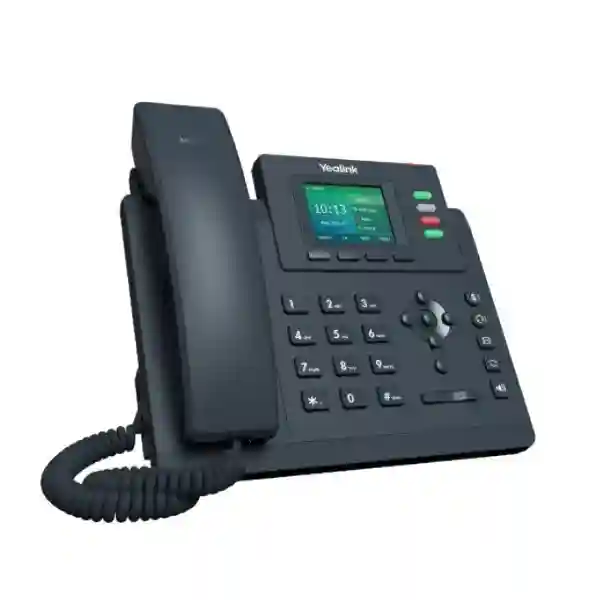
Yealink SIP-T34W Tanzania
The Yealink SIP-T34W is an entry-level business IP phone designed for organizations that want a clear color screen, professional SIP calling, flexible network connectivity and practical office deployment without moving to a premium executive endpoint. Yealink specifies four VoIP accounts, a 2.4-inch 320 × 240 color display, built-in dual-band 2.4GHz and 5GHz Wi-Fi, dual-port Gigabit Ethernet, IEEE 802.3af PoE, a USB 2.0 port for supported wired USB headsets or Bluetooth headsets through compatible Yealink adapters, HD voice, Smart Noise Filtering and local five-way conferencing. For Tanzania businesses, this combination can be especially useful when different desks have different cabling conditions: some users may connect through PoE Ethernet while others can use business Wi-Fi where the wireless design and voice quality are suitable.
Flexible Connectivity
Use Gigabit Ethernet with PoE for clean desk deployments, or built-in 2.4GHz/5GHz Wi-Fi where the business wireless network is designed for reliable voice traffic.
Clear Daily Calling
HD handset and speaker audio, Smart Noise Filtering and full-duplex speakerphone support make the T34W suitable for everyday professional communication.
Simple Fleet Management
Browser, phone and auto-provisioning options help IT teams standardize settings across multiple extensions and branch deployments.
What the Yealink SIP-T34W Is Designed to Solve
Many office phone projects fail because the endpoint is selected only by price. A business desk phone has to match the voice platform, network architecture, power method, user role, headset requirement and management model. The SIP-T34W is positioned for users who need more than a basic monochrome phone but do not require a large touchscreen or high-end executive features. Its four SIP accounts can support multiple lines or identities, while four line keys can be programmed across paperless DSS pages for frequently used functions. The color display improves caller information and menu visibility, which can be valuable for staff who handle transfers, hold, voicemail and directory functions throughout the day.
Built-in Wi-Fi is a major planning advantage when physical cabling is inconvenient, but it should be treated as a deployment option rather than a substitute for good network design. Voice traffic is sensitive to congestion, interference and roaming behavior. Where structured cabling and PoE are available, wired Ethernet may offer the most predictable desk-phone experience. Where desks are temporary, renovated frequently or located away from Ethernet outlets, the T34W can connect over compatible 2.4GHz or 5GHz wireless networks. The best choice depends on signal quality, access-point capacity, VLAN design, QoS policy and the organization’s tolerance for wireless variability.
For companies comparing IP phones, the T34W also provides practical headset flexibility. Yealink lists a USB 2.0 interface for supported wired USB headsets and Bluetooth headsets when used with compatible Yealink BT50 or BT51A adapters. It also supports EHS wireless headset integration. Before purchasing headsets, organizations should confirm the exact headset model, adapter and required user workflow rather than assuming universal compatibility.
Verified Yealink SIP-T34W Technical Highlights
| Area | Specification |
|---|---|
| SIP accounts | Up to 4 VoIP accounts |
| Display | 2.4-inch 320 × 240 color display with backlight |
| Networking | Dual-port Gigabit Ethernet; built-in IEEE 802.11a/b/g/n/ac dual-band Wi-Fi |
| Power | IEEE 802.3af PoE Class 2; optional external 5V/1.2A adapter |
| Audio | HD handset, HD speaker, Smart Noise Filtering, G.722 wideband codec |
| Conference | Local 5-way conferencing |
| Headsets | RJ9 headset port; USB 2.0 for supported wired/Bluetooth headset options; EHS support |
| Directory | Local phonebook up to 1,000 entries; XML/LDAP remote phonebook support |
| Security | SRTP, TLS 1.3, HTTPS certificate management, AES-256 configuration encryption, 802.1X, OpenVPN, WPA2/WPA3, secure boot |
Compatibility, PBX and Provisioning Planning
The SIP-T34W supports SIP v1 and SIP v2, and Yealink documents standard enterprise features including call hold, transfer, forwarding, waiting, voicemail, BLF, call park, call pickup, hot-desking and centralized call recording functions where the connected system supports them. Actual feature behavior depends on the PBX, hosted platform, firmware and configuration. Buyers should therefore treat compatibility as a project check rather than assume that every advertised phone feature will work identically with every service provider.
For multi-phone deployments, auto-provisioning is one of the most useful capabilities. Yealink lists provisioning over FTP, TFTP, HTTP and HTTPS, PnP support and TR-069, along with browser and on-device configuration. IT administrators can use these mechanisms to standardize account settings, network values, codecs, time zones, DSS keys and security policies. A rollout of twenty, fifty or several hundred phones should be planned as a managed endpoint deployment, not as a series of manual desk installations.
If your project also needs broader voice infrastructure, explore FourTeck IP Phone solutions for related endpoint planning, IP PBX solution guidance when the phone system itself is being designed, and Yealink products for Africa when comparing other Yealink endpoint families. These links are useful when the SIP-T34W is only one part of a larger voice modernization project.
Who Should Consider the SIP-T34W?
The strongest fit is a standard office user who needs a professional SIP desk phone with a color display, Gigabit network pass-through and the option of wired or Wi-Fi connectivity. Reception overflow positions, sales desks, administration teams, accounts departments, service coordinators, branch-office users, clinic reception staff, school administration teams and hospitality back offices can all be reasonable use cases. The model is less appropriate for users who specifically require a large touchscreen, integrated video, many dedicated line appearances on one screen or advanced executive controls. In those cases, a higher Yealink family may be more suitable.
A mixed deployment can also make sense. Organizations often save money by matching phone capability to user role rather than buying one premium model for every desk. The T34W can cover routine voice users, while managers, reception supervisors or power users receive higher-end phones. This role-based approach can improve budget efficiency and simplify procurement without forcing every employee into the same feature tier.
Yealink SIP-T34W Tanzania
For organizations purchasing Yealink SIP-T34W in Tanzania, the important buying question is not simply whether the phone can make SIP calls. A good deployment begins with a list of extensions, departments, user roles, PBX or hosted voice platform, available switch ports, PoE capability, Wi-Fi coverage, headset needs and the expected number of simultaneous calls. Tanzania businesses may be replacing analogue phones, expanding an existing IP PBX, opening a new branch, introducing a cloud voice platform or standardizing desk phones across several sites. The SIP-T34W is useful in these scenarios because it can serve as a consistent general-purpose desk endpoint while giving network teams both wired Gigabit and wireless connectivity options.
When preparing a Tanzania quotation, buyers should specify quantity, city, whether power adapters are required, whether existing switches provide IEEE 802.3af PoE and whether headsets or mounting accessories are part of the requirement. The phone’s power adapter is optional in Yealink’s package information, so this should never be assumed. Organizations using Wi-Fi should describe the intended wireless environment, especially if phones will be deployed in dense offices or sites with many access points. A quick wireless survey or at least a review of signal strength and channel planning can prevent voice-quality complaints after deployment.
For businesses that want to compare a broader regional catalog before deciding, the FourTeck Africa technology portfolio can provide context on related communications and infrastructure products. The right outcome is a phone deployment that fits the existing network, supports the required PBX features and gives users a straightforward calling experience. FourTeck can help structure the product discussion around these technical and procurement details before a final quote is prepared.
Yealink SIP-T34W Dar es Salaam
Dar es Salaam organizations often combine headquarters, customer-facing offices, warehouses, clinics, hotels, education sites and branch locations, creating a wide range of desk-phone requirements. A SIP-T34W project in Dar es Salaam should start by distinguishing between fixed desks and flexible work areas. Fixed desks with structured cabling can use the phone’s dual-port Gigabit Ethernet and PoE support, reducing the need for a separate power supply and allowing a connected computer to share the desk network path where the network design permits it. Flexible or renovated spaces may benefit from the built-in dual-band Wi-Fi option, provided the wireless network has stable coverage and appropriate capacity for voice.
Customer-facing teams can benefit from the color display, caller ID, directory search, call hold, transfer and programmable DSS functions. Administrative teams may value local five-way conferencing when several colleagues need to discuss an issue without launching a separate meeting platform. Headset users should confirm whether a wired RJ9 headset, compatible USB headset, EHS wireless option or Bluetooth headset through a supported Yealink adapter best matches their work pattern. This detail matters for call-intensive sales and service desks where comfort affects daily productivity.
Dar es Salaam buyers should request a quote that clearly separates phones, power adapters if needed, headsets, network upgrades and any provisioning or installation scope. This makes it easier to compare offers on a like-for-like basis. FourTeck can assist with model selection and quotation preparation while availability, pricing and delivery arrangements should be confirmed for the required quantity and destination at the time of order.
Yealink SIP-T34W Mwanza
Businesses in Mwanza may be deploying office communications across a main office, retail operation, service center, educational institution, clinic, logistics location or multiple smaller branches. The Yealink SIP-T34W can fit these environments when the requirement is a standard business phone with professional SIP functionality and network flexibility. For sites with existing Ethernet infrastructure, PoE can simplify desk installation by carrying network connectivity and power over one cable. For areas where cabling is difficult, the integrated 2.4GHz/5GHz Wi-Fi option can reduce dependence on a nearby network socket, although wireless voice performance should be checked before a larger rollout.
Mwanza buyers should pay particular attention to the voice platform. A phone may support SIP standards, but features such as BLF, voicemail notification, call park, shared lines and centralized recording depend on the connected PBX or service. IT teams should verify the desired functions on a small number of phones before deploying them widely. Provisioning templates can then be standardized for extension credentials, codecs, security settings, directory services and programmable keys.
A practical procurement checklist includes the number of users, expected desk locations, PBX details, internet and LAN design, PoE switch availability, headset quantity, wall-mount requirements and whether a spare-phone policy is needed for larger sites. This information helps avoid under-specified quotations. The SIP-T34W is best treated as a managed business endpoint that becomes more valuable when it is planned together with the network and phone system rather than purchased as an isolated device.
Yealink SIP-T34W Arusha
Arusha businesses in tourism, hospitality, professional services, education, NGOs, healthcare and administration often need reliable desk communication without excessive complexity. The SIP-T34W can be a strong fit for reception counters, reservations teams, finance desks, administration offices and support staff who need clear voice, transfer functions, directories and multiple SIP accounts. The 2.4-inch color screen is compact but provides a clearer visual interface than a basic monochrome model, helping users see caller identity, line state and menu options during everyday operations.
For hospitality and service environments, headset planning can be as important as the phone itself. Front-desk or reservations users who spend significant time on calls may require a comfortable supported headset and straightforward answer/end-call behavior. Buyers should identify this requirement before the quotation so compatible accessories can be assessed. The USB 2.0 port expands headset choices, while the RJ9 port and EHS support provide other deployment paths depending on the selected accessory.
Arusha projects should also consider whether the phone will connect to an on-premise IP PBX, a cloud-hosted service or a multi-site enterprise platform. Firmware policies, SIP credentials, VLAN configuration, QoS and secure provisioning can differ by environment. Rather than manually programming every phone, a deployment plan should use auto-provisioning where practical. This approach makes future changes easier when extensions move, staff roles change or the organization adds new branches.
Yealink SIP-T34W Dodoma
Dodoma organizations evaluating the Yealink SIP-T34W may include government-related offices, professional firms, education institutions, healthcare facilities, contractors and growing private companies. These environments often need a consistent phone standard that can be deployed across multiple departments. The T34W provides four SIP accounts, programmable line/DSS keys and familiar call controls for hold, transfer, forward, mute, DND and conferencing. This makes it practical for general business users who require core telephony functions without an oversized or complicated endpoint.
Network design should be reviewed before quantity purchasing. If PoE switches are already available, the phone can use IEEE 802.3af PoE and avoid separate desk adapters. If the site does not provide PoE, the quotation should include compatible power options where required. Built-in Wi-Fi can help in areas without Ethernet drops, but voice quality depends on the quality of the wireless environment. A decision between wired and wireless connectivity should therefore be based on network conditions, not only installation convenience.
For larger Dodoma deployments, IT teams can benefit from centralized configuration and auto-provisioning. Standardizing extension settings, security policies, VLAN values, time settings and directory access reduces inconsistency between phones. A staged rollout beginning with a pilot group can confirm PBX behavior, call quality and headset compatibility before full deployment. FourTeck can support the procurement discussion by helping buyers document the technical scope and quantity required for quotation.
Yealink SIP-T34W UAE
UAE businesses often deploy IP phones in highly structured office networks, flexible coworking environments, retail operations, hospitality properties and multi-branch corporate systems. The Yealink SIP-T34W is relevant where organizations want a cost-conscious color desk phone with Gigabit Ethernet, PoE and built-in dual-band Wi-Fi. It can serve standard extension users while higher-end phones are reserved for executives and heavy call-handling roles. This mixed-model strategy can control project cost while maintaining one vendor ecosystem.
For UAE projects, buyers should verify the PBX or hosted voice platform, local network design, VLAN and QoS requirements, phone quantity and accessory list before requesting pricing. Where offices use dense Wi-Fi, the presence of 5GHz support can be helpful, but wireless capacity and interference still require proper planning. Wired PoE remains attractive for fixed desks because it gives a consistent connection and centralized power through the network switch.
Organizations coordinating procurement between Tanzania and the Gulf can also review FourTeck UAE for broader regional technology discussions. The same product may be used in several offices, but power accessories, delivery arrangements and deployment scope should be confirmed per project. A standardized configuration template can help multinational businesses keep extension behavior, security settings and user experience consistent across offices.
Yealink SIP-T34W Uganda
Uganda organizations considering the SIP-T34W may need phones for head offices, branch locations, clinics, schools, hospitality, logistics, retail and service teams. The phone’s combination of wired Gigabit Ethernet, PoE and built-in dual-band Wi-Fi can help when different locations have different infrastructure maturity. A head office may rely on structured PoE cabling, while a smaller branch may need carefully planned Wi-Fi connectivity. Using one endpoint model across both situations can simplify training and support.
The phone supports standard SIP calling and security functions, but buyers should verify compatibility with the selected PBX or hosted provider. Features such as BLF, shared line appearance, call recording and visual voicemail can depend on the server platform. Before purchasing a large number of units, test the intended firmware and configuration with the organization’s real call flows, including transfer, queue handling, voicemail and emergency dialing where applicable.
Uganda buyers managing regional procurement can review FourTeck Uganda for region-specific technology enquiries. A complete quote request should include model, quantity, city, PBX platform, power requirements, headset needs and delivery destination. This provides a stronger basis for an accurate commercial response than a request for unit price alone.
Yealink SIP-T34W Kampala
Kampala offices often need scalable communications for sales teams, administrators, front desks, service centers and distributed departments. The SIP-T34W can suit users who need routine professional voice features, a readable color screen and enough programmability to manage commonly used line and function keys. Four SIP accounts provide flexibility for multiple identities or line appearances, while local five-way conferencing supports quick internal collaboration without requiring a separate meeting application for every discussion.
In dense office buildings, connectivity planning deserves attention. Although the phone supports both 2.4GHz and 5GHz Wi-Fi, many neighboring wireless networks can create interference, particularly in the 2.4GHz band. Business sites planning Wi-Fi phones should prioritize appropriate access-point placement, channel design and capacity. For fixed desks with cable access, Gigabit Ethernet and PoE can be the simpler operational choice. The T34W gives IT teams the freedom to choose per desk rather than locking the entire project into one connection method.
Kampala procurement teams should also confirm whether power adapters are required, because Yealink lists the adapter as optional. Headset requirements should be documented by user group, especially for contact-intensive roles. A pilot deployment with a few phones is recommended when introducing a new PBX, hosted service or Wi-Fi voice design, since it allows call quality and feature behavior to be validated before scale-up.
Yealink SIP-T34W Arua
Arua businesses and institutions can approach SIP-T34W deployment as part of a broader effort to standardize office communication. For a small office, the immediate requirement may be only a few extensions. For an expanding organization, the same phone could become part of a wider branch template. The advantage of a SIP endpoint is that the user experience can remain consistent while call routing and extension management are handled centrally by the PBX or hosted platform.
Where local cabling is limited, built-in Wi-Fi may reduce installation work, but it should not be used without checking signal stability. Voice calls need low latency and consistent packet delivery, so an office Wi-Fi network designed mainly for casual internet browsing may need improvement before carrying many active phones. The alternative is wired Gigabit Ethernet, with PoE simplifying power where suitable switching equipment is available.
Arua buyers should define the exact call workflow: who receives incoming calls, who transfers them, which users need voicemail, whether BLF monitoring is required and how after-hours calls are routed. These requirements help determine whether the SIP-T34W is sufficient or whether certain users need a different endpoint. Procurement should then include the correct accessories and deployment scope rather than focusing on the phone alone.
Yealink SIP-T34W Mbarara
Mbarara organizations may use the SIP-T34W in offices, healthcare administration, education, retail operations, professional services and branch environments. The device is well suited to users who need a conventional handset experience with modern IP telephony features. Its color display helps with line status and navigation, while programmable DSS functions can reduce the number of steps required for frequently used extensions or call features.
From an IT perspective, deployment quality depends heavily on network readiness. Existing LAN switches should be checked for available Gigabit ports, PoE capacity and VLAN configuration. If phones and computers share desk connectivity, network segmentation and QoS should be designed carefully. Wi-Fi can be used when appropriate, but the presence of dual-band support does not remove the need for proper access-point coverage and radio planning.
For Mbarara procurement, a detailed request should state the number of phones, whether desks are wired or wireless, power requirements, headset types, PBX platform and any installation or provisioning assistance expected. This allows accessories and services to be assessed at the same time as the phones. The goal should be a complete working extension deployment rather than a box-only purchase that leaves configuration questions unresolved.
Yealink SIP-T34W Gulu
Gulu buyers looking for a business VoIP phone can consider the SIP-T34W when they need four SIP accounts, reliable wired networking, optional Wi-Fi deployment and a straightforward color-screen interface. It can serve administrative desks, customer service points, finance teams and operational offices where daily calling is important but premium touchscreen features are unnecessary. Local five-way conferencing adds useful flexibility for quick discussions between several participants.
The phone supports security functions such as SRTP, TLS 1.3, 802.1X, WPA2/WPA3 and secure boot. These capabilities are most effective when the PBX and network are configured to use them. Security should therefore be considered end-to-end: device credentials, provisioning servers, switch access, wireless authentication, firmware management and PBX policy all matter. Simply purchasing a phone with security features does not create a secure voice system by itself.
Gulu organizations planning multiple extensions should create a standardized configuration profile before rollout. This can cover naming, time settings, directories, line keys, call forwarding policy and firmware. A documented standard makes support easier if phones are later moved between desks or branches. When requesting a quote, include the current voice system and intended deployment method so compatibility can be reviewed before purchase.
Yealink SIP-T34W Kenya
Kenya organizations often evaluate IP phones for corporate offices, hospitality, education, healthcare, retail, logistics and customer service operations. The SIP-T34W can provide a cost-effective standardized endpoint for routine desk users while preserving business-grade features such as Gigabit Ethernet, PoE, built-in Wi-Fi and secure SIP support. Its four-account capacity can also be useful when users need multiple line identities or when different departments share a device.
For Kenya deployments, organizations should compare the T34W against both simpler and higher-tier models. If the requirement is only one or two lines and basic calling, a lower model may be sufficient. If a user needs a larger display, more line keys or advanced executive controls, a higher model may be more appropriate. Choosing by role usually produces a more efficient budget than applying one model to every employee without considering actual usage.
Regional buyers can review FourTeck Kenya for Kenya-focused technology enquiries. A quotation request should include city, quantity, required delivery schedule, PBX platform, power and headset needs. Pricing and availability can change with supplier status and quantity, so these should be confirmed at the time of purchase rather than assumed from old online listings.
Yealink SIP-T34W Kuwait
Kuwait offices considering the Yealink SIP-T34W may be looking for a reliable desk endpoint for reception overflow, administration, sales, finance and standard extension users. The phone provides the core elements expected in a modern SIP environment: HD voice, color display, Gigabit Ethernet, PoE, Wi-Fi, configurable DSS keys and secure provisioning options. It can therefore fit new office deployments as well as replacement projects where older IP phones no longer match current network or security requirements.
In structured enterprise networks, the phone’s VLAN, QoS and 802.1X capabilities can help integrate voice endpoints into established IT policies. These features should be configured by administrators who understand the network design. In smaller environments, the setup may be simpler, but PBX registration, time synchronization, firmware and security still need attention. Organizations should avoid treating business VoIP phones as plug-and-play consumer devices when consistent service quality matters.
A Kuwait quote should clearly identify the number of units and whether adapters, headsets or wall mounting are needed. Multi-site companies should also state whether a common provisioning profile will be used across offices. This enables procurement and IT teams to align the hardware order with the actual deployment plan.
Yealink SIP-T34W Ghana
Ghana organizations can use the SIP-T34W as a standard office endpoint when they need professional VoIP calling, a clear color display and flexible network options. Businesses with existing PoE switches can simplify cabling, while offices without Ethernet at every desk may evaluate Wi-Fi. The phone’s support for both network methods can be valuable in mixed estates where headquarters and branch infrastructure differ.
The model is suitable for extension users who need core telephony functions rather than a large touchscreen. Sales teams can use speed dial and transfer functions, administration staff can manage directories and voicemail, and supervisors can use BLF where supported by the PBX. Because server-side compatibility affects advanced functions, Ghana buyers should test the phone against the exact PBX or cloud service before standardizing at scale.
A complete procurement request should include expected quantity, city, existing phone system, network details and any accessory needs. Organizations replacing analogue systems should also budget for the PBX, SIP service, LAN switching and implementation work that may be required. The phone is one component of a full voice solution, and successful deployment depends on the surrounding infrastructure.
Yealink SIP-T34W Nigeria
Nigeria businesses often operate across several branches, departments or customer-facing sites, making endpoint standardization important. The SIP-T34W can provide a consistent user experience for standard desk users while allowing centralized provisioning and security configuration. Its Gigabit Ethernet interface makes it appropriate for modern office LANs, and its Wi-Fi option adds flexibility where cabling is not practical.
For larger deployments, organizations should define a phone policy covering firmware version, SIP server addresses, extension naming, VLAN configuration, QoS, passwords, certificates and remote management. The phone supports secure technologies including SRTP and TLS, but these must be enabled and supported throughout the solution. A disciplined provisioning process reduces the risk of inconsistent settings across hundreds of endpoints.
Nigeria procurement teams should also classify users by role. Standard employees may be well served by the T34W, while receptionists or executives may need different models. Headset-intensive contact center positions should be checked for accessory compatibility and ergonomics before bulk purchase. A role-based bill of materials can reduce overspending and avoid deploying underpowered phones to heavy users.
Yealink SIP-T34W Seychelles
Seychelles businesses in hospitality, tourism, administration and professional services may need desk phones that combine a familiar handset with modern network flexibility. The SIP-T34W can suit front-office administration, reservations, finance, support and back-office users. Built-in Wi-Fi may be useful in properties where adding structured cabling to every desk is difficult, although wired PoE should still be considered where consistent Ethernet infrastructure is available.
Hospitality environments should pay particular attention to PBX integration and user workflow. Front desk users may require frequent transfers, directory access, hold, call pickup and BLF. Back-office staff may need only straightforward extension calling. Testing these workflows on the selected PBX prevents surprises after deployment. Headset requirements should also be confirmed for reservation and service teams that handle long calls.
For island procurement, quantity, accessory requirements and delivery destination should be stated clearly in the enquiry so logistics can be evaluated alongside product availability. Businesses should not assume that online pricing includes freight, duties, local handling or implementation. A written quote with an explicit scope provides a stronger basis for purchasing approval and project planning.
Buying and Quotation Checklist
Before requesting a Yealink SIP-T34W quotation, prepare the following information: the number of phones; delivery city and country; current PBX or hosted voice platform; number of SIP extensions; whether PoE switches are available; whether Wi-Fi will be used; whether power adapters are required; headset requirements; wall-mount requirements; any directory or LDAP integration; VLAN and security policies; expected provisioning method; and whether the project includes configuration or installation support. For a multi-branch project, also specify whether all sites use the same PBX and whether a standard template should be applied.
This checklist is important because the lowest phone-only price may not represent the full project cost. Power, switching, headsets, PBX licensing, SIP service, network upgrades and implementation can all affect the final budget. A technically complete quote is more useful than a low unit price that excludes essential components.
Frequently Asked Questions
Does the Yealink SIP-T34W have Wi-Fi?
Yes. Yealink specifies built-in dual-band 2.4GHz and 5GHz Wi-Fi supporting IEEE 802.11a/b/g/n/ac. Wireless voice quality still depends on the office Wi-Fi design, signal strength, interference and network capacity.
How many SIP accounts does the T34W support?
The SIP-T34W supports up to four VoIP accounts. The way those accounts are used depends on the connected PBX or hosted voice platform.
Does it support PoE?
Yes. Yealink lists IEEE 802.3af PoE Class 2. If PoE is not available, an external 5V/1.2A power adapter can be used; Yealink lists the adapter as optional in package information, so confirm it in the quotation.
Can I use a Bluetooth headset?
The phone does not list integrated Bluetooth. Yealink documents support for Bluetooth headsets through compatible Yealink BT50 or BT51A USB Bluetooth adapters. Confirm the exact headset and adapter combination before purchase.
Is the SIP-T34W suitable for 3CX or another SIP PBX?
The phone supports standard SIP protocols and Yealink publishes broad PBX-oriented features. Exact compatibility, provisioning behavior and feature support should be verified against the specific PBX version and provider before deployment.
Can FourTeck provide a price for Tanzania?
FourTeck can prepare a quotation based on the requested quantity, destination, accessories and deployment scope. Current pricing and availability should be confirmed at the time of enquiry rather than assumed from older listings.
Decision Recap
Choose the Yealink SIP-T34W when your business needs a practical four-account SIP desk phone with a color screen, Gigabit Ethernet, PoE, dual-band Wi-Fi, HD voice and flexible headset support. Confirm the PBX, power method, Wi-Fi or wired network choice, headset requirements and provisioning plan before ordering. For standard office users, the phone offers a balanced feature set without the cost and complexity of a large executive touchscreen model.
Talk to FourTeck About Your Yealink Deployment
Share your quantity, city, current PBX, user roles, network connection preference and accessory requirements. FourTeck can use this information to help structure a product quotation and identify whether the SIP-T34W is the right endpoint for every user or whether a mixed Yealink phone deployment would be more suitable. For broader company and technology information, visit FourTeck.


Reviews
There are no reviews yet.