
Yealink W77P Rugged DECT Phone System
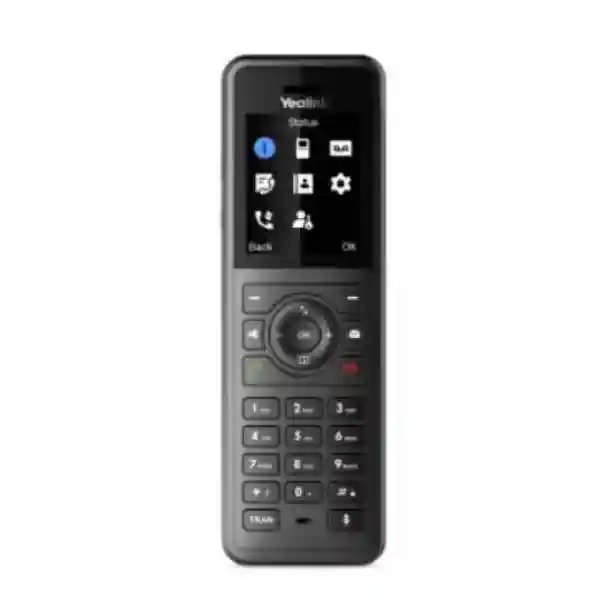
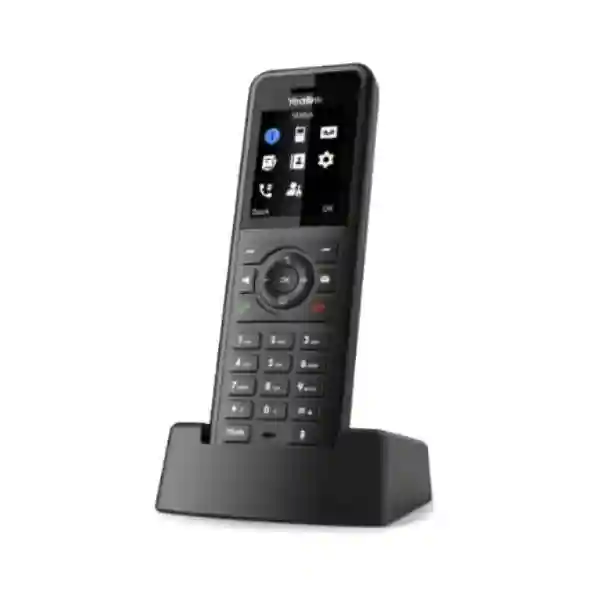
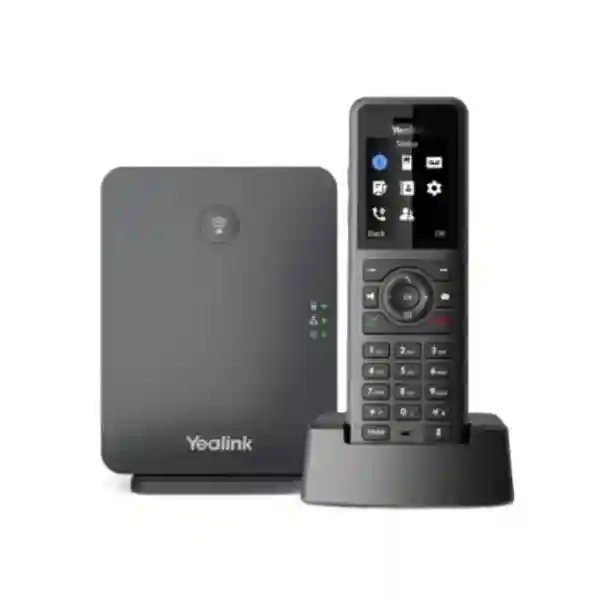
The Yealink W77P is a professional SIP cordless phone system built around the W70B DECT IP base station and W57R rugged handset. It is designed for teams that need to move while staying reachable: warehouse supervisors, hotel operations teams, workshop staff, facility technicians, retail floor managers, healthcare support teams and other employees who cannot remain beside a desk phone. For Tanzanian organizations evaluating cordless business telephony, the W77P offers a practical combination of mobility, call capacity, ruggedness and centralized VoIP integration.
Yealink specifies support for up to 10 DECT handsets, 10 SIP accounts and 20 simultaneous calls per W70B-based W77P system. The rugged W57R handset carries an IP54 protection rating, includes flexible noise reduction/noise cancellation, a vibration alarm, a 1.8-inch 128 × 160 color display and a wall-mountable charger. The base provides a 10/100 Ethernet interface and IEEE 802.3af PoE Class 1 support. These capabilities make the system especially relevant where staff move through operational areas but still need extension-based calling through a SIP PBX.
Quick fit check
Best suited to: mobile staff working within a site where SIP telephony and rugged handset protection matter.
Capacity: up to 10 registered Yealink DECT handsets, 10 SIP accounts and 20 simultaneous calls.
Coverage planning: Yealink publishes up to 50 m indoor and 300 m outdoor range under ideal conditions; real buildings should be assessed for walls, shelving, machinery and interference.
What the Yealink W77P solves
A fixed desk phone works well when a user remains at a workstation, but many operational roles do not. Staff may walk between loading bays and offices, move between hotel service areas, supervise production, handle stock, inspect facilities or respond to customers throughout a building. The W77P allows those users to keep a business extension with them while the W70B base handles SIP registration to the organization’s phone system. This separates mobility from the public mobile network and keeps internal calling within the company telephony environment.
The rugged handset also addresses environments where an ordinary cordless handset may be exposed to dust, splashes, bumps or frequent handling. IP54 does not make the handset waterproof or suitable for unlimited outdoor exposure, but it provides a more appropriate protection level for demanding indoor operational use than a standard office handset. For noisy spaces, vibration alert and noise-reduction functions help staff notice and understand calls. For managers, the larger value is operational: a planned DECT system can provide predictable extensions, centralized provisioning and repeatable handset deployment without asking mobile workers to use personal devices for every business call.
Verified Yealink W77P features
Scalable cordless calling
The W70B platform supports up to 10 Yealink DECT handsets, 10 SIP accounts and 20 simultaneous calls, with up to two simultaneous calls per handset. This can suit small and medium operational teams that need shared site mobility.
Rugged W57R handset
The W57R is IP54 rated and designed for demanding workplaces. It also includes a vibration alarm, useful where machinery, activity or ambient noise can make an audible ring easier to miss.
Business audio
Yealink lists full-duplex speakerphone, G.722 wideband audio, optional AMR-WB, multiple narrowband codecs and flexible noise reduction/noise cancellation to support clearer conversations.
Provisioning and management
Supported methods include auto-provisioning through TFTP, FTP, HTTP, HTTPS and Yealink RPS, plus PnP and handset OTA upgrade capabilities. These options matter when multiple devices must be deployed consistently.
Network and security
The system supports SIP, VLAN, LLDP, 802.1X, static or DHCP addressing, TLS, SRTP, HTTPS, digest authentication, OpenVPN and encrypted configuration options, subject to correct configuration and PBX support.
Coverage expansion
Yealink documents support for up to six RT30 repeaters per base station. Repeater planning should be based on the building and call paths rather than using the maximum count as an automatic design target.
Technical specification summary
| Area | Verified specification |
|---|---|
| System composition | W70B base station + W57R rugged DECT handset package |
| SIP / call capacity | Up to 10 SIP accounts, 10 handsets and 20 simultaneous calls |
| Handset display | 1.8-inch 128 × 160 pixel TFT color screen |
| Rugged rating | IP54 on W57R handset |
| Ideal-condition radio range | Up to 50 m indoors / 300 m outdoors |
| Repeaters | Up to six RT30 repeaters per base station |
| Base network port | 1 × RJ45 10/100M Ethernet; PoE IEEE 802.3af Class 1 |
| Security | TLS, SRTP, HTTPS, digest authentication, AES-secured configuration file support and additional Yealink security functions |
| Battery note | W57R V0–V3: up to 40 h talk / 575 h standby; W57R V4: up to 28 h talk / 320 h standby, under ideal conditions |
Battery performance varies by W57R hardware revision and operating conditions. Confirm the supplied handset revision when battery runtime is a critical procurement requirement.
Compatibility, PBX integration and network readiness
The W77P is a SIP-based DECT system, so purchasing should start with the existing or planned IP PBX. Confirm SIP registration, authentication, extension allocation, codecs, call transfer behavior, voicemail indication, directory requirements and any vendor-specific features before rollout. Yealink explicitly notes that its DECT technology is not compatible with third-party DECT bases or handsets, so expansion should be planned within the supported Yealink DECT ecosystem rather than assuming generic DECT interoperability.
The base can be powered by IEEE 802.3af PoE or the supplied power arrangement, depending on deployment. On a managed network, voice VLANs, QoS, DHCP options and access controls can make the system easier to operate at scale. The W77P should not be treated as isolated hardware: switch configuration, PBX capacity, SIP trunk design and internet or WAN resilience can all affect the user experience. FourTeck Tanzania’s business technology services cover integrated planning across IP telephony, networks and supporting infrastructure, while the Tanzania technology shop provides broader product-category guidance for buyers preparing a bill of materials.
Who should choose the W77P?
The strongest W77P use cases are operational roles where staff move inside a business site and need a durable company-controlled voice endpoint. Warehouses can use rugged cordless handsets for supervisors who move between receiving, picking, dispatch and office areas. Hotels can allocate handsets to engineering, housekeeping coordination or duty teams that respond throughout the property. Workshops and light industrial environments can use the vibration alert and rugged construction where ordinary office phones are impractical. Retail locations may use a cordless extension for floor supervisors, stock rooms or customer-service escalation. Healthcare and campus environments can also benefit when mobile support personnel need an internal extension without relying exclusively on cellular service.
The system is less appropriate when the requirement is broad campus roaming across many buildings, very high handset counts or seamless mobility across a large multi-cell estate. In those cases, a Yealink multi-cell platform may be more suitable. The W77P is best viewed as a powerful single-base rugged DECT solution that can be expanded with supported repeaters where the radio environment permits. A site survey or at least a floor-plan review is valuable before committing to handset and repeater quantities.
Yealink W77P Rugged DECT Phone System Tanzania
For organizations in Tanzania, the W77P is particularly relevant where teams need reliable extension mobility inside offices, warehouses, hospitality properties, workshops, clinics, educational facilities or service compounds. A Tanzanian buyer should begin by separating three questions: how many people need handsets, how many simultaneous calls the operation realistically generates, and how far users need to move from the base. The W70B capacity is generous for a compact site, but the radio layout matters just as much as the SIP capacity. Concrete walls, metal shelving, machinery, stair cores and multiple floors can reduce effective DECT coverage, so published ideal-condition distances should not be treated as a guaranteed building radius.
The procurement conversation should also include the existing PBX or SIP service. If the organization already runs an IP PBX, confirm extension registration details, network VLAN design and whether the switch can provide PoE to the base. If a new PBX is being introduced, define reception flows, hunt groups, voicemail, after-hours routing and mobile roles before handset quantities are finalized. This prevents a common mistake: ordering cordless phones first and discovering later that the network or call-flow design needs restructuring.
For businesses operating across multiple Tanzanian sites, standardization can simplify support. A consistent W77P deployment template can define base naming, IP addressing, firmware policy, handset labels, SIP-account mapping and charging locations. However, each site still needs its own radio assessment. A Dar es Salaam warehouse, an Arusha hospitality property and a Dodoma administrative office can have very different building materials and user movement patterns even if the same handset model is selected.
When requesting a W77P quotation in Tanzania, include the number of required users, floor plan or approximate coverage area, PBX platform, PoE availability, expected simultaneous call load and any requirement for spare batteries, additional W57R handsets or RT30 repeaters. FourTeck can then help shape a bill of materials around the real deployment rather than quoting a single starter kit in isolation. Buyers who also need wider East African sourcing can review FourTeck Uganda for regional technology coordination.
Yealink W77P Rugged DECT Phone System Dar es Salaam
Dar es Salaam organizations often combine office, logistics, retail, hospitality and service operations in environments where employees move between customer areas, back offices, loading zones and technical spaces. The W77P can fit this pattern when the desired outcome is a portable SIP extension rather than a personal mobile number. A logistics operation may give the W57R to a shift supervisor moving between dispatch and warehouse aisles. A hotel may use rugged cordless extensions for engineering or operational coordination. A multi-floor office may allocate the system to facilities or support teams who need to remain reachable away from fixed desks.
Coverage design in Dar es Salaam should be practical rather than assumption-driven. A base located inside a network room may be convenient for cabling but poor for radio propagation if the room is enclosed by dense walls or metal racks. Placing the W70B closer to the center of the actual work area can improve coverage, provided Ethernet and power requirements are met. Where a single base does not cover the intended route, supported RT30 repeaters can be considered after identifying weak zones. Repeaters should not be added blindly because each additional radio element should solve a specific coverage problem.
For voice quality, the LAN deserves the same attention as the handset. If the W70B shares switching with data, cameras and Wi‑Fi, the network should be checked for congestion, VLAN structure and power resilience. A PoE switch can simplify installation, while UPS protection for switching and PBX infrastructure can help keep internal calling available during brief utility interruptions. If the SIP service relies on internet connectivity, the firewall and WAN path also become part of the voice solution.
Dar es Salaam procurement teams should request an itemized quotation that identifies the starter W77P package, additional W57R handsets, repeaters if required, provisioning/configuration scope and any PBX or network changes. This makes it easier to compare proposals on completeness rather than headline hardware price. For broader Gulf procurement coordination when projects span regions, FourTeck UAE provides a related FourTeck network point for IT and telecom sourcing.
Yealink W77P Rugged DECT Phone System Mwanza
In Mwanza, the W77P can support businesses that operate across warehouses, distribution environments, service counters, workshops, hospitality sites and administrative facilities where staff frequently leave a desk. The value proposition is not simply cordless calling; it is the ability to keep users on managed SIP extensions while they move within the site. This can make call handling more consistent for operations teams because colleagues dial an internal extension rather than searching for a personal mobile number.
A Mwanza deployment should map movement routes before choosing equipment quantities. Identify where calls must remain active: warehouse aisles, loading areas, corridors, staircases, reception zones, workshops or external covered spaces. Then place the base with radio propagation in mind. Yealink’s published 50 m indoor and 300 m outdoor ideal-condition figures are useful reference values, but they are not a substitute for site conditions. Dense masonry, metal storage, machinery and building geometry can shorten practical range considerably.
The W57R’s rugged features can be useful in environments where handsets are handled continuously. IP54 protection addresses dust ingress and splashing water at the specified rating, while the vibration function helps in noisy areas. Staff should still be trained to use chargers correctly, keep contacts clean and report physical damage. Rugged equipment benefits from good operating discipline just as much as office devices do.
For procurement, ask whether the deployment needs one W77P starter system or a larger arrangement with additional W57R handsets. Confirm SIP account mapping, PBX compatibility, PoE availability, directory requirements and user naming. If users are spread across multiple buildings, a single-base W77P may not be the correct architecture; multi-cell DECT should then be evaluated instead of stretching a single base beyond its intended role. The goal is to match the Yealink platform to the physical site, not to force a preferred model into an unsuitable layout.
Yealink W77P Rugged DECT Phone System Arusha
Arusha businesses in hospitality, travel support, education, professional services and operational facilities may need staff to remain reachable while moving through reception areas, guest-service zones, maintenance spaces, stores or back offices. The Yealink W77P can serve this requirement by linking rugged cordless handsets to a SIP telephony platform. Instead of using a mixture of desk phones and personal mobile phones for internal coordination, selected mobile roles can be assigned managed extensions with consistent call handling.
Hospitality is a particularly natural use case. Engineering or duty staff may move between plant areas, corridors and service spaces while reception needs a predictable extension to reach them. Before deployment, however, the property should be reviewed for coverage obstacles. Reinforced concrete, elevators, service cores and long building wings can affect DECT propagation. If outdoor movement between separated structures is required, the system design should be tested rather than assuming the outdoor ideal-condition figure will apply across the full property.
Arusha buyers should also think about charging and shift handover. A handset that supports long talk and standby time still needs an operating routine. Identify charging points, label devices to roles or departments, document PIN and configuration ownership, and keep spare charging arrangements where continuous shift operation is important. Because current W57R battery specifications differ by hardware revision, buyers with strict runtime expectations should confirm the supplied version during quotation.
A complete Arusha quotation can include the W77P system, extra W57R handsets, any approved repeaters, PBX configuration and network checks. If the phone system is part of a larger office or hospitality upgrade, align it with switching, VLANs, firewall policy and backup power. This avoids a situation in which the DECT hardware is correctly installed but call quality is affected by broader network issues. A clear handover document should record SIP accounts, base settings, handset names and support procedures.
Yealink W77P Rugged DECT Phone System Dodoma
Dodoma organizations evaluating cordless IP telephony can use the W77P for administrative campuses, service facilities, education, healthcare support, retail operations and other workplaces where selected employees move through a defined site. The system is especially useful when the organization already uses SIP extensions and wants to extend that call flow to mobile operational staff. Users can receive internal calls, transfer calls and access common telephony features without being tied to a desk location.
For a government or administrative-style building, the planning priority may be multi-floor coverage and controlled extension assignment. For a clinic or education site, the priority may be fast internal reachability and clear handset labeling. For a workshop or store, ruggedness and vibration alerts may matter more. These different requirements should shape the deployment even though the underlying W77P hardware is the same. The best configuration is the one that reflects actual workflows rather than merely filling the maximum number of handset registrations.
Network teams in Dodoma should confirm that the W70B can obtain stable Ethernet connectivity and that any voice VLAN or QoS policy is documented. If PoE is used, verify the switch budget and UPS strategy. If external calls depend on a SIP trunk over the internet, evaluate WAN resilience separately from DECT coverage. Radio quality between handset and base and IP quality between base and PBX are two different parts of the call path; troubleshooting is easier when both are documented.
Procurement documentation should list exact handset quantities, whether accessories or additional chargers are required, the intended PBX, expected extensions and any installation scope. Avoid comparing a complete configured system with a hardware-only quote without accounting for provisioning, testing and network work. For larger multi-building environments, request a design review before assuming the W77P’s single-base architecture is the best fit. That decision can prevent unnecessary repeaters or later migration to multi-cell infrastructure.
Yealink W77P Rugged DECT Phone System UAE
UAE buyers often encounter the W77P in warehouse, logistics, hospitality, retail and facilities-management projects where rugged cordless SIP communication is required. The same procurement logic applies whether the system is deployed locally in the UAE or sourced as part of a regional project: define handset count, radio coverage, PBX platform and accessory requirements first. Project quantities should include the complete bill of materials rather than treating extra handsets and repeaters as afterthoughts.
Large warehouses can be deceptive from a radio-design perspective. Open floor space may support good range, but high metal racking, refrigerated zones, fire doors and partitioned offices can create weak areas. A base station mounted solely for cabling convenience may not provide the best radio position. Surveying the expected walking path of users gives a clearer basis for deciding whether one W70B is sufficient or whether another DECT architecture is required.
Hospitality and facilities-management buyers should plan device ownership carefully. A rugged handset can be assigned by role rather than person—for example, duty engineering, security coordination or housekeeping supervisor—so shift handover remains simple. Handset naming in the PBX, clear charger locations and documented extension numbers help the device become part of the operating process instead of an untracked shared phone.
When sourcing for projects that span the UAE and Africa, keep configuration standards aligned where possible: firmware policy, SIP authentication method, handset naming, VLAN approach and support documentation. Regional standardization makes troubleshooting easier while still allowing each site to use the handset and repeater count appropriate to its floor plan. Buyers should confirm current hardware revision, package contents, warranty terms and availability at quotation stage rather than relying on assumptions from older listings.
Yealink W77P Rugged DECT Phone System Uganda
For Uganda deployments, the W77P can serve companies that need rugged cordless extensions in warehouses, hotels, workshops, schools, clinics, retail sites and operational offices. The system’s capacity is appropriate for a compact team when up to ten registered handsets and up to twenty simultaneous calls fit the real requirement. The important design question is whether a single-base DECT architecture matches the building, because handset capacity and radio coverage are independent constraints.
A good Uganda project brief should identify the PBX brand or hosted SIP platform, number of mobile users, expected call volume, building layout and the areas where coverage is essential. If the organization has branches, it can also define whether each site will have a local PBX, register back to a centralized platform or use a hosted service. The W77P can participate in these architectures as a SIP endpoint system, but WAN resilience and call routing must be designed by the telephony platform.
The W57R’s rugged form makes it more appropriate than an ordinary office cordless handset for staff who handle devices during active work. Nevertheless, IP54 should be interpreted correctly: it indicates a defined resistance to dust ingress and splashing water, not unlimited immersion or severe industrial protection. Buyers should match environmental risk to the product rating and keep charging areas protected and organized.
When comparing Uganda quotations, ask whether configuration, handset registration, PBX integration and coverage testing are included. Hardware-only pricing can look lower while leaving important deployment work unspecified. If the same organization also operates in Tanzania, Kenya or the UAE, use a common extension-naming and provisioning standard where practical. This reduces support complexity and makes it easier for technical teams to understand a branch they have not previously visited.
Yealink W77P Rugged DECT Phone System Kampala
Kampala businesses may use the W77P in distribution centers, corporate support operations, hotels, retail environments and service facilities where people need to walk away from fixed desks but remain on the company’s SIP phone system. In a multi-department site, it can be effective to allocate rugged handsets to mobile roles while keeping desk phones for reception, finance and office-based users. This role-based approach avoids buying rugged cordless hardware for users who do not benefit from mobility.
Coverage planning should focus on where conversations must continue. Corridors, staircases, stock areas, workshops and loading points can be more important than executive offices. If an RT30 repeater is considered, place it to extend a verified weak path rather than simply at the edge of the published range. Building materials and local interference can change the usable footprint, so practical testing is more valuable than a theoretical distance calculation.
Kampala IT teams should also define how the W70B will be managed. Browser configuration may be acceptable for a small installation, while auto-provisioning is more useful when several systems follow a common standard. Document firmware versions, SIP credentials management, VLAN assignment and administrative access. Yealink supports secure protocols, but those capabilities only improve security when they are enabled consistently with the PBX and network.
For procurement, request the exact combination of W77P starter systems and extra W57R handsets needed for each location. Include spare or replacement planning if the phones are operationally critical. Confirm battery revision when runtime matters, and ensure the quotation states whether chargers, power adapters and other package components are included. A complete project scope can also include user orientation so staff understand charging, call transfer, directory use and how to report coverage issues.
Yealink W77P Rugged DECT Phone System Arua
Arua organizations with warehouses, service operations, hospitality properties, education facilities or field-support bases can consider the W77P when staff need cordless voice inside a defined business site. The ability to register multiple Yealink DECT handsets to the W70B makes it possible to build a small team around a shared base rather than deploying one independent phone system per user. Internal extensions can remain part of the same SIP dial plan used by office phones.
For sites where internet reliability varies, separate the DECT requirement from the external calling path. Handset-to-base communication is local DECT radio; base-to-PBX communication uses the IP network. If the PBX is on-site, internal calls may follow a different dependency path from cloud or trunk calls. If the PBX is hosted elsewhere, WAN performance becomes more important. Understanding this architecture helps technical teams diagnose whether a dropped or poor-quality call is caused by radio coverage, LAN conditions or the upstream voice service.
Arua buyers should pay attention to power design as part of telephony. PoE can centralize power at the network switch, and a UPS can support the switch, router and PBX components during short interruptions. The handset itself has battery autonomy, but a battery-powered handset cannot make a SIP call if the base and network path are unavailable. This is why voice resilience should be considered end to end rather than judged only from handset standby time.
Before ordering, confirm the physical environment, user count, call concurrency and expansion expectations. If the organization expects rapid growth beyond one base, it may be better to evaluate a multi-cell system early. If the need is stable and compact, the W77P offers a straightforward rugged DECT design. A quotation should state configuration scope, accessories, support boundaries and any network preparation so procurement understands the full project rather than only the device price.
Yealink W77P Rugged DECT Phone System Mbarara
Mbarara businesses can use the W77P where operational staff move through a shop floor, warehouse, hospitality property, clinic, school or service center and need access to the organization’s extension plan. A rugged cordless extension can reduce the need for repeated callback messages to staff who are rarely at a desk. It can also make shift-based roles easier to reach because the extension belongs to the function rather than to an employee’s personal mobile phone.
The W57R handset’s vibration alarm is useful in busy environments, while noise reduction can support clearer conversations. However, handset features cannot compensate for weak DECT coverage. Survey the areas where staff spend time and identify potential barriers such as thick walls, shelving or multiple floors. If coverage must extend through separated buildings or large outdoor zones, check whether a W77P single-base design remains appropriate before adding repeaters in an attempt to solve an architectural limitation.
The network should be prepared for voice. A managed switch can provide VLAN separation and QoS policies where required, while PoE can simplify base installation. Ensure SIP traffic is allowed through the firewall according to the PBX design and avoid insecure exposure of management interfaces. Strong credentials, HTTPS management, current firmware and controlled administrator access should form part of normal deployment practice.
Mbarara procurement teams should share both technical and operational information when asking for a quote. Number of handsets, call concurrency, building size, PBX platform, network switch type, desired coverage and growth expectations all influence the correct bill of materials. If the phones are used by shift teams, include labeling and charger placement in the plan. Small operational details often determine whether users actually adopt the system successfully after installation.
Yealink W77P Rugged DECT Phone System Gulu
In Gulu, the W77P can support mobile communication for warehouses, institutional facilities, hospitality, education, healthcare support and business operations that need SIP calling without fixing every employee to a desk. The W70B base centralizes registration while the W57R handset gives selected users a more durable mobile endpoint. This can be particularly useful for supervisors, facilities staff and operational coordinators who move through the site during most of their working day.
The system should be sized around active calls, not only employee count. Ten registered handsets do not automatically mean ten simultaneous conversations; Yealink specifies up to twenty simultaneous calls across the system, with up to two per handset, which is typically more than sufficient for many small teams. The actual PBX, trunk and network must also support the intended call volume. Capacity is an end-to-end property, not a single device specification.
For coverage, begin with a central base position and test real movement paths. If a staff member needs uninterrupted calling from reception to a warehouse or from an office to a service area, that route should be part of acceptance testing. Repeaters can extend coverage, but a project should document where each repeater is installed and what gap it addresses. This helps future support teams understand the radio layout instead of treating repeaters as mysterious accessories.
Gulu buyers should also plan lifecycle tasks: firmware updates, replacement batteries or handsets, directory maintenance and PBX credential changes. Yealink’s provisioning features can simplify recurring administration when configured correctly. A clean deployment record should include model and hardware revision, extension assignment, MAC addresses, base IP details and support contacts. This documentation is especially valuable if technical support is coordinated from another city or country.
Yealink W77P Rugged DECT Phone System Kenya
Kenyan organizations seeking rugged DECT telephony often evaluate the W77P for warehouses, logistics, hospitality, retail and operational facilities. The starter package combines a W70B base with a W57R handset, and the base can register additional supported Yealink DECT handsets up to its published capacity. For companies with branches in Nairobi, Mombasa or other locations, standardizing the W77P for compact sites can simplify extension templates and spare planning.
The main design decision is whether the site remains within the practical scope of a single base. A large open warehouse may perform differently from a multi-floor office even if both have the same floor area. Metal storage can absorb or reflect radio signals, while reinforced walls and stair cores can create dead zones. Coverage testing and careful base placement should therefore be part of deployment. If users need seamless mobility across a much larger estate, a Yealink multi-cell solution should be considered rather than forcing the W77P beyond its intended topology.
Kenya procurement teams should also compare quotations on exact scope. Some listings describe the W77P bundle while others may price individual components. Confirm that the quoted package includes the W70B base, W57R handset and expected accessories, then separately list additional handsets and repeaters. Confirm current hardware revision and battery specification. This avoids confusion created by older web listings that may show specifications from a previous W57R revision.
For businesses coordinating technology across East Africa, FourTeck Kenya provides a related regional channel for IT, VoIP PBX and network-security projects. A shared deployment standard across Kenya, Tanzania and Uganda can define PBX naming, VLANs, provisioning and documentation while allowing each building to use the radio design that fits its local conditions.
Yealink W77P Rugged DECT Phone System Kuwait
Kuwait buyers can consider the W77P for warehouses, facilities management, hospitality, workshops, retail operations and other businesses where staff need durable cordless extensions. High temperatures outdoors do not mean the handset should be used outside its specified operating range; Yealink lists W57R handset operating temperature from 0 to 40°C, so deployment should respect the published environmental limits. Rugged should not be interpreted as suitable for every extreme condition.
Inside commercial facilities, the key benefit is mobility on SIP. Teams can use internal extensions while moving between service zones, storage areas and offices. A central W70B base can be connected to the voice network, and the W57R handsets can be assigned by role. For facilities teams, this can provide a predictable way for reception or security to reach technicians without depending on personal mobile phones.
Kuwait projects should assess radio coverage around dense concrete walls, service corridors, lift cores and plant areas. If call continuity is required across a large complex, conduct a DECT design review before purchase. Supported repeaters can help extend a suitable single-base installation, but multi-cell may be preferable for large campuses. Voice-network preparation should include PoE, VLANs, firewall policy and PBX registration.
For regional procurement, FourTeck Kuwait provides a relevant FourTeck network resource for technology sourcing and voice projects. When comparing offers, request a complete bill of materials and confirm accessories, configuration scope, warranty conditions and availability at the time of quote. Do not rely on price-only listings that may not reflect the same package or support scope.
Yealink W77P Rugged DECT Phone System Ghana
Ghanaian organizations can deploy the W77P for mobile operational staff in warehouses, hospitality, retail, educational facilities, service centers and industrial support areas. A rugged DECT handset is useful when the user’s job involves movement and regular handling rather than desk-based calling. The W57R’s IP54 rating and vibration alert are practical features for these roles, while the W70B provides the SIP connection back to the organization’s PBX.
For Accra or other urban sites, building layout can create more radio complexity than floor area alone suggests. Glass, reinforced concrete, elevators, partition walls and metal equipment influence propagation. The best W70B location is normally determined by where users need coverage, not simply where the network rack is located. If Ethernet cabling allows, a more central base position can reduce the number of weak areas and repeaters.
IT teams should verify the SIP platform before ordering. The W77P supports standard SIP functionality and common codecs, but organization-specific PBX features should be tested if they are business-critical. Directory integration, transfer behavior, voicemail indication, call pickup, hunt groups and provisioning methods can all be included in an acceptance checklist. This is more useful than assuming every SIP feature behaves identically across platforms.
When planning multiple branches, create a repeatable deployment template for extension names, network addressing, firmware and documentation. Keep site-specific coverage diagrams separate because radio conditions differ. A quotation should identify the starter system, additional handsets, repeaters, PBX configuration and network work as separate lines so finance and IT teams understand both hardware and service scope. This approach reduces surprises during installation.
Yealink W77P Rugged DECT Phone System Nigeria
Nigeria deployments can use the W77P in logistics, warehousing, hospitality, retail, manufacturing support and multi-department business facilities where mobile staff need managed SIP extensions. The system is particularly useful when a supervisor moves continuously through an operational space but still needs to receive transfers from reception or calls from other departments. Instead of relying on informal personal-number sharing, the business can assign a controlled extension to the role.
For larger Lagos, Abuja or Port Harcourt facilities, coverage planning should not be based solely on Yealink’s ideal-condition range. High racks, concrete, machinery and multiple floors can reduce effective radio distance. Create a simple coverage map showing where calls must work and test those locations during commissioning. If one W70B cannot provide the required footprint, evaluate supported repeaters or a larger DECT architecture according to the site.
Power resilience can be important in voice projects. The handset has its own battery, but the base, switch, router and PBX path still need power. Using PoE from a UPS-backed switch can centralize support for the base. If the PBX or SIP trunk depends on internet connectivity, WAN failover may also influence continuity. These elements should be included in the telephony design rather than assuming cordless automatically means independent.
Nigeria procurement teams should request current model confirmation, package details, hardware revision, warranty terms and delivery scope at quote time. If a project needs many units, provide site count and handset quantity so the quotation can be structured per location. The lowest unit price may not produce the lowest project cost if repeaters, configuration, network upgrades or extra chargers are discovered later. A complete bill of materials gives decision-makers a more accurate comparison.
Yealink W77P Rugged DECT Phone System Seychelles
Seychelles hospitality, resort, facilities and service operations may find the W77P useful where staff move through guest-service, engineering, stores and administrative areas. The rugged handset can support roles that are too mobile for desk phones, while the SIP base keeps those users connected to the organization’s PBX. For a resort environment, role-based extensions such as engineering duty or operations supervisor can make internal call routing clearer across shifts.
Coastal and island environments require careful interpretation of rugged specifications. IP54 provides a defined level of protection against dust and splashing water, but it does not make the handset suitable for immersion, saltwater exposure or unrestricted outdoor use. Charging areas should be dry and protected, and equipment should be operated within Yealink’s published temperature and humidity limits. Where outdoor coverage is important, test the real paths staff use between buildings instead of assuming a theoretical open-air range.
Resort layouts can also favor a different DECT architecture if buildings are widely separated. A W77P is a strong compact-site system, but a multi-cell solution may be better when seamless roaming is required across a large property. Early floor-plan and site-map review can avoid purchasing repeaters that cannot solve a fundamental topology problem. The design should start with movement and coverage zones, then choose the platform.
For procurement, include quantities by department, current PBX platform, network readiness and any need for spare handsets or chargers. If shipments are coordinated regionally, standardize configuration before dispatch where practical so installation teams only need site-specific network and coverage adjustments. Maintain a record of handset identities, extensions and charger locations because shared operational devices are easier to support when ownership is clear.
Buying guidance: W77P or another DECT architecture?
Choose the W77P when the requirement is a compact or moderately sized site, rugged handsets are important, and up to ten registered Yealink DECT handsets fit the user population. It is attractive for a defined operational zone where a single base, optionally supported by repeaters, can provide sufficient coverage. The system is also a good fit when organizations want standard SIP integration rather than a proprietary standalone cordless phone arrangement.
Consider multi-cell DECT when users must roam across large campuses, multiple buildings or a site that cannot be covered predictably by one base. Consider ordinary office DECT handsets when ruggedness and vibration alerts are unnecessary and cost optimization matters more than environmental protection. Consider Wi‑Fi voice devices when the organization has a mature enterprise WLAN and specifically wants voice mobility on that network, but evaluate roaming and QoS carefully. The correct choice should follow the site architecture and workflow.
For a broader view of telephony, switching, Wi‑Fi and infrastructure dependencies, FourTeck Tanzania’s service and shop resources can help buyers structure a complete requirement. The objective is not to maximize hardware quantity; it is to select a system that remains easy to operate, expand and support.
Quotation checklist for Yealink W77P
1. Users and calls
Number of mobile users, expected simultaneous calls, extension plan, departments and whether handsets are assigned by person or role.
2. Coverage
Floor plan, floors, walls, warehouse racks, machinery, outdoor paths and any areas where uninterrupted calls are essential.
3. PBX
PBX or hosted SIP platform, account credentials, call features, directories, voicemail, hunt groups and trunk dependencies.
4. Network
PoE availability, VLANs, DHCP, QoS, firewall policy, internet reliability, UPS protection and Ethernet position for the base.
5. Accessories
Additional W57R handsets, approved repeaters, chargers, batteries or spare devices required for shifts and continuity.
6. Services
Provisioning, PBX integration, coverage testing, documentation, user handover, warranty terms and ongoing support scope.
Frequently asked questions
What is included in the Yealink W77P?
The W77P is the W70B DECT IP base station plus the W57R rugged DECT handset package. Official package documentation also lists the charger cradle, rechargeable battery, base stand, Ethernet cable, decorative cover, quick-start guide and power adapters. Confirm current package contents in the quotation because regional packaging can change.
How many handsets can one W77P system support?
The W70B-based system supports registration of up to 10 Yealink DECT cordless handsets, along with up to 10 SIP accounts and up to 20 simultaneous calls. Expansion should use supported Yealink DECT endpoints.
Is the W57R waterproof?
No. It is IP54 rated, which provides a defined level of resistance to dust ingress and splashing water. IP54 should not be interpreted as suitable for immersion or unrestricted exposure to severe weather.
What is the range of the W77P?
Yealink publishes up to 50 meters indoors and 300 meters outdoors under ideal conditions. Practical range depends on walls, floors, racks, machinery, interference and base placement. Coverage should be validated against the actual site.
Can I use third-party DECT handsets with the W70B?
Yealink states that its DECT technology is not compatible with third-party DECT devices. Plan handset expansion using supported Yealink DECT endpoints.
Does the W70B support Power over Ethernet?
Yes. The W70B interface is 10/100M Ethernet and supports IEEE 802.3af PoE Class 1. Confirm the available PoE budget and switch configuration at the installation point.
How long does the W57R battery last?
Current Yealink documentation distinguishes hardware revisions. W57R V0–V3 is listed at up to 40 hours talk time and 575 hours standby, while V4 is listed at up to 28 hours talk time and 320 hours standby, under ideal conditions. Confirm the supplied revision if battery runtime is important.
Can the W77P work with an IP PBX?
Yes, it is a SIP cordless system designed to register to SIP telephony platforms. Exact feature behavior can vary by PBX, so confirm registration, codecs, transfer, voicemail, directory and provisioning requirements with the selected platform.
How do I request an accurate W77P quote?
Provide the number of users, site layout, coverage zones, PBX platform, expected call volume, network/PoE details and any requirement for additional handsets or repeaters. This allows the quotation to reflect the deployment rather than only the starter package.
Decision recap
The Yealink W77P is a strong choice when you need a rugged SIP cordless system for a compact or medium operational environment, with up to ten Yealink DECT handsets and a single-base architecture. Its combination of IP54 handset protection, noise reduction, vibration alert, secure SIP features, PoE-capable base and centralized provisioning makes it well suited to warehouses, hospitality, retail, workshops and mobile support teams.
Before purchasing, validate the site layout, PBX, call concurrency and network. If your requirement extends across large campuses or multiple buildings, compare the W77P with Yealink multi-cell options rather than relying on repeaters alone. A well-sized solution should make daily communication simpler, not create a radio network that is difficult to support.
Talk to FourTeck about your W77P deployment
Share your handset quantity, city, building type, PBX platform and expected coverage area. FourTeck can use those details to help structure the correct W77P bill of materials and identify whether additional handsets, repeaters or a different DECT topology should be considered. For projects that include broader switching, Wi‑Fi, firewall or PBX requirements, include those dependencies in the same discussion so the telephony design can be checked end to end.
A useful quotation should state the exact model combination, quantities, configuration scope, accessories and assumptions. Availability, pricing, warranty and delivery terms should be confirmed at the time of quotation rather than inferred from general product information.



Reviews
There are no reviews yet.