
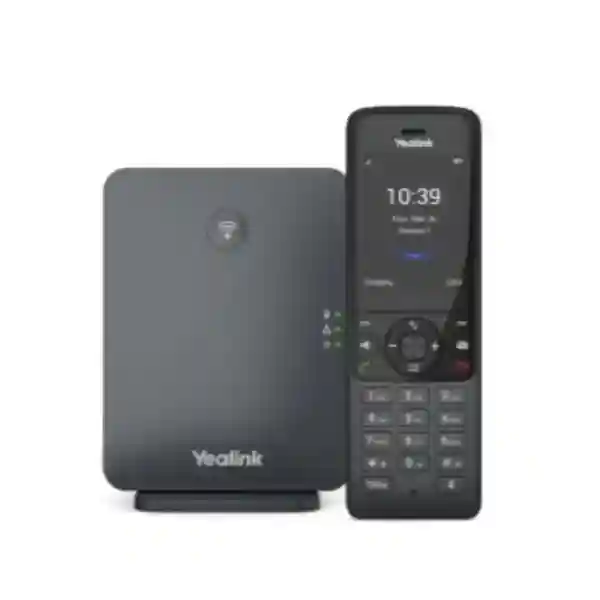
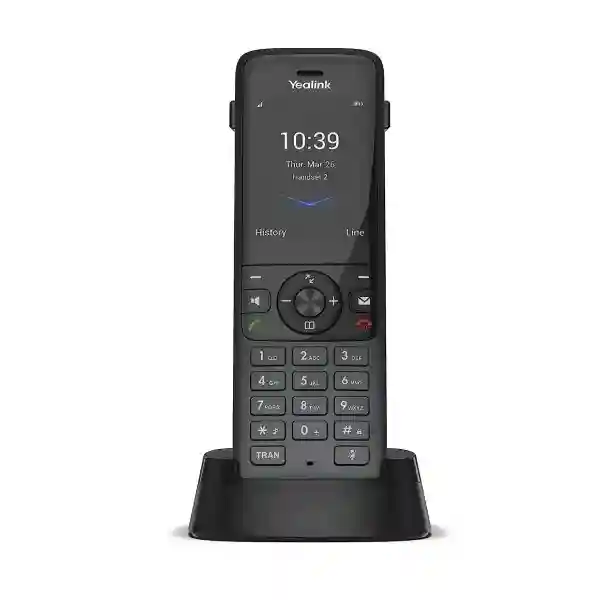
Yealink W78P DECT Phone System
The Yealink W78P is a professional SIP cordless phone system designed for businesses that need staff to move around the workplace while remaining reachable on their business extensions. The package combines a W70B DECT IP base station with a W78H handset. Yealink specifies support for up to 10 W78H handsets, up to 10 SIP accounts and up to 20 simultaneous calls, making the platform suitable for growing small and medium-sized business environments where mobility, call capacity and manageable deployment matter.
W70B base + W78H handset • 2.4-inch 240 × 320 colour screen • Bluetooth 5.1 • 3.5 mm headset jack • flexible noise reduction/noise cancellation • PoE on the base • TLS and SRTP security support • quick charging.
What the Yealink W78P solves for business users
Fixed desk phones work well when a user stays at one workstation, but many teams spend their day moving between counters, rooms, shelves, service areas, loading zones or customer spaces. The W78P gives those users a SIP extension on a cordless DECT handset rather than requiring them to remain beside a desk set. That can be valuable for supervisors, warehouse coordinators, retail personnel, clinic administration, hospitality teams, office support staff and small operational groups that need voice mobility without making every call dependent on a mobile network.
The W78P should be planned as part of the wider voice environment. The W70B connects to the LAN by Ethernet and can use IEEE 802.3af PoE, so the switching layer, VLAN design, DHCP or static addressing, SIP server, firewall policy and PBX provisioning all influence the quality of the final deployment. For buyers comparing cordless business telephony, the practical question is therefore not only whether the handset has the right features, but whether the complete voice system can support the expected users, extensions, call flow, coverage and future expansion.
Key verified Yealink W78P features
Scalable DECT capacity
Yealink specifies up to 10 DECT handsets, 10 SIP accounts and 20 simultaneous calls on the W78P platform, with up to two simultaneous calls per handset.
Mobile audio experience
The W78H provides a full-duplex speakerphone, wideband audio support and Yealink flexible noise reduction/noise cancellation for clearer business conversations.
Headset flexibility
Bluetooth 5.1 and a 3.5 mm headset connection let users select a suitable wireless or wired headset according to their workflow and approved compatibility.
Deployment tools
Auto-provisioning options include TFTP, FTP, HTTP, HTTPS, RPS and PnP, while handset firmware can be updated over the air for easier fleet administration.
Security support
Supported mechanisms include TLS, HTTPS, SRTP, digest authentication and encrypted configuration files, subject to correct PBX and network configuration.
Coverage planning
Yealink lists ideal-condition radio coverage of up to 50 metres indoors and 300 metres outdoors. Real buildings can reduce practical range, so a site assessment remains important.
Technical specification guide
| System composition | W70B DECT IP base station + W78H handset |
| Handsets / SIP accounts | Up to 10 handsets and up to 10 SIP accounts |
| Call capacity | Up to 20 simultaneous calls; up to 2 simultaneous calls per handset |
| Display | 2.4-inch 240 × 320 pixel TFT colour display |
| Network | 1 × RJ45 10/100M Ethernet; static or DHCP addressing; VLAN 802.1Q/802.1P; LLDP |
| Power | IEEE 802.3af PoE Class 1 on base or supported external adapter method |
| Headset | Bluetooth 5.1 and 3.5 mm headset jack on W78H |
| Radio range | Up to 50 m indoors and 300 m outdoors in ideal conditions |
| Expansion | Up to 6 optional RT30 repeaters per base station according to Yealink specification |
Compatibility, PBX integration and network readiness
W78P deployments depend on SIP compatibility and proper provisioning. Yealink documents SIP v1 and v2 support, UDP/TCP/TLS transport, VLAN functions, STUN client support, 802.1X, LLDP and outbound proxy backup. Before ordering, confirm the target IP PBX or hosted SIP platform, extension count, authentication method, codecs, provisioning method and any special features such as voicemail indicators, directory integration, call pickup or shared line behaviour. A successful SIP registration alone does not guarantee that every PBX feature will behave identically, so feature testing is useful for larger deployments.
For wider solution planning, review FourTeck Tanzania’s business IT and IP telephony overview, where IP PBX, IP phones, PoE switching, VLANs and integrated infrastructure are treated as one design problem rather than isolated purchases. Buyers with multi-country projects can also coordinate related communication requirements through FourTeck Kenya, FourTeck Uganda, FourTeck UAE and FourTeck Kuwait for regional technology discussions.
Who should consider the W78P?
The strongest fit is typically an organization that already uses, or plans to use, SIP telephony and has people who need to remain reachable while moving within a defined workplace. Examples include retail supervisors moving between sales areas and stock rooms, warehouse coordinators walking between receiving and dispatch, hospitality teams covering front desk and service areas, office administrators moving between departments, clinic support teams, workshops, schools and small branch environments. The W78P is not a cellular phone and should be evaluated against the physical DECT coverage required. Large campuses or complex multi-building environments may need a different architecture, additional repeaters or a Yealink multi-cell DECT platform rather than a single-base design.
Yealink W78P DECT Phone System Tanzania
For organizations searching for a Yealink W78P DECT Phone System in Tanzania, the most useful buying approach is to begin with how people communicate during a normal working day. A small office may need only one or two cordless extensions for management and administration, while a retail floor, clinic, workshop, warehouse or hospitality property may need several handsets registered to one base. Because Yealink specifies support for up to ten handsets and up to ten SIP accounts, the W78P can provide a practical growth path for a single-base environment, provided the required radio coverage and PBX capacity are also suitable. The procurement discussion should therefore include handset quantity, extension quantity, concurrent call expectations, headset preferences and whether staff need paging, transfer, conference, voicemail or directory features.
Tanzania deployments also benefit from network readiness checks before the equipment arrives. The W70B base station can connect to a PoE switch, which can simplify cabling and help centralize power protection when the switch is backed by an appropriate UPS. Voice VLANs, DHCP, DNS, firewall policy, internet stability for hosted SIP, and Quality of Service should be reviewed according to the selected PBX design. In an on-premises PBX environment, internal calling may remain local to the LAN, while hosted platforms rely more heavily on the WAN path. Neither approach should be selected without understanding the organization’s internet resilience, remote-office requirements and business continuity expectations.
For a Tanzania quotation, prepare the number of users, preferred handset count, current PBX or SIP provider, building layout, number of floors, approximate distance from the proposed base location to the farthest user area, available PoE switching, and whether the system must integrate with existing desk phones or headsets. That information allows the W78P to be evaluated as a complete business voice endpoint rather than as a standalone handset. Buyers should also confirm the applicable DECT frequency version and approved product variant for the intended market before deployment.
Yealink W78P DECT Phone System Dar es Salaam
Businesses in Dar es Salaam often operate in multi-room offices, retail units, warehouses, hospitality properties and mixed commercial buildings where staff mobility is important. In these settings, the Yealink W78P can give selected users a cordless SIP extension while keeping the call-control functions of the business PBX. A receptionist can transfer a call to a roaming supervisor, a warehouse coordinator can remain reachable away from a desk, and a retail manager can answer business calls without relying on a personal mobile number. The value comes from designing roles and call flow first: decide which users truly need cordless mobility, which remain better served by desk phones, and how calls should route when a handset is busy or unanswered.
Building structure matters. Reinforced walls, metal shelving, lifts, service corridors and multiple floors can reduce radio range compared with ideal laboratory-style conditions. Yealink publishes ideal-condition figures, but those numbers should not be treated as guaranteed coverage for every Dar es Salaam building. Position the base where Ethernet and power are practical while keeping radio propagation in mind, then test the areas where users actually work. If dead zones appear, optional repeaters may help in some layouts, while larger or more complex sites can justify a multi-cell architecture instead of stretching a single-base system beyond its intended role.
A useful procurement brief for a Dar es Salaam project includes the PBX platform, SIP account count, expected peak calls, floor plan, wall construction, proposed base position, PoE availability and desired accessories. If the site shares the same switching infrastructure with computers, cameras and Wi-Fi access points, voice VLAN and QoS planning becomes part of the project. This systems view helps buyers avoid a situation where a capable DECT handset is blamed for issues that originate in network congestion, SIP configuration or poor base placement.
Yealink W78P DECT Phone System Mwanza
In Mwanza, the W78P can be relevant for offices, trading businesses, hospitality operations, clinics, schools and operational sites where employees need to move within a property and still answer the organization’s SIP extensions. The purchasing decision should be tied to workflow: identify where calls originate, which roles must answer while mobile, how often staff transfer calls, whether a shared reception number rings multiple handsets, and whether users need Bluetooth headsets for hands-free work. The W78H’s vibration alert can be useful in louder working areas, while the 2.4-inch colour display and physical keypad provide a familiar business-phone experience for staff who prefer a dedicated handset over a smartphone app.
Network and power planning are especially important for sites where continuity is a priority. The W70B can use IEEE 802.3af PoE, allowing the base to receive power from a compatible switch. If that switch, router, PBX and internet equipment are connected to appropriately sized backup power, voice service can be better protected from short interruptions than a design that powers each element independently from unprotected outlets. This does not guarantee calling during every outage because hosted SIP may still depend on internet availability, but it gives the project team a clear architecture to assess and protect.
For Mwanza procurement, confirm whether one base can reasonably cover the desired work area, then size handset quantity and SIP accounts. Yealink supports up to six RT30 repeaters per base, but repeaters should be added according to tested coverage needs rather than used as a substitute for sound site design. A buyer should also document extension names, group ringing, voicemail policy, emergency call expectations, handset charging locations and the process for replacing or reassigning handsets when staff roles change.
Yealink W78P DECT Phone System Arusha
Arusha businesses in tourism, hospitality, professional services, education, healthcare and general commerce can use DECT telephony where staff need dependable on-site mobility without turning every business interaction into a personal mobile call. The Yealink W78P can register multiple W78H handsets to one W70B base, allowing an organization to assign cordless extensions to staff such as duty managers, service coordinators, administrators or operations personnel. The system’s value is highest when the PBX call flow is clear: main-number routing, department groups, transfer rules, voicemail and after-hours behaviour should be documented before handsets are distributed.
Coverage planning for hotels, lodges, offices and multi-room properties requires more than reading a distance figure from a datasheet. Walls, reinforced concrete, stairwells, metal roofs, equipment rooms and outdoor transitions can change radio behaviour significantly. A well-positioned base and a practical walk test can reveal whether one W78P is sufficient. Where a site expands beyond the comfortable single-base footprint, the project should compare repeaters with a multi-cell DECT design rather than simply adding devices without a coverage map.
Arusha buyers should also review headset needs, charging routines and the physical demands of each user role. The W78H includes Bluetooth 5.1 and a 3.5 mm headset jack, which offers useful choice, but the selected headset should still be checked for compatibility and user comfort. For quotation preparation, include the current PBX brand or hosted SIP service, user count, line count, number of floors, proposed base and charger locations, LAN readiness, PoE availability and any requirement for directory synchronization or centralized provisioning.
Yealink W78P DECT Phone System Dodoma
Organizations in Dodoma that are upgrading from analog cordless phones or a desk-only IP phone environment may consider the W78P when selected employees need mobility while remaining part of the corporate SIP system. Instead of forwarding every internal call to mobile networks, a cordless SIP extension can keep transfers, caller identification, voicemail indicators and other PBX features inside the business communication platform. This is especially useful for administrative teams, reception support, stores, facilities personnel and supervisors who frequently move away from a fixed desk but remain within the site.
The W78P can support a small deployment that grows over time, but growth should be planned before purchase. Ten-handset capacity does not mean every organization should immediately populate all ten positions. Begin with current users, then reserve headroom for expected staff additions or new departments. Review peak call concurrency as well as extension count, because simultaneous call requirements can differ from the number of registered handsets. The PBX itself, SIP trunk or hosted plan must also support the call capacity the organization expects.
For Dodoma installations, make the network voice-ready. Put the W70B on a managed switch where possible, document the switch port, confirm VLAN and QoS policy, protect administrative access, and use the PBX’s recommended SIP security settings. If the system is centrally provisioned, maintain configuration templates and device records so replacement or expansion is repeatable. Procurement teams should ask for a complete bill of materials covering the base, required handsets, chargers, approved power arrangements, repeaters if justified, headsets if needed and any PBX-side licensing that applies to additional extensions.
Yealink W78P DECT Phone System UAE
For UAE businesses, the Yealink W78P is a useful option where offices, clinics, warehouses, showrooms, hotels or service operations require cordless SIP communication within a defined site. Procurement teams often compare the cost and manageability of DECT handsets with Wi-Fi phones, mobile apps and fixed desk endpoints. DECT can be attractive when voice mobility is the primary requirement and the organization wants a dedicated business handset that does not depend on the user’s personal smartphone. The W78H also provides Bluetooth 5.1 and a 3.5 mm headset connection, so hands-free workflows can be considered for supervisors, retail personnel or service teams.
A UAE deployment should confirm the correct regional DECT variant, PBX interoperability and local telecom design before purchase. The W70B supports SIP registration, VLANs, TLS, SRTP and common provisioning methods, but configuration must align with the chosen PBX or hosted UC service. In managed office environments, PoE can simplify deployment by allowing the base to use the structured network rather than a nearby standalone power socket. Where voice traffic shares switches with cameras, wireless access points and user devices, QoS and segmentation should be reviewed so that busy data periods do not unnecessarily degrade call quality.
For multi-branch organizations, use the UAE requirement as an opportunity to standardize naming, firmware policy, provisioning templates and extension roles across countries. A quotation request should identify user quantity, PBX platform, desired call features, headset requirements, coverage area and future expansion. Larger buildings should be assessed for multi-cell DECT rather than assuming one W70B can cover every floor. This avoids buying a single-base product where a campus-grade architecture would be more suitable.
Yealink W78P DECT Phone System Uganda
Uganda organizations considering the Yealink W78P typically need reliable cordless business calling tied to an IP PBX rather than consumer cordless telephony. The system can work well for branch offices, retail operations, schools, clinics, logistics teams, hospitality environments and growing companies where a group of employees needs to answer SIP extensions away from fixed desks. Because the W78P supports up to ten handsets on one base, a buyer can begin with a smaller number and expand within the platform limits when business roles justify additional cordless endpoints.
Voice quality and mobility depend on more than the handset. A hosted PBX relies on stable internet access, while an on-premises system relies on a properly designed LAN and local server or appliance. In either case, the base station should be placed with both network connectivity and radio coverage in mind. PoE is useful when the switching environment supports it, and a voice VLAN can help organize traffic and simplify policy. Security settings such as TLS and SRTP should be enabled only in a way that is supported end to end by the PBX, certificates and network path.
For Uganda procurement, document each user’s extension, ring group, voicemail and transfer needs. Confirm whether handsets will be shared by shifts or assigned to individuals, because that changes labeling, charging and directory planning. Sites with long corridors, multiple floors or separated buildings should be assessed rather than designed from published maximum range alone. When a single-base system is not a good physical fit, compare repeater options or move to a multi-cell platform to maintain predictable roaming and growth.
Yealink W78P DECT Phone System Kampala
Kampala businesses frequently need communication systems that connect reception, management, operations and service staff without making every employee stay at a desk. The W78P can support this pattern by giving mobile employees a W78H handset linked to the SIP infrastructure. In a professional office, that may mean a facilities manager can receive extension calls while moving between floors. In retail, a supervisor can answer while on the sales floor. In a clinic, an administrative coordinator can remain reachable between reception and back-office areas. These are workflow benefits rather than claims about guaranteed coverage, which must still be tested at the actual premises.
Kampala buyers should compare the W78P with other endpoint options by looking at user behaviour. A Wi-Fi handset may be appropriate where voice mobility must follow an existing enterprise wireless architecture, while a desk phone remains better for users who need many visible keys or constant access to a large screen. DECT suits users who mainly need reliable cordless calling within the coverage design. The W78H’s vibration alert, Bluetooth support, quick charging and physical keypad can be useful for staff working in active environments where a conventional business phone interaction is preferred.
The quotation stage should cover PBX compatibility, extension count, call concurrency, base placement, PoE, UPS strategy, internet dependency, repeaters and expansion. If an organization operates several Kampala sites, standard device templates and firmware management can simplify support. Configuration records should include MAC addresses, extension assignments, emergency procedures and administrator credentials under controlled access so that future troubleshooting does not depend on undocumented settings.
Yealink W78P DECT Phone System Arua
In Arua, a DECT IP phone system can be useful for organizations that want business-grade cordless communication without giving up centralized SIP call control. The Yealink W78P allows mobile staff to keep an extension active while walking within the site’s DECT coverage, which can support administrative offices, stores, hospitality operations, schools, clinics and service facilities. Before purchase, identify which users genuinely need mobility and whether their tasks happen within one building, across a compound or between separated structures. That physical pattern determines whether a single W70B base is appropriate.
Power and internet resilience should be included in the planning conversation. The base can use PoE, so it can be placed on a centrally protected switching environment when the network is designed that way. A hosted SIP service will still depend on the available WAN path, so an organization that treats voice as critical may need to review backup connectivity and firewall failover separately. An on-premises PBX may preserve internal extension calling during an internet outage, but external calling still depends on the trunk design. These distinctions matter more than a simple product specification when the business is assessing continuity.
For Arua procurement, ask for the exact W78P regional model, the number of additional W78H handsets, charging locations and any repeaters justified by a coverage test. Confirm whether staff will use Bluetooth or wired headsets and whether directory integration is required. The PBX configuration should be documented with extension numbering, caller permissions, transfer rules, voicemail, after-hours routing and admin access. That documentation turns the cordless phones into a maintainable communication system rather than an isolated set of devices.
Yealink W78P DECT Phone System Mbarara
For Mbarara businesses, the W78P can provide a practical bridge between traditional office telephony and mobile working inside a site. Staff can use dedicated SIP handsets for business calls while moving between work areas, reducing the need to route ordinary internal communication through personal mobile numbers. This can be relevant to warehouses, retail branches, education facilities, hospitality teams, healthcare administration and professional offices. The system is particularly attractive where the organization already has a SIP PBX and simply needs a cordless endpoint category for selected users.
The W78P’s capacity figures should be used as design ceilings, not automatic deployment targets. Up to ten SIP accounts and twenty simultaneous calls give useful headroom, but the correct configuration depends on user behaviour and PBX capacity. A small site with three mobile staff may need only three handsets; a larger operation may approach the single-base limits and should consider whether expansion is likely to exceed them. Capacity planning is cheaper before procurement than after the organization has standardized on an undersized architecture.
Coverage should also be validated within the real premises. Published indoor and outdoor distances assume ideal conditions, and physical obstacles can shorten them. Place the W70B where Ethernet, PoE and radio propagation work together, then walk the operational areas with a test handset. If a repeater is required, position it according to the actual signal path. Include network VLANs, QoS, firewall policy, SIP registration, user training and spare-handset strategy in the overall Mbarara deployment plan.
Yealink W78P DECT Phone System Gulu
Gulu organizations can use the Yealink W78P where workers need a business extension that travels with them around a defined workplace. A dedicated cordless handset can be simpler for many roles than asking users to run a softphone on a personal mobile device, especially where the organization wants consistent call controls, shared directories and a centrally managed endpoint. The W78H offers speakerphone, noise reduction, vibration alert and headset connectivity, while the W70B provides the network link and SIP registration platform.
A good Gulu deployment starts with a coverage sketch and call-flow map. Mark where the base could be installed, where users spend time, which walls and structures are likely to weaken the radio signal, and which extensions need to ring together. Then confirm whether the PBX will be local or hosted and whether the network has managed switching and PoE. This makes it easier to decide whether the W78P is the right endpoint system or whether another Yealink DECT architecture is more appropriate.
Procurement teams should also think about lifecycle management. The device supports web, phone and auto-provisioning configuration methods, and handsets can receive OTA updates. Standardizing configuration and firmware versions reduces support complexity when several handsets are deployed. Maintain records of handset assignments, charger locations, spare batteries or replacement policy where applicable, base credentials and SIP account ownership. For organizations with multiple Uganda branches, repeat the same naming and documentation standards so support staff can understand each site without rebuilding the configuration history from scratch.
Yealink W78P DECT Phone System Kenya
Kenya businesses evaluating the Yealink W78P should focus on where mobility improves call handling. In Nairobi offices, Mombasa hospitality properties, warehouses, clinics, schools and branch operations, a cordless SIP handset can keep supervisors and support personnel reachable while they move around the premises. The W78P is suited to a single-base deployment that needs room to add handsets over time, while the broader Yealink DECT portfolio should be considered where a site requires multi-cell roaming across larger areas.
The technical design should match the existing communications platform. Confirm SIP credentials, codecs, voicemail behaviour, transfer method, directory integration, provisioning and security. If the PBX is cloud-hosted, test the internet path for latency, jitter and packet loss rather than assuming a high advertised bandwidth automatically produces good voice. If the PBX is on-premises, confirm LAN segmentation and switch configuration. The W70B’s PoE support can make placement cleaner, but only where the chosen switch provides a compliant PoE port and has sufficient power budget.
For a Kenya quote, list the exact number of W78H handsets, whether staff need headsets, the physical areas to be covered, expected simultaneous calls and the anticipated growth period. Organizations standardizing telephony across Tanzania and Kenya can benefit from common extension templates, provisioning rules and user training. However, regional DECT variants and telecom arrangements must still be confirmed for each market rather than assuming every country uses an identical hardware and service configuration.
Yealink W78P DECT Phone System Kuwait
Kuwait organizations may select the W78P for offices, retail environments, clinics, warehouses and service teams where business calls need to follow staff within a site. The system gives procurement managers a defined single-base capacity and a premium W78H handset experience without requiring each user to depend on a mobile app. For companies already operating Yealink desk phones or a compatible SIP PBX, DECT handsets can be introduced for roles that need mobility while fixed users keep their existing endpoint style.
Building layout is an important part of the decision. Office partitions, reinforced structures, back-of-house zones and warehouse shelving can all affect radio propagation. Yealink’s ideal-condition range figures are useful as a reference but should not replace a walk test or coverage assessment. Buyers should decide whether the site is genuinely a single-cell requirement and should move to a multi-cell system when seamless coverage across a large building is a core objective.
Kuwait procurement should also address integration and security. TLS and SRTP capabilities can help protect SIP signalling and media when the PBX supports them correctly, while VLANs and controlled management access help organize the endpoint on the LAN. Ask for the regional W78P model, required handset quantity, approved accessories, any PBX user licensing, provisioning method and support responsibilities. If the site is part of a group with Tanzania or UAE branches, standardize device names and call-flow documentation while allowing each location’s telecom and network conditions to be configured appropriately.
Yealink W78P DECT Phone System Ghana
In Ghana, the W78P is relevant to businesses that need cordless SIP extensions for staff working away from fixed desks but still within a controlled workplace. This can include hospitality teams, branch offices, retail supervisors, schools, healthcare administration, warehouses and professional service environments. The W78H offers a dedicated phone interface with physical keys and business call features, helping organizations maintain separation between corporate calling and personal mobile devices where that operating model is preferred.
The deployment should begin with the PBX and network architecture. Confirm that the selected SIP platform supports the required registration, feature set and security profile. Plan the W70B connection on an appropriate Ethernet port, ideally a managed environment where voice VLAN and QoS policies can be applied consistently. If a hosted PBX is used, understand the dependency on WAN availability and firewall configuration. If continuity is important, assess internet redundancy, switch and router backup power and the recovery process after a network interruption.
For Ghana buyers, coverage testing is just as important as feature comparison. A base that performs well across an open office may have very different results in a concrete building or metal-filled warehouse. Measure the operational zone, identify challenging areas and decide whether repeaters are justified. Procurement should also include charging locations, headset choice, spares, extension labels, user training and the expected number of future handsets. These practical details make the W78P easier to adopt and support over its working life.
Yealink W78P DECT Phone System Nigeria
Nigeria businesses with busy internal operations can use the W78P as a cordless component of a SIP phone system. A warehouse manager, retail supervisor, facilities coordinator or service-team lead can carry a business extension through their work area while still participating in transfers, call groups and voicemail workflows defined by the PBX. This helps maintain a consistent business identity and call process rather than relying entirely on personal mobile numbers for internal mobility.
A procurement decision should compare single-base DECT with larger multi-cell systems, Wi-Fi phones and mobile softphones. The W78P is strongest where the site fits the W70B coverage model and the organization values dedicated voice handsets. If users must roam across multiple buildings or a large campus, a multi-cell solution may be more appropriate. If staff must take calls beyond the site, a mobile softphone or cellular service may still be needed. Choosing the endpoint technology according to movement patterns prevents overbuying features that do not solve the real workflow.
Network design in Nigeria should include voice traffic prioritization, reliable switching, correct firewall handling and power protection appropriate to the organization’s risk tolerance. PoE can simplify the W70B installation and can make centralized UPS design easier. For a quote, include the PBX brand, SIP provider where applicable, number of handsets, concurrent calls, base location, coverage area, headset requirements and expansion plan. Ask for configuration documentation so that future adds, moves and changes can follow a controlled process.
Yealink W78P DECT Phone System Seychelles
Seychelles organizations in hospitality, professional services, retail, administration and other customer-facing environments may use the W78P where staff need to move within a property while retaining a business SIP extension. Hospitality use is a natural example: supervisors or service coordinators can stay reachable without sitting beside a desk phone. However, resort-style layouts can include separate buildings, outdoor paths and reinforced service areas, so the physical site must be assessed carefully before assuming that one base will cover the required footprint.
The W78P should be integrated with the voice and data architecture rather than installed as a standalone consumer cordless product. Confirm the SIP PBX, extension plan, PoE switching, VLAN policy, internet path for hosted services, firewall configuration and backup power strategy. The W78H’s Bluetooth and wired-headset options can support different staff workflows, while its vibration alert can help users notice calls in active environments. User training should cover transfers, hold, voicemail and charging so that the handset becomes part of a repeatable service process.
For Seychelles procurement, document the building or property layout, indoor and outdoor work zones, handset quantity, call concurrency and any need for repeaters or a multi-cell alternative. The quotation should distinguish the base system from additional handsets and accessories so the buyer understands the complete bill of materials. For organizations managing properties across islands or countries, standardize configuration records and extension naming but validate local telecom, power and radio requirements for each individual site.
Selection and sizing guidance
Choose the W78P when a single-base DECT design matches the physical site and when the expected handset, SIP-account and call requirements sit comfortably within the published platform limits. Count real mobile users, not total employees. Then estimate peak simultaneous calls, decide where the base can connect to Ethernet, and test coverage through the rooms and work zones that matter. If the building requires extensive roaming across floors, blocks or detached structures, evaluate Yealink multi-cell DECT before committing to a single-base architecture.
Also confirm the target PBX, handset firmware policy, regional DECT model, headset compatibility, provisioning approach and support ownership. These checks are particularly important for multi-site projects where a repeatable configuration is more valuable than a one-off installation.
Quotation checklist for Yealink W78P
Frequently asked questions
How many handsets can the Yealink W78P support?
Yealink specifies support for up to 10 DECT handsets on the W78P/W70B platform, with up to 10 SIP accounts. The correct quantity for a site depends on user roles, call demand and coverage.
How many simultaneous calls can it handle?
The published specification lists up to 20 simultaneous calls and up to two simultaneous calls per handset. The connected PBX and SIP service must also have sufficient capacity.
Does the W78P support PoE?
Yes. The W70B base station includes a 10/100M Ethernet port and supports IEEE 802.3af PoE Class 1. A compatible PoE switch or injector and correct network design are required.
Can I use third-party DECT handsets?
Yealink states that its DECT technology is not compatible with third-party DECT base stations or handsets. Plan the system around supported Yealink DECT endpoints.
What is the W78P indoor range?
Yealink lists a maximum of 50 metres indoors and 300 metres outdoors in ideal conditions. Actual coverage varies with walls, metal, floor layout, interference and base placement, so site testing is recommended.
Is the W78P suitable for a large campus?
It is primarily a single-base system. Optional repeaters can extend coverage in appropriate layouts, but large campuses or multi-building sites should compare Yealink multi-cell DECT solutions before deciding.
Decision recap
The Yealink W78P is a strong candidate for businesses that need professional cordless SIP calling with a manageable single-base architecture. Its capacity, premium W78H handset, Bluetooth connectivity, PoE base, security capabilities and provisioning options make it suitable for structured business deployments. The most important buying checks are PBX compatibility, physical coverage, number of mobile users, peak call load and the organization’s expansion path.
If those requirements fit within the W78P design, the system can provide a clean way to add mobile extensions to an IP telephony environment. If they do not, the right answer may be a larger DECT architecture, Wi-Fi voice solution or a mixed endpoint strategy.
Consultation panel
To prepare a useful recommendation, share your location, PBX platform, number of mobile users, desired handset count, building or floor layout, PoE availability and the areas that need cordless coverage. This information helps distinguish a straightforward W78P deployment from a project that would benefit from repeaters, multi-cell DECT or a different voice architecture.




Reviews
There are no reviews yet.