
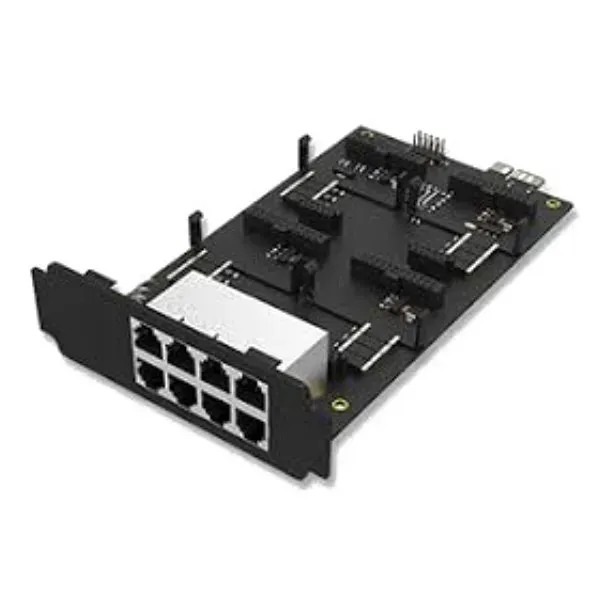
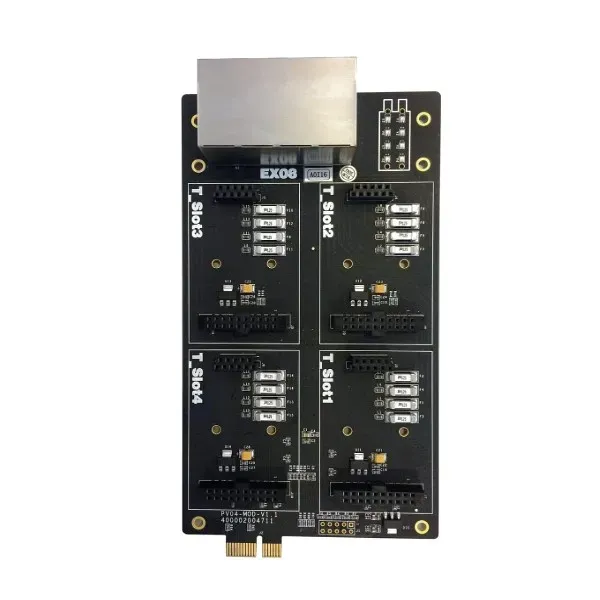
Yeastar EX08 Expansion Board
The Yeastar EX08 is a modular expansion board for compatible Yeastar PBX appliances. Official Yeastar documentation specifies four onboard module positions and eight RJ11 interfaces. By selecting the appropriate optional modules, organizations can extend a PBX with analog station, analog trunk, BRI or supported cellular connectivity without changing the basic PBX platform simply because interface requirements have grown.
Direct answer
The EX08 is a carrier board rather than a complete set of analog or digital ports by itself. Its purpose is to host compatible Yeastar telephony modules and present their connections through eight RJ11 positions. This distinction matters when preparing a bill of materials: the required O2, S2, SO, B2 or supported cellular modules must be selected according to the intended line and extension mix.
Current compatibility
Current Yeastar P-Series Appliance Edition documentation lists the EX08 for P560 and P570. The P560 accepts one EX08 or EX30 expansion board, while the P570 accepts two. Yeastar’s S-Series documentation also records EX08 support for S100 and S300 generations. Buyers should therefore identify the exact PBX model and hardware generation before ordering.
Module choices
Yeastar lists O2, S2, SO, B2 and GSM/3G/4G LTE module families for EX08 use, with the applicable combination depending on PBX generation and deployment. O2 provides FXO capability, S2 provides FXS capability, SO combines one FXS with one FXO, and B2 provides BRI interfaces. Cellular module selection should be verified for the target system and operator environment.
What the Yeastar EX08 Expansion Board solves
Many business phone systems begin with one connection mix and evolve into another. A company may deploy SIP trunks first and later need a pair of analog PSTN lines for fallback, several analog extensions for reception or legacy devices, BRI connectivity for an existing service, or a cellular voice path. Replacing the PBX whenever these physical-interface requirements change can be disruptive. The EX08 provides a modular path for compatible Yeastar appliances so the organization can add the interface types that are actually required.
The board is especially useful when procurement teams want a clear separation between PBX capacity and telephony-interface capacity. The EX08 itself does not automatically increase every PBX resource, and it should not be treated as a user-license or concurrent-call expansion module. It creates positions for telephony interface modules. Yeastar separately identifies the D30 as the capacity-expansion module used on supported systems when additional extensions and concurrent calls are the requirement. Keeping those functions separate prevents a common ordering mistake.
Fourteck Tanzania approaches the EX08 as part of a complete voice design. Before quoting, the useful questions include the exact PBX model, available expansion slots, the number and type of external lines, analog devices that must remain connected, branch or cellular requirements, expected growth, and how the telephony system connects to the LAN, SIP provider and power-protection environment. For wider voice projects, review the Fourteck Tanzania technology portfolio, the Tanzania business technology shop and implementation and support services for related infrastructure planning.
Verified technical overview
| Item | Verified guidance |
|---|---|
| Board function | Expansion carrier for compatible Yeastar telephony interface modules |
| Module positions | Up to 4 modules |
| Panel interfaces | 8 RJ11 interfaces |
| Optional module families | O2, S2, SO, B2 and supported GSM/3G/4G LTE modules |
| Current P-Series support | P560 and P570 |
| S-Series documentation | S100 and S300 documentation also lists EX08 expansion support, subject to model/hardware-generation limits |
Buying and compatibility guidance
Do not select an EX08 only because the connector count appears to match a project. Start with the role of every planned port. An FXS interface serves an analog endpoint such as a conventional analog telephone or fax device, while an FXO interface connects to an analog PSTN line or comparable analog source. BRI requires the relevant digital interface module. Cellular requirements depend on supported module type, PBX generation and service-provider environment. A correct bill of materials maps each requirement to a compatible module and confirms that enough slots remain on both the EX08 and the PBX chassis.
The PBX software version, hardware revision and lifecycle status also matter. Yeastar’s current P-Series documentation clearly lists P560 and P570, while older S-Series documentation still records EX08 use with S100 and S300. Organizations maintaining an existing S-Series estate should provide the exact model and hardware information during quotation rather than assume a new P-Series installation has identical expansion rules.
Yeastar EX08 Expansion Board Tanzania
For organizations in Tanzania, the strongest reason to evaluate the Yeastar EX08 is flexibility within an existing or planned Yeastar PBX architecture. Business telephony in Tanzania can combine SIP services, analog lines, analog endpoints, branch connectivity and cellular paths in different proportions from one site to another. The EX08 helps compatible P560 and P570 installations accommodate physical telephony interfaces without turning every change into a PBX replacement. It is also relevant to installed S100 and S300 environments where the specific hardware generation and Yeastar documentation confirm support. Procurement should begin with the exact PBX model, installed expansion boards, current module allocation and a simple port-by-port description of what needs to connect.
A Tanzania quotation is clearer when the customer separates extension demand from trunk demand. Analog desk phones, door phones, fax devices or other FXS-type endpoints require a different module choice from PSTN lines that need FXO. BRI connections require the B2 route where supported, while cellular connectivity requires a compatible cellular module and operator planning. This makes the EX08 a design component rather than a universal eight-port card. Four onboard module positions allow a mixed interface plan, but the practical port count and function come from the selected modules. Buyers should also decide whether they need capacity expansion in addition to interface expansion, because those are separate requirements in Yeastar architecture.
Deployment quality depends on more than fitting the board. Voice VLAN design, switching, QoS policy, SIP-provider requirements, firewall rules, UPS protection, rack organization and documentation all affect the stability of a business phone system. A branch with intermittent WAN service may prioritize fallback options, while a head office with centralized SIP trunks may use the EX08 mainly for legacy analog devices or contingency lines. Hotels, clinics, schools, warehouses and offices can all have different analog retention needs, so a requirement-led module mix is usually more useful than buying the maximum number of ports automatically.
For Tanzania buyers preparing a request for quotation, provide the Yeastar PBX model, required line types, number of analog endpoints, number of PSTN or BRI trunks, cellular requirement if any, existing modules, and intended growth. This allows Fourteck to check whether the EX08 is the correct expansion path and whether associated modules, IP phones, switching or installation support should be included. For broader regional projects, Fourteck Kenya can provide related regional context while the Tanzania project remains planned around the target site’s actual telephony environment.
Yeastar EX08 Expansion Board Dar es Salaam
Dar es Salaam businesses often run mixed communications environments in which a modern IP PBX has to coexist with legacy analog services, reception devices or fallback lines. The Yeastar EX08 can be useful in that transition because it lets a compatible Yeastar appliance host different telephony interface modules on one expansion carrier. For a new P560 or P570 design, the expansion limits should be checked against the appliance specification before ordering. For an existing S100 or S300 deployment, the hardware generation should be identified because Yeastar documentation records different expansion-board limits across generations. The safest procurement approach is to document what is installed today and what the business wants to add next.
A head office in Dar es Salaam may use SIP as the primary trunk but keep one or more PSTN lines for business continuity. In that case, O2 FXO modules may be relevant. A hotel or service desk may retain analog room or utility phones, making S2 FXS modules more relevant. A mixed branch could need both, which is where the SO module can be useful when supported. BRI and cellular scenarios require their respective modules and should be verified against the PBX generation and service environment. The EX08’s four module positions make this planning flexible, but every module consumes a slot and contributes specific port behavior.
Dar es Salaam deployments also benefit from considering the network and power environment alongside the PBX expansion. Voice quality depends on a stable LAN, sensible VLAN and QoS configuration, predictable SIP routing and firewall policy. The PBX and switching infrastructure should be protected by appropriately sized UPS equipment where continuity is important. Patch leads, rack space and labeling should be planned so future support engineers can identify which physical EX08 port corresponds to which line or endpoint. These operational details are particularly valuable for busy reception, call handling and multi-department environments where troubleshooting time directly affects customer service.
When requesting a Dar es Salaam quote, include a port schedule rather than only saying ‘eight more ports’. List each required analog phone, PSTN line, BRI circuit or cellular path and identify whether the requirement is immediate or planned. Fourteck can then align the EX08 with the correct module mix and wider PBX design. Customers expanding the surrounding infrastructure can also review the Fourteck IP phone specialist site for endpoint planning and compare desk-phone requirements with the PBX interface expansion.
Yeastar EX08 Expansion Board Mwanza
In Mwanza, the EX08 is relevant to businesses that want a Yeastar PBX to accommodate a changing mix of physical telephony connections. A growing office may begin with IP extensions and later inherit analog phones from another site. A hospitality property may need to preserve analog room devices while modernizing call control. A warehouse, clinic or branch office may want one or more conventional external lines retained alongside SIP. Instead of treating these as separate telephone systems, a compatible EX08-equipped Yeastar platform can host the module types needed for the chosen interface mix.
The first sizing task is to classify each connection. FXS connects analog endpoints; FXO connects analog PSTN-style lines; BRI serves the relevant digital service; cellular modules provide the applicable mobile-network path where supported. The EX08 has four onboard module positions and eight RJ11 interfaces, so the maximum useful configuration depends on which modules are installed. This is why a product description that says only ‘eight ports’ is incomplete for procurement. Those eight panel interfaces gain their operational role from the modules selected, and some project requirements may consume module capacity differently from others.
Mwanza buyers should also check whether they are expanding interfaces or overall PBX capacity. If the requirement is simply more users or concurrent calls, another Yeastar capacity option may be more relevant on supported systems. If the requirement is to connect additional physical telephony circuits or analog devices, EX08 is the correct category to evaluate. A combined project may need both interface and capacity planning. Documenting the current extension count, peak call demand, external line types and endpoint inventory makes that distinction much easier before equipment is purchased.
For a reliable Mwanza deployment, include power protection, network configuration and support documentation in the scope. Record the PBX model, firmware, installed boards, module position and port use. Label external lines and analog extension cabling. Confirm SIP and firewall settings if the site also uses IP trunks. This produces a phone system that is easier to troubleshoot and expand. Fourteck Tanzania can use this information to prepare a more precise EX08 quotation and identify any related modules, phones, switching or installation tasks that should be part of the project rather than discovered after delivery.
Yeastar EX08 Expansion Board Arusha
Arusha organizations in hospitality, tourism, professional services, education and multi-site operations can have unusually mixed voice requirements. Some users work entirely on IP phones, while guest areas, service counters, legacy devices or external lines may still depend on analog connectivity. The Yeastar EX08 gives compatible PBX platforms a modular method for retaining or adding those physical interfaces. Rather than assuming all eight RJ11 positions serve the same purpose, the deployment is built from optional modules, allowing the interface mix to reflect the site instead of forcing the site to fit a fixed port arrangement.
For an Arusha hotel, for example, the procurement team should map front desk lines, back-office extensions, guest-room analog needs and any retained PSTN service separately. For a tour operator, branch or office, the requirement may focus more on fallback lines and integration with SIP. O2, S2, SO and B2 modules each serve different roles, and cellular connectivity introduces its own operator and compatibility considerations. Because the EX08 has four module slots, understanding the exact port requirement before ordering protects against running out of module positions or buying interfaces that are not needed.
A second planning point is resilience. Physical telephony expansion is most valuable when the rest of the communications stack is stable. The PBX should sit on a reliable LAN, voice traffic should be considered in VLAN and QoS design, and network security rules should permit the required SIP flows without unnecessary exposure. UPS capacity can be important for businesses that expect calling to remain available through short power disturbances. If analog fallback lines are being retained for continuity, the call-routing configuration should be tested so staff know what happens during an internet or SIP-service interruption.
Arusha customers asking for an EX08 quote can improve accuracy by sharing the Yeastar appliance model, current expansion-board count, installed modules, line types, extension types and desired growth. Where the PBX is part of a larger office refresh, include switch ports, PoE needs for IP phones, headset requirements and cabling changes. Fourteck can then treat the EX08 as one component of a complete communications design rather than a standalone board whose final usefulness depends on missing accessories or unverified compatibility.
Yeastar EX08 Expansion Board Dodoma
For Dodoma offices, institutions and branch environments, the Yeastar EX08 provides a structured way to add physical telephony interfaces to compatible Yeastar PBX appliances. This can be useful where a communications platform needs to support both modern SIP-based calling and existing analog or BRI services. Official Yeastar material identifies four module positions and eight RJ11 interfaces on the EX08, with the actual port functions determined by the installed modules. That modularity allows a project to be designed around the site’s line inventory instead of purchasing a fixed interface card with unused ports.
Government-facing offices, NGOs, professional organizations and distributed enterprises in Dodoma may need clear procurement documentation. A useful bill of materials should therefore state not just ‘EX08’ but also the module types and quantities, the target PBX model, the role of each connection and any associated installation work. The P560 supports one EX08 or EX30 board and the P570 supports two expansion boards according to current Yeastar documentation. Older S100 and S300 installations have their own documented expansion rules, so the appliance generation must be verified before planning an upgrade.
For systems that retain analog equipment, S2 FXS modules can provide analog extension interfaces. O2 FXO modules serve analog external lines. SO combines FXS and FXO functions, while B2 serves BRI. Cellular options should be validated carefully against the supported module and operating environment. The board itself does not determine which connection type is active; it provides the platform for the chosen modules. This is an important purchasing distinction because a bare EX08 does not substitute for the required interface modules.
A Dodoma deployment should also include operational documentation: PBX login governance, backups, firmware policy, line labels, extension numbering, call routing and support contacts. Network readiness matters for SIP and IP phones, so VLAN, QoS, firewall and switch configuration should be reviewed where relevant. Fourteck Tanzania can use a clear site questionnaire to confirm whether the EX08 is the right expansion route, which optional modules are required and whether the scope should also include endpoints, cabling, network changes or commissioning assistance.
Yeastar EX08 Expansion Board UAE
Organizations with operations in both Tanzania and the UAE often want a repeatable communications standard across branches while accommodating different local carrier interfaces. The Yeastar EX08 can support that strategy on compatible appliances because the expansion board is modular rather than tied to one fixed telephony connection type. A UAE branch may rely heavily on SIP while still requiring analog endpoints, legacy equipment or a contingency connection. The same design discipline applies: identify the exact PBX, classify each physical interface and select only the modules that the branch actually needs.
Current Yeastar documentation lists the EX08 for P560 and P570, while S-Series documentation records compatibility with S100 and S300 systems under their respective expansion limits. For multi-country standardization, this version detail is critical. Two branches can both use an ‘EX08’ yet have different motherboard generations, firmware requirements and available expansion slots. A group IT team should therefore keep a site inventory that records PBX model, serial or hardware revision where appropriate, installed board count, module population and the purpose of each port.
In a UAE procurement context, carrier and regulatory requirements should be confirmed locally before deciding how PSTN, BRI or cellular services will be connected. The EX08 is hardware flexibility, not a guarantee that every service type is available or appropriate in every market. Where SIP is primary, the board may be reserved for analog devices or fallback connectivity. Where legacy infrastructure remains important, a mixed module layout can support phased modernization. This approach lets the organization retire old interfaces gradually rather than redesigning the entire PBX around a temporary migration requirement.
For cross-border projects, consistent documentation matters as much as consistent hardware. Use a common naming method for trunks, extensions and ports; record call-flow logic; standardize backups; and define who owns carrier, network and PBX support. Fourteck’s UAE technology site can support related regional planning, while the Tanzania scope can retain its own site-specific module and service requirements. The result is standard architecture without assuming every branch needs an identical interface mix.
Yeastar EX08 Expansion Board Uganda
For Uganda-based businesses and regional organizations with Tanzania operations, the EX08 can support a common Yeastar PBX approach while preserving flexibility for local line types. Branches rarely evolve at exactly the same pace. One location may be fully SIP-based, another may retain analog trunks, and a third may need analog endpoints for specific workflows. A compatible Yeastar platform fitted with EX08 can accommodate these differences through selected modules, reducing the pressure to use entirely different PBX models simply because physical interfaces vary between sites.
The technical planning should still begin at the port level. S2 relates to FXS analog endpoints, O2 to FXO analog lines, SO to a mixed FXS/FXO requirement, B2 to BRI, and supported cellular modules to mobile-network connectivity. The EX08 offers four module positions and eight RJ11 interfaces, so module selection determines what those interfaces actually do. A branch that needs eight analog extensions will not use the same module mix as one that needs four PSTN lines plus several analog devices. Treating the board as a modular carrier avoids ambiguity in quotations.
Uganda procurement teams should also distinguish EX08 from PBX capacity expansion. Interface expansion does not necessarily increase licensed users or concurrent-call resources. If a site is hitting user or call-capacity limits, the PBX model and applicable capacity options need a separate review. Conversely, if the existing PBX has sufficient call capacity but lacks the required physical interfaces, the EX08 may be precisely the needed component. A simple current-state worksheet can document users, concurrent calls, line types, endpoint types and available chassis expansion positions.
Regional projects benefit from shared standards for configuration, but local carrier details must still be confirmed. The voice VLAN, SIP rules, trunk naming, failover behavior and extension ranges can be standardized, while actual analog, BRI or cellular connections remain site-specific. For broader Uganda requirements, Fourteck Uganda provides regional context, while Fourteck Tanzania can coordinate the Tanzanian branch requirements and help keep the multi-site architecture understandable for the group IT team.
Yeastar EX08 Expansion Board Kampala
Kampala offices commonly operate as regional hubs, making telephony scalability and standardization important. A Yeastar EX08 can be useful where a compatible PBX must bridge the gap between IP communications and physical telephony services. Instead of deploying separate gateways for every small analog requirement, the organization can populate the EX08 with the module types needed for the local branch, subject to the PBX model’s expansion rules and the supported module combinations. This can simplify rack planning and keep more of the voice configuration within one Yeastar environment.
For a Kampala head office, procurement should start by documenting reception lines, departmental extensions, fax or analog utility devices, any BRI service, backup lines and expected branch growth. Each item maps to a different interface requirement. The EX08 offers four slots and eight panel interfaces, but the number of functional connections of each type depends on the selected modules. If several interface types are needed at once, reserve module positions for future growth instead of filling every slot with today’s configuration without considering next year’s requirements.
Network readiness remains part of the same project. SIP trunks and IP phones depend on switching, VLAN design, QoS, DNS, firewall policy and reliable internet connectivity. The EX08 may preserve analog fallback, but failover is only useful if the PBX routing is configured and tested to use it. A continuity plan should define which outbound routes are available when the primary SIP path fails and how incoming calls behave under carrier changes. Keeping a written call-flow diagram makes future troubleshooting and staff handover much easier.
Kampala buyers should ask for a complete bill of materials that separates the EX08 carrier from optional modules and from unrelated capacity-expansion components. This prevents assumptions about what is included in the box. Provide the PBX model, current module inventory and desired line map when requesting a quote. Fourteck can then identify the relevant board, modules, installation steps and any supporting network or endpoint requirements while avoiding unsupported promises about carrier services, stock or deployment times.
Yeastar EX08 Expansion Board Arua
In Arua, organizations planning branch communications may value the EX08 for a different reason than a large capital-city office: flexibility can reduce the number of separate devices that must be maintained at a smaller site. A compatible Yeastar PBX can combine IP extensions with selected physical telephony interfaces through the EX08. This is useful when the branch still requires analog phones, conventional external lines or another supported interface while headquarters prefers a standardized Yeastar architecture. The board’s modular design lets the local requirement remain specific without making the entire PBX platform unique to the branch.
Arua project planning should identify which services are operationally important during connectivity disruptions. If the site uses SIP as its primary service, an analog or cellular path might be considered for continuity where technically and commercially appropriate. The EX08 can host the relevant interface modules, but the existence of hardware alone does not create failover. The PBX routing plan, carrier availability and staff procedures must also be configured and tested. Similarly, if analog endpoints are retained, their cabling and extension assignments should be documented clearly.
Because remote or branch-site support can involve travel and coordination, documentation has high value. Label each EX08 port, record the installed module type, note the destination cable or service, keep a configuration backup and include the PBX software version in the site record. If a fault occurs, a support engineer can then distinguish between a module issue, a line-service problem, an analog endpoint fault or a network/SIP problem without relying on memory. This reduces unnecessary hardware swaps and makes expansion easier later.
For procurement, do not request only ‘one EX08’. Specify whether the branch needs FXS, FXO, BRI or cellular capability and how many connections of each type are expected. Also state the exact Yeastar PBX model and available expansion slot. Fourteck can use that information to validate the module combination and prepare a clearer quotation. If the branch is part of a Tanzania-Uganda rollout, maintain a shared template for PBX inventory while allowing each site to have its own line and module schedule.
Yeastar EX08 Expansion Board Mbarara
Mbarara businesses expanding a Yeastar communications system can use the EX08 to add physical telephony interfaces in a controlled, modular way. This is relevant where the organization’s voice strategy is primarily IP-based but some analog or digital circuits still need to remain in service. Examples can include conventional outside lines, analog devices in operational areas, or legacy services that will be migrated later. The EX08 creates a bridge for these requirements on supported Yeastar platforms, allowing the PBX to evolve without forcing an immediate all-or-nothing migration.
The design should be based on exact counts. List every analog extension that needs an FXS interface, every PSTN-style line that needs FXO, any BRI requirement and any proposed cellular connection. The four module slots on the EX08 then become a simple capacity-planning exercise. If all slots are filled, there is no room for another module on that board, so future growth should be considered. The host PBX itself also has expansion-board limits: current P560 and P570 models differ in the number of boards they can accommodate.
Mbarara sites should also review power and cabling. A voice system depends on the PBX, network switch, router or firewall, and possibly the internet service for SIP. If continuity matters, UPS design should protect the full chain rather than only the PBX. Analog line cabling should be labeled and kept tidy, while IP phone traffic should be planned on a manageable network. If the EX08 is being added to an existing PBX, take a configuration backup and record the current state before hardware changes are made.
A useful quotation request includes the PBX model, software version, current user count, peak call estimate, installed boards, existing telephony modules and the requested new line map. This information allows a supplier to identify whether the project is interface expansion, PBX-capacity expansion or both. Fourteck can then align the EX08 and relevant modules with the wider communications plan, helping the customer avoid a board-only purchase that lacks the required module hardware or does not match the available appliance slot.
Yeastar EX08 Expansion Board Gulu
For Gulu organizations, the Yeastar EX08 can support branch modernization while allowing existing telephony assets to remain useful. An office may adopt IP phones and SIP trunks but still depend on a few analog endpoints or outside lines. Rather than maintaining a parallel legacy PBX for those connections, a compatible Yeastar appliance can use an EX08 with the required modules. This makes migration more gradual and gives the organization time to change carrier services or endpoint types according to business priorities instead of replacing every component at once.
The board itself should be viewed as an interface platform. Its four module slots and eight RJ11 positions are only meaningful after the module mix is defined. S2, O2, SO, B2 and supported cellular modules serve different connection types. A procurement schedule should therefore name both the EX08 and the modules. This avoids a common expectation that the bare expansion board automatically provides eight FXS or eight FXO ports. The correct outcome comes from matching modules to the actual line and extension requirements.
Gulu branches may also need clear continuity procedures because support staff can be centralized elsewhere. If analog or cellular connectivity is intended as backup to SIP, the PBX route logic should be tested under realistic failure conditions. Staff should know which outbound calls remain possible, which inbound numbers depend on a specific carrier and who to contact when a service fails. Technical documentation should include port labels, module inventory, extension numbering, trunk settings and network details so remote support can diagnose issues efficiently.
When planning a Gulu EX08 purchase, include information about future branch size. A small site that expects rapid growth may prefer to reserve module slots or select a PBX platform with additional expansion headroom. A stable site may optimize the board for today’s exact mix. Fourteck can help turn the site questionnaire into a practical bill of materials that separates PBX hardware, the EX08 carrier, interface modules, IP phones and supporting infrastructure so each component’s role is clear before the order is approved.
Yeastar EX08 Expansion Board Kenya
Kenya has an active market for Yeastar PBX hardware, and the EX08 appears across many regional reseller catalogs. For procurement, however, official Yeastar documentation should remain the reference for technical facts. It defines the EX08 as an expansion board with up to four modules and eight RJ11 interfaces, and current P-Series information lists P560 and P570 as supported models. S-Series documentation separately covers S100 and S300 installations. This distinction helps buyers avoid relying on reseller pages that may merge several generations or describe optional modules as if they were permanently built into the board.
For a Kenya branch, the use case may be analog migration, PSTN retention, BRI integration, supported cellular connectivity or a combination of these. A business should first prepare a connection schedule. For each port requirement, record whether it is an analog endpoint, analog trunk, BRI service or cellular path. Then select compatible modules and check how many module positions remain. This approach is more reliable than ordering by advertised port count alone and reduces the chance of discovering that additional modules were expected but not included.
Regional IT teams covering Kenya and Tanzania can also use the EX08 as part of a shared architecture. Standardize PBX naming, extension ranges, backup routines, trunk labels and network design, while allowing each branch’s module mix to reflect local carrier services. If the Kenya site uses different telephony interfaces from the Tanzania site, that does not prevent both from following the same operational standard. What matters is keeping a current inventory of boards and modules so support teams can understand the physical layer of each PBX quickly.
When comparing offers in Kenya, check exactly what the price includes. Some listings sell the bare EX08, while others may bundle or imply additional components. Confirm the board, modules, installation, configuration and warranty terms separately rather than assuming. Fourteck can support regional solution planning through its Kenya presence while keeping Tanzania procurement aligned to its own requirements. A well-structured quote should identify every module and service line item so finance and IT teams can compare proposals on a like-for-like basis.
Yeastar EX08 Expansion Board Kuwait
For organizations operating in Kuwait and East Africa, the Yeastar EX08 can fit into a standardized PBX strategy where each branch has different physical telephony requirements. A Kuwait office may use SIP services as the main trunk but still need legacy analog devices or another supported interface for a transition period. The EX08 allows compatible Yeastar systems to host selected interface modules instead of forcing the branch to adopt separate equipment solely because a few physical connections remain.
Carrier availability and regulatory requirements should always be confirmed locally. The EX08 hardware can provide the appropriate physical interface when paired with supported modules, but it does not determine what telecom services are available or permitted. For example, an FXO module is useful only when there is a suitable analog line to connect, and a cellular module must be compatible with both the PBX and the service environment. Procurement should therefore pair technical compatibility checks with local carrier confirmation.
Multi-country organizations benefit from keeping the PBX core standardized and the interface layer documented. A common template can record appliance model, software version, expansion-board position, module type, port assignment, trunk name and destination. This makes it easier for centralized IT teams to support Tanzania, Kuwait and other branches without guessing how each site’s physical telephony is arranged. It also improves lifecycle planning because the team can see which sites still depend on legacy analog or BRI services and which are ready for further migration to SIP.
A Kuwait quotation for EX08 should include the target PBX model and a detailed connection plan. If the project is part of a wider regional rollout, note which configuration elements should be common across countries and which must remain site-specific. Fourteck can then help separate the universal design elements from local service details. This keeps the hardware standard consistent while preventing assumptions that every market has identical trunk products, cellular options, numbering arrangements or installation conditions.
Yeastar EX08 Expansion Board Ghana
Ghana-based branches evaluating Yeastar expansion can use the EX08 when a compatible PBX needs additional physical telephony interfaces. The board is suitable for organizations that are modernizing gradually and still have analog phones, PSTN-style trunks, BRI or supported cellular requirements alongside SIP. Its modular design lets the branch choose the interface combination rather than purchase a fixed-function card. This is valuable for regional enterprises that want one PBX family across multiple countries without assuming every location has the same carrier services.
A correct design begins with a port inventory. Count analog devices separately from analog external lines. Identify BRI circuits explicitly. Treat cellular paths as their own requirement and verify supported hardware. The EX08 provides four module positions, so the module allocation should be planned on paper before the order is placed. If future expansion is likely, reserve headroom where possible and confirm the host PBX’s own expansion-board capacity. Current Yeastar documentation lists one expansion board on P560 and two on P570, while older S-Series products follow their own documented rules.
For a Ghana branch in a larger group, configuration standards can reduce support effort. Use a consistent extension-numbering policy, trunk names, call-routing logic and backup schedule. Keep the EX08 module and port map in the same site document as network VLANs and switch ports. If a support issue appears, the team can quickly tell whether the problem is with an analog line, module, endpoint, SIP service or network path. This is more efficient than treating the PBX as an undocumented appliance.
Procurement teams should request itemized offers. The EX08 carrier, optional modules, installation and PBX configuration are distinct components. Do not assume a quoted board automatically includes O2, S2, SO, B2 or cellular modules unless the offer states this explicitly. Fourteck can use a branch requirement sheet to develop a transparent bill of materials and, where the project connects back to Tanzania, maintain a compatible documentation style so both sites can be managed by the same regional IT team.
Yeastar EX08 Expansion Board Nigeria
Nigeria’s large and varied business environment creates many scenarios where a modular PBX expansion board can be useful. Enterprises may combine SIP trunks, analog services, branch telephony and legacy endpoints across offices that were deployed at different times. The Yeastar EX08 supports this type of mixed environment on compatible PBX systems by providing four module positions and eight RJ11 interfaces. Instead of locking a site into one physical telephony interface, the organization can select modules according to the local operational requirement.
The selection process should separate physical interfaces from user capacity. An EX08 solves interface availability; it does not automatically solve every extension or concurrent-call limitation. Before purchasing, record the PBX model, current user and call load, expansion-board occupancy and required new interfaces. If the business needs both more physical ports and more system capacity, the design should address both requirements separately. This prevents a technically correct board from being purchased for the wrong bottleneck.
For larger Nigerian operations, consistency across branches can be more important than maximizing every local configuration. A standard PBX platform, network policy and documentation template simplifies remote support, while EX08 module choices can differ by branch. One office may use O2 for retained analog trunks, another may use S2 for analog endpoints, and a third may need BRI or supported cellular connectivity. The architecture remains recognizable even though the physical interfaces differ.
When sourcing EX08 for a Nigeria project, verify exact model compatibility from Yeastar documentation and request a module-by-module bill of materials. Avoid relying on marketplace claims that merge specifications across generations. The quotation should also define who will install the board, configure the PBX, test trunks, label ports and document the final state. For a regional deployment connected with Tanzania, Fourteck can align the high-level PBX standard while ensuring each country’s carrier and infrastructure requirements are confirmed independently.
Yeastar EX08 Expansion Board Seychelles
Seychelles organizations, particularly hospitality, service and multi-property operations, may need to preserve analog telephony functions while modernizing the central PBX. The Yeastar EX08 can support this transition on compatible systems by hosting selected interface modules behind eight RJ11 panel positions. This is useful where guest-room phones, service-area devices, external analog lines or another supported interface remain operationally important even as office users move to IP phones and SIP-based calling.
Hospitality projects should inventory endpoints carefully before choosing modules. A property can have many analog devices that are not obvious from the main office phone count, including guest rooms, back-of-house phones or specialized interfaces. The EX08 has only four module positions, so the overall design must consider how many connections each chosen module provides and how many expansion boards the host PBX supports. For larger analog estates, a dedicated analog gateway or a different architecture may be more appropriate than trying to force every connection through one board.
Island operations can also place a premium on clear spares and support planning. Keep a record of the EX08 board, module types, port assignments and the services connected to them. If the site depends on a physical trunk for contingency calling, test that route periodically and document the call behavior. Network and power design should protect the IP side of the PBX as well, because a working analog module does not help if the PBX, switch or supporting infrastructure is unavailable.
For Seychelles procurement, request a compatibility check against the exact Yeastar model and plan the module mix around verified services. Avoid assuming that a module commonly used elsewhere will automatically suit the local carrier environment. Fourteck can structure the quotation around the actual endpoint and trunk schedule, including related IP phones or infrastructure where needed. For multi-country hospitality groups, a standard site worksheet can make Tanzania and Seychelles properties easier to compare while preserving the different telephony interfaces that each property genuinely requires.
Deployment checklist
Record the exact Yeastar appliance model and hardware generation. Confirm how many expansion-board positions are supported and how many are already occupied.
Classify required connections as FXS, FXO, BRI or supported cellular rather than describing them only as telephone ports.
Choose compatible O2, S2, SO, B2 or cellular modules according to the port map and retain headroom if growth is expected.
Check VLAN, QoS, SIP routing, firewall policy, switching and internet reliability for the IP side of the communications solution.
Consider UPS protection for the PBX and the network devices required to keep voice services operating during short disturbances.
Label ports, record module positions, back up configuration and retain a current call-flow and trunk inventory for support.
Frequently asked questions
How many modules can the Yeastar EX08 hold?
Official Yeastar documentation states that the EX08 supports up to four modules and provides eight RJ11 interfaces on the panel.
Which Yeastar PBX models support EX08?
Current P-Series Appliance Edition documentation lists P560 and P570. Yeastar’s S-Series documentation also lists S100 and S300, with expansion limits that vary by model and hardware generation. Confirm the exact appliance before purchase.
Does EX08 include eight FXS ports?
Not by itself. EX08 is a carrier board. The function of its RJ11 interfaces depends on which compatible telephony modules are installed. FXS capability is supplied by the relevant module, such as S2.
What is the difference between EX08 and D30?
EX08 is used for telephony-interface expansion through optional modules. D30 is a separate capacity-expansion module on supported systems for increasing extension and concurrent-call capacity. They solve different problems.
Can I mix FXO and FXS requirements on one EX08?
The modular design is intended to support different compatible module types, so mixed analog trunk and extension requirements can be planned. The exact combination should be checked against the target PBX generation and available module positions.
What information should I send for a quotation?
Provide the Yeastar PBX model, current expansion boards, installed modules, required FXS/FXO/BRI/cellular connections, number of IP extensions, growth expectations and whether installation or configuration support is required.
Quotation checklist for Yeastar EX08
A complete request helps avoid compatibility gaps and incomplete orders. Include the exact PBX model and hardware generation, number of existing expansion boards, current module types, required analog extensions, required analog external lines, BRI requirement, cellular requirement, expected future growth, SIP trunk details, IP phone count, installation location, rack/power information and whether commissioning or configuration support is needed.
If you are replacing an existing system, also provide a simple diagram or list of what each current line and extension connects to. This makes it easier to identify which legacy services should remain, which can move to SIP and which optional modules belong on the EX08.
Decision recap
Choose the Yeastar EX08 when a compatible Yeastar PBX needs additional physical telephony interfaces and a modular mix of connection types is useful. Do not choose it merely because you need more users or concurrent calls; those are separate capacity questions. The strongest procurement process identifies the host PBX, maps every required line and analog endpoint, selects the corresponding modules, verifies expansion headroom and documents the finished configuration.
For Tanzania projects, Fourteck can help translate that requirement into an itemized bill of materials and coordinate the surrounding IP telephony, switching and deployment needs without assuming stock, carrier compatibility or service coverage that has not been confirmed.
Plan the right EX08 module mix before ordering
Send Fourteck Tanzania your PBX model, current modules and the number of FXS, FXO, BRI or cellular connections you need. The team can use that information to prepare a clearer product and deployment discussion. You can also review Fourteck Tanzania services for wider installation and integration requirements.


Reviews
There are no reviews yet.