
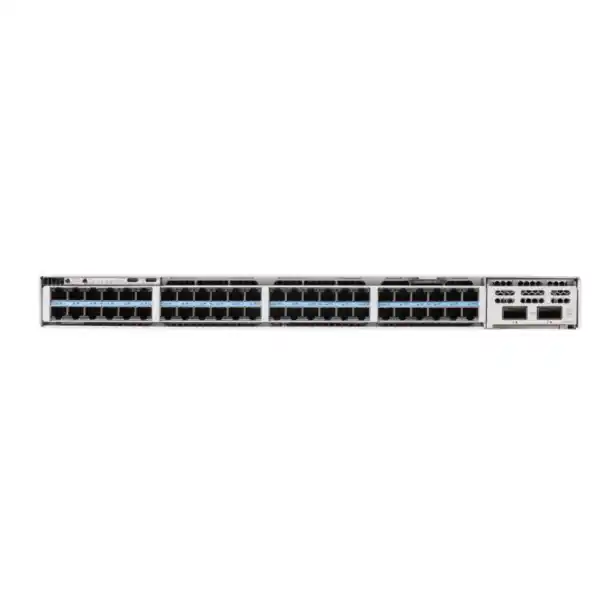
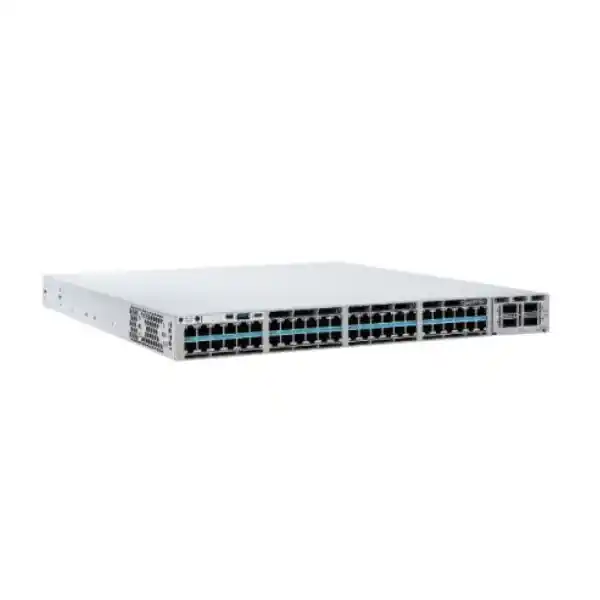
Cisco C9350-48TX Smart Switch
Build a faster enterprise access layer with 48 multigigabit copper ports, modular high-speed uplinks, resilient stacking and Cisco IOS XE operations. The C9350-48TX is designed for organizations that need dense 1G-to-10G data connectivity without Power over Ethernet.
For Tanzania deployments, use this model when endpoint power is handled separately and the network priority is high-speed wired access, scalable uplinks, segmentation, automation and operational consistency. Uplink modules, optics, stacking components, software licensing and support should be validated as part of the final configuration.
Fast buying answer
Choose the C9350-48TX when you need 48 data-only RJ-45 ports that can scale from 1G to 10G, plus enterprise stacking and modular high-speed uplinks. Choose a different C9350 model if your access switch must also power Wi-Fi access points, phones, cameras or other PoE devices.
A 48-port multigigabit access switch for data-first networks
The Cisco C9350-48TX is built for enterprise access designs that need much more than conventional 1 Gigabit Ethernet but do not need the switch to provide Power over Ethernet. Its 48 fixed copper downlink ports use standard RJ-45 connections and support a broad speed range from 10 Mbps and 100 Mbps through 1 Gbps, 2.5 Gbps, 5 Gbps and 10 Gbps. That flexibility allows a network team to connect mixed generations of Ethernet devices on one access platform while reserving the fastest rates for endpoints that can take advantage of them. In practical terms, it is a good architectural match for high-performance desktops, local servers, network appliances, lab systems, storage-adjacent devices, media production endpoints and other equipment that already has its own power source.
The model is especially useful when a business is modernizing cabling and access capacity without wanting to replace every endpoint at once. Existing 1G clients can remain connected while selected systems move to 2.5G, 5G or 10G as requirements increase. This protects the access-layer design from becoming an immediate bottleneck and gives IT teams a clearer migration path than a fixed-speed switch. Because the C9350-48TX is explicitly a non-PoE model, it should not be chosen when the same switch must power wireless access points, IP phones, cameras or other powered devices. In those deployments, a PoE-capable C9350 variant may be more appropriate. The TX model is strongest where data capacity and port density are the primary requirements.
Key verified specifications
Cisco positions the C9350-48TX within the C9350 Series Smart Switches as a stackable 48-port Multigigabit Ethernet model. Each downlink can operate at 10M, 100M, 1G, 2.5G, 5G or 10G, with the lower 10/100 Mbps modes operating full duplex according to Cisco documentation. The switch is based on dual Cisco Silicon One A100/L ASICs. Cisco lists a bandwidth specification of 1760G for the C9350-48TX, 3360G switching capacity with stacking, a forwarding rate of 1309.44 million packets per second, and 2499.84 million packets per second with stacking. These figures make the platform suitable for dense enterprise access environments where many high-speed copper links must coexist without constraining the upstream design.
The chassis is a 1RU-class fixed access platform measuring approximately 4.4 x 44.5 x 47.2 cm (1.73 x 17.5 x 18.6 inches) for the chassis dimensions Cisco publishes for this model family grouping. Cisco lists a weight of approximately 8 kg (17.7 lb) with the default power supply. The C9350-48TX uses a 500W AC power supply as its default option and provides no PoE budget because its downlink ports are data-only. The chassis provides three power-supply bays, three fan-tray bays and dedicated rear connectors for StackWise-1.6T and StackPower+. A deployment should still be designed around the actual power, redundancy and airflow configuration ordered for the rack.
| Specification | C9350-48TX |
|---|---|
| Downlink ports | 48 x RJ-45 Multigigabit Ethernet |
| Supported downlink speeds | 10M / 100M / 1G / 2.5G / 5G / 10G |
| PoE | No PoE; data-only access model |
| Stacking | StackWise-1.6T, up to eight C9350 members with the same license level |
| Uplink architecture | Modular; up to 400 Gbps total uplink bandwidth with supported high-speed modules |
| Bandwidth specification | 1760G |
| Forwarding rate | 1309.44 MPPS |
| Default power supply | 500W AC |
| Operating system | Cisco IOS XE |
Why multigigabit access matters
A conventional Gigabit Ethernet access layer can become a constraint when endpoint capabilities rise above 1 Gbps. Modern workstations, edge-compute appliances, local servers and specialized devices may need sustained transfer rates that exceed a single 1G link. Multigigabit Ethernet gives the network architect more choices without moving every copper endpoint directly to fiber. With the C9350-48TX, a single switch can host legacy clients alongside 2.5G, 5G and 10G equipment, allowing capacity to be assigned where it creates practical value rather than forcing a uniform port speed across the floor.
This mixed-speed capability can also simplify phased upgrades. A Tanzanian enterprise refreshing a branch, campus, production site or technical facility may have areas where existing copper infrastructure and powered endpoints remain serviceable while a new application requires faster access. Instead of replacing the whole access layer again when demand grows, the C9350-48TX gives the organization a higher ceiling at the edge. Cabling quality, distance, transceiver choice and endpoint capabilities still determine the actual negotiated speed, so the switch should be treated as one part of the design rather than a guarantee that every installed copper run will operate at 10G.
Modular uplinks: size the upstream path for real traffic
The C9350-48TX uses a modular uplink architecture rather than locking the buyer into one fixed uplink arrangement. Cisco states that the platform can support up to 400 Gbps of total uplink bandwidth with supported network modules. Options in the C9350 family include modules providing 100G/40G QSFP connectivity, 25G/10G/1G SFP-based connectivity, selected 50G modes and multigigabit copper uplinks. The important purchasing point is that the base switch does not include an uplink module by default. The correct module must therefore be selected as part of the bill of materials, together with compatible optics, cables or copper media.
Uplink sizing should be based on the expected concentration of traffic rather than just the number of access ports. Forty-eight 10G-capable edge ports can produce substantial aggregate demand, but most access networks do not run every port at full line rate continuously. Designers should estimate application behavior, oversubscription tolerance, east-west versus north-south flows, server locations and redundancy requirements. A pair of high-speed uplinks to a distribution or core layer may be sufficient for one site, while another may justify four 100G paths. The modular approach helps keep that decision separate from the access-port purchase and provides room to change the upstream design as traffic patterns evolve.
StackWise-1.6T for scale and operational simplicity
Cisco StackWise-1.6T allows multiple C9350 switches to operate as one logical system using dedicated rear-panel stacking connections. Cisco documents up to 1.6 Tbps of aggregate stack bandwidth and supports up to eight switch members, with the requirement that stack members use the same license level. For network teams, the practical value is not only raw bandwidth. A stack can reduce the number of independently managed access devices, present a common control plane and simplify port expansion when a site grows beyond the capacity of a single chassis.
Stacking should be planned at purchase time because it affects rack layout, cable length, resilience and failure-domain design. StackWise cables are separate accessories, and their lengths need to match the physical arrangement of the rack. Teams should also consider whether a single large stack or several smaller stacks better matches operational boundaries. A larger stack can make management simpler and enables high port density, while separate stacks may contain faults or maintenance windows more tightly. The C9350-48TX gives architects the ability to make that decision without sacrificing the high-speed access characteristics of the individual switch.
Power architecture and the significance of a non-PoE model
The C9350-48TX is intentionally a non-PoE switch. Cisco lists the default supply as PWR-C2-500WAC and no available PoE power for this SKU. That is a major design characteristic, not a minor specification. Buyers should choose it when connected devices receive power independently or when power delivery is handled by another infrastructure layer. Examples include desktop computers, servers, appliances, storage systems, industrial controllers with separate supplies and lab equipment. Using a data-only switch in those situations can avoid paying for PoE capacity that the deployment will not use.
Conversely, a network that expects the access switch to power Wi-Fi access points, IP cameras, VoIP handsets or building-control endpoints should not assume that a fast multigigabit port also supplies power. Cisco offers other C9350 models with PoE, UPOE and UPOE+ capabilities for those needs. Separating data-only and powered-access roles can be a sensible architecture, but it must be deliberate. During procurement, list every endpoint category, its negotiated data rate and how it receives power. This simple exercise often reveals whether the C9350-48TX is the correct model or whether a PoE-capable variant should be selected for some closets.
Redundancy options for access-layer resilience
The chassis includes three power-supply bays and three modular fan units, giving enterprise designers more redundancy choices than a basic fixed switch. Cisco documents front-to-back airflow and field-replaceable power supplies and fans. The platform also supports StackPower+, which can share power across connected C9350 switches in a power domain. Even on a non-PoE model, these capabilities are relevant because resilient switch operation depends on more than redundant data paths. A robust access design should consider power-source diversity, UPS capacity, rack cooling, spare strategy and whether a second or third supply is required for the intended availability target.
Redundancy should be engineered rather than assumed. The presence of multiple power-supply bays does not mean every unit ships with all bays populated, and a stack does not automatically protect against every outage scenario. Consider separate electrical circuits where available, suitable UPS protection, redundant uplinks to upstream devices and configuration practices that avoid single logical dependencies. In Tanzania, where a site may have different power-continuity conditions from one facility to another, the rack and electrical design should be validated for each location instead of relying on a generic template. The switch provides the building blocks; the final resilience outcome depends on how they are deployed.
Cisco IOS XE: consistent enterprise operations
The C9350 Series runs Cisco IOS XE, giving the C9350-48TX a familiar enterprise operating environment for switching, routing, automation and telemetry. Cisco documents model-driven programmability through NETCONF, RESTCONF and YANG, as well as streaming telemetry and on-box Python capabilities. This is useful for organizations moving from device-by-device administration toward repeatable, API-driven network operations. Teams can keep established command-line workflows while also integrating configuration and monitoring into broader automation systems.
Cisco also documents software maintenance capabilities such as in-service patching and Extended Fast Software Upgrade functions, subject to the applicable release and feature requirements. For buyers, the key point is that software lifecycle planning matters as much as hardware selection. The C9350-48TX has a minimum software requirement of IOS XE 17.18.1 in Cisco’s current documentation, while newer features may require later trains. Before deployment, confirm the desired feature set, recommended release, interoperability with network controllers and the organization’s patch policy. Avoid treating the factory image as the final software decision for a production environment.
Layer 2, Layer 3 and segmentation capabilities
Cisco lists Layer 2 switching, IP routing, IP multicast routing, IPv6 routing and IPv6 multicast routing as available capabilities for the C9350 Series. This allows the C9350-48TX to serve as more than a simple unmanaged edge device. Depending on the selected license and design, it can participate in routed access, VLAN segmentation, gateway services and multicast distribution. The platform supports up to 4094 VLAN IDs and up to 4000 active VLANs at the family level, giving architects substantial logical segmentation capacity for enterprise environments.
The right design should use only the scale required by the business rather than maximizing every table. A branch may need a straightforward set of user, server, management and guest segments. A campus or technical site may require more granular segmentation, multiple routed interfaces and policy boundaries. The C9350 platform’s hardware resources and Software Database Manager templates are designed to allocate capacity across forwarding, access control and QoS functions. Network teams should map expected routes, MAC addresses, SVIs, ACLs, NetFlow entries and multicast state to the supported profile before standardizing the switch across a large estate.
Performance headroom for demanding access environments
Cisco’s published performance table lists the C9350-48TX at 1760G bandwidth specification and 1309.44 MPPS forwarding rate, rising to 3360G switching capacity and 2499.84 MPPS forwarding with stacking. The platform uses two Silicon One A100/L ASICs, which is important because 48 ports capable of reaching 10G create a very different traffic profile from a conventional 48-port 1G access switch. This hardware foundation gives designers the headroom to support dense multigigabit access while preserving high-speed paths to the distribution layer.
Performance numbers should still be interpreted in the context of real applications. File transfers, virtualization traffic, high-resolution media, backup flows, analytics platforms and edge workloads can behave very differently from typical office web traffic. The value of a higher-capacity switch is not that every port must run at maximum load; it is that the access layer is less likely to become the first constraint when multiple demanding users or systems are active at the same time. For procurement, pair hardware performance analysis with an uplink plan, traffic baseline and growth assumption rather than comparing only the headline port count.
Hardware resources and application hosting
Cisco lists 16 GB of DRAM and 18 GB of flash for the C9350 platform, with SSD capacity up to 240 GB. The family also reserves resources for application hosting, including 8 GB of DRAM allocation, four virtual CPUs and two 1/10G AppGig ports. These resources reflect Cisco’s direction toward a programmable access platform that can host selected services at the network edge rather than functioning only as a forwarding device.
Application hosting can be useful for services that benefit from proximity to the network, including selected Cisco applications such as ThousandEyes and Cisco Spaces where supported. However, application eligibility, licensing and software-release requirements should be confirmed for the exact use case before procurement. The presence of CPU, memory and storage resources does not mean every third-party workload is automatically supported. Organizations should distinguish between a feature being technically possible on the platform and a workload being validated, licensed and operationally appropriate for production use.
Security and network visibility
The C9350 Series includes enterprise security capabilities and hardware-rooted trust functions. Cisco documents image signing, Secure Boot and Trust Anchor technologies intended to validate software and hardware integrity from boot through runtime. At the network-policy layer, the family supports security ACLs, Quality of Service controls, Flexible NetFlow and Software-Defined Access capabilities. This combination is relevant to organizations that want the access switch to participate in segmentation, policy enforcement and telemetry instead of leaving all controls to upstream firewalls.
Security value comes from configuration and operations, not from the feature list alone. Before deployment, define management access, AAA integration, role-based administration, secure management protocols, logging, time synchronization, software update procedures and configuration backup. Then define how endpoint traffic is segmented and observed. Flexible NetFlow and telemetry can help teams understand usage and identify abnormal patterns, but those capabilities need collectors, retention policies and an incident process to become useful. A well-designed C9350-48TX deployment therefore combines platform features with a disciplined operating model.
Management choices: CLI, controller and cloud-assisted operations
Cisco describes the C9350 Series as supporting flexible management models. Traditional device-based configuration through console, SSH and CLI remains available, while Cisco Catalyst Center can provide centralized on-premises management for supported enterprise networks. Cisco also documents cloud-management modes through the Meraki dashboard for IOS XE platforms, with different configuration-source options. This range can help organizations align the same hardware family with centralized operations, cloud-assisted monitoring or established command-line practices.
The management model should be selected before rollout because it affects licensing, operational workflows, training and change control. A team with mature automation may prefer API-driven configuration and telemetry. Another organization may value a central controller that standardizes templates across many branches. Smaller environments may retain direct management while still using centralized monitoring. The C9350-48TX can fit these approaches, but buyers should verify that the chosen software release, subscription and controller versions support the exact features they plan to use. Management flexibility is valuable only when the operating model is deliberately defined.
Licensing and subscriptions: include software in the buying decision
Cisco states that unified licensing for the C9350 Series is available through a Cisco Networking Subscription or an Enterprise Agreement, and licenses are managed through Cisco Smart Accounts. This means the hardware purchase should not be separated from software planning. The required license level depends on the capabilities and management approach the organization intends to use. A switch can meet the physical port requirement while still being the wrong commercial configuration if the necessary software entitlement is missing.
For a Tanzania procurement, request a quote that identifies the hardware model, uplink module, power configuration, stacking accessories, optics or cables, required software subscription and any support entitlement as distinct line items. This makes comparison easier and reduces ambiguity during renewal or expansion. If the switch is joining an existing C9350 stack, confirm license-level compatibility as part of the design. If the organization already has a Cisco Smart Account, determine who will own license assignment and lifecycle management. The exact configuration should be verified during quotation rather than assuming one subscription suits every deployment.
Physical interfaces and serviceability
The front of the C9350 chassis includes the fixed downlink ports, an uplink-module slot, status controls, a USB Type-C console port and a USB Type-C host port. The rear provides power-supply modules, fan modules, StackWise-1.6T connectors, StackPower connectors, a USB 3.0 SSD slot, an RJ-45 console connection and a dedicated 10/100/1000 management port. This combination gives engineers several ways to access and service the platform while keeping high-speed data ports separate from out-of-band management.
Rack planning should account for the chassis depth, rear cabling and airflow. The C9350-48TX is deeper than some conventional 1G access switches, so cabinets should be checked for usable depth once power, stack and uplink cables are connected. Front-to-back airflow also means the cooling layout of the cabinet matters. Leave enough space to remove fan and power components without disturbing adjacent equipment, and select stack-cable lengths that do not force tight bends. These practical details are easy to overlook during specification but can have a large impact on serviceability after installation.
Environmental and power planning for Tanzania deployments
Cisco specifies operating conditions for the C9350 platform across defined temperature and altitude ranges, with published guidance showing -5°C to 45°C up to about 1.83 km and -5°C to 40°C up to about 3.05 km, along with non-condensing humidity requirements. Those limits are equipment specifications, not a substitute for proper rack-room environmental control. High ambient temperature, restricted cabinet airflow, dust and unstable power can all reduce operational margin even when a device remains within its stated range.
For Tanzanian installations, assess each site’s electrical and cooling conditions before finalizing the bill of materials. Branch offices, campus rooms and technical facilities can differ substantially in UPS availability, generator transfer behavior, grounding quality and cooling continuity. The C9350-48TX supports enterprise power and fan redundancy options, but the surrounding infrastructure needs equal attention. Use appropriately rated UPS systems, surge protection and earthing practices designed by qualified professionals, and ensure rack airflow is not blocked by cable management. Where outages are possible, design upstream links and services so a single closet power event does not create a larger business interruption.
Best-fit deployment scenarios
Enterprise campus access is a natural use case for the C9350-48TX when users or devices need more than 1G and receive power independently. A design may connect engineering workstations, media teams, research systems or local compute appliances at 2.5G, 5G or 10G while using high-speed uplinks toward the campus distribution layer. The same stack can also host ordinary 1G endpoints, which helps avoid creating a separate switch tier for every speed class.
High-performance branch offices can also benefit when the site has a relatively small IT footprint but demanding local workloads. Cisco specifically positions the model for lean branch deployments with high-speed access requirements. In a branch with local servers, content systems, data-processing devices or heavy collaboration traffic, 10G-capable copper access can preserve performance without deploying a dedicated fiber interface to every desk or appliance. The modular uplink selection can then be matched to the WAN edge or core connection.
Technical and lab environments are another strong fit because equipment often has its own power and can generate bursty traffic. Multiple test systems, analysis platforms and appliances can be connected at different Ethernet rates while remaining in a centrally managed enterprise switching platform. The non-PoE design is rarely a disadvantage in such rooms, and the high port density can reduce the number of separate switches needed.
When the C9350-48TX is not the right choice
Do not select the C9350-48TX simply because it is the fastest 48-port option in a comparison table. If most endpoints are 1G and future growth is modest, a lower-speed C9350 model may provide a more economical fit. If the switch must power access points, phones, cameras or sensors, choose a PoE-capable model rather than adding unnecessary external power injectors. If the site mainly needs fiber downlinks, a copper-focused TX model may also be the wrong architecture.
The switch may also be excessive for a very small network that does not need enterprise routing, stacking, automation, centralized management or high-capacity uplinks. The purchase should be driven by workload, resilience and lifecycle requirements, not only by specification headroom. A useful decision process compares the required number of copper ports, expected port speeds, PoE demand, uplink bandwidth, rack constraints, software features, support model and three-to-five-year growth assumptions. The best switch is the one that fits the architecture with enough margin, not the one with the largest number in every column.
C9350-48TX versus PoE-capable C9350 alternatives
The closest conceptual comparison is between the C9350-48TX and C9350 multigigabit models that add PoE capability. The TX model delivers 48 high-speed copper data ports without PoE. The HX family is designed for environments where multigigabit access and high-power PoE are needed together. That difference changes power-supply sizing, heat output, endpoint strategy and overall system cost. If a cabinet serves mostly powered wireless and IoT devices, a PoE model may simplify deployment. If it serves workstations, servers and appliances with independent power, the TX model avoids unnecessary PoE hardware.
A second comparison is against the C9350-48T, which provides 48 standard 10/100/1000 copper downlinks rather than 10G-capable multigigabit access. The 48T can be appropriate when 1G is sufficient and the organization mainly values the C9350 software, stacking and management architecture. The 48TX is the stronger fit when multiple endpoints need 2.5G, 5G or 10G now or during the expected life of the network. Keeping these distinctions explicit helps buyers avoid paying for the wrong kind of capacity.
| Decision factor | C9350-48TX | Consider another model when… |
|---|---|---|
| Copper access speed | Up to 10G on 48 ports | 1G is sufficient for the lifecycle |
| PoE requirement | None | Endpoints must receive PoE/UPoE from the switch |
| Uplink strategy | Modular, high-speed | Only basic fixed uplinks are required |
| Operational model | Enterprise IOS XE with stacking, automation and controller options | A simple unmanaged or SMB switch meets the need |
Cabling and endpoint readiness
A 10G-capable access port does not remove the need to validate the physical layer. The achievable speed over copper depends on cable category, installed-channel quality, length, termination, patching and electromagnetic conditions. Before a large rollout, audit representative links and test them at the intended rate. A network may negotiate successfully at 1G while revealing problems at 5G or 10G. Phased upgrades can use the switch’s multirate behavior to keep difficult runs operational at a lower speed until cabling is remediated.
Endpoint network interfaces also matter. Many client devices still ship with 1G adapters, while higher-performance workstations may use 2.5G or 10G NICs. A clean procurement plan maps switch ports to endpoint capabilities so the expected benefit is measurable. For servers and appliances, confirm whether copper 10G is the preferred interface or whether fiber/direct-attach connectivity to another layer would be more suitable. The C9350-48TX is flexible, but good network design still matches media, distance and device type to the application.
Uplink modules, optics and cables are separate design items
Cisco’s modular uplink approach gives the C9350-48TX substantial flexibility, but it also means the switch should not be quoted as a complete connectivity solution without the uplink components. The selected network module determines port count, media type and maximum aggregate uplink bandwidth. Transceivers, breakout arrangements and patch leads then need to match the module and the upstream equipment. Stacking cables and optional redundancy components are also separate items in many configurations.
When requesting a quote, provide the upstream switch or router model, required link speed, fiber type and distance where known. If a stack will use multiple parallel uplinks, state whether they terminate on one upstream chassis, a virtual chassis pair or separate devices. This allows the bill of materials to be checked for compatibility instead of assuming that any 100G optic or cable will work in every combination. The goal is a complete, validated path from access port through uplink to distribution, not only a correctly named switch chassis.
Operational scale and table capacity
Cisco publishes substantial platform-scale resources for the C9350 family, including up to 64,000 MAC addresses, large IPv4 and IPv6 route tables, thousands of VLAN and SVI entries, security and QoS ACL resources, multicast scale and NetFlow capacity. These figures indicate that the platform is designed for serious enterprise access and edge roles rather than only basic Layer 2 connectivity. They can be useful when a switch is expected to support routed access, dense segmentation or a large number of learned endpoints.
Actual usable scale depends on software release, feature combination and SDM template, so the headline maximums should not be treated as simultaneously available in every configuration. Large deployments should validate their intended route, ACL, policy and telemetry mix against Cisco’s current configuration guides and feature tools. For most branch and campus access networks, the limits will be well above normal requirements, but checking them is still good practice when standardizing on a platform for many sites or when the design uses unusually large segmentation tables.
Automation, telemetry and API-driven operations
For organizations managing many switches, the cost of manual configuration can exceed the cost difference between hardware models. IOS XE support for NETCONF, RESTCONF, YANG models and streaming telemetry gives the C9350-48TX an automation path that can reduce repetitive work. Configuration templates can be generated consistently, compliance can be checked programmatically and selected operational data can be streamed to monitoring platforms. These capabilities support infrastructure-as-code practices without eliminating conventional CLI access.
Automation should begin with controlled, repeatable tasks rather than large unsupervised changes. Define a source of truth for interface roles, VLANs, routing and management addresses; use version-controlled templates where appropriate; validate changes before deployment; and retain rollback procedures. Streaming telemetry should also be scoped to useful measurements so the monitoring system is not flooded with data. The switch provides the interfaces for modern operations, but process design determines whether those interfaces improve reliability or simply add another management layer.
Software-defined access and advanced feature planning
Cisco lists Software-Defined Access as an available capability for the C9350 Series, while newer functions such as BGP EVPN and post-quantum cryptography are tied to specific IOS XE releases in current documentation. This illustrates an important buying principle: the hardware platform may support a broad set of functions, but exact availability depends on software version and license. An organization planning SD-Access fabric roles, EVPN services or advanced security functions should verify those requirements before ordering and again before production deployment.
Avoid designing around a feature name alone. Confirm the exact use case, topology, controller dependencies, minimum release and interoperability with existing infrastructure. If the feature is not required on day one, document it as a future requirement and ensure the chosen subscription path keeps that option open. This approach prevents both under-buying and unnecessary complexity. For many customers, the immediate value of the C9350-48TX will come from high-speed access, resilient stacking and centralized management, with advanced fabric functions introduced only when the broader architecture is ready.
A practical pre-purchase checklist
Before placing an order, confirm the number of required copper access ports and how many endpoints truly need 2.5G, 5G or 10G. Confirm that no endpoint depends on switch-delivered PoE. Identify the preferred uplink speed and media, then select a supported C9350 network module rather than assuming one is included. Determine whether the unit will operate standalone or in a StackWise-1.6T stack, and select stack cables of suitable length. Decide whether additional power supplies are needed for resilience and check that the rack has adequate depth, cooling and power.
Next, define the software and operational requirements. Confirm the required Cisco license level, Smart Account ownership, desired IOS XE release, management model and controller integration. Check routing, security, telemetry and automation features against the selected release. For migration projects, verify VLAN, spanning-tree, routing, QoS and authentication behavior with the existing network. Finally, validate optics, patching, copper cabling and endpoint NIC capabilities. A complete design review before ordering is far less costly than discovering after installation that the switch chassis is correct but a critical module, license or cable is missing.
Migration planning from older access switches
Replacing an existing switch is not only a port-for-port exercise. Before moving to the C9350-48TX, export and review the current configuration, identify obsolete settings and document interface roles. Check spanning-tree modes, trunk allowed VLANs, native VLAN behavior, routing adjacencies, DHCP relay, QoS policies, authentication settings and management ACLs. If the old platform uses proprietary or legacy functions, confirm their equivalent on the target IOS XE release rather than copying configuration blindly.
A staged migration is usually safer for high-density access environments. Preconfigure the new switch or stack, validate management reachability, test uplinks and verify one representative endpoint from each major device type. Then move ports in controlled groups while monitoring errors, negotiated speed, VLAN assignment and application reachability. Because the C9350-48TX supports multiple copper rates, it can temporarily accommodate endpoints that have not yet been upgraded. That makes it well suited to modernization projects where the network and client-refresh schedules do not happen on the same day.
Designing for growth without overbuilding
Future readiness is valuable when it is tied to a realistic plan. The C9350-48TX offers a high ceiling at the access layer, but an organization should still estimate how port demand and throughput will change over the expected lifecycle. Consider workforce growth, application bandwidth, local server consolidation, Wi-Fi backhaul architecture, edge computing and new security or monitoring tools. If several of these trends point toward faster wired access, paying for multigigabit capability now can reduce disruptive switch replacements later.
At the same time, avoid assuming every connected device will soon need 10G. A mixed-speed strategy is often more economical: use 10G for the endpoints that benefit, 2.5G or 5G for intermediate needs and 1G for ordinary clients. The switch’s value lies in supporting these tiers together. Uplink capacity can be sized to aggregate realistic demand with resilience, and additional stack members can be introduced when port count grows. This creates a growth path based on measured needs instead of speculative maximums.
What to include in a Tanzania quote request
A useful quote request should state the exact model, C9350-48TX, and the number of units required, but it should also describe the deployment. Include the expected number of 1G, 2.5G, 5G and 10G endpoints; whether the switches will be standalone or stacked; the desired uplink speed; the upstream device model; and whether fiber or copper uplinks are preferred. State the rack environment and whether redundant power supplies are required. If you already know the preferred network module or transceiver family, include it for validation rather than assuming compatibility.
Software information is equally important. State whether the environment will use direct IOS XE management, Cisco Catalyst Center, Meraki cloud-assisted management or another supported workflow. Identify required routing, segmentation, telemetry and automation features, and note any existing Cisco Smart Account or enterprise agreement that may affect licensing. A more precise configuration can then be prepared for review. Price, stock, delivery schedule, warranty terms and support eligibility should be confirmed in the actual quotation because these commercial details can vary and are not inferred from the switch specification.
Frequently asked questions
Below are practical questions buyers commonly need answered before standardizing on the C9350-48TX. They focus on the differences that change the bill of materials and deployment outcome rather than repeating headline specifications.
Does the C9350-48TX provide PoE?
No. Cisco identifies the C9350-48TX as a data-only multigigabit model. Devices that require power over the Ethernet cable need a PoE-capable switch or a separate approved power method. Do not assume that 10G multigigabit capability implies PoE.
What speeds do the 48 copper ports support?
The fixed RJ-45 downlinks support 10M, 100M, 1G, 2.5G, 5G and 10G. Actual negotiated speed depends on the endpoint, cabling and link conditions.
Is an uplink module included?
Cisco documents the uplink network module as optional. Select the supported module, optics and cables required for the intended upstream bandwidth and media.
How many switches can be stacked?
Cisco StackWise-1.6T supports up to eight C9350 members, with Cisco documenting same-license-level requirements for members in a stack. Stacking cables and physical rack design should be planned separately.
Can it be managed with Cisco Catalyst Center?
Cisco documents Catalyst Center support for enterprise switching and flexible C9350 management models. Confirm the current compatibility matrix, controller version, IOS XE release and license for the exact functions you plan to use.
What IOS XE release is required?
Cisco currently lists IOS XE 17.18.1 as the minimum software requirement for the C9350-48TX. Newer functions may require later releases, so production software should be selected according to the desired feature set and Cisco’s current release guidance.
Is the C9350-48TX suitable for Wi-Fi 7 environments?
Cisco positions the model for high-speed access networking and references Wi-Fi 7-era requirements, but this TX model does not provide PoE. It can therefore fit architectures where high-speed data is required and access-point power is supplied by another appropriate method. If the same switch must power Wi-Fi 7 APs, evaluate a suitable PoE-capable C9350 model instead.
What should be verified before ordering in Tanzania?
Confirm the exact hardware configuration, supported uplink module, optics or cables, stack accessories, power-supply redundancy, software subscription and support entitlement. Also validate rack depth, electrical protection, cooling and the condition of copper cabling. Commercial details such as local price, availability, lead time and warranty should be confirmed in the quotation.
Buying guidance for IT teams and procurement
For technical teams, the strongest reason to choose the C9350-48TX is a clear requirement for dense multigigabit copper access within Cisco’s modern enterprise switching architecture. The decision becomes easier when the workload is defined: powered endpoints are handled elsewhere, several ports need more than 1G, high-speed uplinks are required, resilient stacking is valuable and IOS XE operations fit the organization’s standards. In that situation, the model provides a coherent path from 1G legacy devices to 10G endpoints without fragmenting the access layer across unrelated switch families.
For procurement teams, compare complete configurations rather than chassis-only prices. A quote should identify the switch, uplink module, transceivers, stacking cables, additional power supplies if required, software subscription and support. It should also distinguish what is included from what is optional. This avoids comparing one supplier’s bare chassis against another supplier’s deployable bundle. Do not rely on assumed warranty, stock or delivery promises; request them explicitly in the commercial offer. The technical specification determines fit, while the validated bill of materials determines whether the switch can actually be installed as designed.
Summary: where the C9350-48TX fits
The Cisco C9350-48TX Smart Switch is a high-capacity enterprise access platform for networks that need 48 ports of copper connectivity from legacy Ethernet speeds through 10G, but do not require PoE. Its dual-ASIC architecture, modular uplinks, StackWise-1.6T support and IOS XE software make it suitable for demanding campus, branch and technical environments. The platform can scale from a standalone access switch to an eight-member stack while maintaining a common operational model.
The best deployments treat the switch as part of a complete architecture. Validate cabling, endpoint NICs, uplink modules, optics, stacking, rack depth, power resilience, software release and licensing before purchase. Where powered endpoints dominate, select a PoE-capable alternative. Where independent-powered devices need flexible high-speed access and enterprise manageability, the C9350-48TX can be a strong fit. For a Tanzania deployment, request a configuration review and quotation based on the actual topology so the hardware, software and accessories are aligned from the start.
Request a C9350-48TX configuration review
Share your required port speeds, uplink topology, stack size, rack and power design, management preference and software requirements. A configuration review can then identify the appropriate uplink module, stacking accessories, optics or cables, power redundancy and licensing before quotation.
Commercial availability, price, delivery timing, warranty and support terms should be confirmed in the final Tanzania quotation.




Reviews
There are no reviews yet.