
FORTINET HIGH-END DATA CENTER SECURITY
FortiGate 3000G (FG-3000G) Tanzania
FortiGate 3000G is designed for organizations that need very high firewall capacity, accelerated encrypted connectivity and advanced security inspection without treating the security gateway as an afterthought. For Tanzanian data centers, large campuses, service environments and enterprise network cores, the buying decision should combine throughput, interface design, high availability, inspection requirements, VPN scale, FortiGuard services and operational management. FourTeck Tanzania can help turn those requirements into a clear bill of materials and quotation.
FortiGate 3000G at a Glance
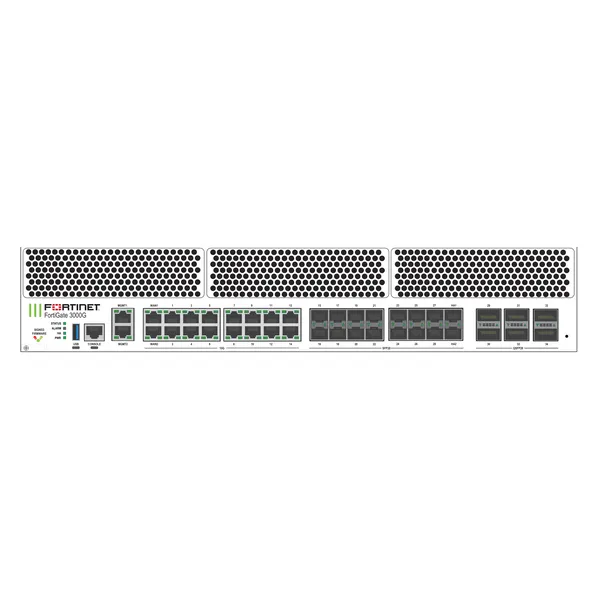
Fortinet positions the FortiGate 3000G in its high-end data-center firewall portfolio. Current Fortinet product-matrix figures list firewall throughput of 397/394/234 Gbps for 1518/512/64-byte UDP traffic, 105 Gbps IPsec VPN throughput, 90 Gbps IPS throughput, 85 Gbps NGFW throughput and 80 Gbps threat-protection throughput. Fortinet documentation for the 3000G/3001G architecture identifies two NP7 network processors and six CP10 content processors. The front-panel design includes two multigigabit management RJ45 ports, sixteen multigigabit RJ45 data ports, sixteen 25/10/1GbE SFP28-class ports including HA interfaces, and six 100/40GbE QSFP28 ports, with breakout capability documented for the high-speed ports.
Published maximum firewall throughput at the largest tested packet size.
Published IPsec VPN throughput for high-capacity encrypted connectivity.
Published enterprise-mix IPS throughput for inspected traffic planning.
High-speed QSFP28 connectivity supports modern data-center and core designs.
Performance figures are vendor-published benchmark values and should not be treated as guaranteed application throughput. Real results depend on traffic profile, enabled inspection, software version, packet size, policies, encryption, logging and architecture.
What the FortiGate 3000G Solves
Large networks rarely need only a faster firewall. They need a security platform that can inspect substantial traffic volumes, enforce segmentation between trust zones, terminate encrypted tunnels, control applications, support resilient internet or WAN designs and remain manageable as policy complexity grows. The FG-3000G addresses this class of requirement by combining FortiOS with purpose-built security processing and high-speed physical interfaces. That makes it relevant where a smaller branch appliance would become a throughput or port-density constraint.
A sound deployment starts by separating headline firewall throughput from the performance metric that actually matters to the project. A data center enabling IPS, application control and threat protection should size against inspected traffic rather than raw Layer-3 forwarding. A VPN aggregation project should consider encrypted throughput, tunnel count, route design and failover. A segmentation project should consider east-west traffic, policy count, VLAN or VXLAN design, routing adjacency and logging. Procurement teams should therefore provide a traffic and services profile before requesting a final configuration.
Key FortiGate 3000G Features and Buyer Benefits
High-throughput NGFW
The 3000G is built for security inspection at enterprise and data-center scale. Its published IPS, NGFW and threat-protection figures make it appropriate for projects where security services must be considered alongside high aggregate bandwidth.
Purpose-built acceleration
Fortinet documents two NP7 processors and six CP10 processors in the 3000G architecture. This hardware-assisted design is intended to accelerate networking and content-security workloads while FortiOS provides the policy and security framework.
High-speed interfaces
100/40GbE QSFP28 and 25/10/1GbE SFP28 connectivity supports core, aggregation and data-center topologies. Multigigabit copper ports add flexibility for environments where RJ45 handoffs remain important.
Secure VPN and WAN
Published 105 Gbps IPsec VPN throughput makes the platform relevant to large encrypted WAN, site-to-site and aggregation designs. Actual tunnel architecture should still be validated against topology, encryption settings and software limits.
Segmentation
FortiGate can enforce policy between network zones so organizations can reduce unnecessary lateral access. This is useful for separating users, servers, management, guest networks, applications, branches and other security domains.
Fortinet ecosystem integration
Projects can be designed with FortiManager for centralized administration, FortiAnalyzer for logging and analytics, FortiSwitch/FortiAP for access networking, and FortiGuard security services according to operational requirements.
Technical Specification Planning
| Metric | Fortinet published figure / design point | Why it matters |
|---|---|---|
| Firewall throughput | 397 / 394 / 234 Gbps | Baseline packet-forwarding capacity; do not substitute it for inspected throughput. |
| IPsec VPN | 105 Gbps | Relevant for encrypted site, data-center and WAN aggregation. |
| IPS | 90 Gbps | Useful when intrusion prevention is central to the traffic profile. |
| NGFW | 85 Gbps | Better planning reference for application-aware inspected traffic. |
| Threat protection | 80 Gbps | Important for multi-service security inspection sizing. |
| Processors | 2 × NP7, 6 × CP10 | Purpose-built acceleration for networking and content processing. |
| High-speed ports | 6 × 100/40GbE QSFP28; 16 × 25/10/1GbE SFP28 class including HA | Supports core and data-center uplinks and resilient designs. |
| Copper data ports | 16 × 10G/5G/2.5G/1G/100M RJ45 | Flexible multigigabit copper connectivity. |
Integration, High Availability and Operations
For production deployment, interface count is only one part of the architecture. The design should document upstream and downstream switches, transceiver types, LACP requirements, VLANs, routing protocols, internet handoffs, private WAN circuits, management networks and out-of-band access. Where uptime is important, organizations commonly evaluate a two-appliance high-availability design so maintenance or a single appliance fault does not automatically become a total security-edge outage. HA requirements should be validated against the exact FortiOS release and topology.
Operations teams should also decide how configuration, logging and reporting will be handled. Centralized management can become valuable when multiple FortiGate devices, VDOMs, branches or policy teams are involved. Logging capacity must be planned separately from firewall throughput because retention, analytics and compliance needs can drive storage requirements. A useful quotation therefore includes the firewall appliance, applicable FortiGuard/FortiCare services, optics, rack and power considerations, management/logging components where needed, and implementation scope.
FortiGuard, FortiCare and Licensing Considerations
The hardware purchase should not be separated from the services that the intended security design requires. FortiGuard security services can provide capabilities such as threat intelligence and security inspection updates, while FortiCare relates to support entitlements. Exact bundle names, service scope and subscription terms can change, so procurement should request the current Fortinet offering that matches the desired controls rather than relying on an old bill of materials.
Before renewal or first purchase, identify which services are required, the desired term, whether the device will participate in an HA pair, and whether centralized management or logging is part of the project. Aligning subscription dates across an HA pair can simplify administration. For broader Fortinet portfolio and renewal context, visit the FourTeck Fortinet specialist site, which covers FortiGate, FortiGuard, FortiCare, FortiManager and FortiAnalyzer requirements.
FortiGate 3000G Tanzania
Organizations searching for FortiGate 3000G in Tanzania are typically not buying a conventional branch firewall. The FG-3000G sits in Fortinet’s high-end portfolio and should be evaluated for data-center edges, large enterprise campuses, high-capacity internet gateways, security segmentation, VPN aggregation and environments where inspected throughput is a major design constraint. In Tanzania, the first step should be to document the current and projected bandwidth, peak east-west and north-south traffic, security services to be enabled, number of sites, VPN topology, routing design, interface requirements and availability objectives. This prevents a procurement exercise from being reduced to a single headline throughput number.
For a Tanzanian enterprise with multiple branches, the 3000G may serve as a central security or VPN aggregation point while smaller FortiGate models serve remote sites. For a data-center environment, 100GbE and 25GbE connectivity can be important when integrating with modern switching fabrics. For a large campus, segmentation between users, servers, management, guest access and critical systems can be a stronger requirement than simple perimeter filtering. In each case, the security policy, logging architecture and failure domains should be mapped before the appliance is ordered.
Procurement teams should request a quote that clearly separates appliance hardware, subscription services, support, optics and transceivers, implementation, migration and optional centralized management or analytics. If an existing firewall is being replaced, provide the current model, enabled services, observed peak utilization, number of policies, VPN count and any recurring performance issue. FourTeck Tanzania’s business technology portfolio places firewall projects in the wider context of switching, servers, Wi-Fi, structured infrastructure and other systems that the firewall must connect securely. This helps buyers plan the FG-3000G as part of an architecture rather than an isolated box.
FortiGate 3000G Dar es Salaam
For FortiGate 3000G requirements in Dar es Salaam, enterprise buyers may be planning a data-center refresh, headquarters security upgrade, high-capacity internet edge, colocation deployment or consolidation of multiple security gateways. The important question is whether the traffic that needs inspection fits the published NGFW and threat-protection envelope after realistic growth is added. A design handling large internet circuits should distinguish total carrier bandwidth from the traffic that will traverse each security zone, because asymmetric routing, multiple upstreams and internal segmentation can materially affect architecture.
Dar es Salaam projects may also involve dual internet providers, private WAN connections, cloud connectivity or links to branch offices. The firewall design should define how failover works, which routes are preferred, whether SD-WAN policy is required, how public services are published, and how remote sites establish encrypted connectivity. If the 3000G will sit between core and data-center switching, validate the exact 100GbE/40GbE/25GbE optics and switch compatibility rather than assuming every transceiver is interchangeable.
Operational readiness matters as much as initial installation. Define administrator roles, configuration backup, change control, log retention, monitoring, alerting and escalation procedures. For regulated or audit-sensitive environments, determine which logs need to be retained and for how long before selecting a logging architecture. For HA deployments, document cabling and failure scenarios so that redundancy exists beyond the firewall pair itself. FourTeck’s verified Tanzania technology enquiry page asks buyers to include internet bandwidth, users, current firewall environment, important applications and expected growth; those details are especially useful for an FG-3000G sizing discussion in Dar es Salaam.
FortiGate 3000G Mwanza
A FortiGate 3000G project in Mwanza should be justified by traffic, security and resilience requirements rather than by model prestige. Large industrial operations, multi-site organizations, service environments, institutions or regional hubs can generate substantial encrypted WAN and internet traffic, but the correct architecture depends on where inspection is performed. If most applications are centralized elsewhere, VPN aggregation and WAN resilience may dominate. If servers or major applications are hosted locally, east-west segmentation and high-speed data-center connectivity can become equally important.
Start with a network diagram that shows internet providers, WAN circuits, core switches, server networks, wireless networks, management systems and remote locations. Mark the expected throughput on each path and identify where IPS, application control, web security or other inspection will be enabled. This makes it possible to compare the requirement with the vendor’s inspected-throughput figures instead of using the raw firewall number. It also reveals whether a pair of 3000G appliances would need 100GbE uplinks, multiple 25GbE links or a different physical design.
Power and rack planning should be included in the implementation checklist, particularly for critical environments where firewall availability depends on upstream switching, power protection and cooling. Migration planning should include policy cleanup, NAT rules, VPN definitions, routing, object databases, certificates and rollback procedures. A staged cutover with validation criteria is safer than treating the change as a simple hardware swap. When requesting a quotation for Mwanza, include required quantities, desired subscription term, HA requirement, optics, current firewall details and whether configuration or migration assistance is needed. This produces a more meaningful commercial response and reduces later changes to the bill of materials.
FortiGate 3000G Arusha
Businesses and institutions evaluating FortiGate 3000G in Arusha should consider the appliance when the security edge must handle enterprise-scale traffic, extensive segmentation or large VPN requirements. A hospitality group, multi-site organization, large campus or service provider may have very different traffic patterns even if the aggregate internet bandwidth looks similar. Guest access, business systems, voice, cameras, cloud applications and administrative networks should not automatically share the same security policy or trust level. The firewall can become an enforcement point for those boundaries when the wider switching and routing design supports them.
For environments with remote sites, define whether the 3000G will operate as a hub and what encryption, routing and failover behavior each spoke requires. If cloud applications are business critical, document primary and secondary internet paths and the application-performance objectives used to steer traffic. If public-facing systems are hosted behind the firewall, include inbound security, NAT, certificate and logging requirements. These design decisions determine how the appliance will be configured and which services need to be licensed.
Arusha procurement teams should also plan lifecycle operations. A high-end firewall can carry a large concentration of business traffic, so firmware management, maintenance windows, configuration backups and administrative access deserve formal procedures. High availability can reduce appliance-level risk, but only when upstream and downstream dependencies are also resilient. Ask for a project quote that identifies hardware, subscriptions, optics, implementation and optional centralized management/logging separately. FourTeck’s Tanzania site states that its technology planning spans firewalls together with switches, Wi-Fi, servers and related infrastructure, which is useful when an Arusha project requires coordinated design rather than a standalone firewall purchase.
FortiGate 3000G Dodoma
For FortiGate 3000G procurement in Dodoma, large institutional, government-adjacent, education, enterprise or data-center environments should begin with a documented security and capacity requirement. The FG-3000G offers performance well beyond ordinary office firewalls, so the business case should identify the high-volume inspection, VPN aggregation, segmentation or core-security role that needs this class of appliance. Where multiple departments or systems share infrastructure, segmentation policy can be particularly important because it reduces unnecessary trust between networks and creates clearer control points for sensitive applications.
A design workshop should establish internet bandwidth, private WAN links, cloud connectivity, server locations, remote sites, number of security zones, routing protocols, VPN requirements and log-retention objectives. If TLS inspection or multiple advanced security services will be used, account for their performance impact rather than assuming the raw firewall benchmark applies. The vendor’s 80 Gbps threat-protection and 85 Gbps NGFW figures are more relevant starting references for security-heavy traffic, while actual production performance remains dependent on configuration and traffic mix.
Procurement documentation should also specify support and subscription term, HA requirements, optics, rack/power dependencies and migration scope. For a replacement project, exporting and reviewing the existing rule base can reveal obsolete objects and policies that should not be carried into the new platform. For a new deployment, a naming standard and policy ownership model can improve long-term administration. The verified FourTeck Tanzania contact page lists Dodoma among its office-contact locations and provides a central enquiry route; buyers can use that page to submit the technical context needed for product selection and quotation without assuming stock or delivery terms that have not been confirmed.
FortiGate 3000G UAE
The FortiGate 3000G in the UAE is relevant to high-capacity enterprise, data-center, cloud-connectivity and service environments that need a high-end NGFW with 100GbE-class interfaces and substantial inspected throughput. UAE projects frequently involve dense data-center connectivity, multiple internet carriers, private cloud or colocation links, branch aggregation and strict operational change controls. The design should therefore be based on traffic flows and security services, not merely total circuit capacity.
For an HA pair, specify both appliances, matching service terms where appropriate, required optics, HA cabling and the upstream/downstream redundancy model. For multi-carrier internet, document BGP or other routing requirements and decide whether Secure SD-WAN policy is needed for application-aware path selection. For data-center segmentation, identify trust zones and expected east-west flows so high-speed interfaces are allocated correctly. Central management and analytics may be appropriate when the UAE deployment is part of a wider regional Fortinet estate.
Commercial requests should include the exact model FG-3000G, quantity, subscription/support term, optics, implementation location and any FortiManager/FortiAnalyzer requirements. Avoid comparing quotes that bundle different security services or support periods, because the totals may look similar while the entitlements differ. FourTeck’s Fortinet UAE resource covers FortiGate sales, license renewal, installation and support topics and can provide regional context for buyers planning UAE deployments or regional projects linked to Tanzania.
FortiGate 3000G Uganda
Organizations evaluating FortiGate 3000G in Uganda should first decide whether the appliance is intended for a national headquarters, data center, large campus, service environment or VPN hub. The high-end capacity of the platform can support demanding designs, but accurate sizing requires a distinction between internet bandwidth, encrypted WAN traffic, internal segmentation traffic and security-inspected traffic. A centralized hub serving many branches may prioritize IPsec performance and routing scale, while a data-center gateway may prioritize 100GbE connectivity and threat inspection.
For cross-border or regional networks, the 3000G can be considered as part of a consistent Fortinet architecture, but each country site should still be sized independently. Links can vary in bandwidth, latency and resilience, and local application hosting may change traffic direction. Define how Uganda sites connect to Tanzania, cloud platforms or other regional hubs, and specify failover behavior before building VPN or SD-WAN policy. This prevents the firewall configuration from becoming an accumulation of ad-hoc routes and tunnels.
A quotation request should list the exact appliance quantity, whether HA is required, desired FortiGuard/FortiCare term, high-speed optics, VPN topology, management/logging requirements and implementation scope. If the project includes branches, include approximate site count and bandwidth tiers so the hub-and-spoke design can be reviewed as a whole. The FourTeck Uganda technology site provides regional IT and networking context, while the Tanzania team can use the same project information to coordinate requirements for organizations operating across East Africa.
FortiGate 3000G Kampala
A FortiGate 3000G deployment in Kampala may suit a major headquarters, financial or service environment, large campus, data center or centralized security hub where traffic volumes justify high-end inspection capacity. Before selecting the model, measure peak and 95th-percentile traffic where possible and identify the services that will be enabled. IPS, application control, encrypted traffic inspection, logging and VPN processing create a different workload from simple stateful firewalling, so the published NGFW and threat-protection metrics deserve close attention.
Kampala projects with many branches should define tunnel architecture and routing ownership early. Determine whether each branch connects directly to the hub, uses redundant hubs, or participates in an SD-WAN design. Identify business-critical applications and the acceptable behavior when a primary carrier fails. If the firewall is also enforcing internal segmentation, ensure the switching fabric can deliver the required traffic to the firewall without creating unnecessary bottlenecks or asymmetric paths.
Operationally, a high-capacity hub should have disciplined change management, backups and monitoring. Centralized tools may reduce administration overhead when the estate includes multiple FortiGate appliances. Logging requirements should be sized according to event volume and retention rather than assumed from appliance capacity. When requesting pricing in Kampala, ask for clearly separated hardware, service subscriptions, optics and professional services so comparisons remain meaningful. FourTeck Uganda’s site describes networking and security solutions for businesses and provides a regional contact route, while the FG-3000G specification itself should remain anchored to current Fortinet documentation.
FortiGate 3000G Arua
For FortiGate 3000G requirements associated with Arua, the strongest use case is likely to be a larger regional or multi-site architecture rather than a routine office perimeter. If Arua is a spoke location, a smaller firewall may be appropriate while a 3000G sits at a central hub; if the site hosts substantial infrastructure or aggregates many networks, the 3000G may warrant direct evaluation. The correct choice depends on inspected throughput, VPN traffic, interface requirements and resilience rather than city size or user count alone.
Connectivity planning should document the available WAN links, backup paths and the applications that must remain reachable during carrier disruption. Where a central 3000G aggregates encrypted traffic from Arua and other locations, the hub must be sized for simultaneous tunnels and aggregate inspection, not for one branch at a time. Routing and address planning should avoid overlapping networks, especially in organizations that have grown through separate site deployments.
Procurement should also consider the practical components around the appliance: supported optics, rack space, redundant power design, management access, logging and service subscriptions. If equipment is being sourced for a regional rollout, standardize the information collected from each site so the hub design is based on consistent data. Include current bandwidth, future bandwidth, user/device estimates, applications, VPN needs and local switching details. A structured bill of materials can then distinguish the central FG-3000G from branch appliances and avoid over-sizing remote locations simply to match the core.
FortiGate 3000G Mbarara
A FortiGate 3000G discussion for Mbarara should focus on whether the location is a high-capacity regional hub, data-hosting site, major campus or part of a larger distributed enterprise. If the firewall will terminate many site-to-site tunnels or enforce security between high-speed internal zones, the 3000G’s IPsec and interface capabilities may be relevant. If the requirement is only a conventional branch internet edge, the wider FortiGate portfolio should be considered to avoid unnecessary capital and operational complexity.
For hub designs, map all branch bandwidth and expected concurrency. A central appliance sees aggregate traffic, and security inspection can increase processing demands during peak periods. For internal segmentation, identify which VLANs or routed domains must cross the firewall and which can remain within the switching fabric. This avoids hair-pinning traffic through the security gateway without a policy reason. If public applications are hosted at the site, document inbound flows, NAT, certificates, security controls and log requirements.
A useful Mbarara quotation request includes the exact FG-3000G model, quantity, HA preference, service term, high-speed interface/optic requirements and deployment scope. Buyers should also specify whether they need configuration migration, policy review, VPN setup, SD-WAN design or centralized management. The goal is to compare complete solutions rather than appliance-only prices. Where a regional architecture spans Uganda and Tanzania, consistent naming, routing and security standards can simplify operations while still allowing each site to use the FortiGate model appropriate to its actual workload.
FortiGate 3000G Gulu
For Gulu, FortiGate 3000G may be considered when the site functions as a substantial aggregation point or hosts infrastructure whose traffic and security requirements justify a high-end platform. Rather than assuming the same firewall at every location, build a tiered architecture: core or hub sites can use higher-capacity appliances, while branches use models sized to local circuits and security services. This approach can provide consistency in FortiOS policy concepts without forcing identical hardware everywhere.
If Gulu participates in a regional VPN topology, document primary and backup links, encryption requirements, routing behavior and failover expectations. For critical applications, determine whether traffic should fail over automatically and what performance is acceptable on the secondary path. If the site hosts servers, identify whether internal users, guest networks, cameras, voice and management systems require separate security zones. Segmentation decisions should reflect business risk and traffic flows rather than creating complexity for its own sake.
Before ordering, validate the physical connectivity required between the firewall and switching environment. The 3000G offers high-speed optical interfaces, but transceiver and cabling selection must match both ends. Include power, rack and cooling planning, especially for critical infrastructure. For procurement, request current Fortinet subscription options rather than copying old license descriptions from previous projects. Provide FourTeck with the current topology, expected growth and desired implementation outcome so the quotation can identify appliance, services, optics and project work clearly.
FortiGate 3000G Kenya
FortiGate 3000G buyers in Kenya may be planning data-center security, large enterprise perimeter replacement, high-speed segmentation or regional VPN aggregation. The platform’s 100GbE connectivity and published 90 Gbps IPS / 85 Gbps NGFW figures make it a candidate for substantial inspected workloads, but production sizing should be based on the specific traffic mix and enabled controls. If a project connects Nairobi or other Kenyan infrastructure with Tanzania and Uganda, aggregate regional traffic and failover paths should be included in the hub design.
Data-center projects should identify where the firewall sits relative to core, aggregation and server switches. High-speed interfaces can reduce port bottlenecks, but architecture still matters: redundant links, routing symmetry, LACP, VLAN design and failure behavior need to be documented. For internet-edge deployments, specify carrier handoffs, BGP requirements, public address space, NAT and DDoS strategy. For VPN hubs, define tunnel count, encryption and branch bandwidth. Each use case exercises the platform differently.
When comparing suppliers, request equivalent FortiGuard/FortiCare terms and confirm whether optics, implementation and management/logging are included. A lower appliance-only number may not represent the same solution. The FourTeck Kenya site covers firewall security and enterprise networking solutions and can support regional project context. For organizations headquartered in Tanzania but operating in Kenya, a shared architecture standard can simplify policy and operations while preserving site-specific sizing.
FortiGate 3000G Kuwait
FortiGate 3000G projects in Kuwait are likely to center on high-throughput enterprise, data-center or service-provider-class security requirements. Hot-climate geography does not remove the need for controlled data-room conditions; the appliance should be installed in an environment that meets Fortinet’s published operating requirements and is supported by suitable rack, power and cooling design. Redundant infrastructure around the firewall is especially important when it protects critical business services.
For data-center edge deployments, map internet and private connectivity, routing protocols, high-speed switch interfaces and public-service requirements. For internal segmentation, quantify east-west traffic so the security layer does not become an unplanned bottleneck. For encrypted inter-site connectivity, use the published IPsec performance as a planning reference while validating the exact tunnel and crypto requirements for the target FortiOS version. If an HA pair is required, include both units and matching service coverage in the commercial request.
Procurement should specify the desired support/subscription term and avoid assuming that every FortiGate quote includes the same FortiGuard services. If centralized management, analytics or long-term logging is needed, add those components to the design from the start. Regional organizations can also align Kuwait policy standards with UAE, Tanzania or East African deployments where appropriate. This provides operational consistency without treating different sites as identical. A complete quote should identify hardware, subscriptions, optics, professional services and any optional management/logging platform separately.
FortiGate 3000G Ghana
Organizations considering FortiGate 3000G in Ghana should evaluate whether their network has the bandwidth, segmentation or VPN aggregation demands that justify a high-end firewall. Large financial, telecom, industrial, campus and data-center environments can require substantial inspected throughput, but the exact model decision should follow measurement. Gather peak traffic, application mix, encrypted traffic, internet growth projections and internal flows before selecting the appliance.
If the 3000G will replace an older firewall, migration planning should include route tables, NAT, VPNs, certificates, objects, policies and security profiles. An opportunity exists to remove obsolete rules rather than transferring years of configuration debt to a new platform. If the deployment is new, define security zones and policy ownership before go-live. High-speed interfaces should be matched to switch capabilities and optics, and HA should be designed across separate failure paths where the surrounding infrastructure allows it.
For Ghana procurement, ask for a bill of materials that states the exact FG-3000G quantity, subscription term, support, transceivers and implementation services. If the organization operates in Tanzania or elsewhere in Africa, decide whether central management and common policy templates would improve governance. Regional standardization can reduce administrative effort, but bandwidth and application patterns still differ by site. The correct outcome is a consistent architecture with right-sized hardware, not identical appliances regardless of need.
FortiGate 3000G Nigeria
The FortiGate 3000G in Nigeria can fit large enterprise, financial, telecom, cloud-connected and data-center security projects where high aggregate traffic and advanced inspection are required. In large networks, resilience often involves multiple carriers, redundant switching and multiple security zones. The firewall design should show how these components interact during normal operation and failure. Simply installing two appliances does not create end-to-end high availability if both depend on one upstream link or one downstream switch.
For multi-site organizations, consider whether the 3000G will act as a VPN hub, internet edge, segmentation gateway or a combination. Combining roles can be efficient, but it also concentrates traffic and operational impact. Capacity planning should account for simultaneous workloads and growth. Security teams should define which FortiGuard services are required, how encrypted traffic is handled, and where logs are stored. Network teams should define routing, SD-WAN and interface design. Bringing these requirements together before purchase reduces rework.
Commercial comparison should be normalized around the same subscription and support term. Ask suppliers to identify any optics, licenses and professional services separately and to avoid ambiguous descriptions such as “full license” without a named entitlement. If the project connects Nigeria with Tanzania or other African operations, centralized management may provide value for policy governance and visibility. However, site-specific regulatory, connectivity and operational requirements should still be documented locally rather than assumed from another country deployment.
FortiGate 3000G Seychelles
FortiGate 3000G requirements in Seychelles are most likely to arise from organizations with unusually high security throughput, centralized hosting, major hospitality or service infrastructure, government-scale environments, or a regional data hub. Because many sites may depend heavily on external connectivity, the firewall design should give particular attention to WAN resilience and the business impact of carrier disruption. The model should still be selected by measured workload; a smaller FortiGate may be more appropriate where local throughput is modest.
If the 3000G is used as a central security gateway, document primary and backup connectivity, cloud and data-center routes, remote-access or site-to-site VPN requirements and the applications that must remain available during failover. High-speed interfaces can connect to modern switching, but the surrounding network must be designed to use that capacity. Security segmentation can separate guest, corporate, server, management and operational networks where appropriate, especially in environments where diverse users share infrastructure.
For procurement, include logistics and implementation planning without assuming stock or delivery times until confirmed. Specify appliance quantity, service term, HA, optics, configuration/migration and management/logging needs. For organizations that also operate in Tanzania, Kenya, Uganda or the Gulf, a common Fortinet operating model can simplify administration while site-specific hardware remains right-sized. FourTeck can use a shared requirement template across locations so quotations are based on comparable information and regional architecture decisions remain visible.
Related FourTeck Resources
A FortiGate 3000G project normally touches more than the firewall itself. Review the FourTeck Tanzania technology portfolio for networking, server and infrastructure context; use the Tanzania contact and project-enquiry page to submit bandwidth, user, application and growth details; consult the FourTeck Fortinet specialist resource for FortiGate, FortiGuard, FortiCare, FortiManager and FortiAnalyzer topics; and use FourTeck Uganda or FourTeck Kenya when a project spans neighboring East African markets.
FortiGate 3000G Selection and Sizing Guide
Start with traffic. Record current internet circuits, peak utilization, internal traffic that will cross security zones, VPN traffic and expected growth. Then identify security services: stateful firewalling, IPS, application control, web security, malware protection, TLS inspection, SD-WAN and other functions do not have identical performance profiles. Use the Fortinet benchmark closest to the intended service mix as the initial sizing reference, then add appropriate design headroom.
Next, map interfaces. List every carrier handoff, switch uplink, HA connection, management interface and expected speed. Decide whether links are single, aggregated or redundant. Identify transceiver and fiber requirements. Then map availability. If the firewall is business critical, determine whether two appliances are needed and whether the switches, carriers, power sources and management paths are also redundant. Finally, map operations: administrators, central management, logging, retention, monitoring, firmware strategy and support term.
This sequence turns a model request into an architecture. It also makes quotations easier to compare because each supplier receives the same assumptions. If a proposed design differs, the difference can be discussed in technical terms rather than hidden inside an unexplained bill of materials.
Quotation Checklist
✓ Exact model: FortiGate 3000G / FG-3000G
✓ Quantity and whether an HA pair is required
✓ Current and future internet/WAN bandwidth
✓ Required security inspection services
✓ IPsec VPN and remote connectivity requirements
✓ 100/40/25/10GbE interface and optics requirements
✓ FortiGuard/FortiCare term and service requirements
✓ FortiManager/FortiAnalyzer requirements if applicable
✓ Migration, configuration and testing scope
✓ Deployment country/site and target timeline
FortiGate 3000G FAQ
What is the FortiGate 3000G used for?
The FG-3000G is a high-end FortiGate intended for demanding enterprise and data-center security roles such as high-capacity NGFW inspection, network segmentation, VPN aggregation and high-speed perimeter security.
What is the FortiGate 3000G firewall throughput?
Fortinet’s current product matrix publishes 397/394/234 Gbps firewall throughput for 1518/512/64-byte UDP packets. This is a benchmark and is different from inspected NGFW or threat-protection throughput.
What are the published NGFW and threat-protection figures?
Fortinet currently publishes 85 Gbps NGFW throughput and 80 Gbps threat-protection throughput for the FG-3000G in its product matrix. Actual production performance depends on configuration and traffic.
Does the FortiGate 3000G support 100GbE?
Yes. Fortinet documentation identifies six 100/40 Gigabit Ethernet QSFP28 front-panel interfaces, with documented breakout capability to lower-speed SFP28 interfaces.
Should I buy one FG-3000G or an HA pair?
That depends on availability objectives. If a single firewall failure or maintenance window would create unacceptable downtime, evaluate a two-unit HA architecture and also remove single points of failure in switches, power and carrier connectivity.
How do I request FortiGate 3000G pricing in Tanzania?
Provide FourTeck Tanzania with the exact model, quantity, desired support/subscription term, bandwidth, security services, HA requirement, optics, VPN needs and implementation scope. Pricing and availability should be confirmed by quotation rather than assumed from a static web page.
Does the FG-3000G include FortiGuard services automatically?
Do not assume a particular security-service bundle from the appliance name alone. Request the current Fortinet service and support package that matches the project, and compare quotes using equivalent terms.
Can the FortiGate 3000G be used for Secure SD-WAN?
FortiGate platforms integrate networking and security capabilities including Secure SD-WAN. For a 3000G deployment, the WAN topology, carrier links, routing and application steering policies should be designed for the specific environment.
Decision Recap
Choose the FortiGate 3000G for evaluation when the project genuinely requires high-end data-center or enterprise firewall capacity, high-speed interfaces, substantial inspected throughput, large encrypted connectivity or a central security role. Do not size from raw firewall throughput alone. Match the project to NGFW, threat-protection, IPS and VPN requirements; validate interfaces and optics; decide on HA; and include management, logging and subscriptions in the architecture.
For Tanzania, the most useful next step is a technical requirement summary rather than a generic price request. Include bandwidth, current firewall, applications, number of sites, VPN requirements, security services, high-availability objective and expected growth. FourTeck can then prepare a more relevant configuration and quotation without making unsupported assumptions about stock, delivery or licensing.
Consult FourTeck Tanzania About FG-3000G
Planning a FortiGate 3000G deployment, replacement, HA pair, VPN hub or data-center security project? Share your current bandwidth, network topology, security services, required interfaces, branch count and growth expectations. The clearer the technical context, the easier it is to prepare a useful bill of materials and commercial quotation.




Reviews
There are no reviews yet.