
Dinstar UC200 Pro IP PBX Tanzania
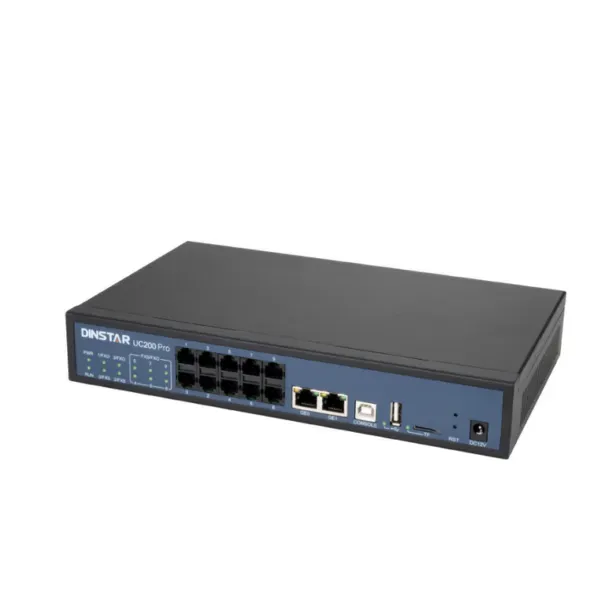
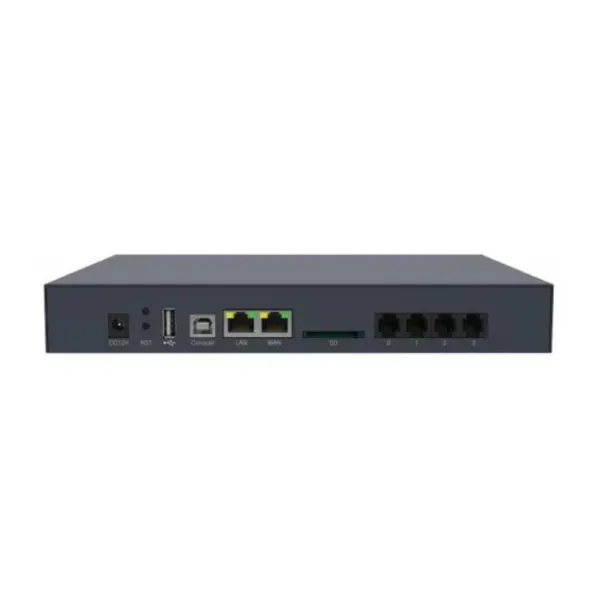
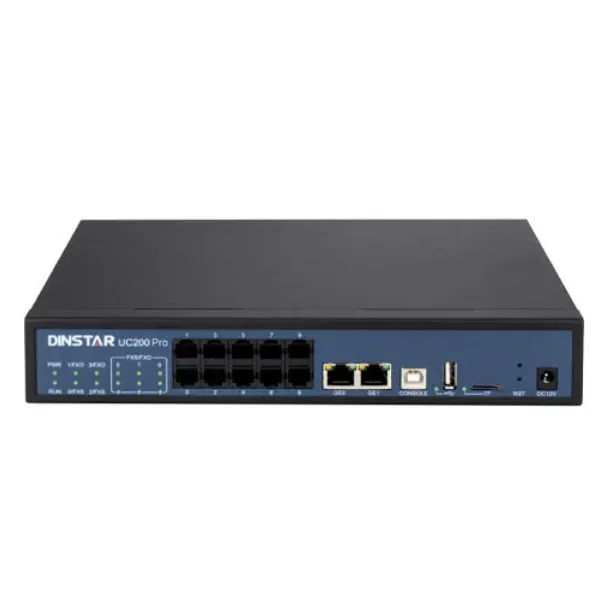
The Dinstar UC200 Pro is an on-premises IP PBX built for small and medium-sized organisations that want structured business calling without starting with an oversized communications platform. It combines SIP extension management, analog line connectivity, multi-level IVR, voicemail, call queues, call recording, flexible routing, security controls and web-based administration in a compact appliance. Dinstar publishes three licensing capacities—60, 200 and 500 SIP users—with corresponding concurrent-call capacities of 15, 30 and 50. The appliance includes two FXS and two FXO ports as standard and supports up to three additional 2S, 2O or 1S1O modules, making it practical for businesses that need to retain some analog phones, fax interfaces or PSTN lines while moving the wider environment toward IP telephony.
Verified capacity snapshot
SIP users: 60 / 200 / 500
Concurrent calls: 15 / 30 / 50
Default analog: 2 FXS + 2 FXO
Expansion: Up to 3 modules
What the Dinstar UC200 Pro solves
A growing office often reaches a point where consumer phone lines, isolated analog extensions or an aging PBX no longer match how teams work. Reception needs a predictable incoming-call flow, departments need ring groups and queues, staff need extension-to-extension calling, managers need voicemail and reporting, and branch users may need to connect across IP networks. The UC200 Pro addresses that middle ground between a very small gateway and a large enterprise call-control platform. It provides a purpose-built IP PBX with enough capacity for many SME deployments while retaining analog interfaces for transitional environments.
For Tanzanian buyers, the most important purchasing question is not simply whether the appliance supports SIP. The useful decision is whether the chosen license tier, concurrent-call capacity, analog port requirement, SIP trunk design and network readiness match the real call flow. A 200-user organisation may not need 200 simultaneous external calls, while a smaller call-intensive team may need careful concurrency planning. The UC200 Pro gives three published capacity tiers, so procurement teams can match expected extensions and call volume instead of choosing by headline user count alone.
Call handling
Multi-level IVR, ring groups, call queues, forwarding, waiting, holding, transfer, three-way conference, paging, dial rules and time-based routing support structured customer and internal call flows.
Analog migration
Two FXS and two FXO ports are built in. Up to three optional 2S, 2O or 1S1O modules can extend analog connectivity, with Dinstar publishing a maximum of eight FXS or eight FXO ports.
Management & security
The platform includes a web interface, configuration backup and restore, remote management, phone auto-provisioning, Dinstar NMS support, built-in VPN server/client capability and published protections including ACL, fail2ban, TLS and SRTP.
Dinstar UC200 Pro technical buying guide
| Area | Published UC200 Pro information | Procurement meaning |
|---|---|---|
| Capacity | 60/200/500 SIP users; 15/30/50 concurrent calls | Select both extension count and peak calling requirement. |
| Analog ports | 2 FXS + 2 FXO default | Useful for legacy handsets, compatible analog endpoints and PSTN transition scenarios. |
| Expansion | Up to three 2S, 2O or 1S1O modules | Plan future analog port growth before finalising the chassis configuration. |
| Recording | Local recording with USB storage support | Define recording policy, storage and retention separately from base call capacity. |
| Power | 12VDC, 2A; published power consumption 10W | Include protected power/UPS planning for production voice service. |
| Physical size | 260 × 154 × 42 mm; unit weight 1.1 kg | Compact for office communications cabinets, subject to safe mounting and airflow. |
Integration, network and deployment considerations
An IP PBX is only one component in a working voice system. Before deployment, map the SIP trunk or PSTN connection, extension numbering plan, desk phones, remote users, firewall policy, VLAN design, QoS treatment, internet dependency and backup-power strategy. Dinstar positions the UC200 Pro for integration with third-party systems such as hotel PMS, billing, CRM, conferencing, paging and security systems, but any live project should validate the exact interface and workflow rather than assume universal plug-and-play behaviour.
The surrounding LAN matters. Voice traffic can be sensitive to packet loss, delay and jitter, so a managed switch environment, appropriate voice VLAN design and sensible QoS can make a significant difference. Remote extensions or branch connectivity also require secure firewall and VPN planning. The UC200 Pro includes built-in VPN server/client capability and published protections such as fail2ban, whitelist/blacklist, ACL, TLS and SRTP, but the end-to-end security posture depends on the phones, SIP provider, firewall and administrative practices as well.
For a broader business-telephony project, FourTeck Tanzania can position the PBX alongside IP phones and related business technology in the Tanzania shop. Where analog devices need separate gateway treatment, related Dinstar products such as the DAG1000-1S analog telephone adapter and DAG1000-2S2O hybrid VoIP gateway provide examples of alternative interface-focused hardware. For wider regional telephony planning, see the FourTeck integrated IT and telecom portfolio and FourTeck IP phone specialist site.
Dinstar UC200 Pro IP PBX Tanzania
For organisations in Tanzania, the Dinstar UC200 Pro fits projects where business telephony needs to become more structured without abandoning every existing analog connection. Typical buyers may include professional offices, distributors, clinics, schools, hospitality properties, logistics companies, retail groups and branch-based organisations that need reception routing, internal extensions, queues, voicemail and centrally managed calling. The appliance is particularly relevant when a business is moving from a basic analog PBX or scattered phone lines toward SIP while still keeping selected PSTN trunks, analog handsets or fax-related endpoints during the transition.
Procurement should begin with a call-flow map. Count users who need extensions, identify reception and departmental groups, estimate the busiest simultaneous call period, decide whether remote users are required, and list any analog interfaces that must remain. The published UC200 Pro tiers provide 60, 200 or 500 SIP users with 15, 30 or 50 concurrent calls. That distinction is important because extension capacity and live-call capacity are different requirements. A company with many lightly used extensions may be comfortable on one tier, while a smaller service desk with heavy inbound traffic may place more emphasis on concurrency and queue behaviour.
Network readiness is equally important in Tanzania. Offices using shared internet for cloud applications, video meetings and SIP trunks should check link stability, firewall configuration, voice VLAN design, switch capacity and backup power. Where voice service depends on internet connectivity, businesses should discuss resilience options with their service providers and design failover according to the actual trunk arrangement. The UC200 Pro supports flexible routing and failover functions, but successful continuity depends on the complete network and carrier path.
When requesting a Tanzania quotation, provide the exact model name, required user tier, expected concurrent calls, number of FXO and FXS ports, preferred SIP provider, IP phone quantities, locations, need for recording, remote extensions and any CRM, PMS or paging integration. This produces a cleaner scope than asking only for a PBX price and helps identify modules, phones, switching and configuration work that may be needed around the appliance.
Dinstar UC200 Pro IP PBX Dar es Salaam
Dar es Salaam organisations often combine customer-facing teams, headquarters functions and branch connectivity, which makes call routing and reception design central to an IP PBX project. The Dinstar UC200 Pro can serve offices that need a defined main number flow, departmental ring groups, queues, voicemail and direct extension calling while retaining a limited number of analog lines. A professional services firm may use IVR to route callers to sales, accounts and support; a logistics company may separate operations and customer service queues; a hotel or serviced office may need controlled extension groups and selected analog interfaces. The correct design should follow the organisation’s real workflow rather than enabling every feature by default.
For Dar es Salaam procurement, identify whether external calling will use SIP trunks, FXO-connected PSTN lines or a hybrid arrangement. The UC200 Pro includes two FXO and two FXS ports and accepts up to three analog expansion modules, allowing a phased transition where legacy connectivity still has operational value. If more than the standard analog ports are required, specify the exact mix before ordering because the 2S, 2O and 1S1O modules serve different interface requirements. The maximum port figures should not be treated as a default configuration.
Call quality depends heavily on LAN and WAN preparation. Busy Dar es Salaam offices may carry data, CCTV, Wi-Fi and voice over the same switching infrastructure. Voice should therefore be assessed for VLAN separation, QoS, uplink congestion and firewall handling. For remote employees or satellite sites, secure connectivity and numbering rules should be tested before production rollout. Dinstar publishes VPN, TLS and SRTP capabilities, but compatibility across SIP endpoints and service providers must be confirmed end to end.
A useful quotation request should include office size, extension count, departments, peak incoming and outgoing calls, existing telephone lines, proposed IP phones, recording expectations and whether configuration, migration or testing assistance is required. Buyers should also confirm power protection for the PBX, switches and internet equipment so the communication path is not interrupted by a single unprotected component.
Dinstar UC200 Pro IP PBX Mwanza
In Mwanza, the UC200 Pro can fit branch offices, trading businesses, healthcare facilities, education sites, hospitality properties and regional operations that need a manageable business phone system with room for growth. A branch may begin with a moderate extension count but still need professional incoming-call handling, voicemail, office-hour routing and the ability to connect staff through SIP. The published 60/200/500-user license approach lets buyers plan capacity according to current and future requirements instead of replacing the entire platform when extension demand grows within the supported range.
Mwanza deployments should pay particular attention to how the PBX reaches external networks. If SIP trunks are used, assess internet stability, firewall configuration and provider interoperability. If existing analog trunks remain important, the built-in FXO interfaces can form part of a hybrid design, with optional modules available where additional analog ports are justified. For analog handsets or compatible legacy devices, FXS capacity should be counted separately. Clearly documenting which line is SIP, which is FXO and which endpoint remains analog prevents confusion during installation and later troubleshooting.
A regional business may also use the UC200 Pro as a consistent platform across locations. In that scenario, create a standard numbering convention, extension template, voicemail policy, administrator access method and backup procedure. Dinstar publishes configuration backup/restore, remote management and NMS support, which can help administrators maintain a repeatable environment. Remote access should still be governed by strong credentials, restricted management exposure and secure network policies.
For procurement in Mwanza, send a scope that includes user count, expected concurrent calls, analog port requirement, SIP trunk details, phone models if already chosen, network topology and support expectations. Where a site has limited onsite IT resources, documentation becomes especially valuable: extension lists, call-flow diagrams, trunk settings, module inventory and escalation contacts can make future support faster and reduce dependence on informal knowledge.
Dinstar UC200 Pro IP PBX Arusha
Arusha has a diverse mix of hospitality, tourism, professional, education and regional administrative organisations, many of which need reliable call handling between reception, reservations, offices and operational teams. The Dinstar UC200 Pro can support this type of environment where multiple extensions, IVR, queues, voicemail and time-based routing are more useful than a simple collection of independent phone lines. For hotels or service businesses, Dinstar also positions the platform for integration with hotel PMS and other third-party systems, but the exact integration method should be verified against the target application before the project is approved.
For an Arusha hotel or lodge office, requirements may include front-desk calling, administrative extensions, office-hour rules, room or service-area endpoints and links to external trunks. For a tour operator, the focus may instead be sales queues, call recording, remote agents and overflow routing. The same PBX can be configured differently depending on business process, so the configuration workshop should precede final programming. Recording requirements also need a retention policy and suitable USB storage planning rather than being treated as an unlimited built-in archive.
Network conditions should be included in the design. If staff rely on Wi-Fi, cloud systems and SIP calling, keep voice traffic predictable with managed switching, QoS and clear firewall rules. Remote extensions should use secure methods, and SIP credentials should not be exposed unnecessarily. The UC200 Pro publishes TLS, SRTP, ACL, fail2ban and VPN capabilities, but security depends on how these features are deployed with compatible endpoints and providers.
An Arusha quotation should state whether the site is a single office or part of a multi-site group, how many extensions need desk phones, which users need soft or remote access, how many simultaneous external calls are expected, and whether analog lines must remain. Providing this information makes it easier to choose the correct UC200 Pro tier and module combination and to identify any switching, UPS, cabling or IP phone requirements that belong in the same project.
Dinstar UC200 Pro IP PBX Dodoma
Dodoma businesses and institutions evaluating the Dinstar UC200 Pro should focus on structured call management, growth planning and dependable administration. Offices with multiple departments can use IVR, ring groups, queues, voicemail and time-based routing to reduce dependence on one receptionist manually transferring every call. The PBX also supports common extension features such as call forward, waiting, holding, transfer and three-way conferencing. These capabilities are most useful when they are mapped to real departmental responsibilities and documented in a call-flow plan.
Capacity selection should be evidence-based. Dinstar publishes 60, 200 and 500 SIP-user levels and 15, 30 and 50 concurrent calls. A government-related office, NGO, educational institution or growing private company may have many extensions but only moderate external concurrency; another service-oriented organisation may have fewer staff but a busier queue. Estimating peak call periods helps determine whether the intended tier is appropriate and avoids sizing only by total headcount.
Dodoma projects may also involve a mixture of new IP phones and retained analog equipment. The two built-in FXS and two FXO ports allow basic legacy connectivity, while optional modules can expand the analog mix. Before ordering, list each analog device and line so the required FXS versus FXO count is clear. FXS serves analog endpoints; FXO connects to compatible analog trunk lines. Confusing the two can lead to incorrect module selection.
Operational continuity should include UPS protection for the PBX, network switch, firewall/router and internet termination equipment, not only the PBX itself. Administrators should keep current configuration backups, document extension assignments and control remote management access. For a quotation, send the expected extension count, concurrency, trunk design, analog requirements, IP phone quantity and any need for recording, CRM linkage, paging or branch connectivity so the implementation can be scoped as a complete communications system.
Dinstar UC200 Pro IP PBX UAE
For UAE businesses evaluating the UC200 Pro, the appliance is most relevant to SME offices, retail groups, clinics, hospitality properties and branch operations that need on-premises call control with SIP and analog flexibility. The core decision remains the same across markets: match the license tier and concurrent-call capacity to the organisation’s real traffic. Dinstar publishes 60/200/500 SIP users and 15/30/50 concurrent calls, so an office should estimate peak external and internal calling before choosing a tier.
UAE deployments frequently include structured Ethernet, managed PoE switching, business firewalls and SIP trunks, which can provide a good foundation for IP telephony when correctly configured. The UC200 Pro can auto-provision supported IP phones and provides web-based management, while built-in VPN functions and security features can support remote and branch scenarios. Exact endpoint interoperability and SIP provider settings should be validated during staging. Where an office retains analog PSTN lines or legacy devices, the two standard FXO and two FXS ports plus optional modules can support a controlled hybrid migration.
Multi-branch organisations should standardise extension numbering, outbound caller rules, permissions, emergency dialing policies, voicemail behaviour and configuration backup. They should also define whether calls between branches traverse a private VPN, public SIP service or another managed connection. The PBX supports flexible routing and source-based rules, but a resilient architecture depends on the whole network, not only PBX features.
For buyers coordinating a Tanzania-UAE communications standard, using the same model family can simplify administration if capacity and local telecom requirements are compatible. Procurement teams should still treat each country’s carrier services, numbering plans and regulatory obligations separately. The FourTeck regional portfolio can support broader technology planning where IP telephony must align with switching, firewall, cabling and endpoint standards.
Dinstar UC200 Pro IP PBX Uganda
Ugandan organisations looking at the Dinstar UC200 Pro may be upgrading from legacy PBX equipment, introducing SIP trunks or standardising communications across branches. The system’s combination of SIP extensions, analog interfaces and scalable licensing is useful where migration cannot happen in one step. Two FXS and two FXO interfaces are included, with up to three analog expansion modules available, while the SIP side can scale through published 60, 200 or 500-user tiers.
A strong Uganda deployment plan begins by separating endpoint count from calling demand. Extensions represent users or devices registered to the PBX; concurrent calls represent simultaneous call sessions. This distinction matters for organisations with many staff who do not all make calls at once, and for customer-service environments where the opposite may be true. Map queue traffic, reception peaks, inter-branch calling and recording needs before selecting the tier.
If the organisation operates multiple sites, build a common numbering and management policy. Dinstar provides configuration backup and restore, remote management, auto-provisioning and NMS integration, which can help reduce configuration drift. Security should include restricted administrator access, strong credentials, firewall policies and encrypted SIP/media where supported throughout the path. Remote endpoints should not be exposed casually to the public internet.
For procurement, provide site locations, user counts, expected simultaneous calls, trunk type, analog line requirements, IP phone quantities and whether each site needs local breakout or centralised call routing. A regional business can also compare support options through FourTeck Uganda, while keeping model, licensing and telecom-service details specific to each deployment.
Dinstar UC200 Pro IP PBX Kampala
Kampala offices often need a PBX that can connect reception, sales, accounts, support and management without making every external call dependent on manual transfer. The Dinstar UC200 Pro supports the core functions required for that structure: multi-level IVR, ring groups, queues, call forwarding, transfer, voicemail, recording and time-based routing. These features can improve consistency when configured around a documented customer journey, for example routing incoming calls to sales during business hours and to voicemail or an alternate destination after hours.
For Kampala SMEs, selecting between 60, 200 and 500 SIP-user tiers should reflect projected growth rather than only today’s employee count. It is also important to estimate concurrent calling. A business with 100 employees may not need 100 simultaneous calls, while a smaller contact-heavy team could require more concurrency than headcount alone suggests. Reception and queue statistics from an existing system can help produce better estimates where available.
Hybrid migration is another practical use case. The built-in 2 FXS and 2 FXO interfaces allow selected analog devices and trunks to remain during a transition, and expansion modules can add further ports when justified. Before purchase, classify each retained connection as an endpoint or a trunk. This ensures the correct FXS/FXO mix and avoids unnecessary modules.
Kampala deployments should also plan the supporting network. Voice VLANs, QoS, firewall rules and UPS coverage help make the PBX predictable during normal operations. SIP trunk providers, remote phones and integrations should be staged and tested using real inbound, outbound, transfer, DTMF, voicemail and failover scenarios. A complete quotation should therefore include not only the PBX model but also phones, switching, power protection, configuration, migration and testing requirements.
Dinstar UC200 Pro IP PBX Arua
In Arua, the Dinstar UC200 Pro can be considered by branch offices, NGOs, service organisations, education sites and growing businesses that need a centrally managed telephone system without deploying a large enterprise platform. A branch with limited onsite IT support can benefit from a consistent extension plan, web-based administration, configuration backups and remote management. These features do not eliminate the need for good documentation, but they can reduce the number of site visits required for ordinary administrative changes.
Connectivity planning is especially important for any site that relies on SIP trunks or a centralised branch connection. Before deployment, test the primary internet link for stability and ensure the firewall handles SIP and RTP according to the provider’s requirements. If the business has a secondary connection, decide whether and how voice should fail over. The UC200 Pro includes flexible routing and failover capabilities, but continuity still depends on available carrier paths, DNS, firewall state and remote provider behaviour.
For local analog requirements, the standard two FXO and two FXS ports provide a starting point, with module expansion available for additional ports. A remote site might retain one analog line for a specific operational reason while moving most extensions to SIP. Another may need analog endpoint support for a fax workflow or legacy phone. Each retained connection should be tested in the final design rather than assumed to behave identically after migration.
An Arua quotation request should include whether the UC200 Pro will operate independently or connect to other branches, how many users and simultaneous calls are expected, which external trunks will be used, and what remote administration model is preferred. Including an inventory of switches, firewall/router, internet links, UPS capacity and IP phones helps identify infrastructure gaps before deployment rather than during installation.
Dinstar UC200 Pro IP PBX Mbarara
Mbarara businesses that are adding departments, opening branches or moving from analog telephony to SIP can use the UC200 Pro as a structured migration platform. The PBX provides built-in analog connectivity while supporting SIP endpoints and multiple capacity licenses, making it possible to modernise call handling without necessarily discarding every existing connection on day one. The strongest fit is where a business needs IVR, departmental routing, voicemail, queues and central administration rather than only basic extension dialing.
Sizing should consider the busiest operating window. Retail, healthcare, hospitality and service environments can see short periods of high call demand even when average usage is modest. Estimate incoming queue peaks, outbound calling by sales or operations, inter-branch sessions and any recording overhead. Dinstar publishes concurrent-call limits aligned to each user tier, so this planning directly affects license selection.
Mbarara deployments should also evaluate the physical communications environment. The PBX consumes relatively little power, but a functioning phone system also depends on switches, routers, firewalls, SIP trunks and endpoint power. A UPS that protects only the PBX will not preserve service if the network switch or internet equipment goes down. Include these dependencies in the resilience plan and document recovery procedures.
For organisations with a head office elsewhere, use consistent extension ranges and naming conventions so users can understand branch dialing. Decide who administers the system, how configuration backups are stored and how firmware updates are controlled. When asking for a quotation, provide expected user and call counts, number of analog trunks/endpoints, phone quantities and whether remote configuration or migration assistance is needed. This turns the purchase from a hardware-only request into a deployable communication solution.
Dinstar UC200 Pro IP PBX Gulu
Gulu organisations may consider the Dinstar UC200 Pro for offices, institutions, service centres and branch locations that need an IP PBX with a manageable physical footprint and room to scale. The platform’s 60, 200 and 500 SIP-user tiers make it suitable for different organisational sizes within its supported range, while 15, 30 and 50 concurrent calls provide a separate measure for traffic capacity. Buyers should choose the tier by combining both metrics with a realistic growth forecast.
For a branch environment, remote administration can be valuable. The UC200 Pro supports web management, configuration backup/restore, phone auto-provisioning and Dinstar NMS. A central IT team can use these capabilities as part of a standard operating model, but should restrict management access, maintain current backups and document who has administrative rights. Security features such as ACL, fail2ban, TLS, SRTP and VPN should be evaluated with the endpoints and SIP carrier rather than enabled without compatibility testing.
Analog transition requirements should be recorded in detail. The appliance starts with 2 FXS and 2 FXO ports and can add up to three compatible modules. If a Gulu site needs only one or two analog lines, the standard interfaces may be sufficient. If it needs several analog devices or PSTN trunks, module quantities and port types must be calculated before procurement. The maximum eight-port figures represent supported expansion limits, not the shipped default.
A practical project scope should cover call flows, hours of operation, extension ranges, ring groups, queues, voicemail, external trunks, remote users, IP phones, network segmentation and power protection. Testing should include inbound and outbound calls, DTMF, transfer, hold, voicemail, queue operation and any failover path. This approach is more reliable than treating installation as simply connecting the appliance and adding extensions.
Dinstar UC200 Pro IP PBX Kenya
Kenyan businesses evaluating the UC200 Pro can use it for SME headquarters, branch offices, hospitality, retail and service environments where an on-premises PBX is preferred. The system’s three user tiers and analog expansion options support gradual growth, while IVR, queues, voicemail, recording and flexible routing give administrators the tools to create more professional incoming-call handling. The appliance should be selected as part of a telephony architecture that includes trunks, endpoints, switching, security and support.
A Kenya project should first determine whether external calling uses SIP trunks, retained PSTN lines or both. The two built-in FXO ports can accommodate compatible analog trunks, while the FXS ports serve analog endpoints. Optional modules can expand either side. If an organisation expects to migrate fully to SIP later, document which analog dependencies are temporary and which must remain for operational reasons. This helps avoid buying expansion hardware that is not needed long term.
For multi-site groups operating in Kenya and Tanzania, standardisation can simplify training and support if each site’s capacity requirements are compatible. Extension numbering, call permissions, administrative roles and configuration backup can follow common templates while local trunk and numbering details remain site-specific. Dinstar’s remote management and NMS capabilities can support such a model.
Kenyan buyers can review broader regional technology support through FourTeck Kenya. When requesting a UC200 Pro quotation, include user count, concurrent calls, location, trunk type, analog ports, IP phones, recording needs and expected integrations. This level of detail helps compare proposals on actual scope instead of comparing only the appliance price.
Dinstar UC200 Pro IP PBX Kuwait
Kuwait SMEs and branch offices can consider the Dinstar UC200 Pro where an on-premises phone system is required for SIP calling, departmental routing and selected analog connectivity. The system is not limited to basic extension registration; it includes IVR, queues, voicemail, call recording, routing groups and time-based dial control. These functions can support reception teams, customer-service desks and multi-department offices when configured to match actual business processes.
The three published user tiers should be evaluated with peak concurrency. A company may need many extensions for managers, offices and shared areas but only a modest number of simultaneous calls. Another organisation may operate a busy support line where concurrent calls are the primary constraint. Recording can also affect performance planning, so a project that records a large proportion of calls should review Dinstar’s current documentation and storage requirements for the intended release and configuration.
Legacy connectivity is supported through the built-in 2 FXS and 2 FXO interfaces plus up to three modules. This can be useful in Kuwait offices where analog lines or endpoints are being phased out gradually. The migration plan should identify whether each analog connection is permanent, temporary or only a fallback. That classification helps determine whether expansion modules are needed and how future SIP migration will simplify the hardware footprint.
Network and security controls should be treated as part of the voice project. Separate voice traffic where appropriate, apply QoS, protect administrator access and test SIP provider behaviour through the firewall. Where remote extensions are enabled, use secure connectivity methods and compatible encryption. A quotation should list all these dependencies so the final deployment includes configuration, testing and documentation rather than only appliance supply.
Dinstar UC200 Pro IP PBX Ghana
Ghanaian organisations can use the Dinstar UC200 Pro for business calling where a compact on-premises IP PBX needs to support both modern SIP endpoints and selected analog connections. The platform is particularly suitable for growing SMEs that need to formalise reception, department routing and voicemail while retaining flexibility for analog trunks or devices. Dinstar’s published capacities of 60/200/500 SIP users and 15/30/50 concurrent calls create clear sizing checkpoints for procurement.
Before purchasing, businesses should build a simple traffic model. Count extensions, estimate the busiest hour, identify queues and ring groups, note any simultaneous recording requirements and account for branch or remote users. This avoids assuming that the largest user tier is automatically the best choice. A correctly sized PBX should meet current demand with sensible growth margin while remaining manageable for the IT team.
For analog migration, start by listing current PSTN lines and analog phones or fax endpoints. The two FXO and two FXS ports may cover a small hybrid requirement, while extra modules can expand capacity. Test fax and other legacy workflows through the complete call path before go-live because compatibility depends on more than the PBX alone.
Ghana deployments should include network documentation, backup power, firewall policy and administrative controls. Dinstar publishes web management, NMS, backup/restore, VPN and security functions, but good operations require disciplined configuration management. If the business spans several countries, keep a common PBX configuration standard while adapting trunks and numbering to each market. A detailed quotation request should therefore identify user count, call concurrency, analog ports, endpoint quantities and integration needs.
Dinstar UC200 Pro IP PBX Nigeria
Nigeria’s large and varied SME market includes offices, retail networks, hospitality sites, clinics, education organisations and service businesses that can benefit from structured call handling. The Dinstar UC200 Pro offers an on-premises platform for SIP extensions, IVR, queues, voicemail, recording and routing, with built-in analog ports for hybrid migration. Its published capacity tiers make it possible to match the appliance to a department, branch or mid-sized office without immediately moving to a larger enterprise PBX family.
For Nigerian deployments, internet and power resilience deserve early attention. If SIP trunks or remote extensions depend on public internet connectivity, the business should define how calls behave if the primary link fails. A secondary ISP can improve resilience only if routing, firewall, DNS and carrier registration are designed to use it. Likewise, UPS or inverter planning should protect the complete voice chain—PBX, switches, router/firewall and internet termination—not only the UC200 Pro.
The system’s analog interfaces can support phased migration. Two FXO and two FXS ports are built in, with optional modules expanding the available port mix. A site that still has important analog lines can preserve them while introducing SIP phones and new call-flow features. Procurement should specify each required port type so the supplied configuration matches the real environment.
Security should include restricted management access, strong passwords, monitored logs and compatible encryption. The UC200 Pro supports published protections including ACL, fail2ban, TLS, SRTP and VPN. These should be integrated into a wider network-security policy rather than treated as a substitute for firewall and endpoint security. A clear Nigeria quotation should list site count, user count, concurrency, trunks, analog devices, phones and support scope to make technical and commercial comparison easier.
Dinstar UC200 Pro IP PBX Seychelles
Seychelles businesses, especially hospitality, tourism, professional services and distributed operations, may evaluate the Dinstar UC200 Pro when they need a manageable IP PBX with analog flexibility. Hotels, resorts and service companies often have structured reception and departmental calling requirements, and Dinstar positions the UC200 Pro for integration with hotel PMS and other third-party business systems. Any planned integration should be confirmed against the specific PMS version and interface before procurement.
For island and multi-property environments, reliable connectivity between sites is a key design factor. If extensions or trunks traverse WAN links, test latency, packet loss and failover behaviour. The UC200 Pro can support VPN functions and flexible routing, but real service continuity depends on the underlying network and carrier services. A centralised PBX may simplify administration, while local PBXs can reduce dependence on inter-site connectivity; the right choice depends on operating requirements and available links.
Analog ports can be useful where existing lines or devices must be retained during a transition. The standard 2 FXS and 2 FXO ports and optional expansion modules provide flexibility, but a hospitality environment should carefully inventory every legacy endpoint before assuming the PBX can directly replace an older system. Room phones, fax devices, door systems and emergency lines can have specialised requirements that need separate validation.
A Seychelles quotation should include property or office type, user count, number of guest or staff extensions if applicable, concurrent calls, analog trunk requirements, PMS integration expectations, remote-management needs and endpoint quantities. Recording, voicemail-to-email and queue features should be linked to operational policies so staff understand how calls are handled and retained. This turns the UC200 Pro into a managed communications platform rather than simply a replacement PBX box.
Related Dinstar and FourTeck Tanzania options
The UC200 Pro is an IP PBX, while Dinstar’s DAG family focuses on analog VoIP gateway and adapter functions. If a project mainly needs to connect one or two analog endpoints to an existing SIP platform rather than deploy a new PBX, review a purpose-built gateway instead. The Dinstar DAG1000-2S two-FXS adapter is an example for analog endpoint conversion, while the UC200 Pro becomes appropriate when call-control functions, extensions, IVR and routing are required in the same appliance.
When comparing alternatives, separate the functions you need: PBX call control, SIP trunking, analog gateway ports, desk phones, network switching, firewall policy and power protection. Combining these requirements in one bill of materials helps prevent purchasing a gateway when a PBX is required—or overbuying a PBX when the real need is only analog-to-SIP conversion.
Quotation checklist for Dinstar UC200 Pro
✓ Required SIP user tier: 60, 200 or 500
✓ Expected peak concurrent calls
✓ Number of IP phones and user roles
✓ SIP trunk/provider details
✓ Required FXS and FXO ports
✓ Need for IVR, queues and recording
✓ Remote users or branch links
✓ CRM/PMS/paging integration requirements
✓ Network/VLAN/firewall environment
✓ UPS and resilience expectations
Dinstar UC200 Pro FAQs
How many users does the Dinstar UC200 Pro support?
Dinstar publishes three SIP extension capacities: 60, 200 and 500 users. The corresponding concurrent-call capacities are 15, 30 and 50. Select the tier using both extension count and peak simultaneous calls.
Does the UC200 Pro include FXO and FXS ports?
Yes. The standard appliance includes two FXS and two FXO ports. Dinstar also supports up to three additional expansion modules in 2S, 2O or 1S1O combinations, with published maximums of eight FXS or eight FXO ports depending on configuration.
Can the Dinstar UC200 Pro record calls?
Dinstar lists local recording with USB storage support. Recording policy, storage capacity, retention and any applicable privacy or compliance obligations should be planned as part of the deployment.
Does the UC200 Pro support IVR and call queues?
Yes. Published features include multi-level IVR, auto attendant, ring groups, call queues, routing groups, dial rules and time-based routing.
Can the UC200 Pro be used with remote offices?
It can support remote SIP endpoints and provides built-in VPN server/client capability. The final remote-office design should validate internet quality, firewall rules, endpoint compatibility, security and failover requirements.
What information is needed for a UC200 Pro quotation in Tanzania?
Provide the city, user count, expected simultaneous calls, SIP trunk or PSTN arrangement, number of FXS/FXO ports, IP phone quantities, recording needs, remote-user requirements, integrations and whether installation or configuration assistance is required.
Decision recap
Choose the Dinstar UC200 Pro when the requirement is a compact SME IP PBX with SIP users, professional call handling, analog trunk/endpoint support and a clear path from 60 users toward higher licensed capacities. Its strongest value is flexibility: the same appliance family can support a small initial deployment, add analog modules where required and provide business functions such as IVR, queues, voicemail, recording and routing.
Before ordering, validate four items: user tier, peak concurrency, FXS/FXO requirements and network/trunk compatibility. Then include phones, switching, firewall rules, backup power, configuration and testing in the project scope. This produces a more reliable result than comparing PBX hardware prices in isolation.
Plan a Dinstar UC200 Pro deployment
FourTeck Tanzania can review your extension count, trunk type, analog interfaces, IP phone requirement and network environment before quotation. Share your current telephone setup and desired call flow so the UC200 Pro configuration can be matched to the project rather than treated as a one-size-fits-all appliance.


Reviews
There are no reviews yet.