

SIP door communication · access-control integration · business deployment
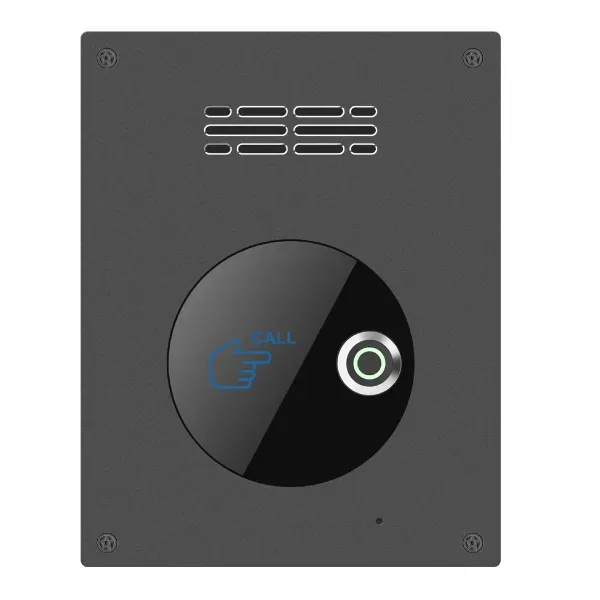
Dinstar DP81U SIP Audio Intercom
The Dinstar DP81U is a purpose-built SIP audio intercom for entrances where visitors need a simple way to call an internal extension and authorized staff need a practical method to release an electronic door remotely. Dinstar positions the DP81U for business, institutional and residential applications and equips it with full-duplex two-way audio, HD voice, two SIP lines, two SIP servers, relay outputs, sensor inputs, PoE, secure SIP options and centralized management capabilities. For buyers in Tanzania, the practical value is not just the call button: it is the ability to connect the entrance intercom to an IP PBX, managed network and door-access workflow so voice communication and entry control are handled as one coordinated system.
Two SIP lines
Two SIP lines and two SIP servers provide flexible registration and resilience options within compatible IP telephony environments.
HD voice
G.722 wideband audio, full-duplex operation, echo cancellation, VAD and comfort-noise generation support intelligible entrance communication.
Door control
DTMF door access and two relay outputs allow the DP81U to participate in electronic-lock and controlled-entry workflows when the full door hardware is designed correctly.
PoE or 12V DC
The unit supports IEEE 802.3af PoE Class 3 or a 12V/1A DC supply, giving installers flexibility in entrance power and network planning.
What the Dinstar DP81U is designed to solve
A conventional doorbell only alerts someone that a visitor is present. A SIP intercom adds a communication layer by registering to a standards-based voice system and placing a call to an extension, hunt group or other configured destination. This is useful in offices, gated premises, schools, clinics, apartment common areas, warehouses and secured facilities where the person deciding whether to admit a visitor may be away from the entrance itself. The DP81U is especially relevant to organizations that already operate an IP PBX or want the entrance device to become part of the same managed SIP environment as desk phones and other voice endpoints.
Dinstar lists SIP v1 and SIP v2 support, SIP over TLS, SRTP, RTP/RTCP, DHCP, static addressing, PPPoE, STUN, VLAN-related functions and several DTMF methods. In practical terms, that gives network and telephony teams a useful set of tools for integrating the intercom into a managed LAN. The door side of the installation includes relay outputs, short-circuit sensor inputs, exit-button connections, tamper detection and an external Wiegand reader interface, so the intercom can sit within a broader controlled-entry design rather than functioning only as an audio endpoint.
The most important buying principle is to evaluate the complete entrance. The intercom itself does not replace every component in a door system. Lock type, door construction, egress requirements, power supply, fail-safe or fail-secure behavior, exit hardware, network availability, PBX destination, mounting position and organizational security policy all need to be considered before installation. FourTeck can help translate those requirements into a practical bill of materials and deployment plan rather than treating the DP81U as an isolated device.
Verified Dinstar DP81U technical highlights
| Area | Verified DP81U detail | Deployment relevance |
|---|---|---|
| SIP | Two SIP lines, two SIP servers; SIP v1 RFC2543 and SIP v2 RFC3261 | Supports standards-based registration with compatible PBX environments. |
| Security | SIP over TLS and SRTP | Provides options for encrypted signaling and media where the PBX and network are configured to match. |
| Audio | G.722, PCMA, PCMU, G.729, G.723 variants and G.726-32; full duplex; G.168 echo cancellation | Supports clear two-way entrance conversations and codec flexibility. |
| Network | 1 × 10/100 Mbps RJ45 Ethernet with PoE; 802.1p/q, DSCP and 802.1x listed | Allows integration with managed switching, QoS and access-control policies. |
| Power | 12V/1A DC or 802.3af PoE Class 3 | Enables either local power or centralized PoE depending on site design. |
| Door interfaces | Two relay outputs, two sensor short-circuit inputs, two exit-button interfaces, tamper detection and external Wiegand reader interface | Supports broader controlled-entry integration when combined with suitable locks and safety hardware. |
| Management | HTTP/HTTPS web management, FTP/TFTP/HTTP/HTTPS/PnP provisioning, SNMP/TR-069, syslog, backup/restore | Useful for repeatable setup, diagnostics and multi-device administration. |
| Installation | Wall mounted; aluminum surface and metal bottom shell; 120 × 153 × 40 mm | Allows installers to plan enclosure position, cable entry and physical clearance. |
| Environment | Working temperature -30°C to 65°C; storage -40°C to 70°C; relative humidity 10%–90% | Useful for checking suitability against actual installation conditions. |
Compatibility, PBX integration and door-system planning
A successful DP81U project normally has three design layers: the SIP call path, the IP network and the physical door path. On the SIP side, the PBX must create or accept an extension for the intercom, determine which destination rings when the call button is pressed and define how the recipient sends the DTMF command used for release. The receiving endpoint could be an IP phone or another supported SIP destination depending on the PBX design. Security settings such as TLS and SRTP should be tested end to end because enabling them only on the intercom does not automatically encrypt the entire call path.
On the network side, planners should confirm Ethernet availability at the entrance, switch port configuration, VLAN policy, PoE budget, DHCP or static-addressing preference, DNS and NTP reachability, firewall rules and the provisioning method. Because intercoms are installed at a physical boundary, network security deserves particular attention. Administrators can use managed switching, segmentation, strong credentials and restricted management access to reduce unnecessary exposure. The DP81U supports HTTPS management, 802.1x and encrypted SIP options, but those capabilities must be configured within the wider architecture.
On the door side, confirm the electronic lock, relay logic, door sensor, exit button and any Wiegand reader requirements before procurement. Door hardware choices have safety and operational consequences, so installers should not assume that one relay wiring pattern is appropriate for every entrance. A secure deployment also considers what happens during power interruption, fire or emergency egress, how staff verify visitors and whether an access-control platform or CCTV system should record related events.
Related FourTeck Tanzania resources
FourTeck Tanzania servicesRelevant when the requirement includes planning, integration, configuration, testing or lifecycle support rather than hardware supply alone.
Dinstar C63G Business IP PhoneA related Dinstar SIP endpoint that can be considered for office telephony environments receiving intercom calls through a compatible PBX.
Dinstar C64G Business IP PhoneA related business SIP handset for organizations standardizing Dinstar endpoints in a voice network.
Dinstar C64GP PoE Business IP PhoneUseful where an organization wants PoE-powered desk endpoints alongside a PoE-powered DP81U entrance intercom.
Dinstar C66G Business IP PhoneA higher-capacity related Dinstar SIP desk endpoint for users who require more advanced call handling.
Dinstar C66GP PoE Business IP PhoneA PoE related handset for integrated voice deployments where centralized power is preferred.
FourTeck Tanzania contact pageUse this page to share quantities, entrance details, PBX information, door-lock requirements and quotation scope.
Dinstar DP81U SIP Audio Intercom Tanzania
Organizations searching for the Dinstar DP81U SIP Audio Intercom in Tanzania are usually solving more than a voice requirement. They need an entrance point that can call the right person, allow the visitor and recipient to speak clearly, and participate in a controlled door-release process without forcing reception staff to remain physically beside the entrance. The DP81U fits this workflow because it operates as a SIP endpoint while also providing relay, sensor, exit-button and reader interfaces that can be used in a broader door design. For an office, school, healthcare facility, warehouse, apartment common area or gated business property, this can create a more structured visitor process than a standalone bell or analog intercom.
Tanzania deployments should start by mapping the entrance to the existing communication environment. If the organization already runs an IP PBX, the technical team should verify extension registration, dial plan, DTMF method, destination behavior and codec policy. If the PBX is being purchased with the intercom, the entrance workflow should be included in the call-flow design from the beginning. This avoids a common project problem where the intercom can register but the chosen door-release command, ringing behavior or security setting does not match the receiving phones. The DP81U provides two SIP lines and two SIP servers, creating useful design options, but the exact configuration should reflect the organization’s PBX and resilience strategy.
Power and connectivity deserve equal attention. The device supports 802.3af PoE Class 3 as well as 12V DC, so a managed PoE switch can simplify the entrance by carrying both data and power on one Ethernet cable. Where continuity during short power interruptions matters, the switch, PBX and other network components may need UPS protection; otherwise a PoE device can still lose service when its upstream infrastructure goes down. Outdoor or exposed mounting conditions should also be checked against the actual enclosure, weather exposure, cable protection and manufacturer environmental limits rather than assuming that every sheltered and unsheltered entrance is equivalent.
For a Tanzania quotation, provide the number of entrances, whether each door has an electronic lock, the lock voltage and type if known, PBX make and version, intended receiving extensions, available network ports, PoE switch details, door sensor or exit-button requirements, Wiegand reader requirement, mounting conditions and desired support scope. This information allows FourTeck to discuss the DP81U as part of a workable entrance system instead of quoting an incomplete set of parts.
Dinstar DP81U SIP Audio Intercom Dar es Salaam
In Dar es Salaam, the Dinstar DP81U can suit corporate offices, logistics facilities, professional-services firms, apartment common areas, warehouses, education sites and hospitality back-office entrances where visitor communication needs to integrate with the organization’s IP network. Many commercial sites in the city already combine IP phones, Wi-Fi, CCTV and business data on managed Ethernet infrastructure. Adding a SIP intercom to that environment can be efficient, but it should be planned as another managed endpoint rather than connected without segmentation, power and access-control consideration.
A typical Dar es Salaam use case may involve a visitor pressing the DP81U call button at a perimeter or reception entrance, with the call routed through the PBX to reception, security or a designated user. After speaking with the visitor, the recipient can send a configured DTMF command to trigger the door relay when the door system is designed for remote release. If reception is temporarily unavailable, the PBX may be able to route the call to a group or alternative extension depending on its capabilities. These workflows should be agreed before installation so users understand who answers, who is authorized to release the door and what happens after hours.
Busy Dar es Salaam offices may also benefit from centralizing power through PoE. The DP81U supports 802.3af PoE, which can reduce the need for a separate power outlet at the intercom location. The PoE switch should have enough budget and should be installed in a protected, documented rack where practical. If the business wants entrance communication to remain available during short interruptions, the network, PBX and switch need a continuity plan rather than focusing only on the intercom. VLANs and restricted management access can help separate the entrance endpoint from general user devices.
Before requesting a Dar es Salaam quotation, identify door construction, lock type, cable distance, network availability, PBX platform, expected call destination, desired DTMF behavior, sensor and exit-button requirements, and whether CCTV is positioned to verify visitors visually. FourTeck can then help align the Dinstar intercom with related switching, IP telephony and access-control planning instead of treating the unit as a standalone purchase.
Dinstar DP81U SIP Audio Intercom Mwanza
Mwanza organizations considering the Dinstar DP81U may be upgrading a branch entrance, introducing IP-based visitor communication or extending an existing SIP telephone system to a gate or controlled door. The model is suitable for environments where reliable voice communication and simple remote door release are more important than video. This can include offices, clinics, schools, storage facilities, residences with managed common entrances and commercial compounds that want a direct communication path between visitors and staff.
Branch environments often place a premium on management and repeatability. The DP81U supports HTTP/HTTPS web administration, several auto-provisioning methods, SNMP, TR-069, syslog and configuration backup/restore. Those features can be valuable when an organization wants to apply consistent SIP, network and security settings across more than one entrance or site. A centralized approach also makes documentation easier because extension numbers, IP addresses, relay behavior and firmware status can be recorded as part of the wider IT asset register.
Connectivity between Mwanza branches and a centrally hosted PBX should be assessed carefully. SIP registration over a WAN requires stable routing, suitable firewall rules and acceptable latency and jitter. The intercom supports common SIP and RTP mechanisms, but endpoint capability does not compensate for an unreliable WAN. Where the PBX is local, the dependency on internet connectivity may be lower, though branch-to-branch or external calling can still involve upstream services. Security teams should also decide whether TLS and SRTP are required and verify that the PBX supports the same implementation.
For procurement, Mwanza buyers should share whether the project is one door or multiple locations, the PBX location, switch and PoE details, lock and door hardware, network addressing preference, user group that receives calls and any need for remote configuration. If the intercom is being added alongside new desk phones or a PBX refresh, it is efficient to plan voice VLANs, QoS, switch ports and UPS capacity as one coordinated project.
Dinstar DP81U SIP Audio Intercom Arusha
Arusha businesses in tourism, hospitality administration, professional services, education, property management and logistics may use a SIP audio intercom to improve visitor handling without requiring staff to remain at the door. The Dinstar DP81U offers an especially practical fit where the site already uses an IP PBX and wants the entrance to call reception, security or another internal extension using the same communication system. The device’s HD voice, full-duplex operation and echo cancellation are intended to keep short entrance conversations understandable while a decision is made about access.
Hospitality and guest-facing properties should define the visitor journey carefully. A service entrance, staff entrance, office lobby and perimeter gate may all require different calling destinations and authorization rules. One entrance may ring reception during business hours and security after hours, while another may be restricted to internal staff. The PBX can often provide time-based routing or hunt groups, but those functions belong to the PBX design and should be tested with the intercom. Dinstar’s two SIP lines and two SIP servers can support flexible registration, but the final logic should be documented.
Physical installation is equally important in Arusha because entrances vary widely. Wall construction, mounting height, shelter, cable path, tamper risk and the location of the electronic lock all affect the installation. The DP81U provides tamper detection and multiple door-related interfaces, but those interfaces need to be wired and configured according to the actual access-control arrangement. Where a Wiegand reader is required, confirm the reader, credential workflow and controller responsibilities before assuming the intercom alone will provide a complete access platform.
An effective Arusha quote request should include a photograph or description of the entrance, number of doors, current lock hardware, PBX information, available PoE, cable route, intended receiving extensions and any requirement for visitor verification through separate CCTV. FourTeck can use those details to discuss whether the DP81U should be supplied alone or as part of a broader SIP, switching and door-security solution.
Dinstar DP81U SIP Audio Intercom Dodoma
Dodoma organizations evaluating the Dinstar DP81U may include offices, institutions, educational facilities, administrative sites and commercial properties where controlled entry must be coordinated with internal communications. A SIP intercom is useful in these settings because it can convert a visitor request into an ordinary PBX call instead of requiring a separate proprietary intercom handset at every location. Users who are already familiar with office phones can answer the entrance call and, when authorized, send the configured door-release command.
Institutional deployments tend to benefit from clear operational policy. The technology should define who receives calls from each entrance, which users are permitted to unlock the door, whether calls are recorded by the PBX, how after-hours access is handled and what happens during network or power failure. The DP81U provides the necessary SIP and relay features for a structured workflow, but the organization still needs procedures around identity verification and emergency egress. A door should never be designed solely around convenience without considering safety and access policy.
Administrators may also value the DP81U management stack. HTTPS web management, auto provisioning, SNMP, TR-069, syslog and configuration backup provide options for standardized operation. In a larger Dodoma campus, these tools can reduce manual configuration when several units are deployed. Network teams should assign consistent naming, IP-addressing and VLAN conventions and record each unit’s switch port, SIP extension and associated door. Doing this at deployment time makes later troubleshooting and expansion easier.
For procurement in Dodoma, provide unit quantity, number of separate entrances, PBX system, switch platform, PoE budget, cable distance, lock interface requirements, sensor and exit-button needs and desired management method. If the project involves a new building or refurbishment, coordinating intercom cabling with structured cabling and access-control works can reduce surface wiring and last-minute changes.
Dinstar DP81U SIP Audio Intercom UAE
UAE organizations often deploy SIP intercoms within structured commercial buildings where managed switches, centralized PBX platforms, access-control systems and CCTV are already present. The Dinstar DP81U can fit that architecture as a standards-based audio entrance endpoint. Its two SIP lines, secure SIP options, PoE, relay outputs and management features make it suitable for offices, warehouses, residential common areas, service entrances and other controlled doors where voice verification is required before access is granted.
For UAE projects, integration boundaries should be defined early. The DP81U may trigger an electronic lock through a relay, but the access-control architecture may already have a dedicated controller responsible for credentials, schedules and event logging. In that case, the intercom should be integrated without bypassing the intended security logic. The same principle applies to network security: connecting the intercom to a corporate LAN does not mean it should sit in the same unrestricted segment as user computers. Managed VLANs and limited management exposure can create a cleaner design.
Multi-site UAE businesses can also use standardized provisioning and configuration backups to maintain a consistent baseline. SIP server addresses, codecs, DTMF methods, time settings and security parameters can be documented per site. PoE can simplify installation when entrance Ethernet cabling already terminates at a suitable switch, and UPS-backed switching can contribute to continuity during short power interruptions. Exact resilience still depends on the PBX, lock power and upstream network, so continuity should be evaluated as a system rather than as a device feature.
For UAE coordination, buyers can also review FourTeck UAE IT and telecom solutions when the intercom is part of a larger regional technology requirement. Include door quantity, PBX platform, network drawings where available, PoE and UPS design, lock/controller interfaces and commissioning expectations in the quotation request.
Dinstar DP81U SIP Audio Intercom Uganda
Uganda businesses and institutions can use the Dinstar DP81U where an entrance needs to communicate with internal staff through a SIP phone system. The device is particularly relevant to organizations already investing in IP PBX, VoIP and managed networks because it extends the same communications architecture to the door. Instead of creating a completely separate intercom system, the entrance can become another managed SIP endpoint with defined extension behavior, security settings and remote-management procedures.
A Uganda deployment may serve a head office, branch, school, clinic, warehouse, residential common entrance or commercial compound. The practical design depends on who answers and how entry is approved. Some sites may route calls to reception; others to security or a small ring group. The DP81U’s two SIP lines and two SIP servers can be used within supported PBX designs, while DTMF door access provides a straightforward release mechanism. The receiving phones and PBX should be tested to confirm the chosen DTMF mode works consistently.
Remote branches should pay particular attention to WAN and power conditions. A centrally hosted PBX may require stable connectivity from the entrance to another site or cloud service. PoE can simplify the local installation, but the PoE switch and network path remain dependencies. If the business expects the entrance to operate through short outages, UPS capacity should cover the relevant switch, PBX gateway and other required components. Where internet connectivity is less predictable, the architecture should consider what level of local operation remains available if the WAN fails.
Regional buyers can review FourTeck Uganda IT and VoIP solutions when coordinating deployments across Uganda and Tanzania. For an accurate quotation, share the site count, door hardware, PBX location, connectivity model, PoE switches, receiving extensions and installation scope.
Dinstar DP81U SIP Audio Intercom Kampala
Kampala offices, property managers, schools, clinics, distributors and service businesses may use the DP81U to connect a controlled entrance with reception or security through an existing IP telephony system. In a dense commercial environment, one advantage of SIP intercom architecture is that the entrance can use the same managed network standards as the rest of the organization. That creates opportunities for central monitoring, standardized configuration and reuse of PBX call-routing functions, but it also means the intercom should be secured and documented like any other network device.
Kampala deployments often mix business data, Wi-Fi, CCTV and voice on shared switch infrastructure. The DP81U only requires Fast Ethernet, yet its traffic should still be placed within an appropriate VLAN and QoS design when the broader network is busy. Audio intercom calls use modest bandwidth compared with video surveillance, but latency, packet loss and jitter can still affect intelligibility. A clear visitor conversation matters because staff may be making an access decision based on what they hear.
Door control should be engineered carefully. The DP81U offers two relay outputs, two sensor inputs and two exit-button interfaces, along with tamper detection and a Wiegand reader interface. Those interfaces create flexibility but should not encourage improvised wiring. The lock power, relay contact requirements, egress hardware and any dedicated access controller need to be verified. If a CCTV camera is already covering the entrance, the organization can use video for visual verification while the DP81U handles SIP audio and door-release signaling.
For Kampala procurement, provide entrance photos, lock/controller model where known, PBX make and version, switch and PoE availability, cable path, number of receiving phones and whether the system will be administered locally or remotely. This gives the project team enough information to specify supporting components and avoid installation delays.
Dinstar DP81U SIP Audio Intercom Arua
Arua branch offices and institutional sites may prioritize simplicity, remote manageability and dependable voice communication at controlled entrances. The Dinstar DP81U can meet that need where a SIP-based PBX is already available or is being introduced as part of a broader communications upgrade. Its wall-mounted form, built-in microphone and speaker, full-duplex audio and call button create a direct visitor-to-staff communication path without requiring a dedicated proprietary indoor station for every door.
For a branch environment, the ability to administer the unit remotely can be important. Dinstar supports web configuration, provisioning through FTP, TFTP, HTTP and HTTPS, SNMP, TR-069 and syslog. A central IT team can use these functions to monitor or standardize devices, but remote access should be restricted. Management interfaces should not be exposed unnecessarily to the public internet; VPN, firewall policy or controlled management networks are preferable when remote administration is required.
Arua deployments also need realistic contingency planning. If the PBX is located in Kampala, Tanzania or another central site, WAN availability becomes part of the intercom service. The team should understand what happens when the WAN is unavailable and whether local security staff have another way to manage visitors. Power continuity is equally important. PoE reduces local adapters, but the upstream switch still needs reliable power if the entrance is expected to remain operational during short outages.
For quotation, identify whether the site uses a local or central PBX, how many entrances need intercoms, the switch model and PoE budget, lock wiring, door sensor requirements and who will receive calls. A pilot at one entrance can be a sensible way to validate call quality, DTMF release and remote management before replicating the configuration across multiple branches.
Dinstar DP81U SIP Audio Intercom Mbarara
Mbarara organizations modernizing office communications can consider the DP81U as an extension of their SIP phone system into physical-security workflows. The model is not a video intercom, so it is best suited to sites where audio communication is sufficient or where separate CCTV already provides visual verification. That separation can be useful in existing buildings because the organization may already have cameras at entrances and only need a reliable SIP audio endpoint with relay control.
In practical use, the visitor presses the call button and the configured SIP destination rings. Staff speak through the intercom, verify the reason for access and, if appropriate, send the DTMF unlock command. The DP81U supports in-band DTMF, RFC2833 and SIP INFO, giving PBX administrators several ways to align signaling with the voice platform. The exact method should be selected and tested rather than left to default assumptions, particularly when calls traverse SBCs, trunks or WAN links.
Mbarara buyers should also consider the entrance as part of a complete access-control circuit. A lock may require its own power source and the relay may operate as only one control input. Door contacts can provide status information, while exit buttons allow authorized egress. Depending on building and safety requirements, emergency release and fire-system integration may be separate responsibilities. These factors should be reviewed by a competent installer so the electronic security design never interferes with safe exit.
For procurement, share site type, entrance count, existing CCTV coverage, PBX environment, PoE availability, desired call route and the lock/controller details. If the organization has multiple Ugandan branches, standardizing SIP naming, VLANs, intercom configuration and documentation can make future support more efficient than configuring each site independently.
Dinstar DP81U SIP Audio Intercom Gulu
Gulu businesses and institutions may use the Dinstar DP81U for entrances where visitors need immediate contact with staff but a permanently staffed reception desk is not practical. By registering as a SIP endpoint, the unit can place a call to an office extension or security point, allowing the same telephony infrastructure to support both normal business calling and visitor communication. This can reduce the number of separate systems an IT team needs to administer.
For smaller Gulu deployments, the most important questions are straightforward: Is there Ethernet at the door? Is PoE available or will 12V DC be used? Which extension should ring? Does the PBX support the required SIP and DTMF functions? What electronic lock is fitted? Are a door sensor and exit button required? Answering these questions before ordering usually prevents more problems than focusing only on headline specifications. The DP81U has broad protocol and interface support, but the surrounding infrastructure determines whether those capabilities can be used effectively.
For larger institutional environments, administrators can take advantage of centralized management. Auto provisioning and backup/restore can create consistent settings across several devices, while syslog and SNMP can support monitoring. The organization should decide who owns the configuration: security, facilities, telecom or IT. Clear ownership matters because a fault can involve the lock, relay, switch, PBX or network rather than the intercom itself.
A Gulu quote request should specify the complete operational workflow, not only the product name. Include how many visitors are expected, who answers, whether the door is remotely released, whether the entrance is sheltered, the distance to the network cabinet and the preferred support model. This produces a quotation that reflects deployment reality and reduces the risk of missing power, cabling or door accessories.
Dinstar DP81U SIP Audio Intercom Kenya
Kenyan organizations with SIP telephony can use the Dinstar DP81U to add a voice-controlled entrance without introducing a separate analog intercom platform. Offices, gated compounds, schools, warehouses and property managers can route visitor calls to normal IP phones and use PBX logic for groups, fallback destinations or schedules. This is particularly useful for organizations operating branches in both Kenya and Tanzania because the same model and configuration principles can be standardized across sites when the network and door hardware are compatible.
Standardization should cover more than the device model. IT teams can define a common naming scheme, SIP extension range, VLAN, firmware baseline, DTMF method and management policy. Facilities or security teams can separately standardize lock types, door contacts and exit-button wiring where building conditions allow. This division of responsibilities helps troubleshooting: the PBX team handles registration and call flow, the network team handles connectivity and PoE, while the access-control installer handles the physical door circuit.
Cross-border procurement teams should also avoid assuming that one site’s building conditions apply everywhere. A Nairobi office lobby, Mombasa warehouse entrance and Tanzanian branch gate can have different exposure, cable distances and visitor volumes. The DP81U’s features remain the same, but mounting, enclosure protection, lock hardware and network design may differ. A repeatable technical standard should therefore define approved options rather than forcing identical installation details.
Buyers coordinating East African deployments can use FourTeck Kenya business technology resources alongside the Tanzania site. For quotation, share each site, door quantity, PBX platform, PoE availability, lock interface and desired commissioning scope so regional procurement can be consolidated without hiding site-specific requirements.
Dinstar DP81U SIP Audio Intercom Kuwait
Kuwait businesses considering the Dinstar DP81U may be looking for a compact audio entrance device that can integrate with a corporate SIP system while supporting electronic-door workflows. In office towers, warehouses, service entrances, residential common areas and institutional sites, a standards-based SIP intercom can simplify communications by routing door calls to normal telephony endpoints instead of requiring dedicated indoor intercom hardware at every desk.
Environmental planning is important in Kuwait. Although Dinstar publishes operating-temperature and humidity ranges for the DP81U, the installation team should still assess direct sun, enclosure temperature, dust exposure, rain or cleaning exposure, mounting surface and cable entry. Manufacturer environmental limits are not a substitute for a suitable site enclosure or shelter where the entrance conditions exceed what the installed unit can tolerate. Cabling and connectors should also be protected so reliability is not undermined by the mounting environment.
Commercial buildings often have existing access-control platforms, so the project team should decide whether the DP81U relay directly controls the lock or signals a dedicated controller. A dedicated controller may remain responsible for credential databases, schedules, alarms and compliance logging, while the intercom provides the visitor call. The correct approach depends on the existing system, security policy and life-safety requirements. SIP and network security should be designed with the same discipline, including VLAN separation and restricted administration.
For a Kuwait quotation, provide floor plans or entrance details where possible, PBX and access-control platform information, lock/interface requirements, PoE switch specifications, environmental exposure, number of units and support expectations. Multi-country groups can use the same DP81U technical standard across Kuwait and Tanzania while adapting the physical installation to each site.
Dinstar DP81U SIP Audio Intercom Ghana
Ghana organizations can deploy the Dinstar DP81U where controlled doors need direct audio contact with office staff over an IP network. The device aligns naturally with business environments that already use SIP phones or IP PBX systems, because entrance calls can be handled through the same extension plan and call-routing logic. For new sites, planning the intercom together with switching, cabling and access control can reduce duplicate infrastructure and create clearer system ownership.
A useful design exercise is to map every entrance to a call destination and door action. The main reception entrance might call reception first and security second. A warehouse gate might call a logistics desk. A staff-only service door might not need visitor calling at all. This prevents the organization from buying identical equipment for entrances with different operational needs. Where the DP81U is appropriate, its two SIP lines, DTMF access, relay outputs and external reader interface provide flexibility for several configurations.
Network administrators should also define how the intercom is managed after handover. Dinstar supports HTTPS administration, provisioning, SNMP, TR-069, syslog and backups. These functions can be integrated into a broader support process so configuration changes are recorded and recoverable. Strong credentials, VLAN separation and limited management paths are particularly important for an endpoint mounted at the physical edge of the premises.
For Ghana projects, FourTeck Ghana IT, security and communication resources can support regional coordination. A quotation request should include the number of doors, PBX information, PoE switches, lock types, reader requirements, cable paths and whether installation and commissioning are part of the scope.
Dinstar DP81U SIP Audio Intercom Nigeria
Nigerian enterprises, schools, residential property managers, logistics companies and offices may use the Dinstar DP81U to combine entrance communication with a SIP-based telephone environment. Instead of installing an isolated intercom that only communicates with one proprietary indoor station, the DP81U can register to an IP PBX and call defined internal endpoints. This approach is useful for organizations that want reception, security and branch teams to share a consistent communication platform.
Power resilience is often an important planning topic. PoE allows the DP81U to receive data and power from one cable, but the complete service still depends on the switch, PBX, router and any lock power supply. If entrance communication is operationally important, UPS coverage should be calculated around the entire chain. Organizations should also determine what happens if the PBX or WAN is unavailable and whether security personnel have a manual process for visitor management during an outage.
For multi-site businesses, the intercom’s provisioning and management capabilities can support a standardized rollout. A central template can define SIP parameters, NTP, codecs, DTMF method and logging, while each site receives unique credentials and addresses. This reduces configuration drift and makes it easier for a support team to compare a failing device against a known baseline. Door wiring should be documented just as carefully so relay and sensor faults can be distinguished from network faults.
Regional procurement teams can review FourTeck Nigeria IT service resources when coordinating the DP81U with networking and communication requirements. Include site count, door hardware, PBX topology, WAN design, PoE and backup-power expectations in the request for quotation.
Dinstar DP81U SIP Audio Intercom Seychelles
Seychelles hospitality properties, offices, residential developments and institutional sites may use the Dinstar DP81U where a visitor needs audio contact with reception or security at a controlled entrance. An IP-based intercom is especially useful when a property already has structured Ethernet and SIP telephony because it can reuse the network and PBX rather than adding a separate cabling and handset environment. The DP81U’s PoE support can also simplify mounting at locations where running a separate power circuit is undesirable.
Coastal and island environments require careful physical installation. Dinstar provides published temperature and humidity ranges, but an installer should still examine salt exposure, direct weather, shelter, cable glands, mounting materials and enclosure conditions. A product mounted in a protected lobby faces different environmental stress from a gate exposed to wind-driven moisture. Proper installation and periodic inspection can be as important as the electronics when a device is positioned at the edge of a property.
Hotels and resorts may also need sophisticated call routing. A guest or supplier entrance may ring reception during the day, security after hours or a dedicated service desk. The PBX should be programmed to reflect that workflow, and the DTMF unlock action should be available only to authorized users. If CCTV is present, staff can use camera views for visual verification while the DP81U provides audio. This combination can be more operationally useful than trying to make one device handle every security function.
For a Seychelles quotation, provide entrance location and exposure, PBX details, intended call destinations, existing camera coverage, PoE switch availability, lock/controller information and desired installation scope. Procurement teams responsible for both Seychelles and East African sites can standardize SIP configuration while allowing the mounting and environmental protection to vary by property.
Buying and quotation checklist
Number of doors, door construction, lock type, relay requirement, door contacts, exit buttons, Wiegand reader and emergency-egress considerations.
PBX make/version, SIP extension plan, receiving phones, call groups, DTMF method, TLS/SRTP expectations and after-hours routing.
Switch model, PoE budget, VLAN, addressing, cable distance, UPS, firewall path and management-access policy.
Supply only, installation, configuration, testing, documentation, training, remote provisioning and ongoing support expectations.
Frequently asked questions about the Dinstar DP81U
Does the Dinstar DP81U work with an IP PBX?
The DP81U is a SIP intercom and supports SIP v1 and SIP v2. It can register with compatible SIP PBX platforms, but exact compatibility should be validated against the PBX version, authentication, codec, DTMF, security and provisioning requirements before a large rollout.
Can the DP81U open an electronic door?
Dinstar lists DTMF door access and two relay outputs. A complete door-release system still requires compatible lock hardware, correct relay logic, power and appropriate safety/egress design.
Does the DP81U support PoE?
Yes. Dinstar specifies 802.3af PoE Class 3. The product also supports a 12V/1A DC supply. Check the switch PoE budget and continuity requirements before installation.
Does the DP81U support encrypted SIP?
Dinstar lists SIP over TLS and SRTP. Encryption only works correctly when the PBX, certificates, network path and endpoint settings are configured to support the same security model.
Can it be centrally provisioned?
Yes. Dinstar lists FTP, TFTP, HTTP, HTTPS and PnP auto provisioning, along with web management, SNMP, TR-069, syslog and configuration backup/restore.
Is the DP81U a video intercom?
No. The DP81U is an audio SIP intercom. Where visual verification is required, buyers can coordinate it with separate CCTV coverage or evaluate a suitable video-intercom model.
What information is needed for a quotation?
Provide the quantity, entrance type, lock/controller information, PBX make and version, receiving extensions, switch and PoE details, cable availability, sensor/exit-button requirements and whether installation, configuration or support are required.
Regional FourTeck coordination
Organizations operating across more than one market can coordinate the DP81U with broader networking, IP telephony and security requirements through the FourTeck regional network. The objective is to keep technical standards consistent while adapting door hardware, installation environment and local project scope to each site.
Decision recap: when the DP81U is a strong fit
The Dinstar DP81U is a strong candidate when a buyer wants a standards-based SIP audio intercom rather than a proprietary standalone doorbell, already has or plans to deploy an IP PBX, needs remote DTMF door release, values PoE installation and wants management tools suitable for business networks. Its relay and sensor interfaces make it relevant to controlled-entry projects, while secure SIP, centralized provisioning and two SIP lines support more structured deployments.
It may not be the right model when integrated video at the intercom itself is mandatory, when the entrance has no practical Ethernet path, or when the door project requires a specialized access controller with capabilities beyond the intercom’s role. In those cases, the project should compare alternative intercom or access-control architectures rather than forcing the DP81U into an unsuitable use case.
Plan the entrance as a complete system
A reliable intercom project joins voice, network, power and door hardware into one documented workflow. Share the door details and existing IT environment with FourTeck Tanzania so the quotation can account for the real deployment rather than only the DP81U unit.



Reviews
There are no reviews yet.