
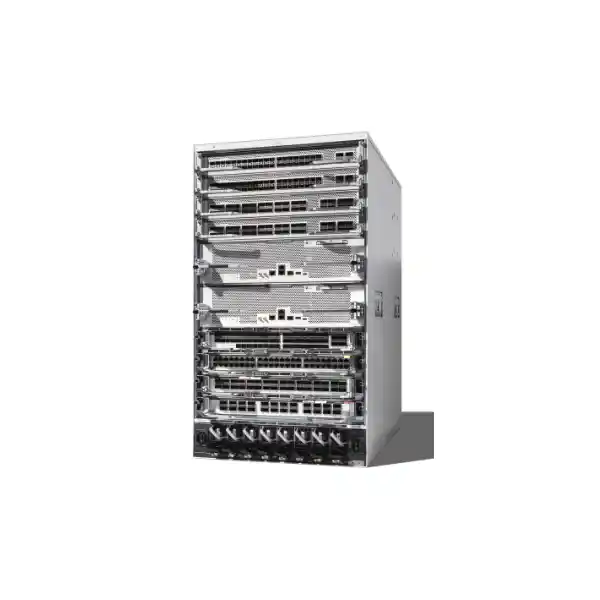
Cisco C9610R Smart Switch Chassis for High-Capacity Campus Core Networks in Tanzania
The Cisco C9610R is a 10-slot modular smart-switch chassis built for organizations that need a high-capacity, resilient core or distribution platform with room to scale. It is designed around two dedicated supervisor slots and eight line-card slots, giving network teams the flexibility to build a port mix that matches current backbone requirements while keeping space for future growth. Depending on the supervisor and line-card configuration, the platform can support interfaces from 10G through 400G and scale to a switching capacity of up to 51.2 Tbps. For a Tanzanian enterprise, university, financial institution, public-sector network, service organization, industrial campus, or multi-building environment, that makes the C9610R relevant when ordinary fixed-configuration switches no longer provide enough density, bandwidth, redundancy, or lifecycle flexibility.
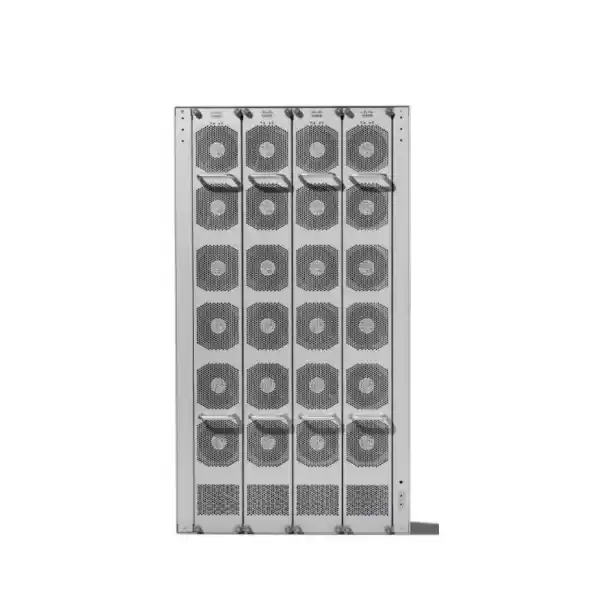
The most important buying point is that C9610R is the chassis, not a complete ready-to-use switch by itself. A working system requires compatible supervisor engine(s), at least one network line card, four fan trays, appropriate power supplies, transceivers or direct-attach cabling where required, software and licensing, plus an installation design that matches the rack, power, cooling, and resilience requirements of the site. The right quotation therefore depends on the required port speeds, fiber or copper interfaces, expected traffic growth, redundancy policy, software features, and the existing network being connected. FourTeck Tanzania can use those requirements to shape a configuration instead of treating the chassis as a one-size-fits-all product.
Quick decision snapshot
What the Cisco C9610R is designed to solve
As a network grows, the core becomes less about the number of access ports and more about how many high-speed links must converge, how much traffic must be forwarded without bottlenecks, and how much disruption the organization can tolerate during maintenance or a component failure. A fixed switch can work well for modest requirements, but a large campus may eventually need more 25G, 50G, 100G, or 400G interfaces than a single fixed platform can provide. It may also need redundant supervisors, modular power, field-replaceable line cards, and a migration path that does not force a full chassis replacement every time the backbone grows. The C9610R addresses that class of requirement with a modular architecture intended for high-scale campus core and distribution deployments.
For buyers in Tanzania, the practical value is not simply “more bandwidth.” The design can help consolidate backbone links from multiple buildings, distribution blocks, server areas, wireless aggregation points, or high-capacity edge domains into a platform that can be expanded by adding or changing line cards. This matters when a network is expected to evolve over several years, especially where fiber counts, uplink speeds, application traffic, backup windows, video, collaboration, cloud access, storage traffic, and high-density Wi-Fi are all increasing. A modular chassis also makes it easier to separate the decisions about chassis lifetime, supervisor scale, line-card mix, and optics rather than purchasing an entirely new switching platform for each growth step.
The C9610R is therefore most appropriate when there is a clear reason to invest in modularity and redundancy. If a site only needs a small number of 10G or 25G uplinks, a smaller fixed or modular Cisco platform may be more economical and simpler to operate. The C9610R becomes compelling when the design needs substantial interface density, high-speed aggregation, redundant control planes, future expansion, or compatibility with selected Catalyst 9600 line cards through the supported adapter. A proper design exercise should compare the expected three-to-five-year port demand and resilience requirement against the cost and operational complexity of the chassis.
Architecture, supervisors and switching capacity
The C9610R chassis has ten physical slots. Slots 5 and 6 are reserved for supervisor engines, while slots 1 through 4 and 7 through 10 are available for line cards. Cisco supports C9610 Supervisor Engine 3 and Supervisor Engine 3XL options for the platform. The architecture uses Cisco Silicon One technology and Cisco IOS XE, with the supervisor providing the forwarding and system-control functions that determine scale, buffering characteristics, routing capacity, application-hosting capability, and the operational feature set available to the design. Cisco currently positions the platform for up to 51.2 Tbps of switching capacity and up to 6.4 Tbps per line-card slot with supported configurations.
The difference between Supervisor 3 and Supervisor 3XL should be treated as a design decision, not a branding upgrade. Supervisor 3 is aimed at medium-to-large Layer 2 and Layer 3 forwarding scale, campus distribution or collapsed-core use, while Supervisor 3XL is intended for larger table scale and deeper buffering requirements. A network with very large routing tables, heavier policy scale, large east-west traffic bursts, or more demanding core requirements may justify the 3XL. A campus with less extreme scale can often be designed around Supervisor 3. The correct choice should be based on route counts, MAC and ARP/ND scale, ACL and QoS requirements, expected growth, application hosting, and the line-card mix rather than on maximum specifications alone.
Cisco IOS XE also gives the platform a programmable operating environment and supports model-driven automation. The C9610 architecture provides local compute resources and optional SSD capacity on the supervisors for supported application-hosting use cases. That is useful where the network team wants the core platform to participate in telemetry, assurance, security, or local application functions without deploying a separate appliance for every function. Whether those capabilities are needed should be decided during solution design because the software subscription, storage choice, operational tooling, and security policy can affect the final bill of materials.
Port density and line-card planning
Port density depends on the line cards installed, not on the chassis alone. Cisco lists maximum platform densities that can reach 16 native 400G interfaces, 256 native 100G interfaces, and 448 native 50G, 25G, or 10G SFP-family interfaces in appropriate configurations. The chassis can also support high-density 10G copper through compatible Catalyst 9600 line cards and an adapter. Those headline maximums are useful for understanding the platform ceiling, but real deployments usually mix speeds. A campus might dedicate some slots to 100G links toward major distribution blocks, others to 25G or 50G aggregation, and a smaller number of 400G ports for an inter-core, data-center, or future high-capacity connection.
| Interface family | Platform maximum | Typical planning question |
|---|---|---|
| 400G QSFP-DD | Up to 16 native ports | Do you need very high-capacity core, inter-building, or future backbone links? |
| 100G QSFP28 | Up to 256 native ports | How many distribution blocks, routers, firewalls, servers, or aggregation devices require 100G? |
| 50G / 25G / 10G SFP family | Up to 448 native ports | What speed will access and distribution uplinks use over the next hardware lifecycle? |
| 10G multigigabit copper | Supported through selected Catalyst 9600 line cards with adapter | Is copper aggregation genuinely required, or would fiber provide better reach and isolation? |
Line-card selection should be tied to the physical media as well as the speed. The C9610-LC-32CD provides a high-density QSFP-oriented option for 100G/40G with high-speed QSFP-DD ports, while C9610-LC-40YL4CD combines many SFP56-family ports with high-speed uplinks. Existing Catalyst 9600 line cards can be supported through the C9610-LC-ADPT where Cisco lists compatibility. That adapter path can be useful to protect an existing hardware investment, but it should be checked slot by slot because airflow, interface capabilities, software support, optics, and the desired long-term density may make a native C9610 line card the better choice for a new build.
High availability for business-critical networks
A modular core is usually purchased because the network matters enough that a single hardware failure should not take down the campus. The C9610R supports dual supervisors in dedicated slots. Cisco documents Stateful Switchover and Nonstop Forwarding capabilities for resilient supervisor operation, together with in-service software upgrade functions in supported software and licensing combinations. The platform also supports StackWise Virtual for designs that pair chassis into a logical system. These features can reduce the operational impact of component failure or planned maintenance, but they do not eliminate the need for a complete high-availability design. Redundant supervisors inside one chassis still share that chassis, rack, room, and upstream power environment.
For a critical Tanzanian campus, resilience should be considered at several layers: supervisor redundancy, power-supply redundancy, diverse utility or UPS feeds where available, redundant uplinks, resilient routing, separate fiber paths, and possibly a second chassis in another rack or room. If all uplinks follow the same physical cable tray or both core systems share one power distribution point, a logically redundant design can still fail from a single physical event. The C9610R gives the network architect tools for resilience, but the final availability outcome depends on how those tools are deployed.
Software maintenance should also be planned before purchase. Features such as ISSU, SSO, NSF, hot patching, and graceful insertion or removal are powerful, but support varies by software release, topology, protocol, feature combination, and licensing. A change procedure should be validated against the exact Cisco IOS XE release and feature set in production. Organizations that have strict maintenance windows should include software lifecycle, rollback planning, configuration backup, monitoring, and spare strategy in the procurement discussion rather than treating them as after-installation tasks.
Security-first core architecture
The C9610 Series is part of Cisco’s current smart-switching portfolio and is positioned with a security-first architecture. Cisco highlights platform trust, Encrypted Traffic Analytics, software protections, and support for post-quantum cryptography capabilities in the series. Hardware authenticity is reinforced through Cisco trust-anchor technology on major modules. These capabilities are useful in a core platform because the core is a high-value control point: it sees large amounts of inter-segment and north-south traffic and often enforces routing, access-control, segmentation, telemetry, and policy functions.
A secure deployment still requires more than purchasing a secure-capable chassis. The organization must define management-plane access, administrative authentication, AAA, secure protocols, control-plane protection, routing authentication where appropriate, logging, time synchronization, software-image policy, configuration backup, segmentation, and vulnerability-management procedures. Features should be enabled intentionally and tested against the organization’s operational model. For example, encrypted-traffic visibility can complement a broader monitoring strategy, but it does not replace endpoint security, firewall policy, identity controls, or incident response.
Buyers should also distinguish platform capability from subscription entitlement. Cisco networking software and management functions are licensed, and some advanced capabilities depend on the selected subscription, controller, or associated service. The quotation should therefore include the hardware and the exact software tier required for the intended design. This avoids the common problem of receiving a technically powerful chassis but discovering after installation that a planned operational or security function requires a different license or management component.
Power, cooling and rack planning before installation
The C9610R is an 18RU chassis measuring approximately 79.93 cm high, 44.20 cm wide, and 66.29 cm deep. Cisco lists a weight of about 120.7 kg for a chassis populated with eight 3000W power supplies and four fan trays. That means rack suitability cannot be assumed from width alone. The installation team should verify rack depth, rail or mounting-kit compatibility, floor loading, equipment-lift requirements, service access, cable-management clearance, front and rear working space, and the loaded rack’s center of gravity. In a shared data room, reserving 18RU plus practical service and patching space may affect the entire rack plan.
Cooling is front-to-back. The room and rack layout should therefore maintain a clean cold-air intake at the front and avoid recirculating exhaust air from the rear. Blanking panels, cable bundles, doors, or adjacent equipment should not obstruct airflow. Cisco specifies normal chassis operation from -5°C to 40°C up to 1,800 metres, with temperature derating at higher altitude. Those are product limits, not a recommended room set point. A production design should maintain stable environmental conditions well within the equipment envelope and provide monitoring for temperature, humidity, power and fan status.
The chassis has eight power-supply bays and supports 3000W AC, 2000W AC, and 2000W DC power-supply options. Cisco supports combined, N+1, and N+N power modes. The correct number and type of supplies depends on the supervisor count, installed line cards, optics, redundancy objective, and available input voltage. Cisco recommends planning 3 kW supplies with high-line input when the goal is maximum efficiency and redundancy. Each circuit, PDU, UPS, generator system, and distribution feed should be sized by a qualified electrical designer against the final bill of materials rather than using the chassis headline rating as a shortcut.
For Tanzania deployments, power continuity is often as important as electrical capacity. The network team should document what happens during utility interruption, generator transfer, UPS maintenance, or a failed PDU. If N+N redundancy is required, the feeds should be genuinely independent enough to survive the chosen failure scenario. Voltage, plug type, branch-circuit protection, earthing, and local electrical-code compliance must be verified for the installation site. No product page can safely determine those details without the actual facility design, so the pre-sales process should capture them before the hardware is ordered.
Where the C9610R fits in a Tanzanian network
Large campus core
Use the chassis to aggregate multiple distribution blocks or buildings where 40G, 100G, or higher-speed links are needed and where redundant supervisors and scalable line-card density justify a modular platform.
Collapsed core
In a design that combines core and distribution functions, the C9610R can provide routing scale, interface flexibility, and redundancy in a central platform. The design should still account for failure domains and physical diversity.
High-density aggregation
Organizations consolidating many high-speed fiber links can use line-card combinations that emphasize 25G, 50G, or 100G density while retaining selected 400G links for future backbone growth.
Campus modernization
Where an existing Catalyst 9600 deployment has reusable supported line cards, the C9610 adapter option can support a staged migration. Compatibility, software and long-term economics should be reviewed before assuming every module should be retained.
Resilient enterprise backbone
Financial, education, healthcare, hospitality, government and industrial networks can use the platform where backbone outage risk is significant enough to justify dual supervisors, redundant power, diverse links and structured maintenance procedures.
Growth-oriented infrastructure
The modular chassis is useful when port requirements are expected to change. A buyer can plan the chassis for the lifecycle while selecting line cards according to current bandwidth and adding capacity as the architecture evolves.
Design the system around traffic, not just port counts
A strong C9610R design starts with a traffic map. Count the number of physical links, but also identify what those links carry and how quickly they may grow. A 100G connection from a major distribution block that aggregates thousands of clients has different resilience and oversubscription considerations from a 100G server link. Separate normal traffic from backup bursts, replication, video, internet breakout, east-west application flows, security inspection, and disaster-recovery traffic. If the organization has large peak events, such as university registration, financial processing windows, software distribution, cloud backups, or media workloads, those peaks should be reflected in the capacity model.
The next step is to define failure behaviour. Decide whether losing a line card can interrupt all links to one building, whether each distribution block should connect to two different line cards, whether the two core chassis should be in separate rooms, and how routing will converge if a path fails. Port-channel design, ECMP, first-hop redundancy, StackWise Virtual, dynamic routing, and physical fiber diversity can all contribute to resilience, but they solve different problems. A chassis with excellent hardware redundancy can still have a weak network architecture if all downstream links terminate on the same card or cable route.
Finally, plan the upgrade path. Reserve enough slot and rack capacity for expected growth, but avoid buying every possible module on day one if the business does not need it. Document which slots are intended for future 100G or 400G expansion, whether breakout optics will be used, and which existing fibers can support the target transceivers. This approach makes the C9610R’s modularity valuable: the chassis can be a long-lived foundation while interface density and bandwidth evolve with the network.
Migration from Catalyst 9600 and existing core platforms
Cisco designed the C9610R to support selected Catalyst 9600 line cards by using the C9610-LC-ADPT adapter. That can be attractive for an organization already invested in Catalyst 9600 hardware because it creates a potential bridge into the newer chassis. However, “supported” does not automatically mean “optimal.” A migration assessment should inventory the exact product IDs, optics, software releases, license state, current traffic, spare strategy, and remaining lifecycle of every module being considered for reuse. Native C9610 line cards may provide a cleaner route to higher density or newer interface combinations, while an adapter-based strategy may reduce near-term capital expenditure.
The migration method should also minimize operational risk. Where possible, build and test the C9610R in parallel, load the target software, validate management access, confirm routing and security policy, test transceivers, and establish telemetry before moving production links. Migration waves can then be organized by building, distribution block, service group, or redundant path. If the old and new cores coexist temporarily, routing metrics and Layer 2 boundaries should be designed deliberately so the network does not create unexpected loops or asymmetric paths.
A rollback plan should be written before the first cable is moved. Record source and destination port mappings, optics, patch-panel positions, VLANs, routed interfaces, port channels, routing neighbours, MTU settings, QoS policies, ACLs, and dependencies. The more modular and high-density the new core is, the more important disciplined documentation becomes. FourTeck Tanzania can use this migration inventory when preparing the solution, especially if the quotation needs to include adapters, new optics, patching, spare transceivers, or staged services.
Operations, automation and observability
A high-end core switch should be evaluated as an operating platform, not only as packet-forwarding hardware. Cisco IOS XE supports programmable management interfaces and model-driven automation, allowing mature network teams to integrate configuration, telemetry and compliance workflows into broader operational systems. That can reduce configuration drift and improve repeatability, particularly in organizations with many network devices. However, automation only helps when the source of truth, approval process, credential handling, testing and rollback procedures are designed properly. The C9610R should fit the organization’s operational maturity rather than forcing automation for its own sake.
Monitoring should cover the whole system: supervisor state, line-card health, interface errors, optical levels, power-supply state, fan status, environmental sensors, CPU and memory, route scale, queue behaviour, link utilization, packet drops, control-plane events, licensing, configuration changes and software lifecycle. At 100G or 400G speeds, a short traffic burst can be much larger than traditional monitoring intervals suggest, so teams with sensitive applications may need streaming telemetry or more detailed analytics. Alert thresholds should be based on normal behaviour and service risk rather than generic percentages.
Operational readiness also includes spares and support. Decide which components merit local spare stock, which failures can wait for replacement, and what the escalation path will be. A spare optic may be easy to justify; a spare line card or supervisor depends on the business impact and the redundancy already built into the design. Warranty or support entitlement should never be assumed from the chassis model alone; it must be confirmed in the actual commercial offer. The procurement stage is the right time to align hardware redundancy with support response expectations and internal incident procedures.
What should be included in a C9610R quotation?
A useful quotation should describe a deployable configuration rather than listing only “C9610R.” At minimum, the design discussion should cover the chassis, supervisor engines, line cards, fan trays, power supplies, power cords, rack-mount kit, software subscription, optics or direct-attach cables, patching assumptions, and any line-card adapters. Depending on the project, it may also need SSD modules, console accessories, spare optics, spare power supplies, implementation services, configuration, migration support, documentation, testing and handover. The exact list changes with the environment, so a configuration should not be copied from another customer without validation.
Number of 10G, 25G, 40G, 50G, 100G and 400G links now, plus realistic three-to-five-year growth.
Single-mode or multimode fiber, copper, distance, connector type, existing patch panels and optic compatibility.
Single or dual supervisors, power mode, dual chassis, diverse uplinks, spare strategy and acceptable outage scenarios.
Routing, segmentation, automation, assurance, security and management requirements that determine the correct licensing.
Rack space, mounting, floor loading, input power, UPS/PDU feeds, earthing, generator behaviour and cooling.
Existing core hardware, reusable Catalyst 9600 modules, configuration conversion, cutover windows and rollback needs.
Tanzania deployment considerations
A national-market product page should not pretend that every Tanzanian site has the same infrastructure. A C9610R installed in a purpose-built data room in Dar es Salaam may face different power, cooling, fiber, space and support conditions from a campus in another region. The deployment assessment should therefore start with the actual facility. Confirm whether the equipment room can support an 18RU chassis, whether the rack is deep and strong enough, whether front-to-back airflow is compatible with the room layout, and whether the power system can support the selected supply configuration with the desired redundancy.
Fiber infrastructure is another critical variable. Before selecting 100G or 400G optics, document the route length, fiber type, connector cleanliness, patch-panel loss, available strands, and whether redundant physical paths exist. A high-speed switch cannot compensate for an unsuitable optical path. Where links run between buildings, grounding, lightning exposure, pathway diversity, and maintenance access should also be considered. The design team should specify supported Cisco optics or validated compatibility appropriate to the exact line card and software release rather than choosing transceivers only by connector appearance.
Operational support should be matched to geography and business impact. If the core serves a 24-hour service, a factory, a financial platform, a large hospitality property, a hospital, or a university network during critical periods, the organization may need a more aggressive spare and support strategy than a site with scheduled downtime flexibility. That decision affects whether spare transceivers, power supplies, fans, line cards, or other components should be budgeted. Availability, warranty, response time and service coverage must be confirmed in the final offer; they should not be inferred from the product model or from another country.
The same principle applies to price and delivery. C9610R systems are configuration-dependent, and the final cost can change substantially with supervisors, line cards, optics, licenses, power supplies and services. A quotation should be based on the validated bill of materials and current commercial terms for Tanzania. This page therefore does not publish an unverified TZS price, stock level or delivery promise. The useful next step is to provide the network requirements so that the commercial offer reflects the system you actually need.
How to decide whether C9610R is the right Cisco platform
Choose C9610R when the design genuinely benefits from a large modular chassis. Strong indicators include a requirement for many high-speed fiber ports, dual supervisors, substantial routing or policy scale, long-term line-card growth, 100G or 400G backbone evolution, or a migration path from supported Catalyst 9600 line cards. The platform is especially compelling when the network team wants one core architecture to serve several growth phases without replacing the entire chassis as interface requirements change.
Consider a smaller platform when the network has only a handful of high-speed uplinks, limited rack or power capacity, no requirement for supervisor redundancy, or a predictable scale that can be met by fixed switches. Modular systems bring flexibility but also require more design work, more components, and more operational discipline. The best value comes from matching platform size to the failure domain and growth model, not from buying the largest switch available.
A pre-sales comparison should therefore include at least one alternative architecture. Compare port density, supervisor redundancy, power and rack impact, licensing, optics, migration effort, support, and five-year expansion. A smaller Cisco core pair may be better for one organization, while a C9610R pair may be clearly superior for another. FourTeck Tanzania can structure that comparison around the buyer’s topology and required outcomes rather than using headline throughput as the only decision criterion.
Frequently asked questions
Is C9610R a complete switch or only a chassis?
C9610R is the 10-slot chassis. A working system requires compatible supervisor engine hardware, at least one line card for network connectivity, fan trays, suitable power supplies, cabling or transceivers, and the software/licensing required for the design. The final bill of materials depends on the intended port mix and resilience target.
How many line cards can the Cisco C9610R hold?
The chassis provides eight line-card slots. Slots 1, 2, 3, 4, 7, 8, 9 and 10 are used for line cards, while the two middle slots, 5 and 6, are dedicated to supervisor engines. The installed card mix determines the actual interface density and port speeds.
What is the maximum switching capacity?
Cisco currently positions the C9610 Series for up to 51.2 Tbps of switching capacity with supported supervisor configurations, with up to 6.4 Tbps per line-card slot. Real application performance depends on the chosen supervisor, line cards, software features, packet profile and configuration.
Does the C9610R support 400G?
Yes. Cisco lists native C9610 line-card options with QSFP-DD interfaces and platform scaling to as many as 16 native 400G ports in an appropriate configuration. The correct optical module, fiber type, reach and software support must be validated for each link.
Can existing Catalyst 9600 line cards be reused?
Selected Catalyst 9600 line cards are supported through the C9610-LC-ADPT adapter. Compatibility is model-specific, so the exact product IDs and software release should be checked before a migration plan assumes reuse. Native C9610 line cards may be preferable for some new high-density designs.
Does it support redundant supervisors?
Yes. The chassis has two dedicated supervisor slots and is designed for redundant supervisor operation. Cisco documents high-availability capabilities including Stateful Switchover and Nonstop Forwarding in supported configurations. A resilient design should also address power, links, fiber paths and chassis-level failure.
What power supplies are supported?
Cisco supports 3000W AC, 2000W AC and 2000W DC power-supply modules for the platform. The chassis has eight power-supply bays and can be designed for combined, N+1 or N+N modes. The quantity should be calculated from the actual supervisor and line-card load plus the required redundancy.
How much rack space does the chassis require?
The C9610R chassis is 18RU high. Cisco lists dimensions of approximately 79.93 × 44.20 × 66.29 cm. The installation should also reserve adequate front and rear service clearance, cable-management space and a rack that can safely handle the fully populated weight.
What airflow direction does C9610R use?
The platform uses front-to-back airflow. The rack and room layout should provide cool intake air at the front and avoid recirculating exhaust from the rear. Cable management, doors and adjacent equipment should not obstruct the intake or exhaust path.
Is C9610R suitable for a university or large enterprise campus?
It can be a strong fit when the campus has many high-speed building or distribution links, requires resilient core operation, expects substantial growth, or needs 100G and 400G evolution. For smaller sites, a less complex Cisco platform may provide better value, so capacity and redundancy should be assessed first.
What information is needed for a quotation in Tanzania?
Provide the current topology, required port speeds and quantities, fiber or copper media, link distances, redundancy target, routing and security requirements, existing Cisco hardware that may be reused, rack details, power and UPS arrangement, desired software functions, and expected growth. Those inputs allow a much more accurate bill of materials.
Is there a published Tanzania price for C9610R on this page?
No unverified price is presented here because a C9610R solution is configuration-dependent. Supervisors, line cards, optics, power supplies, licensing, services and commercial terms can materially change the total. Request a configuration-based quote using the actual network requirements.
Request a Cisco C9610R configuration for Tanzania
For an accurate C9610R proposal, send the required uplink speeds and quantities, current network diagram, fiber types and link distances, redundancy target, existing Catalyst 9600 hardware that may be reused, rack and power details, software requirements, and expected growth. That information allows the chassis, supervisors, line cards, optics, power supplies and licensing to be selected as one coherent system.
FourTeck Tanzania can then prepare a configuration-oriented quotation without assuming price, stock, lead time, warranty or compatibility that has not been verified for the exact project. The goal is a core platform that fits the real network, has a clear migration path, and can be operated safely throughout its lifecycle.



Reviews
There are no reviews yet.