
CISCO NETWORK SECURITY • TANZANIA
Cisco Secure Firewall 3110
For organisations in Tanzania evaluating an enterprise firewall for their internet edge or server networks, the Cisco 3110 offers a rack-mounted platform with a choice of Threat Defense or ASA software. Choose the configuration around the security controls your business needs, the traffic that must cross the appliance and the people who will manage it. Request a configuration-specific quotation from FourTeck Tanzania with your network requirements before selecting hardware, subscriptions and accessories.
Is the 3110 the right firewall for your network?
Start with the business outcome: controlled internet access, separation between sensitive networks, secure connectivity to other locations, or replacement of an existing perimeter device. This model is worth assessing when your requirements call for a physical Cisco appliance and a structured security policy. Its suitability depends on the inspection workload and deployment design; neither employee count nor the speed printed on an uplink is a sufficient sizing method.
A procurement team should involve both network administrators and application owners. Administrators can describe routing, interfaces and management requirements, while application owners identify the transactions that must continue after cutover. Bringing these views together helps turn a firewall purchase into a measurable project: authorised applications remain reachable, unnecessary access is restricted, and support staff understand the resulting policy.
- Consider it for an enterprise perimeter where security inspection and connectivity need to be sized together.
- Assess it for a server boundary when the required traffic will actually pass through the firewall.
- Review another model if the confirmed workload exceeds the capacity, port speeds or expansion options of this appliance.
For an existing Cisco environment, share the current software platform and management arrangement. For a replacement from another vendor, share a topology and a summary of required policies rather than assuming that features with similar names behave identically.
Performance figures: compare the same security workload
| Cisco published 3110 metric | Value and test context |
|---|---|
| Threat Defense: firewall + application visibility and control + IPS | 17 Gbps; 1024-byte traffic |
| Threat Defense: maximum concurrent sessions with AVC | 2 million |
| Threat Defense: new connections per second with AVC | 130,000 |
| Threat Defense: TLS benchmark | 4.8 Gbps; Cisco test uses 50% TLS 1.2 traffic |
| ASA: stateful firewall | 18 Gbps; ideal 1500-byte UDP test |
| ASA: multiprotocol stateful firewall | 15 Gbps |
These are laboratory reference figures from Cisco, not a guaranteed production rate. Software release, enabled services, traffic mix and packet sizes affect results. In particular, the ASA stateful figure is not a rating for Threat Defense with advanced inspection. Use the measurement that resembles your intended policy and ask for a sizing review when encrypted traffic or busy application traffic is significant.
A useful requirement brief separates average traffic from peaks. Include busy-hour traffic, concurrent connections, connection creation rates where available, internal flows and expected growth. A network with frequent short sessions may stress different resources from one carrying a few large file transfers. Include the security functions you intend to enable rather than treating them as a later addition to an already finalised capacity calculation.
Also identify traffic crossing the appliance more than once. Remote access, central internet breakout and connections between internal zones can create loads that are not obvious from the purchased internet circuit alone. Evaluate the proposed traffic path so capacity planning reflects the whole design.
Interfaces and expansion: plan the actual connections
| Connection requirement | 3110 hardware position |
|---|---|
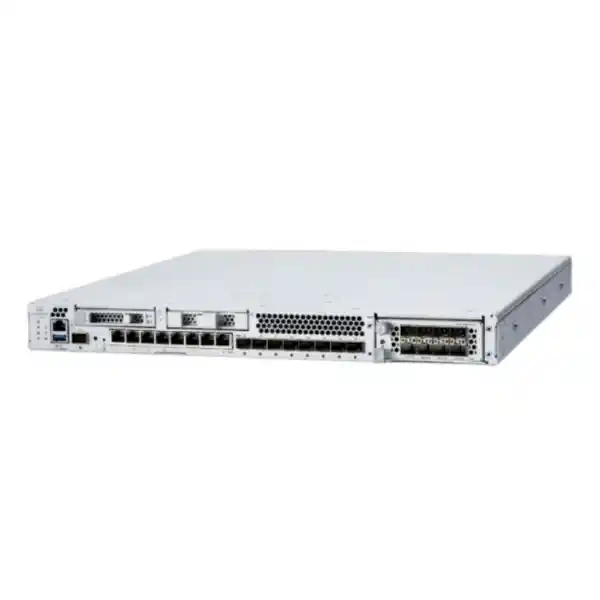
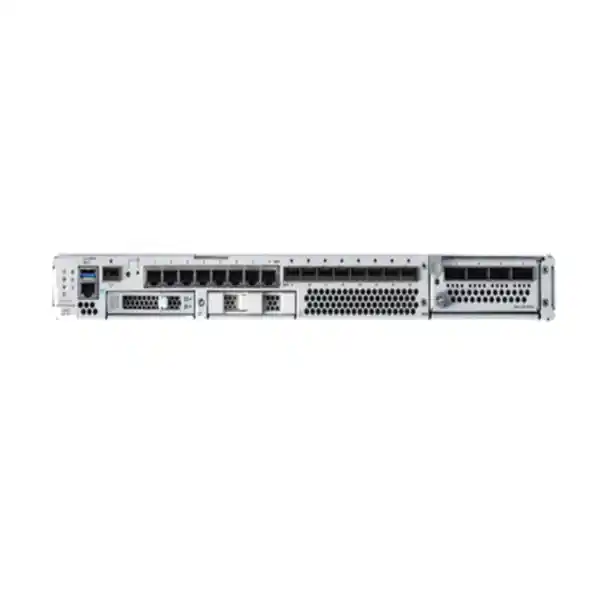
| Fixed copper data ports | 8 × 10/100/1000BASE-T RJ-45 |
| Fixed pluggable data ports | 8 × 1/10-Gbps SFP/SFP+ |
| Expansion | One network-module slot; optional 8-port 1/10G module supported |
| Management and console | Separate 1/10-Gbps SFP management port and RJ-45 serial console |
| Higher-speed modules | 25G, 40G and 100G modules listed for other 3100 models are not supported on the 3110 |
Build a port schedule before ordering. List the WAN handoff, LAN connection, server or DMZ connections, management network and any redundancy links. For each connection, record speed, connector, cable type and the port at the opposite end. This makes it easier to identify a missing optic or an unsuitable copper handoff before the installation window.
Pluggable ports require a compatibility check for the selected transceivers or cables. Match the device support list, software release, fibre type, reach and switch-side connection. Do not treat every SFP-shaped module as interchangeable. Confirm the optics and patch leads in the quotation, especially when reusing components from an older firewall or a different manufacturer.
Expansion should solve a documented port requirement. If the design fundamentally needs faster interfaces than this model supports, adding more lower-speed ports may not address the problem. Compare the required topology with the appropriate alternative appliance before committing to the bill of materials.
Choose Threat Defense or ASA before ordering
Cisco offers this platform with either Firewall Threat Defense or ASA software. Treat that choice as an early design decision. A team seeking integrated threat inspection should assess the Threat Defense configuration and its required entitlements. A team maintaining an ASA operating model should confirm that ASA provides the required functions for the intended design. The two environments have different configuration and management workflows.
| Buying decision | What to establish |
|---|---|
| Threat Defense configuration | Required inspection features, subscriptions, target release and management platform |
| ASA configuration | Required ASA features, target release, management method and any additional entitlements |
| Moving between platforms | Configuration conversion, feature gaps, testing and a maintenance window |
Cisco identifies FPR3110-NGFW-K9 as an appliance with Threat Defense software and FPR3110-ASA-K9 as the ASA variant. These are manufacturer product identifiers for configuration discussions. The final quotation should establish the exact supplied version and every associated line item.
For migration, ask the technical team to map required behaviour rather than merely translate commands. A rule that looks similar may depend on routing, translation, inspection order or identity information elsewhere in the old environment. Require a review of business-critical flows, remote-access assumptions and published services before approving the target configuration.
Security subscriptions and licence ownership
Hardware selection and security entitlement selection are related decisions. For Threat Defense, Cisco documents Essentials licensing for core capabilities and additional licensing for IPS, Malware Defense and category or reputation-based URL Filtering. Malware Defense and URL Filtering have IPS licensing prerequisites. Confirm the exact current ordering combination for the selected software and intended security policy.
Ask for a quotation that names the subscription features and their duration. A vague description such as full security does not explain what the organisation is buying. Identify which functions are required immediately, which are optional and which depend on another entitlement. Remote-access requirements and management licensing should also be checked separately for the chosen design.
- Name the organisation that owns the Cisco Smart Account and the administrator responsible for entitlement access.
- Confirm how purchased licences will be associated with the intended account and assigned to the deployment.
- Record subscription start and end dates, renewal ownership and the commercial treatment of future renewals.
- For a redundant design, verify entitlement requirements for both units against the selected release and configuration.
Use an internal purchasing record that links the approved security requirements to the quoted subscriptions. This helps future administrators understand why an entitlement exists and prevents renewal decisions being made solely from an unfamiliar part number. Keep account credentials and registration secrets out of public enquiry text; exchange sensitive setup information through an agreed secure channel.
Management that fits the team operating the firewall
Cisco provides 3100 deployment guidance for Firewall Management Center and Firewall Device Manager, as well as cloud-delivered management arrangements. Confirm support and feature requirements for the exact software release and selected manager. The appropriate choice depends on the number of devices, policy governance, reporting needs and where the operational team works.
For a single appliance, a locally administered workflow may suit a small operating team if its feature requirements are supported. For multiple appliances, assess whether a common management platform would make policy changes and event review easier. Include the management system in the design, quotation and support responsibilities rather than assuming that the appliance alone defines the complete solution.
Define who can read events, who can edit policy and who approves deployment of changes. Plan management addressing, trusted administrator networks, name resolution, time synchronisation and reachability to required services. A management path should be understandable during an incident, including when a business traffic connection is unavailable.
Agree on an operating process before handover. It should cover access requests, change review, backup ownership and escalation. The value of a central console depends on how consistently the team uses it; an undocumented collection of shared accounts and emergency changes remains difficult to support even with a capable platform.
Segmentation: decide which traffic crosses the firewall
A firewall can only enforce policy on traffic that reaches it. Before using this appliance to separate user, server, guest or operational networks, confirm where routing between those networks occurs. If a core switch routes a flow directly, inserting a firewall at the internet edge will not automatically place that internal flow under its inspection policy.
Create a communication matrix with source network, destination service, business purpose and technical owner. Use that matrix to decide which boundaries belong on the firewall and which remain elsewhere in the network. The design should also account for return traffic and avoid unplanned alternate paths that make troubleshooting inconsistent.
For example, a business might require staff access to an application server while restricting general user access to infrastructure administration. A separate guest network might need internet access without access to internal applications. Treat these as proposed policy outcomes to validate with the customer, rather than default permissions that should be applied to every deployment.
Segmentation projects should include discovery of service dependencies. DNS, time services, directory authentication, backups and monitoring may cross boundaries even when the primary application is easy to identify. Schedule tests with the teams responsible for those systems so a tighter policy does not interrupt a necessary background process.
High availability and continuity planning
For a Threat Defense active/standby deployment, Cisco requires matching devices and compatible hardware, software and licence configurations. One unit forwards business traffic while its peer is available to take over. Plan the failover connectivity and interface allocation explicitly; a second appliance becomes part of a supported design through correct configuration and testing.
Describe the failure you want the design to tolerate. An appliance fault, power interruption, access-switch failure and internet-circuit outage are different events. A firewall pair alone does not remove a shared switch, shared power feed or single provider connection from the traffic path. Review these dependencies with the wider network design.
Size the surviving unit for the required workload. Do not add the headline capacities of two appliances in an active/standby pair and present the total as the available inspected throughput. Also agree on what acceptable recovery means for users: application reconnection, remote sessions, published services and monitoring may each need a separate acceptance test.
Include a planned failover exercise in the project scope and record the outcome. The test should have an agreed maintenance window, named participants and a recovery plan. After deployment, keep both units within the supported configuration and software requirements. Future module additions or entitlement changes should be assessed for their effect on the complete pair.
VPN requirements: separate branch connectivity from remote users
Before sizing VPN use, distinguish connections between sites from connections made by individual remote users. Document the number of peer sites, their networks, required applications and expected encrypted traffic. For remote workers, document concurrent users, client operating systems, authentication, access restrictions and whether their internet traffic will also traverse the organisation’s firewall.
Ask the design team to verify software support, licence requirements, authentication integration and client compatibility for the selected deployment. Avoid treating the existence of VPN capability as confirmation that every client, identity service or peer device will work without additional planning. A mixed-vendor site connection should be checked against both ends of the intended configuration.
A practical example is a head office that receives application traffic from several branches while also serving remote staff. The branch links and user sessions may peak at different times, and the combined workload may cross the same internet interface. Include both in the capacity brief and explain any growth expected during the purchasing period.
Prepare a subnet inventory early. Overlapping address ranges, inconsistent routes and unclear ownership of peer changes can delay a project even when the appliances are appropriate. Share the required topology in the enquiry, but exchange passwords, private keys and other authentication material only through an agreed secure process.
Encrypted traffic inspection: define the policy before sizing
Decide which encrypted flows the organisation intends to inspect and why. A broad instruction to inspect all encrypted traffic leaves unresolved questions about application compatibility, certificate deployment, approved exceptions and the traffic profile used for sizing. The inspection policy should be owned by the business and implemented with the relevant technical and governance teams.
For a proposed decryption rollout, inventory managed endpoints, unmanaged devices and applications that may need special treatment. Establish how trusted certificates will be distributed where required, how exceptions are approved and how users report a broken application. Test representative business transactions before extending the policy to a larger group.
Include the amount of encrypted traffic and its expected growth in the requirement brief. Compare the intended inspection workload with the appropriate vendor benchmark, then validate the design under a representative policy. A total internet bandwidth figure cannot by itself describe the processing required for the traffic the business wants examined.
Make the acceptance criteria specific. Examples include successful access to approved business services, an understood exception process and sufficient operational visibility to explain a failure. Keep a record of the chosen policy and its reasons so later administrators can distinguish an intentional exception from a forgotten temporary workaround. The goal is an inspection design that the organisation can operate and maintain consistently.
Rack, power and installation readiness
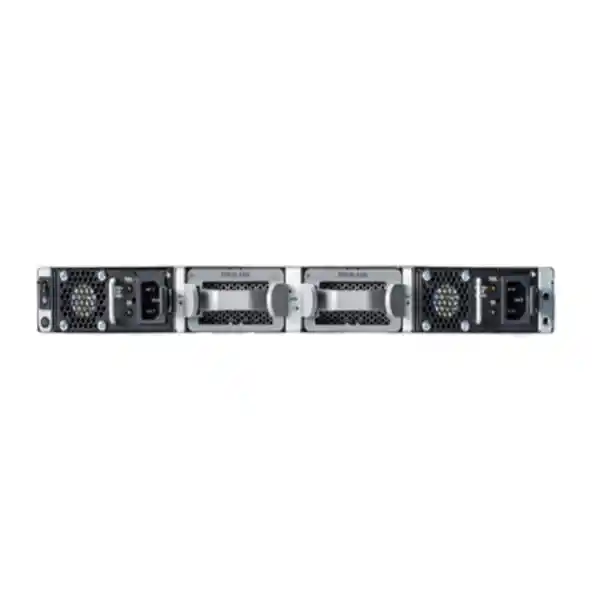
The 3110 occupies one rack unit. Cisco documents front-to-rear airflow, support for a second power supply and a standard configuration with one AC supply. Confirm the delivered power configuration and rack hardware on the quotation. Two power-supply bays should not be interpreted as confirmation that two supplies are included in the offered unit.
Before delivery, check usable rack depth, access to connectors, cable bend space and the route for power leads. Reserve a location that supports the required airflow and allows technicians to service the equipment. Confirm grounding, power distribution and environmental conditions against the current installation guidance for the ordered configuration.
If continuity during a power interruption matters, consider the firewall together with the switches, provider handoff and management equipment that keep the traffic path usable. A UPS plan should account for the connected load and the required operating time rather than only the presence of a battery unit.
Create an installation checklist with responsibility for mounting, power, cabling and labelling. Identify who supplies optics, patch leads and any additional accessories. This is particularly useful when the hardware supplier, network administrator and facilities team are different parties. Agree on these responsibilities before scheduling a cutover so the maintenance window can be used for configuration and testing.
Common deployment scenarios to discuss
Enterprise internet edge
A business refreshing its perimeter should begin with internet links, inbound services and its intended security controls. Record the busiest traffic periods and how cloud applications are used. Ask whether the proposed appliance, policy and management arrangement meet those requirements together. This is also an opportunity to remove obsolete public services and clarify ownership of permitted access.
Application and server boundary
An organisation protecting internal servers should identify the clients and systems that need access, including backup, monitoring and administrative tools. Confirm the routing path and the required port speeds before selecting the appliance. The useful outcome is a documented boundary around the applications, with tests showing that approved workflows still operate.
Head office with connected sites
A central location receiving branch traffic should map the combined load and the effect of internet breakout choices. Include branch address plans and the applications each site needs. Define how a failure at headquarters affects the branches and whether local connectivity must continue independently. These are design questions to resolve before treating the 3110 as the central answer.
Replacement of an existing ASA or another firewall
A replacement project should capture existing behaviour, required improvements and known problems. Keep the reasons for change visible in the scope: extra inspection, cleaner management, revised connectivity or capacity growth. A successful migration can then be judged against those objectives rather than the simple fact that the new device powers on.
Migration planning: protect the business during change
Prepare a current-state record before building the new configuration. Capture interfaces, VLANs, addressing, routes, translations, access rules, VPN relationships and management dependencies. Add application owners and known exceptions. Where the old configuration contains unused objects or rules with unclear purpose, investigate them rather than automatically making them part of the replacement.
Create a target design that explains intentional changes. If a network will move to a different gateway, an address will be translated differently or a broad rule will be restricted, document the expected effect. This allows application teams to prepare tests and prevents every difference during cutover from being treated as an unexpected defect.
- Stage the selected software and management arrangement before the production maintenance window.
- Review migrated objects and policy against the approved communication requirements.
- Prepare a cable map, change sequence, test plan and decision point for rollback.
- Keep a usable record of the original environment and identify who can authorise returning to it.
Migration tools, where applicable, should be treated as aids within an engineering process. The result still needs a review of supported features and intended behaviour. Reserve time for application validation after the links become active, and identify any follow-up tasks that will remain after the initial change. Close the project only when the agreed acceptance results and final documentation are available.
Acceptance tests that make the purchase reviewable
Agree on tests before implementation so the installation can be assessed against business requirements. Basic connectivity is a starting point, but a meaningful acceptance plan should cover the actual workflows that users depend on. Assign an owner to each test and record what a pass looks like.
| Test area | Example acceptance question |
|---|---|
| Internet and name services | Can approved users reach required destinations and resolve names through the intended services? |
| Published applications | Can authorised external clients reach the required service while unintended access remains restricted? |
| Internal policy | Do approved flows cross the correct boundaries, and are prohibited paths blocked? |
| VPN connectivity | Can the intended remote user or site reach the approved application, rather than only establish a tunnel? |
| Operations | Can administrators review events, confirm health and retrieve the agreed configuration records? |
| Continuity | Where redundancy is included, does the tested failure produce the agreed recovery behaviour? |
Include negative tests as well as successful transactions. An application working from an authorised network does not demonstrate that a restricted network is blocked. Use controlled, agreed test traffic and review the associated policy events to understand the result.
Record exceptions and residual issues in the handover. If an application owner was unavailable or a peer site could not be tested, mark the test as outstanding rather than assuming it passed. This gives the customer a concrete basis for accepting completed work and arranging the remaining actions.
Operating the firewall after handover
Assign ownership for policy changes, health review, subscriptions, software maintenance and backups. These responsibilities may sit with different people, but they should be recorded together. Include an escalation route for business-impacting faults and a way for application teams to request a rule change with enough information for a proper review.
A useful access request states source, destination, service, business purpose, owner and any intended expiry date. Maintaining that information makes future policy review more effective. It also helps administrators remove temporary access when the project that required it has ended.
Set logging and event-retention requirements according to operational needs and the systems available to review the events. Decide who investigates alerts and how a significant event is escalated. Collecting records without an owner or review process offers limited practical value, while excessive routine noise can make the important events harder to identify.
Define a backup and recovery procedure for the selected manager and device software. Cisco’s Device Manager documentation places model and exact software-version conditions on restoring to a replacement device. Validate the procedure for your actual deployment, including any separate management system, rather than assuming that one saved file is a universal recovery method. Keep protected copies and clear recovery instructions available to authorised support staff.
What a complete quotation should contain
Ask for a configuration-specific bill of materials that distinguishes the appliance from subscriptions, management, accessories and services. This makes competing offers easier to assess and reduces uncertainty about what is included. The lowest hardware line price may describe a different operating configuration or leave an essential component outside the scope.
- Exact appliance variant, target operating software and quantity, including both units where a pair is required.
- Required security entitlements, management arrangement, subscription terms and account ownership.
- Power supplies, rack hardware, optics, network modules and cables needed for the agreed connections.
- Installation, configuration, migration, testing, documentation and any separately agreed ongoing support.
- Commercial confirmation of price, applicable charges, availability, delivery arrangements and support coverage for the specific offer.
State your preferred purchasing period and ask how licence timing relates to the project schedule. Clarify who will perform registration and who will receive access to the account and documentation. Where support is included, request the scope and applicable terms so the operations team understands the escalation process.
For a Tanzania deployment, provide the installation location and whether on-site work is required. Ask for service eligibility and logistics to be confirmed for that location. Product specifications alone do not establish local stock, a particular delivery date or a service commitment. Keep those details tied to the actual quotation.
Frequently asked questions
Is this a next-generation firewall or an ASA appliance?
The 3110 is a hardware platform available with different software configurations. Confirm the quoted variant and the capabilities needed for your project. Threat Defense and ASA should be evaluated as separate operating choices, with their own management and entitlement requirements. If an offer names only the model, ask for the operating software to be stated before comparing it with another quotation.
How many users can it support?
There is no reliable universal user count for this purchase. User activity, application traffic, inspection policy and connectivity requirements determine the workload. Provide busy-hour measurements, concurrent remote-access needs and growth expectations for a sizing review. A smaller group transferring large volumes or creating many connections can place a different demand on the appliance from a larger group with light usage.
Does the appliance purchase include every security feature?
Do not assume that the chassis price covers every subscription or management requirement. Ask the supplier to identify the entitlements included in the specific configuration, their terms and any prerequisites. Match those items to your required security functions. Keep the agreed feature list with the purchase record so future renewal and operational decisions are based on a clear baseline.
Can I reuse my existing fibre modules and cables?
Possibly, but compatibility must be checked before reuse is included in the design. Provide the existing component identifiers, cable type, reach and switch-side details. Confirm support for the intended appliance interface and software release. Include a link test in the staging plan, and identify replacement components in advance if an existing item is unsupported or unsuitable.
Will a second power supply provide firewall high availability?
It addresses a different dependency. A redundant power configuration can help with an appropriate power-supply or feed design; appliance failover requires a separate firewall design. Decide which failures the organisation needs to tolerate, then include the necessary equipment, connections and tests. Review shared upstream and downstream dependencies so a local improvement is not mistaken for complete network continuity.
Can an existing firewall configuration be copied directly?
Plan a review and migration rather than assuming that a direct copy will produce the intended result. Even when a tool can assist conversion, routing, translations, security features and platform-specific behaviour need validation. Ask for an agreed application test plan and rollback procedure. Use the replacement project to document unclear rules and retire exceptions that are no longer required.
What determines the price for a Tanzania deployment?
The offered software variant, appliance quantity, security subscriptions, management, accessories and service scope all affect the quotation. Installation location and logistics also need commercial confirmation. Request an itemised offer for your requirements rather than comparing an unspecified chassis price. Confirm availability, delivery arrangements and support terms with that offer before making a purchasing decision.
What should I send to start a sizing discussion?
Provide the current firewall, a network diagram or interface list, internet speeds, measured traffic where available, internal zones, VPN requirements and the security functions you intend to enable. Add growth expectations, the preferred management approach and any continuity objective. If measurements are unavailable, say so explicitly so discovery can be included before the appliance configuration is finalised.
Request a Cisco 3110 configuration quote for Tanzania
Share your traffic requirements, software preference, interface schedule and installation location with FourTeck Tanzania. Include whether you need a standalone appliance or a resilient deployment, and whether the project involves a new installation, replacement or policy redesign. Request an itemised response covering hardware, entitlements, accessories and the services you want included.
For deployment planning, review the Cisco firewall installation and configuration service. Use that discussion to establish the engineering scope, acceptance tests and documentation required for your environment. Final model suitability and commercial details should be confirmed against the agreed configuration before purchase.
Bring your network requirements; request a configuration that can be reviewed, sized and quoted clearly.



Reviews
There are no reviews yet.