
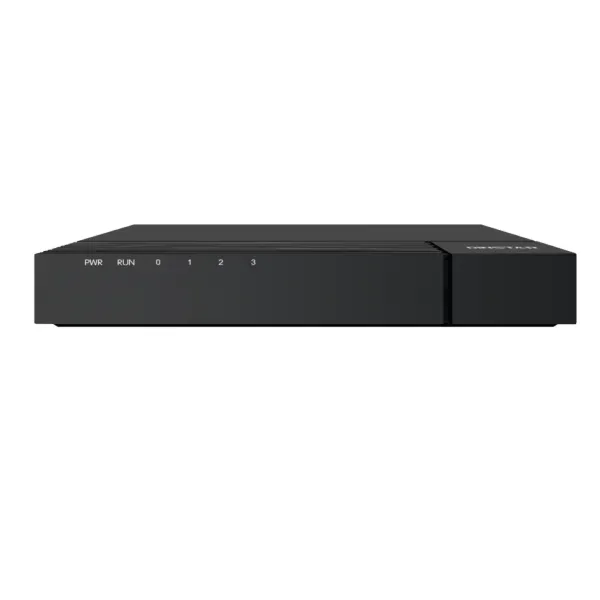
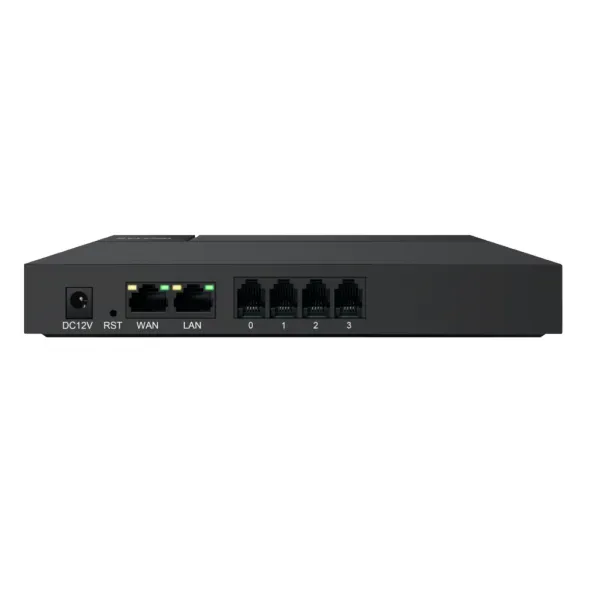
Dinstar DAG1000-4S GE FXS VoIP Gateway
The Dinstar DAG1000-4S GE is built for organisations that need to retain useful analog telephony equipment while moving voice services onto an IP network. Its four FXS interfaces can connect standard analog telephones, fax machines or compatible analog PBX interfaces, while the Gigabit Ethernet WAN and LAN interfaces provide a modern network path for SIP-based communications. For Tanzania deployments, this makes the gateway especially relevant to branch offices, reception environments, clinics, hospitality sites, schools, small businesses and distributed organisations that need a measured migration from traditional analog devices to IP telephony rather than a disruptive all-at-once replacement.
Choose this model when the requirement is four analog FXS endpoints, SIP/IMS interoperability, Gigabit Ethernet, fax-over-IP support and centrally manageable VoIP connectivity.
Connect analog phones, fax devices or suitable analog PBX ports to an IP telephony network.
One WAN and one LAN interface support 10/100/1000 Mbps Ethernet connectivity.
Designed for interoperability with SIP-based IP PBX, softswitch and IMS/NGN environments.
T.38 and pass-through fax support help preserve fax workflows where they remain operationally necessary.
What the Dinstar DAG1000-4S GE solves
Many businesses have equipment that still depends on an analog line interface even after the organisation has standardised on Ethernet and SIP. Replacing every analog telephone, fax machine or PBX interface may not be necessary at the same time as the VoIP migration. The DAG1000-4S GE acts as the conversion point between these two worlds. Each FXS port presents an analog subscriber interface to a connected endpoint while the gateway registers or routes calls through the IP telephony environment. That allows a business to keep selected analog devices in service while consolidating call control on an IP PBX, SIP server or compatible carrier platform.
The product is particularly useful when there are exactly a few analog endpoints rather than dozens. Four FXS ports suit a reception back room, small clinic, small branch, residential-style staff accommodation, fax-dependent department, lift/intercom integration scenario where technically compatible, or a legacy PBX migration in which only a limited number of analog circuits must remain active. The two Gigabit Ethernet interfaces also make the GE variant a better fit than older Fast Ethernet-only designs when the local network has standardised on Gigabit switching.
For a broader business voice project, FourTeck Tanzania can align the gateway with the organisation’s PBX, SIP trunks, VLAN plan, switching, firewall policy and endpoint strategy. The FourTeck Tanzania services portfolio explains how IP PBX, IP phones, networks and supporting infrastructure are planned together rather than treated as isolated purchases.
Verified feature overview
Four FXS RJ11 ports for analog endpoints, with caller-ID support, programmable call progress tones and common supplementary call features.
One Gigabit WAN and one Gigabit LAN RJ45 interface, with IPv4/IPv6 capability and common IP networking functions.
SIP v2.0 support over UDP, TCP and TLS, plus RTP/SRTP options for voice transport and security planning.
T.38 and fax pass-through options for organisations that still depend on fax transmission.
Flexible dial plans, prefix-based routing and hunting-group capabilities support practical migration and branch scenarios.
Web administration, automated provisioning, SNMP, TR-069, backup/restore and diagnostic tools support structured operations.
Technical and deployment guidance
| Model | DAG1000-4S(GE) |
| FXS capacity | 4 FXS ports, RJ11 |
| Ethernet | 1 WAN + 1 LAN, 10/100/1000 Mbps RJ45 |
| Signalling | SIP v2.0 with UDP/TCP/TLS; SIP/IMS environments |
| Fax | T.38 and pass-through |
| Security | TLS and SRTP support, subject to compatible peer configuration |
| Management | Web interface, SNMP, TR-069, automated provisioning, configuration backup/restore |
| Network planning | IPv4/IPv6, VLAN/QoS capabilities and SIP failover options should be mapped to the customer’s LAN and PBX design. |
A successful deployment depends on more than connecting cables. Confirm which FXS port maps to each analog device, how SIP credentials or trunks are assigned, whether the PBX expects registration or IP-based peer routing, which codecs are permitted, how inbound and outbound number translation should work, and whether fax needs T.38 or pass-through. Network administrators should also decide whether voice traffic belongs on a dedicated VLAN, how QoS is applied, which firewall rules are required and how the gateway will be backed up and monitored.
Buying and sizing checklist
Confirm that four FXS ports are sufficient, list the analog devices to be retained, identify the IP PBX or SIP platform, confirm SIP trunk behaviour, check fax requirements and verify Ethernet, VLAN, IP addressing and power arrangements.
Prepare extension or trunk credentials, dial-plan rules, number mappings, caller-ID requirements, codec policy, time settings, management credentials and a documented port map for the four analog endpoints.
Test inbound and outbound calls, DTMF, caller ID, transfer behaviour, fax where required, failover rules, backup/restore and administrative access. Save a clean configuration backup and deployment record.
For broader procurement, buyers can also review the FourTeck Tanzania technology shop to frame voice equipment alongside switches, firewalls, IP phones, PBX hardware and infrastructure dependencies.
Dinstar DAG1000-4S GE FXS VoIP Gateway Tanzania
In Tanzania, the Dinstar DAG1000-4S GE is a practical fit for organisations that are modernising business telephony while still relying on a small number of analog devices. A company may already have an IP PBX and Ethernet switching but retain a fax machine, analog desk phone, door-phone interface or legacy PBX extension that cannot register directly to SIP. Instead of keeping a separate analog telephony system for those endpoints, the gateway can present four FXS ports and carry the resulting calls across the IP voice platform. This gives procurement teams a defined migration component rather than forcing replacement of every endpoint at once.
Tanzania deployments should begin with the call flow and site network. If the gateway will sit in a head office, branch, clinic, school, lodge, warehouse or administrative site, document the PBX address, SIP registration method, VLAN, IP addressing, DNS and time settings before installation. Voice reliability depends on the complete path: the gateway, local switch, router or firewall, PBX and any SIP trunk provider. If calls traverse the public internet, bandwidth is only one factor; packet loss, latency, jitter, NAT behaviour and firewall session handling can influence the result. A voice VLAN and QoS policy may improve control where the wider LAN carries heavy business traffic.
Power conditions also matter. The gateway should be installed with suitable power protection and in a ventilated location, ideally near the switching and PBX equipment if that keeps cabling organised. When the connected analog devices are operationally important, consider whether the network switch, firewall, PBX and gateway share UPS protection so a short power interruption does not leave only part of the voice chain running. Keep a current configuration backup and record which analog device is attached to each FXS port.
When requesting a Tanzania quotation, provide the exact model, quantity, number of analog endpoints, PBX brand and version, SIP provider information if relevant, fax requirement and expected installation scope. This allows the proposal to separate product supply from configuration, network changes or migration services. FourTeck’s Tanzania technology solutions overview is useful when the gateway is part of a wider PBX, LAN, firewall or branch-office project.
Dinstar DAG1000-4S GE FXS VoIP Gateway Dar es Salaam
For businesses in Dar es Salaam, the DAG1000-4S GE can support a staged voice migration in offices where analog endpoints still serve a purpose but the main communication platform has moved to SIP. Corporate offices, professional services firms, logistics operations, retail support teams and hospitality businesses may have only a handful of devices that require an FXS interface. The four-port capacity is therefore useful when the project is too small for a high-density analog gateway but still needs a managed, business-oriented conversion point.
A Dar es Salaam deployment should be designed around the building’s real network. In multi-tenant offices, check whether the gateway will connect to a local PBX, a hosted PBX reached through the internet or a centrally managed PBX in another site. Each topology changes the firewall and routing requirements. If the voice platform is hosted, document the SIP provider’s supported transport, NAT recommendations and codec policy. If the PBX is local, place the gateway on the appropriate voice subnet and restrict management access to authorised administrators. TLS and SRTP can be considered when supported end to end, but configuration must match the peer system.
Dar es Salaam organisations frequently operate several departments or branch locations, so naming and documentation are valuable. Label each FXS port with the connected endpoint and business function, such as reception backup phone, fax, security desk or legacy PBX connection. Maintain a simple table showing extension, authentication method, outbound caller ID, dial-plan rule and destination. This makes troubleshooting faster than relying on memory when a call fails months after deployment.
Before purchase, buyers should clarify whether the requirement is truly FXS. FXS ports connect analog subscriber devices; they are not a substitute for FXO ports used to connect analog PSTN lines. This distinction avoids one of the most common gateway-selection mistakes. A clear quotation request should specify what cable currently plugs into the existing analog device or PBX and what the new SIP platform expects. FourTeck can then align the gateway with switching, IP PBX and security requirements rather than treating it as an isolated adapter.
Dinstar DAG1000-4S GE FXS VoIP Gateway Mwanza
In Mwanza, the Dinstar DAG1000-4S GE can be relevant to branch offices, trading businesses, healthcare sites, education environments, hotels and administrative locations where a small analog estate must be connected to a central or hosted VoIP system. Four FXS ports provide a compact boundary between legacy analog devices and SIP infrastructure. That is useful when replacing all analog equipment at once would add cost without improving the immediate business requirement.
Branch connectivity should be reviewed carefully before the gateway is commissioned. If calls register to a PBX outside Mwanza, the quality of the WAN path becomes part of the voice system. Test stable routing, DNS, latency and packet loss rather than assuming that a high headline internet speed guarantees good voice quality. Where the site uses multiple WAN links, define which route voice should follow and what happens during failover. SIP sessions can behave differently after a public IP change, so recovery should be tested rather than left as an assumption.
The analog side also deserves attention. Check the connected telephone or fax cable condition, extension distance and dial behaviour. The Dinstar platform supports common analog calling functions and flexible dial plans, but the final user experience depends on how those functions are mapped into the PBX. For example, transfer codes, voicemail access and outbound prefixes should match the organisation’s established procedure so users do not need to learn a completely different workflow simply because the transport changed from analog to IP.
For a Mwanza quotation, describe the existing environment rather than listing only the model name. Include the number of analog phones or fax devices, whether there is an existing PBX, the intended SIP provider, LAN switch type, voice VLAN status and any requirement for remote configuration. If the site is one of several Tanzanian branches, also share the desired standard for numbering, gateway naming and configuration backups. A repeatable template across sites can simplify support and future expansion.
Dinstar DAG1000-4S GE FXS VoIP Gateway Arusha
Arusha organisations often combine office, hospitality, travel, education and service operations, and some of these environments retain analog endpoints even when the main network has become IP-based. The Dinstar DAG1000-4S GE gives such sites four FXS interfaces without requiring a large analog gateway. A hotel back office may keep a fax or analog service device, a business office may retain a legacy phone in a specific operational area, or a branch may need a temporary bridge while extensions are migrated to SIP handsets.
For hospitality or customer-facing environments, continuity and clear dial plans matter. Before installation, document which calls are local extensions, which must reach external numbers and how emergency or special service numbers are handled under the organisation’s policy. The gateway’s routing capabilities should be aligned with the PBX rather than configured independently in a way that creates competing dial logic. Keeping most business routing in the PBX and using the gateway for predictable analog-to-SIP conversion can simplify troubleshooting.
Arusha sites that depend on cloud or remote PBX services should also assess internet resilience. A secondary link can improve availability, but only if the firewall, DNS, SIP registration and NAT behaviour are designed to recover cleanly. The gateway supports primary/backup SIP-server concepts, yet failover design should be tested with the actual PBX platform. Security settings such as TLS and SRTP should likewise be validated for compatibility rather than enabled by name alone.
Procurement teams should ask for configuration scope separately from product supply. The hardware may be straightforward, while the work required to map numbers, register ports, tune fax, update firewall policy and test calls can vary significantly by site. Supplying the PBX details, current numbering plan, analog endpoint list and network diagram with the quotation request helps produce a more accurate solution. It also creates a better handover record for the IT team that will manage the gateway after installation.
Dinstar DAG1000-4S GE FXS VoIP Gateway Dodoma
In Dodoma, the DAG1000-4S GE can serve administrative offices, professional organisations, education sites, project offices and branch facilities that need to connect a limited number of analog devices to a modern voice platform. The device is not intended to replace the PBX; instead, it provides the FXS edge ports that analog endpoints need and converts their calls for transport through SIP. This role should be clearly understood during planning so the gateway is integrated into the wider telephony design.
Government-adjacent and administrative environments often place a high value on documentation and predictable support. A good installation record should list the device hostname, IP address, VLAN, PBX address, SIP accounts or trunk details, firmware version, administrator access ownership, connected FXS endpoints and backup-file location. Such records reduce dependency on a single technician and make future audits or migration work easier. Configuration backups should be updated after any material change.
Network segmentation can also improve operational control. If the organisation already uses a voice VLAN, place the gateway according to the same addressing and QoS standards used by IP phones. If it does not, assess whether the gateway will share a general data LAN and whether that introduces management or performance concerns. Firewall rules should be limited to the traffic genuinely required between the gateway, PBX, DNS, NTP and management systems. Avoid unnecessarily exposing the web interface to public networks.
When requesting a Dodoma quotation, include the project objective: migration, branch extension, fax retention, temporary coexistence or permanent support for analog endpoints. This helps determine whether the four-port GE model is correctly sized or whether a different port count would be more appropriate. It also helps define whether installation requires only gateway configuration or wider changes to PBX routing, switching, cabling and network security.
Dinstar DAG1000-4S GE FXS VoIP Gateway UAE
For UAE organisations, the DAG1000-4S GE can support regional standardisation when a business has offices in both East Africa and the Gulf. A group may operate a central SIP or IP PBX platform and need a consistent method for attaching a few analog endpoints at each branch. Using the same four-port gateway model across selected sites can simplify configuration templates, spares planning and support documentation, provided local telecom and PBX requirements are verified for each country.
The UAE use case is often less about replacing a full legacy telephone system and more about preserving individual analog interfaces during a broader UC or SIP migration. Fax devices, analogue service phones, lift or intercom interfaces where technically compatible, and specific operational devices may remain analog even in a heavily IP-based office. The gateway provides the FXS electrical interface while letting the central PBX retain control over numbering, permissions and routing.
Cross-region IT teams should build a common deployment template but leave room for local differences. Standardise naming, VLAN conventions, NTP, administrator security, backup procedures and monitoring. Then document country-specific SIP trunk behaviour, caller-ID rules and numbering patterns separately. This prevents a copied configuration from causing avoidable errors when a Dubai or Abu Dhabi branch uses a different telecom service from a Tanzania branch.
FourTeck’s broader regional network can help procurement teams keep related voice projects aligned. The Tanzania page may serve the East African deployment discussion, while regional specialists can address requirements in other markets. The key buying question is whether four FXS ports and Gigabit Ethernet are the correct fit for the local analog endpoint count. If more ports are needed, compare the requirement against higher-density Dinstar FXS models before standardising the bill of materials.
Dinstar DAG1000-4S GE FXS VoIP Gateway Uganda
In Uganda, this four-port FXS gateway can be used by organisations that are moving branch telephony toward SIP but still need analog endpoints. The device is especially sensible when the analog requirement is small and defined. Rather than buying a high-density chassis for only a few lines, a branch can map four analog devices to SIP accounts or routes and manage them as part of the wider PBX environment.
A multi-country business with operations in Tanzania and Uganda should consider whether the same PBX policy can be used on both sides. Standard extension ranges, user classes, outbound permissions and configuration naming can improve support, but trunk and carrier rules may differ. The gateway’s dial plan should therefore complement the PBX, not replace a carefully designed central routing policy. The network team should also verify WAN stability, DNS, NAT and firewall behaviour for any branch that registers across the internet.
Operational support becomes easier when the analogue port purpose is explicit. Label ports physically and in the web interface, and record the connected device, extension and destination. If a fax workflow is retained, test real fax traffic with the chosen SIP provider because T.38 availability and behaviour can depend on the full call path. Where fax is business-critical, define a fallback process instead of assuming every destination will negotiate T.38 in the same way.
For Uganda-related projects, the FourTeck Uganda solutions site can complement the Tanzania project when procurement spans both countries. Share the same project brief across teams: endpoint count, PBX platform, desired numbering, voice VLAN, trunk provider, fax use, security requirements and rollout schedule. This creates a consistent design basis without making unsupported assumptions about local stock or service availability.
Dinstar DAG1000-4S GE FXS VoIP Gateway Kampala
Kampala businesses that operate IP PBX platforms may still discover that a few essential devices require analog FXS service. The Dinstar DAG1000-4S GE addresses that narrow but important gap. It supports four analog endpoints and connects them to the IP side through Gigabit Ethernet, allowing IT teams to retire a larger legacy analog system while retaining only the devices that still add operational value.
In office environments, a typical project might retain one fax line, an analog phone in a security or reception area, and one or two legacy devices while all normal users move to SIP phones or soft clients. In that design, the gateway should be treated like any other managed network appliance. Give it a reserved or static address according to IT policy, place it in the correct VLAN, restrict administrative access and maintain firmware and configuration records.
Kampala branch deployments that connect to a remote PBX should also be tested during internet failover. A second WAN circuit is only useful for voice if the registration, routing and firewall state recover after the path changes. Make test calls during planned failover, verify inbound reachability and check whether DNS or public IP dependencies delay reconnection. If a backup SIP server is configured, confirm that both primary and secondary paths deliver the expected dial plan and caller ID.
A precise procurement request should state whether the buyer needs hardware only, remote configuration, on-site installation or a complete voice migration. It should also state whether cables, switches, UPS protection or PBX changes are part of the scope. Separating those items makes quotations easier to compare because the buyer can see what is included beyond the gateway itself. Avoid comparing only headline device price when one proposal includes configuration and testing while another is supply only.
Dinstar DAG1000-4S GE FXS VoIP Gateway Arua
For an Arua branch or project site, a compact gateway can be more practical than a larger telephony appliance when the requirement is limited to a few analog devices. The DAG1000-4S GE allows four FXS endpoints to be integrated with SIP while keeping the hardware footprint small. This can support a branch standard in which most users have IP phones but selected analog equipment remains connected through a gateway.
Connectivity planning deserves particular attention when the PBX is located elsewhere. A remote gateway depends on the WAN path for registration and call transport, so the network should be tested for stability rather than evaluated only by nominal bandwidth. Monitor latency, jitter and packet loss during busy periods. If other applications consume the same link, use QoS policies where the network supports them and ensure the local switch is configured consistently with the branch voice design.
Maintenance should be simple and repeatable. Save a configuration backup after commissioning, document administrator ownership and record the SIP credentials through the organisation’s secure credential-management process. Do not leave passwords in an open handover document. A support engineer should be able to identify the device, confirm network reachability, inspect registration state and map each FXS port to its intended endpoint without travelling to the site simply to discover the basic topology.
For procurement, confirm shipping and service scope separately rather than assuming that a regional product listing means local stock or immediate delivery. Provide the exact model string, quantity and deployment requirements and request a formal quotation. If the organisation has other Uganda locations, consider using one documented template for the gateway and adapting only site-specific IP addresses, extensions and carrier settings. Consistent documentation can be more valuable to long-term support than small differences in initial configuration effort.
Dinstar DAG1000-4S GE FXS VoIP Gateway Mbarara
In Mbarara, the gateway can support businesses, education sites, healthcare operations, hospitality properties and branch offices that need to connect analog telephony devices into a SIP-based communications platform. Its four-port capacity makes it most attractive when the requirement is clearly below the threshold that would justify a larger FXS gateway. That right-sizing matters because unused port capacity adds little operational value if the site is unlikely to grow.
Before ordering, survey the analog devices and confirm their purpose. A standard telephone and a fax machine are straightforward examples, but specialised legacy equipment can have signalling, voltage or tone expectations that should be checked with the equipment manufacturer. Do not assume that every device with an RJ11 connector behaves like a normal telephone. Where the use case is unusual, test a pilot unit with the actual equipment before planning a wider rollout.
The IP side should be equally well defined. Establish whether each FXS port will register as an individual extension, whether the gateway will use trunk-style routing, which codec policy applies and how caller ID should appear. If the PBX has a standard provisioning approach for gateways, follow that method. If not, document the manual configuration carefully so the site can be rebuilt after replacement or reset.
Mbarara buyers comparing quotations should look beyond the hardware model. Ask whether the quote includes configuration, remote support, installation, testing, cabling, UPS protection or PBX changes. Confirm what information the customer must supply, such as SIP credentials or network addresses. A complete scope reduces delays because technicians arrive with the prerequisites already defined rather than discovering that key PBX or network details are unavailable on installation day.
Dinstar DAG1000-4S GE FXS VoIP Gateway Gulu
A Gulu deployment can use the Dinstar DAG1000-4S GE as a small branch gateway for analog phones or fax equipment while the organisation centralises call control on a SIP PBX. This is useful when a branch does not need its own full PBX but still has a few devices that cannot be replaced immediately. The gateway gives those devices a controlled path into the IP voice system and can be managed through the same network used by other branch technology.
Remote support should be planned from the beginning. Place the device on an address that administrators can reach through the organisation’s approved management method, not through unrestricted public exposure. If remote administration crosses a VPN, confirm that the management and SIP routes survive branch failover. Keep the web interface limited to trusted networks and change default credentials as part of commissioning. Configuration backups should be stored centrally with a record of the firmware and site name.
For voice quality, test from the branch during real working hours. Calls can sound good during a quiet installation window yet degrade when file transfers, backups or cloud applications consume the WAN link. Voice QoS, traffic shaping and suitable WAN capacity can help, but they should be validated on the actual router and provider connection. If call quality issues appear, collect evidence such as packet loss and jitter rather than immediately changing codecs without diagnosis.
When the gateway is part of a larger branch rollout, include it in the site acceptance checklist. Verify all four ports, inbound and outbound calls, DTMF, transfer functions, caller ID and fax if used. Confirm that the PBX sees the expected registrations and that the branch numbering plan works for internal calls to other offices. A documented acceptance test gives procurement and IT teams a clear point at which the equipment has moved from delivered hardware to an operational business service.
Dinstar DAG1000-4S GE FXS VoIP Gateway Kenya
Kenya organisations with regional offices can use the DAG1000-4S GE as a repeatable four-port analog edge gateway where a central SIP architecture is already in place. Businesses operating across Nairobi, Tanzania and Uganda may benefit from standardising on common configuration principles: consistent device naming, voice VLAN design, management security, backup procedures and PBX routing conventions. Hardware standardisation should still follow real endpoint counts so a four-port model is selected only where it fits the site.
A Kenya branch may use the gateway for fax retention, temporary analog phones during migration, a small legacy PBX connection or another normal FXS use case. The correct interface type matters. FXS supplies the subscriber-side analog interface for a telephone or similar endpoint; it does not replace an FXO gateway required to connect traditional carrier lines. Clearly identifying the direction of the analog interface before purchase prevents expensive selection errors.
For multi-site SIP designs, decide where routing intelligence lives. Central PBX routing generally simplifies numbering, policies and reporting, while the gateway can handle local digit manipulation only where needed. If every branch builds a different complex dial plan inside its gateway, future changes become difficult to manage. Use configuration templates and central documentation, and record any site-specific exceptions with a reason.
Kenya procurement teams coordinating with Tanzania can review the FourTeck Kenya business technology site for related regional requirements. A cross-country quotation brief should include the quantity per location, analog endpoint inventory, PBX topology, SIP providers, network assumptions and support scope. That approach helps keep the design consistent while allowing each market’s telecom and logistics requirements to be addressed separately.
Dinstar DAG1000-4S GE FXS VoIP Gateway Kuwait
In Kuwait, the Dinstar DAG1000-4S GE is suited to small analog migration requirements inside an otherwise SIP-based environment. A branch may have modern IP desk phones yet retain one fax machine, one reception backup phone and one or two legacy interfaces. Four FXS ports give the IT team a contained way to support those endpoints without maintaining a separate analog PBX solely for a handful of devices.
The gateway should be considered part of the network-security design. Assign it to the appropriate VLAN, use strong administrator credentials, restrict management access and permit only the necessary SIP, RTP, DNS, NTP and management traffic. If TLS and SRTP are required, verify the PBX certificates, cipher compatibility and provisioning process before rollout. Security features provide value only when both endpoints of the connection are configured to use them correctly.
Kuwait businesses with a regional IT team can benefit from the GE model’s Gigabit interfaces because the gateway can fit cleanly into standard enterprise switching without introducing a Fast Ethernet bottleneck on a passthrough path. Nevertheless, the actual voice bandwidth of four calls is modest; the value of Gigabit connectivity is primarily infrastructure consistency and network flexibility rather than a need for gigabit voice throughput.
When buying for Kuwait, confirm the exact scope through a quotation instead of assuming price, availability, warranty or delivery from a generic web listing. Provide the target PBX, desired number of FXS ports, quantity and any installation or configuration requirement. If the business is standardising the same gateway in Tanzania or other countries, request consistent configuration documentation so each regional IT team receives the same baseline while local carrier settings remain properly separated.
Dinstar DAG1000-4S GE FXS VoIP Gateway Ghana
For Ghana deployments, the DAG1000-4S GE can bridge a small number of analog endpoints into a SIP-based business voice system. The strongest use case is not a large call-centre analog conversion project but a compact office or branch where four FXS ports match the remaining legacy requirement. Keeping the gateway closely sized to the actual number of analog endpoints reduces unnecessary hardware and keeps configuration simpler.
A branch migration plan should identify which devices will remain analog and for how long. Some may be temporary during a phased rollout, while others may remain because replacement is operationally inconvenient. Separate those categories. Temporary ports can be scheduled for retirement, while permanent analog services need ongoing monitoring, documented ownership and tested failover. This prevents an old migration workaround from becoming an undocumented permanent dependency.
Ghana IT teams should also decide how the gateway will be monitored. SNMP and the device’s management functions can support visibility, but monitoring should focus on actionable conditions such as reachability, registration state and interface status. Configuration backups are equally important. If a gateway must be replaced, a clean backup and port map can reduce restoration time significantly compared with rebuilding the dial plan from memory.
For procurement, include any requirement for fax testing, remote PBX registration, VLAN configuration or firewall changes. A supply-only quote and a fully commissioned solution are different deliverables and should be compared accordingly. Confirm exact model naming because Dinstar offers both the DAG1000-4S and DAG1000-4S(GE); the GE variant is the one with Gigabit Ethernet interfaces. Model precision helps avoid receiving a technically different unit from what the network design expects.
Dinstar DAG1000-4S GE FXS VoIP Gateway Nigeria
Nigeria businesses with multiple branches can use a four-port FXS gateway as a small but standard component of their VoIP architecture. The DAG1000-4S GE suits sites where analog endpoint count is low and where centralised SIP call control is preferred over maintaining independent legacy systems. Examples include branch fax retention, reception or security phones and limited coexistence during an IP phone migration.
Because branch internet conditions can differ significantly, voice readiness should be tested site by site. Measure the quality of the path to the PBX or SIP provider and examine how the router handles NAT, failover and QoS. If a site has two internet circuits, create a documented voice failover test. Verify that registrations recover and that inbound calls follow the expected route after the public IP or path changes. A backup link that supports web browsing but leaves SIP unavailable is not full voice resilience.
Power resilience is equally important. A gateway connected to a UPS provides little benefit if the switch, router or PBX it depends on loses power first. Review the entire voice chain and define what must remain active during a short outage. For a branch, that may include the gateway, access switch, router/firewall and local PBX appliance if present. The appropriate UPS capacity should be based on actual loads and required runtime rather than a generic assumption.
Nigeria procurement teams should request a documented bill of materials and service scope. State whether the project includes only the gateway or also IP phones, PBX, switching, configuration and support. Confirm exact quantities per branch and identify any site that needs more than four FXS ports so the architecture does not become a collection of small gateways where a higher-density model would be cleaner. The objective is a maintainable voice design, not simply adding hardware wherever an analog cable appears.
Dinstar DAG1000-4S GE FXS VoIP Gateway Seychelles
In Seychelles, compact offices, hospitality operations and island-based business sites may have a small number of analog devices that still need to connect to a SIP PBX or hosted voice platform. The Dinstar DAG1000-4S GE offers four FXS ports in a compact gateway, making it suitable where retaining a few analog endpoints is more practical than replacing them immediately. The gateway can become a defined part of the network rather than an unmanaged adapter hidden behind a desk.
Remote management is valuable for distributed island operations. Plan a secure administrative path from the start and document the device clearly. If the IT team manages the site from another location, ensure that management access, SIP traffic and monitoring traverse approved VPN or firewall policies. Avoid exposing administration directly to the internet. Store configuration backups centrally and record which connected endpoint uses each FXS port so remote troubleshooting has enough context.
For hospitality use, clarify whether analog devices have special signalling expectations. Standard analog phones and fax machines are common FXS endpoints, but room systems or specialised devices may require compatibility verification. A pilot test with the actual equipment is preferable to assuming that an RJ11 connection guarantees interoperability. If the gateway is replacing an older analog PBX function, map the dial plan and service codes carefully before cutover.
A Seychelles quotation request should include the exact destination, quantity, PBX platform, endpoint type and required service scope so logistics and configuration can be assessed separately. Do not infer stock, delivery time or on-island service coverage from the product page. For regional businesses, maintaining the same documentation format used in Tanzania, Kenya or Uganda can still simplify central IT operations even when procurement and carrier conditions differ locally.
Compatibility, integration and operational notes
Dinstar positions the DAG1000-4S(GE) for interoperability with leading softswitches, IP PBXs and SIP servers, but interoperability should always be validated against the exact PBX version, SIP features and provider configuration used in the project. Basic registration can work while individual functions such as transfer, caller ID, fax, early media or secure transport still require tuning. For that reason, deployment acceptance should test the functions the business actually uses instead of stopping after the first successful call.
Use the gateway’s management and backup capabilities as part of normal operations. A configuration export after commissioning, after major changes and before firmware maintenance can shorten recovery. SNMP or other monitoring can be integrated where appropriate, and administrators should periodically confirm that the gateway remains registered to the intended SIP server and that no unexpected configuration drift has occurred.
For a complete office voice solution, the gateway may sit alongside an IP PBX, IP phones, managed switching, a firewall, UPS protection and structured cabling. The most reliable result comes from planning these dependencies together. FourTeck Tanzania can help customers translate the endpoint count, existing PBX, network design and branch requirements into a bill of materials and implementation scope.
Frequently asked questions
What is the Dinstar DAG1000-4S GE used for?
It connects up to four analog FXS endpoints, such as standard analog phones or fax machines, to a SIP-based IP telephony environment. It is commonly used when a business wants to retain selected analog devices while migrating the main phone system to VoIP.
Does the DAG1000-4S GE have Gigabit Ethernet?
Yes. The GE variant provides one WAN and one LAN RJ45 interface supporting 10/100/1000 Mbps Ethernet.
Can it connect an analog PSTN line?
The DAG1000-4S GE provides FXS ports intended for analog subscriber devices. Connecting a traditional carrier line normally requires FXO functionality instead. Confirm the interface direction before ordering.
Does it support fax?
The model supports T.38 and fax pass-through. Actual fax performance depends on the complete SIP path, PBX and service provider, so fax should be tested with the intended environment.
Can the gateway work with an IP PBX?
Yes, it is designed for SIP/IMS environments and is positioned for interoperability with IP PBXs, softswitches and SIP servers. Verify the exact PBX version and required features during deployment.
Does it support encrypted SIP and media?
The product supports SIP over TLS and SRTP. Secure operation requires compatible configuration on the peer PBX or SIP platform and appropriate certificate and policy settings.
How should I request a quotation?
Provide the exact model, quantity, deployment country and city, number and type of analog endpoints, PBX or SIP platform, fax requirement, network details and whether you require configuration, installation or supply only. This makes the commercial and technical scope clearer.
Quotation checklist
Send the required quantity, four-port suitability, analog endpoint types, PBX/SIP platform, SIP trunk provider if applicable, fax requirement, VLAN/IP details, desired security transport, installation location and required service scope. Also state whether switching, firewall, UPS or cabling changes are expected.
Decision recap
The DAG1000-4S GE is a strong candidate when you need exactly four FXS analog ports, Gigabit Ethernet, SIP/IMS interoperability, T.38 fax capability, flexible dial plans and managed integration with a modern IP telephony environment. If you need more analog ports, compare higher-density FXS models before ordering.
Plan the gateway as part of the complete voice environment
A VoIP gateway works best when the PBX, SIP trunk, switching, firewall, addressing, VLANs and analog endpoint requirements are documented together. FourTeck can help define the bill of materials, migration sequence and configuration scope for a single site or a regional branch rollout without assuming stock, price or compatibility that has not been confirmed.
For related business technology planning, use the Tanzania site for local solution context, or the regional FourTeck sites linked above when the project spans Kenya or Uganda.




Reviews
There are no reviews yet.