
Dinstar H60P Hotel IP Phone
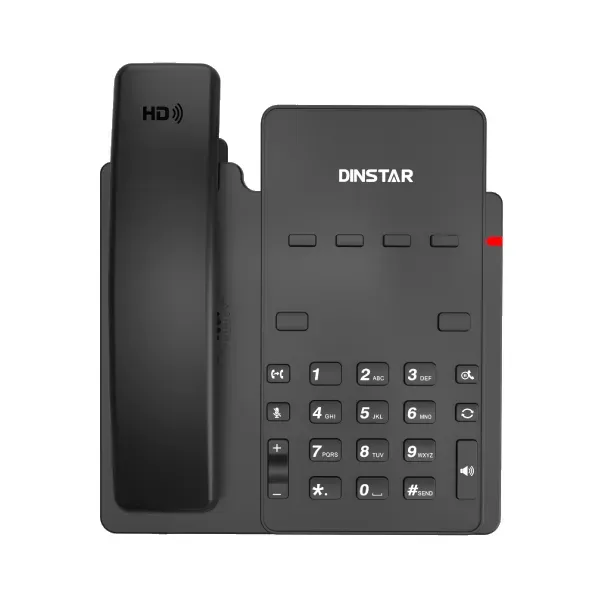
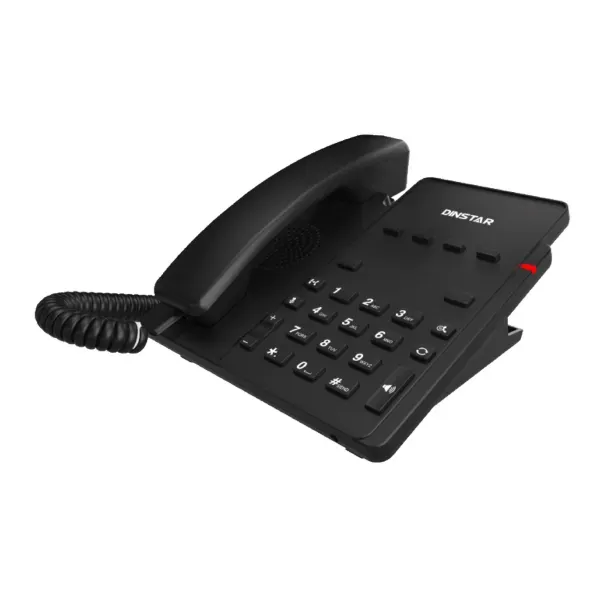
The Dinstar H60P is a purpose-built hotel IP phone for guest-room and hospitality communication environments. Dinstar positions the H60P around HD audio, two SIP accounts, Power over Ethernet, programmable service keys, customizable hotel faceplates, auto provisioning and IP PBX integration. For hotels, resorts, serviced apartments and other accommodation businesses, those capabilities support a practical objective: give guests a simple telephone while giving administrators a manageable SIP endpoint that can be deployed consistently across many rooms.
Quick buying answer
Choose the H60P when your hotel needs a compact SIP room phone with PoE, HD voice, service-speed-dial capability and a customizable hospitality presentation. Before ordering, confirm PBX interoperability, PoE switching, VLAN/QoS design, provisioning method, quantity, faceplate requirements and the exact guest-service call flow.
What the Dinstar H60P solves for hotels
Guest-room telephones have a different job from executive desk phones. The user may stay for one night, may never have seen the handset before and usually wants immediate access to reception, housekeeping, room service, reservations or emergency assistance. The H60P is designed around that simplified interaction. Its programmable service keys can be mapped to hotel hotlines, while the customizable faceplate can present those services in a form that matches the property’s workflow and visual identity. The phone supports two SIP accounts, call waiting, forwarding, transfer, hold, mute, DND, speed dial, hotline, redial, auto-answer and other common SIP calling functions.
For IT teams, the more important benefit is repeatability. A hotel can have tens or hundreds of rooms, so configuring phones one by one is inefficient. Dinstar lists auto-provisioning and network-management capabilities for the H60P. In a properly planned deployment, administrators can standardize account templates, service keys, dialing rules and firmware practices. Power over Ethernet can also simplify room installation by carrying power and network connectivity through the Ethernet infrastructure, provided the access switch has sufficient PoE capacity.
HD voice
Wideband audio support includes G.722 and OPUS-WB, helping improve voice clarity where the network and call path support wideband audio.
2 SIP accounts
Two SIP registrations allow the endpoint to participate in supported IP PBX calling plans and hospitality communication workflows.
PoE and dual Ethernet
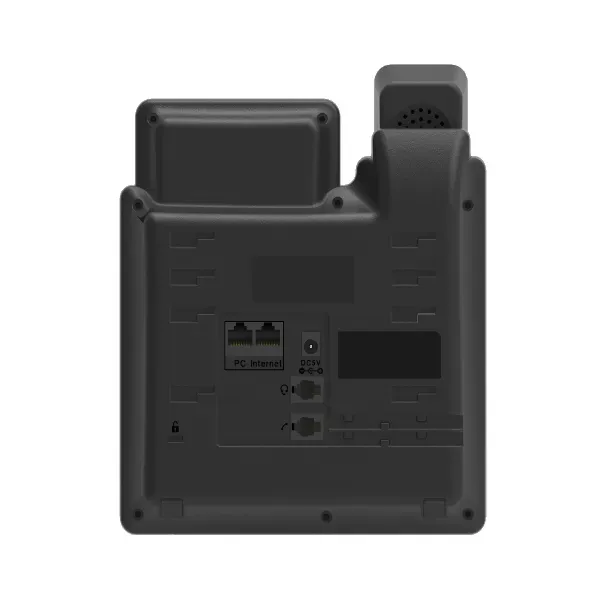
Dual 10/100 Mbps Ethernet and PoE support can reduce separate power-cabling requirements where compatible PoE switching is installed.
Hotel service keys
Six programmable soft keys are listed on the current Dinstar product page and datasheet, giving hotels fast access to selected services.
Verified H60P technical highlights
| Capability | Dinstar H60P |
|---|---|
| Voice | HD voice; G.722 and OPUS-WB wideband codecs; additional codecs listed by Dinstar include PCMA, PCMU, G.729, G.723, G.726, AMR, OPUS and iLBC. |
| SIP | 2 SIP accounts. |
| Network | Dual-port 10/100 Mbps Ethernet. |
| Power | PoE supported; Dinstar datasheet identifies the power adapter as optional. |
| Hotel interface | Programmable service keys and customizable hotel specialty faceplate. |
| Calling | Call forward, waiting, transfer, hold, mute, DND, speed dial, hotline, redial, call return, auto-redial, auto-answer and 5-way conference. |
| Management | Auto provisioning and web/network management functions are supported according to Dinstar documentation. |
| Interoperability | Dinstar lists compatibility with platforms including 3CX, Asterisk, Yeastar, Xorcom, VoIP.ms, BroadSoft and FreeSWITCH. Exact deployment interoperability should still be validated against the intended PBX version and configuration. |
Deployment and integration guidance
A hotel IP phone project should start with the call flow, not with handset quantity alone. Define what happens when a guest presses reception, housekeeping, restaurant, reservations or another service. Decide whether those keys route to a single extension, ring group, queue, IVR destination or time-based rule. Confirm how voicemail, wake-up processes and after-hours calls are handled by the PBX. If the property uses a hospitality PMS or a specialized hotel PBX workflow, confirm which functions are performed by the PBX, which are performed by the PMS and which are merely presented on the phone.
Network preparation is equally important. The H60P supports PoE, but the switch must have enough PoE budget for the number of endpoints connected. Voice traffic should be considered in VLAN and Quality of Service planning, particularly where the same access network also carries guest data, staff Wi-Fi, CCTV or IPTV. DHCP, DNS, NTP, provisioning servers and firewall rules should be documented. For larger rollouts, create a room-to-MAC or room-to-extension inventory so replacements and moves can be performed without losing the relationship between room number, SIP account and faceplate programming.
The H60P faceplate is a practical hospitality feature, but the content should be planned before production. Use clear service names, avoid overly small text, keep emergency information unambiguous and make sure programmed keys match the printed labels. If a property operates in several languages, determine whether the faceplate, dial plan and guest instructions need multilingual treatment. A pilot installation in a few rooms is useful before a mass rollout because it exposes issues with cabling, VLAN tagging, PBX templates, call routing, labeling and user experience.
Related FourTeck Tanzania telephony pages
For organizations comparing room phones with business desk phones, the Dinstar C63G Business IP Phone provides a useful reference for a more conventional office endpoint. The Dinstar C64G Business IP Phone and Dinstar C64GP PoE Business IP Phone are relevant when hotel administration or back-office teams need richer desk-phone functions than a guest room. For higher-line-count business use, review the Dinstar C66G Business IP Phone and Dinstar C66GP PoE Business IP Phone.
You can also use the FourTeck Tanzania technology shop to review broader IP phone and IP PBX procurement options, and the FourTeck Tanzania services page when the requirement includes network preparation, configuration, installation or support planning. For a quotation or compatibility discussion, use the verified FourTeck Tanzania contact page.
Dinstar H60P Hotel IP Phone Tanzania
For hotels in Tanzania, the Dinstar H60P is most relevant where guest-room telephony is being standardized around SIP and the property wants a handset that is simpler than a full enterprise desk phone. The purchasing conversation should begin with room count, front-desk and service-department extensions, the existing or planned IP PBX, switch infrastructure, cabling and the guest services that should be presented as one-touch destinations. A property with 40 rooms has different provisioning and PoE requirements from a multi-building resort with several hundred rooms, even when the handset model is identical.
Tanzania deployments should also consider the wider hotel network. Guest Wi-Fi, staff devices, CCTV, access control, IPTV and voice may share switching or backbone infrastructure. The safest approach is to design voice as a defined service with clear VLAN, DHCP, addressing and QoS policies instead of plugging room phones into an undocumented flat network. Where power interruptions are a concern, the practical resilience of a PoE phone depends on whether the PoE switch, router, firewall and PBX platform are themselves protected by suitable UPS capacity. PoE removes the need for a separate room adapter, but it does not remove the need for power-resilience planning upstream.
Procurement teams should request an exact bill of materials rather than a handset-only price. The quotation should identify H60P quantities, any required faceplate customization, PoE switching implications, PBX licenses if applicable, provisioning and configuration scope, cabling or patching work, UPS dependencies and testing. If an existing PBX will remain in service, provide its vendor, model, version and SIP configuration information before final approval. For new deployments, define whether the PBX is on-premises, hosted or hybrid and how the hotel expects calls to continue if an internet link fails. These questions help turn a product purchase into a reliable guest communication system rather than a collection of endpoints.
Dinstar H60P Hotel IP Phone Dar es Salaam
Hotels and serviced accommodation projects in Dar es Salaam often combine front-office telephony with high-density guest connectivity, meeting facilities, surveillance and business networks. In that environment, the H60P should be planned as part of the room technology stack. A guest should be able to lift the handset and reach the intended service without understanding extensions or SIP. That requires the PBX dial plan and the H60P programmable keys to be aligned with hotel operations. Reception, housekeeping, restaurant, concierge or engineering destinations should be decided by the property and tested under normal, busy and after-hours conditions.
For a new build or refurbishment, verify that each room has an appropriate Ethernet path back to managed switching and that the selected switches provide enough PoE capacity. The H60P uses 10/100 Ethernet, so there is no requirement to treat the endpoint itself as a high-bandwidth device; the important issue is network organization and stability. If the same floor switches also power wireless access points or cameras, calculate the aggregate PoE budget rather than simply counting ports. Document patch-panel positions and room numbers so maintenance staff can quickly identify the correct cable when troubleshooting.
Dar es Salaam buyers comparing quotations should look beyond the unit price. Ask whether the quote covers only hardware or includes SIP registration, service-key programming, provisioning templates, labeling, PBX integration, testing and handover. If custom faceplates are required, provide the desired service names and branding early because artwork approval can become a separate project dependency. Organizations with several properties should also decide whether a common extension plan and provisioning standard will be used across sites. A standardized design simplifies spares, staff training and future expansion while still allowing each property to define its own guest-service destinations where necessary.
Dinstar H60P Hotel IP Phone Mwanza
For accommodation businesses in Mwanza, the H60P can support a straightforward transition from conventional room telephones to SIP-based guest communication. The technical decision is not only whether the phone registers to the PBX, but whether the full communication path is ready. Confirm the room cabling, PoE switch capacity, network segmentation, PBX extension plan, inbound and outbound dialing policy and service-desk routing. If the hotel already has analog room phones, determine whether the project is a phased migration or a complete cutover because that affects how extensions, gateways and room records are managed during the transition.
A useful procurement exercise is to group rooms and service areas into profiles. Standard guest rooms may use the same H60P template, while suites, reception, reservations and administration may require different endpoint types or different key assignments. The H60P’s hospitality orientation makes it suitable for the guest-room profile, but back-office teams may need business phones with more line keys or display features. Using one model everywhere simply for consistency can be less effective than defining a small set of standardized endpoint roles.
Mwanza projects should also create a maintenance process before rollout. Keep a record of each room extension, phone MAC address, switch port and provisioning status. Store approved configuration templates and identify how replacement phones will be enrolled. If the hotel uses multiple service hotlines, verify that each one returns the expected result during busy periods and outside normal hours. Check emergency calling policies and any regulatory or operator requirements separately. When requesting a quotation, include the exact quantity, PBX details, number of floors or buildings, switch model information, faceplate requirements and whether the scope includes installation and configuration. This gives suppliers enough context to identify dependencies instead of pricing a handset in isolation.
Dinstar H60P Hotel IP Phone Arusha
Arusha hospitality environments can range from city hotels and conference properties to lodges and tourism-oriented accommodation. The H60P’s simple guest-facing interface is useful where the telephone should provide immediate access to hotel services without presenting unnecessary enterprise-phone complexity. Before purchase, define which services deserve dedicated keys and whether the printed faceplate should use English, Swahili or another language combination. The physical labeling should match the PBX programming exactly so guests are not sent to the wrong department.
Network topology deserves particular attention when a property has separate buildings, cottages or long cable routes. Standard copper Ethernet distance limits and PoE design may affect how switches are distributed. Some sites may require fiber uplinks between buildings with local access switches serving groups of rooms. The H60P itself remains an Ethernet SIP endpoint, but the surrounding network architecture determines whether the service is stable. Where links between buildings depend on wireless bridges or other transport, voice quality should be validated under realistic network load and appropriate QoS policies should be applied.
For procurement, separate verified product capabilities from project assumptions. The H60P supports PoE, two SIP accounts, HD voice and hospitality service keys, but the phone does not by itself provide a hotel PMS, SIP trunk, internet connection or call routing policy. Those belong to the wider solution. Arusha buyers should ask the solution provider to document which component performs each function. A well-structured quotation can show handsets, network requirements, PBX or hosted-service requirements, installation tasks, configuration, testing and support boundaries. If the property plans future room expansion, include expected room count growth now so switch port capacity, PBX extensions and provisioning conventions can be sized with reasonable headroom.
Dinstar H60P Hotel IP Phone Dodoma
Hotels, guest houses and institutional accommodation in Dodoma evaluating the Dinstar H60P should approach the purchase from both guest experience and infrastructure perspectives. The handset is intended to be easy for a transient user, but the back-end setup must be disciplined. Decide which keys are exposed to the guest, how calls reach reception and departments, what happens when a department is busy and whether the property uses centralized or site-specific voicemail and call reporting. The H60P can participate in these workflows as a SIP endpoint, while the PBX determines the routing behavior.
From an infrastructure perspective, inspect the existing network before ordering a large quantity. Confirm Ethernet availability in rooms, switch capacity, PoE budget, VLAN support and UPS coverage for the voice path. A phone powered by PoE will stop if the switch loses power, so resilience depends on upstream systems. If guest rooms are on multiple floors, verify rack locations and uplink capacity. Maintain separation between guest Wi-Fi and operational voice traffic where appropriate, and restrict device-management access to authorized administrators.
Dodoma procurement teams can improve quote quality by providing a room schedule and current communications diagram. Include the number of guest rooms, service desks, administrative extensions, PBX type, SIP trunk arrangement if relevant, and whether faceplate customization is required. Ask how phones will be provisioned, how configuration backups are maintained and how a replacement unit is introduced. If the hotel is replacing analog phones gradually, identify gateway or hybrid-PBX dependencies so the migration does not interrupt service. The H60P should be evaluated as one endpoint within that transition plan. Clear documentation of assumptions makes it easier to compare bids on actual scope rather than on a headline handset price alone.
Dinstar H60P Hotel IP Phone UAE
For UAE hospitality projects, the H60P is relevant to hotels that want a dedicated SIP guest-room endpoint with PoE and programmable services rather than a feature-heavy office handset. Large properties should standardize the deployment template: room extension format, SIP credentials policy, provisioning URL, firmware baseline, VLAN settings, time configuration and service-key destinations. A documented standard becomes especially valuable across towers, resort buildings or multiple managed properties because it reduces configuration drift and makes replacement procedures predictable.
Procurement should account for local carrier, PBX and hospitality-system design. Dinstar lists broad IP PBX interoperability, but an actual project should validate the intended platform version and any hotel-specific middleware. If a PMS integration is required, confirm whether it connects to the PBX, a hospitality gateway or another server rather than assuming the room phone itself provides that integration. Review privacy requirements for guest information and keep administrative access to phones and provisioning systems restricted.
UAE buyers can also coordinate with the wider FourTeck network. The FourTeck UAE site provides a regional starting point for broader infrastructure requirements, while specialist telephony information is available through FourTeck IP phone resources and IP PBX solution resources. When seeking a quotation, provide hotel room quantity, PBX platform, expected custom faceplate content, installation location, required accessories, and whether the project includes switches, cabling, UPS and configuration. That scope enables a meaningful comparison between product-only supply and a complete deployment.
Dinstar H60P Hotel IP Phone Uganda
In Uganda, hotels considering the H60P should first define whether the project is a new SIP deployment, an extension of an existing PBX or a migration from analog room phones. That distinction affects network and gateway requirements. A new SIP design can place H60P endpoints directly on the voice network and register them to the chosen PBX. A phased migration may need temporary coexistence with analog extensions or gateways. Documenting the migration sequence helps prevent room-number confusion and reduces disruption during occupancy.
The H60P’s PoE support can simplify guest-room installation, but the switch infrastructure must be sized for both port count and total power budget. If access points, cameras and room phones share switches, calculate all PoE loads and preserve headroom. Use managed switching when practical so voice VLANs and troubleshooting are easier. Confirm whether the PBX is on-site or hosted and how branch or internet outages affect internal hotel calling. Internal calls between rooms and service desks may be expected to continue even when external connectivity is unavailable, depending on the architecture.
The FourTeck Uganda site covers IP PBX, VoIP and networking themes relevant to a hotel phone project. For the H60P specifically, request a scope that includes the exact phone quantity, PBX compatibility validation, faceplate design if needed, provisioning approach, service-key programming and final acceptance tests. Testing should include reception, housekeeping and other one-touch destinations, inbound room calls where permitted, voicemail or message waiting if used, transfer behavior and emergency procedures. A structured handover should document extensions, switch ports and administrator responsibilities so the system can be supported after installation.
Dinstar H60P Hotel IP Phone Kampala
Kampala hotels and serviced apartments may need room telephony that fits into increasingly converged networks. The H60P can be a practical guest-room endpoint, but network sharing should be controlled. If the same physical infrastructure carries office data, Wi-Fi, CCTV and phones, use VLANs and access policies to separate functions. Voice quality depends on latency, jitter and packet loss, so QoS and uplink capacity should be checked during busy periods rather than only during an empty-site installation test.
Guest-facing usability should be validated with real staff workflows. A housekeeping key should call the correct team, but the organization must decide whether that destination is a fixed extension, ring group or queue. Reception may need different routing during night shifts. Restaurant or room-service calls may be directed by time of day. Those rules live in the PBX and should be documented before H60P keys are programmed. If the faceplate is customized, use concise labels that guests can understand immediately and avoid printing service options that the PBX cannot reliably deliver.
Kampala buyers should also consider replacement and lifecycle operations. Keep at least the configuration process and room inventory documented, even if spare-unit quantities are decided separately. When a phone is replaced, the administrator should know how to assign the correct extension and restore the appropriate service-key template. If centralized provisioning is used, protect the provisioning server and credentials. In a quotation request, include room count, number of buildings, current PBX, switch models, desired service buttons and whether implementation occurs in an operating hotel. An occupied property may require phased room access and tightly scheduled cutovers, while a new property can usually be staged floor by floor before opening.
Dinstar H60P Hotel IP Phone Arua
Arua accommodation projects considering SIP room phones can use the H60P where a straightforward handset and centralized IP-based management are priorities. Start by validating the network path from each room to the PBX. Check cable quality, switch placement and power continuity. In buildings where the network has grown incrementally, an audit can reveal unmanaged switches, undocumented patching or insufficient PoE capacity that should be corrected before dozens of phones are installed.
The most useful design question is what the guest needs from the phone. Many hotels require only a small set of service destinations, and the H60P’s programmable keys are intended for that model. Define those destinations and make sure staff ownership is clear. If housekeeping or maintenance calls ring unanswered, the telephone is functioning technically but the guest experience still fails. PBX ring groups, overflow rules and after-hours routing should therefore be part of acceptance testing, not an afterthought.
For procurement, specify whether the requirement is supply-only or a complete deployment. Supply-only should still confirm exact model, quantity, included accessories and power method. A deployment scope should add PBX registration, switch/VLAN preparation, provisioning, service-key programming, faceplate coordination, testing and documentation. Where connectivity to a hosted PBX crosses an internet link, evaluate link stability and any local survivability requirement. Where the PBX is on-premises, protect the core voice equipment and PoE switching with appropriate power backup. These practical questions matter more than marketing claims when the phone is expected to remain available for guest communication throughout daily hotel operations.
Dinstar H60P Hotel IP Phone Mbarara
For hotels in Mbarara, the H60P can serve as a standardized room endpoint while reception and administrative teams use different Dinstar business-phone models better suited to staff workloads. This role-based approach keeps the guest room simple and avoids paying for enterprise features that guests may never use. At the same time, it gives front-office staff access to richer call handling where required. The PBX ties those endpoint roles together through extensions, ring groups, queues and transfer rules.
Before rollout, build a room-extension plan that is easy for staff to understand and maintain. The numbering can reflect room numbers when appropriate, but security and operational requirements should also be considered. Avoid exposing administrative passwords or SIP credentials in room-facing materials. Central provisioning can reduce manual configuration, but only if templates are carefully tested. A bad template can replicate the same error across an entire property, so pilot a limited group first and confirm audio, key assignments, time settings and call routing.
Mbarara procurement requests should identify whether PoE switching already exists. If it does, provide switch models and available budget; if it does not, include managed PoE switching in the design. Count not just phones but all PoE endpoints on each switch. Confirm UPS runtime expectations for the PBX, switches and network edge. If a custom H60P faceplate is desired, prepare approved branding and service labels before final ordering. Ask for a handover package containing the extension list, configuration method, network addressing, switch-port map and support contacts. That documentation is especially valuable when local hotel staff handle first-line troubleshooting before escalation to an integrator.
Dinstar H60P Hotel IP Phone Gulu
Gulu hospitality businesses evaluating IP telephony can use the H60P to replace room-phone complexity with a focused guest interface. The phone’s purpose is not to replicate a receptionist console; it is to give the guest clear voice access and fast service calling while remaining manageable for IT. That makes the quality of the service-key plan more important than the number of advanced features. Select only useful destinations and test them with the departments that will receive those calls.
A site survey should confirm room data outlets and cable condition. If some rooms lack Ethernet, the project may require cabling work rather than relying on improvised network extensions. If multiple buildings are connected, examine backbone links and where PoE access switches will be located. Provide adequate rack space, ventilation and UPS protection. The H60P supports dual 10/100 Ethernet, but the wider network may need faster uplinks depending on other traffic such as Wi-Fi and CCTV. Separate endpoint speed from backbone capacity when designing the network.
During quotation, ask the supplier to state assumptions explicitly. Is the PBX already available? Are SIP licenses required? Who programs the extensions? Is faceplate customization included? Who configures switches and VLANs? Is cabling tested? How are phones provisioned and firmware maintained? Are acceptance tests documented? These questions help Gulu buyers avoid comparing a bare hardware quote with a full implementation quote as if they were equivalent. If the property expects expansion, identify future room blocks or buildings so port count and PBX capacity can be reviewed now. A scalable plan does not require buying all future hardware immediately; it requires knowing what the next expansion step will demand.
Dinstar H60P Hotel IP Phone Kenya
Hotels in Kenya can evaluate the H60P when they need a hospitality-specific SIP phone that works as part of a managed IP PBX deployment. The endpoint should be selected after confirming the operating model of the property: number of rooms, service departments, PBX platform, expected call features, network design and maintenance responsibilities. For a chain or management group, standardizing on a common room-phone template can simplify training and support while individual properties retain their own service destinations.
The FourTeck Kenya site covers VoIP business phones and IP PBX communication systems relevant to the surrounding solution. The H60P itself supports two SIP accounts, PoE, HD voice and programmable hotel service keys. Those functions should be mapped to a deliberate PBX design. Confirm SIP registration, codecs, DTMF handling, transfer behavior, voicemail or message waiting where used, and one-touch service dialing. Avoid assuming that every PBX feature automatically behaves the same across different firmware or deployment modes; interoperability testing remains good practice.
Kenya procurement teams should request clarity on supply, installation, taxes, logistics and project services without assuming stock or delivery times. For multi-site purchases, separate common hardware pricing from site-specific implementation work. A Nairobi city hotel, coastal resort or remote lodge may use the same H60P but require different network and power architecture. Include faceplate artwork, language requirements, PoE switch capacity, UPS design and provisioning method in the technical scope. The final acceptance process should verify that a guest in every tested room can reach the intended hotel services and that staff can identify, replace and reprovision a phone without reconstructing the configuration from scratch.
Dinstar H60P Hotel IP Phone Kuwait
Kuwait hospitality projects looking for a compact SIP guest-room phone can assess the H60P around its defined hospitality capabilities rather than office-phone specifications. Two SIP accounts are generally sufficient for typical room endpoint use, while programmable service keys and custom faceplates are directly aligned with hotel workflows. Determine whether the property needs one standard faceplate across all rooms or different layouts for suites, residences or branded properties.
The FourTeck Kuwait site provides regional context for VoIP, PBX and network-security projects. For an H60P rollout, verify PoE switching, VLAN design and PBX interoperability before bulk deployment. Large properties should use provisioning templates and maintain a clear device inventory. If the PBX is hosted, examine internet redundancy and whether room-to-service calls remain available during WAN disruption. If the PBX is local, ensure core equipment and access switching are backed by appropriate UPS systems and maintained in suitable rack environments.
A Kuwait quotation request should describe the technical scope with enough precision for bidders to price the same requirement. State the quantity of H60P phones, PBX platform, number of rooms and buildings, network readiness, faceplate customization, service-button mapping, installation responsibility, testing requirements and documentation expectations. If existing phones are being replaced, include the current extension numbering and any analog or digital interfaces that must be retired. Where a PMS or other hospitality software is part of the project, identify the integration point and vendor so responsibility is clear. This prevents the common mistake of expecting the guest-room handset to provide functions that actually belong to the PBX or hotel application layer.
Dinstar H60P Hotel IP Phone Ghana
Ghana hotels adopting SIP room telephony can use the H60P as the guest-facing endpoint while a broader IP PBX platform manages routing, voicemail and service logic. The design should make the guest experience obvious: clear labels, simple dialing and reliable access to staff. Before deciding on custom faceplate content, hotel operations should agree on the services that will be staffed consistently. A button labeled housekeeping is only useful if the destination is monitored and overflow rules are defined.
The FourTeck Ghana site covers business communication and IP phone solution themes that can complement a hotel phone project. Technical planning should confirm SIP PBX compatibility, PoE budget, room cabling, network segmentation and provisioning. If the hotel has several floors, allocate switch ports and PoE power by floor and keep a documented room-to-port map. If CCTV and Wi-Fi share the same switching estate, consider their traffic and power demands when sizing uplinks and power supplies.
Ghana procurement teams should use a quotation checklist that distinguishes product supply from implementation. Hardware scope includes the exact H60P quantity and any approved accessories. Implementation scope can include PBX extension creation, configuration templates, VLAN and QoS setup, service-key mapping, custom faceplate coordination, installation, testing and staff handover. Ask how replacement phones are handled after deployment and whether configuration can be restored centrally. If the property has expansion plans, request an architecture that preserves enough switch, addressing and PBX capacity for additional rooms. The objective is not to overbuy on day one, but to avoid a design whose first expansion requires replacing core infrastructure.
Dinstar H60P Hotel IP Phone Nigeria
Nigeria hospitality projects often place strong emphasis on power resilience and network manageability, both of which directly affect an IP phone deployment. The H60P can be powered through PoE, simplifying endpoint power, but the complete calling path still depends on PoE switches, the PBX, routers and any required WAN connectivity. A resilience plan should therefore protect the upstream infrastructure and define what calling functions must remain available during internet or utility-power disruptions.
The FourTeck Nigeria site provides broader regional IT and communications context. For hotels, the H60P’s programmable keys can be configured for services such as reception, housekeeping or restaurant contact. The exact destination and call treatment should be defined in the PBX. Consider day/night routing, busy overflow and departmental staffing. If guests can make external calls, define authorization and billing policies at the PBX or hospitality platform; do not rely on the room phone alone to enforce business policy.
When comparing H60P offers in Nigeria, request a scope that specifies PBX compatibility validation, PoE and switching requirements, configuration method, faceplate customization, installation, acceptance testing and documentation. For large deployments, ask how automated provisioning will be structured and secured. Keep an inventory of MAC addresses, room numbers and extension assignments. If several hotels or branches use the same endpoint, standardize configuration naming and support procedures. This reduces troubleshooting time and makes spare units easier to deploy. Any promise about stock, delivery, warranty or local service coverage should be confirmed in the actual supplier quotation rather than assumed from generic product information.
Dinstar H60P Hotel IP Phone Seychelles
Seychelles resorts and island hospitality properties can benefit from the H60P’s simple guest-room design, but geographic layout can make the surrounding network architecture especially important. A resort may have villas, separate buildings or dispersed accommodation areas. Before choosing endpoint quantities, map how Ethernet and power reach each room cluster, where access switches are located and how those switches connect back to the PBX. Fiber or wireless backbone links may be involved between buildings, and voice quality should be tested across those links under realistic load.
Guest-service calling should remain intuitive even when the underlying property is complex. Program only the services that are consistently available and route them through PBX groups that match operational staffing. If a resort has several restaurants or activity desks, avoid overloading the faceplate with too many options; a concise set of high-value service keys is usually easier for guests. The custom faceplate can reinforce the property’s service design, but it should be reviewed by operations as well as marketing.
Procurement in Seychelles should factor logistics and spares into the project plan without making unsupported assumptions about availability. Ask the supplier to state delivery scope, lead-time commitments, warranty handling and spare recommendations in the quotation. Technically, confirm H60P quantities, PoE switch capacity, UPS protection, PBX licensing, provisioning and acceptance testing. For remote properties, documentation is particularly valuable because on-site staff may need to perform basic replacement tasks. A simple written procedure covering cable checks, extension identification, replacement-phone enrollment and escalation can reduce downtime. If connectivity to a hosted PBX crosses a WAN link, decide whether local calling or survivability is required and design the PBX architecture accordingly.
Buying checklist for a Dinstar H60P quotation
State guest-room quantity, suites, staff areas and any spare-unit requirement separately.
Provide vendor, model, software version, hosting model and SIP-registration expectations.
List PoE switches, available ports, VLAN plan, cabling status and UPS protection.
Define the exact labels and PBX destinations for reception, housekeeping and other services.
Confirm branding, language, artwork approval responsibility and whether customization is required.
Clarify supply-only versus configuration, installation, testing, documentation and support.
Frequently asked questions
Is the Dinstar H60P designed specifically for hotels?
Yes. Dinstar identifies the H60P as a hotel IP phone and highlights hospitality-oriented functions including programmable service keys and a customizable hotel faceplate.
How many SIP accounts does the H60P support?
Dinstar lists two SIP accounts for the H60P.
Does the H60P support PoE?
Yes. The official datasheet lists PoE support and dual 10/100 Mbps Ethernet. Verify that the selected network switch provides sufficient PoE capacity for the full deployment.
Can the hotel service buttons be customized?
The H60P supports programmable service keys, and Dinstar also advertises customizable hotel faceplates. The exact button labels and destinations should be coordinated with the property’s PBX call flow.
Will the H60P work with our IP PBX?
Dinstar lists compatibility with a range of IP PBX platforms including 3CX, Asterisk, Yeastar, Xorcom, BroadSoft and FreeSWITCH. For procurement, validate the exact PBX version, SIP settings and required features in a pilot before a large rollout.
What information should we send for a quotation?
Send the phone quantity, hotel room count, PBX platform, switch and PoE information, desired service-key mapping, faceplate requirements, installation location and whether you need configuration, cabling, testing or documentation.
Decision recap
The Dinstar H60P is best considered as a dedicated hotel-room SIP endpoint: simple for guests, programmable for hotel services and manageable for IT. Its verified strengths include HD voice, two SIP accounts, PoE, dual 10/100 Ethernet, programmable service keys, customizable faceplate options and auto-provisioning support. A successful purchase still depends on the surrounding design: compatible PBX, sufficient PoE switching, a clear voice network, tested service routing, accurate faceplate labels and documented provisioning.
For regional projects, FourTeck resources in UAE, Uganda, Kenya, Ghana, Nigeria and Kuwait can be used as regional starting points. Product availability, delivery, warranty and service scope should be confirmed in the final quotation for the specific destination.
Plan your H60P hotel phone deployment
Share your room count, PBX platform, existing network, target service buttons and desired faceplate approach. FourTeck can use those details to structure a compatibility and quotation discussion around the complete requirement rather than the handset alone.


Reviews
There are no reviews yet.