
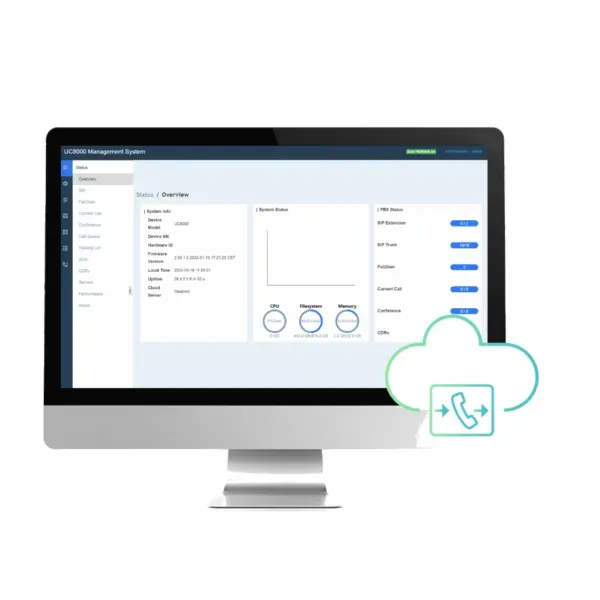
Dinstar UC8000 Software IP PBX
Dinstar UC8000 is a software-edition IP PBX designed for medium and large enterprises, multi-branch organisations, government environments and industry deployments that need scalable SIP communications without being tied to a single hardware appliance. Dinstar states that UC8000 can scale to as many as 20,000 SIP extensions and 4,000 concurrent calls, with software deployment on supported x86 or ARM platforms, virtual machines and cloud infrastructure.
The practical value is architectural flexibility. A customer can design the PBX around its own server or virtualisation strategy, integrate mainstream SIP endpoints and Dinstar devices, build call queues and multi-level IVR, apply call recording and routing rules, and add high-availability options for business-critical voice services. For Tanzania deployments, planning should begin with extension counts, busy-hour call concurrency, SIP trunking, branch requirements, voice VLANs, firewall policy, internet resilience, backup, user roles and growth.
Capacity: up to 20,000 SIP extensions and 4,000 concurrent calls.
Deployment: on-premises, virtual machine or cloud.
Availability: hot-standby redundancy plus redundant routing options.
Security: TLS, SRTP, HTTPS administration, permissions and built-in IP firewall capabilities.
Telephony: IVR, queues, voicemail, recording, routing, conferencing, CDRs, auto-provisioning and more.
Maximum SIP extensions stated by Dinstar for UC8000.
Maximum concurrent calls stated by Dinstar.
Hot-standby architecture can be designed for continuity requirements.
Interoperability with Dinstar and mainstream SIP endpoints and gateways.
What Dinstar UC8000 solves
UC8000 is relevant when a conventional small-office PBX no longer fits the organisation. Common triggers include rapid extension growth, multiple branches, a need for centralised dial plans, call-centre style queues, reception workflows, recording policies, remote extensions, SIP trunk consolidation, high availability or a preference to deploy communications software on existing virtualisation or cloud infrastructure. Because the platform is software-based, the design conversation moves beyond choosing a fixed appliance and toward sizing compute, network, storage, licensing, redundancy and operational support for the customer’s expected call load.
For a structured Tanzania deployment, FourTeck can help define the telephony scope alongside the wider LAN and security environment. The FourTeck Tanzania services portfolio is relevant because UC8000 depends on switching, routing, firewall rules and implementation discipline, while the FourTeck Tanzania technology shop helps buyers consider companion IP phones, gateways, switches and supporting infrastructure rather than treating the PBX as an isolated purchase.
Key verified features and technical capabilities
Flexible software deployment
Dinstar lists support for on-premises and cloud deployment, x86 and ARM hardware architectures, and virtual environments including VMware and KVM families. Supported operating-system references include Ubuntu, CentOS, openEuler and Kylin. Exact version compatibility should be confirmed against the current vendor documentation before production rollout.
Business telephony features
The feature set includes call forwarding, blind and attended transfer, voicemail and voicemail-to-email, call parking, call waiting, ring groups, call queues, auto-attendant, multi-level IVR, scheduled routing, caller-number manipulation, call recording, conference functions, CDR reporting and attendant-console support.
Security controls
UC8000 provides TLS and SRTP support for protected signalling and media, secure HTTPS administration, multi-level user permissions and IP-blacklist/firewall functions. These capabilities should form part of a broader voice-security design that also includes strong credentials, trusted management paths, network segmentation and correctly scoped firewall access.
High availability
Dinstar highlights hot-standby redundancy, load balancing, redundant routing and multi-branch connectivity with local survivability. The exact HA design should be documented against recovery objectives, SIP trunk behaviour, DNS, network routing, storage and upstream dependencies rather than relying on PBX redundancy alone.
Media and protocol support
Published protocol support includes SIP over UDP/TCP, RTP/RTCP and media capabilities for common voice codecs such as G.711, G.722, G.729, G.723, G.726 and Opus, along with video codec support and T.38/pass-through fax functions. Codec and carrier interoperability should always be tested with the intended SIP service.
Administration and troubleshooting
Web GUI administration, backup and restore, CDR export, network capture, ping and traceroute tools, NTP and other diagnostics help administrators manage and troubleshoot the system. Auto-provisioning can simplify endpoint rollout when supported IP phones and provisioning workflows are planned consistently.
Integration with IP phones, gateways and the LAN
An IP PBX is only one layer of the communication environment. User endpoints, SIP trunks, analogue or digital gateways, firewall policies, DNS, DHCP, switching, PoE and WAN connectivity all affect the quality and reliability of the final service. Dinstar specifically positions UC8000 as interoperable with Dinstar IP phones and VoIP gateways as well as mainstream SIP terminals. For organisations migrating from analogue lines, legacy PBXs or mixed branch environments, gateways can preserve useful interfaces while the core call-control platform moves to SIP.
FourTeck Tanzania’s integrated IT and telecom overview explains why voice should be coordinated with the rest of the network. IP phones commonly rely on PoE, voice VLANs and QoS. Branch connectivity may rely on secure WAN or VPN architecture. Remote extensions can be affected by NAT, carrier restrictions and internet quality. Recording or voicemail storage needs should be considered along with backup and retention policies.
Customers planning regional deployments can also use the wider FourTeck network for related requirements, including FourTeck Uganda, FourTeck Kenya, FourTeck UAE, FourTeck Ghana and FourTeck Nigeria. These links are useful for customers coordinating common telephony standards across multiple countries.
Deployment and sizing guidance
Although UC8000 supports a high maximum extension count, correct sizing is not simply a matter of counting registered users. A project should estimate simultaneous calls, busy-hour call attempts, conferencing behaviour, call recording, transcoding, IVR usage, branch routing, SIP trunk capacity, redundancy and future growth. Compute resources should be selected against the actual workload and vendor recommendations. Network latency, packet loss and jitter matter as much as server capacity because a correctly sized PBX cannot compensate for poor transport quality.
A useful quotation brief therefore includes the present number of extensions, forecast growth, expected concurrent calls, external numbers, SIP trunk provider, current telephone infrastructure, remote-user count, branch list, reception and queue requirements, recording policy, voicemail usage, HA objective, preferred hosting model and management responsibility. If UC8000 will be virtualised, include the hypervisor and available resources. If cloud-hosted, include the target region, public IP requirements, security policy, bandwidth and backup expectations.
Network preparation should cover dedicated or logically separated voice traffic where appropriate, PoE budgets for phones, DHCP options if used for provisioning, DNS and NTP reachability, firewall/NAT policy, SIP ALG considerations, QoS, WAN failover, secure administration and monitoring. The FourTeck Tanzania company overview provides context for integrated multi-system planning, while the Tanzania contact page is the place to submit the technical details needed for a quotation.
Dinstar UC8000 Software IP PBX Tanzania
For organisations evaluating Dinstar UC8000 Software IP PBX in Tanzania, the strongest use case is a business that needs a scalable, centrally administered voice platform rather than a small fixed-capacity appliance. The software architecture is especially relevant to enterprises with several departments, multiple sites, large extension plans, call queues, service desks, front-office reception, internal helpdesks or a requirement to consolidate SIP communication under one management platform. Buyers should begin with operational requirements rather than the headline maximum capacity. A 500-extension organisation with complex call recording and branch failover can have a different resource profile from a 2,000-extension organisation with mostly internal calling.
In Tanzania, procurement planning should include the connectivity path between the PBX, SIP carrier and branch sites. The customer should document primary and backup internet circuits, public IP arrangements, firewall policies, DNS and NTP, expected remote users and any sites where local survivability is important. Power continuity also matters because IP telephony depends on the server, switches, gateways, routers, firewalls and phones remaining powered together. UPS-backed network infrastructure can therefore be as important as the PBX software itself.
UC8000 can support centralised or distributed deployment, so a Tanzanian organisation with branches can decide whether to concentrate services in one data centre, use a cloud environment or design local elements for resilience. That decision should be based on WAN reliability, recovery objectives, IT skill, security policy and where telephone services terminate. For businesses integrating analogue devices or legacy carrier circuits, Dinstar VoIP gateways can be evaluated as companion components. For all-SIP designs, interoperability with the selected IP phones and trunk provider should be validated before mass rollout.
A FourTeck Tanzania quotation discussion should include extension count, concurrent calls, phone quantities, gateway interfaces, branch locations, call-flow diagrams, queue and IVR requirements, recording, high availability, deployment platform and expected implementation scope. This produces a procurement document that reflects the whole system rather than software alone.
Dinstar UC8000 Software IP PBX Dar es Salaam
Businesses in Dar es Salaam frequently need voice systems that can connect head offices, reception teams, departments, warehouses, customer-service desks and branch operations while keeping administration centralised. Dinstar UC8000 is a good candidate when the organisation expects more than basic extension-to-extension calling and wants structured IVR, queues, time-based routing, call recording, attendant workflows and a platform that can scale without replacing a proprietary appliance every time user counts increase. The software deployment model also aligns with organisations already operating virtualised server environments.
A Dar es Salaam project should pay particular attention to network architecture around voice. Office buildings may combine IP phones, computers, cameras, Wi-Fi and servers on shared switching infrastructure, so VLAN design and QoS can help keep voice predictable. If the PBX is hosted off-site or in the cloud, internet resilience becomes part of the phone-system design. If it is hosted on-premises, the server room, power, backup, firewall and remote administration model should be documented. For reception-heavy businesses, busy-hour concurrency and queue behaviour should be measured rather than estimated casually.
Companies migrating from older PBXs should map every existing line, extension, hunt group, receptionist key, fax workflow and analogue endpoint. This migration inventory prevents overlooked dependencies from appearing during cutover. Where traditional interfaces remain necessary, appropriate Dinstar gateways can bridge analogue or digital services into the SIP environment. For new offices, an all-IP approach can simplify cabling and management when PoE switching and structured cabling are already planned.
When requesting a Dar es Salaam quotation, provide the office user count, number of simultaneous calls, departments, reception flow, existing telephone numbers, carrier information, remote-user requirement, recording needs, branch links and the intended hosting environment. These details allow the UC8000 design to be matched to the business rather than treated as a generic PBX licence.
Dinstar UC8000 Software IP PBX Mwanza
For a Mwanza organisation, Dinstar UC8000 can provide a central voice platform for offices, distribution operations, service teams, hospitality properties, educational institutions and multi-site businesses that want unified extension numbering and consistent call handling. A software IP PBX is particularly useful when the organisation expects change: new departments, branch openings, remote users or additional SIP trunks can often be incorporated through configuration and licensing rather than a complete replacement of the telephony core.
The network path should be assessed carefully. If users at different Mwanza sites register to a centrally hosted UC8000, the design should identify the primary WAN path, failover strategy, expected voice bandwidth and what happens if connectivity is lost. Dinstar’s multi-branch and local-survivability positioning is relevant, but the final behaviour depends on the complete topology and any gateways or local services included. For critical calling, redundancy should cover more than the PBX application; switches, routers, firewall, DNS, carrier services and power are also dependencies.
Call-flow design can produce major operational improvements. Instead of simply assigning extensions, businesses can define department queues, overflow destinations, after-hours logic, voicemail-to-email, supervisor handling and differentiated routes for customers, suppliers or internal staff. Recording can be incorporated where the organisation has a valid business need and appropriate policy. Number manipulation and time-based routing can help unify several sites under one coherent dial plan.
Before procurement, Mwanza buyers should document extension classes, concurrent-call expectations, IP phone requirements, analogue devices, call-recording retention, branch links and SIP trunk details. A pilot with representative endpoints and the intended carrier is advisable where interoperability or network quality is uncertain. This makes the final deployment easier to support and reduces surprises during migration.
Dinstar UC8000 Software IP PBX Arusha
Arusha organisations in hospitality, tourism, professional services, education, logistics and administration often need telephone systems that combine reliable front-desk call handling with back-office extensions and, in some cases, connections to properties or offices in other locations. Dinstar UC8000 provides a software platform for these environments with multi-level IVR, ring groups, call queues, voicemail, recording, conferencing and SIP interoperability. The important procurement question is not whether these features exist, but how they should be configured around the customer’s workflow.
Hospitality-style environments may require integration planning between front-office calling, guest or room extensions, reception consoles and existing property workflows. Dinstar separately offers a PMS product for UC-series environments, but exact compatibility, licensing and required versions should be confirmed with the vendor for the intended deployment. A standard office may instead prioritise department queues, executive assistants, remote extensions and branch connectivity. Both cases can use the same UC8000 core while requiring very different call flows.
Arusha sites should also review network and power resilience. IP phones, access switches, routers and PBX infrastructure form one service chain, so a failure at any point can affect calling. Voice VLANs, QoS, UPS capacity and documented failover are therefore practical design topics. For cloud-hosted UC8000, internet redundancy becomes more important; for on-premises hosting, local server reliability, backup and secure remote access need more attention.
A useful Arusha quotation request should state whether the requirement is for a single office, hotel, campus or multi-site organisation; give extension and phone quantities; identify reception and queue functions; list analogue or gateway needs; describe SIP carrier services; and define the expected installation, configuration, training and support scope.
Dinstar UC8000 Software IP PBX Dodoma
For institutions and enterprises in Dodoma, UC8000 is suited to structured deployments where extension scale, policy-based call handling and centralised administration matter. Government-related offices, education environments, larger commercial organisations and multi-department facilities may benefit from a PBX that can support thousands of SIP users without being constrained to one fixed hardware chassis. The platform’s role can range from internal extension services to a broader communication hub linking SIP trunks, branch locations, voicemail, conferencing and call recording.
Procurement teams should define governance requirements early. Administrator roles, change approval, recording permissions, extension naming, numbering plans and configuration backup should be documented so the system remains manageable after handover. UC8000 supports multi-level permissions and HTTPS administration, but these controls need to be incorporated into an operational process. Secure management access should be limited to authorised networks or secure remote methods rather than being exposed unnecessarily.
For deployments spanning several buildings or branches, fibre or WAN links, voice VLANs, routing, DNS, NTP and firewall rules should be mapped with the telephony topology. If local gateways are used to connect legacy phones or circuits, their failure and recovery behaviour should be understood. If high availability is required, the customer should specify acceptable downtime and test failover as part of acceptance rather than assuming the presence of a standby instance guarantees end-to-end continuity.
A Dodoma UC8000 proposal is strongest when it includes a requirements matrix for users, departments, trunks, call queues, IVR levels, reporting, recording, branch connections, high availability, hosting, backup and training. This approach turns the PBX project into a controlled infrastructure deployment instead of a one-time software installation.
Dinstar UC8000 Software IP PBX UAE
Organisations coordinating Tanzania and UAE operations can use Dinstar UC8000 as part of a common SIP telephony architecture, subject to carrier, regulatory and technical requirements in each market. The software PBX model is useful for regional businesses because extension policies, IVR logic, dial plans and endpoint standards can be documented centrally while deployment can remain on-premises, virtualised or cloud-based. A regional design should not assume the same SIP trunk or numbering arrangement is available in every country; local telecommunications rules and service-provider capabilities must be verified separately.
For UAE-linked deployments, the customer may choose to host the core PBX in one data centre and connect branches securely, or maintain country-specific instances with controlled interconnection. The decision should consider latency, business continuity, data and recording policies, local survivability, IT ownership and carrier integration. Dinstar’s support for hot standby, redundant routing and multi-branch architecture can be incorporated where resilience is required, but the network and carrier layers should be designed to the same availability objective.
Endpoint standardisation can simplify support. Dinstar IP phones and mainstream SIP devices can be evaluated for shared provisioning templates, while Dinstar gateways may be useful where analogue or digital interfaces remain part of the environment. FourTeck UAE resources at FourTeck UAE can support related regional infrastructure discussions, while the Tanzania site can remain the reference point for Tanzania-side requirements.
A cross-border quotation brief should clearly separate each country’s user count, numbers, trunks, sites, internet links, phones and gateways. It should also identify whether the objective is a shared dial plan, common management, free internal calling over private links, unified reporting or simply consistent equipment standards.
Dinstar UC8000 Software IP PBX Uganda
Ugandan businesses considering Dinstar UC8000 can use the platform for scalable enterprise telephony, especially when a company operates several sites or expects extension growth beyond the comfortable range of a small appliance PBX. The central design questions are the number of users, call concurrency, branch topology, SIP service, endpoint mix and expected availability. UC8000’s published capacity provides significant headroom, but the production configuration should still be sized to the actual workload and host resources.
For regional companies with offices in both Tanzania and Uganda, extension numbering and call routing can be coordinated without forcing every site into an identical implementation. A Kampala head office might need large queues and reception handling, while a smaller branch may need only standard extensions and local fallback. The network design should account for latency, packet loss, internet failover and what users should experience when a WAN path is unavailable. Local trunking and emergency-calling requirements should remain country-specific.
Security is another important area. TLS, SRTP and HTTPS capabilities are useful, but administrators should also apply strong credentials, controlled management access, firewall policy, segmentation and monitoring. Public-facing SIP services should be exposed only where required and protected with appropriate routing and access controls. Recording, voicemail and configuration backups should follow the organisation’s data-handling practices.
Customers can also review FourTeck Uganda for localised technology discussions. For a UC8000 quotation, provide extension quantities, concurrent calls, trunk details, branch list, user roles, handset preferences, recording policy, hosting model, redundancy and any integration with gateways or existing PBXs.
Dinstar UC8000 Software IP PBX Kampala
Kampala enterprises often need a phone system that can support reception, sales, customer service, finance, operations and branch communication under one administrative model. Dinstar UC8000 is relevant to these environments because it combines high extension scale with call queues, IVR, recording, voicemail, conferencing, auto-provisioning and flexible routing. The software model can also fit organisations that already maintain virtual servers and prefer to allocate telephony resources within that infrastructure.
A Kampala implementation should be designed around the busy hour. The number of registered extensions is not the same as the number of simultaneous calls. Contact-oriented teams may create much higher concurrency than back-office departments. SIP trunk capacity, internet bandwidth, recording, conferencing and failover should all be aligned with the expected call profile. Where staff use softphones or remote extensions, the network security and NAT design should be tested with representative devices.
For multi-floor offices, PoE switching and voice VLANs are practical considerations. Central provisioning can simplify large endpoint deployments, while standard phone profiles can reduce helpdesk complexity. Reception and supervisor roles should be mapped separately because they may require more programmable keys, attendant-console workflows or queue visibility than ordinary users. If analogue endpoints such as fax machines, paging interfaces or door phones remain, gateway requirements should be included in the bill of materials.
A Kampala quotation should therefore identify user groups, extension quantity, call concurrency, receptionist needs, branch links, SIP provider, analogue interfaces, remote workers, call recording and HA objectives. This information enables a solution proposal that addresses the complete communication service rather than only the UC8000 software licence.
Dinstar UC8000 Software IP PBX Arua
In Arua, a UC8000 deployment may be valuable for organisations that want a central phone system while supporting offices, field operations or links to larger regional headquarters. The flexibility to deploy on customer-controlled hardware, virtual machines or cloud infrastructure allows the architecture to be adapted to available IT resources. For a smaller branch, the PBX does not need to be physically located on-site if connectivity and resilience are sufficient; alternatively, local services can be considered where continuity during WAN outages is important.
Connectivity assessment should come before licensing decisions. Voice quality is sensitive to packet loss, latency and jitter, so the route between endpoints and the PBX should be tested. Where internet links are shared with business applications, QoS and bandwidth planning can protect voice during busy periods. If a branch depends entirely on a remote UC8000 instance, the organisation should define what happens when the primary link fails and whether backup connectivity is available.
Operational simplicity is also important for remote sites. Auto-provisioning, consistent extension naming, standard IP phone models and documented troubleshooting procedures can reduce support effort. Configuration backups and remote administration should be secured and controlled. If a local gateway connects analogue devices or local carrier services, its configuration and fallback behaviour should be included in the site documentation so technicians can distinguish PBX problems from access-network issues.
For procurement in Arua, prepare a site-by-site list of users, phones, analogue endpoints, WAN links and local numbers. Add the expected call flows, working hours, after-hours routing, voicemail and recording needs. The resulting proposal can then determine whether a centralised, distributed or hybrid UC8000 architecture best fits the organisation.
Dinstar UC8000 Software IP PBX Mbarara
Mbarara businesses with growing call requirements can use Dinstar UC8000 to standardise extensions, route external calls and connect departments or branches. The platform is suitable when the organisation needs more control than consumer or small-office telephony can provide: multiple IVR levels, group ringing, queues, voicemail-to-email, recording, time-of-day routing and central administration can all contribute to a more consistent customer and employee calling experience.
A successful rollout starts by mapping calls. Procurement teams should document the main inbound numbers, which department answers each number, overflow logic, unanswered-call destinations, after-hours treatment and which employees require direct inward dialling or mobile extensions. This process often reveals that a smaller number of well-designed queues and IVR options can be more effective than creating a complex menu structure that callers struggle to navigate.
Infrastructure readiness should cover PoE switching, voice VLANs, internet resilience, firewall rules and UPS. If call recording is enabled, storage and retention need explicit sizing and policy. If the organisation connects a remote branch, the WAN link should be monitored for latency and packet loss. For cloud UC8000, the customer should define secure administrative access and backup; for local hosting, server resource allocation and recovery procedures should be included in operations documentation.
When seeking a Mbarara UC8000 quote, include extension count, simultaneous call estimate, SIP trunks, phone quantities, remote users, analogue interfaces, queue requirements, recording, hosting choice and support expectations. This lets the solution be designed around measurable requirements and future expansion.
Dinstar UC8000 Software IP PBX Gulu
For Gulu organisations, the Dinstar UC8000 can serve as a scalable communication platform for institutions, offices, service organisations and branch networks that need reliable extension management. Its software architecture gives IT teams flexibility over where the PBX runs, while SIP interoperability allows a mix of supported phones, gateways and trunk services. The most important planning step is to separate core telephony requirements from optional features so the initial deployment remains understandable and supportable.
Core requirements may include extension calling, reception, hunt groups, queues, voicemail and external trunks. Advanced requirements may add multi-level IVR, automatic recording, reporting, conference functions, remote extensions or HA. Each addition has implications for configuration, security and sometimes compute or storage. Defining these layers makes it easier to test the system in phases and train administrators without exposing them to unnecessary complexity on day one.
Gulu sites connecting to a remotely hosted PBX should assess both primary and backup connectivity. A voice system can remain healthy while users experience poor calls because the WAN is congested or unstable. QoS, traffic visibility and separate voice VLANs can help with troubleshooting. Power protection is also part of service continuity because phones and network switches need to remain operational with the PBX.
A procurement brief should describe site count, user count, concurrent calls, reception workflow, external lines, remote staff, phone classes, recording, branch connectivity and planned growth. If the organisation expects additional sites later, numbering and routing standards should be designed now so future expansion does not require redesigning the entire dial plan.
Dinstar UC8000 Software IP PBX Kenya
Dinstar UC8000 is relevant to Kenyan enterprises that need scalable software-based call control across head offices, branches and service teams. Regional companies with operations in both Kenya and Tanzania can use a consistent UC8000 design framework while still keeping local trunks, numbering and compliance requirements separate. The software can be deployed centrally or in distributed form, and its SIP orientation allows businesses to standardise endpoint and gateway policies across sites where appropriate.
A regional architecture should define whether internal calls between countries use SIP peering, private WAN links or another approved method, and how each site behaves when cross-border connectivity is unavailable. It should also distinguish shared services such as configuration standards and monitoring from country-specific services such as carrier trunks and emergency calling. This avoids creating an architecture that is technically centralised but operationally fragile.
For larger deployments, UC8000’s published support for up to 20,000 SIP extensions and 4,000 concurrent calls creates significant scale, but those maximums should not substitute for proper host sizing. Resource allocation, codec use, recording, conferencing, transcoding and HA should be reviewed with current Dinstar guidance. The network should support stable latency and controlled packet loss, and firewalls should be configured for the specific SIP design rather than broad unrestricted exposure.
FourTeck Kenya at kenya.fourteck.com can support Kenya-side technology discussions. A quotation request should include sites, users, concurrent calls, trunks, remote extensions, phone models, gateways, recording, hosting preference and rollout stages so the proposal can be built around the business operating model.
Dinstar UC8000 Software IP PBX Kuwait
For organisations with Kuwait operations, UC8000 can provide enterprise SIP call control in an architecture that is consistent with other regional sites. As with every market, local carrier service, numbering and regulatory requirements should be validated independently before a deployment is finalised. The PBX can support common corporate features such as central reception, queues, IVR, voicemail, recording, conference calls and branch routing while allowing the customer to decide where the software runs.
A Kuwait deployment that is part of a wider Middle East and Africa network should clearly define which services are central and which are local. Central administration and standard phone templates can reduce support effort, but local trunk termination can improve survivability and align with country-specific service arrangements. If several UC8000 instances are deployed, numbering and routing conventions should be standardised so users do not need different dialling behaviour at every site.
High availability should be designed end to end. A standby PBX instance may protect against one class of failure, but voice service also depends on hypervisors or servers, switches, firewalls, DNS, WAN links, SIP carriers and power. Recovery tests should verify the actual user experience, including endpoint re-registration and inbound/outbound trunk behaviour. Security controls should include TLS/SRTP where appropriate, HTTPS administration, role separation and restricted management access.
FourTeck Kuwait resources are available at FourTeck Kuwait. For quotation preparation, list local users, branches, trunks, call flows, endpoint classes, analogue gateway needs, expected concurrency, recording and the preferred hosting and redundancy model.
Dinstar UC8000 Software IP PBX Ghana
Ghanaian enterprises can consider Dinstar UC8000 when they need a software-based PBX with room for large extension counts, multi-branch connectivity and richer call handling. A centrally managed system can help standardise extension numbering, reception workflows, department queues and reporting across a growing organisation. The UC8000 feature set is broad, so implementation should focus first on the functions that directly support the customer’s operations and introduce more complex features only when there is a clear requirement.
For businesses operating between Ghana and Tanzania, a common PBX standard can simplify administration, but each country’s carrier and numbering environment should be treated separately. Internal inter-site calling can be designed over approved IP links where appropriate, while local inbound and outbound calls can remain attached to local services. This separation supports operational flexibility and avoids making every country dependent on a single external trunk arrangement.
Network quality, power and security should be included in the bill of requirements. Voice VLANs and QoS can help maintain quality on busy LANs. Redundant internet links may be justified for cloud-hosted or cross-site telephony. UPS coverage should include the phones and PoE switches, not only the PBX server. Administrative access should use secure channels and multi-level permissions, with configuration backups protected and tested.
Customers can review FourTeck Ghana for country-specific technology enquiries. To price UC8000 accurately, provide extension and concurrent-call counts, trunk requirements, phone quantities, gateways, branches, remote users, IVR and queue requirements, recording and preferred deployment platform.
Dinstar UC8000 Software IP PBX Nigeria
In Nigeria, Dinstar UC8000 can support larger organisations, call-intensive teams and multi-site enterprises that need scalable SIP telephony. The system’s support for high extension and call capacity, queues, IVR, recording, routing and HA can make it suitable for customer-service environments, corporate offices and regional operations. Capacity planning should nevertheless be based on actual concurrent call patterns and workload rather than assuming the published maximums apply automatically to every hosting configuration.
Multi-site Nigerian deployments should define the role of each branch. Some branches may require local trunking and fallback so they can continue to make essential calls when a WAN circuit fails. Others may be able to operate entirely through a central instance. UC8000’s distributed and redundancy capabilities can support different approaches, but the final design should be validated with carrier behaviour, routing and endpoint registration under failure conditions.
Security should be explicit. SIP services are often targeted by automated scanning and fraud attempts, so the PBX should not be exposed more broadly than necessary. Strong credentials, IP restrictions, firewall controls, TLS/SRTP where supported end to end, monitored logs and restricted administration all contribute to a safer deployment. Recording and CDR data should be handled according to the organisation’s governance and retention practices.
For country-specific technology enquiries, customers can use FourTeck Nigeria. A UC8000 proposal should identify users, sites, concurrent calls, trunks, phones, gateways, remote workers, recording, IVR, queues, HA and the intended server, VM or cloud platform.
Dinstar UC8000 Software IP PBX Seychelles
For businesses and hospitality organisations in Seychelles, UC8000 can provide centralised SIP telephony for offices, properties and distributed teams that need structured call routing and manageable growth. A software PBX is useful where the organisation wants flexibility over hosting and the ability to connect standard SIP phones, gateways and trunks. Hospitality or multi-property customers should pay particular attention to reception call flows, property-specific numbering, emergency procedures and any required integration with other operational systems.
Island and inter-site connectivity can make resilience especially important. If a property depends on a cloud-hosted or remote UC8000, the design should identify backup internet options and the acceptable impact of a WAN outage. Where local calling must continue during connectivity interruptions, local trunking or survivability options should be evaluated. The PBX, gateways, switching and power should be treated as one service chain rather than separate purchases.
For tourism-facing businesses, call handling should be simple for guests and staff. IVR menus should remain concise, reception overflow should be clear, voicemail should route to responsible teams and after-hours logic should be tested. If call recording is used for service or compliance reasons, storage, consent and retention practices should be defined. Multi-language system prompts may be useful where the organisation serves diverse callers, subject to the language assets available for the deployment.
A Seychelles quotation request should include the number of properties or sites, extensions, room or desk phones, reception positions, concurrent external calls, carrier trunks, gateways, WAN links, recording and desired hosting model. These details determine whether the best UC8000 architecture is centralised, distributed or hybrid.
Related Tanzania FourTeck resources
IP PBX and IP phones
The services page explains FourTeck Tanzania’s business-telephony approach, including extensions, call flows, reception, branch connectivity and network dependencies.
Dinstar gateway products
The Tanzania shop currently lists Dinstar analogue and hybrid VoIP gateways, useful when a UC8000 project must bridge analogue phones or PSTN interfaces.
Dinstar DAG1000-1S
The Dinstar DAG1000-1S analogue telephone adapter can be relevant where an analogue endpoint must be retained in a SIP environment.
Dinstar DAG1000-1S1O
The Dinstar DAG1000-1S1O hybrid VoIP gateway is a companion option for mixed FXS/FXO migration scenarios where exact interface requirements match.
Dinstar DAG1000-2O
The Dinstar DAG1000-2O FXO VoIP gateway can be considered when analogue line interfaces need to connect into a SIP telephony design.
Network and infrastructure planning
The FourTeck Tanzania home page covers switching, Wi-Fi, firewalls, servers, cabling and UPS—the supporting systems that affect UC8000 voice quality and availability.
Project and company context
The About FourTeck Tanzania page explains the integrated technology approach relevant to customers who want telephony coordinated with network and security infrastructure.
Quotation and consultation
Use the verified FourTeck Tanzania contact page to submit extension counts, branches, trunks and deployment details for solution review.
Quotation checklist for Dinstar UC8000
Current extensions, three-year growth, estimated concurrent calls, busy-hour patterns and conference usage.
Main numbers, IVR levels, reception, queues, ring groups, overflow, working hours, after-hours and voicemail.
SIP trunks, analogue/digital interfaces, number ranges, failover routes and service-provider details.
Desk phones, reception consoles, softphones, conference devices, analogue endpoints, intercoms and gateways.
On-premises server, supported VM or cloud, operating system, backup, monitoring and administrator ownership.
HA objective, WAN failover, UPS, TLS/SRTP, firewall policy, secure administration, role permissions and recovery testing.
Decision recap
Choose Dinstar UC8000 when the requirement is a scalable software IP PBX for medium or large organisations, multi-branch environments or businesses that want flexibility in server, virtual machine or cloud deployment. Its published scale of up to 20,000 SIP extensions and 4,000 concurrent calls, broad telephony feature set, SIP interoperability, security controls and high-availability functions make it suitable for substantial deployments when properly designed.
Do not choose the platform by maximum extension count alone. Confirm licensing, compute sizing, carrier interoperability, call concurrency, storage, branch topology, endpoint provisioning, security and failure behaviour against the current Dinstar documentation and the customer’s actual environment.
Dinstar UC8000 FAQs
How many extensions does Dinstar UC8000 support?
Dinstar publishes support for up to 20,000 SIP extensions. Actual deployment sizing should also consider concurrent calls, enabled features, host resources, recording, conferencing and redundancy.
How many concurrent calls can UC8000 handle?
Dinstar states up to 4,000 concurrent calls. A production design should validate the required call profile and server resources with current vendor guidance.
Can UC8000 run in the cloud?
Yes. Dinstar positions UC8000 for on-premises, virtual-machine and cloud deployment. The vendor references private-cloud environments and major cloud platforms. Exact supported images, versions and architecture should be confirmed before deployment.
Does UC8000 support high availability?
Dinstar lists hot-standby redundancy, load balancing and redundant routing capabilities. End-to-end availability also depends on network, DNS, trunks, gateways, hypervisors, storage and power.
Can UC8000 work with third-party SIP phones?
Dinstar states interoperability with its own products and mainstream SIP terminals. Specific phone models and features should be tested or checked against current interoperability guidance before large-scale rollout.
Does UC8000 support call recording and IVR?
Yes. Published features include one-touch and automatic recording, web playback, auto-attendant and multi-level IVR functions, along with queues, ring groups, voicemail and flexible routing.
What information is needed for a Tanzania quotation?
Provide extension count, concurrent calls, branches, SIP trunks, phone and gateway quantities, reception and queue requirements, recording, remote users, hosting preference, HA objective and implementation scope.
Consultation panel
Planning a Dinstar UC8000 deployment in Tanzania or across several regional sites? Prepare your user count, expected simultaneous calls, branch list, current PBX or carrier details, phone requirements and desired call flows. FourTeck can use that information to identify the PBX, gateway, network and deployment dependencies that should be included in the proposal.


Reviews
There are no reviews yet.