
Fanvil H5W Wi-Fi IP Phone
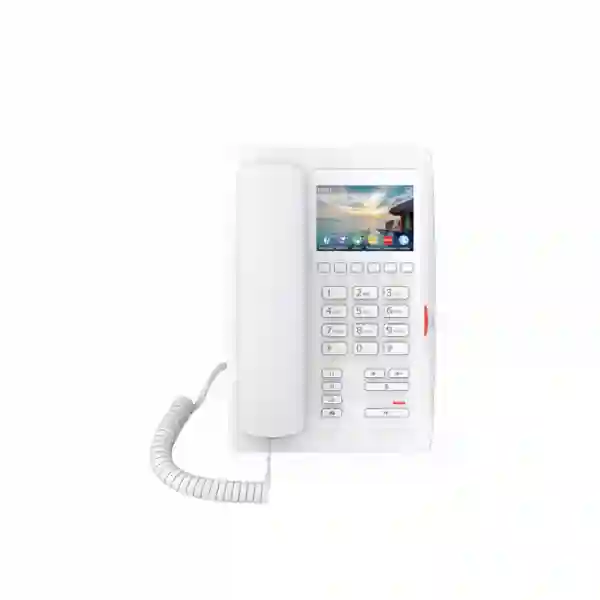
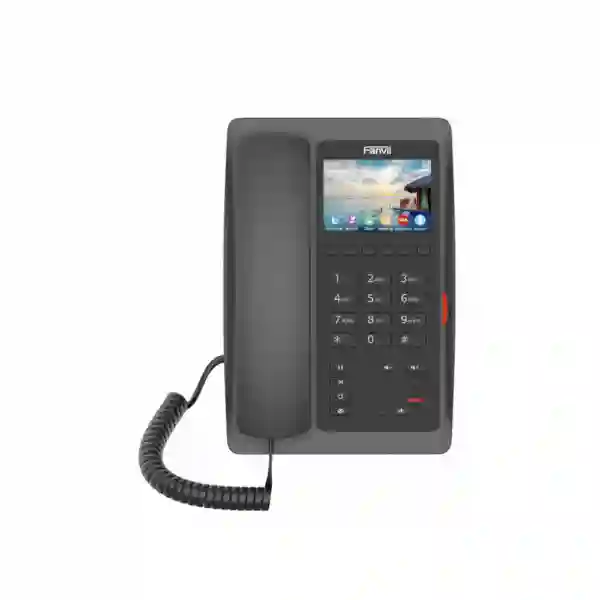
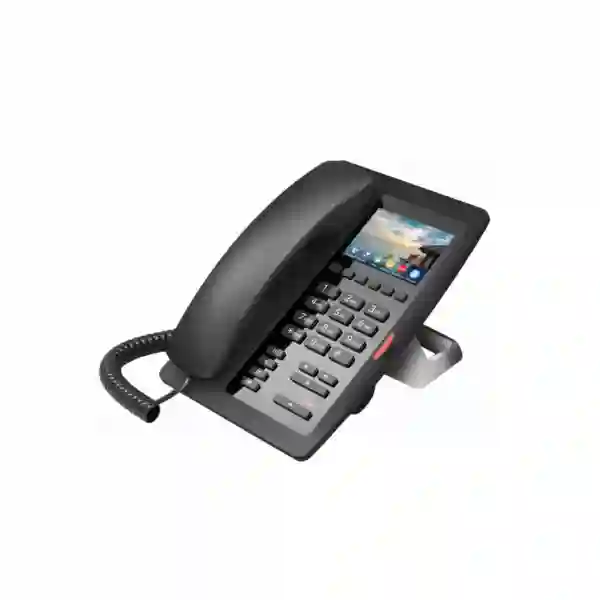
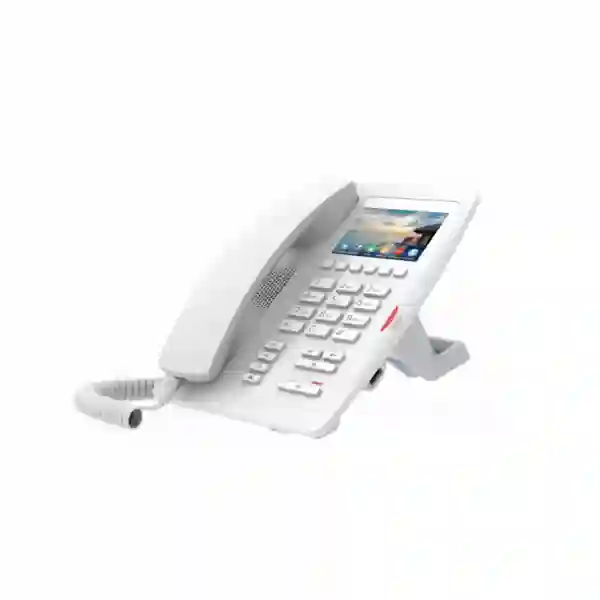
The Fanvil H5W is a compact Wi-Fi IP phone designed around hospitality communication, while remaining useful in hospitals, supermarkets, shopping environments and other customer-facing sites. Fanvil specifies two SIP lines, a 3.5-inch color display, built-in 2.4GHz IEEE 802.11b/g/n Wi-Fi, integrated PoE, HD voice with G.722 and Opus, programmable keys and hardware H.264 video decoding. For hotels and service organizations, that combination can reduce dependence on a dedicated data cable at every phone position while still supporting wired Ethernet where required.
Consider the H5W when you need a SIP phone with built-in 2.4GHz Wi-Fi, two SIP registrations, a color screen and hotel-oriented service keys. Confirm wireless coverage, PBX compatibility, power method and any door-intercom integration before quantity deployment.
What the Fanvil H5W is designed to do
The Fanvil H5W belongs to Fanvil’s H Series hotel-phone family and combines familiar SIP calling with wireless network access. Its strongest use case is a guest room, service point or shared location where a conventional business desk phone may be visually or operationally excessive. The 3.5-inch display provides a clear interface for phone status and hotel information, while six programmable keys can be arranged around frequent service destinations such as reception, housekeeping, food and beverage or another internal extension configured by the administrator. The model is not limited to hospitality: Fanvil also positions it for hospitals, supermarkets and shopping malls, where a compact, easy-to-understand endpoint may be preferred.
Wireless connectivity changes the deployment conversation. The H5W includes 2.4GHz Wi-Fi based on IEEE 802.11b/g/n, allowing the phone to reach the IP network without a dedicated Ethernet data path at every final position when suitable Wi-Fi coverage exists. It also supports Ethernet and PoE, so a project can choose wired or wireless networking according to room conditions. Buyers should not interpret Wi-Fi as eliminating all infrastructure requirements: every phone still needs stable IP connectivity and a power strategy, and voice quality remains dependent on the PBX, network congestion, radio conditions, internet or SIP-trunk path and quality-of-service design.
Verified Fanvil H5W features
2 SIP Lines
Two SIP registrations allow the endpoint to be configured with two identities where the selected PBX and call design require them.
3.5-inch Color Display
A color screen presents the user interface and can support hospitality-oriented information and service access.
2.4GHz Wi-Fi
Built-in IEEE 802.11b/g/n Wi-Fi provides a wireless network option for rooms or service points with suitable coverage.
PoE & Ethernet
Integrated Power over Ethernet and 10/100 Mbps Ethernet support conventional wired IP-phone installation where cabling is available.
HD Voice
G.722 and Opus are among the supported wideband codecs, with full-duplex hands-free operation and voice-processing features.
H.264 Video Decoding
Hardware video decoding can be used with compatible SIP video sources such as door phones or intercoms so users can view a visitor image before access decisions.
Technical and network considerations
| SIP | 2 SIP lines; SIP hotspot support listed by Fanvil. |
| Display | 3.5-inch color display. |
| Wireless | Built-in 2.4GHz Wi-Fi, IEEE 802.11b/g/n; WPA/WPA2-PSK and 802.1X EAP modes listed in Fanvil material. |
| Ethernet | 10/100 Mbps Ethernet; IPv4/IPv6 options; static, DHCP and PPPoE addressing documented. |
| Voice | HD voice with G.722 and Opus; additional narrowband codecs documented by Fanvil. |
| Video | Hardware video decoding with H.264 and supported resolutions up to 1080P according to Fanvil documentation. |
| Power | Integrated PoE; external power is also documented as an option depending on deployment. |
| Other ports | Fanvil documentation identifies USB for charging, PC and network interfaces, handset and power connection. |
Technical capability should be matched to the intended deployment rather than treated as a checklist. For example, 2.4GHz Wi-Fi can be convenient in guest rooms, but a hotel with dense neighboring access points should verify channel use, signal quality and capacity before installing many phones. Likewise, PoE is valuable only when the wired switch and cabling path support it. PBX interoperability should be tested against the exact platform version and the calling features the property expects to use.
Hospitality deployment and integration guidance
In a hotel, the endpoint is only one part of the guest communication flow. A useful design starts with the services a guest should reach: front desk, housekeeping, room service, emergency assistance, reservations or another department. Programmable keys can then be mapped to the correct extensions or service destinations. The PBX should apply the property’s call-routing rules, extension numbering, outbound restrictions and voicemail policy. If the hotel uses property-management integration or another middleware layer, compatibility should be confirmed separately because the presence of SIP on the phone does not by itself guarantee every hospitality workflow.
The H5W’s H.264 decoding creates a useful option for properties using compatible SIP door phones or intercoms. A room or service desk can potentially view a video image from the entrance before allowing access, but the complete workflow depends on the selected intercom, SIP server and door-control logic. Procurement teams should validate video call behavior, resolution, codecs, one-touch access commands and network segmentation with a pilot before relying on the function across a property.
Wireless projects deserve a room-by-room coverage review. A phone that registers successfully near an access point can still experience poor call quality if signal strength falls, interference increases or too many clients share the same radio. Hotels often have walls, doors, bathrooms, corridors and service spaces that change radio propagation. A well-designed Wi-Fi deployment should consider coverage, capacity, roaming policy, VLAN separation, authentication and QoS. Where wired Ethernet already exists at the bedside or desk, PoE can provide a more deterministic path; where cable installation is difficult, Wi-Fi can reduce physical constraints.
Regional FourTeck network for multi-country projects
Organizations standardizing telephony across more than one market can coordinate related requirements through the wider FourTeck network. FourTeck UAE is relevant for UAE IT and telecom requirements, FourTeck Uganda supports Uganda-focused technology projects, and FourTeck Kenya provides a regional reference for Kenyan deployments. Buyers responsible for West African operations can also review FourTeck Ghana and FourTeck Nigeria. For specialist voice-system context, FourTeck IP Phone solutions covers business telephony concepts across the wider network.
Fanvil H5W regional buying and deployment guidance
Fanvil H5W Wi-Fi IP Phone Tanzania
For Tanzania hotels, hospitals, retail properties and service-oriented businesses, the Fanvil H5W is most relevant where a compact SIP endpoint must fit naturally into a room or public-facing environment without forcing every location into a conventional office-phone design. Its built-in 2.4GHz Wi-Fi can be useful in retrofits where adding structured cabling to every guest room is disruptive, while integrated PoE provides a wired option for new projects or sites that already have Ethernet at the phone position. The decision between wired and wireless should be made from actual infrastructure conditions rather than simply choosing Wi-Fi because it is available. In a multi-floor property, signal strength, access-point placement, channel planning and user density can vary significantly between rooms and corridors.
Tanzania buyers should begin with the call flow and guest-service requirements. Define which keys need to reach reception, housekeeping, room service or other departments, whether guests can make external calls, whether the phone will register one or two SIP identities, and whether the PBX must support wake-up, voicemail, billing or other hospitality functions. The H5W provides a capable SIP endpoint, but higher-level hotel workflows depend on the PBX and any property-management integration. A pilot unit should therefore be configured with the actual PBX before bulk procurement. Test inbound and outbound calls, transfer behavior, service keys, caller ID, voicemail indication, time settings and any video-door interaction planned for the property.
Power and network resilience also matter. A PoE deployment can centralize phone power at the switch, which can then be protected by UPS where appropriate. A Wi-Fi deployment still requires local power at the handset and a resilient wireless network. When requesting a Tanzania quotation, provide room count, phone quantity, PBX brand and version, access-point model or wired switch details, desired service-key mapping, color preference if relevant, door-intercom requirements and the sites involved. FourTeck Tanzania can then evaluate the H5W as part of the complete voice and network environment rather than treating the phone as an isolated device.
Fanvil H5W Wi-Fi IP Phone Dar es Salaam
Dar es Salaam hospitality properties often combine guest rooms, reception areas, restaurants, conference spaces, staff offices and security points within the same site. The Fanvil H5W can be used where a room or service location needs a straightforward SIP extension with a color display and easy access to frequently called services. For an urban hotel refreshing existing guest rooms, built-in 2.4GHz Wi-Fi may reduce the need to open walls or add new data cabling at every bedside or desk. That advantage should be balanced against wireless design: dense properties can have many neighboring networks and connected devices, so a room phone should not be added to an already congested radio environment without checking access-point capacity and channel planning.
A new-build or major renovation may favor wired PoE because it provides a predictable network path and centralizes phone power. In that case, ensure the access switch has sufficient PoE budget and that voice VLAN, DHCP, QoS and PBX reachability are configured before phones are deployed. For properties that combine Wi-Fi and Ethernet across different wings, configuration standards should remain consistent so support staff know how each room connects. The H5W supports common IP networking options, but the site should still define address assignment, authentication, provisioning, extension naming and firmware policy.
Dar es Salaam buyers considering the H5W for hotels, clinics, retail administration or customer-service points should also decide whether H.264 video decoding is operationally useful. If a compatible SIP door phone or intercom is installed at a gate or entrance, a pilot can confirm whether the expected video preview and door-control workflow operate correctly. Include the intercom model, PBX, access-control method and required user action in the design brief. For procurement, specify the number of rooms or endpoints, expected installation method, existing Wi-Fi or PoE switching, PBX platform, service-key labels and support requirements. This provides a more accurate bill of materials than requesting a handset price alone.
Fanvil H5W Wi-Fi IP Phone Mwanza
Mwanza organizations may evaluate the Fanvil H5W for hotels, clinics, retail sites, guest accommodation, campuses and other facilities where a compact SIP phone is preferable to an enterprise desk model. The built-in Wi-Fi option is particularly relevant when a property is operational and running new Ethernet to every final handset position would be costly or disruptive. Before choosing wireless, however, test coverage in representative rooms rather than relying on a corridor signal check. Walls, doors, furniture and floor layout can affect 2.4GHz performance, and voice is sensitive to packet loss, jitter and latency that may not be obvious during ordinary web browsing.
For a Mwanza property with existing structured cabling, PoE can simplify power and network management. The phone can connect to a managed switch, receive power centrally and participate in a dedicated voice VLAN if the network design uses one. That may be attractive for sites where telephony continuity is important and the rack has UPS protection. Wireless deployments should similarly consider UPS for access points and network gateways, otherwise a locally powered phone can remain on while the Wi-Fi infrastructure is offline. The H5W’s dual network capabilities allow project designers to select the method that best matches the building rather than forcing a single topology.
Mwanza buyers should define the extension plan, service-key destinations and any integration requirements before bulk ordering. If reception wants one-touch transfers to departments, establish the PBX short codes and naming convention first. If room phones must interact with video door devices, validate the exact SIP intercom and access workflow. If centralized configuration is expected, create and test the provisioning template on a small pilot group. A quotation request should therefore include phone count, room types, PBX system, switch or access-point details, power availability, cabling status and any hospitality features required from the broader system. These inputs help determine whether the H5W is the right endpoint or whether another phone family better matches the site.
Fanvil H5W Wi-Fi IP Phone Arusha
Arusha’s hospitality and tourism-related properties can use the Fanvil H5W as a guest-room or service-area SIP phone where appearance, simple operation and flexible network connectivity matter. A guest should be able to pick up the handset, reach the front desk or a service department quickly and understand the phone without training. The H5W’s color display and programmable keys can support that objective when the PBX and key assignments are configured around the property’s actual service model. Hotels should avoid filling every key merely because one is available; the most valuable buttons are the few destinations guests genuinely need.
For lodges or properties with building layouts that make new cable installation difficult, 2.4GHz Wi-Fi may be an attractive deployment path. The wireless network must nevertheless be treated as voice infrastructure. Coverage should be checked inside rooms, not only in common areas, and access points should have enough capacity for phones plus guest devices. Where the property already uses separate guest and operational SSIDs, the phones should normally connect to a controlled network intended for managed devices rather than the open guest network. VLAN and firewall rules can then limit unnecessary access while allowing the phone to reach the PBX and required services.
Arusha buyers should also review power continuity, especially for properties where a guest phone is part of emergency or operational communication. PoE can centralize endpoint power where Ethernet exists; Wi-Fi mode requires local handset power plus available wireless infrastructure. If H.264 visitor video is part of the plan, test the exact intercom and door workflow before rollout. When requesting a quotation, include property type, room count, number of staff or common-area phones, PBX platform, Wi-Fi coverage design, service-key labels, color preference and whether installation or configuration assistance is needed. A well-defined room profile makes the deployment easier to replicate across a hotel or lodge.
Fanvil H5W Wi-Fi IP Phone Dodoma
Dodoma hotels, institutions, clinics, accommodation facilities and service organizations can consider the Fanvil H5W where a SIP phone needs both a hospitality-friendly interface and flexible networking. The phone’s two SIP lines can support a primary room or service extension and a second identity when the PBX design requires one. Its 3.5-inch color display can provide a more approachable user experience than a small monochrome office phone, while programmable service keys can reduce the need for guests or visitors to remember extension numbers. The benefit comes from thoughtful configuration, so the project should define key destinations, labels and call permissions before handsets are installed.
Dodoma deployments should evaluate whether wireless or wired connectivity offers the better lifecycle. Wi-Fi can simplify a retrofit and allow more placement flexibility, but it depends on consistent 2.4GHz coverage and a managed RF environment. Wired PoE can be more predictable when structured cabling is already available, and it can reduce the number of local power adapters in rooms. For either approach, the phone should operate on a network where DHCP, DNS, PBX access and QoS are predictable. If voice traffic shares the same infrastructure as CCTV, guest internet and staff data, managed segmentation can improve troubleshooting and reduce unwanted interaction between device groups.
For public-sector, institutional or multi-building projects in Dodoma, standardized configuration is particularly useful. Establish an extension-numbering plan, device naming method, provisioning profile and documentation template before rolling out many units. A pilot group can verify audio, transfer, service keys, time synchronization, security settings and any video-door function. The procurement request should state quantity by building or room, PBX model, network design, whether PoE is available, wireless access-point environment, required accessories and rollout schedule. This allows purchasing teams to compare the complete cost of deployment, not just the handset unit price.
Fanvil H5W Wi-Fi IP Phone UAE
For UAE hotels and multi-country organizations standardizing endpoints across regional properties, the Fanvil H5W can provide a consistent guest-room SIP interface while allowing wired or wireless deployment according to each building. The built-in 2.4GHz Wi-Fi option is useful for refurbishment projects where adding cable is difficult, while PoE can fit properties with modern structured cabling. UAE environments often operate dense wireless networks with guest devices, IoT endpoints, staff systems and room technology, so an H5W project should be coordinated with the property’s WLAN design rather than connected casually to any available SSID.
Regional standardization should focus on configuration profiles rather than assuming every site has identical infrastructure. A hotel group can keep the same service-key logic, extension naming, handset appearance and support process while still choosing wired Ethernet in one building and Wi-Fi in another. PBX compatibility must be validated for the exact platform and firmware, particularly where the property uses hotel middleware, room-status workflows or centralized voice services. Fanvil publishes compatibility information for several major PBX platforms, but deployment teams should test the specific functions they need instead of treating registration as complete interoperability.
Organizations operating in both Tanzania and the UAE can use FourTeck UAE for regional project coordination while maintaining a common design standard. A useful quotation brief includes number of properties, rooms per site, PBX platform, SIP-trunk architecture, Wi-Fi design, PoE availability, service-key layout, required door-phone integrations and any central provisioning requirements. This helps determine whether a single H5W template can be repeated safely across sites or whether local network and PBX differences require separate profiles.
Fanvil H5W Wi-Fi IP Phone Uganda
Ugandan hotels, hospitals, retail properties and service facilities can use the Fanvil H5W where a room or counter needs a SIP endpoint that does not look or behave like a complex executive desk phone. Built-in 2.4GHz Wi-Fi can help in buildings where the voice system is being modernized without a full recabling project, while PoE remains available for sites that prefer a wired network. The choice should be based on coverage, capacity, power resilience and supportability. A wireless phone is only as dependable as the access points, switching and IP path behind it.
For multi-site organizations in Uganda, standardization can reduce support overhead. The same service-key map, extension naming, screen information and provisioning logic can be reused, provided the PBX and network design are consistent. Kampala, Gulu, Mbarara and Arua sites may have different building conditions, so the network access method can vary without changing the user-facing phone model. IT teams should document SSIDs, VLANs, PBX addresses, credentials, firmware policy and replacement procedures so a failed handset can be swapped without rebuilding its configuration from memory.
For procurement, avoid specifying only “Fanvil H5W quantity.” Include the PBX model, number of rooms or service points, whether phones use Wi-Fi or PoE, access-point or switch models, planned service keys, external-call requirements, any video door phone and the expected support model. FourTeck Uganda can provide regional context for organizations coordinating voice and network infrastructure across the country, while the Tanzania team can align common standards for customers operating in both markets.
Fanvil H5W Wi-Fi IP Phone Kampala
Kampala properties frequently operate busy wireless environments where guest internet, staff devices, point-of-sale systems, cameras and operational equipment all share the same site. The Fanvil H5W adds another managed endpoint, so its Wi-Fi connection should be planned rather than treated like a casual guest device. A dedicated or controlled SSID, appropriate VLAN placement, strong authentication and reliable 2.4GHz coverage can make phone behavior more predictable. If Ethernet is already available at the room or desk, PoE may be preferable for sites that want centralized power and a deterministic network path.
Hotels can make the H5W easier for guests by limiting the interface to useful service destinations. A reception key, housekeeping key and another essential service can be more effective than a long list of internal numbers. The PBX should handle routing, after-hours behavior, call restrictions and any queue logic. If a Kampala property uses SIP video intercoms at gates or entrances, the H5W’s H.264 decoding can be evaluated for visitor viewing. The final workflow should be tested with the chosen intercom and access-control system because remote unlock behavior is not defined by the handset alone.
For larger Kampala rollouts, stage the project. Start with several rooms or service points representing different building conditions. Measure call quality, verify registration stability, test every service key and confirm that configuration can be restored to a replacement phone. Then expand in controlled batches. A quotation request should provide endpoint count, room layout, PBX, access points or switches, internet/SIP-trunk architecture, service-key requirements and any planned integrations. This process reduces the risk of discovering wireless or call-flow problems after hundreds of phones have been installed.
Fanvil H5W Wi-Fi IP Phone Arua
Arua hotels, clinics, lodges, institutions and commercial sites can consider the Fanvil H5W when they need a compact SIP extension with Wi-Fi flexibility. In a smaller property, the phone may support only a few guest rooms and a reception point; in a larger facility it can become part of a repeatable room standard. The same design principles apply in both cases: choose a reliable network path, define service destinations clearly and make sure the PBX supports the functions the property expects. Built-in wireless can be convenient where room cabling is limited, but coverage should be validated inside actual rooms and not inferred from the presence of a nearby access point.
For sites that already have Ethernet, PoE can simplify endpoint power and make it easier to place telephony infrastructure on UPS. Where Wi-Fi is used, both the phone’s local power and the wireless infrastructure need resilience appropriate to the business requirement. A phone that remains powered cannot place a call if the access point or router has lost power. This is why network and electrical planning should be included in the telephony discussion rather than left until installation day.
Arua procurement teams should ask whether the H5W’s 3.5-inch display and programmable keys provide genuine operational value for the intended users. For guest rooms and service locations, they often can. For a back-office employee who needs many line appearances, Bluetooth or a higher-capacity directory workflow, another business-phone family may be more appropriate. Include user role, phone quantity, PBX platform, network method, existing cabling, power availability, service-key map and support expectations in the quotation request so the endpoint selection follows the actual requirement.
Fanvil H5W Wi-Fi IP Phone Mbarara
Mbarara hospitality, healthcare and service organizations can deploy the Fanvil H5W in rooms or shared areas where a simple SIP interface is more useful than a feature-heavy office endpoint. The Wi-Fi capability can reduce installation constraints in existing buildings, particularly where opening walls or adding a data outlet at every room position is undesirable. Wireless should still be designed for voice. Coverage, interference and access-point capacity need to be checked at peak occupancy, because guest devices can place heavy demand on the same 2.4GHz spectrum used by the phone.
A wired PoE option may make sense at reception, staff desks or renovated wings where structured cabling is available. Mixed deployments are possible, but they should be documented carefully so support staff know which rooms depend on wireless and which depend on switch ports. The PBX configuration should use consistent naming and extension templates across both groups. The programmable keys can then follow one service layout so guests see the same interface regardless of how the phone reaches the network.
Mbarara buyers interested in door-intercom integration should test the H.264 video workflow with their exact SIP door phone, including call initiation, video display, audio and any remote opening command. Security teams should also decide whether room phones are allowed to control a door or whether the function belongs only at reception. Before placing an order, document room count, PBX platform, wired or wireless method, Wi-Fi access-point model, PoE-switch availability, service-key requirements and any installation or training scope. That information helps convert the H5W from a product purchase into a predictable communication system.
Fanvil H5W Wi-Fi IP Phone Gulu
Gulu businesses and hospitality properties can use the Fanvil H5W where a small color-screen SIP phone with flexible networking suits the user environment. A hotel guest room, clinic room, reception point or retail service desk typically needs quick access to a limited set of contacts rather than dozens of enterprise telephony functions. The H5W’s programmable keys support that simplified model, while two SIP lines provide flexibility for sites that need more than one registered identity.
For Wi-Fi deployment, survey the actual operating environment and check how many phones and other clients will share each access point. The 2.4GHz band generally offers useful coverage but can be congested, especially where many consumer access points and guest devices are present. Voice traffic benefits from consistent latency and low packet loss, so a network that appears acceptable for email may still need optimization for calling. Wired PoE can provide a stable alternative where Ethernet is accessible, and a hybrid property can use both methods when the configuration standard is controlled.
Gulu buyers should think about maintenance from the beginning. Keep an inventory of phone MAC addresses, extensions, room numbers and configuration profiles. Establish a process for firmware updates and replacement phones. If the property has several remote sites, central provisioning can reduce manual work, but the template should be tested before broad deployment. A quotation request should contain phone quantities, site list, PBX model, network topology, Wi-Fi details, service-key mapping and any required intercom integration. This enables the supplier and IT team to identify supporting switch, power or wireless requirements before the installation begins.
Fanvil H5W Wi-Fi IP Phone Kenya
Kenyan hospitality and business buyers can evaluate the Fanvil H5W when they need a guest-room or service-oriented SIP handset with integrated 2.4GHz Wi-Fi. Nairobi hotels, coastal properties, lodges, healthcare sites and retail environments may all have different infrastructure, so the phone should be chosen for its fit rather than merely because it is labeled a hotel phone. Properties with established structured cabling can use PoE, while refurbishment projects may prefer wireless to avoid new cable routes. The decision should include network resilience, support access and the expected lifetime of the room design.
For a hotel group with multiple Kenyan sites, a repeatable H5W configuration can simplify training and support. Program the same service keys, apply a consistent room-numbering convention and document the PBX profile. Site-specific differences such as SSID names, VLANs and trunk routing can be separated from the guest-facing configuration. Before standardizing, test the phone against the production PBX for transfer, caller ID, voicemail, time, language, service-key behavior and any intercom video. A small pilot at one property can reveal issues that are cheaper to solve before regional rollout.
Organizations coordinating Kenya and Tanzania projects can reference FourTeck Kenya for regional requirements while using a common telephony architecture where practical. Procurement requests should list quantities by site, room or user type, PBX platform, Wi-Fi or PoE approach, existing switching and access points, service-key labels, external-call policy and any door-intercom integration. Comparing quotations on these assumptions is more meaningful than comparing handset unit prices alone.
Fanvil H5W Wi-Fi IP Phone Kuwait
Kuwait hotels and service facilities considering the Fanvil H5W should focus on how the handset fits into room technology and property networking. The 3.5-inch display, programmable service keys and two SIP lines make it suitable for a guest-service role, while Wi-Fi can be useful in renovated properties where adding Ethernet is difficult. In modern hotels with structured cabling, PoE may offer a cleaner operational model because phones can receive data and power through the network switch and be protected through centralized UPS infrastructure.
Wireless density deserves particular attention in large hospitality buildings. Guest devices, smart TVs, tablets, IoT sensors and operational systems can create a busy RF environment. The H5W uses 2.4GHz 802.11b/g/n, so the WLAN design should ensure appropriate coverage and channel use rather than assuming newer 5GHz guest capacity automatically solves the phone’s requirements. A dedicated managed-device SSID can make authentication and troubleshooting easier. Where local policy requires stronger segmentation, the phone network can be separated from guest access and permitted only the services needed for PBX communication and management.
Kuwait procurement teams should include PBX and middleware details when requesting the H5W. If a property expects wake-up calls, room-status integration, billing, PMS linkage or door-control features, clarify which system provides each function. The handset can participate in SIP communication but does not replace these higher-level platforms. A pilot should verify the complete workflow. For multi-country hotel groups, documenting one baseline template and then adjusting only site-specific network parameters can reduce configuration drift and simplify future replacement.
Fanvil H5W Wi-Fi IP Phone Ghana
Ghanaian hotels, clinics, service businesses and retail facilities can use the Fanvil H5W where a compact hospitality-style SIP phone offers the right balance between usability and network flexibility. Built-in 2.4GHz Wi-Fi can help when existing buildings lack dedicated data points in every room, while PoE supports traditional wired deployment in newer or renovated sites. The choice should follow the building and support model. A wireless installation may save cabling effort but increases dependence on RF coverage, access-point capacity and local handset power.
For properties in Accra or elsewhere with dense guest Wi-Fi usage, voice endpoints should be placed on a managed network with deliberate capacity planning. The phone does not require the highest possible Wi-Fi speed; it requires stable connectivity with low packet loss and predictable latency. Network administrators should confirm DHCP, DNS, PBX routing and any QoS policy. If the phone is connected by Ethernet, verify the PoE switch budget and whether UPS-backed switching is required for service continuity.
A Ghana quotation should identify the number of rooms, common-area phones, staff phones and service points separately because each role may need a different key layout or call permission. If H.264 video door integration is required, provide the intercom model and expected opening workflow. If the organization operates multiple properties, standardize naming and provisioning to simplify support. FourTeck Ghana can support regional project discussions while the Tanzania team can align requirements for customers operating across both markets.
Fanvil H5W Wi-Fi IP Phone Nigeria
Nigeria’s hotel, healthcare and commercial sectors often operate large multi-floor properties where voice endpoints must be simple for users yet manageable for IT teams. The Fanvil H5W can fit guest rooms and service areas because it combines a 3.5-inch display, programmable service keys, two SIP lines and either Wi-Fi or Ethernet connectivity. For retrofits, Wi-Fi may reduce cabling disruption; for new projects, PoE can simplify centralized power. Large sites should not mix these methods informally. Document which zones use each topology and apply consistent PBX profiles so endpoint behavior remains predictable.
Wireless deployment requires disciplined RF planning. The H5W uses the 2.4GHz band, which can be crowded in busy environments. Site surveys should check room-level coverage and interference during representative occupancy. Where hotels already have extensive guest Wi-Fi, phones should normally use a controlled operational SSID rather than share an open guest network. Voice VLANs, firewall rules and QoS can be designed so the endpoint reaches the PBX without receiving unnecessary access to other systems.
Nigeria buyers should pilot the handset against the production PBX before committing to a large room count. Test registration, audio codecs, transfer, hold, service keys, caller ID, voicemail indication, time settings, remote provisioning and any door-video feature. For properties with frequent power interruptions, examine the complete continuity chain: the phone, PoE switch or local adapter, access point, router, PBX and internet or SIP-trunk service may all require backup according to the desired availability. FourTeck Nigeria can support regional project requirements for organizations coordinating deployments with Tanzania.
Fanvil H5W Wi-Fi IP Phone Seychelles
Seychelles hospitality properties may find the Fanvil H5W attractive because guest-room communication often needs to combine simple service access with minimal visible infrastructure. In an island resort or boutique hotel, a phone may need to reach reception, housekeeping, dining or guest services without presenting a complicated enterprise interface. The H5W’s color display and programmable keys can support this simplified interaction, while built-in Wi-Fi can help in villas or rooms where adding a new Ethernet path would disturb finished interiors.
Wireless convenience must still be balanced with operational reliability. Resort layouts can include separate buildings, thick walls, outdoor pathways and varying distances from network closets. The phone requires consistent 2.4GHz coverage at its final location. Properties should validate every room type, not only a sample near reception. Where Ethernet is available, PoE can provide a more predictable connection and central power. A mixed design can be sensible for a resort with newer and older buildings, provided the configuration and documentation remain consistent.
Seychelles buyers should also consider support logistics. Standardizing one handset model and maintaining spare configured units can reduce downtime when a room phone needs replacement. Keep a record linking room number, extension, MAC address and network method. If a door phone or gate intercom sends H.264 video to the H5W, test the actual call and access workflow before deployment. A complete quotation request should include property layout, number of rooms and service points, PBX platform, Wi-Fi/access-point design, PoE availability, service-key mapping, desired spares and any remote provisioning requirement.
Quotation checklist for Fanvil H5W projects
Fanvil H5W FAQs
Does the Fanvil H5W support Wi-Fi?
Yes. Fanvil specifies built-in 2.4GHz Wi-Fi supporting IEEE 802.11b/g/n. Wireless deployment should still be validated for room-level coverage, capacity and interference.
How many SIP lines does the H5W support?
Fanvil lists two SIP lines. The way those registrations are used depends on the PBX and the organization’s call-flow design.
Can the Fanvil H5W be powered by PoE?
Yes. Integrated PoE is listed in the vendor documentation. Confirm the switch supports the required PoE method and has adequate power budget.
Is the Fanvil H5W only for hotels?
No. Fanvil positions the H5W primarily as a hotel-oriented phone but also identifies hospitals, supermarkets and shopping malls as suitable scenarios. The right fit depends on user role and required call functions.
Can the H5W display video from a door phone?
The H5W supports hardware H.264 video decoding. Fanvil describes use with compatible SIP door phones, intercoms or cameras for viewing visitors. The exact door-control workflow should be validated with the selected intercom and PBX.
Does the H5W support HD voice?
Yes. Fanvil lists HD voice and supports wideband codecs including G.722 and Opus. End-to-end audio quality also depends on the PBX, remote endpoint, network and codec negotiation.
What should I test before deploying many H5W phones?
Test registration, inbound and outbound calls, transfer, hold, service keys, voicemail behavior, caller ID, wireless stability or PoE operation, provisioning and any door-video integration. A pilot should represent the actual PBX and network environment.
What information should be included in a quotation request?
Provide quantity, site or room count, PBX platform, Wi-Fi or wired deployment method, access-point or switch details, service-key requirements, intercom integration needs, power-continuity expectations and whether configuration or installation is required.
Decision recap
Choose the Fanvil H5W when the requirement centers on a hospitality-friendly SIP phone with two lines, a 3.5-inch color screen, built-in 2.4GHz Wi-Fi, PoE, HD voice and optional video-viewing workflows with compatible SIP devices. The strongest deployments start by validating the PBX, network and room workflow rather than buying on features alone. Wi-Fi can solve cabling challenges, but it must have reliable coverage. PoE can simplify wired power, but the switch must be sized correctly. Programmable service keys can improve guest experience, but the call flow must already be defined.
If you are comparing the H5W with conventional office phones, decide whether the user is a guest or service user who benefits from simple service access, or an employee who needs more enterprise features. That distinction is often more important than a minor specification difference.
Talk to FourTeck Tanzania about your H5W requirement
Use the verified FourTeck Tanzania contact page to share the model, quantity, site, PBX, network method and integration requirements. For multi-room hospitality projects, including a room count, floor plan or a summary of existing Wi-Fi and cabling can make the discussion more productive. FourTeck can then evaluate the handset together with the supporting IP PBX, switching, wireless and power requirements.


Reviews
There are no reviews yet.