
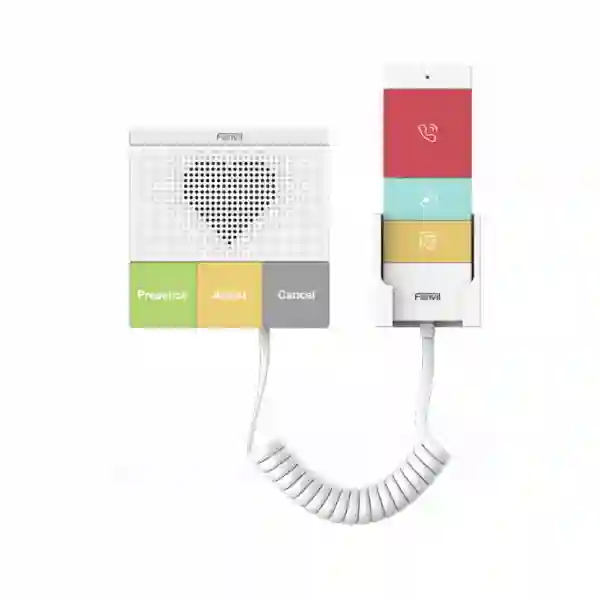
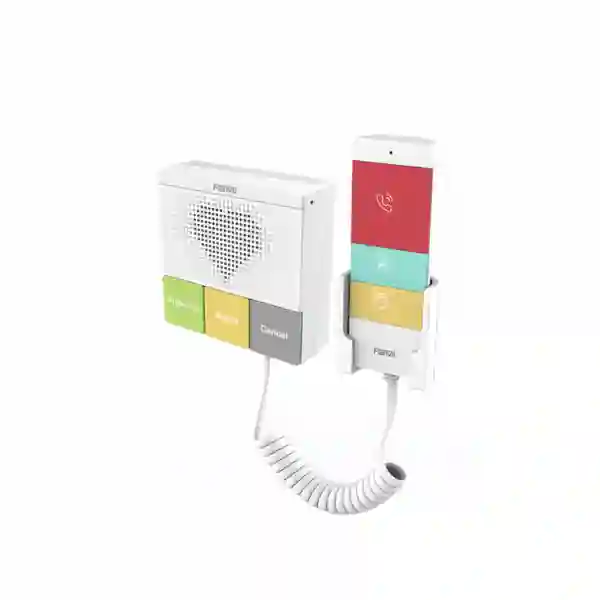
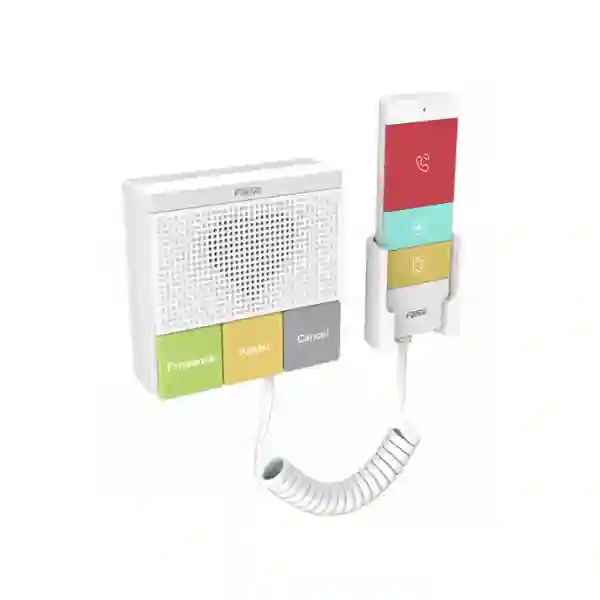
Fanvil Y501-Y-E SIP Healthcare Intercom
The Fanvil Y501-Y-E is a purpose-built SIP healthcare intercom for indoor patient-care, assisted-living, nursing and medical communication environments that require simple bedside calling, clear audio, emergency communication and integration with IP-based systems. This exact Y501-Y-E variant is the 86-box embedded, wired model: it provides two SIP lines, six detachable antibacterial-material function buttons, PoE, HD audio, IP54 protection and one short-circuit input plus one short-circuit output. It does not include the dual-band Wi-Fi fitted to the Y501W-Y-E variant, so procurement teams should keep the model suffix exact when requesting a quotation.
Healthcare-oriented controls
Six detachable antibacterial-material function buttons can support clearly defined care workflows. Fanvil documents healthcare call types including normal nurse call, emergency nurse call, toilet emergency, staff assistance, staff emergency, Code Blue and staff presence within the wider Y501-Y platform.
SIP-based communication
Two SIP lines allow the unit to register with compatible SIP environments. This helps healthcare projects combine bedside endpoints with IP PBX, nurse-call, console, paging and related communication systems where the required SIP behavior has been validated.
Structured installation
The Y501-Y-E is the embedded installation version for a standard 86-type box. PoE can simplify power and network planning by allowing the endpoint to receive operating power from suitable Ethernet switching infrastructure.
Care-system I/O
One short-circuit input and one short-circuit output provide a practical path for approved external devices such as buttons, sensors or alarm indicators where the electrical interface and overall system design are compatible.
What the Fanvil Y501-Y-E is designed to solve
Healthcare communication endpoints need to be easy to recognize, straightforward to operate and practical to integrate into the wider care environment. The Fanvil Y501-Y-E is designed for indoor healthcare and care-related scenarios such as nursing facilities, assisted-living environments, clinics, patient rooms and home-care installations where users may need quick access to staff without operating a conventional business telephone. Rather than presenting a full desk-phone interface, the product centers the interaction around dedicated function buttons and a medical handset.
For IT and facilities teams, the advantage is that the endpoint uses SIP and Ethernet rather than requiring an isolated analog-only communication system. That can make the Y501-Y-E easier to include in an IP-based communications architecture, but it does not remove the need for careful integration. The SIP server, nurse console, call priorities, button labels, network VLAN, PoE budget, emergency workflows and any external input/output devices should be planned as one system. In healthcare, a technically successful SIP registration is only the beginning: the complete call path, escalation behavior and staff response process should be tested before the solution is placed into operational use.
The embedded “-E” format is especially relevant where designers want a cleaner fixed installation using a standard 86-type box. Buyers should not confuse Y501-Y-E with Y501W-Y-E. The latter is the wireless-network variant with 2.4 GHz and 5 GHz Wi-Fi; Y501-Y-E is the wired Ethernet model. If Wi-Fi is required, specify the W version explicitly rather than assuming wireless connectivity is shared across the series.
Verified Fanvil Y501-Y-E technical highlights
| Item | Y501-Y-E | Procurement meaning |
|---|---|---|
| SIP accounts | 2 | Two SIP identities can be configured where supported by the target platform. |
| Network | 10/100 Mbps Ethernet | Plan a wired LAN port at each endpoint location. |
| Power | PoE supported | Check switch PoE capacity and power resilience. |
| Wi-Fi | No | Choose Y501W-Y-E when integrated dual-band Wi-Fi is required. |
| Function buttons | 6 detachable antibacterial-material buttons | Supports care-oriented button labeling and workflows. |
| Audio | HD audio; G.722 and Opus listed | Wideband quality depends on compatible network and SIP endpoints. |
| Protection | IP54 | Designed for indoor settings requiring dust and splash resistance at the specified rating. |
| I/O | 1 short-circuit input + 1 output | Useful for compatible external alarm, button or indicator integration. |
| Wireless call button | Supports specific 433 MHz wireless button; accessory optional | Confirm compatible accessory model and quantity separately. |
| Installation | 86-box embedded | Coordinate mounting box, cabling depth and wall finish before installation. |
Network planning
Treat the intercom as a managed voice endpoint. Confirm VLAN design, DHCP or static addressing policy, SIP reachability, QoS, PoE budget, switch resilience and any firewall rules. For multiple rooms, use a consistent naming and addressing plan so support staff can identify each endpoint quickly.
Clinical workflow planning
Map each button to a defined staff response process. If normal call, emergency, assistance or Code Blue functions are being used, verify priority, alerting, acknowledgement and escalation behavior with the chosen nurse-call or SIP platform before operational deployment.
Physical installation
Because Y501-Y-E is the embedded version, wall preparation matters. Confirm the 86-box position, cable route, accessible mounting height, handset reach, cleaning requirements and clearance around adjacent medical or electrical equipment.
Compatibility, integration and deployment guidance
Fanvil positions the Y501/Y501-Y family within its healthcare communication portfolio, including integration with its A320i nurse console environment and healthcare-oriented call workflows. The bedside station can also work as a standards-based SIP endpoint, but procurement should distinguish between “SIP compatible” and “fully validated for the required workflow.” A deployment may depend on call-priority handling, button-event mapping, address-book behavior, auto answer, paging, alert acknowledgement, logging and external I/O actions. These should be validated against the exact SIP server, IP PBX or nurse-call platform and software version.
The optional 433 MHz wireless button can be useful when a patient or resident needs a portable call trigger. It is a separate accessory, and Fanvil notes that a compatible wireless button must be purchased separately. Confirm the accessory model, usable operating conditions, coverage within the building, battery-management process and how the event is represented to staff. Wireless convenience should be backed by a clear testing and replacement procedure because emergency communication systems depend on predictable operation.
For buyers building a broader voice environment, FourTeck Tanzania also maintains a business technology shop for related infrastructure and a PoE SIP desk-phone reference that illustrates how PoE endpoints fit into a managed voice network. These products serve different users, but the same switching, VLAN, QoS and provisioning disciplines can affect both healthcare intercoms and normal SIP phones.
Buying checklist before requesting a Fanvil Y501-Y-E quotation
Fanvil Y501-Y-E SIP Healthcare Intercom Tanzania
Healthcare providers, care homes, clinics and assisted-living projects in Tanzania considering the Fanvil Y501-Y-E should begin with the care workflow rather than the device count alone. The product can provide a SIP-based bedside communication point with a medical handset, six detachable function buttons, HD audio and PoE, but the value comes from how those functions are mapped into the facility’s staff response process. A normal patient request, urgent assistance call and emergency escalation should not simply ring the same destination with no distinction. The call type, alert priority, staff acknowledgement method and fallback route need to be designed and tested with the selected nurse-call or SIP platform.
The Y501-Y-E is suited to projects that can provide a wired Ethernet connection at the bedside or room location. Because it supports PoE, a managed PoE access switch can centralize power and data. In Tanzanian facilities where electrical continuity is an important design consideration, the switch and upstream network can be protected by suitable UPS infrastructure so multiple endpoints benefit from centralized resilience. The power design should be sized from the actual switch, number of connected devices and required backup duration; no fixed runtime should be assumed without calculation. A separate voice or healthcare VLAN may help isolate endpoint traffic and simplify policy control.
Physical installation should be reviewed before quantities are finalized. The “-E” designation indicates the embedded 86-box format, so wall box position, cable termination, mounting height, handset reach and cleaning access matter. For retrofit sites, confirm that existing boxes and cable pathways are suitable rather than assuming the unit will replace an old analog call point without modification. For new construction, coordinate outlet locations with room layouts and furniture so the intercom remains reachable from the intended bed or care position.
When requesting a Tanzania quotation, provide room count, proposed nurse station arrangement, network diagrams if available, PoE switch details, SIP platform, preferred call types, optional wireless-button requirement and any external alarm-light or sensor integration. FourTeck Tanzania’s technology services overview can provide context for network, telecom and deployment planning, while the Tanzania contact page is the correct route for a scoped enquiry.
Fanvil Y501-Y-E SIP Healthcare Intercom Dar es Salaam
Dar es Salaam healthcare and care-sector buyers may encounter very different installation conditions: new private clinics, hospital renovations, elderly-care facilities, home-care projects and multi-floor medical environments all place different demands on the intercom design. The Fanvil Y501-Y-E fits best when the project has a planned wired network and needs an embedded bedside or room communication endpoint rather than a conventional desktop phone. Its two SIP lines allow registration to a compatible SIP environment, while PoE can reduce the need for individual local power adapters at each bedside position.
In larger facilities, network segmentation should be addressed early. Voice and healthcare endpoints can share physical switch infrastructure with other systems, but they should not be allowed to compete unpredictably with large backups, guest Wi-Fi, CCTV streams or general user data. Managed switching, defined VLANs and QoS can make operation more controlled. The 10/100 Mbps interface is ample for the unit’s voice-oriented role, but the access switch uplink and aggregate traffic across many endpoints still need sensible design. If an institution has multiple buildings, confirm how SIP routing, firewall policy and any central nurse console communication will cross between network segments.
The six detachable function buttons are a practical feature for care workflows, especially when button labels and functions are standardized across rooms. A patient should not have to interpret different controls from one room to another. Facilities can define functions such as normal call, assistance or emergency according to the supported platform and internal policy, then validate that the receiving console displays the expected room identity and priority. Any Code Blue or other high-priority clinical workflow should be tested end-to-end and aligned with the facility’s own safety procedures rather than relying on factory defaults.
A Dar es Salaam procurement brief should state whether the deployment is greenfield or retrofit, identify room quantities, show nurse-station locations, list PoE switch models and define optional accessories. If ordinary staff desk phones are being upgraded at the same time, the Dinstar C60S business SIP phone provides a separate office-use reference, helping procurement distinguish bedside healthcare endpoints from standard administrative telephony while keeping the wider SIP architecture coordinated.
Fanvil Y501-Y-E SIP Healthcare Intercom Mwanza
Mwanza organizations evaluating the Fanvil Y501-Y-E may be planning a new healthcare communication system or replacing older room call equipment with an IP-based architecture. Migration projects should document what the old system currently does before selecting a replacement. A legacy nurse-call installation may include corridor lamps, pull cords, bathroom calls, staff presence, room labels or escalation logic that cannot be inferred from the visible wall station alone. The Y501-Y-E provides SIP communication, six care-oriented function buttons and short-circuit input/output, but the complete replacement design must reproduce or intentionally redesign each required operational function.
For sites with an existing structured LAN, PoE can simplify the endpoint layer. Each room can receive power and network over Ethernet, allowing centralized switching and potentially centralized UPS protection. Before reuse of existing cabling, verify cable condition, termination quality, switch capacity and available PoE budget. A healthcare endpoint should not be deployed on an overloaded or undocumented network simply because a spare port is available. Room-by-room labeling, patch-panel records and switch-port documentation can significantly improve future troubleshooting.
The embedded 86-box form factor also creates a useful opportunity to plan a neat, fixed installation. Confirm wall depth and box suitability during the survey. If rooms are being renovated, agree on mounting height and location before walls are closed. The handset and buttons should be accessible from the intended patient or resident position, and the placement should not interfere with beds, rails, medical equipment or cleaning routines. IP54 protection helps with dust and splashes, but it is not a substitute for facility-approved cleaning methods or an assumption of full wash-down resistance.
For Mwanza quotations, include the exact Y501-Y-E model name so it is not confused with Y501W-Y-E. If wireless networking is not needed, the wired model can be a more deterministic choice in rooms with installed Ethernet. If portability is needed for the call trigger rather than the intercom itself, ask about the compatible optional 433 MHz wireless button and confirm coverage through an on-site test. Procurement should also specify whether configuration, integration testing, labeling, documentation and staff handover are required in addition to hardware supply.
Fanvil Y501-Y-E SIP Healthcare Intercom Arusha
Arusha healthcare environments range from clinics and private medical practices to hospitality-linked care settings, rehabilitation facilities and institutional projects. The Fanvil Y501-Y-E is relevant where a room requires a dedicated SIP-based communication point that is simpler and more care-focused than a normal IP phone. Its medical handset, six detachable function buttons and support for healthcare call types can make the user interaction more intuitive when the system is configured around the facility’s actual procedures.
A useful design exercise is to classify every endpoint by room type. A normal patient room, treatment room, assisted-living bedroom and bathroom may not need identical controls or accessories. Some locations may use the Y501-Y-E as the primary bedside station, while other areas may require a wired emergency button, compatible wireless button or external indicator. The built-in short-circuit input and output provide integration options, but the electrical behavior of every third-party device should be checked before connection. Life-safety and clinical systems should never be improvised from unverified accessory combinations.
Network readiness is equally important. The product supports PoE and wired 10/100 Mbps Ethernet, so every planned location needs an appropriate structured cable run and PoE switch port. If a facility has separate buildings or floors, the voice and healthcare VLAN should be able to reach the SIP server and nurse console through controlled routing. QoS can help protect time-sensitive audio, while switch monitoring can provide visibility if a room endpoint goes offline. Network and endpoint clocks should also be synchronized so logs and event timing are easier to interpret.
Arusha buyers should request a pilot when the system is part of a larger care workflow. One sample room can validate mounting, label visibility, handset ergonomics, SIP registration, audio quality, call priorities and staff acknowledgement before dozens of endpoints are installed. A clear quotation should then separate endpoint quantity, accessories, switching, cabling, configuration, testing and documentation. This avoids comparing a hardware-only offer with a complete deployment offer as though they were equivalent.
Fanvil Y501-Y-E SIP Healthcare Intercom Dodoma
Dodoma institutions, healthcare providers and administrative projects considering a SIP healthcare intercom should define both the technical architecture and the operating responsibility. The Fanvil Y501-Y-E can act as a room or bedside SIP endpoint with two SIP accounts, HD audio, PoE and healthcare-oriented buttons, but someone must own the call-flow configuration, network maintenance, endpoint firmware, user labeling and periodic testing after installation. This lifecycle view is particularly important for facilities where the system is expected to remain in service for many years.
For structured procurement, document the project in layers. The room layer covers Y501-Y-E endpoints, handsets, optional buttons and mounting. The network layer covers Ethernet outlets, PoE switches, VLANs, QoS, IP addressing and UPS. The application layer covers SIP registration, nurse console behavior, call types and escalation. The operations layer covers staff training, response policy, maintenance and replacement procedure. Separating these layers makes it easier to identify which vendor or internal team is responsible for each element and reduces the risk of unassigned gaps.
The “embedded” model designation should also be reflected in construction drawings. A product selected after wall finishing can create rework if the required box position or cable route was not included. In new Dodoma developments, designers should coordinate telecom outlets with electrical and architectural plans early. In existing sites, a room survey should confirm whether the intended wall position can accept an 86-type embedded box and whether the Ethernet cable can be routed safely without disrupting other services.
When asking for a quote, procurement teams can make evaluation easier by providing a schedule listing room number, endpoint quantity, button requirement, accessory requirement and connection notes for each location. Add nurse stations, proposed switch locations and any central SIP or Fanvil console requirements. This structured schedule gives bidders the same information and helps the buyer compare the actual scope rather than only unit price.
Fanvil Y501-Y-E SIP Healthcare Intercom UAE
UAE healthcare, assisted-living and medical-facility projects often use structured IP networks and centralized building systems, making the Fanvil Y501-Y-E a relevant option when a wired SIP bedside endpoint is required. The model’s PoE support aligns well with managed switching architectures because room units can receive network connectivity and power through the access layer. This does not eliminate design work: PoE budgets, VLANs, firewall policy, high availability and UPS capacity should be assessed against the actual number of rooms and the criticality of the communication service.
A key procurement distinction is the exact suffix. Y501-Y-E is wired; Y501W-Y-E adds dual-band Wi-Fi. In a new facility with structured cabling to each room, the wired variant may provide a straightforward, controlled path. In a retrofit where cable routes are difficult, the wireless variant might be evaluated instead, but Wi-Fi coverage, roaming, congestion and power still need proper engineering. Model selection should therefore be based on infrastructure rather than on the assumption that wireless is automatically easier.
Healthcare workflow integration should be validated through a test environment. The six detachable buttons can be assigned to facility-defined actions, and Fanvil’s healthcare platform supports multiple call types. Confirm how those events appear at the nurse console, how priority is indicated, what happens if the first destination does not answer and how events are logged. Where external indicators or buttons are connected to the short-circuit I/O, validate electrical compatibility and failure behavior.
For UAE project context, organizations can review FourTeck UAE IT and telecom solutions and the FourTeck IP phone specialist site. A useful quotation pack includes floor plans, room schedules, network topology, endpoint quantities, nurse-station requirements, optional accessories, installation scope and test criteria. This allows the hardware selection to be evaluated as part of a complete communication system rather than a stand-alone item.
Fanvil Y501-Y-E SIP Healthcare Intercom Uganda
Ugandan healthcare providers and care facilities moving toward IP communications can consider the Fanvil Y501-Y-E when they require a fixed, embedded patient-room or bedside station rather than a general-purpose desk handset. Two SIP accounts, PoE and HD audio make it suitable for a managed VoIP environment, while the six detachable healthcare buttons can create a more accessible user interface for residents, patients and care staff. The product is most effective when the facility first defines the events that each button should trigger.
For multi-site operators, standardization can simplify support. A consistent room naming convention, SIP extension format, VLAN, button layout and firmware policy can help technical staff troubleshoot endpoints across several facilities. Standardization should still allow local workflow differences where required. For example, one facility may route normal calls to a local nurse station and emergencies to both the station and a secondary response group. These choices belong in the system design and should be documented rather than configured ad hoc room by room.
PoE is valuable where the network rack has suitable power protection. If endpoints are expected to remain available during short electricity interruptions, check the UPS requirement for the PoE access switches, upstream routing and SIP server together. Protecting only one part of the path can leave the service unavailable. Likewise, if the SIP platform is cloud-hosted, internet-path resilience becomes part of the communication design. If the platform is local, server redundancy and local network resilience may be more important.
Organizations coordinating Ugandan deployments can use FourTeck Uganda’s IP PBX and VoIP context alongside the Tanzania project team when regional standardization is required. A quotation request should state site count, room quantities, network condition, SIP platform, nurse-console requirement, optional wireless buttons and whether installation, configuration and acceptance testing are in scope.
Fanvil Y501-Y-E SIP Healthcare Intercom Kampala
Kampala hospitals, clinics and care environments may use the Fanvil Y501-Y-E as part of a broader migration from isolated communication equipment to an IP-based voice and nurse-call architecture. The endpoint can be connected to a compatible managed network and powered through PoE, helping consolidate cabling and centralize device management. The change should be approached as a system migration rather than a one-for-one device swap, because SIP call behavior, nurse-console integration, emergency priorities and external alarm functions need to be validated.
A room survey can reveal practical issues before installation begins. Confirm the wall can accept the 86-box embedded format, check Ethernet cable routes, identify the closest access switch and note whether bed positions may change. The call station should remain reachable after furniture is installed. If an optional wireless call button is used, test it from the actual patient positions and likely movement areas. RF performance can differ across buildings, so a published technology description should not be treated as a guarantee of coverage in every room.
Kampala facilities with many IP systems should also avoid mixing critical care traffic into an unmanaged flat network. CCTV, guest Wi-Fi, staff devices and healthcare endpoints can share physical infrastructure where capacity allows, but logical segmentation and access policy can reduce unnecessary exposure and make diagnostics easier. Monitoring switch ports and keeping an inventory of room-to-MAC-address relationships helps technical teams identify a disconnected or replaced endpoint quickly.
During procurement, include acceptance criteria rather than only a product list. Example criteria can include successful SIP registration, correct display of room identity at the console, verified audio in both directions, correct button-event priority, operation of any connected input/output device and recovery after a network or power restart. These project-specific tests help ensure that the installed system behaves the way clinical and care teams expect.
Fanvil Y501-Y-E SIP Healthcare Intercom Arua
Arua healthcare projects may place a high value on straightforward infrastructure and remote manageability, especially where specialist technical support is not always located on site. The Fanvil Y501-Y-E can support that objective because it is an IP endpoint with SIP registration and PoE rather than a purely proprietary room device. However, remote manageability depends on the surrounding design: network addressing, secure administrative access, configuration backups, documentation and a reliable method for identifying each room endpoint should be established from the start.
For a smaller clinic or care facility, the project may begin with only a limited number of rooms. It is still worth choosing a repeatable numbering and cabling scheme so future expansion does not create inconsistency. Label every wall outlet, patch-panel port and switch port. Use room names or numbers consistently in SIP extensions and nurse-console entries. If a replacement unit is needed later, clear records reduce the time required to restore service.
The optional 433 MHz call button can add mobility for residents or patients who may not always be next to the wall station. Procurement should include the button as a separate line item where required and define who is responsible for periodic functional checks. The wireless accessory should complement, not obscure, the fixed communication design. In rooms where a wired emergency button is more appropriate, the Y501-Y-E platform’s input interface can be evaluated with a compatible device.
Arua buyers should also distinguish the costs of supply from those of a working system. Hardware may include the intercoms and accessories, while deployment may require PoE switches, UPS, structured cabling, SIP or nurse-console configuration, installation, testing and staff orientation. A quotation that clearly separates these components allows procurement to compare alternatives fairly and helps management understand which dependencies are already available on site and which must be added.
Fanvil Y501-Y-E SIP Healthcare Intercom Mbarara
Mbarara facilities evaluating the Fanvil Y501-Y-E should focus on how the endpoint will fit into staff response patterns. The intercom’s healthcare-specific design is useful because dedicated buttons can be made more meaningful than the generic line keys of a desk phone. A patient may need one clear call action while staff may require assistance, emergency or presence functions. The exact configuration should reflect the facility’s approved operating procedure and the capabilities of the connected SIP or nurse-call platform.
Audio quality should be tested in realistic conditions. Fanvil lists HD audio and wideband codecs including G.722 and Opus, but end-to-end quality also depends on the receiving device, SIP server, codec negotiation and network. Test conversations with doors open and closed, ambient equipment operating and staff at normal working positions. If the nurse station uses a console or speakerphone, check both handset and hands-free behavior. Clear speech is especially important where a caller may be elderly, distressed or speaking softly.
The IP54 rating provides protection against dust and splashing at the stated level, which is helpful for indoor care environments, yet the product should still be installed according to manufacturer guidance. Facilities should confirm cleaning products and procedures separately, especially where infection-control teams have specific chemical or wipe-down requirements. Do not infer chemical resistance or sterilization compatibility from IP54 alone.
For Mbarara procurement, request confirmation of the exact model and accessories in writing. The family includes wall-mounted, embedded, wired and Wi-Fi variants, so “Y501-Y” by itself may not be precise enough for a multi-room order. The purchase schedule should say Y501-Y-E where 86-box embedded, wired PoE installation is required. Include expected quantities, spare units if the organization chooses to hold them, button labels, accessories and test services so the delivered scope matches the installation design.
Fanvil Y501-Y-E SIP Healthcare Intercom Gulu
Gulu healthcare and care-sector organizations can evaluate the Fanvil Y501-Y-E as a structured communication endpoint for patient rooms, care bedrooms and similar indoor spaces. The combination of SIP, PoE and dedicated healthcare buttons can be useful where a facility wants to build communication over managed Ethernet rather than maintain a separate room-by-room analog call network. The architecture should still be designed for resilience, because an IP system depends on switching, routing, the SIP application and power continuity working together.
A practical approach for new deployments is to create a small prototype zone. Install one or two Y501-Y-E units, connect them to the proposed PoE switch, register them to the selected platform and configure the intended call types. Ask care staff to test the buttons, handset, call acknowledgement and escalation sequence. Their feedback can identify label or workflow issues that technical teams may not notice. Once the prototype is accepted, copy a controlled configuration template to the remaining endpoints.
For facilities that expect future growth, switch and rack planning should include spare PoE capacity. Adding new rooms later should not require replacing the entire access layer because the original switch was sized only for day-one ports and power. Likewise, keep IP address and extension ranges available for expansion. Documentation should record each endpoint’s room, switch port, extension, hardware address and configuration profile.
Gulu buyers can improve procurement clarity by separating must-have clinical functions from optional convenience features. A wired emergency button may be essential, while a wireless pendant might be optional for selected residents. A corridor indicator might be required only in certain zones. Define these items by room rather than multiplying the same accessory set across every endpoint. This room-based bill of materials reduces unnecessary cost and gives installers a precise schedule to follow.
Fanvil Y501-Y-E SIP Healthcare Intercom Kenya
Kenyan hospitals, medical centers and assisted-care projects looking for IP-based bedside communication can consider the Fanvil Y501-Y-E where embedded wired installation is appropriate. Because the device supports SIP and PoE, it can fit structured network environments that already use managed switching and centralized communications. Care should be taken to separate the healthcare role of the Y501-Y-E from a normal IP phone: it is designed around dedicated call functions, a medical handset and integration options rather than general office calling features.
In projects covering several branches or facilities, procurement teams may want one standardized endpoint model. Standardization can reduce spare-part variety and simplify training, but only after local infrastructure is confirmed. One site may have Ethernet to every room while another relies on older cabling. One may use a Fanvil nurse console while another uses a third-party SIP server. Pilot testing at each architecture type can identify differences before bulk deployment.
The embedded format should be coordinated with building work. For renovations, review existing wall boxes and conduits before ordering. For new builds, place the 86 box and data cable where patients can reach the handset and call buttons safely. Consider where future beds, curtains, furniture and medical equipment will sit. A good installation is not only electrically correct; it is physically usable by the intended person.
Regional projects can consult FourTeck Kenya’s VoIP and network solutions for Kenya-side infrastructure context. For a meaningful quote, provide the number of rooms, building or branch count, chosen SIP platform, network-switch specifications, required call types, optional wireless buttons, external I/O devices and implementation scope. If the requirement is part of a new clinic build, share the telecom drawing early enough for outlet and rack planning to be coordinated with construction.
Fanvil Y501-Y-E SIP Healthcare Intercom Kuwait
Kuwait healthcare and care-facility buyers can evaluate the Fanvil Y501-Y-E for patient-room communication where a fixed wired SIP endpoint is preferred. The product’s embedded format supports a clean in-wall installation, while PoE can simplify power distribution from the communications rack. This is particularly useful in projects where the telecom network, UPS and access switches are already part of the building design. The endpoint should be included in PoE power calculations along with phones, access points, cameras and other powered devices sharing the same switch.
Facilities should define whether the system needs only call communication or a broader Fanvil nurse-call workflow. The wider Fanvil medical solution can incorporate nurse console and related devices, whereas a SIP-only integration may use an existing communications platform. These two architectures can have different configuration, licensing, management and acceptance-test requirements. Clarify the target design before ordering large quantities so the selected accessories and console components match the intended system.
The Y501-Y-E’s six detachable buttons can be assigned to care-specific functions, but labels should be selected for the users and languages in the facility. Clear icons and terminology can reduce hesitation in stressful situations. Staff should also know how calls appear at the receiving station, how to acknowledge them and how the endpoint behaves if the first call destination is unavailable.
For Kuwait procurement, request a complete bill of materials covering endpoints, optional wireless buttons, any external call devices, switching, UPS and configuration. Also ask for the proposed testing method. A room communication device should be verified after installation for audio, button operation, room identity, call priority and recovery after restart. Documenting those results creates a useful baseline for future maintenance.
Fanvil Y501-Y-E SIP Healthcare Intercom Ghana
Ghanaian healthcare, elderly-care and assisted-living projects may use the Fanvil Y501-Y-E when they need an IP-based bedside station with simple, dedicated controls. The wired embedded model is appropriate where Ethernet cabling can be delivered to each room and the project can provide PoE switching. Its two SIP accounts allow integration with compatible SIP systems, while the detachable healthcare buttons help adapt the user interface to the facility’s chosen call types.
Before deployment, determine whether calls remain within one building or need to cross multiple sites. A single-facility system can keep the SIP server and nurse station on the local network, while a multi-site design may rely on WAN links or centralized services. The architecture affects resilience: if a remote connection fails, facilities should understand which local communication functions remain available. Critical workflows deserve a documented continuity plan rather than assuming normal internet or WAN service will always be present.
Room installations should include accessible physical placement and labeled cabling. The Y501-Y-E is not a Wi-Fi model, so a working Ethernet path is mandatory. In retrofit buildings, test the cable before mounting the device, and replace poor terminations rather than troubleshooting intermittent SIP calls after handover. Where network cabinets already serve cameras and wireless access points, verify that sufficient PoE capacity remains for the new healthcare endpoints.
Organizations coordinating Ghana deployments can refer to FourTeck Ghana technology solutions for regional procurement context. A quotation should identify exact endpoint quantities, whether Y501-Y-E is required in every room, accessory counts, platform compatibility, installation responsibility and post-installation testing. When comparing suppliers, confirm that both offers include the same accessories and implementation scope before comparing total price.
Fanvil Y501-Y-E SIP Healthcare Intercom Nigeria
Nigeria’s large healthcare market includes hospitals, specialist clinics, care residences and multi-site medical groups that can benefit from standardized IP communications. The Fanvil Y501-Y-E is relevant when the requirement is a fixed bedside or room intercom with SIP, PoE and dedicated care buttons. A large deployment should be treated as an endpoint-management project as well as an installation project. Configuration templates, firmware policy, device inventory and room-to-extension mapping become increasingly important as the number of units grows.
For large facilities, create a hierarchy for naming devices. Building, floor, ward, room and bed identifiers can be encoded consistently in the nurse-console label or internal documentation. This makes emergency calls easier to locate and simplifies troubleshooting when IT receives a report about one endpoint. The exact convention should be chosen with clinical staff so technical identifiers remain understandable to people responding to the call.
The network should be sized for availability rather than raw bandwidth alone. Voice traffic is lightweight, but hundreds of endpoints can depend on the same access switches and upstream links. Consider switch redundancy where appropriate, UPS, spare ports, PoE headroom and monitored uplinks. If the SIP server or nurse console is centralized, protect the path between wards and the core network. Backup configurations should be available so failed hardware can be replaced predictably.
Multi-country or Nigerian deployments can use FourTeck Nigeria IT services and FourTeck Africa regional technology coverage for wider project context. For procurement, provide a room schedule and expected rollout phases. Phased implementation can allow the first ward or facility to validate workflow and configuration before the same template is applied to later stages.
Fanvil Y501-Y-E SIP Healthcare Intercom Seychelles
Seychelles healthcare and assisted-care projects may prioritize compact, manageable systems that can be supported efficiently across limited technical resources. The Fanvil Y501-Y-E can fit this requirement when a facility has structured Ethernet and needs a care-focused SIP station rather than a standard desk phone. PoE reduces the number of separate bedside power supplies, while the embedded format can create a clean installation in patient or resident rooms.
Because replacement logistics can be more complex on island projects, buyers may want to plan sensible spares and maintain complete configuration records. The required spare quantity depends on the deployment size and service strategy, so it should be agreed rather than assumed. Keep a copy of the endpoint configuration, firmware information, SIP parameters and room mapping. If a spare unit is installed, the technician should be able to restore the expected profile without recreating settings from memory.
The optional 433 MHz wireless button can be useful in assisted-living environments where residents may move around a room, but its range and reliability should be verified in the actual building. Walls, equipment and layout can affect radio performance. A commissioning test should include the real movement area and should be repeated periodically according to the facility’s maintenance process. Where fixed wired call devices are preferred, evaluate the input interface with approved compatible hardware.
A Seychelles quotation should include the exact embedded wired Y501-Y-E model, room count, SIP server or nurse-console plan, PoE switches, UPS, accessories and installation scope. If remote support will be used after handover, define secure administrative access and documentation procedures in advance. Good remote support depends on a well-organized local network and accurate records, not simply on the ability to reach a device web interface.
Related Tanzania FourTeck telecom and network references
Healthcare intercoms operate as part of a larger network and communications environment. For buyers planning both clinical and administrative voice systems, the following FourTeck Tanzania pages provide adjacent procurement context without implying that ordinary desk phones replace healthcare call stations.
Browse the wider business IT, telecom, networking and security portfolio for supporting infrastructure.
Dinstar C60SP PoE Business IP Phone
A standard office SIP endpoint reference for projects where administrative phones share the same managed voice infrastructure.
Dinstar C60U-W Wi-Fi IP Phone
Useful for comparing wired healthcare endpoints with office-use Wi-Fi SIP devices where different user roles need different connectivity.
Dinstar C62UP PoE Business IP Phone
Another PoE desk-phone reference for administrative offices, reception points and non-clinical extensions.
FourTeck Tanzania Services
Review integration, networking and technology-service context for projects that require more than hardware supply.
Frequently asked questions
Does the Fanvil Y501-Y-E have Wi-Fi?
No. The Y501-Y-E is the wired Ethernet model. Fanvil lists dual-band 2.4 GHz and 5 GHz Wi-Fi for the Y501W-Y and Y501W-Y-E variants. Choose the exact suffix according to the required network method.
Does Y501-Y-E support Power over Ethernet?
Yes. Fanvil lists PoE support for Y501-Y-E. Confirm the planned PoE switch, available power budget and any UPS-backed continuity requirement for the complete network.
How many SIP accounts and buttons does it support?
Fanvil specifies two SIP accounts and six detachable antibacterial-material function buttons for the Y501-Y family, including Y501-Y-E.
What is the difference between Y501-Y-E and Y501-Y?
The primary installation distinction is that Y501-Y-E is designed for standard 86-box embedded installation, while Y501-Y is the wall-mountable form. Both are wired models without the integrated Wi-Fi found on the W variants.
Can it be used with a wireless emergency button?
Fanvil lists support for a specific 433 MHz wireless button as an optional accessory. Confirm the compatible button model, required quantity and tested operating range for the building.
Can Y501-Y-E connect to alarm lights or external call devices?
The unit includes one short-circuit input and one short-circuit output. These interfaces can support compatible external devices, but the exact electrical and workflow compatibility should be verified before connection.
Is it suitable for outdoor installation?
Fanvil positions the Y501-Y series for indoor healthcare and care-related use. Its IP54 rating provides defined dust and splash protection, but that should not be interpreted as an outdoor deployment rating without explicit manufacturer guidance for the intended environment.
What information should I provide for a quotation?
Provide the exact Y501-Y-E model, room quantity, required button functions, SIP or nurse-call platform, PoE switch details, 86-box readiness, optional wireless buttons, external I/O devices, installation location and whether configuration, testing, training and documentation are required.
Decision recap
Choose the Fanvil Y501-Y-E when your healthcare or assisted-care project needs a wired, PoE-powered SIP bedside intercom with embedded 86-box mounting, six care-oriented buttons, HD audio, optional compatible 433 MHz wireless call-button support and simple external I/O. It is particularly suitable for projects that already have or are planning structured Ethernet to each room.
Choose a different Y501-Y variant when the installation method or network method differs. Y501-Y is the wall-mountable wired version; Y501W-Y-E is the embedded version with dual-band Wi-Fi. Keep model suffixes exact in purchase orders and quotations because the mechanical and wireless differences materially affect deployment.
Plan the complete healthcare communication system
A successful Y501-Y-E project combines the room endpoint with the right SIP platform, nurse-console workflow, PoE switching, VLAN design, UPS, cabling, accessories and acceptance testing. Share your room schedule and existing infrastructure with FourTeck Tanzania so the quotation can distinguish endpoint hardware from the supporting network and integration scope.
For regional deployments, FourTeck network resources include FourTeck UAE, FourTeck Uganda, FourTeck Kenya, FourTeck Ghana, FourTeck Nigeria and FourTeck Africa for cross-market technology project context.




Reviews
There are no reviews yet.